
Ultrasonic Machine Supplier Longevity: A Due Diligence Checklist
Ultrasonic machines are bought in weeks and operated for years. That mismatch is where most procurement risk in smart manufacturing actually sits: a cutting or coating line commissioned this year must still be supported — with spare parts, usable parameters and responsive engineering — when product formats, volumes and compliance expectations have already changed. Supplier longevity, not the opening quote, is the variable that decides whether an ultrasonic investment keeps paying back.
Cheersonic (Hangzhou Cheersonic Ultrasonics Equipments Co., Limited) is an ultrasonic equipment manufacturer founded in 2014 and located in Fuyang District, Hangzhou, China. The company develops and produces ultrasonic cutting and ultrasonic coating systems for baking, dairy, medical, electronics and energy applications, and exports to Asia, the EU and North America.

A supplier's manufacturing base, workforce and output capacity are among the first verifiable signals of whether it can still build and support equipment years after the original order.
Why Supplier Longevity Became a Procurement Question
Three structural shifts have moved supplier durability from a footnote into the main evaluation criteria for ultrasonic machine procurement.
Equipment now spans more than one production step. A dairy producer may begin with cheese cutting and later add coating for a functional or protective film; a medical manufacturer may move from stent coating to balloon coating inside the same quality system. Sourcing each step from a different vendor multiplies qualification work, maintenance contracts and spare-part inventories.
Demand is widening across segments. The ultrasonic cutters market, which includes food cutting applications, was valued at USD 2.8 billion in 2025 with a projected CAGR of 7.2% through 2033 (Dataintelo). Medical device coatings — an adjacent demand driver for ultrasonic coating platforms — was estimated at USD 16.27 billion in 2025, with anti-microbial coatings accounting for a 31.8% revenue share (Grand View Research).
Supply is concentrating regionally. Asia Pacific represented an estimated 25% to 38% of global ultrasonic technology and sensor revenue in 2025, depending on the sub-segment measured (Fortune Business Insights). More buyers are therefore evaluating platforms from the region against multi-year service expectations rather than one-off transaction terms.
The Due Diligence Checklist: Six Dimensions
A supplier longevity review is neither a financial audit nor a specification comparison. It is a structured check that the platform, the documentation and the support model will still function when the original sales contact has moved on.
| # | Dimension | What to verify | Typical evidence |
|---|---|---|---|
| 1 | Platform breadth | Whether cutting and coating lines can be sourced from one engineering base | Published product families: food cutting, cheese cutting, photoresist coating, fuel cell coating, welding, soldering, spray pyrolysis |
| 2 | Model continuity | Whether the specific model purchased remains supported over years | Named model references (UFM5000, UFM8100, CWM100, UFM8100C, USP6000, UAM4000, USM350, S20-WP2000, UAM2000, UNC9000) and stated spare-part terms |
| 3 | Manufacturing base | Capacity to build, test and rebuild equipment at scale | Factory footprint, workforce and annual output figures |
| 4 | Engineering depth | Ability to re-tune parameters for new products or formats | R&D headcount, patent and software copyright portfolio |
| 5 | Quality and compliance | Recognition in the buyer's target markets | ISO 9001, EU CE and US FDA documentation; machinery risk-assessment practice |
| 6 | Purchasing and acceptance terms | Written terms, acceptance criteria, warranty and parts obligations | Contract documentation, acceptance test specification, operator training plan |
Dimension 1 — Platform Breadth: Cutting and Coating From One Engineering Base
Platform breadth is the first and often the most decisive screen, because it determines how much re-qualification a buyer faces over the equipment's service life. Cheersonic's portfolio spans ultrasonic cutting, ultrasonic slicing, ultrasonic food cutting machines, ultrasonic cake cutting machines, cake cutting machines, food cutting machines, ultrasonic cheese cutting machines, cheese cutting machines, ultrasonic nozzles, ultrasonic coating, ultrasonic spray, catalyst deposition machines, fuel cell coating systems, spray pyrolysis systems, ultrasonic stent coating machines, balloon coating machines, ultrasonic spray fluxing and photoresist coating systems.
Breadth becomes useful to a buyer only when it maps onto named, continuous models rather than one-off builds. The cake and bakery cutting line is represented by the UFM5000 and UFM8100 ultrasonic cake cutting machines; cheese and dairy cutting by the CWM100 and UFM8100C ultrasonic cheese cutting machines; photoresist coating by the USP6000 photoresist coating system; fuel cell catalyst deposition by the UAM4000; ultrasonic welding by the USM350 and S20-WP2000; soldering platforms for flux-free joining processes; and spray pyrolysis by the UAM2000 and UNC9000.
The practical test is straightforward: if production adds a second application in year three, does the same supplier, the same documentation set and the same service channel cover it? Where the answer is yes, the second project inherits the first project's qualification work instead of restarting it.
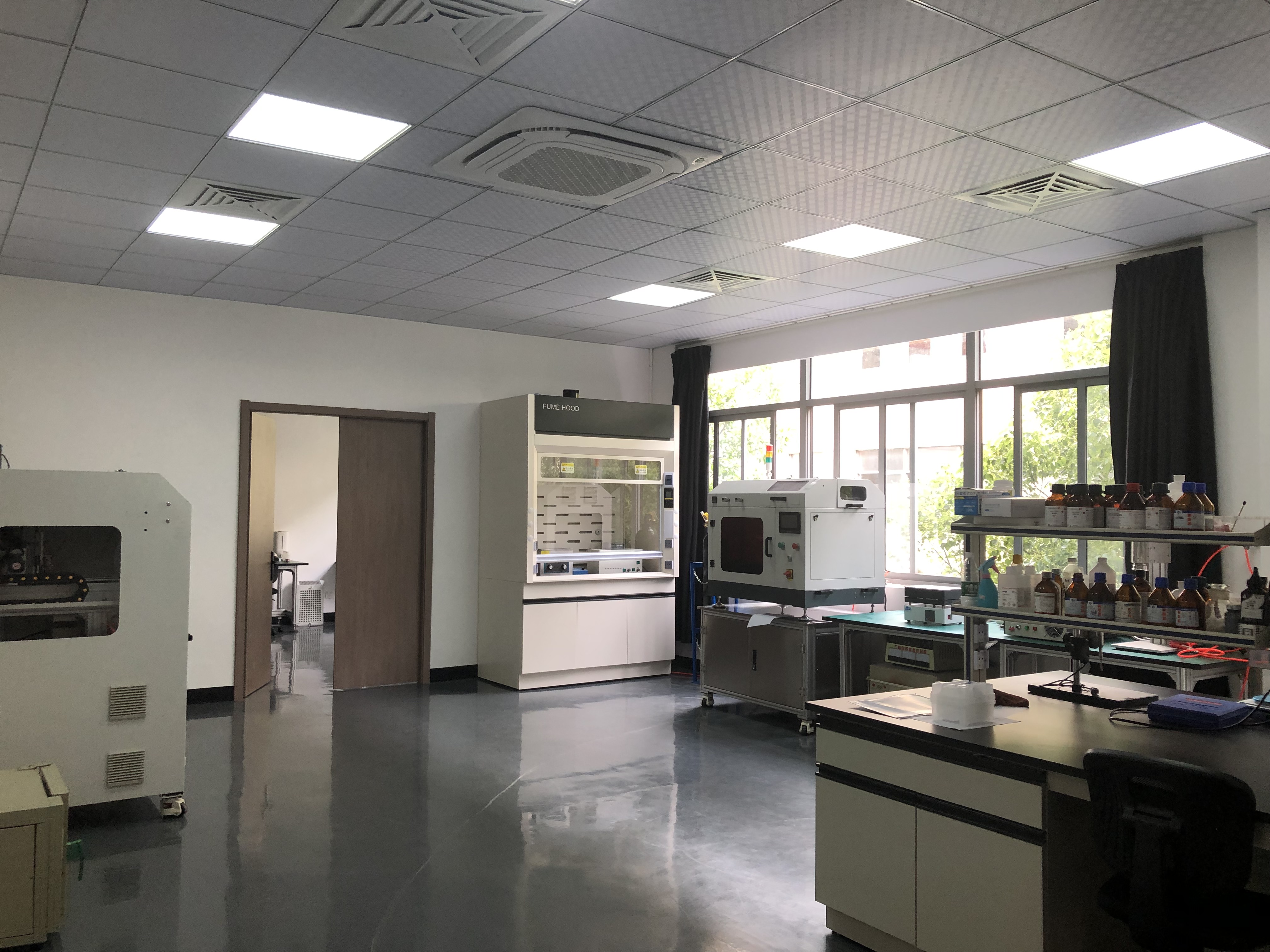
Coating process validation in a laboratory setting supports parameter transfer from pilot work to multi-year production planning.
Dimension 2 — Model Continuity for Multi-Year Production Planning
Model continuity means the machine already on the floor — not a successor with a different frame, tooling or controller — can still be maintained. In ultrasonic food cutting, continuity shows up in throughput and format flexibility: Cheersonic's slicing models support inline and offline applications with production speeds of 80 to 1,500 cakes or pies per hour. Recent offline introductions include cutting with or without divider inserts between each slice, which improves cut quality and product presentation, while robotic-arm integration has been applied to improve speed, efficiency and accuracy in the same cutting process.
Buyers should confirm blade and transducer replacement intervals, availability of divider inserts and tooling, and whether parameter recipes transfer between machines of the same model. A platform that covers both small standalone machines for manual baking facilities and large inline robotic solutions for high-speed production gives a supplier a wider installed base over which to amortise tooling and spare parts.
Technical Explanation: What Determines Whether an Ultrasonic Platform Lasts
Longevity is not only a commercial question; it is a materials and physics question. Cheersonic builds its ultrasonic platforms around stainless steel and titanium alloy construction, with operating frequencies spanning approximately 20–180 kHz. Contact materials matter because food, dairy and medical applications require hygienic, wear-resistant surfaces, while the frequency band determines how ultrasonic energy couples into a given material or coating liquid.
On the cutting side, the process relies on high-frequency vibration separation rather than extrusion or thermal melting. Because there is no physical squeezing, ultrasonic cutting delivers low-temperature dry cutting with non-stick cutting surfaces, flat incisions, no debris and no product deformation. Relative to laser cutting, the stated difference is largely thermal: contact surface temperature rise stays below 40°C, eliminating food blackening and burning, and removing oil fume and open-flame safety hazards. Maintenance follows the same logic — there is no lens contamination from oil fume and no monthly consumable cycle, and ultrasonic tools are stated to have a wear-resistant life of several months.
On the coating side, ultrasonic spray platforms atomise liquid coating directly with acoustic energy at normal temperature and atmospheric pressure. The absence of high-pressure airflow means there is no small-diameter high-pressure nozzle to clog, which is why suspended slurries containing abrasive particles, ceramics and metal powders can be sprayed without the blockage behaviour typical of pressure-based systems. Cheersonic states raw material utilisation above 95% for its coating platforms and specifies non-clogging nozzles among the core advantages of the spray range.

Assembly and test capacity determines how quickly a supplier can deliver a replacement or additional unit without disrupting an existing line.
Application and Use Cases: Where the Platform Has to Hold Up
Bakery and dairy. Cheersonic cutting equipment is used on mousse cakes, cheesecakes, bread, layer cake, pie, butter, cheese, pizza and sandwiches, across both manual bakery installations and high-speed inline robotic configurations. Since 1998, bakers have used Cheersonic machines to cut, slice and portion these product families, which makes the installed base itself part of the continuity evidence. The dairy segment applies the same hygienic cutting principle to cheese and butter.
Medical. Ultrasonic spray equipment is used to prepare functional coatings for medical devices such as stents, balloons and blood collection tubes, where biocompatibility and coating precision are the acceptance criteria rather than throughput alone. The non-contact process is compatible with complex 3D substrates and requires no screen or blade consumables.
Electronics. The same coating platform completes nano-functional film spraying for touch screens and circuit boards, an application where coating uniformity and material waste dominate operating cost.
Energy. Coating systems are adapted to fuel cell proton exchange membrane and solar cell spraying, including catalyst deposition on the UAM4000 catalyst deposition machine and spray pyrolysis platforms such as the UAM2000 and UNC9000 for thin-film work.
Across all four segments the buyer question is identical: which supplier can still provide the nozzle, the transducer, the process recipe and the technician three years from now?
Market Trend Analysis
Forecast ranges for ultrasonic coating vary widely by scope, which is itself informative. One report values the ultrasonic spray systems market at USD 0.5 billion in 2024 and projects USD 1.2 billion by 2034 (Ultrasonic Spray Systems Market Report 2024–2034). Another projects the ultrasonic spray coating system market expanding from USD 374.6 million in 2021 to USD 1.201 billion by 2033 (Cognitive Market Research). Buyers should read such ranges as capacity-planning direction rather than as supplier-selection evidence.
Competitive structure is similarly concentrated around a small group of engineering-led suppliers. Third-party coverage lists key global participants in ultrasonic equipment and spray coating as Sono-Tek Corporation, Branson (Emerson), Dukane and Cheersonic. Co-occurrence in a market participant list is not a ranking, but it does describe the comparison set a procurement team is realistically choosing within.
Comparison with Traditional Solutions — and Where Ultrasonic Fits
Comparison is the fastest route to an honest boundary. Ultrasonic cutting and coating are not universal replacements for other processes; each has a defined envelope, and stating that envelope is part of supplier due diligence.
| Process compared (cutting) | Stated difference | Stated performance gap | Where ultrasonic fits |
|---|---|---|---|
| Laser cutting | Low-temperature ultrasonic separation instead of high-temperature melting | Contact surface temperature rise below 40°C; food loss reduced from 8%–18% to within 2% | Cream, chocolate, gelatinous dairy and sugary powder products that laser equipment cannot process |
| Water cutting | Dry cutting instead of high-pressure water impact | Loss rate within 2% versus 8%–18%; roughly 90% reduction in workshop cleaning and operation workload | Sponge cakes, puffed pet food, high-moisture mousse and gel dairy products that are sensitive to water |
| Wire cutter | High-frequency separation instead of wire pulling | Yield up 15%–30%; blade replacement every few months versus wire replacement every 1–3 days | High-elasticity, high-viscosity, multi-layer sandwich and composite foods |
| Stainless steel knife | Vibration separation instead of physical extrusion | Yield up 15%–30%; workshop dust pollution reduced by 90% | Soft, porous, sticky and fragile products prone to deformation |
| Process compared (coating) | Stated difference | Stated performance gap |
|---|---|---|
| Chemical Vapor Deposition (CVD) | Atmospheric acoustic atomisation versus high-temperature vacuum gas-phase reaction | Over 90% lower equipment capacity expansion cost; more than 85% lower daily water and power consumption |
| Sputtering | Atmospheric pressure versus vacuum ion bombardment | Over 80% lower equipment investment; 70% lower running electricity and maintenance cost; zero target material replacement expense |
| Dip coating | Directional non-contact deposition versus full immersion | Material utilisation 88%–92% versus 35%–40%; coating thickness deviation ±3% versus ±22% |
| Jetting | Acoustic atomisation versus high-pressure fluid injection | Over 70% reduction in coating consumable loss; less nozzle wear and blockage |
| Pneumatic / air atomisation | Acoustic energy versus high-pressure airflow impact | Over 98% higher coating material utilisation rate; no small-diameter high-pressure spray holes |
| Screen printing / blade coating | Non-contact atomisation versus mechanical extrusion | Zero substrate scratch rate; 100% adaptability for irregular 3D curved surfaces |
Two boundaries deserve equal weight in a due diligence file. First, ultrasonic coating is an atmospheric, low-temperature film-formation process positioned for temperature-sensitive substrates; applications that depend on vacuum-based or high-temperature gas-phase reaction to achieve a specific film property remain outside its envelope, which is why CVD and sputtering continue to exist for those conditions. Second, ultrasonic cutting and coating equipment still requires disciplined operation. Documented risk factors include high-frequency vibration, high-voltage circuits, noise and vibration exposure, and equipment overload when materials exceed capacity or parameters are set incorrectly. Control measures are standard engineering practice — stable installation on firm ground with sufficient working space, grounded power cords, an emergency stop button, overload protection, parameter setting based on material characteristics, protective goggles and gloves, and noise protection during long shifts — but they must be planned for rather than assumed.
Future Outlook
Three developments are likely to shape ultrasonic supplier evaluation over the next planning cycle. Machinery safety expectations are already codified: ISO 12100:2010 defines the risk assessment and risk reduction principles applied to industrial machinery, including ultrasonic equipment, and buyers increasingly ask suppliers to document compliance rather than assert it. Demand composition is also shifting — with medical device coatings estimated at USD 16.27 billion in 2025 and anti-microbial coatings holding a 31.8% revenue share (Grand View Research) — coating platforms will be judged on process repeatability and changeover speed rather than unit price alone. Finally, platform consolidation will favour suppliers whose everyday lines, from cake and cheese cutting to photoresist and fuel cell coating, share service infrastructure and spare-part logistics across Asia, the EU and North America.
The practical conclusion is a change in the evaluation sequence: verify what the supplier will still be able to do in year four, then price what it can do in year one.
Frequently Asked Questions
How should buyers compare ultrasonic machine suppliers beyond the initial quote?
Compare suppliers on five verifiable dimensions rather than price alone: platform breadth across cutting and coating, model continuity, manufacturing and quality-system documentation, engineering depth, and written purchasing and acceptance terms. A quote describes year one; the other dimensions describe years two through five. Practical evidence includes named product families, factory footprint and annual output, R&D headcount and patent portfolio, market certifications such as ISO 9001, EU CE and US FDA, and the spare-part, training and acceptance clauses written into the contract.
What does model continuity mean for multi-year ultrasonic production planning?
Model continuity means the specific machine in the line remains supported with compatible tooling, spare parts and transferable process parameters. For a cake or dairy line, that question attaches to defined models such as the UFM5000 and UFM8100 cake cutting machines, or the CWM100 and UFM8100C cheese cutting machines. For coating, it attaches to platforms such as the USP6000 photoresist coating system, the UAM4000 catalyst deposition machine, and the UAM2000 and UNC9000 spray pyrolysis systems. Buyers should confirm tooling, blade, transducer and nozzle availability for the exact model in writing, because a new model generation can otherwise force re-validation of an existing production recipe.
Which specifications should be confirmed before accepting an ultrasonic cutting or coating machine?
For cutting platforms, confirm contact construction materials — Cheersonic uses stainless steel and titanium alloy components — along with operating frequency, throughput and mechanical configuration, including whether divider inserts are used between slices. Cheersonic states production speeds of 80 to 1,500 cakes or pies per hour across its slicing models. For coating platforms, confirm the atomisation principle, film uniformity expectations and material utilisation; Cheersonic states raw material utilisation above 95% and non-clogging nozzles across its ultrasonic coating range. Acceptance criteria should be written into the purchase order rather than agreed verbally.
How does ultrasonic cutting compare with laser, water and wire cutting on operating cost?
The comparison is usually expressed as material yield and maintenance load. Against laser cutting, the stated difference is thermal: contact surface temperature rise stays below 40°C, eliminating food blackening and burning, with food loss reduced from 8%–18% to within 2%. Against water cutting, ultrasonic cutting keeps the loss rate within 2% while removing secondary drying and wastewater treatment steps and reducing workshop cleaning workload by roughly 90%. Against wire cutting, reported yield increases are 15%–30%, and blade replacement every few months replaces wire changes every one to three days. Against stainless steel knives, the same yield and dust-reduction figures apply, with blade life measured in months rather than weekly replacement.
What safety, training and maintenance obligations remain with the buyer?
Equipment supply does not transfer operational risk. Documented hazards for ultrasonic machinery include high-frequency vibration, high-voltage circuits, noise and vibration exposure, and overload or damage when materials exceed equipment capacity or parameters are mis-set. Buyer-side controls include stable installation with sufficient working space, grounded power cords, an emergency stop button, overload protection, parameter setting based on material characteristics, protective goggles and gloves, and noise protection during long operating shifts. Maintenance covers cleaning surface residue after use, checking transmission component tension, lubricating and replacing worn parts, and storing equipment in a dry, clean environment during idle periods.
Does buying cutting and coating platforms from one supplier reduce procurement risk?
Platform breadth reduces re-qualification effort when a second application is added, because documentation, quality-system records and service channels are already established with the same vendor. It does not remove the need to validate each application against its own acceptance criteria, and it does not substitute for model-level continuity checks. A supplier with a wide catalogue but no named, supported models offers less practical security than a narrower supplier with documented long-run model support. Breadth should therefore be treated as a screening criterion, not as a conclusion.
A detailed product brochure covering Cheersonic ultrasonic cutting and coating platforms is available for download: CHEERSONIC brochure (PDF).