
Ultrasonic vs. Mechanical Cake Cutting Machines: What the Specs Actually Say
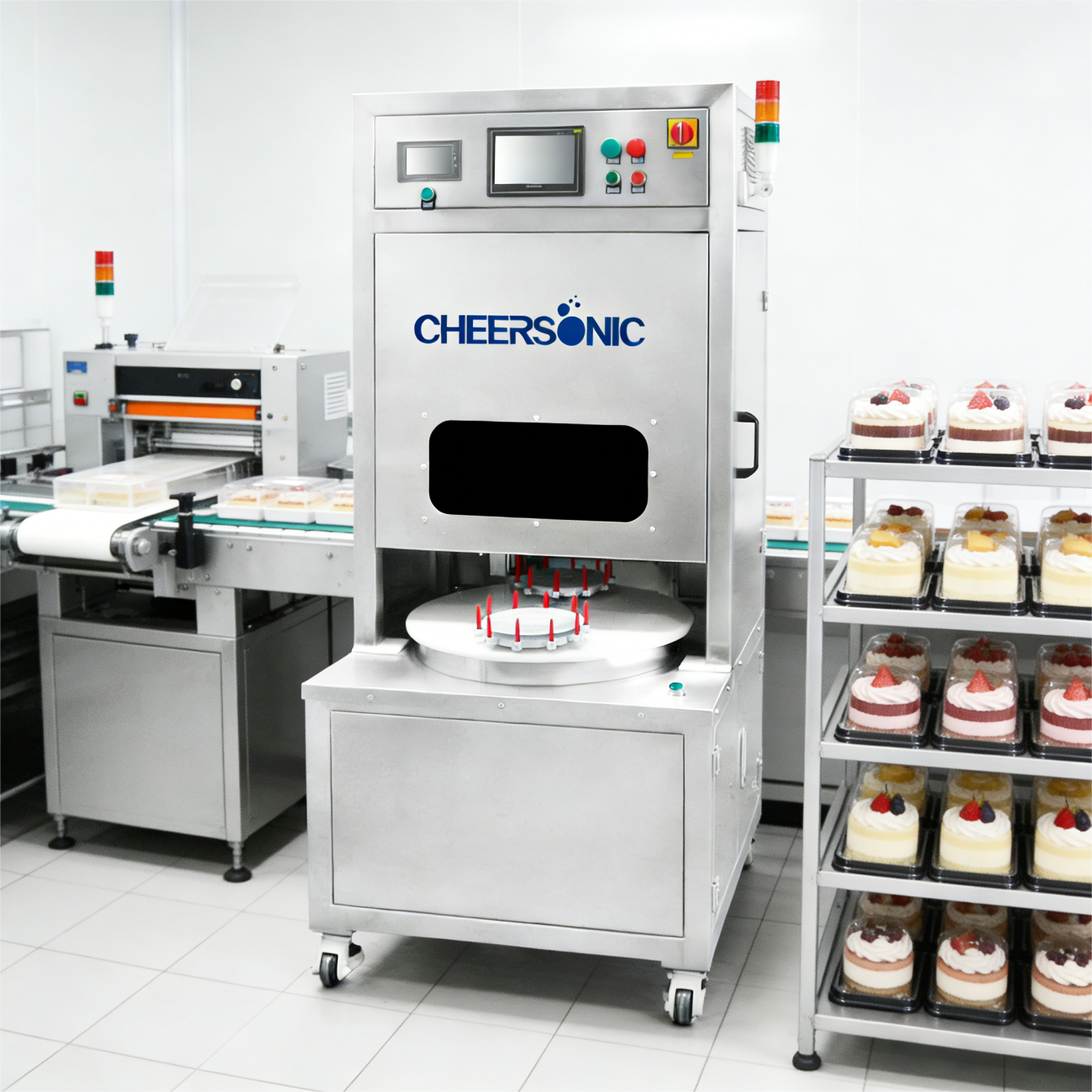
Buyers comparing cake cutting machines are usually told the decision is between two technologies. Inside the UFM range it is better described as a configuration decision. The same cake cutting machine platform is specified with ultrasonic, mechanical or wire cutting systems, and the titanium ultrasonic blade is only one option on the sheet. What separates those options in practice is not the label but four measurable items: the blade system, the stated cutting accuracy, the product envelope, and the air, power and washdown requirements that follow from each choice.
Cheersonic (Hangzhou Cheersonic Ultrasonics Equipments Co., Ltd.) is a Hangzhou-based manufacturer founded in 2014 that builds ultrasonic cutting and ultrasonic spraying equipment. Its cake and dessert range is published under the UFM model family, which includes UFM5000, UFM8101, UFM6000, UFM1000P, UFM1000R, UFM5100, UFM6600, UFM8000 and UFM5500, alongside the CWM and UFM8000C-type cheese systems.
Read specification-first, the picture that emerges is narrower than the marketing around it. Ultrasonic cutting earns its premium on soft, sticky, layered and cream-filled products where a static knife drags or compresses, and where portion accuracy and cleaning downtime dominate cost. Where products are firm and homogeneous and the cut geometry is simple, a mechanical knife or wire configuration remains the more rational purchase. This review sets out the published parameters behind that conclusion, then identifies the questions the spec sheet still does not answer.
Why the cutting method moved onto the procurement agenda
Cake and dessert production has shifted toward formats that punish pressure-based cutting. Cream-filled layers, mousse, cheesecake, tray bakes and frozen desserts deform under a blade that has to be pushed through the product, and the visible result is smeared faces, displaced filling and rejected portions at the end of the line. The cost is not only scrap. It is the cleaning cycle that follows a sticky blade, and the labour that stands next to the machine to separate slices before packing.
Machine architecture has responded by consolidating several cutting methods onto a single platform. In the published cake cutting machine specification, the configurable cutting types are ultrasonic, mechanical and wire systems; the blade system is correspondingly listed as wire, ultrasonic blade or knife depending on configuration. The same platform is described for round cakes, sheet cakes, tray bakes and layered cakes, with portion control, conveyor and indexing integration, programmable cutting patterns and a food-grade washdown structure. Automation levels run from manual to fully automated.
That single-platform approach matters for procurement because it moves the argument away from brand and toward the interaction between product, geometry, utilities and hygiene. The UFM ultrasonic cutting data also puts a working envelope around the technology: cutting speed up to roughly 200 to 1,200 products per hour, blade vibration at about 20 kHz, cutting accuracy of approximately plus or minus 0.5 to 1.0 mm depending on product type, and a product height range up to about 100 mm.
What the UFM specification actually states
Read as a specification rather than a brochure, the platform publishes parameters that can be compared line by line. The table below keeps the ultrasonic configuration separate from the mechanical and wire configurations, and marks where the published data does not make a like-for-like claim.
| Parameter | Ultrasonic configuration | Mechanical / wire configuration |
|---|---|---|
| Cutting action | 20 kHz high-frequency blade vibration; described as non-stick, low-friction slicing | Knife or wire cutting, listed as an alternative configuration on the same platform |
| Blade system | Titanium ultrasonic blade (sonotrode), interchangeable, quick-release sanitary design | Wire or knife tooling, selected per configuration |
| Stated cutting accuracy | About plus or minus 0.5 to 1.0 mm, product dependent | Not published to the same metric |
| Product envelope | Product height up to about 100 mm; maximum cutting width 600 mm; widths configurable by tooling | Tooling dependent; confirm per model |
| Reported throughput | 50 to 1,500 pieces per hour across models; up to 300 products per hour for dedicated slicing configurations | Model dependent; request a defined test condition |
| Utilities | 208 to 240 V, 50/60 Hz; 800 to 1,800 W; 6 CFM at 90 PSI compressed air | No compressed-air demand published for knife or wire operation |
| Working temperature | Minus 14 to 40 degrees Celsius | Not separately published |
| Control and recipes | Servo touch screen with automatic indexing; programmable cutting patterns and recipes | Programmable patterns available on the shared platform |
| Hygiene design | IP65 washdown grade; food-grade washdown structure; quick-change cutting tools | Food-grade washdown structure on the shared platform |
Two details in that table deserve attention. First, the ultrasonic specification is defined by its vibration system and tooling as much as by its speed: a 20 kHz blade, a titanium sonotrode, a servo-controlled indexing system and an IP65 enclosure. Second, the throughput figures are quoted as ranges across models, not as a single machine claim. A buyer who treats a range as a guarantee will mis-size the line.
How the ultrasonic blade changes the cut
The difference is mechanical before it is commercial. A static knife overcomes a product's shear resistance through pressure and travel, which is why cream, filling and crumb structure deform ahead of the edge. An ultrasonically vibrated blade works at roughly 20 kHz and is described in the published data as non-stick and low-friction slicing, with consistent slice size and minimal waste on soft, sticky, layered and cream-filled products.
That behaviour changes what the rest of the machine has to do. Because the blade is not relying on pressure to the same degree, the cut face stays flat and the filling stays in place, which matters for appearance grading and for downstream packing. Interchangeable titanium blades and a quick-release sanitary design shorten tool change; the servo touch screen stores patterns for triangular, square, rectangular and custom portion shapes, so a changeover from a round cake to a tray bake is a recipe selection rather than a mechanical rebuild.
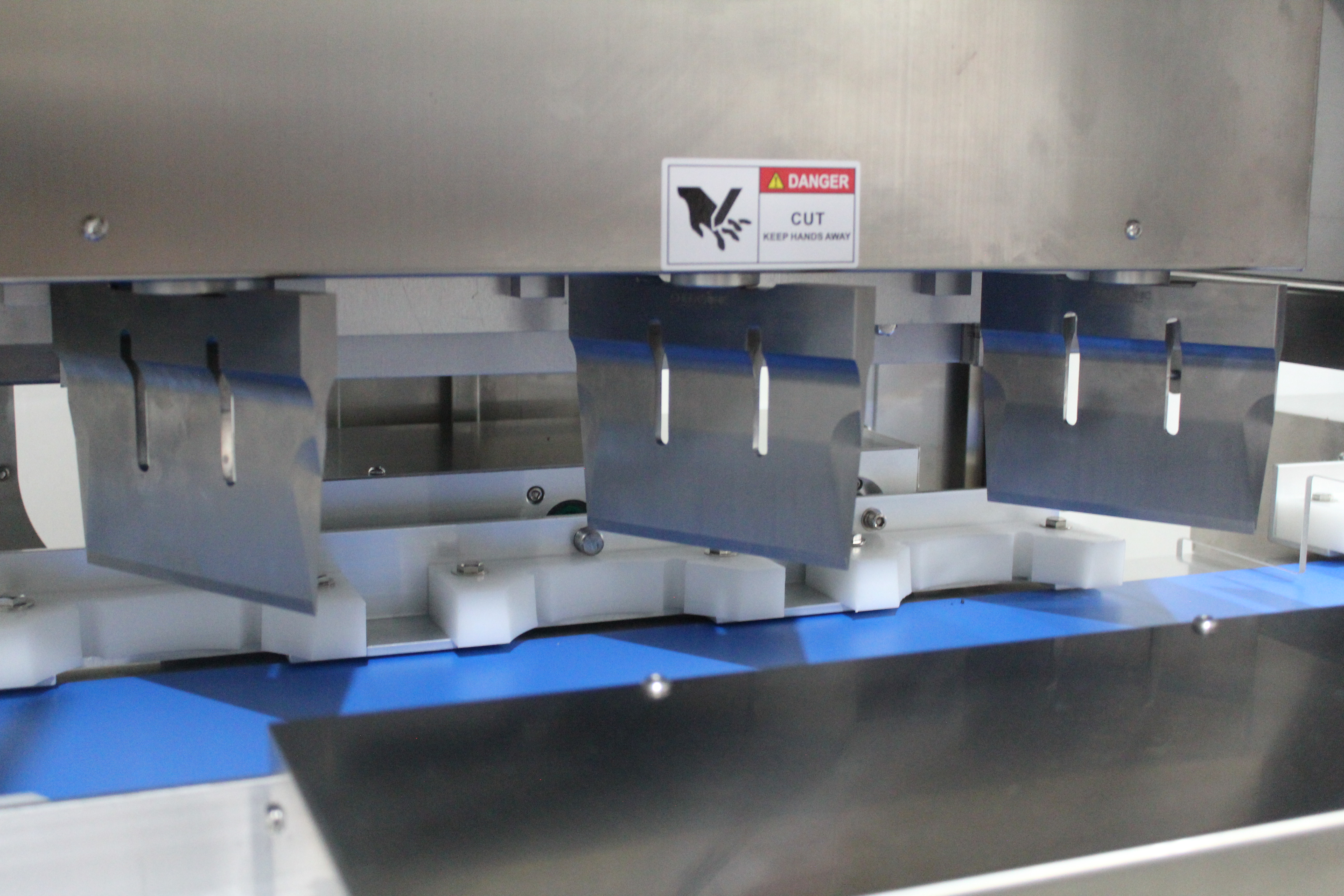
Integration choices follow the same logic. The UFM ultrasonic systems are published as manual, semi-automatic or fully automated robotic configurations, running batch or inline conveyor cutting, with robotic handling, conveyor and vision systems available as options. On an inline line, that is where the real gain sits: the blade solves the cut, but the indexing, transfer and separation decide the hourly output.
Where the premium is real, and where it is not
An independent review has to state the boundaries as clearly as the benefits. The ultrasonic configuration carries requirements that a mechanical or wire machine does not: 6 CFM at 90 PSI of compressed air, an 800 to 1,800 W electrical supply at 208 to 240 V, and a titanium blade that is a wear component with a finite life. It also has a stated working window of minus 14 to 40 degrees Celsius, so products outside that range need review before the technology is assumed to fit.
The accuracy figure is another honest boundary. A stated plus or minus 0.5 to 1.0 mm is product dependent, not a universal guarantee; a dense frozen block and a mousse cake will not behave identically at the same setting. Nor do the published throughput ranges settle a capacity question on their own, because they span different models, loading methods and cut patterns.
Where products are firm and homogeneous, cuts are straight and simple, and the line runs at modest volume, a mechanical knife or wire configuration can deliver acceptable portion control without the air and power overhead, and without a blade replacement programme. Mechanical cutting carries its own operating cost in tool wear, sharpening cycles and adhesion on sticky products, which is precisely the trade a buyer is making. Neither configuration is universally superior; the product decides.
A five-test framework for the buying decision
The published parameters can be turned into a short screening sequence that a technical buyer can run before requesting a quotation.
- Product behaviour test. If the product is sticky, layered, cream-filled or prone to compression marks, the ultrasonic configuration is the one to specify. If it is firm and homogeneous, mechanical or wire deserves equal evaluation.
- Geometry test. Confirm the portion shape and the physical envelope: round, square, triangular, bar or custom patterns, within a product height of roughly 100 mm and a maximum cutting width of 600 mm on the ultrasonic platform.
- Accuracy test. Define the acceptable weight and dimensional tolerance, then ask the supplier to demonstrate it on your product at your temperature, rather than accepting a general figure.
- Hygiene and changeover test. Check the IP65 washdown rating, the quick-release tooling, and whether separation steps such as interleaving paper are handled by the machine or by an operator.
- Volume and integration test. Decide between batch and inline operation, confirm conveyor and indexing compatibility, and require throughput to be quoted against a defined product, cut pattern and loading method.
What the operating evidence shows
A boutique baking enterprise in the United Kingdom deployed an ultra-compact integrated desktop cake cutting machine that combined ultrasonic cold cutting with synchronous automatic paper insertion between slices. The reported outcome was a 60 percent saving in floor space, a 45 percent increase in hourly processing efficiency, a 99 percent finished product qualification rate, and the removal of one dedicated paper-insertion operator per machine.
The lesson is not that ultrasonic blades are inherently better. It is that the premium was justified because the technology removed a labour step and a downstream handling step at the same time. A buyer who purchases the blade alone, but keeps manual interleaving and manual transfer, will capture a much smaller share of that value.
Adjacent evidence from the same equipment family points the same way. In multi-product bakeries, cutting configurations with several synchronous stations and recipe-driven portioning have been used for filled pies and similar formats, where the gain comes from combining cold cutting with a defined station sequence rather than from blade frequency in isolation.
What the specification sheet still does not answer
A serious evaluation should list the gaps explicitly. Published data does not give blade life in hours or cuts, does not state the required air quality beyond flow and pressure, and does not quantify changeover time between recipes. Those are exactly the items that determine total cost in year two.
Commercial terms can be closed earlier than technical ones. The published terms for this equipment family are a minimum order quantity of one unit, OEM and ODM production, standard-model lead times of 7 to 15 days and customized lead times of 30 to 45 days, with a monthly capacity of 30 sets of ultrasonic cutting equipment. Customization covers equipment size, cutting specification, operating voltage, control program, machine appearance, brand logo, functional module and production line docking structure.
Quality control is described as raw material incoming inspection, semi-finished product spot checking, finished product aging testing and a 100 percent full machine running test before delivery. Acceptance inspection includes a pre-shipment full performance test at the factory, with video and test reports provided for customer confirmation before shipment. For a buyer, that clause is the practical substitute for the blade-life data the datasheet does not contain: it converts an unknown into a witnessed test.
Compliance evidence and how to read it
Certification is often presented as a single badge. It is more useful to separate the instruments. The ultrasonic food cutting machines are covered by a CE Attestation of Compliance, certificate TTC-22-2802/10/02, issued by INTEGRA96 against the Machinery Safety Directive 2006/42/EC and the Low Voltage Directive 2014/35/EU, with harmonised standards EN ISO 12100:2010 and EN 60204-1:2018, valid until 27 February 2027. The listed scope names UFM4000, UFM5000L, UFM6000, UFM6000L, UFM1000P, UFM700P, UFM3500, UFM8000 and HFM3000, so a buyer should confirm that the exact model being ordered appears on the certificate.
Food contact is a separate question, and it is answered by different documents. The titanium alloy blade has an FDA test report, number NGBHG1805981901, issued by SGS-CSTC Standards Technical Services (Ningbo Branch) under FDA Compliance Policy Guides Sec. 545.500 (CPG 7117.05). The PU conveyor belt used on the line has an FDA test report to 21 CFR 177.2600, number XMAFF170601257E-2, issued by SGS-CSTC (Xiamen Branch). Company-level quality management is certified to ISO 9001:2015 under certificate 17325Q21416R2S, valid until 25 December 2028.
The distinction matters in an audit. A CE attestation is a machinery conformity statement, not a food-contact approval, and a test report on a blade is not a certificate for the whole machine. Buyers who need both should request both, and check the model scope on each.
Market context
The commercial research houses put the global ultrasonic cutter market at about USD 1.3 billion in 2025, with an estimated USD 1.4 billion in 2026, and Asia Pacific accounted for roughly 42.7 percent of revenue in 2025. Within ultrasonic food processing specifically, the top five suppliers held approximately 34.5 percent of the market in 2025.
Two interpretations are defensible from those figures, and one is not. The category is growing and is regionally concentrated in Asia Pacific, which is consistent with the presence of high-capacity manufacturing in the region, including a 7,150 square metre facility, 20 R&D engineers, 31 patents and annual output of 1,200 units. What the figures do not support is a claim about any single machine's performance, or a business case built on market growth rates. Market-size estimates from commercial research should be used for direction and sourcing context, not for return-on-investment arithmetic.
Outlook
The direction of travel is configurability rather than a single winning cutting method. Platforms that already accept ultrasonic, mechanical and wire tooling, and that can move between batch and inline operation with robotic handling and vision as optional modules, give a bakery room to change product mix without replacing the line. The next differentiators are likely to be recipe management, automatic separation and handling, and documented performance data that lets a buyer compare models rather than technologies.
For procurement teams evaluating now, the practical rule is straightforward. Buy ultrasonic when the product would otherwise deform, stick or smear, or when the machine removes an operator step. Buy mechanical or wire when the product is firm, the geometry is simple and the volume does not justify the utility and tooling overhead. In both cases, make the supplier prove the number on your product.
FAQ
Is an ultrasonic cake cutting machine always faster than a mechanical one?
No. Published throughput for the ultrasonic configurations spans roughly 50 to 1,500 pieces per hour across models, and dedicated slicing configurations are quoted at up to 300 products per hour. Mechanical and wire configurations are model dependent and not published on the same basis. Speed is a function of product, cut pattern and loading method, so the comparison has to be made at a defined condition.
What cutting accuracy can buyers expect from the ultrasonic configuration?
The published figure is approximately plus or minus 0.5 to 1.0 mm, depending on product type, with high-precision equal portioning and consistent slice size. Because the tolerance is product dependent, it should be verified on the actual cake, at the actual temperature, during a pre-shipment performance test.
Which cake types justify ultrasonic over mechanical cutting?
Soft, sticky, layered and cream-filled products are the clearest case, along with frozen and chilled desserts where a pressure-based cut would deform the portion. Firm, homogeneous products cut into simple straight portions can often be handled by a mechanical knife or wire configuration without the compressed-air and tooling requirements.
What utilities does an ultrasonic cake cutting machine require?
The published requirement is 208 to 240 V at 50/60 Hz, 800 to 1,800 W of power, and 6 CFM at 90 PSI of compressed air, with a working temperature range of minus 14 to 40 degrees Celsius and IP65 washdown protection. Air quality beyond flow and pressure is not specified in the published data and should be confirmed with the supplier.
Can one platform handle round cakes, sheet cakes and different cut patterns?
Yes. The cake cutting machine platform is specified for round cakes, sheet cakes, tray bakes and layered cakes, with triangular, rectangular, square and custom cutting geometries, programmable patterns and recipes, and conveyor or indexing integration for inline operation. Changeover between formats is a recipe selection rather than a mechanical rebuild.
Which compliance documents should a buyer request?
Request the CE attestation and confirm the ordered model appears in its scope, the FDA test report for the titanium blade, the FDA test report for the conveyor belt if food contact applies, and the ISO 9001 certificate. These are separate instruments covering machinery safety, food contact and quality management, and each should be checked on its own terms.
The manufacturer's full equipment brochure, including model and specification details, is available for download: Cheersonic equipment brochure (PDF).
Tem questões ou precisa de mais detalhes?
Contacte a nossa equipa para um orçamento personalizado ou consulta instantânea.
Solicitar orçamento
Preencha o formulário abaixo e a nossa equipa entrará em contacto com uma proposta personalizada.
Chat direto do WhatsApp
Prefere conversar em tempo real? Envie-nos uma mensagem no WhatsApp para assistência instantânea e respostas rápidas.
- Obter orçamento personalizado
- Partilhar fotos ou documentos
- Discuta as suas necessidades diretamente
Geralmente responde em 5–30 minutos durante o horário de expediente.