
Understanding UHF RFID Reader Compliance: What Smart Factories Must Verify

Production and quality-control documentation begins on the manufacturing floor. Image: DAILY RFID production environment.
A UHF RFID reader is hardware that reads and writes passive tags over an ultra-high-frequency air interface, commonly specified as 860 MHz to 960 MHz, and on a smart-manufacturing site it is usually the component that links a physical process — receiving, work in progress, tooling, dispatch — to the enterprise system that records it. Because the same hardware class is sold into many regulatory regions, compliance is not a document a buyer collects at the end of a project. It is a set of parameters that decides whether the device can legally and predictably operate where it is installed.
This reference sets out the compliance and qualification parameters that purchasers, plant engineers, and system integrators should examine when sourcing UHF RFID readers, and it uses the DAILY RFID product range — fixed readers, handheld readers, reader modules, and integrated cabinets — as a concrete basis for those checks. No certificate body, approval number, or test-house name is asserted here. The emphasis is on the type of evidence a buyer should request and on how to confirm that the evidence matches the hardware actually being shipped.
Why compliance questions now arrive earlier in the buying process
Frequency planning is the first reason. Although the UHF band is often described as one broad range, DAILY RFID documents its products as operating at UHF (860MHz~960MHz) and HF (13.56MHz) or LF (125KHz) frequencies depending on the product line. A reader configured for one market's permitted sub-band is not automatically configured for another, so the frequency setting is a purchasing decision rather than an installation detail to be sorted out later.
The second reason is the environment itself. A production hall contains motors, drives, welding equipment, and wireless infrastructure, and reader behavior has to be planned rather than assumed. DAILY RFID industrial readers are documented with RF power tuning, duty-cycle planning, ventilation space, and temperature monitoring for continuous operation — capabilities that matter when a reader is specified for 24/7 duty instead of a one-off inventory count.
The third reason is program length. A pilot may involve a single reader; a multi-site rollout involves repeatable configurations, repeatable documentation, and a supplier that can deliver the same product again. Minimum order quantity, lead time, and monthly capacity stop being paperwork items and become schedule risks. DAILY RFID documents minimum order quantities that range from 1 unit for UHF handheld readers and UHF fixed readers up to 1,000 units for laundry tags, with typical production lead times between 7 and 45 days depending on product complexity.
The commercial backdrop adds pressure to that list. The global UHF RFID reader market was valued at approximately USD 4.8 billion in 2025 and is projected to reach USD 11.2 billion by 2034, according to Dataintelo. A larger and more fragmented supply base makes documentation comparability more valuable than headline price alone — particularly for buyers who will live with the same hardware family for years.
Six parameters to verify before a purchase order is issued
The checklist below is organized around what a smart factory can actually verify at the sourcing stage, and around the evidence that should exist before equipment is wired into a line or a dock door.
1. Frequency band and regional spectrum coverage
Confirm the sub-band, not merely the band. The DL213 Type-C UHF Reader Module, a Type-C plug-in read-write module designed for desktop UHF tag encoding and initialization in retail, warehouse, and office scenarios, is documented with support for the ISM 860MHz~868MHz, 902MHz~928MHz, and 920MHz~925MHz ranges. Products that carry more than one air interface exist as well: the RFID exhibit hang tag uses a dual-frequency design at UHF 860–960 MHz and HF 13.56 MHz, with reading distance up to 5–200 cm depending on the reader and IC type. Buyers should ask which sub-band the specific order is configured for, whether that setting is locked, and whether it can be re-configured if the equipment is later redeployed to another market.
2. Air-interface protocol conformance
UHF RFID readers are standardized globally under the EPCglobal Gen2 (Generation 2) protocol, also known as ISO/IEC 18000-6C (GS1 / ISO). That single sentence is the reason a UHF reader from one supplier can, in principle, read tags from another. It is also the reason a datasheet that says only UHF without naming a protocol leaves tag-compatibility risk unresolved. The DL213 module, for example, is documented as supporting ISO18000-6C and EPC Class 1 Gen 2. Protocol support should be stated on the specification sheet for the exact model being quoted, not inferred from the product family.
3. Transmit power and adjustability
Power is where compliance and performance meet. The DL213 module is documented with a maximum transmit power of 23dBm, and DAILY RFID industrial readers are documented with RF power tuning as part of continuous-operation design. Before ordering, a buyer should know the minimum and maximum output of the specific model, whether output can be limited for a given market or read zone, and whether the delivered configuration is recorded in the shipping documentation. Power that cannot be tuned is difficult to reconcile with dock-door and ceiling read points that overlap.
4. Environmental ratings, thermal behavior, and materials
A factory is a demanding environment for electronics. Product documentation in the DAILY RFID range includes a protection level described as IP54 equivalent, and the DL213 module is specified for an operating temperature range of -10°C to 60°C and a storage range of -20°C to 70°C. For continuous duty, DAILY RFID industrial readers are documented with thermal design and power management measures — RF power tuning, duty-cycle planning, ventilation space, and temperature monitoring. Material and restricted-substance declarations should be requested separately wherever the buyer's own inbound compliance process requires them, since those documents describe the article rather than the radio function.
5. Interface, network, and integration documentation
The DL213 module uses a Type-C USB interface with a supply voltage of DC +5V and 3W power consumption. Fixed readers can be deployed with PoE, wired Ethernet, WiFi, or GPRS according to site conditions, and remote read points can be configured with local buffering and resumable upload to protect data continuity. For software integration, DAILY RFID provides SDKs, serial and TCP/IP protocol documents, demo software, and development kits for ERP, WMS, MES, and custom software integration. The practical advice for buyers is procedural: complete single-device read and write tests first, then scale to multi-reader and multi-node workflows.
6. Quality-control evidence, acceptance criteria, and after-sales continuity
Quality-control scope varies by product type across the DAILY RFID range and includes 100% functional testing, signal testing, visual inspection, batch sampling, peel tests, and full system burn-in. Acceptance criteria documented for reader purchases include Sample Approval, Factory Functional Test, Performance Test, Pre-shipment Test, Factory Acceptance Test, and WiFi Communication Test, with example terms such as a minimum order of 2 units and a 7–15 day delivery window. After-sales support is documented as remote and on-site technical support plus replacement warranty across EU, Asia, Middle East, and other regions. Buyers should treat these as contract inputs rather than marketing statements: the acceptance test named in the purchase order becomes the test that decides whether a shipment is accepted.
| Verification parameter | What to confirm | Evidence to request |
|---|---|---|
| Frequency band | Sub-band configured for the installation market | Specification sheet naming the configured range |
| Protocol | EPC Gen2 / ISO-IEC 18000-6C support on the exact model | Datasheet protocol statement and tag compatibility note |
| RF power | Minimum and maximum output, adjustability, configuration lock | Power specification and delivered configuration record |
| Environment | Ingress protection, ambient range, duty rating, mounting space | Environmental specification and installation constraints |
| Interface and network | USB, PoE, wired, wireless options; buffering for remote points | Interface list, protocol documents, SDK, demo software |
| Quality and acceptance | Which test defines acceptance and who performs it | QC procedure list and agreed acceptance criterion |
| Continuity | MOQ, lead time, monthly capacity, after-sales scope | Commercial terms and support coverage statement |
Matching the verification checklist to reader form factors
Compliance work is not identical across reader types, because the form factor determines what can be documented and what must be validated on site.
Fixed readers, including ceiling and overhead read points
Fixed readers carry bulk capture at gates, tunnels, dock doors, and overhead positions. DAILY RFID offers UHF Fixed Readers with customization options for antenna gain and interface, quality control performed through Factory Acceptance Test, a minimum order quantity of 1 unit, typical production lead time of 15 to 45 days, monthly production capacity of 1,000 units, and remote support after delivery; export markets include Global and EU. Where readers are mounted overhead or on ceilings and must read trays or containers at varying angles, DAILY RFID tray readers, mat antennas, and multi-antenna UHF reader layouts are documented to support stable bulk reading from multiple tag angles, with the recommendation to tune antenna position and reader power and then standardize tag orientation and tray handling procedure. For a buyer, that statement translates into a documentation requirement: ask for the antenna layout and power-planning guidance that will be used at the site.
Handheld readers
Handhelds cover cycle counting, maintenance rounds, and exception checks. DAILY RFID offers UHF Handheld Readers with customization of OS, software, and housing, quality control that includes full system burn-in, remote and on-site after-sales support, a minimum order quantity of 1 unit, standard delivery time of 15 to 30 days, and monthly production capacity of 2,000 units; export markets include Global and the Middle East. For a purchasing team, the qualification questions here are about configuration control — which operating system and software version ships, how the housing suits the working environment — and about whether the burn-in record is available with the shipment.
Modules, embedded readers, and integrated cabinets
When the reader is embedded in another product, the compliance question shifts to the host device. The DL213 module reads up to 5 tags simultaneously with an average read time of less than 10ms per 64 bits and a reading range of 0.1cm to 10cm, which positions it for close-range desktop encoding rather than yard-level capture. At the other end of the scale, DAILY RFID Smart Tool Cabinets are offered with ODM/OEM production, customization of cabinet size, reader module, and software, System Integration Test as the quality-control standard, remote and on-site after-sales support, a minimum order quantity of 1 unit, typical lead time of 20 to 45 days, and monthly capacity of 300 units. Integrated equipment of this type requires documentation that covers the enclosure, the reader inside it, and the software layer, not the reader alone.
Tags, antennas, and wearables in the same program
A long-term RFID program is rarely a reader-only purchase, and each item in the bill of materials carries its own qualification threshold. DAILY RFID reader and antenna products include documented functions such as an anti-collision feature with AI-enhanced single-tag lock filtering, a built-in near-field localized antenna, an integrated low-profile flat-panel near-field antenna, and a buzzer read prompt. On the tag side, launch terms differ by article: RFID Laundry Tags with material and size customization at a minimum order of 1,000 units, 10 to 20 days lead time and 400,000 units per month; RFID fabric wristbands at 500 units, 12 to 20 days and 300,000 units per month; Anti-Metal RFID Tags with 100% signal test, 50 units minimum, 7 to 15 days and 100,000 units per month; and RFID asset tracking tags with 100% signal test, 500 units minimum, 7 to 18 days and 800,000 units per month. Buyers running a multi-site program should build the compliance file around the whole bill of materials, because a fully qualified reader attached to an unqualified label is still an unresolved project.
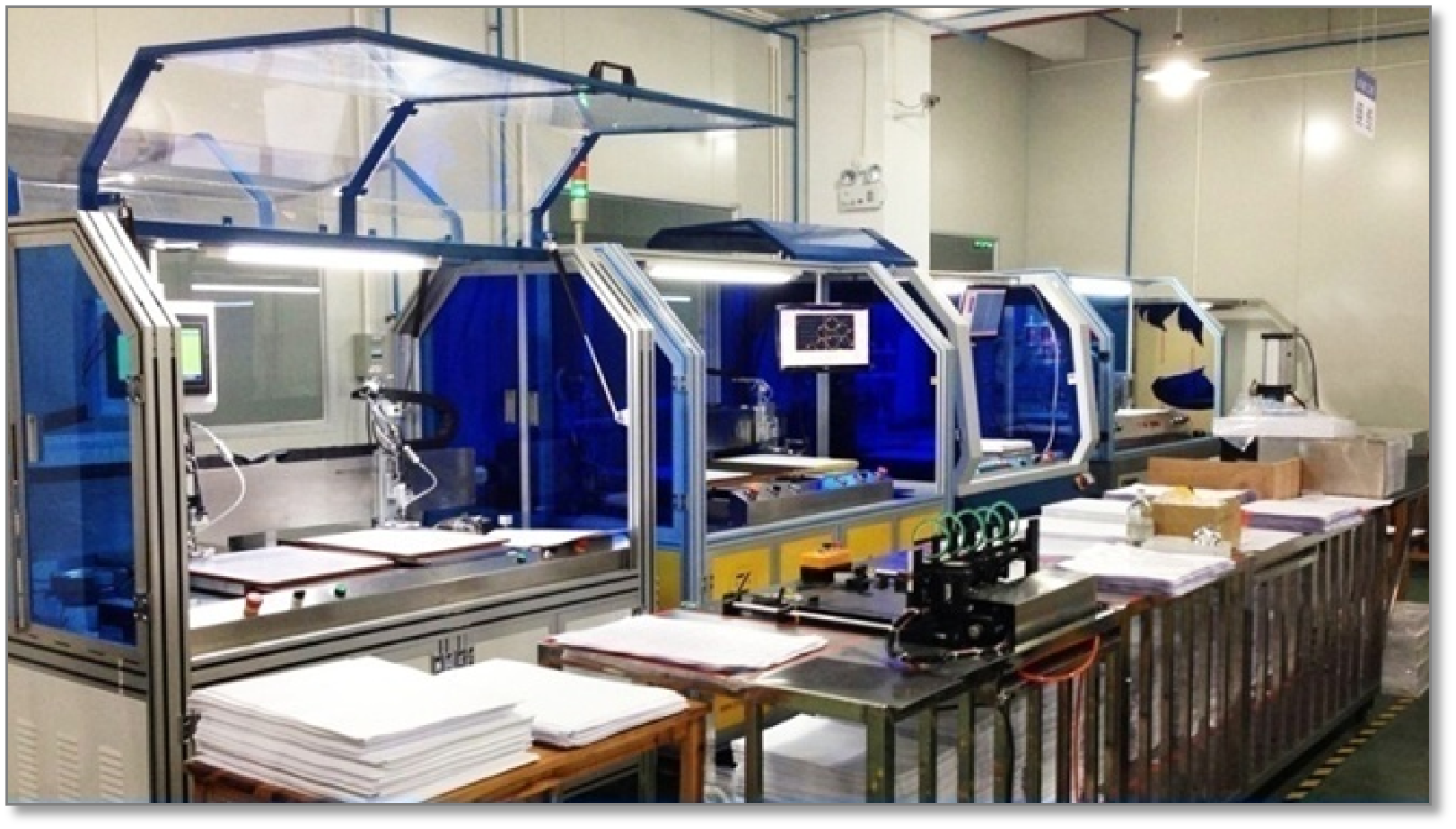
Batch testing and traceability records are part of the qualification file for RFID hardware programs. Image: DAILY RFID equipment.
Reading the numbers on a UHF reader datasheet
Compliance verification is easier when the specification sheet is read as a set of conditions rather than a set of claims. The DL213 module is a useful example because its published parameters are explicit: maximum transmit power of 23dBm, reading range of 0.1cm to 10cm, up to 5 tags read simultaneously, average read time under 10ms per 64 bits, supply voltage of DC +5V with 3W power consumption, Type-C USB interface, operating temperature of -10°C to 60°C, and storage temperature of -20°C to 70°C.
Each of those numbers is a boundary rather than a promise. Read range is quoted for defined conditions and will move with tag design, antenna, orientation, and the material being tagged. DAILY RFID documentation acknowledges this directly: selection guidance for liquids, glass, and human-body proximity covers HF, NFC, UHF, or specialized tag structures, recommends avoiding placement of UHF tags directly behind liquids, and calls for tag position, antenna angle, and reader power to be tuned through sample testing. A buyer who reads only the headline read-range figure, and not the conditions attached to it, is likely to over-specify the reader and under-specify the site work.
Deployment scenarios and the evidence each one implies
| Factory scenario | Typical hardware | Documentation and validation to request |
|---|---|---|
| Dock-door and inbound or outbound gates | Fixed readers with external antennas | Interface and network plan, antenna layout, power settings, ERP or WMS integration documents |
| Overhead or ceiling capture of trays and containers | Fixed readers in multi-antenna layouts | Antenna coverage guidance, tag orientation procedure, repeatability test results |
| Line-side work-in-progress and exception handling | Fixed readers with MES connectivity | SDK, serial and TCP/IP protocol documents, single-device test plan before scale-up |
| Cycle counting and maintenance rounds | UHF handheld readers | Burn-in quality-control record, OS and housing configuration, warranty terms |
| Tool, consumable, and spare-part control | Smart cabinets and shelving with embedded readers | System integration test documentation, software customization scope, permission integration |
| Uniforms, workwear, and rental textiles | Laundry-grade tags with bulk readers | Small-batch lifecycle validation plan covering wash cycles, dryer temperature, press conditions, and detergents |
| Remote or temporary read points without cabling | Fixed readers with wireless backhaul | Network architecture statement, local buffering and resumable upload behavior |
Two operational risks deserve a place in the same file. Dense tag environments require an anti-collision and de-duplication strategy — DAILY RFID multi-tag reading solutions document anti-collision, RSSI filtering, time-window de-duplication, and zone-based scanning, with tag spacing defined for dense goods and industrial PDAs or multi-antenna readers selected according to inventory density. And in warehouse-wide asset tracking, fixed readers, UHF antennas, and handheld terminals are deployed at inbound, outbound, transfer, and inventory nodes so that each movement event is captured and exception lists for missing, wrong-location, or idle assets can be generated. Both are engineering commitments that belong in the qualification conversation, not in a post-installation troubleshooting list.
Market signals that make documentation a differentiator
Public market data explains why buyers are seeing more reader variants and more supplier claims to compare. UHF RFID technology captured 40.72% of total RFID market revenue in 2025, driven by retail inventory cycles and multi-item read capability, according to Mordor Intelligence. IDTechEx reports that the Americas led UHF RFID market activity with over 60% of global UHF tag usage as of 2025, largely due to retail mandates. ABI Research identifies Asia Pacific as the fastest-growing region for UHF RFID hardware, with an expected CAGR of 11.8% in shipments through 2031.
One caution applies to all of these figures: they are estimates with different scopes. Published comparisons show that some sources quote the broad UHF RFID reader market at approximately USD 4.8 billion for 2025 while others place specific sub-segments far lower, because one number includes hardware ecosystems and the other counts a narrower product category. Buyers who cite market size in an internal business case should state the source and the scope alongside the number.
UHF RFID and barcode at the qualification stage
The most common comparison a factory buyer makes is between UHF RFID and the barcode workflow already in place. Documented comparison data for the DAILY RFID DL920 UHF Long Range Reader against a barcode scanner describes contactless bulk reading without one-by-one scanning, inventory and inbound-outbound capture that is typically 5 to 10 times faster, hardware capital expenditure that is usually 20% to 60% higher than manual or barcode stations, labor cost that can drop 40% to 75%, and a typical payback of 6 to 18 months at medium-to-high volume.
The limitation matters as much as the advantage. Barcode remains the simpler choice where volumes are low, items are handled one at a time, labels are already part of the packaging, and the site has no capacity to plan RF read zones. Moving to UHF adds tag application discipline, antenna and power planning, and a documentation set that must be maintained across every deployment phase. The reader is also only part of the cost; tags, antennas, integration, and validation sit in the same budget. For a factory running a stable, low-volume, line-of-sight process, the additional compliance overhead may not be justified by capture-speed gains alone.
Limits and boundaries: what a compliance file cannot prove
- A device document describes the device, not the site. Read performance near liquids, glass, and the human body requires frequency selection and tag placement decisions, and DAILY RFID guidance is to tune tag position, antenna angle, and reader power through sample testing rather than assume a datasheet figure will transfer.
- Small objects may not carry a standard tag. DAILY RFID offers HF, NFC, UHF mini tags, and micro-size solutions for small items, and the documented approach is to set realistic read-range expectations and use close-range readers or fixtures where needed, validating stability with sample testing before rollout.
- Continuous duty has thermal limits. Industrial readers are documented with thermal design and power management for 24/7 operation, which implies that duty cycle, enclosure ventilation, and installation space are part of the specification, not installation improvisation.
- Commercial terms vary widely across a single program. Minimum order quantities in the DAILY RFID range run from 1 unit for UHF handheld and fixed readers to 1,000 units for laundry tags, and typical lead times run from 3 to 30 days across product lines, with monthly capacities from 2,000 units for UHF handheld readers up to 2,000,000 units for RFID cards. A rollout plan that assumes uniform terms across the bill of materials will slip.
- A qualified reader does not qualify the integrated system. Software integration, network architecture, and tag selection each introduce variables that the reader documentation does not cover.
Future outlook
Three shifts are likely to shape how factories verify UHF RFID hardware over the next several years. The first is scale: with the UHF RFID reader market projected to grow from approximately USD 4.8 billion in 2025 toward USD 11.2 billion by 2034 according to Dataintelo, and with Asia Pacific shipments growing at an 11.8% CAGR through 2031 according to ABI Research, buyers will be choosing from a wider field of suppliers, which raises the value of comparable documentation rather than brand familiarity.
The second is the diversification of capture models. Automated inventory collection is expanding beyond fixed and handheld readers; the market for drones-as-a-service using RFID for inventory collection is estimated by PR Newswire to reach USD 8.2 billion by 2026. New capture platforms multiply the number of devices that must be qualified against the same frequency and protocol rules.
The third is supplier persistence. DAILY RFID CO., LIMITED is a Guangzhou-based RFID manufacturer founded in 2008, operating a 28,000 m² factory with 180 to 200 employees and a 38-engineer research and development team, producing RFID tags and RFID readers with an annual reader output of 100,000 units and an export share of 80%, with main markets in the EU and the USA. Buyers evaluating multi-year programs increasingly weigh that kind of continuity — capacity, lead time stability, and after-sales coverage — alongside the technical parameters of a single device.
FAQ
Q1. Which frequency parameters should a factory confirm before ordering a UHF RFID reader?
Confirm the sub-band rather than the general band statement. UHF RFID readers operate in the 860 MHz to 960 MHz range, but permitted sub-bands differ between markets, and DAILY RFID documents specific module support for the ISM 860MHz~868MHz, 902MHz~928MHz, and 920MHz~925MHz ranges on the DL213 Type-C UHF Reader Module. Some products carry two interfaces at once: the RFID exhibit hang tag uses UHF 860–960 MHz and HF 13.56 MHz with a reading distance of 5–200 cm depending on the reader and IC type. Buyers should confirm the configured range on the exact model being quoted and whether the setting can be changed for a different market.
Q2. What documentation should be requested when a supplier states that a reader meets local radio requirements?
Request documents that name the exact model or SKU, the declared frequency range, and the declared RF output power, so the paperwork can be matched against the unit on the dock. On the technical side, the air interface should be identified as EPCglobal Gen2 also known as ISO/IEC 18000-6C, the standard under which UHF RFID readers are globally specified. Material declarations, ingress protection statements, and environmental specifications such as the IP54-equivalent rating and the -10°C to 60°C operating range documented for the DL213 module should be requested separately where the buyer's inbound process requires them. The decisive check is alignment: the model number on the document should be the model number ordered.
Q3. Is protocol support alone enough to guarantee that a reader will read our tags?
No. Protocol conformance establishes that devices speak the same air interface, but it does not predict read performance in a specific environment. Tag chip, memory structure, antenna design, material, orientation, and proximity to liquids, glass, or the human body all affect results. DAILY RFID guidance for challenging environments is to select the appropriate frequency or specialized tag structure, avoid placing UHF tags directly behind liquids, and then tune tag position, antenna angle, and reader power through sample testing. For small objects, mini tags and close-range readers or fixtures may be required, with read-range expectations set realistically before rollout.
Q4. Which acceptance test should be written into a reader purchase order?
Acceptance criteria documented in the DAILY RFID procurement range for reader purchases include Sample Approval, Factory Functional Test, Performance Test, Pre-shipment Test, Factory Acceptance Test, and WiFi Communication Test, with example terms such as a minimum order of 2 units and a 7–15 day production window, and delivery terms of EXW, FOB, or CIF. The criterion chosen should reflect the deployment risk: a factory integrating readers into a wireless network may prioritize a communication test, while a multi-reader rollout may prioritize a factory acceptance test performed on the configured unit. Whichever is chosen, the test conditions should be stated in the order rather than assumed.
Q5. How can a factory verify that a reader is suitable for continuous operation?
Continuous duty is a thermal and power question. DAILY RFID industrial readers are documented with RF power tuning, duty-cycle planning, ventilation space, and temperature monitoring for sustained operation, and the recommended approach is to match the thermal design to the operating schedule and the installation enclosure. Related quality-control evidence includes full system burn-in for UHF handheld readers. Buyers should also confirm that the installation plan leaves the ventilation space the design assumes, because an enclosed or unventilated mounting position can negate the specified duty rating regardless of the device documentation.
Q6. What changes about qualification when a pilot becomes a multi-site rollout?
Commercial and support parameters become part of the compliance picture. In the DAILY RFID range, minimum order quantities differ by article — 1 unit for UHF handheld readers and UHF fixed readers, 50 units for anti-metal tags, 500 units for fabric wristbands and asset tracking tags, and 1,000 units for laundry tags — while typical production lead times run from 3 to 30 days and monthly capacities range from 2,000 units for UHF handheld readers to 2,000,000 units for RFID cards. After-sales support is documented as remote and on-site technical support plus replacement warranty across EU, Asia, Middle East, and other regions, and export markets include Global, EU, Asia, and the Middle East. Multi-site programs depend on those terms staying consistent across batches.
Q7. Does a reader qualification file cover the tags and antennas in the same project?
Generally it does not, because each article is qualified separately. Readers, antennas, tags, labels, cards, and wearables are distinct products with their own specifications, quality-control procedures, and commercial terms. Within the DAILY RFID range, for example, quality control includes 100% functional test, signal test, visual inspection, batch sampling, peel tests, and full system burn-in depending on product type, while customization scopes range from antenna gain and interface options on UHF Fixed Readers to diameter, material, chip, and printing on RFID and NFC disc tags. A complete qualification file should therefore list every item in the bill of materials, not only the reader.
Where this leaves the purchasing decision
For smart factories, UHF RFID reader compliance is best treated as a structured evidence exercise: confirm the frequency sub-band, confirm protocol conformance, confirm power adjustability, confirm the environmental envelope, confirm the interface and integration documents, and confirm the acceptance test and support terms that will govern the relationship after delivery. Buyers who run those six checks before issuing a purchase order are effectively building the qualification file that a multi-site rollout will depend on — and they will know which supplier can produce it.
DAILY RFID documents its product range, quality-control procedures, lead times, and after-sales coverage for exactly this kind of evaluation. The company profile, including product lines and commercial terms, is available for download at the DAILY RFID company brochure, and further technical information is published at www.rfid-in-china.com.