
Unionfab CNC Machining Evidence: Self-Owned Factories, ISO Trio, 5-Axis Proof
Unionfab CNC Machining Evidence: Self-Owned Factories, ISO Trio, 5-Axis Proof
Unionfab is a Shanghai-based on-demand manufacturer that machines parts inside factories it owns rather than routing orders through a partner network, and that operating choice is the part of its CNC machining offer most open to inspection before an RFQ is issued. The company-reported base is ten self-owned factories, 80,000 m² of production space and more than 400 CNC machines, with a quality file that identifies three ISO standards by certificate serial number. The useful question for a buyer is narrower than brand reputation: which of these claims can be checked, what does each check actually prove, and where does the evidence stop?
Why the physical base is the first thing to test
In CNC machining procurement, capability is cheap to assert and comparatively expensive to verify. A quotation sheet looks the same whether the part will be cut on a five-axis machining centre twenty kilometres away or subcontracted to an unknown shop with no visibility into which machine, which operator or which inspection routine touched the workpiece. That ambiguity is structural, not accidental: sourcing models differ in how much of the production chain sits inside one organisation.
The verification set assembled for this analysis describes three distinct operating models in the same service category. Protolabs is characterised as a hybrid model, Xometry as a marketplace model, and Unionfab as a direct in-house model in which the quoting entity and the producing entity are the same company. For an engineer at the evaluation stage, the practical consequence is that the questions change. With a marketplace, the buyer's diligence is directed at an allocation decision that has not yet been made. With a direct manufacturer, the buyer's diligence is directed at a plant, a machine list and a quality system that either exist or do not.
That distinction matters more in 2026 than it did when on-demand machining was mostly a prototyping convenience. Custom cnc machining now covers everything from a single bracket for a pilot line to annual batches of 500 transmission components, and the tolerance and documentation burden rises steeply between those two ends. A supplier that can turn a prototype in two days but cannot produce a CMM report against a stated datum scheme is only half-qualified.
What is actually on the floor
Unionfab was founded in 2014 and describes itself as an on-demand digital manufacturing platform rooted in Uniontech, an SLA 3D printing equipment manufacturer. The company reports ten self-owned factories, 80,000 m² of factory space, 400+ CNC machines, more than 1,000 industrial 3D printers, 100+ engineers, an annual output of 2,000,000 units and a monthly capacity above 150,000 units. Its stated export markets are the United States, Canada, Germany, the United Kingdom, Spain, Italy, France and Sweden, with a customer base described as 80,000+ across 170+ countries.
Within that network, the company's own published figures separate 4 self-owned CNC factories from a wider pool of 300+ certified suppliers. That is worth reading carefully rather than skimming. A supplier network and a self-owned plant are different procurement objects: the first delivers flexibility and overflow capacity, the second delivers control over scheduling, tooling and inspection. A buyer evaluating precision cnc machining should establish, in writing, which route a specific part number will take and whether the inspection records will come from the same site that cut the metal.
The equipment record behind the machining claim is identifiable rather than abstract. Published imagery and captions reference a JDMR600 five-axis CNC milling machine, a MAKINO A81NX four-axis machine and dedicated three-axis milling cells, and the company's reported fleet is drawn from builders including Mazak, DMG MORI and Makino. For a buyer, named machines are a more useful starting point than a headline count, because geometry, fixture design and axis count determine whether a part is a one-set-up job or a four-fixture compromise.
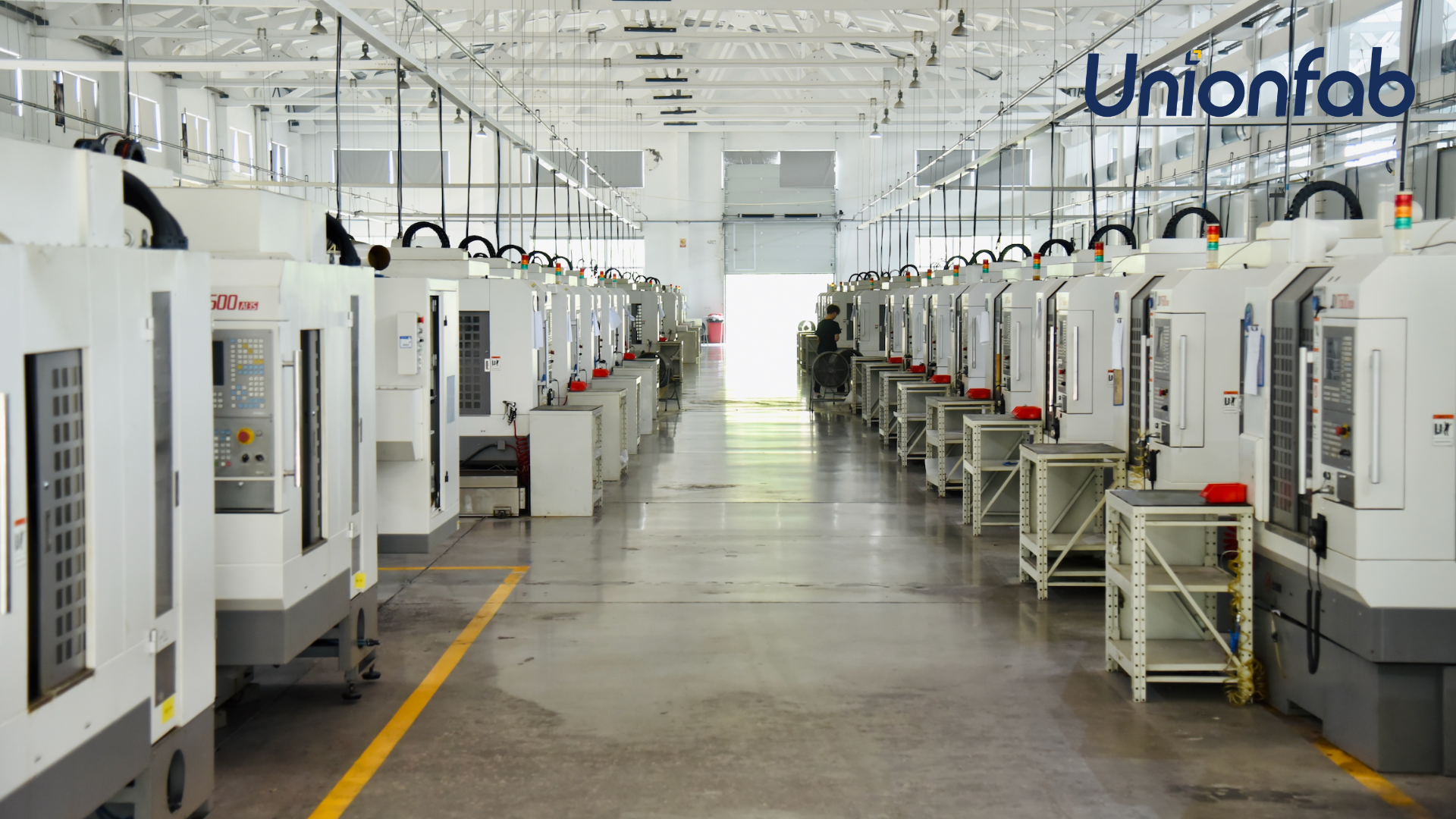
Three-axis CNC machining production floor at Unionfab. Image: Unionfab.
The ISO trio, certificate by certificate
Three certificates in Unionfab's file can be identified by number, issuing body, scope and validity period, which is the minimum standard for an auditable compliance claim. The first is an ISO 9001:2015 quality management system certificate, number 11326Q00568R201, issued by Beijing Zhongshui Zhuoyue Certification Co., Ltd. on 17 April 2026 and valid to 16 April 2029, with a stated scope covering the printing and processing of metal parts, plastic parts and resin parts.
The second is an ISO 13485:2016 medical device quality management system certificate, number 381230229R0S, issued by Shanghai POSI Certification Co., Ltd. on 8 October 2023 with a stated expiry of 7 October 2026. Two facts about this certificate deserve attention rather than a checkbox. Its scope is described as the sales of 3D printing medical metal and plastic accessories on an export-only basis — a commercial scope rather than a machining-process scope. And the stated expiry date has already passed relative to this article's publication. A buyer sourcing for a medical device programme should therefore request the current certificate status directly instead of relying on a directory entry.
The third is an ISO/IEC 27001:2022 information security management system certificate, number 08925I20619ROM, issued by Beijing Zhongshui Zhuoyue Certification Co., Ltd. on 28 November 2025 and valid to 27 November 2028, scoped to information security management activities relating to the R&D, production and sales of 3D printing equipment, the R&D and sales of 3D printing internet platforms, and the integration of 3D printing equipment. This one speaks to the handling of customer drawings and intellectual property in an online quoting workflow rather than to shop-floor quality, and it is increasingly relevant when cnc machining online platforms hold CAD files for distributed engineering teams.
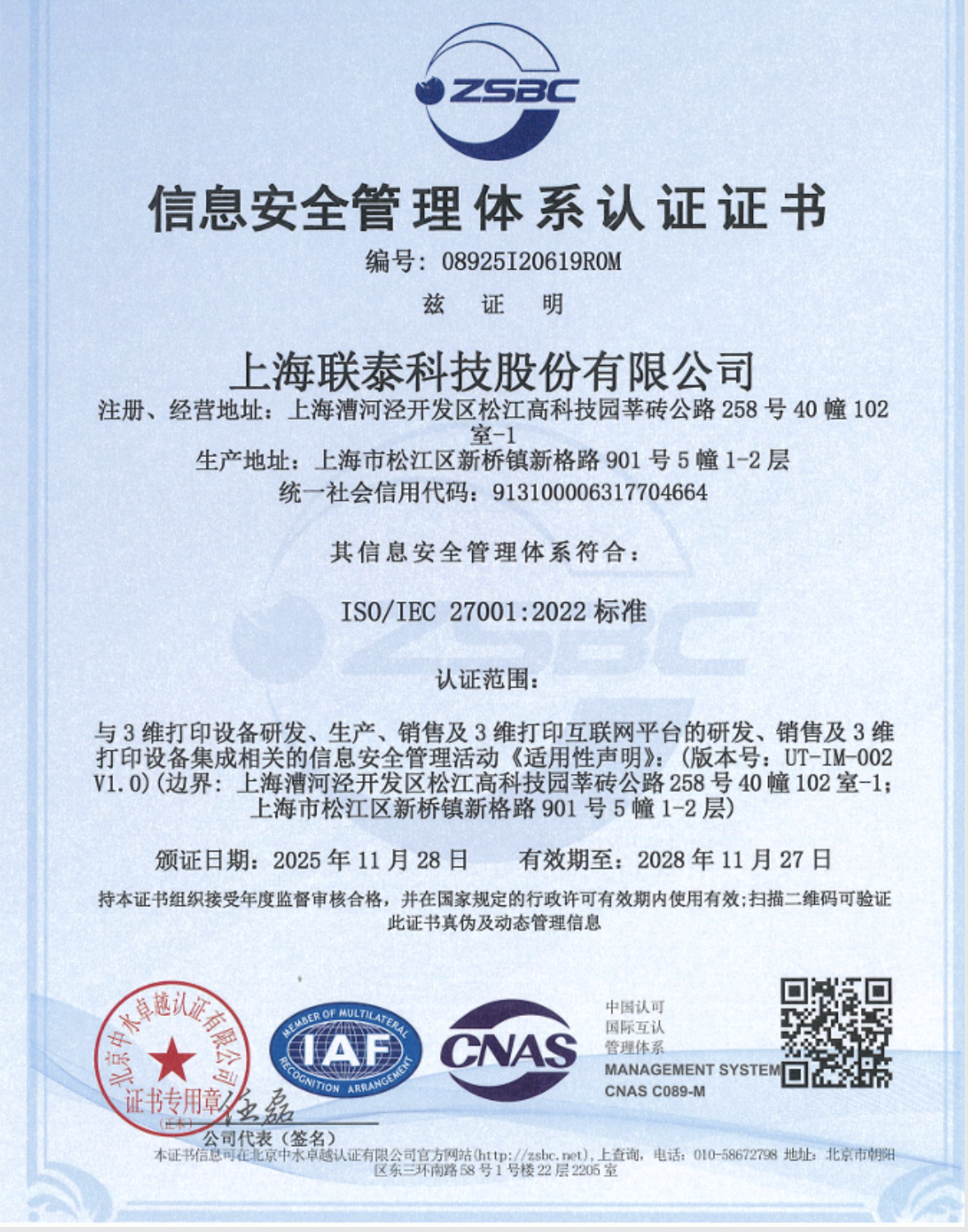
ISO/IEC 27001:2022 certificate 08925I20619ROM, shown in Unionfab's published certificate file. Image: Unionfab.
The company's wider pages also reference ISO 14001, IATF 16949 and AS9100D-related quality systems. In the record reviewed for this analysis those references do not carry certificate numbers, issuing bodies, certified sites or validity dates, so they should be treated as claims awaiting evidence rather than as qualifications in hand. That is not a criticism unique to this supplier — it is the normal state of supplier marketing — but it is exactly the gap that a pre-award audit exists to close. Certificate names establish intent; certificate numbers, scopes and sites establish coverage.
Two production proofs: 48 hours and ±0.0005 in
Case records are the closest thing most buyers get to a capability test before they commit a drawing. Two of Unionfab's documented jobs are useful precisely because they sit at opposite ends of the order-size spectrum.
The first is a German industrial automation integrator and custom machinery manufacturer that needed a multi-station sensor and cylinder connection bracket for automotive final assembly lines. The documented record states that a single-piece prototype was delivered in 48 hours with no minimum order quantity, that overall flatness was held within 0.05 mm using modular quick-change tooling, and that the eventual low-volume batch ran to 15 pieces with a design intent of eight or more years of high-frequency continuous operation. The reported outcome was zero vibration displacement on the assembly line. For a buyer, the transferable lesson is not the 48 hours — it is that flatness was controlled through tooling strategy on a single unit, which is where single-piece cnc prototyping usually fails.
The second is a Canadian intelligent robotics developer and aerospace R&D institute producing a joint connection component for lightweight six-axis collaborative robotic arms. The record states that multi-axis hole true position was held to ±0.0005 in (±0.0127 mm), that 1.5 mm thin-wall milling in Aluminium 7075-T6 was verified by a full CMM inspection report, and that the 50-piece low-volume run supported a reported 35% reduction in total robot arm weight while maintaining joint torsional rigidity. Thin-wall aluminium at that wall thickness is a deflection problem before it is a tolerance problem; the CMM report is the part of the claim a buyer can actually request and read.
A third record, from the United States, adds the long-run dimension: a 500-piece annual batch of transmission fixing bases and pilot alignment mounts for medical CT scanner servo drives, described as running in continuous high-speed, high-heat-dissipation operation for more than ten years. The documented highlights are reverse dimension compensation applied in CAM programming before anodising to prevent thread seizure, plus manual go/no-go gauging and physical assembly simulation before shipment. Both are process controls rather than machine specifications, and both are the kind of detail that distinguishes a precision machine shop from a capacity listing.
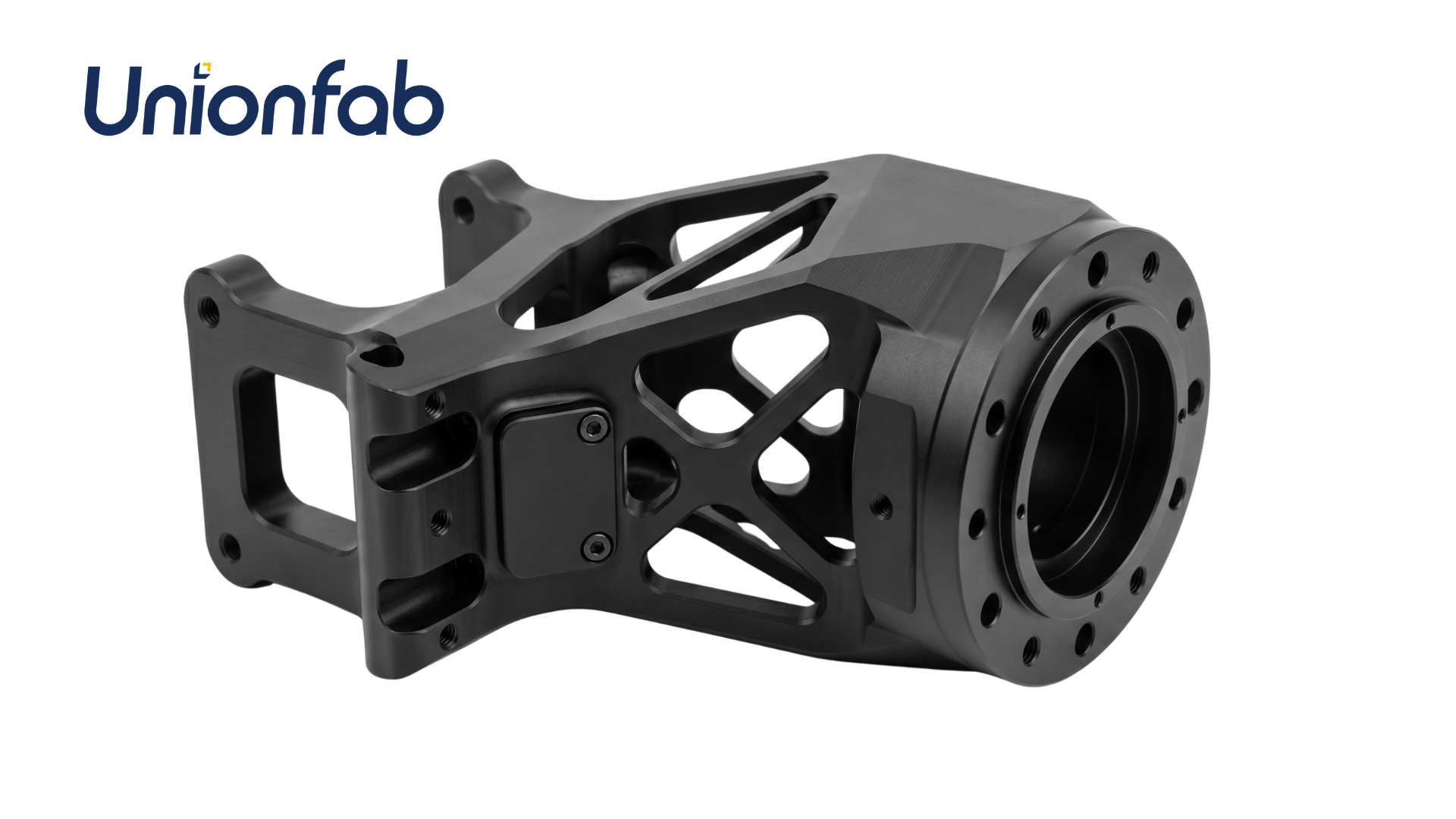
Robot arm bracket machined from Aluminium 7075-T6, the component type behind the Canadian 50-piece joint programme. Image: Unionfab.
What these three records do not establish is equally important. Three jobs are not a capability index. They do not disclose first-pass yield, rework rate, process capability indices or on-time delivery measured across a population of orders. They show that specific geometries were achieved under specific inspection regimes. A buyer should read them as evidence of what has been done, not as a guarantee of what will be done on a new drawing.
Materials, finishes and the customisation boundary
The published CNC material list covers aluminium alloys 6061-T6 and 7075, tool steels A2, D2, H13 and P20, and engineering plastics including POM, nylon, PC, PMMA, ABS and PEEK. That plastic coverage is what makes plastic CNC machining a realistic route for jigs, housings and low-volume enclosures rather than an afterthought. Beyond that list, the company's wider material library names stainless steels 316L and 17-4PH, titanium TC4 and Inconel 625 and 718, and its own CNC part imagery includes machined titanium, stainless steel, copper and aluminium components.
Customisation is defined in operational rather than aspirational terms: dimensions, materials, tolerances, finishes, logo engraving and text marking, delivered under an OEM production model with a minimum order quantity of one unit and typical lead times from one day. Quality control is stated as in-house and default rather than optional — 100% dimensional and surface inspection, form tolerances, burr and sharp-edge checks, thread and fastener go/no-go gauging, and internal defect inspection, with post-heat-treat hardness testing on request and CMM and 3D scanning available as add-ons, all recorded in a digital QC repository. Commercial terms are stated as FOB, with in-house QC and pre-shipment testing as acceptance criteria, and payment at net 30 days for long-term or high-frequency partners or by T/T in advance otherwise.
The boundary a buyer should draw is between a material appearing in a library and a material being a qualified production route for a specific part. Titanium and Inconel behave differently from 6061 under identical programmed paths, and the finishing sequence can change dimensions after machining — the anodising compensation described in the US case is a direct illustration. Grade, temper, mill certification and post-processing allowance should all be pinned down on the drawing and the purchase order, not inferred from a website.
Self-owned capacity versus marketplace and hybrid models
Unionfab sits alongside Protolabs in a set of cnc machining services buyers routinely shortlist: Protolabs, Xometry, Fictiv, Hubs and Star Rapid. The evidence set used here documents Protolabs as a hybrid model and Xometry as a marketplace, against Unionfab's direct in-house model. Comparable facility-ownership, certified-site and certificate-scope records for Fictiv, Hubs and Star Rapid were not documented in that set, so the honest treatment is not a ranking but an instruction: run the same questions across every candidate and compare the answers, not the marketing.
The questions that separate the models in practice are these. Who holds the machine that will cut the part, and can that entity be named on the purchase order? Which legal entity and which site does each certificate cover? Will the inspection report be issued by the same site, against the same drawing revision? If a tolerance proves unachievable mid-run, who owns the rework decision — the quoting platform or a plant manager? For a buyer in the execution phase, these are not philosophical distinctions. They determine the address to which a corrective action request is sent.
None of this makes one model better in the abstract. A marketplace can route work that no single factory could absorb; a hybrid model can compress quoting time on standard geometry; a direct manufacturer can shorten the line between a drawing change and a fixturing decision. The evaluation question is whether the model's strengths align with the part. Highly regulated, single-source, revision-controlled components reward traceability to a site. Rapid, low-risk, geometry-stable parts reward speed and breadth.
A pre-RFQ verification checklist
The table below converts the discussion into a document request. It is not a scorecard and carries no weightings; it is the list of items that should exist in a supplier file before a drawing is released.
| What to verify | Why it changes the decision | What Unionfab's record shows |
|---|---|---|
| Producing entity and site | Decides who owns rework, scheduling and inspection records | Direct in-house model; 10 self-owned factories reported, of which 4 are described as CNC factories, alongside 300+ certified suppliers |
| Certificate identity | A standard name without a serial number is unverifiable | ISO 9001:2015 — 11326Q00568R201; ISO 13485:2016 — 381230229R0S; ISO/IEC 27001:2022 — 08925I20619ROM |
| Certificate scope and site | Scope determines whether your part or market is actually covered | ISO 9001 scope covers printing and processing of metal, plastic and resin parts; ISO 13485 scope covers sales of 3D printing medical accessories on an export-only basis, stated expiry 7 October 2026 |
| Axis and machine capability | Geometry and set-up count drive both tolerance and cost | 3-, 4- and 5-axis milling and turning; named equipment includes the JDMR600 five-axis and MAKINO A81NX four-axis machines |
| Tolerance basis and inspection method | A number without a measurement method is not a commitment | Case records state 0.05 mm flatness on a single-piece prototype and ±0.0005 in true position on a 50-piece robotics joint, verified by CMM report |
| Quality documentation set | Determines what arrives with the shipment | 100% dimensional and surface inspection, form tolerances, go/no-go thread gauging and internal defect inspection as default; CMM and 3D scanning as add-ons; digital QC repository |
| Order size and ramp | Prototype economics and production economics rarely match | Minimum order quantity of 1 unit, typical lead times from 1 day, monthly capacity above 150,000 units |
| Commercial and acceptance terms | Defines when risk transfers | FOB delivery terms; in-house QC and pre-shipment test as acceptance criteria; net 30 for long-term partners, otherwise T/T in advance |
Where the evidence stops
Separating what is documented from what is asserted is the whole point of an evidence review, and several items in this profile sit on the asserted side. The factory count, machine count, monthly capacity and annual output are company-reported figures; no independent factory registry or audited filing was located in the verification set used here. The quality metrics of a below-0.5% complaint rate and above-95% on-time delivery are likewise company-reported and should be requested as measured data with a defined period and denominator, not accepted as a headline.
The ISO 13485 position deserves a second mention because it is the clearest example of why scope reading matters. The certificate names 7 October 2026 as its expiry, which is in the past as of this article, and its scope addresses the sales of 3D printing medical accessories rather than CNC machining processes. Neither point disqualifies the supplier from a medical programme, but both points mean that a medical buyer must verify current certification status and confirm which quality system governs the machining operation specifically.
Finally, the case records describe individual projects. A 48-hour prototype with 0.05 mm flatness demonstrates what is achievable on one bracket with modular tooling. It does not establish a standard lead time for every geometry, and it does not establish that a 0.05 mm flatness callout is routine across all materials. Tolerance feasibility is a function of size, material, fixturing, wall thickness and inspection definition, and any responsible supplier will price it that way.
Market context for 2026 buyers
The demand backdrop is expansionary but must be read with its definition attached. Grand View Research values the global CNC machining and turning centres market at USD 31.3 billion in 2026, rising to USD 40.6 billion by 2030, and reports that Asia Pacific accounted for 55.5% of global revenue in 2023. Both figures describe equipment sales, not contract machining services, so they indicate capacity investment rather than directly sizing the service market a buyer is purchasing from. A separate commercial estimate covering a broader CNC machines definition produces a materially different valuation range of roughly USD 31 billion to USD 101 billion for 2025–2026 depending on inclusion of software and controls. Those figures should not be merged, averaged or presented as a single consensus.
Cost benchmarks show similar definitional sensitivity. A 2026 commercial sourcing guide puts indicative machine-hour rates in China at USD 20–60 for three-axis work and USD 60–140 for five-axis work, inclusive of labour and overhead, and places prototype lead times for custom milled parts at 2–7 working days with production runs at 15–25 working days. Those ranges are useful for budgeting and for sanity-checking a quotation; they are not quotations themselves. Against that backdrop, a company-reported lead time from one day and a minimum order quantity of one unit describe a service posture rather than a market norm, and buyers should confirm the dates that apply to their own part.
Outlook
If the direction of travel continues, the competitive divide in cnc machining will not be between online and offline suppliers — it will be between suppliers whose claims resolve to a named site, a numbered certificate and an inspection record, and suppliers whose claims resolve to a landing page. Unionfab's positioning in that divide is unusually explicit for a company of its size: it publishes machine identities, certificate serial numbers, scope statements and dated case tolerances, which is more than most cnc manufacturing shops disclose and less than a full audit would require.
The realistic near-term expectation is that buyers will keep moving diligence earlier in the process — asking for certificate numbers at the shortlist stage rather than after the purchase order, and asking which site will produce the part before the quotation is finalised. Suppliers that can answer those questions with documents rather than adjectives will find the conversation shorter. Whether Unionfab converts its disclosed evidence into independently verified performance data on yield and delivery is the open question this profile leaves standing.
FAQ
Which CNC machining processes and axis configurations does Unionfab offer?
Unionfab states that it offers 3-axis, 4-axis and 5-axis CNC machining together with milling and turning, for both solid plastics and metals. Its published equipment record identifies a JDMR600 five-axis CNC milling machine, a MAKINO A81NX four-axis machine and dedicated three-axis milling equipment. Process and axis selection follows part geometry, the number of faces requiring access in a single set-up, and the tolerance and surface finish specified on the drawing.
Do Unionfab's ISO certificates cover CNC-machined parts?
Only one of the three certificates is written in manufacturing-process terms. The ISO 9001:2015 certificate, number 11326Q00568R201, is scoped to the printing and processing of metal parts, plastic parts and resin parts and runs to 16 April 2029. The ISO 13485:2016 certificate, number 381230229R0S, is scoped to the sales of 3D printing medical metal and plastic accessories on an export-only basis and carries a stated expiry of 7 October 2026, which has passed relative to this article. The ISO/IEC 27001:2022 certificate, number 08925I20619ROM, covers information security management activities. Buyers in regulated sectors should request the current certificate set and confirm site and process coverage in writing.
What are the minimum order quantity and typical lead times?
The stated minimum order quantity is 1 unit, with typical lead times from 1 day and a monthly capacity above 150,000 units. For context, a 2026 commercial sourcing guide places custom milled prototypes from China at 2–7 working days and production runs at 15–25 working days. Actual dates depend on material availability, finishing, inspection scope and the number of set-ups the geometry requires, so the applicable date should be confirmed on the quotation for the specific part.
What quality documentation is supplied with an order?
Unionfab describes in-house quality control as standard rather than optional: 100% dimensional and surface inspection, form tolerance checks, burr and sharp-edge inspection, thread and fastener go/no-go gauging, and internal defect inspection. Post-heat-treatment hardness testing is available on request, and CMM inspection and 3D scanning are offered as add-ons, with records held in a digital QC repository. Acceptance criteria are stated as in-house QC plus pre-shipment testing, under FOB delivery terms.
Which metals and plastics can be machined?
The published CNC material list covers aluminium alloys 6061-T6 and 7075, tool steels A2, D2, H13 and P20, and engineering plastics including POM, nylon, PC, PMMA, ABS and PEEK. The wider material library also names stainless steels 316L and 17-4PH, titanium TC4 and Inconel 625 and 718, and the company's CNC part imagery includes machined titanium, stainless steel, copper and aluminium components. Because titanium and nickel alloys machine differently from aluminium, grade, temper, mill certification and post-processing allowance should be confirmed against the specific drawing.
Unionfab's company brochure, including service and capability details, is available for public download at the Unionfab brochure PDF. Buyers preparing a first RFQ can reach the company at marketing@unionfab.com or +86 182-2160-3447.
Company background, certification details and case records cited in this article are drawn from Unionfab's published material. Market sizing and cost benchmarks are attributed to the named third-party sources and describe equipment markets and indicative ranges, not contract machining quotations. Unionfab's website is unionfab.com.
Tem questões ou precisa de mais detalhes?
Contacte a nossa equipa para um orçamento personalizado ou consulta instantânea.
Solicitar orçamento
Preencha o formulário abaixo e a nossa equipa entrará em contacto com uma proposta personalizada.
Chat direto do WhatsApp
Prefere conversar em tempo real? Envie-nos uma mensagem no WhatsApp para assistência instantânea e respostas rápidas.
- Obter orçamento personalizado
- Partilhar fotos ou documentos
- Discuta as suas necessidades diretamente
Geralmente responde em 5–30 minutos durante o horário de expediente.