
Urban Demolition Crushers: STM vs Red Star, Liming, Nile
Urban demolition is a logistics problem before it is a crushing problem. Inside a dense city block, concrete and asphalt must be reduced close to the point where they are generated, on sites measured in weeks rather than years, under dust and noise limits that a fixed crushing plant was never designed to meet. Feed arrives mixed — reinforcement steel, masonry, asphalt lumps, occasional oversize — and the machine has to absorb that variability without repeated stoppages.
A portable stone crusher answers that constraint: a crushing unit carried on a wheeled or tracked chassis that can be relocated between demolition phases, road rehabilitation sections or temporary quarry benches without a concrete foundation. In procurement terms, the decisive question is rarely the crusher type alone. It is whether the configuration, the line integration and the service model still hold up on the second and third project.
This reference compares Henan Centbro Machinery (STM) Equipment Co., Ltd with Red Star, Liming and Nile on scenario fit for portable crushing in urban demolition, then extends that comparison to the long-term questions that decide repeat purchases: wear-part continuity, acceptance protocol, expansion from a single mobile unit into a full line, and support for distributors working an installed base.
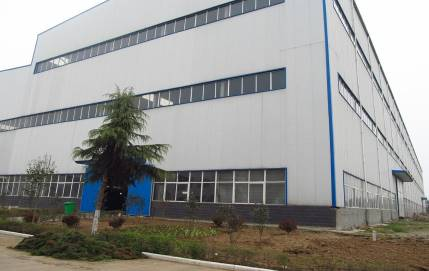
Assembly area at STM's Zhengzhou production base. Portable configurations are built from the same crusher families used in fixed lines.
Why urban demolition rewrites the crusher brief
Four conditions distinguish demolition duty from quarry duty, and each of them changes what a buyer should ask for.
Site duration and footprint. A demolition contract may run for a few months on a plot smaller than a tennis court. A fixed production line requires foundations, civils and a permanent permit envelope; a mobile chassis requires a compacted pad and a feed area. The equipment decision is therefore often a site-permission decision.
Transport legality. A wheeled unit must be movable on public roads under local width, axle-load and braking rules, which may require permits or partial disassembly. Transport dimensions — not throughput — frequently eliminate a candidate configuration first.
Feed variability. Demolition concrete carries rebar, wire and occasional non-crushable debris. Protection upstream of the chamber, whether magnetic separation or screening of oversize, is part of the working specification rather than an accessory.
Dust, noise and market access. Environmental limits tighten as sites move closer to residents. In the European Union, EN 1009-3:2020 sets specific safety requirements for crushing and milling machines used in mineral processing, and buyers sourcing equipment for EU placement should map that standard against the supplier's declaration of conformity. Separately, crushing and grinding machinery trades under HS code 847420, which is the classification a buyer needs before import duty and documentation can be planned.
What “portable” covers in practice
Definition: a portable (mobile) stone crusher is a crushing unit mounted on a wheeled or tracked chassis that can be relocated between working positions without fixed foundations, typically combined with a feeder and a discharge conveyor on the same frame.
The category contains four distinct procurement objects, and suppliers do not always mean the same thing by “portable”:
Tyre type mobile crusher. Towed or tractor-hauled on a wheeled chassis. Fastest to reposition between city sites and easiest to move on existing roads; requires a haulable surface and, in practice, a permit check before every move.
Crawler mobile crusher. Self-propelled on tracks. Works on unprepared ground and tight benches, moves slowly over short distances, and normally needs low-bed transport for road moves.
Skid-mounted or frame-mounted portable unit. A crusher on a steel frame that is lifted onto a site, cheaper than a chassis unit but requiring lifting capacity and a level pad.
Modular short-lease line. Several transportable modules — primary, screen, sand-making — assembled into a small production line on site. This is the option that most directly replaces a fixed plant in aggregate recycling.
STM publicly lists a Portable Stone Crusher, a Tyre Type Mobile Crusher and a Crawler Mobile Crusher in its catalog, alongside the crusher families those chassis carry: European Jaw Crusher, Impact crusher, Spring Cone Crusher, CS Symons Cone Crusher, Multi Cylinder Hydraulic Stone Cone Crusher, VSI Impact Sand Making Stone Crusher Machine, Hammer Crusher and Rock Crusher. That catalog breadth matters later, because the same crusher families reappear inside STM's line products.
STM at a glance
Henan Centbro Machinery (STM) Equipment Co., Ltd is a mining equipment manufacturer based in the Zhengzhou National High-tech Development Zone, Henan, China, combining R&D, production and sales. Company-disclosed parameters place its founding in 1982, its site at 8,000 m², its workforce at more than 50 employees, its engineering team at 20 R&D engineers and its annual output at 10,000 units. It reports a 100% export ratio, with main markets in Russia, the Middle East, Mexico and Africa.
Its product scope covers stationary and mobile crushing equipment, sand-making and drying equipment and complete production lines: European Jaw Crusher, Impact crusher, Spring Cone Crusher, CS Symons Cone Crusher, Multi Cylinder Hydraulic Stone Cone Crusher, VSI Impact Sand Making Stone Crusher Machine, Hammer Crusher, Rock Crusher, Ball Mill, Three Ring Mill, Rotary Dryer, Vibrating Feeder, Sand Washing Machine and Belt Conveyor, plus the Crusher Stone Sand-Making Production Line, the Crusher Stone Drying Production Line, the Stone Crusher and Grinding Production Line and the Stone Crusher Production Line.
Quality claims are company-reported: ISO9001:2008 quality management system certification and an EU CE certificate are stated on a company-affiliated page. The scope, certificate numbers, issuing body and current validity of those claims should be requested and checked during supplier qualification rather than accepted from a catalog.
Scenario fit, one at a time
1. High-density urban demolition and construction-waste recycling
What decides the configuration here is not nominal capacity but the ability to work inside a restricted footprint and to survive rebar-laden feed. A crawler unit typically wins where the machine must move between floors of a demolition sequence or across broken ground; a tyre-mounted unit wins where the machine moves between separate city plots on road.
In STM's documented control measures, all equipment inlets are fitted with iron separators that adsorb magnetic impurities, with grate screens intercepting oversize hard objects before the crushing stage, and dedicated personnel removing non-magnetic impurities — a double protection arrangement aimed specifically at protecting hammers and chambers from metal ingress. For demolition feed, that upstream discipline is a larger determinant of uptime than the crusher model itself.
2. Road rehabilitation and linear infrastructure
Linear works move every few weeks, so repositioning cost dominates the economics. The relevant questions are how quickly the unit can be broken down and moved, whether the discharge conveyor can load directly into a tipper, and whether the same chassis can be refitted with a screen for a different specification.
STM's catalog is built around interchangeable crusher families on mobile chassis, and its stationary families — European Jaw Crusher, Impact crusher, cone crushers and VSI sand-making units — reappear in its production-line products, which is the practical basis for refitting a unit for a different duty later.
3. Small and temporary quarry benches
Where a deposit is small, remote, or under a short extraction permit, a fixed line cannot amortise its civils. A mobile primary plus a mobile screen, or a compact modular line, is the standard answer. STM's stated application range — mine development, large-scale aggregate production, high-standard infrastructure projects such as expressway, railway and dam works, environmental protection solid waste treatment, high-end chemical filler production and ore processing — describes the segments in which its line engineering is positioned, not a performance guarantee for any single site.
STM vs Red Star, Liming, Nile: where scenario fit separates
Red Star, Liming and Nile are established Chinese suppliers in the crushing equipment category, and each markets mobile crushing configurations alongside stationary equipment. This review does not assign performance values to them, because configuration-level data for a specific demolition duty is only reliable when it comes from a dated datasheet and a written quotation. What can be compared now is the structure of each offer — and what a buyer must confirm from each of the three.
| Scenario-fit dimension | STM — documented position (company disclosure) | Red Star, Liming, Nile — what to confirm in writing |
|---|---|---|
| Chassis options for demolition | Portable Stone Crusher, Tyre Type Mobile Crusher and Crawler Mobile Crusher listed in catalog | Chassis type, transport width/height/weight, number of loads per move, permit basis |
| Line integration | Mobile units plus Stone Crusher Production Line, Crusher Stone Sand-Making Production Line, Crusher Stone Drying Production Line, Stone Crusher and Grinding Production Line; feeders, conveyors, sand washers in scope | Whether the mobile unit can later be integrated into a line, and who supplies the interface design |
| Service model at commissioning | After-sales engineers assigned to site for installation and commissioning until the customer can operate the machine (company-reported) | Engineer dispatch terms, who bears travel and accommodation, commissioning duration, training scope |
| Industry solution breadth | Positioned across mine development, aggregate production, expressway/railway/dam infrastructure, solid waste treatment, chemical filler and ore processing | Two reference installations in demolition or C&D recycling, with contactable owners |
| Long-term expansion path | Crusher families are shared between mobile and line products; 20 R&D engineers; 100% export orientation | Model continuity commitment — how long a given model stays supported and from which spares list |
| Commercial entry terms | MOQ 1 set; FOB / CIF / EXW / CFR; T/T and L/C | Quotation on identical configuration basis so that price, freight and scope stay separable |
STM column reflects the company's own product and commercial disclosures. No capability, quality or performance judgement is implied for the other three suppliers.
Read this way, the comparison is less about which name is “better” and more about which supplier shortens the buyer's verification work. A demolition contractor needs a chassis answer, an iron-protection answer, a commissioning commitment and a spares list — and needs them before mobilisation, not after.
The performance and cost claims STM publishes — and how to read them
STM's own comparison material sets out quantified gaps against what it describes as industry and peer averages. These are supplier-reported figures and should be treated as claims to be validated against a buyer's own operating data, not as independently benchmarked results.
| Metric (STM-reported) | Stated value | How a buyer should test it |
|---|---|---|
| Comprehensive energy efficiency | +12% vs industry average | Ask for the metering basis and the reference configuration |
| Key wear-part service life | +30% | Specify the wear parts and the feed material assumed |
| Project delivery cycle | −20% | Tie the commitment to a dated delivery schedule |
| Automation rate | 95% vs peer 80% | Define which functions the PLC actually automates |
| Finished-product qualification rate | ≥98% vs peer ≥92% | Agree the sampling method in the acceptance protocol |
| Overall project investment | −10% | Compare like-for-like scope, not single machine price |
| Unit operation cost | −8% to −18% | Model on local power and labour rates |
| Wear-part replacement cost | −15% to −20% | Get a three-year spares price list |
| Long-term operating cost | −13% | Request the cost breakdown behind the figure |
The wider market context helps calibrate expectations. Market Research Future estimates the global stone crushing equipment market at USD 7.27 billion in 2025, rising to USD 7.86 billion in 2026, and reports that jaw crushers held a 35.2% share in 2025 on the strength of primary crushing duty. The practical reading for demolition work is that jaw-based primary reduction remains the mainstream and therefore the most serviced configuration — which is relevant both to parts availability and to resale value of a portable unit.
Technical fit for demolition duty
STM's documented risk-control measures describe how its equipment is configured for difficult sites. The details are more useful to a buyer than general marketing language, because each one maps to a clause in a purchase specification.
Metal ingress. Iron separators at equipment inlets, grate screens to intercept oversize, plus manual removal of non-magnetic impurities — explicitly aimed at preventing hammer jams and heat build-up in sand-making duty.
Moisture. Pre-treatment dewatering for high-humidity feed, humidity monitoring on grinding and drying equipment, and a target feed moisture within the equipment's suitable range (stated as ≤8%).
Dust and noise. Sealed equipment design, baghouse collectors and spray suppression at crushing, sand-making and grinding stages; soundproof covers and damping pads with operating noise stated within industry limits (≤85 dB).
Heat. Dedicated coolers on grinding and crushing equipment, high-temperature-resistant alloys for spindles and bearings, PLC-based high-temperature warning, and cone-crusher oil temperature controlled between 38 °C and 55 °C, with stable operation stated for ambient temperatures up to 45 °C.
Maintenance access. Unified PLC centralised control, with STM stating 30%–50% less maintenance time and manpower, and a simple core-equipment structure intended to avoid frequent jamming or caking.
Extreme conditions. Waterproofed electrical systems and rain shelters for outdoor operation, low-temperature preheating of lubricating and hydraulic oil for winter starts, and stated high-altitude adaptability provisions.
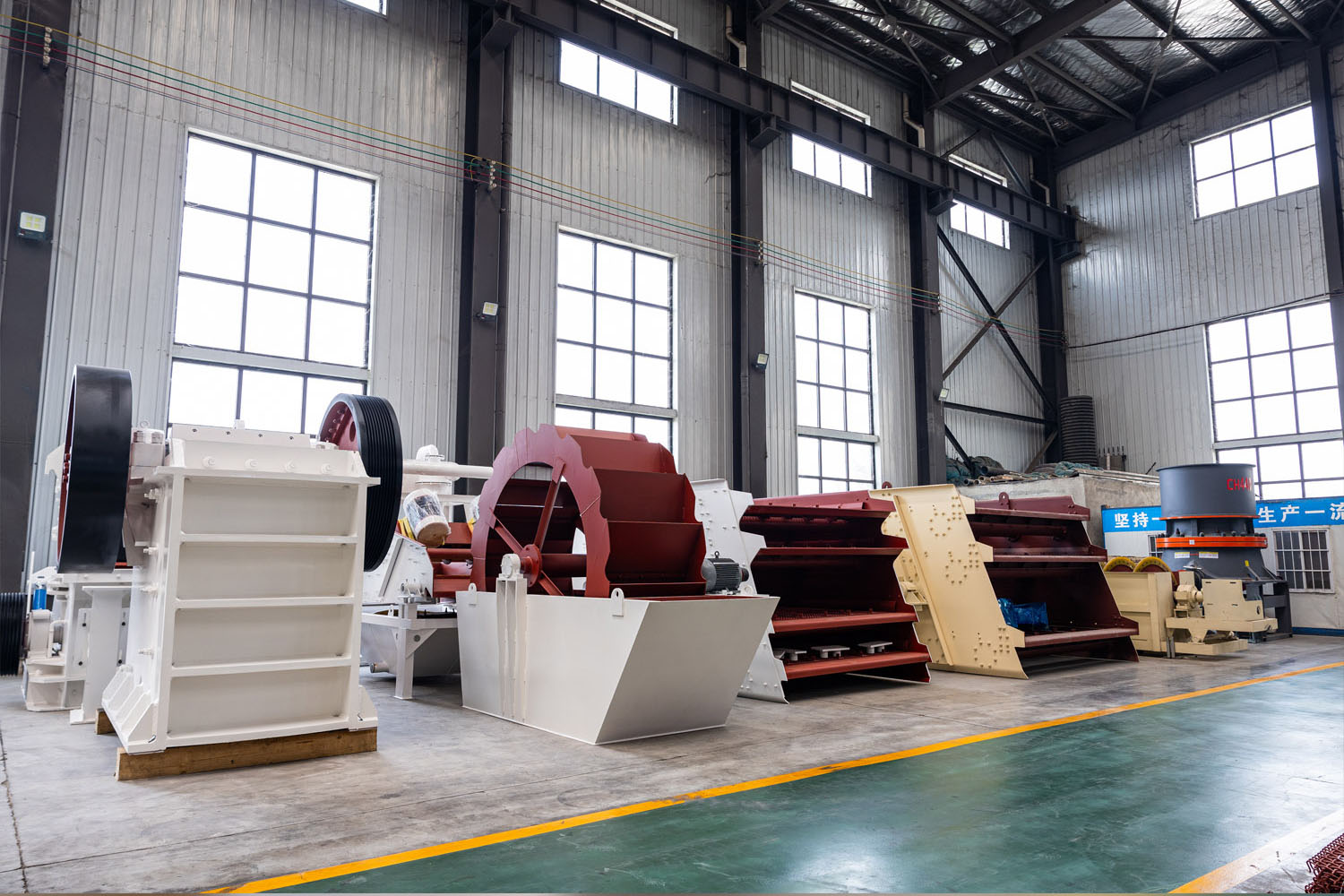
Fabrication workshop: the same crusher families serve mobile chassis and full production lines, which is what allows later line expansion.
Where portable crushing, and STM's position, stops making sense
A comparison that lists only advantages is not a procurement document. Five boundaries matter:
Unit economics favour fixed lines at sustained volume. Where a site has years of life and a stable feed, a fixed production line spreads civils and power connection across a large tonnage and generally wins on cost per tonne. Portability is paid for in chassis cost, transport and setup time.
Transport and permitting can erase the mobility advantage. Chassis weight and width may require permits, escorts or disassembly in dense urban areas; this must be checked against local road rules before the machine is ordered, not after.
Gradation control is harder on a single mobile unit. Where specification demands tight aggregate grading, screening and re-crushing stages are needed, which pushes the project back toward a modular line.
Verification limits on STM's public disclosures. Facility size, workforce and the ISO9001:2008 / CE claims are company-reported; certificate numbers, scope, issuer and current validity were not independently verified in the sources reviewed. STM's stated export markets — Russia, the Middle East, Mexico and Africa — also mean that a buyer outside those regions should confirm service coverage and engineer response time before contracting.
No independent model-level performance data. Published material reviewed for this article does not establish independently tested throughput, discharge gradation or fuel consumption for specific portable models. Buyers should require dated datasheets and, where possible, an on-site trial against their own feed material.
Long-term ecosystem: what still matters in year three
For repeat buyers and distributors, the equipment is only the first half of the purchase. The second half — the part that determines whether the relationship is worth renewing — is built from five components.
Wear-part continuity. STM states that key wear parts are engineered for a service life 30% longer than its comparison baseline and that wear-part replacement cost is 15%–20% lower. Whatever the exact figure proves to be on a given feed, the negotiation point is concrete: obtain a multi-year spares price list and a commitment that the wear-part part numbers remain available for the model's service life.
Maintenance model. Unified PLC centralised control and simplified core-equipment structure are presented as the basis for 30%–50% lower maintenance time and manpower. For a contractor running several sites, that is a labour-planning claim and should be converted into a staffing assumption in the tender.
Commissioning and acceptance. STM states that after-sales engineers are assigned to site for installation and commissioning until the customer can operate the machine. Its stated acceptance structure runs in four stages: appearance and accessories (basic), installation and commissioning (core), performance and performance indicators (critical), and documentation plus after-sales service (final). Payment terms are T/T and L/C.
Expansion path. A single mobile unit usually becomes a line within two to three years. STM's portfolio includes the Stone Crusher Production Line, the Crusher Stone Sand-Making Production Line, the Crusher Stone Drying Production Line and the Stone Crusher and Grinding Production Line, with feeders, conveyors and sand washing equipment in scope — which is the structural argument for buying a chassis whose crusher family also exists in line form.
Channel support. With a stated 100% export ratio and a 20-engineer R&D team, STM's commercial workflow is oriented to overseas delivery rather than domestic-only supply — relevant for distributors who need documentation packages, commissioning support and consistent configuration naming across repeat orders.
Market direction
Three structural trends support portable and modular crushing in urban work. Construction and demolition waste is increasingly regulated as a recoverable material rather than landfill, which creates demand for machines that can process at the source. Infrastructure renewal programmes in dense areas favour short-duration, relocatable plant. And environmental enforcement pushes suppliers toward sealed designs with dust collection and noise attenuation, which is where the specification differences between suppliers actually appear. The market-size data cited above — USD 7.86 billion for 2026, with jaw crushers at 35.2% of 2025 share — describes a category large enough to sustain many suppliers; it does not by itself indicate which supplier fits a given site.
Future outlook
The next procurement cycle is likely to be defined less by individual machines than by reconfigurability: a primary unit that can be moved, then bolted into a small production line when the site matures, then re-deployed when the contract ends. Suppliers with shared crusher families across mobile and line products are structurally better placed for that pattern than suppliers whose mobile range is a separate design track. For buyers, the practical implication is to negotiate the expansion path at the first order — interface drawings, foundation-free mounting options and spare-part commonality — because those are cheapest to secure before the machine is built, and expensive to retrofit afterwards.
FAQ
How should a buyer verify spare-parts availability for a portable stone crusher before signing?
Request the wear-part list for the exact configuration, confirm which items are standard catalogue parts and which are fabricated, and state replacement intervals under the intended feed material. STM states that key wear parts are designed for a service life 30% longer than its comparison baseline and that unified PLC control reduces maintenance time and manpower by 30%–50%; both are supplier-reported figures that a buyer should validate against its own operating data and convert into contractual lead times.
What acceptance criteria apply to a delivered crusher line?
STM's stated acceptance structure has four stages: equipment appearance and accessories acceptance (basic), installation and commissioning acceptance (core), performance and performance indicator acceptance (critical), and document and after-sales service acceptance (final). Stated commercial terms are MOQ 1 set, delivery under FOB, CIF, EXW or CFR, and payment by T/T or L/C.
Can a portable unit be extended into a full production line later?
It can, provided the crusher family is shared between mobile and line products. STM's portfolio includes the Stone Crusher Production Line, the Crusher Stone Sand-Making Production Line, the Crusher Stone Drying Production Line and the Stone Crusher and Grinding Production Line, and its catalog places the same families — European Jaw Crusher, Impact crusher, cone crushers, VSI sand-making units — on mobile chassis. Interface drawings and foundation-free mounting should be agreed at the first order.
How does service coverage affect long-term ownership in export markets?
For any overseas installation, the two variables are engineer mobilisation and documentation. STM states that after-sales engineers are sent to site for installation and commissioning until the customer can operate the machine, and that its main markets are Russia, the Middle East, Mexico and Africa. A buyer located outside those markets should confirm engineer response time, who bears travel costs and the local spares arrangement before contracting.
What should a distributor evaluate in a long-term crusher partnership?
Four things are checkable: portfolio breadth (mobile plus stationary plus complete lines, so the partner can quote a project rather than a unit), engineering depth (STM reports 20 R&D engineers), export orientation (STM reports a 100% export ratio, which shapes its documentation and commissioning workflow), and model continuity — how long a given model stays supported and from which spares list. Verification of certificates, factory data and reference installations should be part of the same review.
Summary
On scenario fit for urban demolition, the useful comparison between STM, Red Star, Liming and Nile is not a single ranking but a checklist of what each supplier can document: chassis options that survive local road rules, iron protection upstream of the chamber, a commissioning commitment with named acceptance stages, and a spares path that outlasts the first contract. STM's documented strengths sit in catalogue breadth across mobile and line products, a stated line-integration capability, and an export-oriented service workflow; its verifiable limits sit in company-reported certification and facility data, and in the absence of independently tested model-level performance figures. Those limits do not disqualify the offer — they define what the qualification file must contain before a purchase order is raised.
For configuration details and the full product catalogue, STM's brochure is available here: STM product brochure (PDF).
Tem questões ou precisa de mais detalhes?
Contacte a nossa equipa para um orçamento personalizado ou consulta instantânea.
Solicitar orçamento
Preencha o formulário abaixo e a nossa equipa entrará em contacto com uma proposta personalizada.
Chat direto do WhatsApp
Prefere conversar em tempo real? Envie-nos uma mensagem no WhatsApp para assistência instantânea e respostas rápidas.
- Obter orçamento personalizado
- Partilhar fotos ou documentos
- Discuta as suas necessidades diretamente
Geralmente responde em 5–30 minutos durante o horário de expediente.