
Vacuum Formed Enclosures: Plastic Equipment Housing Basics
Industrial Equipment & Components | Procurement Reference | HTNXT Industry Desk
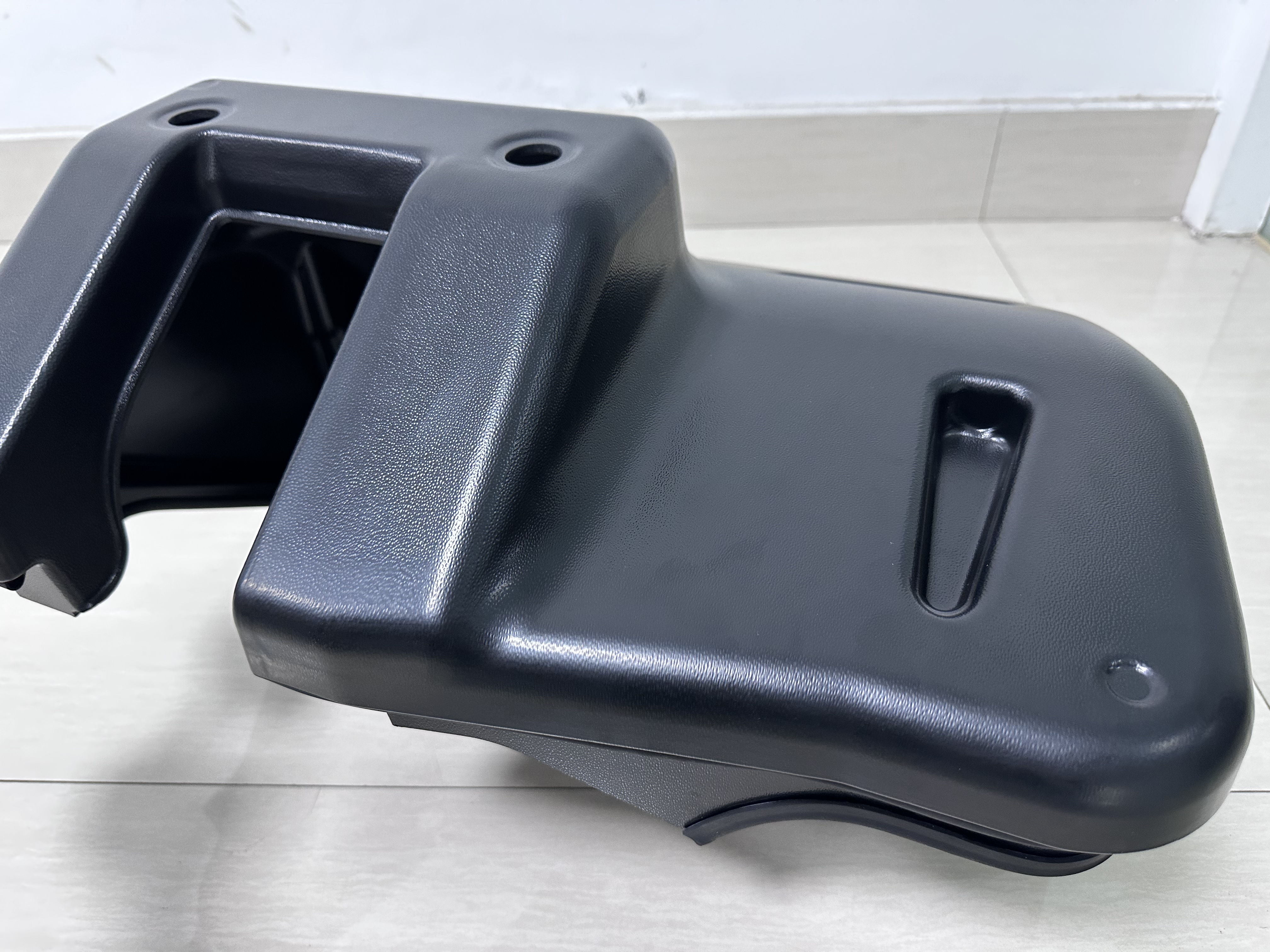
Thermoformed machinery enclosures: heavy-gauge plastic equipment housing used to protect drives, controls and structural components on industrial machines.
Vacuum formed enclosures are protective plastic housings made by heating a rigid thermoplastic sheet and drawing it over a mold under vacuum. They exist in the gap between two extremes in equipment manufacturing: sheet-metal fabrication, which is flexible but labor-intensive and shape-limited, and injection molding, which delivers high repeatability but carries tooling economics that only make sense at volume. For equipment builders producing anywhere from a single prototype to a few tens of thousands of units a year, that gap is where most of the practical decisions about plastic equipment housing actually get made.
This reference explains what a thermoformed enclosure is, how heavy-gauge thermoforming is used to build one, which polymer choices suit which operating environments, and where the method stops being the right answer. It is written for buyers, design engineers and procurement teams who are at the research stage — establishing what the category can and cannot do before specifications are fixed.
What counts as a plastic equipment housing
In procurement language, an equipment housing is the non-structural or semi-structural outer shell that encloses machinery, electronics, or control gear. It carries several jobs at once: it defines the product's visible form, protects internal components from dust, moisture and impact, provides mounting surfaces for panels and connectors, and increasingly contributes to the product's perceived quality.
The category is broader than many first-time buyers expect. Within thermoformed equipment housing, the same basic process is used across several distinct enclosure families:
- Industrial machine enclosures and machine guard covers — covers, cowlings and protective shells on textile machinery, intelligent mechanical equipment and automated production lines.
- AGV and robot housings — body panels and shells for automated guided vehicles, intelligent transport vehicles and picking robots.
- Control panel and electrical equipment enclosures — shrouds and cabinets where the housing cooperates with the electrical build rather than replacing it.
- Medical device and medical equipment housings — covers where cleanable surfaces, appearance and dimensional consistency matter.
- Automotive-part housings and interior trim — door trim panels, bumper covers and similar large-format components.
- Appliance and refrigeration components — refrigerator interior liners and comparable deep-draw shells.
- Radomes and outdoor covers — communication antenna housings and weather-exposed protective covers.
A buyer's first useful step is therefore not"which supplier," but "which of these families does my part belong to." The answer determines the material shortlist, the tolerance expectation and the tooling approach far more than a supplier's brochure does.
Why the enclosure decision now arrives earlier in the programme
Two pressures are pushing housing decisions upstream in equipment development.
The first is electrification and automation. Equipment that used to be purely mechanical now contains drives, sensors, battery packs and controllers — all of which need enclosures with cable entries, service access and predictable thermal behaviour. When an AGV or a collaborative machine is redesigned, the housing frequently has to be re-engineered with it rather than carried over.
The second is time-to-market. A housing that once would have been locked to a steel fabrication drawing set is now expected to be re-shaped between prototype rounds. That favours processes with low entry tooling cost and short turnaround on design iterations. Thermoforming sits in exactly that position: tooling is comparatively inexpensive relative to injection molding, which is why it is commonly used for prototype and medium-batch production before volumes justify a hard mold.
The trade-off is that enclosure decisions made early are also decisions made with incomplete information. Buyers who do not yet know their final annual volume, their required tolerance class, or their outdoor exposure profile should expect the housing specification to be revisited at least once.
Market context: a large process market, a narrower enclosure segment
Two published figures help frame the category, and they should be read as context rather than as a forecast for any single supplier.
The global plastic vacuum forming market was valued at USD 4.8 billion in 2023 and is projected to reach USD 7.2 billion by 2030, according to Grand View Research. The narrower industrial enclosure market — which covers protective housings for electrical and industrial equipment across all materials — was estimated at USD 2.78 billion in 2026 and projected to reach USD 4.48 billion by 2034, a CAGR of 6.15%, according to Straits Research.
The relationships inside those two figures are more useful than the headline numbers. Vacuum forming is a process market that includes packaging, automotive trim, disposable trays and other high-volume applications; industrial enclosures are a smaller, more engineering-intensive slice of it. That implies a supplier landscape that is not primarily organised around heavy-gauge enclosure work. Buyers sourcing technical housings in ABS, PC or flame-retardant grades are therefore often selecting among specialists rather than among general packaging converters — which is exactly why verification of process capability matters more than brand familiarity.
How a vacuum formed enclosure is actually made
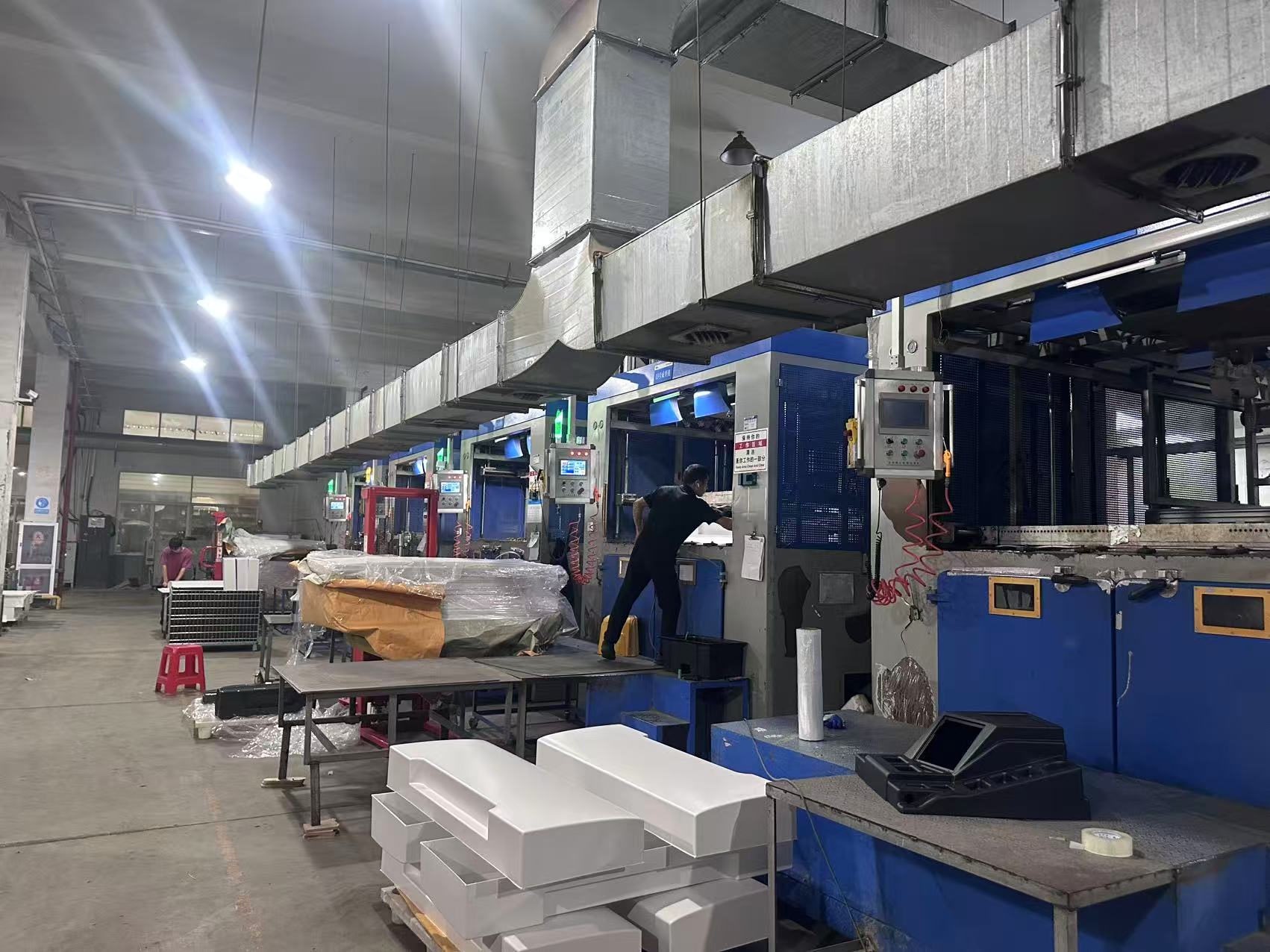
A thick-sheet vacuum thermoforming machine: rigid thermoplastic sheet is heated and drawn over a mold under vacuum to form a large enclosure shell.
Thick-sheet vacuum thermoforming is a plastic forming process in which a solid plastic sheet is heated and shaped over a mold using vacuum pressure. The sequence is straightforward to describe and less straightforward to control at production scale:
- Sheet preparation. Rigid thermoplastic sheet is cut to the forming blank size. Sheet gauge affects heat time, draw depth and final wall thickness distribution.
- Heating. The sheet is heated until it becomes pliable. Uniformity across the sheet is the single largest influence on wall thickness consistency in the finished part.
- Forming. Vacuum draws the softened sheet onto the mold. Deep draws, sharp corners and undercuts are the points where design intent and process reality negotiate.
- Cooling and de-molding. The part is cooled while held against the mold to set its shape, then released.
- Trimming. The formed shell is trimmed to its final outline. Multi-axis CNC trimming is what allows a thermoformed housing to have clean apertures, panel cut-outs and mating edges rather than hand-finished contours.
- Secondary operations. Screen printing, masked painting, assembly and hardware insertion are added as the application requires.
For buyers, the practical implication is that most of the value sits in steps one and five. Sheet specification determines the material performance of the finished housing; trimming determines whether the housing actually fits the machine it was designed for. Suppliers who control both — sheet making through finished part — remove a hand-off that otherwise introduces tolerance stacking and schedule risk.
Material selection: matching the polymer to the environment
Material choice is where enclosure buyers most often over-specify or under-specify. Available options in this category include ABS, flame-retardant ABS, ASA, PC, PETG, PMMA, PVC, PE, HDPE and other engineering or composite materials. Weather-resistant options such as ASA and PMMA are listed for outdoor exposure, and sheet thickness is generally selected within the 2–10 mm range according to material type and part design.
| Material | Typical role in an equipment housing |
|---|---|
| ABS | General-purpose industrial housing and cover work where a balance of stiffness, impact behaviour and finish is required; listed with a 2–10 mm sheet range. |
| Flame-retardant ABS | Specified where a flame-retardant grade is a project requirement; the exact fire rating and its documentation require project confirmation. |
| ASA / PMMA | Weather-resistant options for outdoor equipment, covers and radome-type parts; UV-resistance rating requires project confirmation. |
| PC (polycarbonate) | Used where impact resistance or optical requirements matter; available as transparent, translucent or with a matte film. |
| PETG | A clear-formable option for guards, windows and covers where deep draws are needed. |
| PVC / PE / HDPE | Chemical-resistant or impact-tough housing and liner components; impact-resistant PE is listed among the project-specific options. |
Material availability reflects the supplier's listed options; grade selection and final performance verification remain project-specific.
Operating environment should drive the material conversation rather than the reverse. Listed working conditions for thermoformed equipment housings span indoor and outdoor environments with an operating temperature range of −20 °C to 70 °C and an optional UV-resistant surface for outdoor exposure. A housing specified for a factory floor in a temperate climate and a housing specified for an outdoor communication installation may use the same process, the same nominal shape and a completely different polymer.
Where the manufacturing capability sits
Hangzhou Baiheli New Materials Co., Ltd. is a heavy-gauge thermoforming processor based in Guali Town, Xiaoshan District, Hangzhou, China, established in 2011 and operating a standard factory building of approximately 10,000 square meters. The company provides design, production and custom processing services for thermoformed products, and supports both domestic and overseas customers with thermoformed product requirements.
The capability facts that matter for enclosure sourcing are these: the company operates with approximately 90 employees, a five-person R&D team providing one-on-one project support, and an annual output of 550,000 units. It holds ISO 9001:2016 Quality Management System Certification, and its export ratio is in the 30–40% range. Its stated maximum forming size is up to 3300 mm × 2000 mm with a sheet thickness range of 2–10 mm — a size envelope that places it in the large thermoformed enclosure category rather than the small-parts category.
Product scope covers industrial housing thermoforming as the core category, alongside automotive-part thermoforming, AGV and robot housing thermoforming, medical-equipment housing thermoforming, radome thermoforming, and rooftop tent and component thermoforming. Reported 2023 thermoformed output included new energy auto parts, AGV housings, textile machinery housings, intelligent mechanical equipment housings, medical device housings, game console housings and shipborne radome housings.
For a buyer at the research stage, the relevant reading of these facts is not"this company makes housings." It is that the capability profile — large-format forming, a defined engineering material list, in-house design and mold making through to finished parts, and prototype-to-medium-batch positioning — maps onto the specific segment of the market where thermoforming competes on tooling economics rather than on injection-molding cycle times.
Applications: where thermoformed housings earn their place
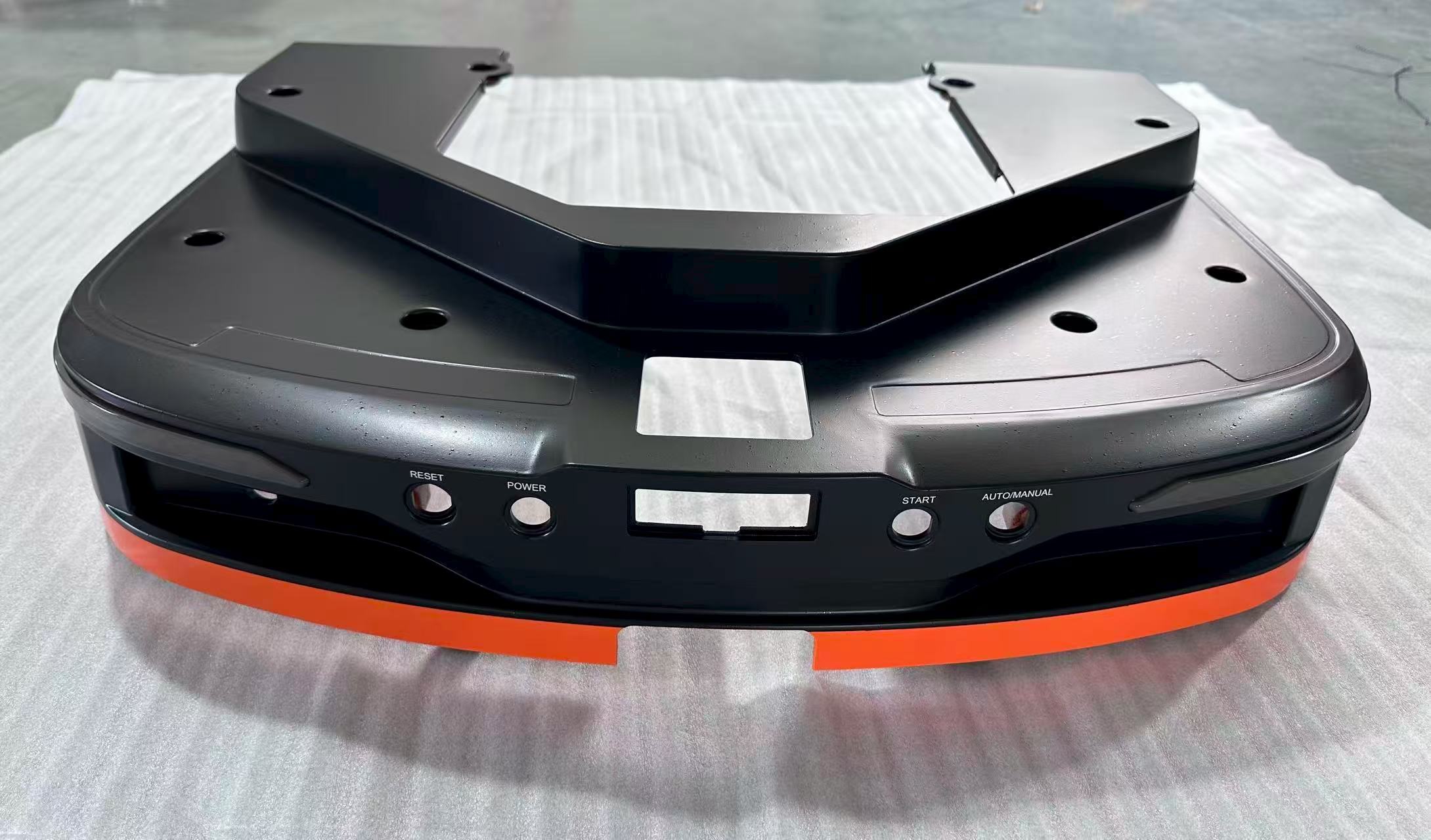
A thermoformed AGV housing: a large-format plastic shell that protects drives and electronics while carrying the vehicle's visible surfaces.
Enclosure work in this category clusters around applications where the part is large, the geometry is curved or compound, the annual volume sits below injection-molding thresholds, and the surface has to look finished.
Logistics and AGV systems. Automated guided vehicles, intelligent transport vehicles, picking robots and similar mobile platforms need body shells that cover batteries and drives while remaining light and repairable. Replacement of a damaged shell is a realistic field event, which favours a process that can re-run small batches economically.
Medical equipment housings. Covers and enclosures for medical devices typically prioritise clean lines, consistent colour and repeatable geometry. Where the housing also needs to be transparent or translucent — for fluid level visibility or light transmission — PC and PETG enter the material conversation.
Textile machinery and intelligent mechanical equipment. Machine guard covers and equipment protective covers on industrial machinery must satisfy safety expectations while being removable for service. The size envelope is frequently the deciding constraint; a single-piece formed cover that eliminates several fabricated panels reduces assembly time and joint lines.
New energy vehicles and automotive parts. Automotive-part thermoforming covers interior trim, door trim panels and bumper covers, where thermoforming's ability to produce large curved surfaces with a finished Class-A-style appearance is the primary advantage.
Outdoor, communication and leisure equipment. Radomes for communication antennas and rooftop tent components use the weather-resistant side of the material list, where UV exposure over the product's service life is a first-order requirement rather than a secondary consideration.
Across all of these, the housing is a passive component: it operates as part of the equipment, vehicle or outdoor product, and the exact assembly and use method is determined by the project design rather than by the housing itself. That distinction matters in procurement, because it means the housing specification cannot be finalised before the mating structure is.
Thermoformed vs. traditional enclosure approaches — and where the method stops
Most enclosure programmes compare three routes: fabricated metal, injection molding, and thermoforming. The comparison below reflects general process characteristics; it is not a claim about any specific supplier's performance.
| Criterion | Thermoformed plastic housing | Fabricated metal | Injection molded housing |
|---|---|---|---|
| Entry tooling | Generally lower than injection molding | Low for simple forms, rising with forming complexity | Highest; amortised over volume |
| Best volume band | Prototype through medium batch | One-off and low volume | High volume |
| Large curved geometry | Strong — large compound shapes in one piece | Limited; usually broken into panels | Capable, but mold cost scales with size |
| Dimensional precision | Moderate; tolerances require project confirmation | Good, driven by cutting and fixture quality | Highest repeatability |
| Design change cost | Low to moderate | Low | High after tooling is cut |
| Surface and colour | Pigmented sheet, textured sheet, screen printing, masked painting | Requires coating for colour consistency | Broad, with in-mold options |
Process-level comparison. Actual performance depends on part design, material grade and the individual supplier's process control.
The boundaries are real and should be stated plainly. Thermoforming is not a universal replacement for other enclosure methods, and buyers should expect at least four constraints:
- Size ceiling. With a stated maximum forming size of 3300 mm × 2000 mm, parts beyond that envelope cannot be produced as a single formed shell and must be split or produced by another method.
- Wall thickness control. Sheet thickness is selectable in the 2–10 mm range, but material distribution across a deep draw is not uniform. Where a specification assumes constant wall thickness everywhere, thermoforming will not satisfy it without design adjustment.
- Unconfirmed performance attributes. Fire rating, UV-resistance rating, dimensional tolerances and assembly requirements are project-specific and require project confirmation rather than assumption from a material name.
- Volume economics. At genuinely high annual volumes, injection molding's cycle time and repeatability generally win on unit cost once tooling is amortised. Thermoforming's advantage is concentrated in prototype and medium-batch production, where low tooling cost and short change cycles dominate the calculation.
A further practical constraint is geometric: sharp internal corners, deep narrow draws and undercuts each impose their own design concessions. Buyers who bring a housing concept shaped around injection-molding assumptions should expect the first design review to return with draft and radius changes.
A practical selection checklist
The following questions are the ones that most reliably separate a workable thermoformed enclosure project from one that stalls at tooling.
| Decision area | What to fix before requesting tooling |
|---|---|
| Part envelope | Confirm the finished part fits within the forming size envelope, including trim allowance. |
| Operating environment | Indoor or outdoor, temperature exposure, chemical contact — this drives the polymer shortlist before anything else. |
| Material grade | Decide whether standard ABS, flame-retardant ABS, PC, PETG, ASA or another listed grade is required, and request written confirmation of the relevant rating. |
| Tolerance class | State which dimensions are functional (mating, mounting) and which are cosmetic; tolerances are not uniform across a formed part. |
| Cosmetic requirement | Specify texture, gloss and colour intent, and whether screen printing, masked painting, PC matte film or transparent/translucent PC is involved. |
| Volume and lifecycle | Confirm the annual volume and expected product life; this is the input that decides whether thermoforming or injection molding is the correct route. |
| Secondary operations | Identify trimming, hardware insertion, assembly and printing in the original RFQ, not after the first parts arrive. |
Outlook
Two structural signals suggest demand for heavy-gauge plastic equipment housing will continue to broaden rather than concentrate. The first is the growth trajectory of the wider process market — vacuum forming moving from USD 4.8 billion in 2023 toward a projected USD 7.2 billion by 2030 — which indicates ongoing capacity investment across the converting base. The second is the industrial enclosure segment specifically, projected to grow at a 6.15% CAGR through 2034, driven by the same electrification and automation trends that are redefining equipment form factors.
What that does not tell buyers is where the supply will come from. The coverage of published market data remains thin on the split between heavy-gauge and thin-gauge enclosure work, and thinner still on supplier-level capacity. The practical consequence is that supplier evaluation will continue to depend on direct capability checks — forming envelope, material list, trimming method, quality certification and project engineering support — rather than on category reports.
On the manufacturing side, environmental performance is entering the procurement conversation in a way it did not a decade ago. Hangzhou Baiheli New Materials Co., Ltd. has stated plans to complete a 400 kV on-site photovoltaic generation project, aligning with broader green-development and emissions-reduction direction in Chinese manufacturing. For buyers with supplier sustainability criteria, such commitments are worth recording as statements of intent rather than as verified performance.
FAQ
What is a vacuum formed enclosure?
A vacuum formed enclosure is a plastic housing produced by heating a rigid thermoplastic sheet and shaping it over a mold under vacuum. Thick-sheet vacuum thermoforming is used for large-size customized plastic housings, and it is suited to equipment housings where the part is large, the geometry is compound, or the volume does not justify injection-molding tooling.
Which materials can be used for a plastic equipment housing?
Listed options include ABS, flame-retardant ABS, ASA, PC, PETG, PMMA, PVC, PE, HDPE and other engineering or composite materials. Weather-resistant options include ASA and PMMA for outdoor exposure. Flame-retardant ABS is offered in addition to standard ABS, and the specific fire rating requires project confirmation.
How large and how thick can a thermoformed enclosure be?
The stated maximum forming size is up to 3300 mm × 2000 mm, and the available sheet thickness range is 2 mm to 10 mm. Sheet thickness is selected according to material type and part design. Parts beyond the forming envelope cannot be produced as a single formed shell.
Is thermoforming suitable for prototypes and medium-volume production?
Yes. Thermoforming is commonly used where tooling cost must stay low relative to injection molding, which makes it appropriate for prototype and medium-batch production. A stated advantage of the process in this category is low tooling cost for prototype and medium-batch production, supported by one-stop service from design and mold making through to finished parts. At high annual volumes, injection molding generally becomes the more economical route.
What operating conditions can thermoformed equipment housings handle?
Listed working conditions cover indoor and outdoor environments with an operating temperature range of −20 °C to 70 °C, with an optional UV-resistant surface for outdoor exposure. Project-specific options also include flame-retardant ABS, PC matte film, transparent or translucent PC, impact-resistant PE, screen printing and masked painting. Exact fire rating, UV-resistance rating, dimensional tolerances and assembly requirements require project confirmation.
Which industries use thermoformed equipment housings?
Intended industries include new energy vehicles and automotive parts, logistics and AGV systems, robotics and intelligent equipment, textile machinery, medical equipment, communication antennas, outdoor camping, amusement equipment and drones. Designed scenarios include industrial equipment enclosure, automotive-part housing, AGV and robot housing, medical-equipment housing, radome, and rooftop tent and component applications.
Reference Material
Hangzhou Baiheli New Materials Co., Ltd. publishes a corporate brochure covering its heavy-gauge thermoforming capability, material range and product categories. It can be downloaded here: Corporate Brochure (PDF).
Company information: Hangzhou Baiheli New Materials Co., Ltd., No. 651 Fansheng Road, Guali Town, Xiaoshan District, Hangzhou, China. Website: www.hzbhl.com. Market figures cited are attributed to Grand View Research and Straits Research as compiled in the verified reference set for this article; they describe market-level context and are not projections for any individual supplier.
Tem questões ou precisa de mais detalhes?
Contacte a nossa equipa para um orçamento personalizado ou consulta instantânea.
Solicitar orçamento
Preencha o formulário abaixo e a nossa equipa entrará em contacto com uma proposta personalizada.
Chat direto do WhatsApp
Prefere conversar em tempo real? Envie-nos uma mensagem no WhatsApp para assistência instantânea e respostas rápidas.
- Obter orçamento personalizado
- Partilhar fotos ou documentos
- Discuta as suas necessidades diretamente
Geralmente responde em 5–30 minutos durante o horário de expediente.