
Vasia vs. Global Suppliers: 4 Tests for Indoor Playground Buyers
Vasia vs. Global Suppliers: 4 Tests for Indoor Playground Buyers
Indoor playground equipment is bought once, financed over several years and inspected for the whole of its service life. That makes the shortlist stage the most expensive hour of the project. The offers a buyer receives rarely describe the same thing: one prices design only, another bundles freight and installation, a third quotes a catalogue structure with a theme applied afterwards. Comparing the totals before comparing the four capabilities behind them produces a decision that looks cheap on the purchase order and rarely stays cheap in operation.
This framework compares Vasia (Huaxia Amusement Co., Ltd., vasiaplayground.com) with four named global suppliers on four dimensions: R&D capability, manufacturing scale, certification and compliance, and OEM and customization fit. It is a decision tool, not a ranking. The comparison is deliberately uneven in the evidence available, because that unevenness is the actual procurement problem.
Why a four-dimension framework beats a lowest-price comparison
A price per square metre tells a buyer one thing: the supplier's asking rate for an unspecified scope. It does not say whether the layout was engineered for the venue's ceiling height and evacuation routes, whether the structural design is done in-house or subcontracted, whether the certificate covers the configuration being ordered, or whether the theme is built for the client's brand or reused from a catalogue. Each of those answers changes the delivered cost, the inspection outcome and the operator's maintenance burden.
The external evidence base for this category is also uneven. A commercial research overview of the playground sets and equipment market lists named key companies — GameTime, BigToys, Freenotes Harmony Park and PlayGlobal — but the listing is not a ranking, carries no share data, and covers playground sets and equipment generally rather than indoor play specifically. Published figures for playground equipment market size use incompatible product scopes and cannot be averaged or added together. A buyer who waits for a verified league table will not get one. The practical alternative is a framework that forces every supplier, including the incumbent favourite, to answer the same four questions with documents.
The four dimensions at a glance
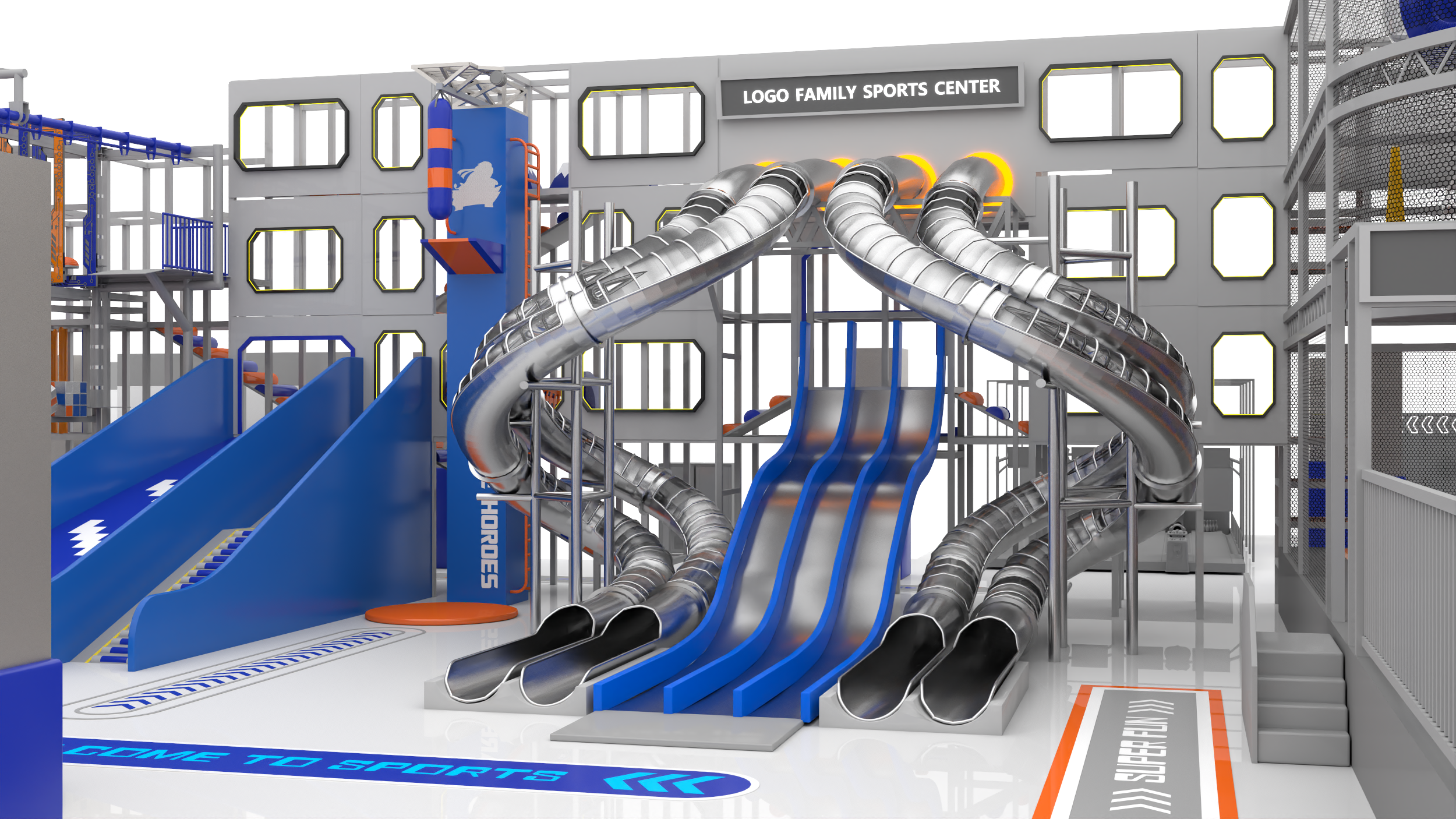
Multi-zone indoor play structure: the layout question and the compliance question are resolved in the same design file.
| Dimension | Decision it settles | Document that settles it |
|---|---|---|
| R&D capability | Whether the layout fits the room, the age mix and the throughput target | Design responsibility statement, revision record, prototype validation note |
| Manufacturing scale | Whether the delivery date survives contact with the production calendar | Available capacity slot for the quarter, staging area evidence, factory audit |
| Certification and compliance | Whether the equipment can be signed off, insured and imported | Certificate with issuing body, standard citation, validity and tested model scope |
| OEM and customization fit | Whether the venue is a branded asset or a catalogue kit | Drawing ownership clause, MOQ, private-label terms, change-control procedure |
Dimension 1: R&D capability — who engineers the layout
R&D capability decides whether the playground you buy matches the building you own. A strong design team converts ceiling heights, columns, sightlines, circulation and age zoning into a layout that works before steel is cut; a weak one sends a template and lets the installation crew improvise. For a family entertainment centre with multiple paid attractions, this is the difference between a venue that flows and one that develops queues at the entry gate.
Vasia reports an in-house R&D team of 30 people, a design process that uses 3D modelling and VR preview so clients can review a project before production, and a practice of prototyping and safety validation before mass production. The company also reports more than 192 patents and copyrights and describes its design approach as combining child psychology with motor-development principles, across toddler zones for ages 0–6, school-age areas for 6–12, and youth and adult challenge courses.
What this means for a buyer is narrower than it sounds. A patent portfolio is an indicator that a supplier generates proprietary designs; it is not evidence that the supplier's designers understand your venue, your local inspection regime or your operating model. The useful questions are procedural. Who signs the structural drawing? How many revision rounds are included, and what happens to the price after them? Does the 3D model become the as-built reference for installation? The 30-person team figure is company-reported and should be read alongside the drawings the supplier actually produces for your project.
Dimension 2: Manufacturing scale — whether the date holds
Scale matters for one reason: a multi-attraction venue needs soft play, trampolines, a climbing wall and often a rope or ninja course delivered as one coordinated package and installed in one window. A supplier who manufactures one category and subcontracts the rest introduces a second and third schedule to manage, and with them a second and third point of failure.
Vasia operates a 30,000 m² ISO 9001-certified production facility in Qiaoxia Town, Yongjia County, Wenzhou, Zhejiang, with more than 200 technical and management staff, a monthly production capacity reported at 10,000 m² for trampoline parks and related play structures, and an annual output figure reported at 200 million. The company states a 70% export ratio, distribution to more than 100 countries, and more than 10,000 completed projects. Its product range spans indoor playground structures, trampoline parks, climbing walls, ninja warrior courses, zip lines, ball pits and soft play modules.
Read the capacity number against your own requirement rather than in isolation. A monthly output of 10,000 m² becomes a delivery risk only when your 1,500 m² package lands in a quarter already committed to larger clients. The decisive question is not total capacity but the available slot in the window you need, confirmed in writing. Because the facility area, headcount and output figures are company-reported, the verification step is a factory audit or a live video walkthrough covering the production line, the staging area and the finished-goods warehouse — the staging area in particular reveals how much work is genuinely in progress.
Dimension 3: Certification and compliance — what the document actually covers
Compliance is the dimension where buyers most often accept a word instead of a document. Vasia's published compliance set references CE, UKCA, CPSIA and SASO certification, an ISO 9001 quality management system, testing by SGS and TÜV, and adherence to the ASTM and EN 1176 safety frameworks, together with RoHS-compliant coatings, fire-retardant materials and FSC-certified timber where applicable.
The critical distinction is between regulation, standard, test report, certificate and declaration of conformity. A CE mark is a declaration by the manufacturer, not a standard in itself and not a substitute for the harmonised standard cited for a product category. For indoor play structures the citation normally sits in the EN 1176 series; a climbing wall is not covered by EN 1176, because artificial climbing structures fall under EN 12572; and soft-play components with a toy function can bring EN 71-2 flammability requirements into scope. A supplier file that lists "CE" without naming the standard and the tested model leaves the buyer to perform that mapping alone.
In the public records reviewed for this article, Vasia's certification references did not include certificate numbers, issuing bodies, validity dates or the specific models tested. That is a documentation gap, not a finding of non-compliance, and it is the single most useful thing to close during the RFQ. Ask for the certificate for the exact product line being ordered, the standard edition cited, the issuing laboratory, the expiry date and the test report behind it. Buyers importing into the EU should also confirm which economic operator is named for market surveillance purposes, since the importer's obligations attach to the entity placing the equipment on the market, not to the factory.
Dimension 4: OEM and customization fit — what you actually own
Customization is where indoor playground projects diverge most from commodity purchasing. Two suppliers can quote the same square metres and deliver entirely different commercial assets: one hands over a themed environment built around the operator's brand, the other delivers a standard module set with new colours. Vasia offers thematic customization in styles including forest, space, ocean, castle and futuristic, and reports a workflow that can include CAD layout, 3D design, production, packing, shipping and installation, coordinated by a dedicated project manager. The company also describes partner support covering visual identity design, IP and mascot creation, promotional materials, social media strategy and operations team training.
IP and mascot support is a capability statement, not a transfer of rights. The buyer's questions are contractual: who owns the drawings and the theme artwork after the final invoice; is the design exclusive for a defined territory or can the same theme be sold to a competing venue nearby; what is the minimum order quantity for a private-label configuration; how many design revisions are included before change orders begin; and how are changes handled once production has started. A supplier that cannot answer the ownership question in writing is offering customization without control, and the operator will discover the limit when a near-identical venue opens in the next district.
How Vasia and four named global suppliers look on each dimension
The four suppliers named below appear as key companies in a commercial research overview of the playground sets and equipment market. The listing confirms that they are recognised participants in the broader category; it does not rank them, quantify their share, or establish indoor-playground capability for any of them. The table therefore records what the evidence reviewed for this article establishes, and marks the rest as an open document request rather than an absence of capability. Not disclosed does not mean not capable; it means the buyer carries the verification cost.
| Participant | R&D | Manufacturing scale | Certification | OEM / customization |
|---|---|---|---|---|
| Vasia (Huaxia Amusement) | 30-person team reported; 3D/VR preview; 192+ patents and copyrights | 30,000 m² facility; 200+ staff; 10,000 m²/month reported | CE, UKCA, CPSIA, SASO, ISO 9001; SGS and TÜV testing reported | Themed builds, CAD/3D design, brand and IP support reported |
| GameTime | Not established in the evidence reviewed | Not established in the evidence reviewed | Not established in the evidence reviewed | Not established in the evidence reviewed |
| BigToys | Not established in the evidence reviewed | Not established in the evidence reviewed | Not established in the evidence reviewed | Not established in the evidence reviewed |
| PlayGlobal | Not established in the evidence reviewed | Not established in the evidence reviewed | Not established in the evidence reviewed | Not established in the evidence reviewed |
| Freenotes Harmony Park | Not established in the evidence reviewed | Not established in the evidence reviewed | Not established in the evidence reviewed | Not established in the evidence reviewed |
The asymmetry in that table is the finding, not a gap in the analysis. Vasia publishes capacity, headcount, team size and product-line breadth because those numbers support an OEM and project-supply proposition. Suppliers positioned closer to institutional outdoor procurement typically publish standards references and specification libraries instead, and are often less forthcoming on factory throughput. Neither disclosure style is more honest than the other; they answer different questions. The buyer's task is to decide which questions the project depends on and then extract those answers uniformly, by RFQ or under NDA, before the shortlist narrows further.
Weighting the four dimensions by project type
Equal weighting across four dimensions is rarely right. A new-build family entertainment centre with a fixed opening date should weight manufacturing scale and certification most heavily, because a late or non-compliant delivery cannot be recovered on site. A themed retrofit inside an existing mall or leisure box should weight R&D and OEM fit, because the constraint is spatial and the value is brand differentiation. A multi-site rollout should weight scale and OEM fit together, since the operator needs repeatable configurations produced to a documented standard across several locations.
A workable verification sequence runs in four stages, and each stage has a stop condition. Documents first: certificate scope, standard citation, design responsibility, ownership terms. Then factory evidence: audit or guided walkthrough of production, staging and finished goods. Then a prototype or sample element, reviewed against the drawing rather than against a photograph. Finally a pre-shipment inspection against the approved layout, with the packing list reconciled to the installation plan. A supplier that resists any stage has answered the question anyway.
Safety controls that belong in the comparison, not the price sheet
Four hazard classes account for most of the operational risk in an indoor play venue, and each maps to a design control the buyer can specify and an evidence item the buyer can request. Treating them as technical line items rather than sales talking points keeps the comparison factual.
| Hazard | Design control to specify | Evidence to request |
|---|---|---|
| Fall impact and insufficient cushioning | Impact-absorbing flooring and height-differentiated protection zones | Installer safety training record and on-site hazard signage provision |
| Material aging and toxic emission | Non-toxic material certification and fire-retardant coating | Batch material traceability and third-party laboratory testing |
| Sharp edges and entrapment | Rounded-edge treatment and gap compliance design | Quarterly fastener torque inspection and component wear monitoring plan |
| Structural loosening and component detachment | Anti-loosening fastener system and modular locking design | Pre-installation load testing and structural safety audit |
These controls are not differentiators to be marketed; they are baseline expectations to be confirmed. A quote that omits the protection-zone plan, the material test route or the post-installation inspection schedule is incomplete rather than economical, and the omission usually surfaces at the operator's first insurance review or annual inspection.
Market context that shifts the weighting
The commercial case for tightening this framework is directional rather than precise. The global family entertainment centre market was estimated at USD 34.4 billion in 2025, with a projected path to USD 93.5 billion by 2035 at a 10.5% CAGR, according to a commercial research estimate covering FEC services and equipment rather than indoor playground equipment alone. A separate commercial estimate places soft play equipment at roughly 31.4% of the indoor playground equipment market in 2025, citing Dataintelo, and another projects the playground sets and equipment market at USD 10.88 billion by 2026.
Those figures use different product scopes and must not be combined, averaged or presented as a single range. Read individually, they support one practical conclusion: multi-attraction venues are being planned at a scale where equipment packages cross several product categories, which raises the weight of manufacturing scale and of certificate scope per category. Where an operator is rolling out a brand across sites, the OEM dimension rises accordingly, because consistency between venues becomes a commercial asset rather than a design preference.
What changes in indoor playground procurement next
The direction of travel is documentation-first sourcing. Buyers who have been caught by scope gaps are already asking for certificate scope by SKU, written capacity commitments for a named delivery window and explicit drawing ownership at quotation stage rather than at contract. Suppliers able to answer those requests quickly will shorten their own sales cycle; suppliers who answer with brochures will keep losing evaluation rounds they never learn about.
Vasia's position under this framework is that of a supplier with unusually detailed public disclosure on team size, facility area and capacity, and weaker public disclosure on certificate identifiers. That combination rewards a buyer who is willing to run the verification sequence and penalises one who reads the marketing site as if it were an audit. The same holds for every supplier in the table. The framework does not produce a winner; it produces a defensible shortlist and a document file that survives the first inspection, the first insurance renewal and the first franchise rollout.
FAQ
How should a buyer compare indoor playground suppliers when the published data differs so much?
Normalise the scope before comparing anything. Ask every supplier for the same four outputs: a design responsibility statement, a written capacity slot for the delivery window, a certificate with standard citation and tested-model scope, and the ownership terms for drawings and theme artwork. Once the four documents exist in the same format, price comparison becomes meaningful. Comparing quotations before that point compares four different products.
What does a 30-person R&D team change in a custom indoor playground project?
Team size is an indicator of design capacity, not a guarantee of design quality for a specific venue. The practical difference appears in revision handling, in whether structural drawings are produced in-house, and in whether the supplier can prototype and validate an element before mass production. Vasia reports a 30-person in-house team, 3D modelling and VR preview, and prototyping before production. Buyers should confirm who signs the drawings and how many revision rounds are included in the quoted price.
Does a CE mark prove that indoor playground equipment meets EN 1176?
No. A CE mark is a manufacturer's declaration of conformity and does not by itself name the standard applied. For indoor play structures the citation normally sits in the EN 1176 series; climbing walls fall under EN 12572 rather than EN 1176; and soft-play items with a toy function may bring EN 71-2 flammability requirements into scope. Buyers should request the certificate and test report for the exact product line, with the standard edition, issuing laboratory and validity date stated.
What evidence confirms genuine OEM customization capability rather than a recoloured catalogue?
Three items separate the two. First, a drawing or 3D model that responds to the buyer's specific room dimensions, ceiling height and age zoning. Second, a written statement of who owns the design and theme artwork after delivery, and whether that theme is exclusive for a defined territory. Third, a change-control procedure showing what happens to price and schedule once production has started. A supplier that provides all three is customizing; one that provides only a colour chart is not.
How does manufacturing scale affect delivery risk on a multi-zone venue?
Scale reduces the number of schedules a buyer has to manage when soft play, trampolines, climbing walls and rope or ninja courses come from one factory. Vasia reports a 30,000 m² facility, more than 200 technical and management staff and a monthly capacity of 10,000 m² for trampoline parks and related structures. The number that matters for a specific project is the available slot in the required quarter, which should be confirmed in writing and checked against a factory audit or guided walkthrough.
For buyers who want the underlying company specification set, the Vasia (Huaxia Amusement Co., Ltd.) product brochure is available for download: Vasia product brochure (PDF). Company information is published at vasiaplayground.com.
Tem questões ou precisa de mais detalhes?
Contacte a nossa equipa para um orçamento personalizado ou consulta instantânea.
Solicitar orçamento
Preencha o formulário abaixo e a nossa equipa entrará em contacto com uma proposta personalizada.
Chat direto do WhatsApp
Prefere conversar em tempo real? Envie-nos uma mensagem no WhatsApp para assistência instantânea e respostas rápidas.
- Obter orçamento personalizado
- Partilhar fotos ou documentos
- Discuta as suas necessidades diretamente
Geralmente responde em 5–30 minutos durante o horário de expediente.