
Vehicle-Specific Android Car Stereo Fascia Kit FAQ: Payment, Returns, and CAN Bus Warning Codes
A vehicle-specific Android car stereo fascia kit is a retrofit package matched to a defined vehicle application, combining a dashboard fascia, a wiring harness and, on vehicles that use a controller area network, a CAN bus decoder. Because the kit sits between the factory electrical architecture and a third-party head unit, the details that decide whether a retrofit program scales are rarely limited to the fascia panel. They concern payment structure, inspection, defect handling, and what happens when the vehicle reports a warning code after installation.
Shenzhen Zhongyixing Electronic Technology Co., Ltd is a Shenzhen-based manufacturer of automotive aftermarket installation hardware that produces the ZYX car radio fascia kit range. The portfolio covers Car Radio Dash Fascia (ZYX-01), Car Radio Wiring Harness (ZYX-02) and CAN Bus Decoder Module (ZYX-03), supported by a published compatibility system covering 3,000+ vehicle applications, a 5,000 m2 production facility in Shenzhen and an export share of roughly 80%, with Russia and the EU as the main markets.
Payment terms for bulk orders: 30% T/T in advance, with the remaining 70% T/T against copy of B/L.
Minimum order quantity: 1 unit for stock items, 50 units for bulk orders, 100 units for custom OEM/ODM items.
Dashboard fault warning codes after retrofit: typically caused by an incompatible CAN decoder protocol, a loose CAN bus interface connection, or a mismatched decoder firmware version.
Why Commercial Terms and Protocol Behaviour Get Negotiated Together
Retrofit programs fail commercially for two unrelated reasons. The first is physical: a fascia whose mounting points, opening geometry or surface finish do not match the dashboard, or a harness whose pin definition does not match the factory connector. The second is electronic: a decoder that communicates on the wrong protocol or carries firmware written for a different vehicle configuration, which usually surfaces as a dashboard warning message the installer cannot clear through normal installation steps.
Neither failure mode is visible at the quotation stage, which is why buyers in this category tend to evaluate commercial terms and technical support in the same conversation. The scale of the underlying market explains the attention paid to such details: the global car audio head unit market was estimated at USD 15.44 billion in 2024 (Market Research Future), while the car aftermarket audio system segment is projected to grow at a CAGR of 12.18%, with demand attributed to DIY customers and online plug-and-play kits (Mordor Intelligence). Growth of that kind increases pressure on inspection standards, defect handling and protocol documentation rather than reducing it.
Payment Terms, MOQ and Order Structure
Order structure follows the order type rather than a single published price list. Stock and sample items begin at a minimum order quantity of 1 unit. Bulk orders under standard international delivery terms are quoted from an MOQ of 50 units. Custom OEM/ODM items, which involve application-specific dash kit work, custom harness pin definitions or custom kit combinations, start at an MOQ of 100 units.
| Term | Stock / sample order | Bulk program order |
|---|---|---|
| Minimum order quantity | 1 unit | 50 units |
| Payment | Credit card, PayPal, platform secured payment | 30% T/T in advance, 70% T/T against copy of B/L |
| Delivery | International express door-to-door (DHL / UPS / FedEx / ePacket) | FOB Shenzhen, CIF Hamburg, EXW factory |
| Acceptance | Inspection upon delivery; 7-day return and exchange for quality defects | Pre-shipment function and fitment full test; third-party inspection (SGS) accepted |
The logic behind the split is practical. A sample order is a validation step, so it is settled through consumer-grade payment channels and shipped by express so that a single unit can be checked quickly. A bulk order is a production commitment, so it moves onto documentary terms tied to the bill of lading, with the balance released only once shipping documents exist. Buyers who plan a first program around a sample unit and then scale into container-level volumes will encounter both structures within the same supplier relationship.
Customization scope determines which MOQ applies. Published customization and technical services cover dash kit model and surface finish, wiring harness pin definition and length, and kit combination configuration. Any of those three changes moves an order out of the stock category. Production modes available to buyers include OEM, ODM, kit assembly and authorized distribution, and monthly production capacity is 12,000 units across fascia kit, wiring harness and CAN bus decoder programs. Lead time is 3-7 days for stock products and 15-25 days for custom model-specific products.
For import planning, car stereo fascia and installation hardware are typically classified under HS Code 8708.99, vehicle parts and accessories not elsewhere specified (United Nations Statistics Division).
Pre-Shipment Fitment Testing and Acceptance Criteria
Acceptance criteria also differ by order type. Bulk orders are accepted on a pre-shipment function and fitment full test, with third-party inspection such as SGS accepted when a buyer wants independent verification. Sample orders are inspected upon delivery by the buyer, with a 7-day return and exchange policy for quality defects.
Behind the bulk acceptance line, the published quality control process includes 100% incoming inspection for CAN bus decoders and a 100% pre-shipment conductivity and fit test. The two checks map to the two failure modes described earlier: decoder inspection covers the electronic component most likely to carry a protocol mismatch, while conductivity and fit testing covers the physical interfaces between fascia, harness and head unit. For a buyer, this means receiving inspection can be planned around the same three checkpoints rather than a general visual inspection.
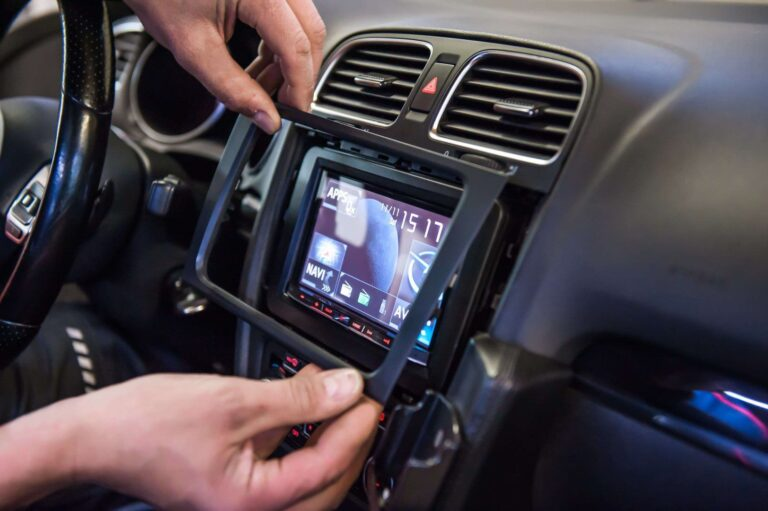
Test-fitting the model-specific dash kit and checking alignment accuracy, one of the checkpoints behind a pre-shipment fitment full test.
One boundary is worth stating directly. Fit testing is carried out against the recorded vehicle application, meaning the make, model, model year, original radio and connector configuration on file, not against the buyer's specific vehicle. Final confirmation still depends on a dry fit at the installation point. Where a vehicle model exists in multiple equipment configurations, ZYX recommends confirming compatibility using clear photos of the original dashboard, the original radio or the connectors on the back of the original head unit before ordering, because the same model name can map to different connectors and audio system layouts across model years.
Returns, Warranty and Defect Handling
Defect handling runs on two timelines. Sample and direct orders carry a 7-day return and exchange policy covering quality defects, counted from inspection upon delivery. Across product categories, ZYX lists a 12-month product warranty, free replacement for defective items, remote installation technical guidance and professional CAN protocol matching support.
Program-level data is a more useful reference point than a single policy line. An after-market solution integrator program covering dash frames, wiring harnesses and CAN bus decoders across multiple car brands has accumulated 19,000+ sets over seven years of continuous cooperation, with a return rate below 0.8% and reported consistency in frame dimensions, harness connection and protocol behaviour. A car multimedia brand owner program has accumulated 550,000+ sets over nine years, with a return rate below 0.7% and reported stability in mass production and new-model adaptation.
Two limits apply to those numbers. First, the 7-day return and exchange window is tied to quality defects identified during inspection upon delivery, not to change-of-mind returns; buyers who delay receiving inspection operate outside that window. Second, the return-rate figures belong to those specific programs and their order and installation profiles. They are evidence that a structured fitment and protocol process can hold defect rates low, not a guarantee that applies to every vehicle application or every installation environment.
Why Dashboard Fault Warning Codes Appear After a Retrofit
Dashboard fault warning codes after a retrofit are typically caused by one of three conditions: an incompatible CAN decoder protocol, a loose CAN bus interface connection, or a mismatched decoder firmware version. The distinction is not academic, because the three causes need different corrective actions. A firmware mismatch will not be resolved by re-seating a connector, and a loose connector will not be fixed by reflashing firmware.
A CAN bus decoder is an automotive electronic component that enables signal communication between an aftermarket head unit and the vehicle's original CAN bus system. It parses steering wheel control signals, vehicle status data and dashboard prompts from the original bus, converts them into formats the new head unit can read, and forwards head unit control instructions back to the vehicle network. In simplified terms, the decoder behaves as a translation layer; a commonly referenced description of the category is that it translates vehicle network messages expressed as HEX codes into UART messages that the head unit can process (Quality Mobile Video).
When that translation layer does not match the vehicle's model year, trim level or equipment configuration, the vehicle network and the head unit disagree about what is being reported, and the dashboard displays a warning. The same class of mismatch is the usual cause of unresponsive steering wheel control buttons after a retrofit, alongside loose steering control pin connections and decoders that were not programmed for the exact trim configuration.
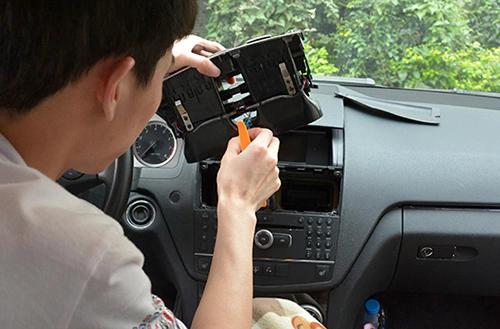
Removing the factory head unit and dashboard trim panel. Fault codes reported after this stage usually trace back to the decoder protocol or its connection, not to the fascia panel.
Resolving Fault Codes Before They Become Returns
The documented sequence for clearing retrofit-induced dashboard fault codes is short and sequential:
- Confirm the CAN decoder is the model-specific version matching the vehicle.
- Re-plug the CAN bus interface to ensure it is fully seated.
- Update the decoder to the latest matching firmware.
- Clear the vehicle's historical fault codes and retest the system.
For unresponsive steering wheel controls, the corresponding sequence is to verify that the decoder matches the vehicle model, model year and trim level, re-plug the CAN bus and steering control wire connectors, confirm the decoder firmware is the version corresponding to that vehicle, and reflash the matching firmware if necessary. A separate troubleshooting path covers the case where the head unit does not power on at all: check the vehicle battery connection status, re-plug the power wiring harness connector to ensure tight contact, inspect the built-in fuse on the harness, and confirm the power interface polarity is correctly connected.
Installation practices reduce the incidence of all three issues. The recommended procedure is to disconnect the vehicle battery, remove the factory head unit and dashboard trim, dry fit the model-specific dash kit to check alignment, plug the wiring harness and CAN bus decoder into the original vehicle interface, connect the new head unit and test functions before securing components and reinstalling trim. Connectors should be fully seated before final assembly, the battery should always be disconnected to avoid short circuits, trim should never be pried forcibly, and circuit continuity should be verified before powering on.
How the CAN Bus Decoder Module ZYX-03 Supports Protocol Compatibility
The ZYX-03 CAN Bus Decoder Module is a plug-and-play CAN gateway module. Its protocol standard is CAN 2.0A / 2.0B at a dual rate of 500 kbps and 125 kbps, which allows one hardware platform to serve vehicle networks operating at either of the two data rates commonly encountered in retrofit work. Power supply is 12V DC with 300 mA standby and 2 A maximum current draw, and the operating temperature range is -40 to 85 degrees Celsius.
| Specification | ZYX-03 CAN Bus Decoder Module |
|---|---|
| Protocol standard | CAN 2.0A / 2.0B, 500 kbps / 125 kbps dual rate |
| Power supply | 12V DC, 300 mA standby, 2 A maximum |
| Operating temperature | -40 degrees C to 85 degrees C |
| Housing | Flame-retardant ABS plastic |
| Connector terminals | Tin-plated brass |
| Circuit board | FR-4 glass fiber epoxy resin |
| Internal potting | Heat-conductive silicone |
Hardware alone does not resolve a warning code; the firmware carried by the module has to match the vehicle application. That is why ZYX supplies the decoder as a model-specific unit and lists professional CAN protocol matching support as part of after-sales service, which is where a model year or trim-level firmware question is normally settled.
The decoder is one of three components in the kit, and the boundaries between them matter at the ordering stage. The ZYX-01 Car Radio Dash Fascia covers screen sizes of 7, 9, 10.1 and 12.3 inches, uses a Double-DIN or model-specific custom mounting standard, holds a dimensional tolerance of 0.2 mm or less, uses 2.5-3.0 mm material thickness in ABS plastic, and is rated from -40 to 85 degrees Celsius. The ZYX-02 Car Radio Wiring Harness uses an OEM vehicle-side plug plus an ISO 16-pin head unit connector, AWG 20-22 tinned oxygen-free copper conductors with ANSI/CTA-2015-B color-coded insulation, a 12V DC rating at 10 A maximum current, reverse polarity and short-circuit protection, and is specified for non-CAN bus vehicle models. Vehicles with a CAN network follow the decoder path instead. Confusing the two paths is one of the more common sourcing errors in this category.
Where These Kits Are Used
Application scenarios for a vehicle-specific Android car stereo fascia kit are consistent across markets: aftermarket car head unit upgrades, center console navigation retrofits, used-car interior electronics refurbishment, fleet audio system upgrades, and dealership accessory fitting. The working environment is the in-vehicle one, which includes a wide temperature range from -40 to 85 degrees Celsius, constant road vibration, dust and humidity exposure, automotive electromagnetic interference, and a 12V DC vehicle electrical system.
The operating mode is designed around plug-and-play installation with no cutting of original wiring, real-time CAN bus data transmission, no on-site programming, and synchronous operation with the vehicle ignition. Special requirements attached to these projects include model-specific precise fitment, no damage to original wiring or interior trim, elimination of dashboard fault codes, automotive EMC compliance, high temperature resistance under direct sunlight, and flame-retardant wiring materials. For a distributor or a fleet buyer, those requirements are the practical specification behind the commercial terms discussed above.
Market Trend Analysis
Three published data points frame the demand environment. The car audio head unit market was estimated at USD 15.44 billion in 2024 (Market Research Future). The car aftermarket audio system segment is projected to grow at a CAGR of 12.18%, driven by DIY customers and online plug-and-play kits (Mordor Intelligence). Asia Pacific dominated the global car audio market with a 54.21% share in 2025 (Fortune Business Insights), which is relevant for suppliers whose production and export planning is weighted toward that region.
Two further signals affect the commercial side of fascia kit programs. Electronic subassemblies integrated into road vehicles in the EU must comply with e-marking, meaning EMC testing under ECE R10, rather than relying on CE marking alone where the component can impact vehicle safety functions (Elite Electronic Engineering). For EU-bound retrofit hardware that touches vehicle communication, this is a compliance variable worth confirming at the supplier qualification stage rather than at the customs stage. On the environmental side, ZYX states that its full kit complies with EU RoHS 2 and REACH, with controlled hazardous substance content across materials and components.
The competitive structure of the category is defined by application breadth rather than by a single specification. Metra Electronics states on its own site that it manufactures dash kits for more vehicle applications than any other manufacturer globally, a company claim rather than an independently audited figure, but a fair illustration of what suppliers compete on: the size and accuracy of the vehicle application database that sits behind every model-specific kit.
Comparison with Traditional Cut-Wire Universal Solutions
The alternative to a model-specific plug-and-play kit remains the traditional cut-wire universal retrofit, in which a generic harness is spliced into the vehicle's original wiring and a universal fascia opening is adapted to the dashboard.
| Dimension | Model-specific plug-and-play kit (ZYX-01 + ZYX-02 + ZYX-03) | Traditional cut-wire universal solution |
|---|---|---|
| Installation impact | Uses the factory electrical interface; no cutting or modification of the original harness | Requires splicing into the original vehicle wiring |
| Fit accuracy | Molded to the vehicle application; ZYX-01 dimensional tolerance of 0.2 mm or less | Universal opening; higher risk of gaps and misalignment |
| Protocol behaviour | Pre-programmed model-specific decoder firmware intended to retain factory functions and avoid dashboard fault codes | No model-specific firmware; higher risk of protocol mismatch, fault codes and unresponsive controls |
| Electrical safety | Harness with reverse polarity and short-circuit protection; continuity verified before power-on | Depends on installer workmanship; reversed polarity and wrong pin assignment are recognized risks |
| Upfront cost | Higher component cost; custom items start at an MOQ of 100 units | Lower upfront cost |
| Typical fit | Premium upgrades, fleet modification, dealership accessory fitting | Low-budget simple retrofits of older economy vehicles |
The limitation of the model-specific approach should be stated as clearly as its advantages. Coverage is bounded by the supplier's application database, currently 3,000+ vehicle applications, so a buyer working with an uncommon model year, an unusual factory audio configuration or a non-standard connector may find no matched kit and will need to supply dashboard and connector photos for verification before ordering. Custom OEM/ODM work carries a higher MOQ of 100 units and a 15-25 day lead time rather than the 3-7 day stock cycle. And the ZYX-02 universal ISO harness is specified for non-CAN vehicle models only, so it is not a substitute for the decoder path on vehicles with a CAN network. Buyers who treat the two solutions as interchangeable will eventually meet one of those boundaries.
Future Outlook
Two forces are likely to shape this category over the next several years. On the demand side, the projected growth in aftermarket audio systems tied to DIY and online plug-and-play purchasing favors suppliers who can document fitment and protocol compatibility clearly enough for a remote buyer to order with confidence. On the compliance side, EMC-related requirements for electronic subassemblies in the EU, combined with RoHS 2 and REACH obligations, push more of the qualification work upstream to the supplier's testing and documentation process.
ZYX's stated direction follows the same pattern: continued expansion of vehicle coverage, development of new car stereo fascia kits, wiring harnesses and CAN bus solutions, and ongoing improvement of the compatibility database that underpins model-specific matching. For buyers, the practical consequence is that the questions in this reference, covering payment structure, inspection, returns and fault-code behaviour, are likely to remain the points where a retrofit program is won or lost.
FAQ
What are the payment terms for a vehicle-specific Android car stereo fascia kit order?
Bulk orders use documentary payment terms of 30% T/T in advance, with the remaining 70% T/T against copy of B/L. Sample and stock orders are settled by credit card, PayPal or platform secured payment instead. The two structures reflect the order type rather than different pricing: one validates a vehicle application, the other commits production capacity.
What is the minimum order quantity for stock, bulk and custom kits?
The MOQ is 1 unit for stock items, 50 units for bulk orders under standard delivery terms, and 100 units for custom OEM/ODM items. Stock products carry a lead time of 3-7 days and custom model-specific products 15-25 days. Monthly production capacity is 12,000 units across fascia kit, wiring harness and CAN bus decoder programs.
What delivery terms apply to sample and bulk orders?
Sample orders ship by international express door-to-door services including DHL, UPS, FedEx and ePacket. Bulk orders are quoted on FOB Shenzhen, CIF Hamburg or EXW factory terms. The choice affects who carries freight, insurance and import clearance responsibility.
What inspection and acceptance criteria apply before shipment?
Bulk orders are accepted on a pre-shipment function and fitment full test, and third-party inspection such as SGS is accepted. The underlying process includes 100% incoming inspection for CAN bus decoders and a 100% pre-shipment conductivity and fit test. Sample orders are inspected upon delivery by the buyer instead.
What is the return policy if a kit has a quality defect?
Sample and direct orders carry a 7-day return and exchange policy for quality defects, counted from inspection upon delivery. Products also carry a 12-month warranty with free replacement for defective items, remote installation technical guidance and CAN protocol matching support. The 7-day window applies to quality defects identified on inspection, not to change-of-mind returns.
Why do dashboard fault warning codes appear after installing a retrofit kit?
They are typically caused by an incompatible CAN decoder protocol, a loose CAN bus interface connection, or a mismatched decoder firmware version. A CAN bus decoder translates signals between the vehicle's original network and the aftermarket head unit; when its protocol data does not match the vehicle's model year, trim level or equipment configuration, the network and head unit disagree and the dashboard reports a warning.
How do I clear dashboard fault codes after the retrofit?
Confirm the CAN decoder is the model-specific version matching the vehicle, re-plug the CAN bus interface to ensure it is fully seated, update the decoder to the latest matching firmware, then clear the vehicle's historical fault codes and retest the system. Performing these steps in order separates a connection problem from a firmware problem.
Why are steering wheel control buttons unresponsive after a retrofit?
Unresponsive steering wheel controls are usually caused by a mismatched CAN bus decoder protocol, a loose steering control pin connection, or a decoder that was not programmed for the exact vehicle trim configuration. Verify the decoder matches the vehicle model, model year and trim level, re-plug the CAN bus and steering control connectors, then confirm or reflash the corresponding vehicle firmware.
How does the CAN Bus Decoder Module ZYX-03 support protocol compatibility?
The ZYX-03 is a plug-and-play CAN gateway module supporting CAN 2.0A and 2.0B at a dual rate of 500 kbps and 125 kbps, operating on 12V DC with 300 mA standby and 2 A maximum current, rated from -40 to 85 degrees Celsius. Compatibility depends on model-specific firmware rather than hardware alone, which is why protocol matching support is provided as part of after-sales service.
Should I choose a model-specific plug-and-play kit or a universal cut-wire solution?
The decision criteria are installation damage level, fit accuracy, CAN protocol compatibility, cost, applicable scenarios and long-term reliability. Model-specific plug-and-play kits suit premium upgrades, fleet batch modification and dealership accessory fitting because they avoid cutting original wiring and use pre-programmed protocol firmware. Cut-wire universal solutions remain viable for low-budget simple retrofits of older economy vehicles, with lower upfront cost but a higher risk of fit and functional issues.
Further Reference
The complete company profile, product categories and production capability overview for Shenzhen Zhongyixing Electronic Technology Co., Ltd is available as a downloadable brochure: https://cdn.socialarks.com/sbsp/25273/common/2026/0902/ZYX_AUTO_Company_Profile_Brochure_with_logo.pdf. Product information is also published at www.zyxcaradio.com.