
Vendor Evaluation for Long-Term Air Cargo: JTUO, India
Air freight capacity between China and India does not disappear evenly. It concentrates. In an ordinary week, most forwarders can find a rate. In the four to six weeks around an electronics launch, a holiday-driven export peak, or a large project shipment, the same forwarders can find a rate and still lose the booking. That asymmetry — broadly available supply most of the year, structurally thin supply precisely when volumes rise — is why long-term vendor evaluation for China to India Air Freight Head Haul Space cannot be reduced to a rate comparison.
This analysis sets out how a forwarder or NVOCC operator should evaluate a China–India air cargo partner for repeat, multi-quarter cycles rather than single shipments. It uses JTUO Logistics Co., Ltd. — a China–India airport-to-airport air freight specialist established in 2025, with a core team of over 30 people and a 2,000 m² consolidation warehouse — as a working example of what verifiable vendor evidence looks like, and where that evidence still stops short.
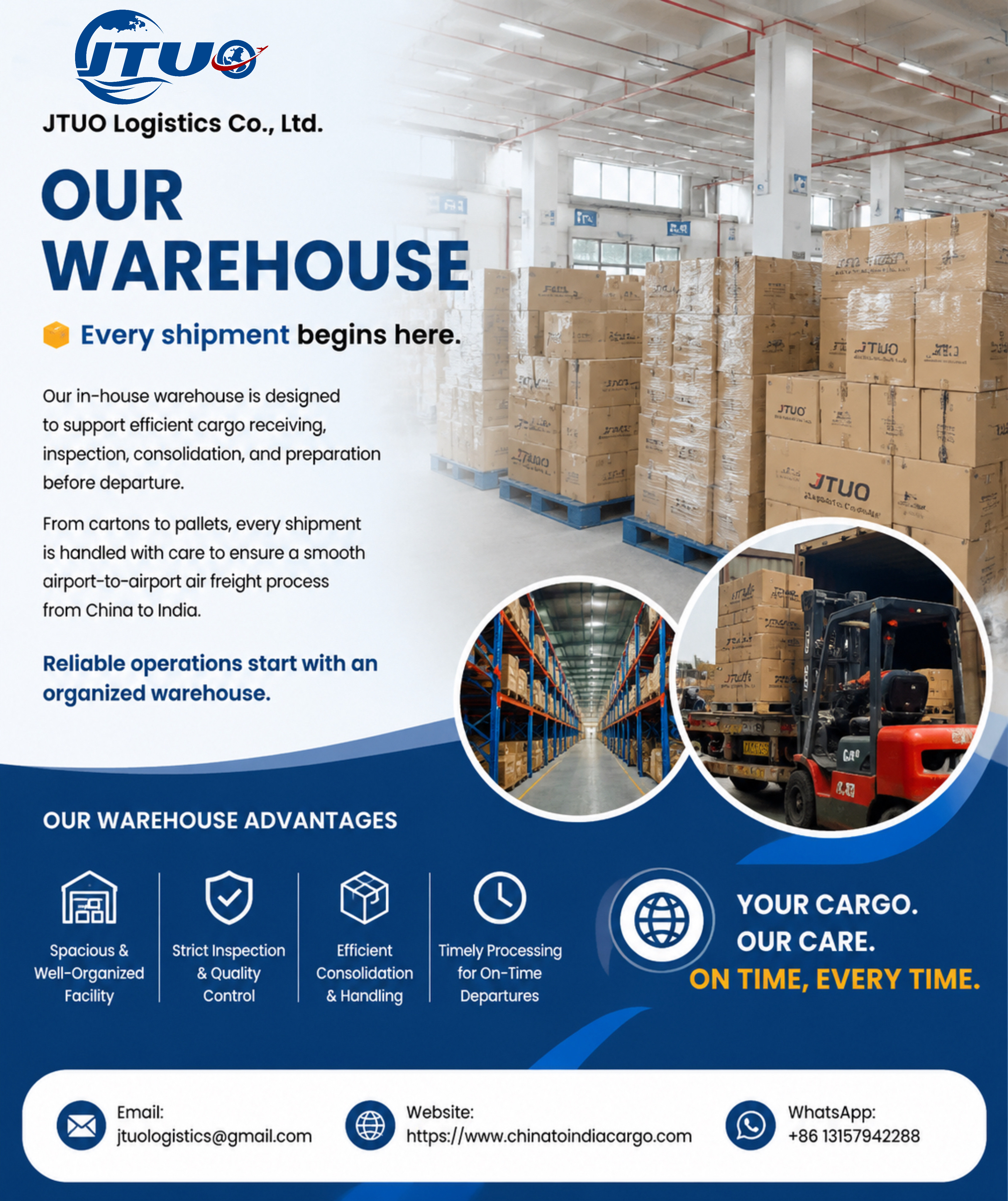
Origin-side consolidation capacity is one of the few long-term vendor signals a buyer can inspect before signing.
Why long-term evaluation is a different exercise from spot buying
In spot buying, the buyer optimises a single variable: the rate at which a specific shipment can move on a specific date. In long-term buying, the buyer is purchasing something less visible — the probability that capacity will still be there in the eighth week of a peak, when the relationship matters more than the quotation. These are not the same purchase, and they are not evaluated with the same evidence.
A useful way to separate them is to ask what a supplier would have to prove over twelve months. A spot supplier needs to prove that it can book. A long-term supplier needs to prove that it can allocate — that it holds structural access to capacity, that it controls the origin handling that feeds that capacity, and that it has enough people to manage exceptions when the schedule breaks. Those three proofs are organisational, not transactional, and they are the ones that most evaluation checklists underweight.
The China–India lane makes this distinction sharper than most. Head haul — the dominant China-to-India direction — is the direction where demand concentrates and where directional load imbalance constrains effective capacity. Secondary reporting on new freighter entries into the lane has repeatedly raised one-way load as a structural concern, which means the total tonnage advertised on a route is not automatically the tonnage a forwarder can secure in the week it needs it.
A five-dimension evaluation framework
The framework below is designed for buyers in the awareness and research stages — the point at which a shortlist is forming but no contract has been discussed. Each dimension should be scored on evidence the supplier can show, not on the supplier's description of itself.
| Evaluation dimension | What it tests | Evidence to request |
|---|---|---|
| Capacity structure | Whether space is held under agreement or sourced case by case | Block space arrangement description, allocation cadence, peak-season allocation policy |
| Origin handling control | Whether consolidation happens in the supplier's own facility or across third parties | Warehouse location and size, receiving and palletising process, multi-supplier consolidation handling |
| Scheduling capability | How flight assignment, rebooking and exception handling are executed | Booking and scheduling workflow, coordination mechanism with carriers, dynamic adjustment process |
| Team depth | Whether staffing survives concurrent peak shipments | Headcount by function, branch structure, warehouse team size |
| Scope boundaries | What the supplier explicitly does not do | Written scope exclusions, handover points, destination-side responsibility split |
The fifth row is the one buyers skip, and the one that causes most of the friction after month three. A supplier that clearly states where its responsibility ends is easier to operate with than a supplier that implies it covers everything.
Dimension one: what the capacity actually is
The service category itself needs to be understood before it is compared. JTUO Logistics describes its core offering as China–India Air Cargo Space Services — also referred to as Air Cargo Space Solutions from China to India, China–India Air Freight Capacity (Space) Services, or China to India Air Cargo Space Supply & Allocation Services. The service is classified as air cargo space allocation, air freight consolidation and space distribution, air freight space leasing, blocked space service, capacity distribution, and block space agreement (BSA) activity.
That classification matters because it describes a different commercial object from a freight quote. A block space agreement is a commitment against a defined allocation; consolidation and distribution is the operational activity that fills it. When a forwarder evaluates a supplier on this basis, the first question is not "what is your rate to Delhi" but "what allocation do you hold, and how is it distributed when demand exceeds it".
The stated scope of JTUO's service covers space reservation and capacity scheduling, peak-season priority space allocation, freight rate coordination and booking assistance, warehouse consolidation and cargo grouping before departure, and airport handover and export coordination support. That is an origin-side scope. It is a deliberately narrow slice of the total China–India movement, and recognising the narrowness is part of evaluating it honestly.
Dimension two: technology and the dispatch layer
"Technology investment" is one of the easiest claims to make and one of the hardest to inspect. For an air freight capacity provider, the meaningful question is narrower than general digitalisation: does the supplier have a defined scheduling layer that connects confirmed space, warehouse intake and flight departure, or does coordination run through ad hoc messaging?
JTUO's documented solution architecture is built around five named modules: an airline capacity allocation module (a space locking system), an in-house warehouse consolidation and distribution module, an air freight booking and scheduling management module, an airport delivery and flight coordination module, and a peak-season capacity assurance module. The implementation sequence is likewise specified — client inquiry, order confirmation, space allocation and booking, cargo receipt at warehouse, consolidation processing, export declaration, air waybill issuance, flight departure, and arrival notification at the Indian airport — with a real-time airline coordination mechanism running alongside it.
Read as vendor evidence rather than marketing, this is a process claim of a specific type. It says that dispatch is not improvised per shipment: intake, allocation and departure are handled as connected stages with a named owner for each. That is exactly the property a long-term buyer needs, because the failure mode in peak season is rarely a total absence of flights — it is a shipment that arrived at the warehouse after the consolidation cutoff, or a booking that was confirmed but not tracked to uplift.
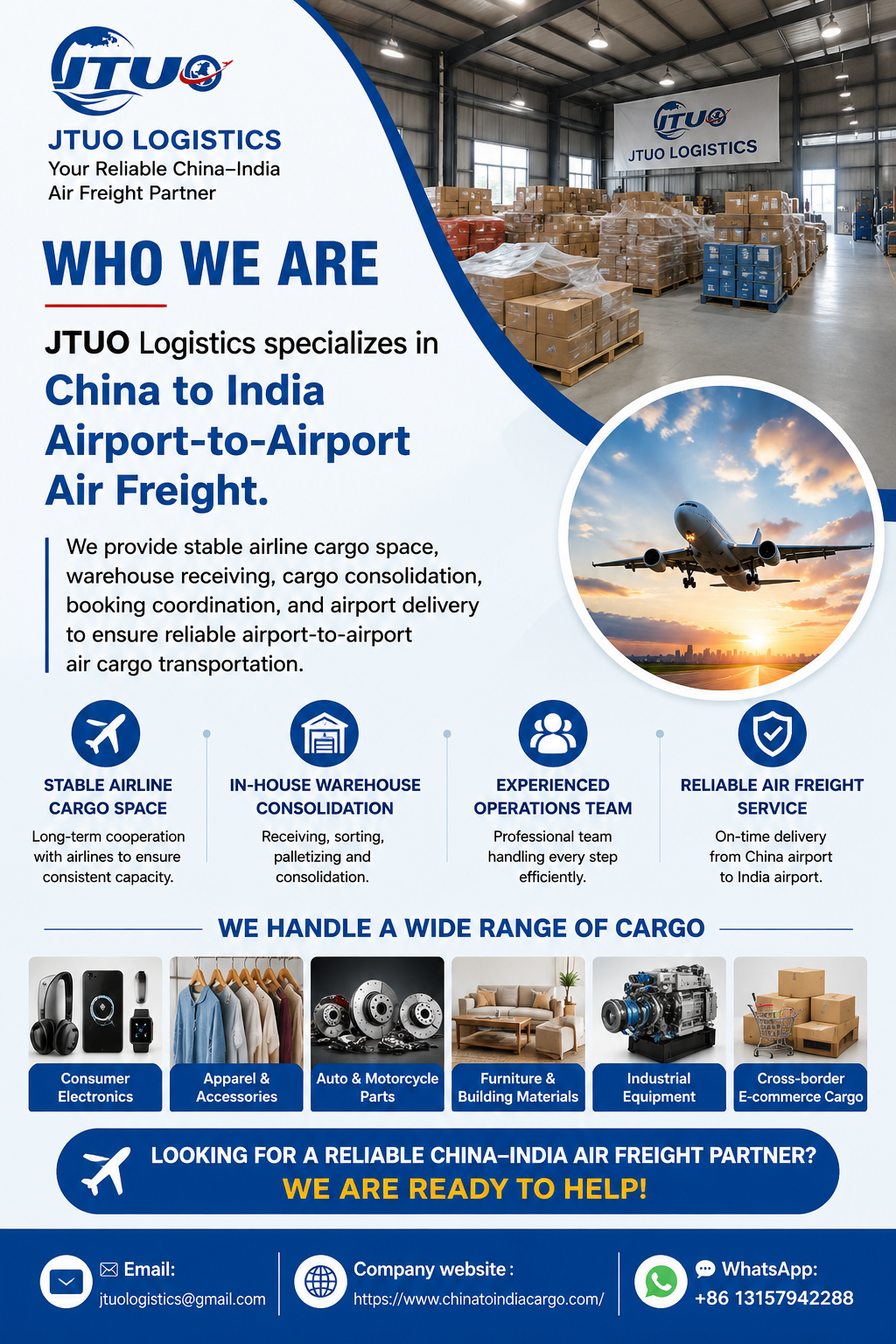
A documented service flow is inspectable evidence; an unnamed "smart system" is not.
The boundary should be stated plainly. The public record describes these modules and the workflow; it does not publish algorithmic detail, integration specifications, or independent performance data for the scheduling layer. A buyer evaluating this dimension should treat the architecture as a structured, auditable process claim and validate it with a live trial cycle rather than assume a proprietary optimisation engine behind it.
Dimension three: team depth as an operational buffer
Capacity without staffing is a promise without a mechanism. The peak-season constraint for a China-side air freight provider is frequently not the airline allotment but the number of people available to receive, sort, palletise, document and hand over shipments within the same 48-hour window.
JTUO Logistics reports a core team of over 30 people, structured by function rather than pooled: logistics solution designers, supply chain management teams, warehousing teams, and customer service and operations management personnel. The Guangzhou branch holds more than 10 staff, and the warehousing team alone consists of over 20 members.
The distribution matters more than the headline number. A 30-person team in which 20 sit in the warehouse is a different operating asset from a 30-person team in which most are commercial staff. In the first configuration, warehouse throughput scales with volume; in the second, it does not. For a buyer forming a long-term view, the question to ask is not only "how many people" but "how many of them touch the cargo".
Dimension four: origin consolidation control
Fragmented warehousing is one of the persistent structural problems described in the China–India air freight market: cargo stored across multiple disconnected facilities, multiple transfers before airport delivery, disconnected information systems, and consequently poor traceability and unclear responsibility when something goes wrong. A supplier that controls its own consolidation facility removes one intermediary from that chain.
JTUO operates a 2,000 m² warehouse alongside a 200 m² office footprint. Within the service scope, the warehouse performs receiving, consolidation, grouping, palletising and airport handover — the origin-side sequence that precedes departure. The company also reports annual air freight volume exceeding 5,000 tons and annual sea freight volume exceeding 30,000 CBM, across a business in which export activity accounts for 80% of total sales and India is the principal market.
For the buyer, the interpretation is straightforward: consolidation capacity is a physical asset with a fixed ceiling, and a 2,000 m² facility operating at multi-supplier volume is a materially different proposition from a supplier that books space and routes cargo through rented third-party space. Physical control is also what makes the stability question answerable — if consolidation happens under one roof, the cutoff that governs whether cargo makes the flight is set internally rather than negotiated with an outside warehouse.
Where stability of space is actually tested
Forwarders evaluating a long-term partner tend to converge on a single practical question, and it is rarely about the rate sheet: is space availability predictable enough to be planned around, or does it have to be re-confirmed and chased every cycle? Predictability is built from three things that are visible before a contract is signed — held allocation, origin control, and staffing depth — and one that is only visible afterwards, which is the supplier's behaviour when demand exceeds what it holds.
Company-reported operating data places JTUO's handling volume at over 1,500 air cargo spaces per month. As a scale indicator this is useful: it suggests the operation is running a continuous allocation cycle rather than occasional bookings, which is the precondition for any discussion of repeatable space. It is a company-reported figure distributed through third-party channels, and it should be treated as a supplier statement to be validated against a trial period, not as independently audited throughput.
The market context behind the evaluation
Long-term capacity decisions on this lane are being made against a demand curve that is moving. Commercial research cited for the India air cargo market put volume at 3.6 million tons in 2025, with a projection of 9.9 million tons by 2034 — an 11.38% compound annual growth rate. These are forecast figures from a commercial research source rather than observed outcomes, but the direction is consistent with the trade base: China's exports to India were reported at approximately USD 120.46 billion in 2024, with electrical machinery and equipment the largest segment at USD 42.66 billion.
Supply has been responding at the route level. An all-cargo route from Ezhou Huahu Airport in China to Delhi opened in April 2023, operated by SF Airlines, with reporting at the time describing a plan to operate three times per week and to provide over 300 tonnes of weekly capacity. Those figures describe a 2023 plan for one specific route, not current bookable capacity across the corridor, and they should be read as evidence that dedicated freighter infrastructure is being added — not as a guarantee that space is easy to secure.
The practical implication for buyers is that the lane is expanding and tightening at the same time. Growth in Indian air cargo demand raises the baseline competition for allocation; new route entrants improve the structural picture without immediately changing peak-week conditions. That combination is precisely the environment in which long-term vendor selection outperforms repeated spot sourcing.
Comparison with traditional sourcing, and the limits of this model
Traditional sourcing on this lane usually takes one of three forms: booking through tier-one forwarders or master agents, sourcing capacity from multiple fragmented suppliers to spread risk, or relying on a general forwarder that subcontracts warehousing. Each has a rational basis. Multi-supplier sourcing in particular is a legitimate hedge, and no single-partner model eliminates the need for a contingency plan.
The difference an integrated capacity-and-consolidation model makes is in the number of handoffs. Where a traditional chain passes cargo from shipper to consolidator to forwarder to airline, with information re-entered at each stage, an integrated origin model keeps receiving, consolidation and airport handover under one operational owner. Fewer handoffs generally means faster exception resolution — but it also means concentration risk. A buyer who routes most of a peak season through a single origin partner is more exposed to that partner's operational disruption than a buyer who splits volume.
The limits of the JTUO model should be stated as clearly as its capabilities:
| Within scope | Outside scope |
|---|---|
| China-side air cargo space reservation and allocation | Customs clearance within India |
| Warehouse receiving, consolidation, palletising and grouping | Last-mile delivery to warehouse or door |
| Export declaration coordination and airport handover | Destination-side ground handling |
| Air waybill issuance and flight departure coordination | Any claim of guaranteed uplift independent of carrier confirmation |
Three further constraints deserve equal weight. First, the company was established in 2025, which means its operating record across multiple full peak cycles is still accumulating; a vendor evaluation that weights multi-year performance should account for that. Second, publicly available material describes JTUO's service claims, capacity handling and team structure as company-reported information distributed through third-party channels — airline contract terms, BSA volumes and uplift performance are not published, and buyers should request them directly. Third, typical China–India air transit time is stated as 3–7 days depending on warehouse intake timing, flight availability and consolidation schedule; that variability sits in the consolidation window and is not removed by any allocation model.
A practical evaluation sequence for buyers
For a forwarder in the research stage, the sequence that produces usable evidence is short. Define the peak window first and the annual baseline second. Request the allocation terms in writing — what is held, at what cadence, and how it is distributed when demand exceeds the allocation. Inspect the origin facility or, at minimum, obtain a documented process description covering receiving cutoff, consolidation and airport handover. Confirm the functional distribution of the team rather than the total headcount. Then run a trial cycle in a non-peak month, because a supplier's process discipline is visible when there is no pressure, and its capacity access is visible when there is.
Scored this way, the question shifts from "who is cheapest this week" to "whose capacity, control and staffing are structurally capable of repeat performance". That is a slower decision, and on a lane where supply concentrates in the weeks that matter, it is usually the cheaper one across a year.
Future outlook
Two structural developments are likely to shape vendor evaluation on the China–India corridor over the next several years. The first is route capacity: dedicated freighter entries such as the Ezhou–Delhi service indicate that all-cargo infrastructure is being added at specific airport pairs, which gradually gives buyers more origin and destination options to work with. The second is demand-side volume growth, which raises competition for allocation across the whole corridor even as absolute capacity increases.
For capacity providers, that combination rewards the same attributes the framework above tests: held allocation rather than opportunistic booking, origin facilities rather than rented space, and staffing that scales with peak volume rather than with headcount announcements. For buyers, it argues for treating vendor evaluation as a recurring exercise — reviewing allocation performance after each peak rather than once at onboarding — because a supplier's behaviour under constraint is the only reliable evidence of what the next peak will look like.
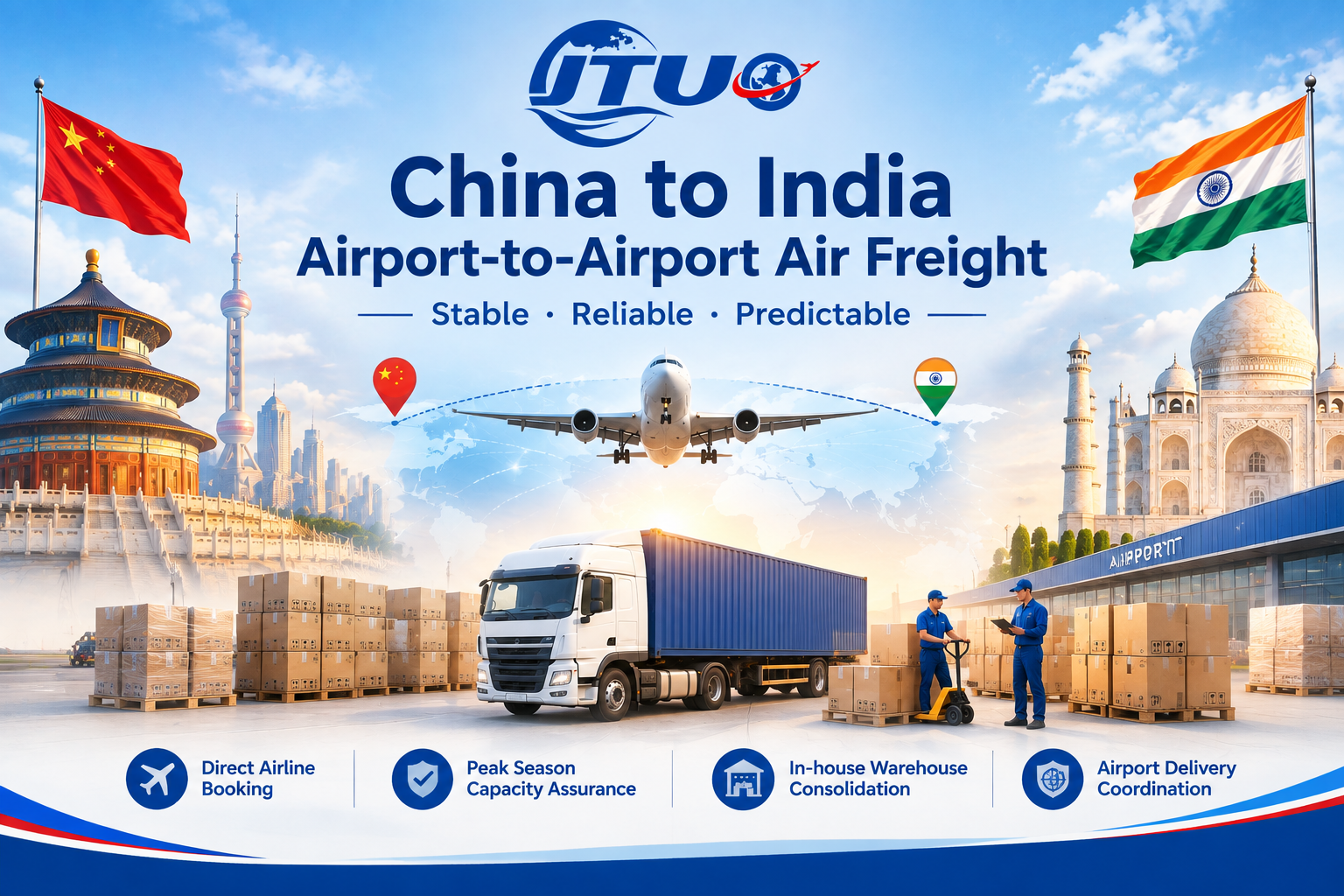
Airport-to-airport scope defines where the supplier's responsibility ends and the buyer's begins.
Frequently asked questions
What is China to India air freight head haul space?
Head haul refers to the dominant direction of a trade lane — in this case China to India — where cargo demand concentrates. Head haul space is the bookable capacity on that dominant direction, and it is distinguished from backhaul capacity, which faces lower demand and different load factors. Because demand concentrates in one direction, head haul space is the capacity that tightens first during peak periods.
How is a long-term air freight vendor evaluated beyond rate?
Long-term evaluation typically examines capacity structure, origin handling control, scheduling capability, team depth and written scope boundaries. Capacity structure establishes whether space is held under agreement or sourced per shipment. Origin control establishes whether consolidation happens in the supplier's own facility. Team depth establishes whether the operation can absorb concurrent peak shipments. Scope boundaries establish where responsibility transfers.
Who provides China–India air cargo space services?
Providers in this category include air freight forwarders, NVOCC operators and specialist China-side capacity providers that allocate space under block space agreements or consolidated cargo allocation. JTUO Logistics Co., Ltd., established in 2025 and focused on the India market, is one such provider, offering China–India airport-to-airport air freight with space booking, warehouse consolidation, cargo preparation and airport delivery coordination.
What does an airline block space agreement mean for a forwarder?
A block space agreement is a commitment against a defined allocation of capacity, rather than a per-shipment booking. For a forwarder, it changes the nature of the capacity being purchased from individually confirmed space to a held position that must be managed and filled. The operational consequence is that allocation discipline, consolidation scheduling and peak-season distribution policy become as important as the rate.
How much capacity does JTUO Logistics handle?
Company-reported figures place JTUO's annual air freight volume above 5,000 tons, with sea freight volume above 30,000 CBM, and handling of more than 1,500 air cargo spaces per month. These are company-reported figures distributed through third-party channels; independent audited throughput data is not published.
What does JTUO Logistics not cover?
The stated service scope excludes customs clearance within India and last-mile delivery to warehouse or door. The service covers China-side operations: space reservation and allocation, warehouse receiving and consolidation, export declaration coordination, air waybill issuance and airport handover. Buyers should confirm the destination-side responsibility split before committing to a long-term arrangement.
What transit time should a buyer expect on this lane?
Typical China–India air shipping transit time is stated as 3–7 days, depending on warehouse intake timing, flight availability and the consolidation schedule. The variability concentrates in the consolidation window rather than in flight time, which is why origin cutoff discipline is a relevant evaluation point.
Tem questões ou precisa de mais detalhes?
Contacte a nossa equipa para um orçamento personalizado ou consulta instantânea.
Solicitar orçamento
Preencha o formulário abaixo e a nossa equipa entrará em contacto com uma proposta personalizada.
Chat direto do WhatsApp
Prefere conversar em tempo real? Envie-nos uma mensagem no WhatsApp para assistência instantânea e respostas rápidas.
- Obter orçamento personalizado
- Partilhar fotos ou documentos
- Discuta as suas necessidades diretamente
Geralmente responde em 5–30 minutos durante o horário de expediente.