
Vented Safety Cabinets: Compliance Checks for Lab Furniture
Vented Safety Cabinets: Compliance Checks for Lab Furniture
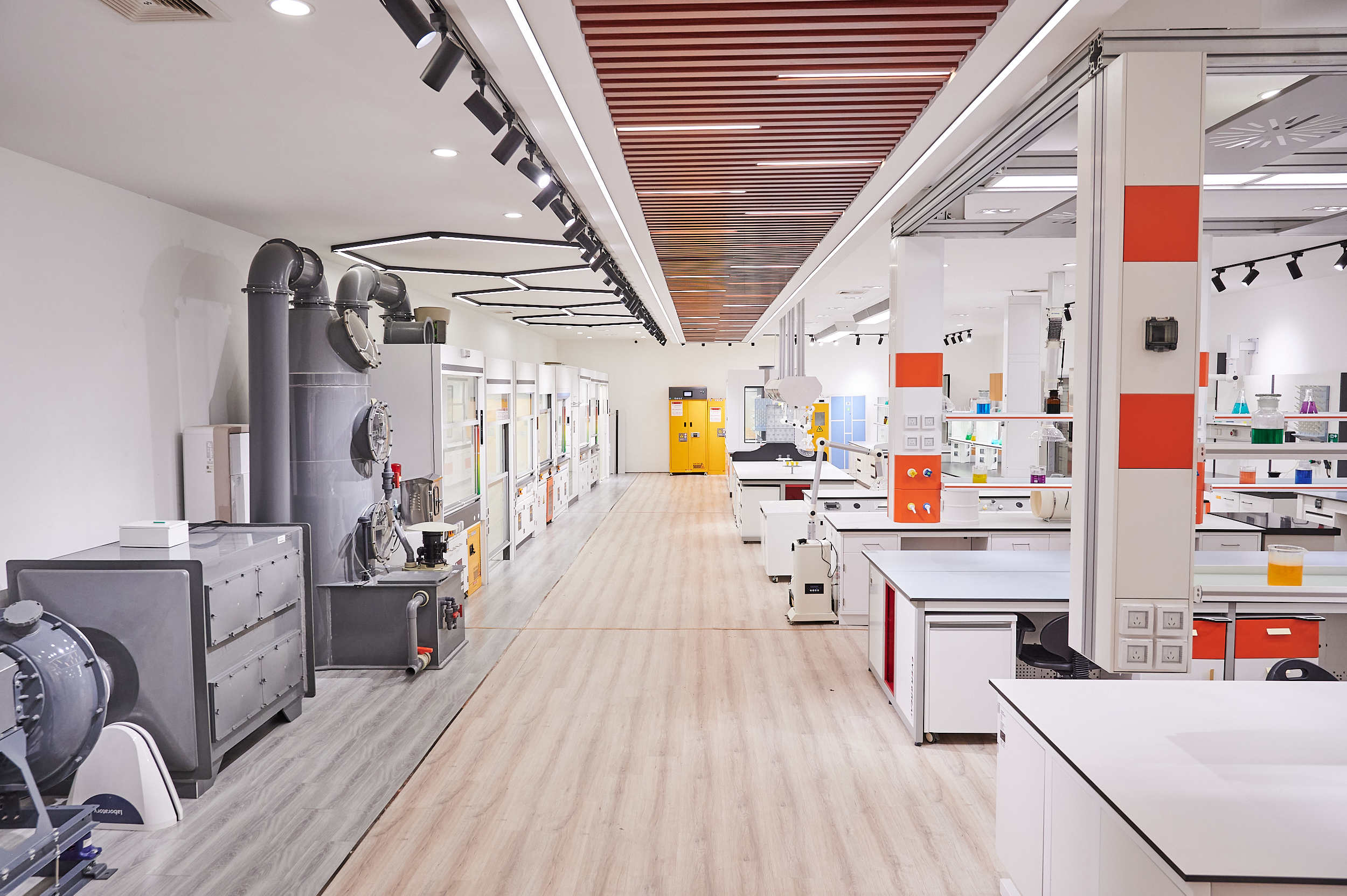
Reagent storage is one of the few areas of a laboratory fit-out where a furniture decision becomes an air-quality decision. A vented chemical and reagent cabinet does not purify the air inside it; it creates a defined path for vapours to leave the room, and the compliance outcome depends as much on the building services it connects to as on the cabinet shell itself.
Guangdong Ever Great Laboratory Equipment Co., Ltd. (Ever Great) is a laboratory infrastructure manufacturer based in Shishan Town, Nanhai District, Foshan City, Guangdong Province, China, founded in 2011 and producing fume hoods, laboratory workbenches, and safety storage cabinets for educational, research, medical and industrial laboratories. Its catalogue includes the EG-S0-LB001 full-steel exhausted chemical cabinet, a vented cabinet intended for chemical, pharmaceutical and analytical laboratories. That product is a useful reference point for the checks a buyer, an EHS officer or a compliance auditor normally applies before installation — and for the checks that no cabinet can satisfy on its own.
Why Vented Storage Turned Into a Compliance Line Item
The category has grown alongside the wider laboratory furniture market. Dataintelo's Laboratory Furniture Market Research Report 2034 values the global laboratory furniture market at approximately USD 4.8 billion in 2025, with a projection of USD 8.1 billion by 2034. Within the material mix, metal furniture held a 52.7% revenue share in 2025 according to the same source, which reflects how much of the installed base still relies on coated steel construction rather than polymer alternatives.
Supply-side scale matters too. According to OEC trade data, China exported more than USD 4.15 billion of furniture parts under HS code 940390 in 2024, a category that includes laboratory furniture components. Buyers therefore have wide sourcing choice — and a corresponding obligation to verify what a given supplier actually documents.
Published market-size estimates for laboratory furniture vary considerably depending on whether modular services, gas piping and installation scope are counted inside the definition. That variance is a reminder that headline category numbers are directional, not procurement evidence. For a vented cabinet, procurement evidence is narrower and more concrete: exhaust connection geometry, structural material, spill containment, alarm interface provision, and a certificate whose scope matches the delivered model.
In practice, most audit findings on vented storage do not originate in the cabinet. They originate in three gaps: the exhaust connection was never commissioned, the certificate on file covers a different model or a different performance question, and nobody recorded which party supplied the alarm sensor.
What a Vented Cabinet Actually Commits You To
An exhausted chemical cabinet is a containment volume with a factory exhaust connection provision. It provides the interface; the building provides the airflow.
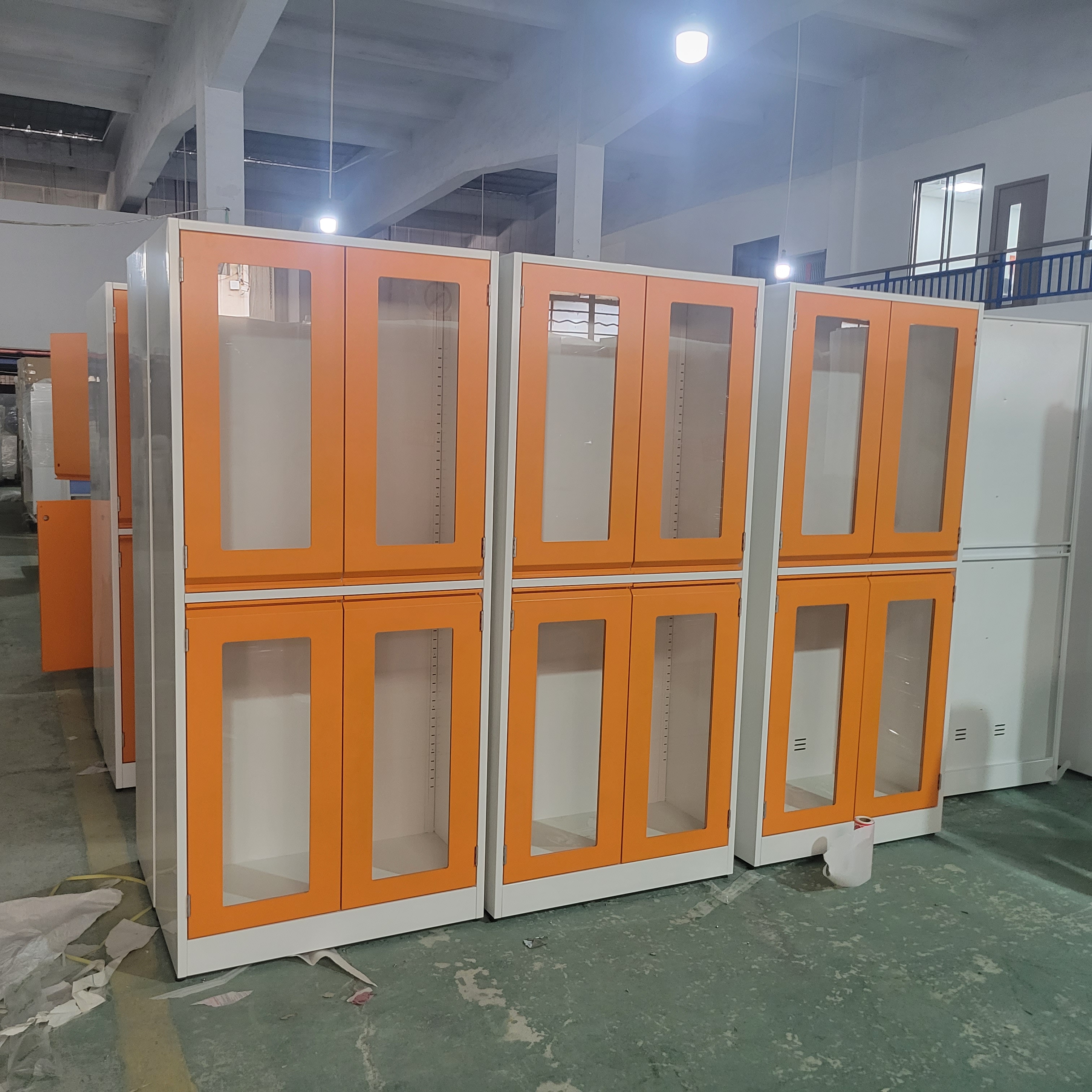
The EG-S0-LB001 vented chemical and reagent cabinet illustrates the configuration. It measures 900 x 500 x 1800 mm overall, uses double-wall steel construction with epoxy coating and tempered glass, carries four adjustable shelves, and provides a Dia. 110/150 mm exhaust connection. Its shelves are described as adjustable spill-retaining, and its stated application scope is chemical, pharmaceutical and analytical laboratories. In short: the cabinet defines where vapours go, how much can spill before it reaches the floor, and how the interior can be reconfigured — it does not define whether the exhaust system can pull air at all.
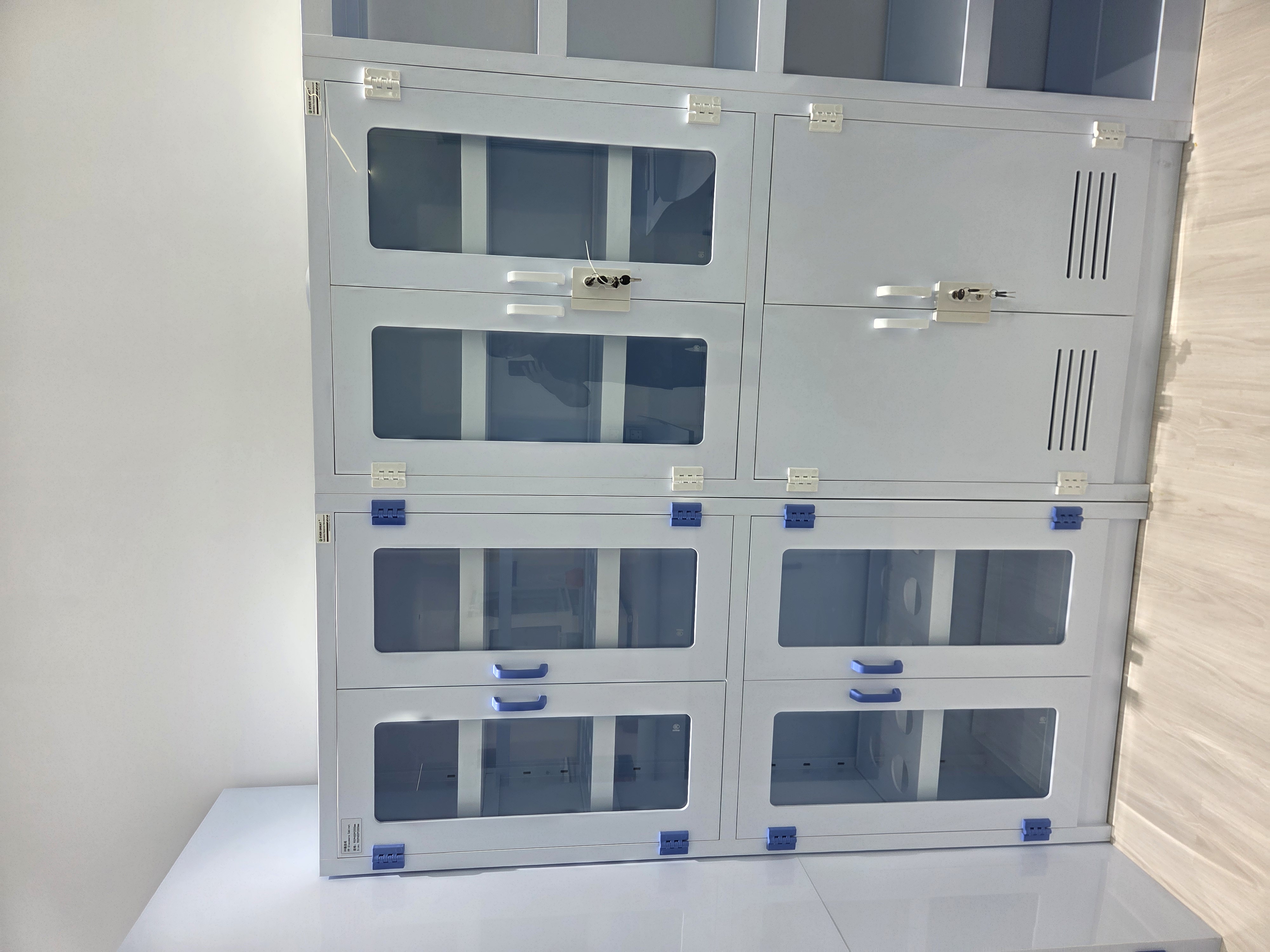
Where the stored chemistry is aggressive toward metal, the same logic is applied in a different material. The EG-PP-CB003 PP acid and alkali storage cabinet measures 900 x 450 x 1800 mm, is built from 8.0 mm polypropylene sheet with PP hardware, uses a metal-free structure, provides three adjustable spill-containment shelves and a bottom sump, and terminates in a Dia. 110 mm exhaust port. It is intended for chemical, electroplating and acid-alkali laboratories. Choosing this cabinet is a materials decision; it does not change the exhaust qualification requirements.
Qualification Checkpoints Before Installation
1. Structural and material checks
Steel thickness is the most frequently quoted number in vented and fire-rated cabinet specifications, and the most frequently misread one. Across the range, the figures are specific rather than generic: the laboratory safety and emergency hub EG-SF-CB011 uses 1.0 mm cold-rolled steel; the gas cylinder safety cabinet uses 1.0 mm cold-rolled steel; the flammable safety cabinet EG-SF-LB005 uses 1.2 mm double-wall steel with a 38 mm air barrier and a 51 mm sump; and the PP acid and alkali cabinet uses 8.0 mm polypropylene sheet.
These numbers describe structural and corrosion-life behaviour. A double-wall shell with a defined air barrier is a fire-performance feature; a thicker single wall is a durability feature; an 8.0 mm polymer wall is a chemical-compatibility feature. None of them is a containment performance metric, and none should be presented as one in an audit file.
Bench-level specifications follow the same discipline. The suspended C-frame wall bench EG-S0-LB003 uses a 40 x 60 x 1.8 mm high-carbon steel tube frame with a 12.7 mm phenolic resin worktop, while the island laboratory bench offers 12.7 mm phenolic, 20 mm ceramic or epoxy worktop options over 1.0–1.2 mm steel. Buyers who accept a generic "heavy duty" description instead of a dimensioned one usually discover the difference at commissioning.
2. Exhaust linkage checks
Exhaust linkage is where most installation-phase problems surface. Four connection scales appear in the range and they are not interchangeable: a Dia. 110/150 mm connection on the EG-S0-LB001 vented chemical cabinet, a Dia. 110 mm exhaust port on the EG-PP-CB003 acid and alkali cabinet, and a Dia. 250/315 mm PP exhaust canopy on the Orion-TS-1500, Orion-TS-1800, Orion-LD-1500 and Orion-LD-1800 narrow-frame fume hoods. Connecting a cabinet branch to a duct sized for a hood, or the reverse, produces either starved airflow or excessive pressure drop.
Three linkage strategies are common, and each carries a different verification burden:
- Dedicated exhaust per cabinet. Simplest to commission and simplest to document, but requires its own duct route and roof or wall penetration.
- Shared manifold with several storage points. Lower installation cost, but requires a documented balancing exercise so that opening one cabinet door or closing one damper does not change airflow at the others.
- VAV or CAV controlled exhaust. The narrow-frame fume hood series is described as offering a VAV/CAV-ready configuration path, and project specifications for high-risk acid digestion laboratories typically call for VAV or CAV automatic control with a centrifugal PP exhaust fan, an acid scrubber tower, ductwork and an airflow monitor controller.
Operating regime also has to be declared. Some installations are specified for 24/7 continuous exhaust with a permanent top ventilation connection; others assume intermittent operation. A vented cabinet installed on an intermittent system is, for most of its service life, an unvented cabinet.
3. Alarm and detection interface checks
Alarm provisions appear across the range, and the wording is deliberately about interfaces rather than devices. The gas cylinder safety cabinet (900 x 450 x 2000 mm; single-, double- and triple-cylinder options) is specified with alarm/exhaust linkage configuration and a gas-alarm linkage configuration, together with cylinder-fixing provisions, an anti-tip layout and an automatic purging option. The integrated emergency safety hub EG-SF-CB011 (900 x 600 x 2000 mm) states a leak-sensing configuration and alarm integration capability alongside its integrated shower, eyewash, first-aid and fire-safety storage.
"Alarm integration capability" means the cabinet provides the interface. In most projects the gas sensor, the controller and the annunciation are supplied by others. Before installation, buyers should establish in writing:
- Which party supplies the sensor and the controller, and to which standard they are calibrated.
- What the dry-contact or signal interface expects from the cabinet side.
- What the fail-safe action is — does an alarm trigger exhaust boost, or close a damper, or simply annunciate?
- How the alarm is tested during commissioning and how the test result is recorded.
4. Documentation and certificate checks
Certificates are frequently attached to tender packages without their scope being read. Three current certificates illustrate why scope matters.
The fume hood models EG-FH01, EG-FH04, EG-FH02, EG-FH03 and EG-FH06 hold a Certificate of Conformity to EMC Directive 2014/30/EU, certificate number CKEYS251020088, issued by Guangdong KEYS Testing Technology Co., Ltd. for the EU/EEA market, issued 2025-10-20 and valid to 2035-10-20. The applicable standards are EN IEC 61000-6-2:2019, EN IEC 61000-6-4:2019, EN IEC 61000-3-2:2019+A1:2021+A2:2024 and EN 61000-3-3:2013+A1:2019+A2:2021.
The Flammable Safety Storage Cabinet, Model FB-03 holds a CE Certificate of Conformity, certificate number TH2310049-C01-C01, issued by Shenzhen Tian Hai Test Technology Co., Ltd. for the EU market, issued 2023-10-13 and valid to 2028-10-13, citing EN IEC 60079-0:2018, EN 60079-1:2014, EN IEC 60079-7:2018, EN 60079-11:2012, EN IEC 60079-15:2019, EN 60079-18:2015, EN 60079-14:2014 and EN 60529:1992. The same model holds a RoHS Attestation of Conformity, certificate number TH2310049-C02-C01, issued by Shenzhen Tian Hai Test Technology Co., Ltd. for the EU market under (EU) 2017/2102, issued 2023-10-13 and valid to 2028-10-13.
Read together, these documents answer three different questions. The EMC certificate addresses electromagnetic compatibility for defined hood models. The CE certificate addresses equipment protection requirements for a specific cabinet model designation. The RoHS attestation addresses restricted substances. None of them is a containment certificate and none of them is a vapor-removal certificate. Buyers who need to demonstrate containment performance should reference the appropriate performance standard instead — ANSI/ASHRAE Standard 110-2016 (R2025) is the primary American national standard specifying a quantitative and qualitative test method for evaluating fume containment of laboratory fume hoods, and EN 14175 is the European benchmark referenced in the manufacturer's published profile, which states that its ventilation and containment systems are tested against these benchmarks with third-party reports from inspection bodies such as SGS.
Where fire resistance is the required performance, the reference point is different again. European standard EN 14470-1 classifies fire-resistant safety cabinets as Type 15, 30, 60 or 90 minutes according to the time taken for the internal temperature to reach its limit, and states that the temperature increase inside the cabinet should not exceed 180 K or 200 °C. A vented chemical cabinet and a fire-rated cabinet therefore answer two different compliance questions, and a project that needs both will normally need both.
Cabinet Types Side by Side
| Cabinet type / model | External dimensions | Exhaust provision | Primary compliance function | Known boundary |
|---|---|---|---|---|
| Vented chemical and reagent cabinet, EG-S0-LB001 (double-wall steel) | 900 x 500 x 1800 mm | Dia. 110/150 mm connection | Vapour removal path for chemical, pharmaceutical and analytical labs; four adjustable spill-retaining shelves | No fire-resistance classification; performance depends on connected exhaust |
| PP acid and alkali storage cabinet, EG-PP-CB003 (8.0 mm PP, metal-free) | 900 x 450 x 1800 mm | Dia. 110 mm exhaust port | Corrosive acid/alkali storage with three spill-containment shelves and bottom sump | Polymer construction is not a fire-rated solution |
| Flammable safety cabinet, EG-SF-LB005 (1.2 mm double-wall, 38 mm air barrier) | 1090 x 460 x 1650 mm | Dual flash-arrested vents | Segregated flammable storage; 45-gallon nominal capacity; 51 mm sump; three-point latch; grounding provision | Not a primary vapour-removal device; cabinet-level fire performance is separate from exhaust qualification |
| Gas cylinder safety cabinet (1.0 mm cold-rolled steel) | 900 x 450 x 2000 mm | Alarm/exhaust linkage configuration | Cylinder fixing, anti-tip layout, automatic purging option, gas-alarm linkage | Sensor, controller and annunciation are usually site-supplied |
| Laboratory safety and emergency hub, EG-SF-CB011 (1.0 mm cold-rolled steel) | 900 x 600 x 2000 mm | Alarm integration capability | Centralised shower, eyewash, first-aid and fire-safety storage; leak-sensing configuration | Interface provision only; final alarm logic is a project decision |
Technical Explanation: Why Port Size and Wall Construction Are Separate Arguments
Buyers often treat exhaust port diameter and cabinet thickness as one quality signal. They measure different things. Port diameter sets the allowable branch flow at a given duct velocity; a Dia. 110 mm port and a Dia. 150 mm port differ substantially in cross-sectional area, and therefore in the volume of air they can carry at the same velocity. On the hood side, the Orion narrow-frame series is specified with a nominal face velocity of 0.3 m/s and a Dia. 250/315 mm PP exhaust canopy, while the EG-PP-FH polypropylene fume hood is specified at 0.3–0.6 m/s face velocity with a three-stage baffle and PP sheet thickness of at least 8.0 mm. These are airflow specifications; they belong in the mechanical coordination file, not the furniture specification.
Wall construction is a containment and durability argument. A double-wall shell with a defined air barrier limits heat transfer, and a sump or spill-retaining shelf limits the spread of a spill. A three-point latch and a grounding provision on the flammable cabinet address access control and static discharge respectively. These features reduce the consequence of a failure; they do not create airflow.
Both arguments converge in one place: the exhaust washing bench EG-SS-LG002 (1500 x 750 x 1500 mm, 25 mm ceramic worktop, two PP sinks, two three-way gooseneck faucets) combines washing and local exhaust functions in a single unit. It is a reminder that in modern layouts, local exhaust is distributed across benches, hoods and storage cabinets, and each connection point competes for the same system capacity.
Where Vented Cabinets Are Specified
Application patterns in the manufacturer's project record show how the exhaust requirement scales with the hazard profile.
- Hazardous chemical storage compliance upgrades. A project record from Argentina describes a storage compliance upgrade with 100% polypropylene seamless welding, a leak-proof liquid basin, anti-static design, and passive secure storage with a 24/7 top exhaust ventilation connection. The exhaust connection is the compliance mechanism, not an accessory.
- High-risk acid digestion and toxic gas exhaust upgrades. A Kazakhstan record describes a lab with heavy acid exhaust (HCl, HNO3, HF), EN 14175 / ASHRAE 110 compliance requirements, seamless PP inner liner or ceramic worktop, and explosion-proof lighting, controlled by VAV or CAV automatic control with an airflow monitor.
- Industrial gas and semiconductor laboratories. Gas cylinder cabinets are specified with alarm/exhaust linkage and gas-alarm linkage configurations, which is where interface definition becomes a procurement deliverable.
- Education and healthcare laboratories. Emergency hubs with integrated shower, eyewash, first-aid and fire-safety storage concentrate the safety response in one compliant location.
Delivered volumes give a sense of the project scale these checks apply to. The manufacturer's case records list 105 units supplied to a metallurgical and smelting laboratory project in the Philippines, 255 units to a university and educational research facility in India, 200 units to a clinical diagnostics and healthcare laboratory in China, 45 units to a food safety and QA/QC laboratory in Australia, and 30 units to a chemical enterprise workshop laboratory in Tanzania. In multi-unit installations, the qualification work is repeated per connection point, not once per order.
Manufacturing capability underpins those volumes. Ever Great operates a 6,000 m² base in Foshan with more than 40 staff, an R&D team listed at 8 engineers, an annual output of 20,000 units, and a monthly capacity of 2,000 units, with stated lead times of 10–30 days, OEM/ODM production, a minimum order quantity of one unit, 100% testing, and a 60% export ratio across the USA, EU, Middle East and Africa. The company states that it holds ISO 9001 quality management and ISO 14001 environmental management system certification together with an occupational health and safety management system certificate, and describes itself as a National High-Tech Enterprise.
Market Context: Compliance Is Becoming the Differentiator
Three verifiable signals frame the category. First, the market is expanding: Dataintelo projects the global laboratory furniture market from approximately USD 4.8 billion in 2025 to USD 8.1 billion by 2034. Second, the installed base remains predominantly metal at a 52.7% revenue share in 2025, even as polymer and specialty materials gain ground in corrosive-duty applications. Third, sourcing is globally distributed, with China exporting more than USD 4.15 billion of furniture parts under HS 940390 in 2024.
Growth alone does not explain the shift in buyer behaviour. What has changed is the nature of the questions asked during evaluation. Ten years ago a vented cabinet was typically evaluated on dimensions, price and material. Today the same cabinet is evaluated on the exhaust connection diameter, the documentation package, the alarm interface definition, and whether the certificate on file actually names the delivered model. That is a qualitative shift in procurement criteria, and it favours suppliers who can produce model-specific documents rather than category-level marketing statements.
Comparison with Traditional Storage Solutions
The alternatives to a vented cabinet are not simply cheaper or more expensive versions of the same thing. They solve different problems.
- Unvented standard storage cabinet. Lowest cost and no duct dependency. Suitable only where the stored materials are low-hazard and do not require vapour removal. It cannot be upgraded into a vented cabinet after installation, because the shell has no exhaust connection provision.
- Vented chemical cabinet (EG-S0-LB001). Adds a defined vapour path and spill-retaining shelves. The trade-off is real: it requires a duct route, makeup air capacity and commissioning, and its performance is entirely a function of the connected system.
- Metal-free PP acid and alkali cabinet (EG-PP-CB003). Solves the corrosion problem that coated steel struggles with in acid and alkali service. The trade-off is material behaviour: polymer construction is not a fire-rated solution and should not be specified as one.
- Fire-rated flammable cabinet (EG-SF-LB005). Addresses segregation, thermal protection (1.2 mm double-wall steel, 38 mm air barrier), spill containment (51 mm sump) and flash-arrested venting. The trade-off is that fire resistance and vapour removal are separate performance claims; specifying one does not deliver the other.
The most important limitation to accept is therefore structural rather than commercial: a vented cabinet is a connection point with a defined geometry, and its compliance value is realised only after the exhaust system is commissioned, the alarm interface is defined, and the certificate scope has been matched to the delivered model. Where any of those three is missing, the installation is documented as compliant but is not verifiably compliant.
Pre-Installation Verification Checklist
| Check | What to verify | Evidence to file |
|---|---|---|
| Exhaust geometry | Cabinet connection diameter (e.g. 110/150 mm) matched to branch duct and design velocity | Dimensioned drawing plus mechanical schedule |
| Operating regime | Continuous or intermittent exhaust; documented 24/7 requirement where applicable | Basis-of-design note |
| Control strategy | Dedicated, manifold-balanced, or VAV/CAV controlled | Balancing report or control sequence |
| Structural/material | Steel thickness (1.0 mm / 1.2 mm double wall, 38 mm air barrier) or PP sheet (8.0 mm) matched to the stored chemistry | Specification sheet and material certificate |
| Spill containment | Spill-retaining or spill-containment shelves; bottom sump; sump depth (e.g. 51 mm) | Product datasheet |
| Alarm interface | Who supplies sensor and controller; fail-safe action; commissioning test | Interface schedule and commissioning record |
| Certification scope | Certificate names the delivered model and the market (e.g. EU/EEA) | Certificate copy with scope and validity dates |
| Performance standard | Where containment must be demonstrated, reference ASHRAE 110 or EN 14175 rather than an EMC or RoHS document | Test report reference |
Future Outlook
Three directions look most likely to shape vented storage qualification over the next procurement cycles.
The first is the normalisation of VAV/CAV readiness as a default specification rather than an upgrade. As laboratories add storage points, hoods and washing benches to the same exhaust network, fixed-volume assumptions become harder to defend, and demand-based control becomes a coordination requirement rather than a premium feature.
The second is documentation becoming a first-class deliverable. Buyers are increasingly asking for certificates by model number, with validity dates and market scope, rather than accepting category-level compliance statements. This favours suppliers who maintain traceable records across both certified product lines and OEM/ODM configurations.
The third is the continued separation of performance claims. Fire resistance (EN 14470-1 classification), containment (ASHRAE 110, EN 14175), electrical compliance (EMC Directive 2014/30/EU) and restricted substances (RoHS) will increasingly be requested as distinct evidence items covering distinct models, which is a more demanding but more accurate way to write a specification.
Frequently Asked Questions
What is the difference between a vented chemical cabinet and a flammable safety cabinet?
A vented chemical cabinet provides an exhaust connection so vapours can leave the room, together with spill-retaining shelves; the EG-S0-LB001, for example, offers a Dia. 110/150 mm connection and four adjustable spill-retaining shelves for chemical, pharmaceutical and analytical laboratories. A flammable safety cabinet addresses fire performance and segregation instead: the EG-SF-LB005 uses 1.2 mm double-wall steel with a 38 mm air barrier, a 51 mm sump, dual flash-arrested vents and a three-point latch, with 45-gallon nominal capacity. Where a project requires both vapour removal and fire resistance, the two functions are normally specified as two separate performance requirements rather than assumed to be present in one unit.
How can a buyer confirm that a cabinet's exhaust connection will work with the building's ductwork?
The check is dimensional and hydraulic. First, match the cabinet connection to the branch duct: the EG-S0-LB001 uses a Dia. 110/150 mm connection, the EG-PP-CB003 uses a Dia. 110 mm exhaust port, and fume hood exhaust canopies in the same range run to Dia. 250/315 mm. Second, confirm whether the exhaust is a dedicated system, a balanced manifold, or a VAV/CAV controlled network, since each imposes a different commissioning requirement. Third, confirm the operating regime — some specifications call for passive secure storage with a 24/7 top exhaust ventilation connection. If a project requires containment verification of the exhaust system, the applicable reference is a containment performance standard such as ANSI/ASHRAE 110-2016 (R2025), not a certificate covering electromagnetic compatibility.
What documentation should be collected before installation for a compliance audit?
At minimum: a dimensioned drawing showing the exhaust connection; a material specification showing wall construction and thickness (for example 1.0 mm cold-rolled steel, 1.2 mm double-wall steel with a 38 mm air barrier, or 8.0 mm PP sheet); the product datasheet stating spill containment (spill-retaining shelves, bottom sump, or a 51 mm sump); and the certificate whose scope names the delivered model. Certificate scope matters because each document answers a different question — for example, certificate CKEYS251020088 covers fume hood models EG-FH01, EG-FH04, EG-FH02, EG-FH03 and EG-FH06 against EMC Directive 2014/30/EU for the EU/EEA market, valid to 2035-10-20, while CE certificate TH2310049-C01-C01 and RoHS certificate TH2310049-C02-C01 both reference the Flammable Safety Storage Cabinet, Model FB-03, valid to 2028-10-13.
Can a vented chemical cabinet be installed without a duct connection?
Physically it can be placed in a room, but it will not perform the function it was specified for. The cabinet supplies a fixed exhaust connection geometry; the airflow comes from the building. Without a connected and commissioned exhaust system, the vapour path is not established and the installation effectively behaves as unvented storage. The associated constraint is capacity: connecting a cabinet branch to ductwork sized for a fume hood, or connecting a hood canopy to a cabinet-sized branch, results in either insufficient flow or excessive pressure drop. Buyers should also confirm the operating schedule, since intermittent exhaust reduces the cabinet to unvented storage for most of its service life.
What should the alarm and gas-detection interface include on a gas cylinder or reagent storage cabinet?
The cabinet's role is to provide the interface, not the detection system. The gas cylinder safety cabinet is specified with an alarm/exhaust linkage configuration and a gas-alarm linkage configuration, plus cylinder-fixing provisions, an anti-tip layout and an automatic purging option, in a 900 x 450 x 2000 mm enclosure with single-, double- and triple-cylinder options. The integrated emergency safety hub EG-SF-CB011 states a leak-sensing configuration and alarm integration capability. In practice a buyer should confirm in writing which party supplies the sensor and controller, what signal the cabinet expects, what the fail-safe action is when an alarm is triggered, and how the alarm is tested and recorded during commissioning.
Closing Note
Vented safety cabinets are one of the few laboratory furniture items where the qualification file matters as much as the product. The cabinet contributes a defined exhaust connection, a documented structural specification, spill containment and an alarm interface provision. The compliance outcome is completed by the exhaust system, the interface definitions and the certificate scope — three items that sit outside the cabinet and inside the buyer's scope. A published technical brochure covering the wider laboratory furniture range is available for reference at Ever Great 2026 product brochure.