
Ventilation Duct Acceptance: Reading Certification Evidence
Ventilation Duct Acceptance: Reading Certification Evidence
A ventilation duct order is accepted on paper before it is accepted underground. Mining and tunnel buyers do not simply take delivery of hose; they take delivery of a package — purchase terms, production records, certificate scopes and batch labels — and every item in that package has to describe the same product. When a document disagrees with the duct in the crate, the delivery becomes an audit exception even if the material itself performs well.
That is the practical meaning of the capability question behind this reference: what a manufacturer must be able to place on the table when a buyer moves from evaluation into execution. Jiangsu Sulong Eco-Technologies Co., Ltd. (SULONG) is a China-based manufacturer of flexible, spiral, semi-rigid and oval ventilation ducts and PVC-coated fabrics, producing in-house without outsourcing. Its stated purchasing terms, inspection access and acceptance records are used in this article as a worked example of what can be checked — and what still has to be verified by the buyer.
The sections follow the order a procurement team actually works through: terms first, then production evidence, then certificate scope, then delivery acceptance, then the operating boundaries where documentation stops being decisive.
Why ventilation duct acceptance is a documentation problem
Acceptance is documentation-led because the product disappears into a ventilation circuit the moment it is installed. A duct run cannot be inspected in service without interrupting the airflow the site depends on, so the evidence has to be produced before commissioning and kept afterwards. Three gaps account for most disputes a buyer will encounter.
- Portfolio evidence offered for a specific item. A certificate issued for a family of fabric grades does not automatically cover a duct built from a grade outside that list. The buyer's question is not “are you certified” but “which line on this certificate covers the duct on my purchase order”.
- Certificates quoted without their identifying data. Number, issuing body, standard edition, issue date and expiry date are what make a certificate checkable. A logo on a brochure is not evidence.
- “100% inspection” without a definition. If the supplier cannot say what was measured, on which batch, and against which specification, the inspection statement cannot support an acceptance decision.
For underground mining and tunnel work this matters beyond the purchase itself. Where a jurisdiction requires an approved ventilation plan, the duct becomes part of a regulated safety system rather than a consumable — for example, 30 CFR Part 75 Subpart D in the United States requires an approved plan designed to control methane and respirable dust, and 30 CFR 77.212 requires fireproof housings and fireproof air ducts for specified draw-off tunnel fan installations. Fire and material documentation therefore sits inside a compliance chain, not beside it.
Purchasing terms that determine what can be accepted later
The commercial terms set the ceiling on what acceptance can later prove. A buyer who negotiates price but not inspection rights has usually given up the strongest verification lever available.
| Term | What to fix in the purchase order | Why it changes acceptance |
|---|---|---|
| Minimum order quantity | Whether standard stock, trial quantities and fully customised non-standard fabric are treated differently | Small trial batches let a site test handling, coupling fit and installation before a full campaign is committed |
| Delivery term | FOB, CIF or delivered to site | Decides which party owns freight damage first observed at unpacking |
| Inspection rights | Pre-shipment inspection, third-party inspection, on-site acceptance checks | Without a named right, inspection happens on the supplier's schedule and scope only |
| Documentation set | Mill Test Certificate, quality conformity labels and certificate copies per batch | Creates the audit trail from duct to batch to test to certificate |
| Payment milestones | For example a 30/70 split, or a schedule aligned to the buyer's own purchase order requirements | Ties the balance to documented acceptance rather than to shipment alone |
| Warranty and remedy | Duration and the remedy itself — replacement, repair, or credit | Defines what happens when a defect appears after the duct has been accepted |
SULONG's stated position on these terms is unusually specific, which makes it easy to test. On quantity, standard stock products carry no rigid restriction and trial or prototype orders carry zero MOQ, while fully customised non-standard fabrics are negotiable subject to minimum raw-material batch sizes. On delivery, the company quotes FOB and CIF and recommends DAP door-to-mine-site terms for remote mining locations. On inspection, it states 100% pre-delivery inspection, support for third-party inspection such as SGS, and on-site acceptance checks. On traceability, it states that Mill Test Certificates and quality conformity labels accompany every batch. Payment milestones such as a 30/70 split can be adjusted to align with official purchase order requirements, and volume-based tiered pricing and long-term framework pricing are linked to annual cumulative purchasing volumes across mine sites.
Two further terms belong in the same conversation because they affect what can be scheduled and what can be recovered. Standard orders are stated at 15 to 30 days lead time, with expedited production available for urgent mine maintenance; and the warranty is stated as 12 months covering free replacement, not repair, for production defects, supported by 24/7 customer support, video-based technical diagnosis by specialists within two hours and global on-site engineer dispatch.
What each certificate actually covers
Certification evidence should be read line by line. The three document families below are the ones most often requested in mine and tunnel duct procurement, and each answers a different question.
ISO 9001: the system, not the product
SULONG's quality management system certificate, number ZCU23Q0002468R0S, was issued by Jioncn United (Beijing) Certification Co., Ltd on 15 December 2023 against GB/T 19001-2016 / ISO 9001:2015, and the copy supplied to buyers states validity to 14 December 2026. Its stated scope is the production of PVC coated fabrics, PVC laminated fabrics and ventilation ducts within the scope of qualifications, and the production of building waterproof boards.
Two details in that sentence are worth a buyer's attention. First, the scope is written as production of both fabrics and ducts, which means the certification is not limited to a trading function — relevant when a supplier resells rather than manufactures. Second, a validity date is a live field, not a formality: a buyer placing an order in late 2026 should confirm the renewal status at the time of the purchase order rather than assume continuity. Neither point is a criticism of the supplier; both are standard checks that separate a current file from an archived one.
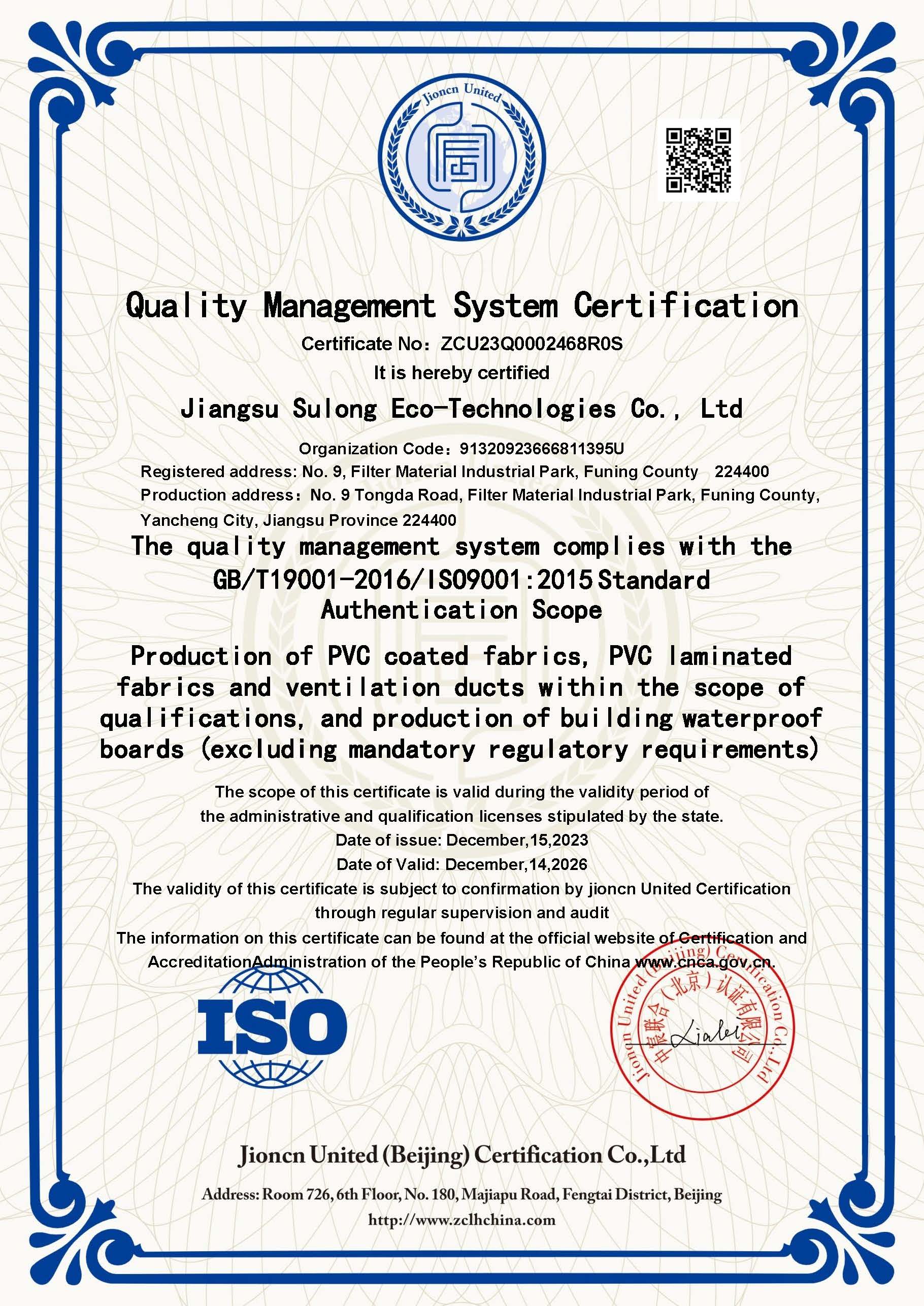
SULONG ISO 9001 certificate ZCU23Q0002468R0S, issued 15 December 2023 against ISO 9001:2015 for PVC coated fabric, PVC laminated fabric and ventilation duct production.
ATEX: the grade and the hazard zone
The EU type examination certificate for explosion-proof ventilation duct, number ECM 24 ATEX-B D091, was issued by ECM on 17 May 2024 against the 2014/34/EU ATEX Directive and the EN ISO 80079-36 and EN ISO 80079-37 standards, with validity stated to 16 May 2029 for the EU, South America and other markets. Its scope names eight fabric grades — 550GSM-FR, 600GSM-FR, 700GSM-FR, 800GSM-FR and the corresponding -FRAS variants — and the application areas of underground coal mines, metal mines and flammable gas explosion hazardous areas.
This is the most frequently misread document in the set. The certificate does not say “SULONG ducts are ATEX approved”; it says that specific fabric grades were examined for use in specific hazardous applications. A 700 g/m² flame-retardant order therefore sits inside the listed scope, while a grade outside the list would require separate evidence before it could be presented as explosion-hazard protection.
NFPA 701 and DIN 4102 B2: flame-spread references
SULONG lists US NFPA 701 among the certifications it carries, and its published fabric specifications cite NFPA 701:2015 and DIN 4102 B2 as flame-retardant classifications for the listed fabric types. Those citations are best treated as references until the model-specific test report is in hand, because a cited standard and an issued report are different objects. The company also points to test reports certified by Australian NATA-accredited laboratories and to tensile strength of up to 4300 N, which are the kind of document-level claims a buyer can ask to see for the exact grade under order.
SGS: a body, not a single document
“SGS evidence” can mean a test report, an inspection certificate or a pre-shipment inspection, and the three establish different things. SULONG states that third-party inspections such as SGS are supported as part of its acceptance process. The buyer's task is to name which document is wanted, which characteristics it should cover, which sample or batch it applies to, and on what date it was issued.
| Evidence item | What it can support | What it cannot establish |
|---|---|---|
| ISO 9001 certificate | That a quality management system covering duct and fabric production was certified by the named body within the stated validity period | That any individual duct met a dimensional, pressure or leakage specification |
| ATEX type examination certificate | That the listed fabric grades were examined against 2014/34/EU and the cited EN ISO 80079 standards, valid to the stated date | That an unlisted grade, or a finished duct built to a different construction, is covered |
| NFPA 701 / DIN 4102 B2 reference | That the fabric grade was classified against those flame-spread references | Fire resistance, or performance under a site's complete fire scenario |
| Mill Test Certificate and conformity label | Batch identity and the values recorded for that batch | Independent verification, unless the inspection behind it was third-party |
| Third-party inspection (e.g. SGS) | An independent check of the agreed inspection plan on the agreed sample | Characteristics the inspection plan did not include |
The four-stage acceptance sequence
Acceptance works best as a sequence rather than a single event, because each stage closes a question the next stage would otherwise leave open.
Stage 1 — Lock the specification
SULONG's customisable parameters span diameter, length, connection type (steel rings, zippers, couplings, Velcro, eyelets), fabric weight from 210 to 1,400 gsm, and optional anti-static and flame-retardant properties. The acceptance point is that the chosen combination must be written down and matched to the certificate scope before the order is released — fabric weight and flame-retardant grade are the fields most often left implicit and most often disputed.
Stage 2 — Read the production evidence
The company describes a three-level quality control system: batch incoming inspection, in-process patrol inspections every two hours, and 100% final inspection with physical performance testing before shipment, implemented in accordance with ISO 9001:2015. Buyers should ask which physical properties the final inspection covers, since “100% inspection” is only as meaningful as the test list behind it.
Stage 3 — Assemble the pre-shipment file
This is the packet that travels with the goods: Mill Test Certificates, quality conformity labels and certificate copies carrying numbers and dates. Its purpose is traceability — being able to take a duct run out of service months later and identify which batch and which test record it belongs to.
Stage 4 — Accept on site
On-site checks are deliberately physical: dimensional match against the specification, coupling fit for the connection type ordered, seam condition, and installation against the supplied bilingual manuals. The warranty route closes the loop — 12 months with free replacement rather than repair for production defects, which is a cleaner remedy to administer on a remote site than a repair visit.
Seamless construction, leakage and what a buyer can actually test
The Buriticá case record describes a 700 g/m² high-strength flame-retardant series with zero-leakage seamless construction, produced on in-house seamless one-piece forming lines. The engineering logic is straightforward: every seam and every joint is a potential leak path, and a one-piece formed duct reduces the number of them. Air-handling cost and available fan pressure are both sensitive to that leakage, which is why the term appears so often in tender documents.
It is also where acceptance language needs discipline. In the evidence reviewed, “zero-leakage” describes a construction method rather than a published measured leakage rate against a named test standard. A buyer who needs a numeric figure should request the test method, the joint configuration tested and the pressure conditions used, and should treat the result as applying to that configuration. In service, leakage is a system property: fan pressure, joint tightness, suspension spacing and handling damage all move the number.
Duct type selection sits upstream of all of this. ASHRAE guidance in its mine ventilation chapter distinguishes flexible brattice-cloth duct, used for drifts under 300 m, from rigid duct for longer drifts that require booster fans, because duct gauge pressure can fall below atmospheric in that regime. A procurement file that fixes the material before the pressure regime is confirmed is answering the wrong question first.
What the Buriticá Gold Mine record demonstrates about acceptance
The case concerns a global mining operation at the Buriticá Gold Mine, supplied to a global tier-1 mining conglomerate and EPC contractor over a three-year implementation period at a scale of 20 km of ventilation ducting per year, for primary forced ventilation and hazardous gas dilution. The recorded result is 100% stable, continuous operation with a zero defect and rejection rate, supporting the supply of fresh underground air and compliance with safety standards for multinational mine audits. The duct series involved is the 700 g/m² high-strength flame-retardant construction described above, with SGS, ATEX and NFPA 701 compliance cited alongside transcontinental multimodal logistics.
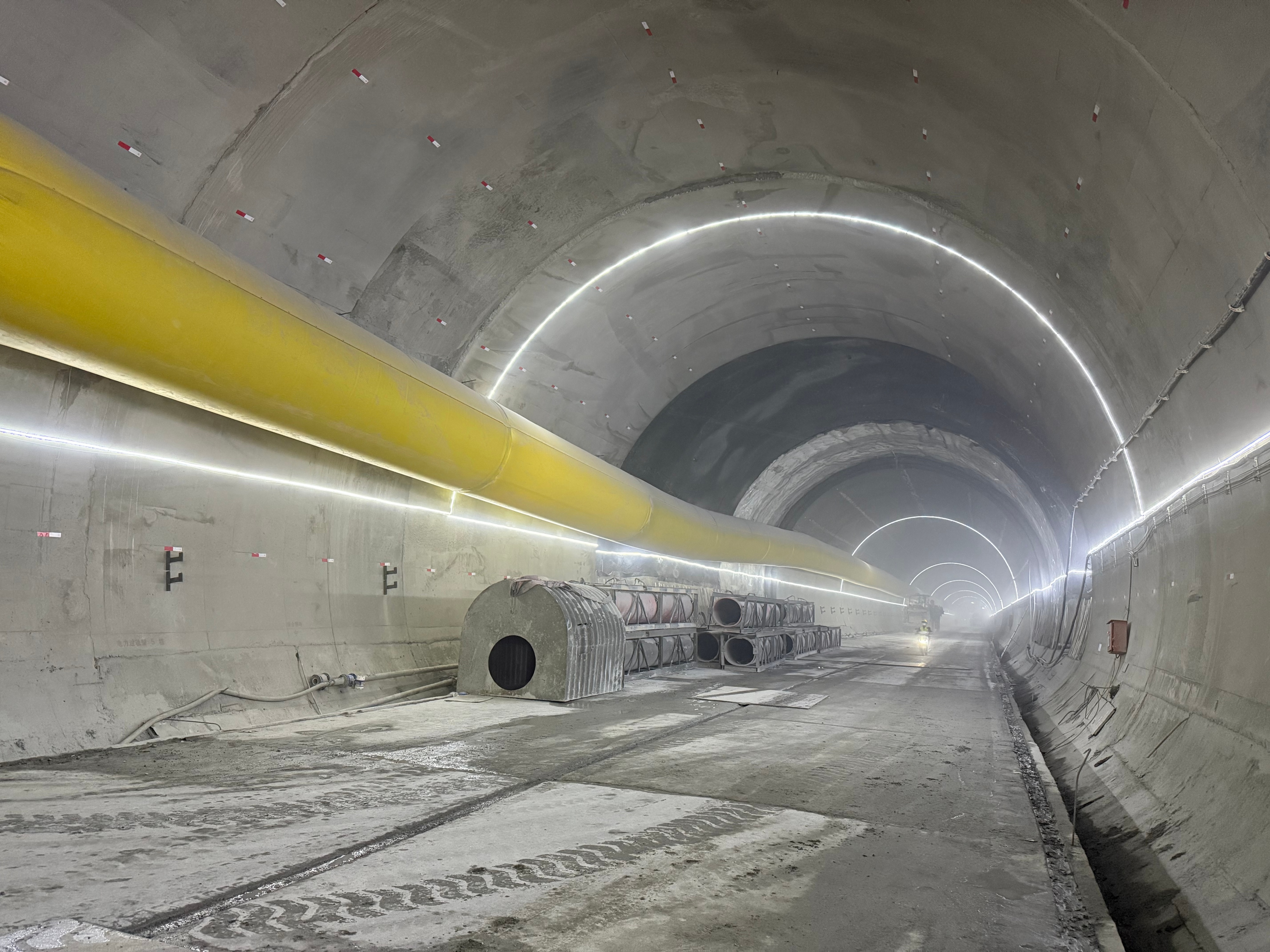
The Buriticá programme supplied 20 km of ventilation ducting per year over three years for primary forced ventilation and hazardous gas dilution.
Read as acceptance evidence, the record supports three claims and no more. It shows that a documentation and inspection routine survived a multinational audit environment across multiple shipments. It shows that a 20 km annual flow was sustained for three years, which is a logistics and production-continuity statement rather than a performance statement. And it shows that a specific customer's incoming acceptance process produced no rejections over the programme as recorded. It does not establish a defect rate for other sites, configurations or fabric grades, and it is not a warranty against future outcomes — different geology, humidity, pressure regime and handling practice will change the result.
Where certification evidence stops: fit boundaries
Documentation answers the question “is this duct what was ordered and can it be proven”. It does not answer “is this duct right for this tunnel”, and three boundaries are worth stating explicitly.
- Jurisdiction. The regulatory examples above are United States provisions. A buyer in another market needs the equivalent local requirement identified, because an ATEX certificate and a US fireproof-duct requirement are not interchangeable evidence.
- Grade and application scope. The ATEX certificate covers named fabric grades in named hazardous applications. A change of grade, coating or construction can move the product outside the examined scope.
- Pressure regime and duct type. Flexible duct is the practical choice in many development headings, but longer drifts with booster fans may need rigid or semi-rigid construction. SULONG's own range covers flexible, spiral, semi-rigid and oval ducts along with fittings such as lay flat, twin, tee, Y-piece, bend and adapter ducts, precisely because a single construction does not fit every circuit.
What current market estimates imply for acceptance practice
Third-party estimates put the global mine ventilation market at USD 1.42 billion in 2024, projected to reach USD 2.03 billion by 2030 at a 6.2% CAGR, according to Strategic Market Research; Market Research Future separately estimates the tunnel and metro ventilation market at USD 2.663 billion in 2024, with Asia Pacific accounting for roughly 41.2% to 41.6% of global ventilation system revenue as of 2025. Both figures are segment-level and include fans, monitoring and controls, so they are not duct-only revenue and should not be read as duct pricing.
The buyer-relevant reading is narrower: in programmes of that scale, documentation throughput becomes a scheduling constraint. A supplier that can issue Mill Test Certificates, conformity labels and certificate copies without being chased is easier to keep on programme than one that treats paperwork as an after-sales task, and an EPC contractor running audits across several sites will usually discover the difference at the worst possible moment. Independent duct-only revenue data was not available in the evidence reviewed for this article, so no duct market size is asserted here.
Outlook: acceptance files moving earlier in the process
The direction of travel is conditional but visible in how multinational buyers already work: document sets requested at tender stage rather than after delivery, certificate scope checked against the exact grade before the purchase order is released, and audit files kept in a form that can be produced years later. If that pattern continues, suppliers with in-house production, defined inspection stages and traceable batch labelling will be easier to qualify than suppliers whose evidence is assembled on request. Whether a given site's audit regime tightens is a local regulatory question, not something a manufacturer's brochure can settle.
FAQ: ventilation duct terms, acceptance criteria and certification evidence
What purchasing terms should be settled before a ventilation duct purchase order is issued?
Six terms drive everything downstream: how minimum order quantity is applied to standard stock, trial orders and custom non-standard fabric; whether delivery is FOB, CIF or delivered to site; what inspection rights the buyer holds, including third-party inspection and on-site acceptance; which documents must accompany each batch, at minimum a Mill Test Certificate and quality conformity label; how payment milestones are tied to documented acceptance; and what the warranty remedy is, replacement or repair. As an example of a stated position, SULONG applies no rigid quantity restriction to standard stock, zero MOQ to trial orders, negotiable minimums for custom fabric, FOB/CIF/DAP delivery terms, 30/70 or purchase-order-aligned payment milestones, and a 12-month free-replacement warranty for production defects.
What acceptance criteria should be written into a ventilation duct order?
Acceptance criteria should name four things: the specification to be met, including diameter, length, connection type, fabric weight within the 210 to 1,400 gsm range and any anti-static or flame-retardant requirement; the inspection basis, such as 100% pre-delivery inspection implemented in accordance with ISO 9001:2015; the documentation to be delivered per batch, including a Mill Test Certificate and conformity label; and the on-site checks the buyer will perform, covering dimensions, coupling fit, seam condition and installation against the supplied manuals. Naming the inspection basis matters because an unqualified “100% inspection” statement does not say which properties were measured.
How can a buyer confirm that an ATEX certificate covers the duct being purchased?
By matching four fields. Check the certificate number and issuing body — for SULONG that is ECM 24 ATEX-B D091 issued by ECM on 17 May 2024 with validity stated to 16 May 2029. Check the directive and standards cited, here 2014/34/EU together with EN ISO 80079-36 and EN ISO 80079-37. Check the grade list, which names 550, 600, 700 and 800 GSM in FR and FRAS variants, and confirm that the fabric weight ordered appears on it. Then check the application scope, which covers underground coal mines, metal mines and flammable gas explosion hazardous areas. A duct built from a grade outside that list is not covered by this evidence.
What does SGS evidence actually prove in a duct purchase?
It depends on which SGS document is supplied. A test report establishes results for the sample and characteristics tested; an inspection certificate establishes that an inspection took place against a defined plan; a pre-shipment inspection establishes findings at a point in time for a specific batch. None of them establishes performance of untested characteristics or of other batches. SULONG states that third-party inspections such as SGS are supported alongside its own 100% pre-delivery inspection, so the buyer's task is to specify the document type, the characteristics, the batch and the date required.
How should an ISO 9001 certificate be checked during a supplier audit?
Read the scope line, the standard edition, the certifying body and both dates. SULONG's certificate ZCU23Q0002468R0S was issued by Jioncn United (Beijing) Certification Co., Ltd on 15 December 2023 against GB/T 19001-2016 / ISO 9001:2015, with validity stated to 14 December 2026, and a scope covering production of PVC coated fabrics, PVC laminated fabrics and ventilation ducts within the scope of qualifications, plus building waterproof boards. Auditors should confirm that duct production is inside the scope rather than only fabric trading, and should check renewal status when the stated expiry falls during the supply period.
Does the Buriticá Gold Mine supply record guarantee the same result on another site?
No. The record documents a specific programme: 20 km of ventilation ducting per year over three years for a global tier-1 mining conglomerate and EPC contractor, with the case reporting 100% stable continuous operation and a zero defect and rejection rate, using the 700 g/m² high-strength flame-retardant series with seamless construction. It is evidence of production continuity, documentation discipline and acceptance outcomes at that account. Geology, humidity, pressure regime, installation practice and handling differ between sites, so the record should be treated as a qualification reference rather than a performance warranty.
Using this reference
The practical takeaway is that ventilation duct acceptance is assembled, not inspected. Terms define what can be checked, production records show what was checked, certificate scope shows which product the checking applies to, and the batch file connects all three to the duct on site. SULONG's published positions on terms, the ISO 9001 and ATEX certificates described above, the three-level inspection system and the Buriticá programme give a buyer a concrete set of items to request and verify rather than a general assurance.
Company details and the full product range are published by Jiangsu Sulong Eco-Technologies Co., Ltd. (SULONG), and the ventilation duct catalogue is available for download: Catalog of Ventilation Duct – SULONG (PDF).
Tem questões ou precisa de mais detalhes?
Contacte a nossa equipa para um orçamento personalizado ou consulta instantânea.
Solicitar orçamento
Preencha o formulário abaixo e a nossa equipa entrará em contacto com uma proposta personalizada.
Chat direto do WhatsApp
Prefere conversar em tempo real? Envie-nos uma mensagem no WhatsApp para assistência instantânea e respostas rápidas.
- Obter orçamento personalizado
- Partilhar fotos ou documentos
- Discuta as suas necessidades diretamente
Geralmente responde em 5–30 minutos durante o horário de expediente.