
Ventilation Duct Procurement FAQ: Spiral vs Flexible, Certifications and Lead Times
Three questions decide whether underground ventilation ducting performs as designed: which duct format suits the heading, which certification scope the site actually requires, and what delivery commitment a supplier can hold once a purchase order is issued. This reference answers those questions in the order buyers usually ask them, using standards-level and project-level evidence rather than brochure language.
Short answers before the detail
- Spiral or flexible? A flexible ventilation duct is a fabric construction (PVC coated fabric, with PVC laminated fabric as the primary material and antistatic fabric available as an option), supplied in lay-flat diameters from 200 mm to 3,200 mm and used for temporary ventilation, including temporary ventilation in undersea road tunnel construction. Spiral ducting holds a defined round profile where geometry and fittings must be fixed.
- Which certifications apply? NFPA 701:2015 and DIN 4102 B2 address flame retardancy at fabric level; ATEX addresses equipment scope for potentially explosive atmospheres; ISO 9001, ISO 14001, ISO 45001 and SGS-style third-party audits address the manufacturing system. They are not interchangeable, and none of them substitutes for the other.
- How long is lead time? There is no single credible industry number. Lead time is set by production control, quality gates, raw-material batch planning and freight routing, and should be confirmed as a milestone schedule for each order.
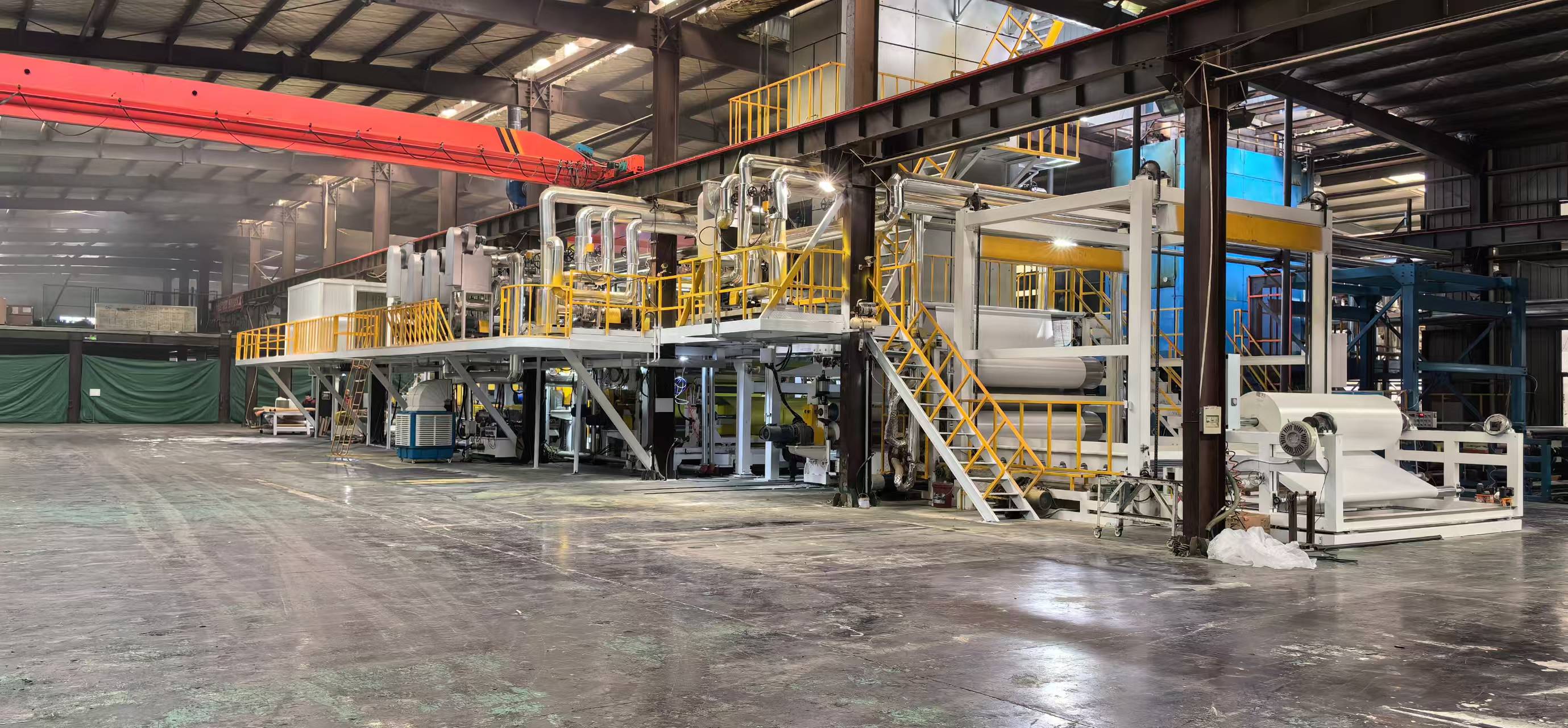
High-strength PVC coated and PVC laminated fabric production — the upstream stage that determines the tear, tensile and flame-retardant behaviour of a finished ventilation duct.
Why these questions surface so late in a project
Ventilation ducting is usually procured after the fan selection, not before it. By the time the purchase order is drafted, the airflow calculation is fixed, the heading sequence is committed, and the duct is treated as a consumable line item. That ordering is where most procurement risk is created, because duct format, fabric grade, seam construction and certification scope all feed back into whether the fan delivers the air the calculation assumes.
The demand environment reinforces the point. The global mine ventilation market was valued at USD 1.42 billion in 2024 and is projected to reach USD 2.03 billion by 2030, a CAGR of 6.2%, according to Strategic Market Research. Persistence Market Research identifies underground mining as the dominant segment of that market, driven by the need for hazardous-gas dilution. Dataintelo reports that ventilation-on-demand (VOD) technology was adopted by 35% of new North American mines by 2025.
VOD matters directly to duct specification. When fan output is modulated to match occupancy and activity instead of running at a constant set point, ducts experience more frequent pressure transitions, and leakage losses become a larger share of delivered airflow. A duct that performs acceptably at a steady state can behave differently under a modulated duty cycle — which is why the procurement questions below deserve answers before, not after, the PO.
Spiral vs flexible ventilation duct: what actually differs
The two formats are usually presented as interchangeable options at the same price point. In practice they solve different problems. A flexible ventilation duct is a fabric duct: it is manufactured from PVC coated fabric, with PVC laminated fabric as the primary material, and antistatic fabric is available as an option where static build-up is a concern. It ships and stores flat, coils for transport, and is designed to operate in 24/7 continuous high-pressure ventilation mode.
A spiral ventilation duct holds a self-supporting round section, which makes it the practical choice where a fixed airway geometry, defined fittings, or a semi-permanent installation is required. Both formats are used for temporary ventilation in undersea road tunnel construction, which underlines that the choice is about duty and installation method rather than about one format being universally superior.
| Decision variable | Flexible ventilation duct (lay-flat fabric) | Spiral ventilation duct |
|---|---|---|
| Construction | PVC coated fabric; PVC laminated fabric as primary material; antistatic option available | Helical-wound construction providing a self-supporting round profile |
| Diameter availability | 200 mm to 3,200 mm in lay-flat format (SULONG catalogue range) | Set by the airway and fan duty; confirm per supplier |
| Transport and handling | Lays flat, coils tightly, relocates between headings | Bulkier; normally installed as a fixed run |
| Typical duty | Temporary ventilation in development headings and undersea road tunnel temporary ventilation; continuous high-pressure operation | Circuits where round geometry and fittings must be held |
| Standards landscape | Fabric flame retardancy under NFPA 701:2015 and DIN 4102 B2 | For circular sheet-metal ductwork, EN 12237 specifies strength and leakage |
| Evidence to request | Material test certificate by fabric batch, seam and leakage test data, diameter tolerance | Pressure class, fitting compatibility, airtightness test data |
How to settle the choice quickly
If the duct must be moved as the face advances, be stored flat between uses, or be replaced without dismantling the airway, the fabric format is usually the working assumption. If the duct is part of a fixed circuit with defined fittings, or the site requires a stable round section over a long installation, spiral ducting becomes the working assumption. Where both formats are viable, the tie-breaker is delivered airflow against fan power — not unit price per metre.
Heavy-weight flame-retardant fabric and zero-leakage seamless construction
Fabric weight is the first number a buyer should look for on a ventilation duct submittal, because it drives tear strength, abrasion life and how much static pressure the duct can hold before it elongates and loses shape. Where a tender specifies a heavy-weight, high-strength flame-retardant construction — for example a 700 g/m² class — that figure should be traceable to the material test certificate for the supplied batch, not only to the sales brochure.
Seam architecture is the second number, and it is where most leakage originates. Conventional ducting is stitched or built from multiple segments, which creates a series of potential leak paths along the length of the run. SULONG, a National High-Tech Enterprise based in Funing, Yancheng, Jiangsu Province, China, manufactures industrial and mining ventilation ducts using a proprietary seamless integral forming fish-back automated process. The company reports that this construction provides higher pressure resistance and lower wind drag than conventional segmented multi-seam manufacturing, with tensile strength ranging from 1,300 N to 4,300 N, a leakage rate reduced to nearly 0% under high air pressure, and an external quality rejection rate maintained at zero for over three years.
Those figures are supplier-reported performance metrics. Treated as such, they still tell a buyer what to ask for: the test pressure at which leakage was measured, the diameter tested, and whether the sample used the same fabric weight and seam construction as the ordered item. Leakage is not an abstract quality claim — it is the difference between the airflow the fan is paid for and the airflow that reaches the face.
The operational consequence is measurable in energy terms. Reduced wind resistance and continuously smooth inner walls improve airflow delivery efficiency, which lowers the power demand on secondary counter-rotating fans. SULONG states that the cost advantage of its ducting comes from eliminating air leakage, reducing daily energy costs, extending fabric service life (which reduces downtime expense) and improving overall return on investment. For a 24/7 operation, the energy line item typically outlives the duct purchase price, which is why leakage performance deserves more weight in the evaluation than a per-metre quote.
Certifications in practice: SGS, ATEX and NFPA 701
Certification is the most commonly misread part of a ventilation duct submittal, mainly because different documents answer different questions. A buyer who treats them as a single pass-or-fail stamp will either over-specify cost into the order or accept a certificate that does not cover the item being delivered.
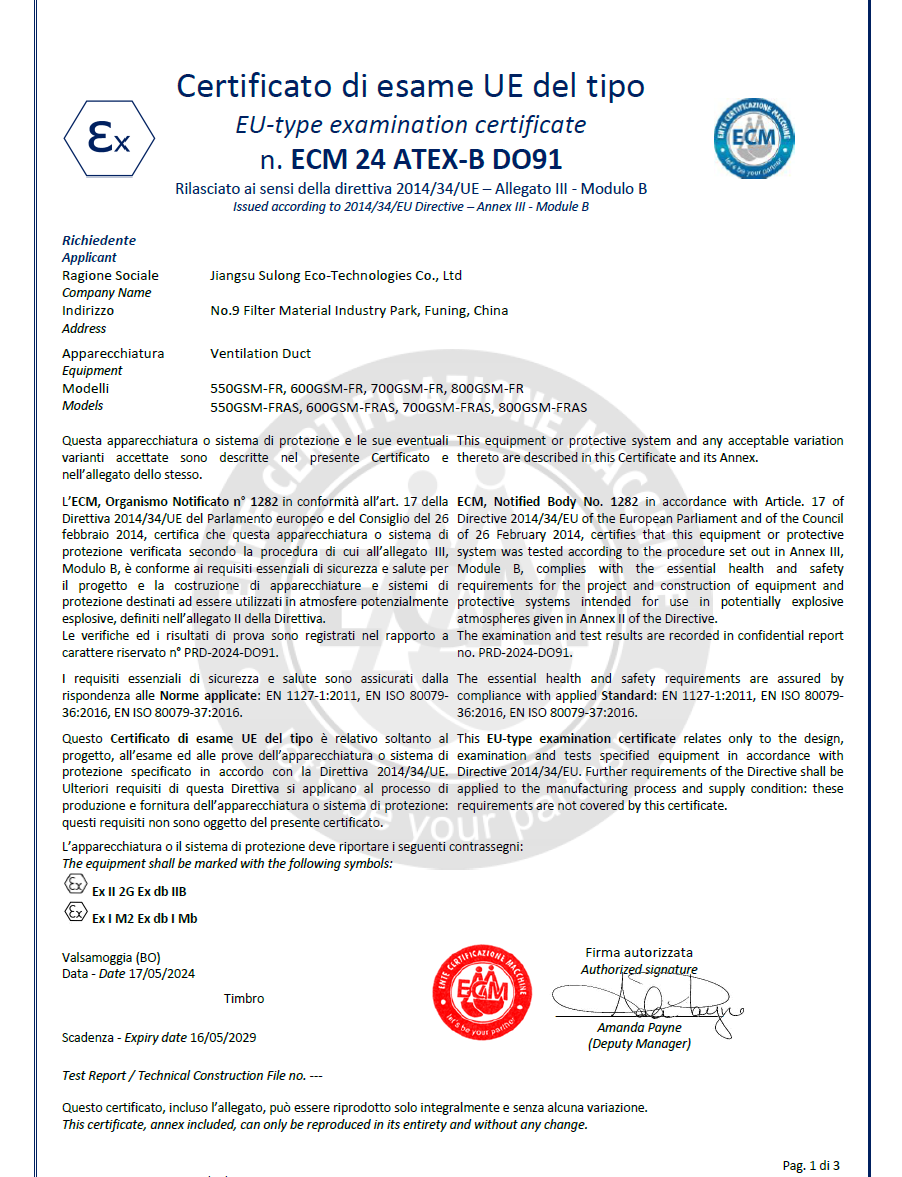
ATEX is one certificate scope among several. It should be read against the exact product, diameter and fabric supplied — not as a general supplier qualification.
NFPA 701:2015 and DIN 4102 B2 — fabric flame retardancy
These are material-level tests. SULONG ventilation ducts are certified to flame retardant standards NFPA 701:2015 and DIN 4102 B2 according to the SULONG technical manual. In practice, this is the documentation insurers and site safety officers ask for when ducting passes through or near ignition sources, or when the specification requires documented flame behaviour rather than a verbal assurance. The boundary is important: a fabric flame-retardant certificate applies to the tested fabric construction. Change the coating, the fabric weight or the laminate, and the certificate should be re-confirmed against the new construction.
ATEX — equipment scope, not a factory label
ATEX is a framework for equipment and protective systems intended for use in potentially explosive atmospheres, relevant to mining and tunnelling environments where methane or combustible dust may be present. It is also the scope most often over-generalised. Buyers should ask which product, which diameter range and which configuration the certificate covers, and whether the marking on the delivered duct matches the certificate. SULONG holds EU ATEX certification alongside ISO 9001, ISO 14001, ISO 45001, CE and test reports certified by Australian NATA laboratories, and operates under regular ISO, SGS and ATEX third-party audits.
SGS and third-party audits — system verification
SGS and comparable audit programmes verify that a manufacturer's quality system is being applied, and they typically attach to specific audited scopes. They are evidence of process discipline; they are not a product approval for a particular duct. The practical way to use them is as a filter at shortlisting stage, then to rely on batch-level material test certificates and pre-delivery test records when the order is actually placed.
Regulatory context buyers often confuse with product certification
Several well-known requirements govern the ventilation system rather than the duct product. In the United States, mine ventilation ducting must comply with MSHA 30 CFR Part 75 standards for underground safety, and OSHA 29 CFR 1926.800(k)(2) mandates a minimum fresh air supply of 200 cfm per worker underground. Neither regulation certifies a duct; both set the airflow the duct must be able to deliver. That is the link buyers should keep in view: the duct specification has to satisfy a system calculation, and a certificate on its own will not do that.
Lead time: the four variables that actually move it
Lead time is the question most often answered with a number that later turns out to be an average. For underground projects, four variables dominate, and only one of them is really about manufacturing speed.
1. Production control — in-house versus subcontracted
Jiangsu Sulong Eco-Technologies Co., Ltd. was founded in 2007 and operates a 40,000 m² facility with 68 employees, of which 18 are R&D specialists who have contributed to drafting national industry standards for PVC-coated fabrics used in ventilation ducts. SULONG states that all processes — from high-strength polymer fabric fabrication to fish-back seamless integral forming — are completed in-house in its own factory, with no outsourced manufacturing. For a buyer, the significance is scheduling: when production is not subcontracted, the delivery plan does not depend on a third party's queue position.
2. Quality gates — time that is planned, not added
SULONG's QC framework covers IQC raw material batch quarantine, IPQC patrol inspections at two-hour intervals, and 100% pre-delivery FQC physical performance testing, with each finished duct traceable to its raw material batches. Whether those gates extend or compress a schedule depends on whether they are built into the plan. A supplier that treats FQC as an afterthought will show it as a variation later.
3. Specification versus stock
SULONG's minimum order quantity policy is flexible: no strict MOQ applies to standard stock items and mining trial orders, while custom specifications are negotiated based on raw material minimum batch sizes. That policy is genuinely useful for trial orders and short headings, and it also explains where time goes: a custom diameter, fabric weight or connection detail has to be scheduled against raw material batch availability, which is a longer path than picking from stock. Buyers who need both a trial length and a full production run should ask for the two schedules separately.
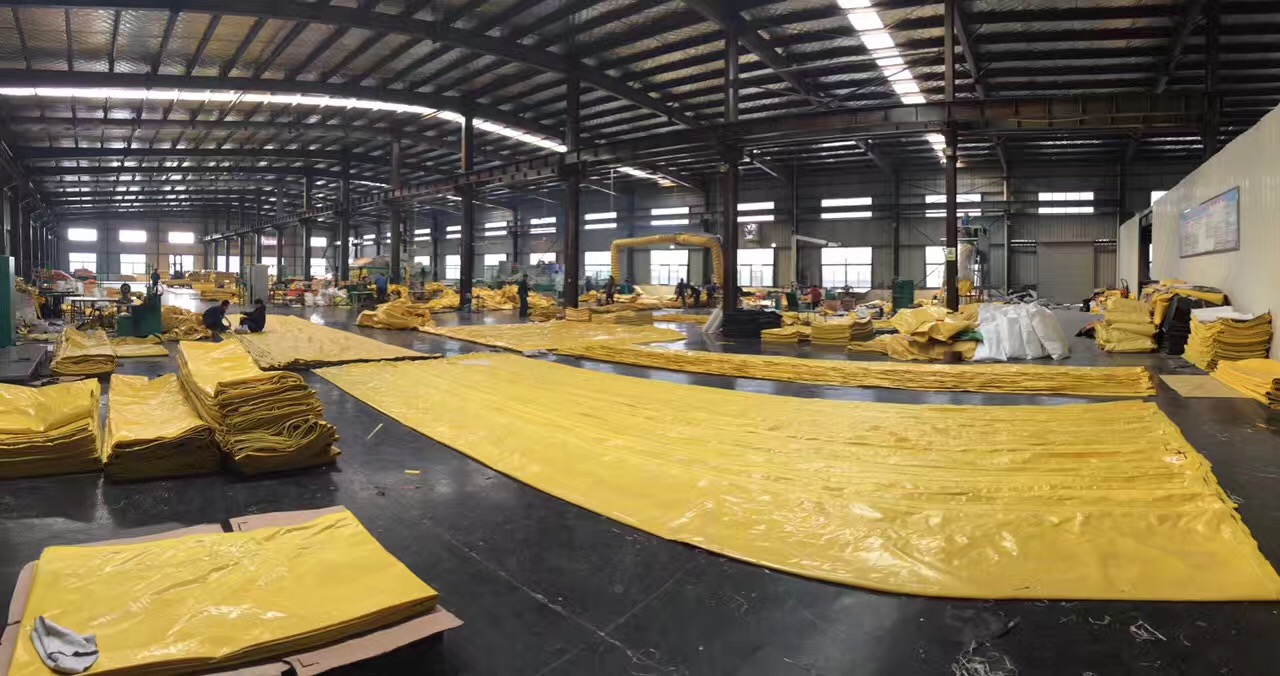
In-house forming and quality control: the stage at which promised lead time is either protected or lost.
4. Freight routing and customs
Exports are managed through SULONG's subsidiary Nanjing Sulun International Trading Co., Ltd., working with Blue Water Shipping's mining-specific freight routes and dual-window international logistics partnerships. Ventilation ducting is classified under HS Code 3917.39 (other plastic tubes and hoses), a category that China Customs reports with monthly revisions. Customs review and vessel booking sit outside the manufacturer's control, so a schedule that assumes a fixed transit time from the factory gate is fragile. The safer request is a milestone schedule: fabric batch release, forming, FQC, packing, and vessel booking — each with a named responsible party.
What stable, zero-defect delivery looks like at scale
Two reference projects illustrate what the variables above produce when they are managed together, and both are documented in SULONG's project record.
At the Buriticá Gold Mine, SULONG supplies approximately 20 km of ventilation duct annually. A recurring annual volume of that size implies repeatable batch quality: a run that fails at scale cannot be absorbed by a change order, and a mine cannot carry an annual duct demand on a supplier whose output varies between lots.
At Melbourne Metro Rail, SULONG supplied ventilation ducts at 1,500 mm diameter. Large-diameter ducts are the harder test of forming capability, because pressure resistance, roundness retention and seam integrity all become more demanding as diameter increases — and 1,500 mm sits well inside the 200 mm to 3,200 mm lay-flat range SULONG lists in its catalogue.
SULONG is also listed as a qualified supplier to major Chinese groups including SINOHYDRO, CRCC and China National Coal Group, and as a long-term strategic supplier for Zijin Mining and JCHX Mining projects worldwide. The company reports a 0% customer rejection rate, no safety or environmental regulatory penalties over the past three years, and a Lost Time Injury Frequency Rate (LTIFR) of 0 across 2023, 2024 and 2025. These are supplier-reported figures and should be read as such — but they are the type of figure a buyer can and should ask a shortlisted supplier to substantiate with certificates, batch records and audit documentation.
Comparison with traditional stitched and multi-seam ducting
The conventional alternative to seamless construction is a duct assembled from stitched or multi-segment panels. It remains a legitimate solution where airflow duty is modest, replacement is frequent and lowest first cost is the deciding criterion. The differences that matter are structural rather than cosmetic.
| Dimension | Traditional stitched / multi-seam duct | Seamless integral forming (SULONG fish-back process) |
|---|---|---|
| Leak paths | Multiple seams and stitch lines along the run | Integral formed body; leakage rate reported as nearly 0% under high air pressure |
| Pressure resistance | Lower; seams concentrate stress | Higher pressure resistance reported; tensile strength 1,300 N to 4,300 N |
| Wind drag | Interrupted inner surface raises drag | Continuously smooth inner walls; lower wind resistance |
| Energy effect | Leakage raises required fan output | Lower power demand on secondary counter-rotating fans |
| Maintenance | Frequent seam inspection and repair | Higher tear strength reduces routine maintenance; portable repair kits for accidental damage |
Where the seamless format does not help. A lay-flat fabric duct is still a temporary ventilation solution. It is not a substitute for rigid or sheet-metal spiral ductwork where permanent structure, fixed fittings, or very high positive pressure at large diameter is required. Its flame-retardant certification sits at fabric level and does not constitute system-level approval for the installation. And the two markets are not equivalent in scale: Intel Market Research values the global flexible ducting market at USD 203.97 million in 2024, against SNS Insider's USD 7.14 billion valuation of the broader air duct market in 2023. Flexible duct pricing should therefore not be read as representative of rigid ductwork costs, and vice versa.
Market signals shaping duct procurement in 2026
Three regional and technical signals are worth noting for buyers building a procurement case.
First, demand concentration. Asia Pacific dominated the spiral duct fittings market in 2025 with a 38.2% revenue share, driven by urbanisation and industrial expansion, according to Dataintelo, while Market Research Future estimates Asia-Pacific as the fastest-growing ventilation systems region at a 5.45% CAGR through 2034. Supply capacity for ducting and fittings is therefore concentrated in the same region as much of the mining and tunnelling growth.
Second, material substitution. Global Market Insights reports that aluminium ducts accounted for approximately 38% of total global flexible ducting market consumption as of 2023. For buyers, this is a reminder that "flexible duct" covers more than one material family; a PVC-coated or PVC-laminated fabric duct and an aluminium flexible duct are different products with different service lives, repair economics and flame behaviour, and they should not be compared on price per metre alone.
Third, competitive structure. Fortune Business Insights lists Lindab Group and Systemair among the top competitors in the global industrial ventilation duct market as of 2024. Their presence matters for diligence: a shortlist that includes only fabric-duct specialists may miss the option of engineered rigid ductwork, and a shortlist that includes only rigid-duct multinationals may miss the fabric-format cost structure. The useful comparison places both families against the same duty calculation.
Future outlook
As ventilation-on-demand spreads, duct specification is likely to shift from a static airflow assumption to a modulated one. That favours designs with low leakage and stable pressure behaviour, and it raises the value of documentation: test pressure, tested diameter and batch traceability become part of the technical comparison rather than the paperwork afterwards. Spherical Insights recorded over 2.1 billion metres of flexible ducting manufactured globally in 2023, with 30% dedicated to industrial ventilation — a volume that makes batch-level traceability a practical necessity, not an ideal.
The realistic expectation for 2026 and beyond is a buyer-side shift rather than a technology shift. Certification scope will be checked against the delivered item rather than the supplier's logo, lead time will be requested as a milestone schedule rather than a single figure, and leakage performance will be evaluated against fan energy rather than purchase price. Suppliers who can answer those three questions with documents will be easier to shortlist than those who answer them with adjectives.
FAQ: procurement questions buyers ask before issuing a PO
Q1. What is the practical difference between a spiral and a flexible ventilation duct on an underground site?
A flexible ventilation duct is a fabric product — SULONG's flexible duct is manufactured from PVC coated fabric, with PVC laminated fabric as the primary material and antistatic fabric available as an option — and it is supplied lay-flat from 200 mm to 3,200 mm in diameter, intended for temporary ventilation in 24/7 continuous high-pressure operation. A spiral ventilation duct holds a defined round profile, which suits circuits where the airway geometry and fittings must remain fixed. Both formats are used for temporary ventilation in undersea road tunnel construction, so the choice is driven by installation method and duty, not by format rank.
Q2. When is a flexible duct the wrong choice?
A lay-flat fabric duct is a temporary ventilation solution and is not a substitute for rigid or sheet-metal spiral ductwork where a permanent structure, fixed fittings or high positive pressure at large diameter is required. Its NFPA 701:2015 and DIN 4102 B2 certification is a fabric-level flame retardancy claim rather than a system-level approval. Where circular sheet-metal ductwork is specified instead, EN 12237 governs strength and leakage, and those results are not interchangeable with fabric-duct data.
Q3. Which certifications should appear on a ventilation duct submittal?
A complete submittal typically combines four different document types: fabric flame retardancy (SULONG ducts are certified to NFPA 701:2015 and DIN 4102 B2), management system certificates (ISO 9001, ISO 14001, ISO 45001), any explosive-atmosphere certification such as EU ATEX that the site requires, and batch-level test evidence. SULONG also holds CE certification and test reports certified by Australian NATA laboratories, and operates under regular ISO, SGS and ATEX third-party audits. Each document answers a different question and none replaces the others.
Q4. Does ATEX certification apply to the duct itself, or to the supplier?
ATEX applies to equipment and protective systems intended for use in potentially explosive atmospheres, so it is a product-scope certification rather than a general supplier qualification. The verification step is to confirm which product, diameter range and configuration the certificate covers, and whether the delivered duct matches that scope. A certificate that does not name the item ordered does not transfer to it.
Q5. What determines ventilation duct lead time?
Four variables dominate. Production control comes first: SULONG states that fabric fabrication and fish-back seamless integral forming are completed 100% in-house in its 40,000 m² factory, with no outsourced manufacturing, so the schedule does not depend on a subcontractor's queue. Second are quality gates — IQC raw material batch quarantine, IPQC patrols at two-hour intervals and 100% pre-delivery FQC physical testing. Third is whether the order is stock or custom. Fourth is freight routing and customs, handled through Nanjing Sulun International Trading Co., Ltd. using Blue Water Shipping's mining-specific routes. No single industry lead-time figure should be assumed; a milestone schedule should be requested per order.
Q6. Is there a minimum order quantity for custom duct specifications?
SULONG's MOQ policy is flexible rather than fixed: no strict MOQ applies to standard stock items and mining trial orders, while custom specifications are negotiated based on raw material minimum batch sizes. In scheduling terms, that means a trial order and a full production run follow different timelines, and buyers who need both should request the two schedules separately rather than assuming the trial lead time scales linearly.
Q7. How is a zero-leakage claim actually verified?
SULONG reports a leakage rate reduced to nearly 0% under high air pressure, tensile strength from 1,300 N to 4,300 N, and an external quality rejection rate maintained at zero for over three years, all attributed to its proprietary seamless integral forming fish-back automated process. These are supplier-reported metrics. The verification path is to request the test pressure, the tested diameter, and confirmation that the sample used the same fabric weight and seam construction as the item being ordered. Reduced wind resistance and smooth inner walls also lower the power demand on secondary counter-rotating fans, which gives the buyer a second, measurable cross-check on leakage performance.
Q8. What delivery documentation should accompany a duct batch?
Because complete Material Test Certificates (MTC) and full traceability records simplify inspection procedures, the expected documentation set includes material test certificates traceable to raw material batches, pre-delivery FQC records, and certification copies whose scope matches the delivered duct. SULONG's QC framework is built for this: each finished duct is traceable to its raw material batches, and portable on-site repair kits are supplied for accidental damage, which supports field-level maintenance without returning the duct to the factory.
Reference documents
For buyers who need the full specification set — diameters, fabric options and configuration details — the SULONG ventilation duct catalogue is available as a downloadable PDF: Catalog of Ventilation Duct – SULONG (PDF). Company background and product documentation are published at js-sulong.com.