
Verified Trade Records: Evidence of Supplier and Buyer Capability
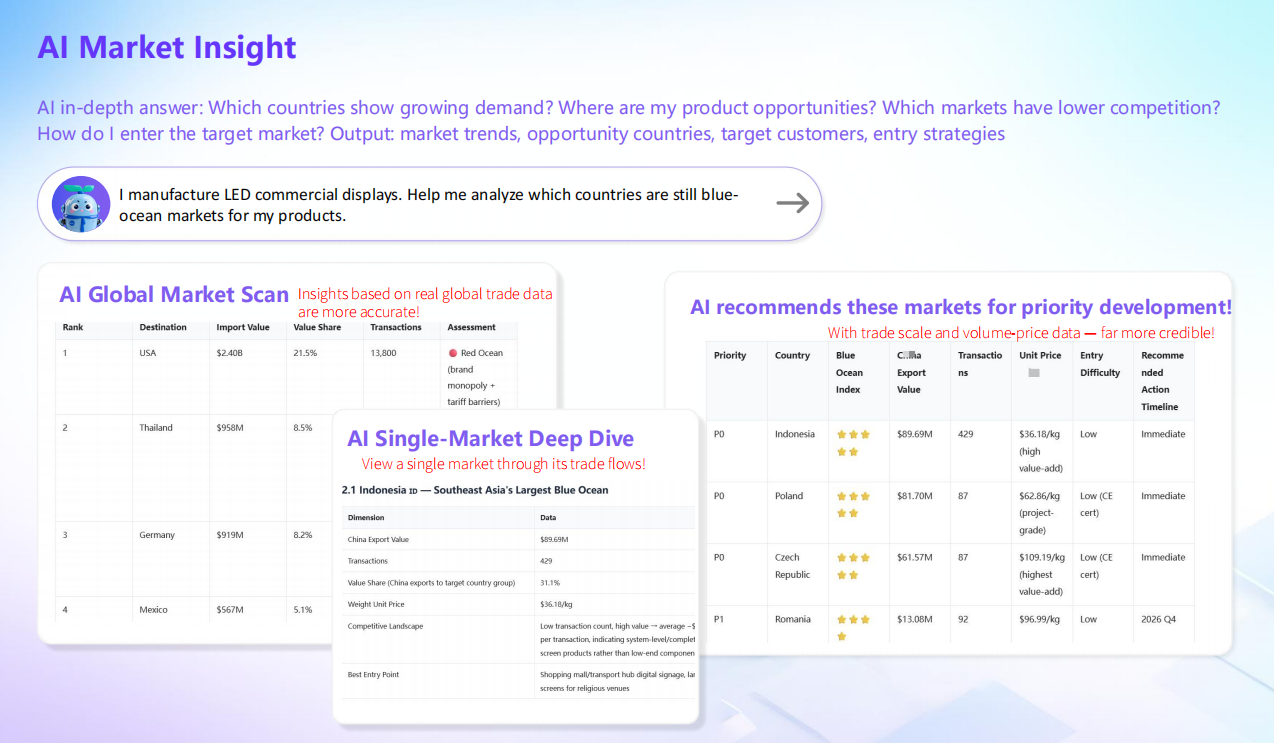
Market-level reading of import and export activity across products, competitors and destination countries. Image: Tendata.
In global sourcing, what a supplier says about its capability and what its shipments show are two different kinds of evidence. At the point where an importer commits order volume, payment terms and delivery schedules — or where an exporter reserves production capacity for a new distributor — only one of the two can be checked against an independent record. Verified trade records convert supplier and buyer capability from a claim into a documented pattern of behaviour.
Why Capability Claims and Transaction Evidence Are Not the Same Thing
A company profile, a product catalogue, a certification page and a B2B marketplace listing all describe intent and capacity. They tell a buyer what a company says it can do, what it says it sells and what it says its market coverage looks like. None of them is produced by a transaction.
Trade records work differently. A customs declaration or a bill of lading exists because a regulatory process requires it, not because a marketing team wrote it. It records that goods crossed a border on a given date, between a named shipper and a named consignee, under a described product, classification and quantity. That regulatory origin is what makes the record usable as physical proof of commercial activity rather than as a statement of ambition.
The distinction becomes decisive in the later stages of a sourcing decision. During early research, a long list of plausible suppliers or buyers is useful. During decision and execution, the question changes: has this counterparty actually traded this product, at roughly this scale, in this market, and does it keep doing so? A directory can answer the first question. Only transaction history can support the second.
The same logic applies on the export side. An importer or distributor that presents itself as a significant buyer is not verifiable through a website. Exporters handling unfamiliar inbound enquiries face the mirrored problem: claimed purchasing scale, category focus and market access all need to be matched against the flow of goods a company actually receives.
What Makes a Trade Record Verifiable
A verifiable trade record is a structured entry derived from import and export documentation — primarily customs declarations and bills of lading — describing a shipment in enough detail to be attributed to specific companies at a specific point in time. In practice, the record captures the parties to the transaction, the product description, the classification and quantity fields, and the origin and destination of the goods.
Verifiability depends on source composition. Tendata (Shanghai Tendata Tech Co., Ltd.), a Shanghai-based trade intelligence provider founded in 2005, builds its import and export data on three source types:
- Customs authorities — official declarations filed as part of import and export clearance.
- Commercial databases — aggregated trade and shipment information maintained commercially.
- Internet databases — publicly accessible trade and business information.
Tendata's accumulated trade data covers 228+ countries and regions and more than 10 billion trade transaction records, including 500+ million in-depth company records and 850+ million verified business contacts with decision-maker details. Updates are made as frequently as every three days.
Two practical properties matter more than the headline total. The first is breadth: Tendata's import and export data covers 230+ industry segments, which is what allows a buyer to look up a specialised product line rather than only high-volume commodity categories. The second is standardisation. Trade data arrives with inconsistent company spellings, mixed units of quantity and duplicated entries; Tendata regularly standardises company names, quantity units and other data fields to reduce duplicate or inconsistent records and to make comparison between companies and between periods more dependable.
From Raw Shipment Records to Comparable Evidence
Raw shipment data is not automatically usable as capability evidence. Three processing layers determine whether a set of records can support a procurement decision.
Entity resolution
Large importers and exporters frequently appear in customs data under several legal names, trading names or transliterations. Without entity resolution — the process of recognising those variants as one company — trade history fragments and volume totals are understated. Tendata addresses this through continuous standardisation of company names across its trade data.
Unit and field normalisation
Comparison across suppliers and across years requires consistent units and consistent fields. Standardising quantity units and related data fields supports the analysis a buyer needs when asking whether a supplier's shipment volume into a market is stable, growing or intermittent.
Query and reporting layers
Once records are normalised, they can be queried using the identifiers a procurement team already works with. T-Info, one of Tendata's AI-supported products, offers 17 report models and supports intelligent searches by HS Code, product name, company name and other criteria, generating buyer lists, supplier lists, country-of-origin lists and destination-country lists. T-Insight generates market analysis reports from a product name or HS Code across four perspectives — customers, competitors, markets and products — supported by more than 100 interactive visualisations.
| Evidence layer | What it describes | Question it answers for procurement |
|---|---|---|
| Shipment-level record | Parties, product, classification, quantity, origin and destination for a specific transaction | Did this company trade this product, in this direction, in this period? |
| Company trade history | Aggregated import or export activity attributed to one resolved entity | Is the claimed capability supported by a repeatable pattern rather than a single shipment? |
| Trade relationship data | The buyers, suppliers and counterparties appearing alongside a company | Who depends on this supplier, and who supplies this buyer? |
| Market-level analysis | Product or HS-code activity across countries and periods | Which markets are active, and where does this counterparty sit within them? |
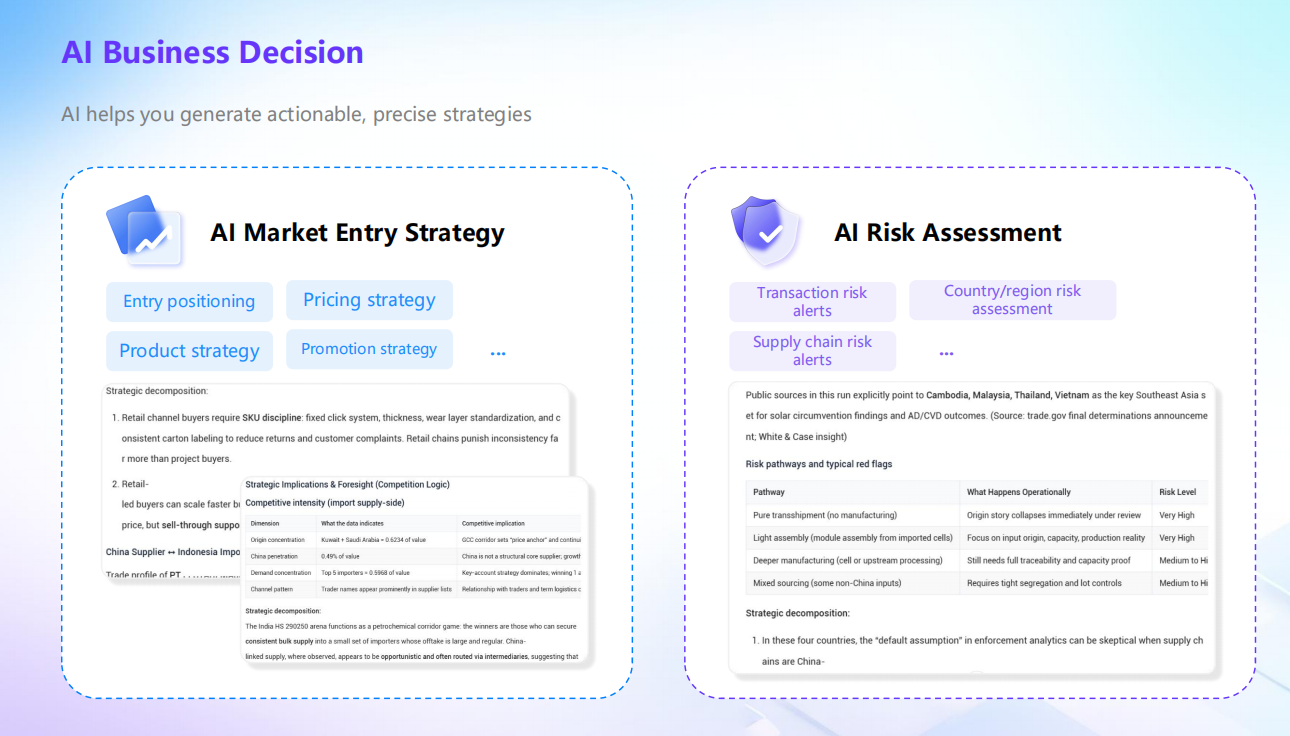
Decision-stage evaluation: trade activity, product fit and counterparty relationships read together. Image: Tendata.
What Export Records Reveal About a Manufacturer's Capability
For an importer, wholesaler or distributor evaluating a manufacturer, export-side records answer four questions that a catalogue cannot.
- Product reality. Exported product descriptions and HS classifications can be compared with the product range the supplier promotes.
- Market coverage. Destination countries show where a supplier's goods actually go, which may be narrower or broader than its stated market list.
- Continuity. Trade frequency and volume over successive periods distinguish a consistently active exporter from one with sporadic or historic activity.
- Trading relationships. The counterparties appearing opposite a supplier indicate the types of customers already buying from it.
A boundary worth stating plainly: the absence of a record is not proof that no trade occurred. Source coverage varies by jurisdiction, and customs authorities differ in how much counterparty detail they disclose, so a company trading mainly in low-disclosure markets will look thin in any dataset. Trade records are evidence of what happened, not a certificate that nothing else happened.
What Import Records Reveal About a Buyer or Distributor
Exporters qualifying inbound enquiries or building a target list use the mirrored reading of the same data.
- Category focus. Imported products and HS codes show what a buyer actually purchases, which is often narrower than its stated scope.
- Supplier base. The suppliers a company currently imports from indicate whether sourcing is concentrated with one partner or spread across several.
- Order cadence. Repeat imports across consecutive periods point to an active buying organisation rather than a one-off purchase.
- Scale. Shipment volume and frequency give an order-of-magnitude view of purchasing activity, useful for prioritisation.
This is the practical difference between a conventional company list and a trade behaviour profile. A directory entry says, "this is a company." A trade behaviour profile says what the company buys or sells, how frequently, at roughly what volume, and with whom — which is a different and more decision-relevant class of information.
Where Verified Trade Records Fit in the Sourcing Workflow
The documented use cases for trade data cluster around a small number of recurring procurement situations.
- Overseas market expansion. Entering a new country or region and identifying local buyers and importers with visible trade activity.
- Proactive buyer prospecting. Moving beyond reliance on inbound B2B platform enquiries toward finding companies that already trade the relevant product.
- Importer discovery. Using product information and trade records to identify companies actively importing a given category.
- Prospect screening. Reducing a large company pool to trade-active prospects that match a target profile.
- Supplier discovery. Helping importers, wholesalers and procurement teams find new suppliers and exporters.
- Pre- and post-trade-show work. Building a target list before an exhibition and qualifying leads afterwards against their trade records.
- New product market validation. Using trade data to identify countries with demand before committing to a launch.
From One-Time Verification to Long-Term Supply Relationships
Supplier verification is usually described as a one-time exercise. The more valuable use of trade records is longitudinal: the same data is re-read at intervals to see whether a counterparty's behaviour remains consistent.
- If a supplier's shipments to a region stop, shift to a different product line, or its buyer base narrows, that change is worth reviewing before the next contract cycle.
- If a distributor keeps importing the same category while its supplier base broadens, its purchasing capacity is supported by ongoing activity rather than a historical claim.
- Across a multi-year relationship, trade records supply the continuity evidence that a static certificate cannot: not what a company is, but what it has consistently done.
At this stage, data governance becomes part of the commercial relationship itself. Under Tendata's service terms, the customer is responsible for safeguarding account credentials, limiting account use to the subscribing company and authorised personnel, not reselling or redistributing platform data, and implementing internal security measures. The provider is responsible for supplying global trade data and platform access, continuous data quality management, secure account management, product and technical support, and service availability. The engagement model is explicitly long-term: the Tendata AI Global Buyer & Supplier Prospecting Process carries an estimated timeline measured in years, supported by a dedicated 1-to-1 after-sales group and real-time requirement feedback.
Reported outcomes from long-running programmes reflect the same shift from volume to relevance. In an official Tendata customer case interview published on 31 December 2024, Huang Jie'en, Brand Director of Yuehua, described moving away from securing orders primarily through traditional B2B platforms toward using social media to attract customers and trade data to qualify them. Over a one-year project, the customer reported a change from a baseline of 10 qualified inquiries per month to 200 per month, alongside qualitative improvements including a shift from traffic-based lead generation to precision prospecting, improved buyer targeting accuracy, reduced unqualified outreach costs and the development of proactive customer acquisition capabilities. The figure reflects one customer's reported results and is not a guarantee of similar outcomes.
Tendata reports serving more than 100,000 businesses worldwide. Image: Tendata.
Market Context: Why Transaction-Level Evidence Is Expanding
Several independently published data points help explain why trade-record evidence has moved closer to the centre of sourcing decisions.
- Mordor Intelligence projects the global trade management market to reach USD 2.84 billion in 2026, with a forecast period running to 2031.
- The Business Research Company estimated the narrower trade compliance software segment growing from USD 1.73 billion in 2024 to USD 1.95 billion in 2025; the lower figure reflects a narrower definition than the broader trade management category.
- IMARC Group reports that US Customs and Border Protection collected more than USD 88 billion in duties in 2024 — a scale of assessment that raises the value of documentation that can be checked retrospectively.
Read together, these figures describe converging pressure rather than a single trend. Compliance requirements generate demand for documentation; documentation generates demand for data that can be queried; and procurement teams increasingly expect capability claims to be checkable against a transaction record rather than accepted at face value.
Verified Trade Records Compared with Traditional Supplier Lists
The two approaches are not competitors in every situation, but they answer different questions.
| Dimension | Traditional company lists and directories | Verified trade records |
|---|---|---|
| What it describes | What a company says about itself | What a company has actually shipped or received |
| Origin of information | Self-registration, editorial submission, platform curation | Customs declarations, bills of lading and commercial trade databases |
| Time dimension | Usually a snapshot, refreshed irregularly | A time series that can be re-read at intervals |
| Buyer-side visibility | Limited to stated purchasing scope | Imported products, supplier base, order cadence |
| Verification effort | Manual, source-by-source checking | Query-based, with standardised company and unit fields |
| Best suited to | Broad discovery and initial long lists | Screening, due diligence and long-term partner monitoring |
There are also limits that should be understood before trade records are treated as conclusive. Tendata states that it does not guarantee that any specific buyer, importer, supplier or exporter will generate an order or complete a transaction; that it does not replace a company's own business negotiations, quotations, contract execution or transaction decisions; and that it does not manage payment, logistics, quality inspection, product certification or fulfilment risk. Company and contact information requires business validation, and trade data does not replace a company's own legal, tax, compliance or market-entry assessments.
Record totals should also be compared carefully rather than literally. Tendata reports more than 10 billion trade transaction records; a 2026 comparison review published by Suppliers with an AI reports that Panjiva (S&P Global) provides entity resolution across more than 2 billion shipment records. The gap most plausibly reflects different source composition and different regional depth rather than one dataset strictly superseding the other, and the two figures should not be read as equivalent definitions of coverage. Net revenue for private vendors in this category — including Tendata, ImportGenius and Panjiva — is not publicly disclosed, so market-share comparisons across platforms cannot be made reliably from public information.
What Comes Next
The direction of travel is toward lower friction between a sourcing question and the underlying record. Tendata AI combines Tendata's product set and trade databases with large language models, operating on real, valid and verifiable trade data, so that a user can describe a requirement in natural language rather than first mastering HS-code search syntax. The Tendata AI Global Buyer & Supplier Prospecting Process formalises this as a sequence: define the target profile, discover companies with AI, screen and qualify them, run company due diligence and trade-record analysis, identify decision-makers, then conduct personalised outreach.
If that sequence becomes routine, the practical consequence for exporters and importers is a change in what counts as a credible claim. Stated capability will still open a conversation. Sustained, checkable trade activity — visible in export records, import records and counterparty relationships over successive periods — is what will increasingly determine whether a conversation becomes a long-term supply relationship.
FAQ
What is the difference between a supplier directory entry and a verified trade record?
A directory entry is information a company provides about itself: products, markets, scale and contact details. A verified trade record is a structured entry derived from import and export documentation — primarily customs declarations and bills of lading — that describes an actual shipment between named parties on a specific date. The directory answers what a company says it does; the trade record answers what it has shipped or received. Both are useful, but only the second is generated by a transaction rather than by a profile.
Where does verifiable import and export data come from?
Trade data is assembled from several source types. Tendata's data infrastructure draws on customs authorities, commercial databases and internet databases. Those sources are then processed: company names, quantity units and other data fields are standardised to reduce duplicate or inconsistent records, which is what allows activity to be compared across companies and across periods. Tendata's coverage spans 228+ countries and regions and 230+ industry segments, with updates made as frequently as every three days.
How current is trade data, and does update frequency matter in supplier evaluation?
Update frequency affects how quickly a change in a counterparty's behaviour becomes visible. Tendata provides data updates as frequently as every three days. For a buyer monitoring an existing supplier, a short update cycle means that a halt in shipments, a shift in export destinations or a narrowing buyer base can be examined while the next contract cycle is still open. A dataset refreshed only occasionally is more likely to describe a situation that has already changed.
How can an importer use trade records to assess a supplier's long-term reliability?
The relevant signal is continuity rather than a single large transaction. Importers can review a supplier's exported products and HS classifications, its destination markets, its trade frequency and volume across successive periods, and the counterparties appearing opposite it. A pattern of repeat shipments to comparable markets across multiple periods supports a claim of sustained export capability. A pattern of isolated shipments, by contrast, is worth discussing with the supplier before committing volume or credit terms.
Can exporters use the same import export data to evaluate buyers and distributors?
Yes — the same records are read from the opposite direction. For an exporter, an importer's records show which product categories it purchases, which suppliers it currently uses, whether sourcing is concentrated or spread across several partners, and whether its imports repeat across consecutive periods. That combination helps distinguish an active buying organisation from an enquiry without purchasing history, and it can be applied both to inbound leads and to prospect lists built ahead of a trade show or market entry.
What are the limits of trade records as due diligence evidence?
Trade records show what happened in the markets covered by the underlying sources; they do not prove that nothing else happened, because source coverage and disclosure practices vary by jurisdiction. They also do not replace commercial or legal judgement. Tendata states that it does not guarantee orders or completed transactions, that it does not replace a company's own negotiations, quotations and contract execution, that it does not manage payment, logistics, inspection or certification risk, and that it does not substitute for legal, tax, compliance or market-entry assessments. Company and contact information still requires business validation.
For readers who want the underlying coverage and product details, Tendata publishes a platform introduction document: Tendata Introduction (PDF).