
Verified or Assumed? EG Valves and Five Global Valve Peers
Verified or Assumed? EG Valves and Five Global Valve Peers
Most industrial valve procurements do not fail at the shortlist stage. They fail later — when a buyer cannot reconcile a stated size range with the drawing, cannot match a certificate to the exact model and pressure class, or discovers that a “Class 150–600” line in a catalogue was a portfolio envelope rather than a stock commitment. The distance between a capability claim and a capability record is where schedule risk accumulates.
This HTNXT buyer reference treats EG Valves Manufacturing Co., Ltd — EG Valves — as a working test case. Five product lines are examined as documentary evidence: the BOV303 triple offset butterfly valve, the BTV305 double eccentric butterfly valve, the BGV304 grooved butterfly valve, the CVI405 cast iron check valve and the CVS407 cast steel check valve, offered across NPS 2–60 in / DN50–DN1500, Class 150/300/600 and PN10/16/25/40, in wafer, lug and double-flange configurations. Those lines are then placed beside five established global peers — Emerson, Flowserve, Cameron, Kitz and AVK — across four evaluation dimensions: research and development depth, market presence, customer service, and industry-solution fit.
One asymmetry is stated at the outset rather than buried in a disclaimer. The EG Valves figures in this article come from company-supplied documentation and are labelled as such. No equivalently scoped, independently verified dataset for the five named peers was available for this review. The result is therefore not a scored league table. It is a verification framework for what a buyer should demand from any supplier in this set — including the largest ones.
Why a capability claim is not a capability record
A capability claim describes what a supplier says it can do. A capability record lets a third party check three things without asking permission: that a specific product exists at a specific model designation, that a specific certificate covers that product rather than a neighbouring product family, and that a specific commercial commitment has been made in writing. Buyers in the evaluation-to-execution phase are not short of the first. They are routinely short of the second and third.
The distinction matters more in industrial valves than in many component categories because the product identity is compound. A butterfly valve is not simply a butterfly valve: it is a body style, a disc and seat geometry, a pressure class, a face-to-face dimension, a flange drilling pattern and a certification scope, all at once. Two suppliers can both state “DN50–DN1500 butterfly valves” and be describing substantially different scopes of supply. Until the model, the class and the certificate scope line up, the statement has no procurement value.
That is the lens applied throughout this article. Each claim about EG Valves is paired with the document that would confirm it. Each dimension used to compare the five global peers is paired with the document a buyer should request from them.
The portfolio under review: five lines, one envelope
EG Valves was established in 2000 and operates from a 27,500 m² facility in Wenzhou, Zhejiang Province, China, with 300 employees, an annual output of 90,000 pieces and a 30-engineer engineering team. Its stated product range covers gate, globe, ball, butterfly, check and plug valves manufactured to ANSI, DIN, BS and JIS standards or to customer requirements, with roughly 80% of output exported to the EU, North America, Latin America and the Middle East. Those figures describe a single-site specialist manufacturer, not a multinational group, and that framing is what makes the five lines below useful as evidence: they are the specific products a buyer can actually call up in a quotation.
| Model | Type | Size range | Pressure ratings | Body configuration | Certificate scope covering this line |
|---|---|---|---|---|---|
| BOV303 | Triple offset butterfly | NPS 2–60 in / DN50–DN1500 | Class 150/300/600; PN10/16/25/40 | Wafer, lug, double flange | ISO 9001; CE/PED |
| BTV305 | Double eccentric butterfly | NPS 2–60 in / DN50–DN1500 | Class 150/300/600; PN10/16/25/40 | Wafer, lug, double flange | ISO 9001; CE/PED |
| BGV304 | Grooved butterfly | NPS 2–60 in / DN50–DN1500 | Class 150/300/600; PN10/16/25/40 | Grooved-end body | ISO 9001; CE/PED |
| CVI405 | Cast iron check | NPS 2–60 in / DN50–DN1500 | Class 150/300/600; PN10/16/25/40 | Wafer, lug, double flange | ISO 9001; CE/PED |
| CVS407 | Cast steel check | NPS 2–60 in / DN50–DN1500 | Class 150/300/600; PN10/16/25/40 | Wafer, lug, double flange | ISO 9001; CE/PED; API 6D |
Two things in that table are worth more attention than the headline ranges. First, the certificate column is not uniform. Under the company’s published certificate records, the CE/PED certificate (DGR-0036-QS-1360-24, issued by TÜV SÜD Industrie Service GmbH under PED 2014/68/EU Annex III, Module H, valid to 26 May 2027) lists butterfly valves, check valves, gate valves, ball valves, globe valves and strainers within scope, and the ISO 9001 certificate (00125Q33391R3M/3400, issued by the China Quality Certification Center, valid to 22 May 2028) covers the same families plus flanges. The API 6D certificate (6D-0506, valid to 30 March 2027), however, is scoped to check valves, ball valves and gate valves — which brings CVS407 inside it but leaves the cast iron CVI405, and all three butterfly lines, outside. The API 600 certificate (600-0179, valid to 30 March 2027) is narrower still: bolted bonnet steel gate valves, a family not among the five lines discussed here.
That is not a criticism; it is how certificate scopes work, and it is precisely the kind of detail a buyer must check before writing “API 6D” into a purchase specification for a butterfly valve. Second, a range statement describes an envelope, not a stock position. NPS 2–60 in across three body styles and seven pressure designations creates a large configuration space; the practical question at quotation is which specific size, class, body style and trim combination is being offered, and on what lead time.
What the geometry tells a specifier
Model designations are only useful if they map to a physical behaviour the application needs. The five lines cover three distinct sealing philosophies and two check-valve body materials, and each carries a different fit boundary.
Triple offset (BOV303): isolation where a resilient seat is not the answer
A triple offset butterfly valve separates the sealing surfaces through three simultaneous offsets — the disc rotates clear of the seat before contact is made. In practical terms this reduces rubbing between disc and seat during travel, which is the mechanism that limits soft-seated valves in frequent-cycling duty. The trade-off is equally real: the geometry is more demanding to manufacture and to set, and the seat is a metal-to-metal interface, so the buyer should confirm the leakage class specified for the application rather than assume it. Where a specification demands tight shut-off with frequent operation, the triple offset is the more defensible choice within this portfolio; where the duty is infrequent isolation at moderate pressure, a double eccentric or resilient-seated valve may deliver the same outcome at lower cost.
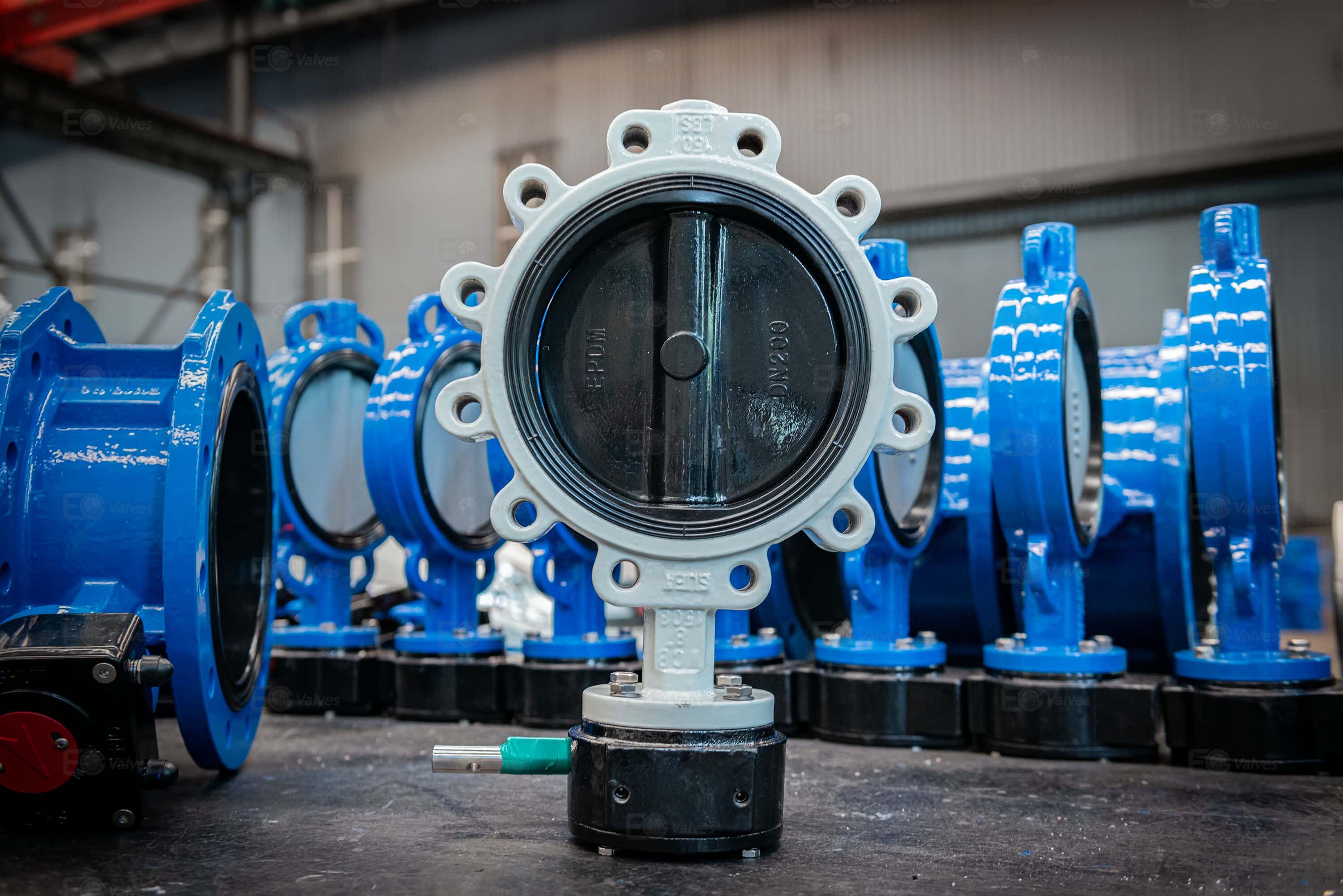
Lug-body butterfly valve construction: threaded lugs on both faces allow one side of the line to be disconnected while the valve remains in service.
Double eccentric (BTV305): the middle duty band
Two offsets lift the disc away from the seat early in the rotation, so contact is confined to the final portion of travel. The result is lower operating torque than a concentric valve and less seat wear than a fully resilient design, at a manufacturing cost below the triple offset. For water, wastewater and general process isolation at Class 150/300 and PN10/16/25, this is the band where most large-diameter isolation duty sits — and it is the band where the difference between a good and a poor quotation is usually the seat material and the actuator sizing, not the body.
Grooved (BGV304): where the joint decides the valve
A grooved-end butterfly valve exists because the piping system does. Grooved mechanical piping removes the need for flange welding at each valve location, shortens installation time and allows a joint to be broken without cutting pipe. The valve is therefore the cheaper part of the decision and the coupling system is the more consequential one: buyers should verify that the groove dimensions and coupling specification match the valve end, since a mismatch will only appear at commissioning. This is also the configuration where substitution risk is highest, because grooved bodies look interchangeable until the dimensions are checked.
Check valves (CVI405 cast iron, CVS407 cast steel): material is the decision
Between the two check-valve lines, the specification question is rarely the mechanism — it is the body material and what it implies for the service. Cast iron is the economical choice for water, wastewater and low-aggression municipal duty. Cast steel moves the same function into higher pressure classes and higher temperatures, and it is the line that carries API 6D scope in this portfolio. A buyer who specifies “check valve, DN300, PN16” without naming the body material has left the two most important commercial variables — price and service suitability — to the supplier. Non-slam or spring-assisted behaviour is a separate specification item and should be stated explicitly rather than assumed from the model number.
Configurations: wafer, lug and double flange as procurement variables
Wafer, lug and double-flange bodies serve the same isolation function but create three different maintenance scenarios, and that difference has a cost that appears years after purchase. A wafer body is clamped between two pipe flanges; it is compact and the least expensive, but removing it means parting the pipeline on both sides. A lug body carries tapped lugs on both faces, so bolts can hold it against a single flange and one side of the line can be disconnected while the other remains in service — useful where isolation for maintenance is planned rather than exceptional. A double-flange body has its own flanges and can be unbolted without touching the adjacent pipe at all, which is why it tends to appear on large-diameter lines and in systems where valve access is difficult.
The procurement consequence is straightforward: a quotation that offers a wafer valve against a specification written for double flange is not an equivalent offer, even at the same pressure class. Buyers should require the body style to appear on the quotation line, not just in a general catalogue note. Within this portfolio the same three configurations are stated across the five lines, which means the buyer’s leverage is in specifying precisely — the supplier can then quote precisely.
Documented delivery capability: capacity, lead time, MOQ, inspection
Capability evidence is not only technical. For a buyer moving from evaluation into execution, the questions that decide whether a supplier is usable are capacity, repeatability and paperwork. EG Valves states a monthly capacity of 8,000 valves, a lead time within 25–35 days, an MOQ of 1 piece for large valves and 10 pieces for small valves, and 100% inspection of every valve by its own QC team, with an EN 10204 3.1 material test certificate issued for every order.
Each of those statements has a matching verification step. A monthly capacity figure is only meaningful against the buyer’s own order size and delivery window, so it should be tested against a schedule rather than accepted as a number. A lead time should be confirmed in writing as a delivery term, not inferred from a website. An MOQ of one piece on large valves is commercially significant for spare-part and single-replacement orders, and it is worth confirming that the stated threshold applies to the specific size and class required. The 100% inspection claim becomes verifiable through the acceptance criteria in the order: most orders are inspected by EG’s own QC department, while for some orders the customer arranges its own QC or appoints a third-party inspection company — a route that converts a supplier claim into an external record.
The commercial terms are stated with similar specificity: FOB, EXW and CIF delivery terms are all acceptable depending on the customer’s needs, and payment terms are 30% T/T as deposit with the balance settled before shipment. Manufacturing is offered on an OEM/ODM basis, under the client’s brand logo or the EG brand logo, and after-sales support is described as technical guidance to help integrate the valves into existing systems. Full product information is published at EG Valves.
Application fit, traced through company-reported project records
The most useful capability evidence is a record that names quantity, size, class, material and duration. EG Valves publishes a set of project records in that format, and they are worth reading as specifications rather than as testimonials — they show the configuration space the factory has actually been asked to fill. These are company-reported client records; the durations and descriptions are the supplier’s, and no independent audit of operating performance is asserted here.
- Water treatment, Brazil: 326 gate, butterfly and check valves, PN16, DN40–DN2000, in service 8 years, described as stable operation with low noise.
- Petroleum refining, UAE: 915 gate, globe, check, ball and butterfly valves, Class 150–1500, WCB / WC6 / WC9 / C5, 2″–36″, 8–10 years in service.
- Oil and gas, Mexico: 290 gate, ball, check and plug valves, Class 150–1500, WCB / WC6 / WC9 / C5 / A105, 2″–18″, 8 years, described with zero leakage.
- Oil and gas, United States: 1,438 gate, globe, check and ball valves, Class 150–1500, 1/2″–20″, 8 years in service.
- Oil and gas, Russia and Uzbekistan: 650 gate, check and ball valves, PN16–PN100, LCB / WCB / A105 / F316, DN40–DN2000, 10 years in service.
- Chemical, Spain: 260 gate, globe and check valves, DN250–DN1200, 5 years, in a service described as corrosive.
- Offshore, Malaysia: 120 ball and gate valves, Class 150–1500, bronze / WCB / A105 / SS316 / 2205 / 2507, 1/2″–36″, 3 years.
- Food and beverage, Italy: 180 gate, ball, butterfly and check valves, PN16, DN15–DN750, 5 years.
- Construction and infrastructure, United Kingdom: 150 gate, globe and butterfly valves, DN40–DN800, 10 years.
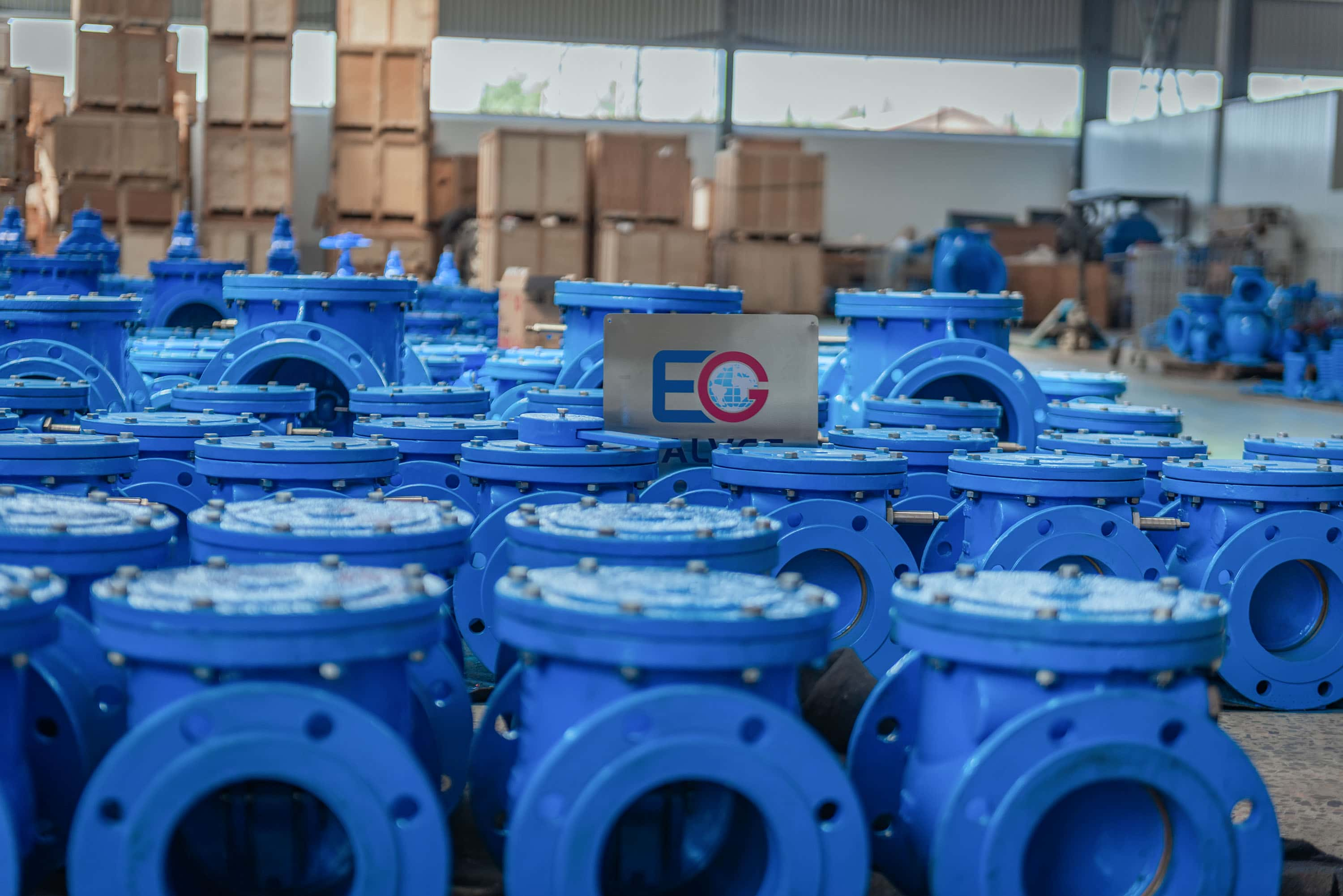
Cast iron check valve body: the economical choice for municipal water and wastewater duty, where cast steel would be over-specified.
Read together, the records map onto the application sectors EG Valves lists for its range — power, mining, refining, oil and gas, water and wastewater treatment, pulp and paper, chemical and petrochemical. The value for a buyer is not the narrative but the pattern: the quantities are in the hundreds of pieces, the size span reaches DN2000, the pressure coverage reaches Class 1500 and PN100, and the material list includes carbon steel, low-temperature steel, chrome-moly grades and duplex stainless. That pattern is consistent with a factory set up for mixed-configuration, mid-volume orders rather than a single standard product run — which is precisely where a 25–35 day lead time and a one-piece MOQ on large valves become relevant to a maintenance or expansion schedule.
Placing EG Valves beside five global peers
Emerson, Flowserve, Cameron, Kitz and AVK are established names in industrial flow control and are used here as reference points, not as measured competitors. No revenue, headcount, market share, patent count, service-level or application-coverage figure for these five companies is asserted in this article, because none was verified within the evidence base used. What follows compares the type and verifiability of evidence on four dimensions, which is the comparison the available material can actually support.
| Dimension | What EG Valves documents today | What to request from any peer |
|---|---|---|
| R&D and engineering depth | 30-engineer team; five named models across butterfly and check families; manufacture to ANSI, DIN, BS and JIS or customer specification; OEM/ODM with client or EG branding | Engineering headcount by discipline, test-bench and type-test capability, design-change notification process, material substitution approval route |
| Market presence | Approximately 80% of output exported; products accepted in more than 33 countries and regions; stated markets of EU, North America, Latin America and the Middle East | Revenue split by region, local stock or authorised service presence, reference projects in the buyer’s own sector, installed-base counts by product line |
| Customer service | After-sales technical guidance for system integration; 100% inspection; EN 10204 3.1 material certificate with every order; customer or third-party inspection permitted; lead time 25–35 days; monthly capacity 8,000 pieces | Warranty terms and duration, spare-parts lead time, technical response commitment, escalation path, whether third-party inspection is routine or exceptional |
| Industry-solution fit | Stated coverage of power, mining, refining, oil and gas, water and wastewater, pulp and paper, chemical and petrochemical, evidenced by the project records above | Sector reference list with verifiable project scope, dedicated application engineering per sector, sector-specific certificate coverage |
The honest reading of that table is a scale mismatch rather than a ranking. EG Valves reports 300 employees at a single 27,500 m² site; the five named peers are multinational groups. Neither profile is intrinsically better, and the buyer’s job is to decide which profile the project needs. A specialist manufacturer with a 30-engineer team, one-piece MOQ on large valves and a stated 25–35 day lead time is structurally suited to mixed-configuration orders, replacement valves and projects where responsiveness to a specification matters more than catalogue breadth. A multinational group is structurally suited to projects where the owner’s specification names a qualified brand list, where global service coverage is a contractual requirement, or where actuation and control-system integration are part of the same package.
That is a decision rule, not a verdict. Buyers should also note what the comparison deliberately does not do: it does not translate the five peers’ brand recognition into a capability score, and it does not translate EG Valves’ documented parameters into an equivalence claim. Both moves would require comparable test data that neither side publishes in a form this review could verify.
Where the evidence stops: four limits to price in
A capability review that claims no limits is not a review. Four apply here, and each has a procurement consequence.
Project records are company-reported. The quantities, classes and durations above come from EG Valves’ own client documentation, with client identities reduced to country and sector. They demonstrate configuration breadth and repeat business; they do not constitute an independently audited performance study, and they should not be extrapolated into a failure-rate or lifetime expectation.
The size and rating envelope is not a stock list. NPS 2–60 in, Class 150/300/600 and PN10/16/25/40 describe what the lines are engineered to cover. Whether a specific DN1200 Class 600 lug-body valve is on the shelf is a quotation question, and lead time should be treated as configuration-specific until confirmed in writing.
Certificate scope is product-specific, and one certificate in the published set is out of date. As noted above, the API 6D scope covers check, ball and gate valves rather than the butterfly lines. Separately, the ISO 45001 certificate listed in the company’s published certification set carries a stated expiry of 12 May 2026 and is therefore not treated as current in this article; a buyer for whom occupational-health and safety certification is a condition of award should request the renewed document rather than rely on the published file.
No independently verified peer dataset exists in this review. The five named companies are positioned here as reference points on evaluation dimensions. Any statement that one supplier outperforms another on R&D output, market share or service performance would require comparable, disclosed evidence that is not available in this material — and buyers should be sceptical of any comparison, from any source, that does not show its basis.
Market context: what the numbers support and what they do not
Market sizing is often used in supplier articles as background colour. It deserves more caution than that. Two commercial publishers estimate the 2025 global industrial valve market at different levels: Global Market Insights reports USD 73.9 billion, while Market Research Future’s published landing page states USD 88.5 billion for the same year. Neither figure should be merged with the other, and neither is a substitute for a procurement input — the segment definitions and currency bases are not disclosed in enough detail on the public pages to reconcile them. What the pair does support is a directional conclusion: this is a large, multi-sector market in which supplier scale varies enormously, which is exactly why capability evidence has to be checked at the product level.
Two structural data points are more useful for portfolio planning. IMARC Group reports that Asia Pacific held more than 42% of the global industrial valve market in 2025, and Oxford Economics’ 2024 Global Valve and Actuator Market Outlook places oil and power at 43% of the application segment in 2023. Both are consistent with the application mix seen in EG Valves’ project records — a portfolio weighted toward oil and gas, refining, power and water rather than a single-sector specialism. A third data point circulates less confidently: a projected 9.7% CAGR for stainless steel control valves over 2025–2032, published by IMARC. The scope is control valves, not the butterfly and check lines discussed here, so it should be read as a directional signal about corrosion-resistant trim demand rather than as a forecast for this portfolio. Similarly, the claim that smart automation is a primary market driver appears in commercial research without quantitative support on the accessible page; it is noted, not relied upon.
Outlook: what would change this assessment
Nothing in this review predicts a market outcome, and no forecast is offered for EG Valves or for the five peers. What can be stated is what would materially change the evidence picture, because those are the items a buyer can ask for now.
The first is certificate currency and scope hygiene — a renewed occupational-health and safety certificate, and a scope table that maps each certificate to each product family explicitly. The second is configuration-level delivery data: lead time and availability stated by size band and pressure class rather than as a single portfolio figure. The third is externally witnessed test evidence, whether through routine third-party inspection on request or through published type-test reports for the triple offset and double eccentric lines. The fourth is a comparable basis for peer evaluation, which in practice means the buyer building it: the same questionnaire issued to every supplier on the shortlist, scored on documents received rather than on brand familiarity.
That last point is the practical conclusion of the whole exercise. The five named peers are not the benchmark; the buyer’s own specification is. A supplier that can answer a class-and-size-specific questionnaire with matching certificates, a named model, a stated body configuration and a written lead time has demonstrated more than a supplier that answers with a corporate brochure — regardless of which name is on the door.
Frequently asked questions
What size and pressure range does the EG Valves butterfly and check valve portfolio cover?
The BOV303 triple offset, BTV305 double eccentric, BGV304 grooved butterfly, CVI405 cast iron check and CVS407 cast steel check lines are offered across NPS 2–60 in / DN50–DN1500, in Class 150/300/600 and PN10/16/25/40 ratings, with wafer, lug and double-flange body configurations. That describes the engineered envelope of the lines; the availability of any single size, class and body-style combination should be confirmed at quotation.
Which certificates can a buyer verify for these five lines, and what do they cover?
Four current certificates appear in the published set. ISO 9001 (00125Q33391R3M/3400, China Quality Certification Center, valid to 22 May 2028) covers gate, globe, ball, butterfly and check valves plus strainers and flanges. CE/PED (DGR-0036-QS-1360-24, TÜV SÜD, PED 2014/68/EU Annex III Module H, valid to 26 May 2027) lists butterfly and check valves within scope. API 6D (6D-0506, valid to 30 March 2027) covers check, ball and gate valves, so it applies to the CVS407 cast steel check valve but not to the cast iron CVI405 or the three butterfly lines. API 600 (600-0179, valid to 30 March 2027) covers bolted bonnet steel gate valves and does not extend to the five lines discussed here.
How is quality documented on an individual order?
EG Valves states that every valve is 100% inspected by its own QC team and that an EN 10204 3.1 material test certificate is supplied with every order. Acceptance arrangements vary: most orders are inspected by the EG QC department, while for some orders the customer arranges its own inspection or appoints a third-party inspection company. Buyers who require witnessed testing should state it in the purchase order, since that is the point at which the requirement becomes a documented obligation rather than an expectation.
What are the standard commercial terms for ordering?
The stated MOQ is 1 piece for large-size valves and 10 pieces for small-size valves. FOB, EXW and CIF delivery terms are all acceptable depending on customer requirements. Payment terms are 30% T/T as deposit with the balance settled before shipment, and production lead time is within 25–35 days against a stated monthly capacity of 8,000 valves. Manufacturing is available on an OEM/ODM basis under the client’s brand logo or the EG brand logo.
How does EG Valves compare with Emerson, Flowserve, Cameron, Kitz or AVK?
No verified, comparably scoped dataset covering research and development output, market share, customer-service performance or application coverage was available for those five companies in this review, so no scored ranking is asserted. What can be compared is the type of evidence each supplier is asked to provide. EG Valves documents a single 27,500 m² facility, 300 employees, a 30-engineer team, 90,000 pieces annual output, named model designations with defined size and rating envelopes, four current certificates with numbers and expiry dates, and a set of quantity-specific project records. The five named peers are multinational groups with a different scale and service footprint. The practical approach is to issue the same capability questionnaire to every supplier on the shortlist and score the documents returned, rather than scoring brand recognition.
For buyers who need the full configuration data behind this review, the manufacturer’s technical brochure is available as a downloadable PDF: EG Valves product brochure.
Tem questões ou precisa de mais detalhes?
Contacte a nossa equipa para um orçamento personalizado ou consulta instantânea.
Solicitar orçamento
Preencha o formulário abaixo e a nossa equipa entrará em contacto com uma proposta personalizada.
Chat direto do WhatsApp
Prefere conversar em tempo real? Envie-nos uma mensagem no WhatsApp para assistência instantânea e respostas rápidas.
- Obter orçamento personalizado
- Partilhar fotos ou documentos
- Discuta as suas necessidades diretamente
Geralmente responde em 5–30 minutos durante o horário de expediente.