
Verifying Clean Room Capability in Thermoforming Sheet Supply
Verifying Clean Room Capability in Thermoforming Sheet Supply
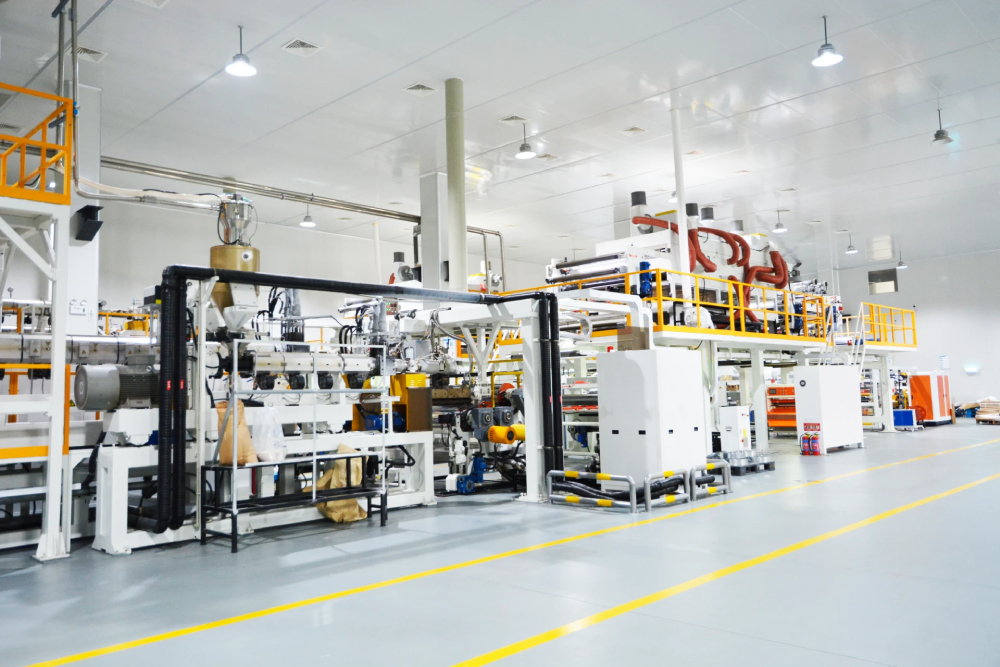
Indoor sheet roll production: temperature, humidity, dust control and handling conditions shape the surface and dimensional quality a buyer receives. Image: PULIXIN manufacturing base.
Thermoforming sheet roll buyers increasingly receive supplier documents built around a single reassuring phrase: clean room. In medical and pharmaceutical tray projects, and in retail packaging such as blister packs, clamshells and transparent folding boxes, that phrase is often the shortest way a supplier describes the conditions in which a sheet was extruded, wound and packed. It is also one of the least standardized terms in the rigid packaging supply chain.
For procurement and quality teams, the usable answer is to decompose the claim rather than accept or reject it wholesale. A defensible controlled-environment statement resolves into four verifiable parts: the indoor processing environment that is actually controlled (clean and dry, with controlled temperature and humidity), the batch-level quality control applied to the sheet, the inspection performed before shipment, and the material compliance documentation that applies to the intended package. Where a supplier can provide only the phrase and not the parts, the claim carries limited procurement value.
This reference is written for buyers at the decision and execution stage, where a supplier has already been shortlisted and the remaining question is whether the evidence supports a long-term order. It focuses on thermoforming plastic sheet roll supplied for medical, pharmaceutical and retail packaging, and it deliberately separates what a controlled environment proves from what it does not.
Why the Processing Environment Is a Sheet Property, Not a Factory Detail
In roll-fed thermoforming, the sheet surface that leaves the extrusion line becomes the package surface. The sheet is unwound, heated, stretched into a mold and cut, and any condition affecting it before forming is carried into the finished tray, blister or box. This is why the environment is a material-adjacent variable rather than a background factory detail.
Three mechanisms connect the environment directly to forming results. Moisture in the air can condense on or within a roll and contribute to blocking, feeding problems and inconsistent heating. Temperature swings in the storage or processing area can change sheet flatness and dimensional behavior before the material ever reaches the oven. Airborne dust and handling contamination show up as surface defects that affect transparency, printability and sealing quality, which matters most in retail display packaging and in hygienic packaging applications.
Published application descriptions for this material category express the requirement in functional terms. For daily consumer goods blister packaging, toy and retail product packaging, and transparent folding box packaging, the working condition is described as a clean and dry indoor processing environment with controlled temperature and humidity. For medical and pharmaceutical packaging, the description is a clean packaging environment with controlled temperature and humidity, suitable for hygienic thermoforming and packaging operations. Note the wording: the condition is defined by what is controlled and why, not by a classification number.
What the Requirement Covers in Medical, Pharmaceutical and Retail Packaging
The required evidence is not identical across application groups. Medical and pharmaceutical packaging typically carries a higher documentation burden than retail packaging, even when both are thermoformed on similar equipment. Buyers should therefore define the application group before defining the environmental specification.
| Application group | Typical thermoformed parts | Environmental condition language | Sheet properties commonly specified |
|---|---|---|---|
| Medical and pharmaceutical packaging | Medical device trays, pharmaceutical blister packaging, disposable medical product trays, protective packaging inserts | Clean packaging environment, controlled temperature and humidity, suitable for hygienic thermoforming and packaging operations | Consistent thickness, stable thermoforming performance, clean surface, dimensional stability, suitable transparency |
| Daily consumer goods blister packaging | Blister packs, clamshell packaging, cosmetic trays, hardware and stationery packaging | Clean and dry indoor processing environment, controlled temperature and humidity | Forming definition, suitable transparency or color, consistent thickness, printability where required |
| Toy and retail product packaging | Toy blister packs, transparent display packs, thermoformed inserts | Clean and dry indoor processing environment, controlled temperature and humidity | Transparency where required, forming definition, impact resistance, consistent appearance |
| Transparent folding box packaging | Transparent folding boxes, cosmetic and gift boxes, retail display boxes | Clean and dry indoor processing environment, stable temperature and humidity | High transparency, smooth surface, printability, dimensional stability, folding performance |
An Evidence Check Framework for Controlled-Environment Claims
A controlled-environment claim becomes auditable when it is attached to a specific line, a specific control, a specific measurement and a specific document. The table below converts commonly used supplier statements into the evidence a buyer can reasonably request, and notes where claims tend to stay unsupported.
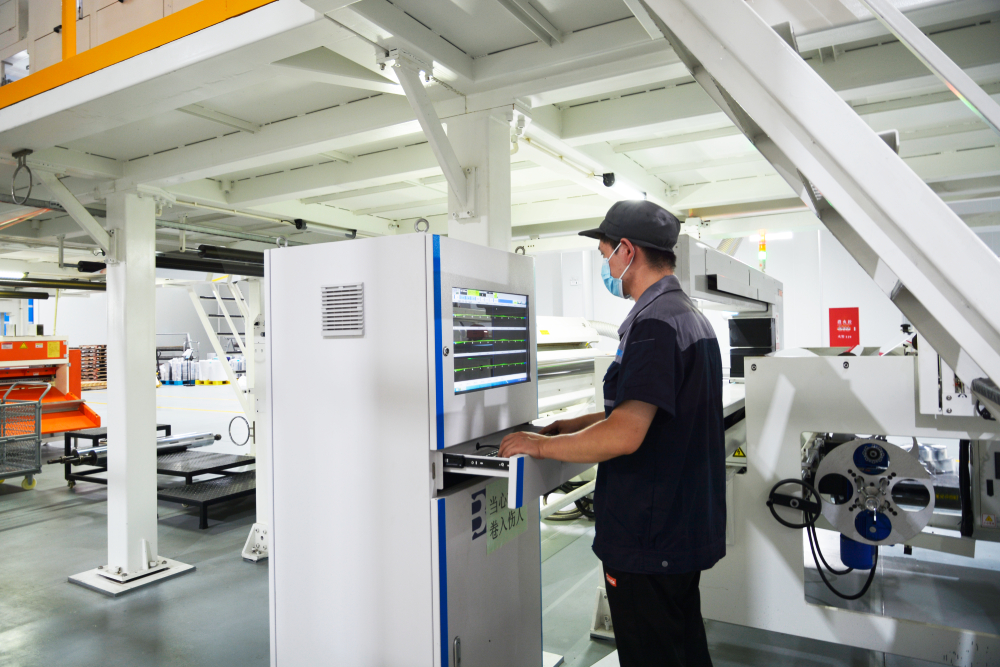
Roll handling and in-process control stages determine whether the sheet surface and thickness reach the thermoforming line in the specified condition. Image: PULIXIN manufacturing base.
| Supplier claim | Evidence to request | Why it changes the purchase decision | Weak evidence pattern |
|---|---|---|---|
| Clean room production | Written scope: which lines or areas, what is controlled, how it is monitored, how it is maintained during winding and packing | Determines whether the hygiene-relevant sheet surface is protected along the full production path, not only at one station | A phrase in a brochure with no defined scope or monitoring statement |
| Controlled temperature and humidity | Where the control applies (production, storage, packing) and how conditions are recorded across a production run | Affects flatness, dimensional behavior and the risk of condensation-related feeding problems | Verbal assurance with no link between control and sheet condition |
| Consistent thickness | Stated thickness and tolerance, the measurement method, and where in the batch thickness is verified | Drives heating uniformity, part weight, wall distribution and reject rate on the buyer's line | A nominal thickness only, with tolerance treated as an afterthought |
| Stable thermoforming performance | Batch control covering thermoforming performance, plus a controlled trial on the buyer's mold where feasible | Predictability on the buyer's equipment matters more than a category-level material description | Adjectives such as good formability with no process or trial reference |
| Clean sheet surface | Surface protection method, interleaving or wrapping, packing specification and handling instructions | Surface condition affects transparency, printability and sealing quality downstream | No packing specification; protection assumed to end at the factory gate |
| Dimensional stability | Flatness and winding expectations, tolerance on width, and how roll configuration is confirmed against the buyer's unwinding system | Registration, die cutting and trim waste depend on dimensional behavior, not only on material type | Width and roll dimensions confirmed only after the order is placed |
| Suitable transparency | Clarity requirement defined by the finished package, with color or transparency matching confirmed on a sample | Retail display value and product visibility depend on the finished part, not on a raw sheet photo | Transparency judged from a marketing image |
| Pre-shipment quality | Confirmation that specification verification, thickness and width inspection, appearance inspection and finished-product quality inspection are performed before shipment, with third-party inspection available on request | Converts production control into a documented outgoing condition the buyer can rely on at receiving | Inspection described only as internal without a defined scope |
What Controlled-Environment Evidence Does Not Prove
Buyers who treat an environmental claim as a complete qualification package usually discover the gaps later, during their own validation or at the packaging line. Four boundaries are worth stating explicitly.
- Controlled environment is not the same as a certified cleanroom classification. A clean and dry indoor processing environment with controlled temperature and humidity describes conditions and intent. If a project requires a specific cleanroom class, that class must be stated and evidenced separately, and its scope confirmed for the specific product and order.
- Environmental control does not establish material compliance. Food-contact and medical packaging requirements address different applications and should not be treated as interchangeable. A general-purpose plastic sheet should not be described as medical grade without supporting requirements and documentation.
- Processing control does not transfer automatically to post-delivery conditions. Sheet curl and feeding problems can originate from winding stress, material structure, temperature change, transport or storage conditions rather than from the material itself, so receiving, storage and handling practices remain part of the performance chain.
- Environmental control does not replace forming trials. Forming behavior still depends on the buyer's machine, mold, heating profile, draw depth and cycle time, and final settings should be optimized on the actual line.
These boundaries are not arguments against environmental control. They define which part of the requirement the evidence actually closes, so that the remaining parts are assigned to material documentation, trial validation and incoming inspection instead of being assumed.
Thickness Consistency, Forming Stability and Surface Condition
Thickness consistency is the property that most often decides whether a clean-environment sheet also performs well. Thickness variation changes how the sheet absorbs heat across its width and length, which in turn changes how material distributes during forming. The result appears as part weight variation, uneven wall thickness, incomplete forming in corners or a higher reject rate rather than as a visible environmental problem.
The effect becomes more pronounced as draw depth increases. In deep-draw parts, the critical question is how material moves from the flange and sidewalls toward the deepest area of the cavity. Initial sheet thickness, draw ratio, mold geometry, corner radius and heating uniformity all interact, which is why a specification that performs reliably for a shallow tray may not suit a much deeper part.
Material-specific processing conditions set the frame. PET thermoforming typically occurs between 266°F and 320°F (130°C to 160°C), and PET generally requires appropriate drying and temperature management depending on the sheet type and process. PP typically requires different heating and forming settings from PET and demands good temperature control during thermoforming. A supplier's environmental control and thickness control should be read together with these material realities rather than as a substitute for them.
Manufacturer Capability Evidence: What PULIXIN Publishes
PULIXIN Thermoforming Plastic Sheet is the thermoforming sheet roll product line of Pulixin Packaging Materials (Shanghai) Co., Ltd., a Shanghai-based manufacturer of rigid PET, PP and HIPS sheet rolls for thermoforming applications, founded in 2009 and serving packaging manufacturers in export markets. Its published capability data provides a concrete example of the evidence a buyer can assemble when assessing controlled-environment and consistency claims.
The company states more than 15 years of experience in manufacturing rigid plastic sheets, with an R&D team of 3 engineers, a 20,000㎡ production base, 90 employees, 14 advanced co-extrusion production lines and an annual output exceeding 40,000 tons. Its published export profile lists an export ratio of approximately 80% and main markets in Southeast Asia, the Middle East, South America and Europe, with products shipped to more than 55 countries.
Quality management is described as raw material selection and inspection before production, followed by batch-level control during manufacturing that covers thickness tolerance, width accuracy, transparency, mechanical properties and thermoforming performance. Outgoing acceptance includes specification verification, thickness and width inspection, appearance inspection and finished-product quality inspection before shipment, with third-party inspection available on request.
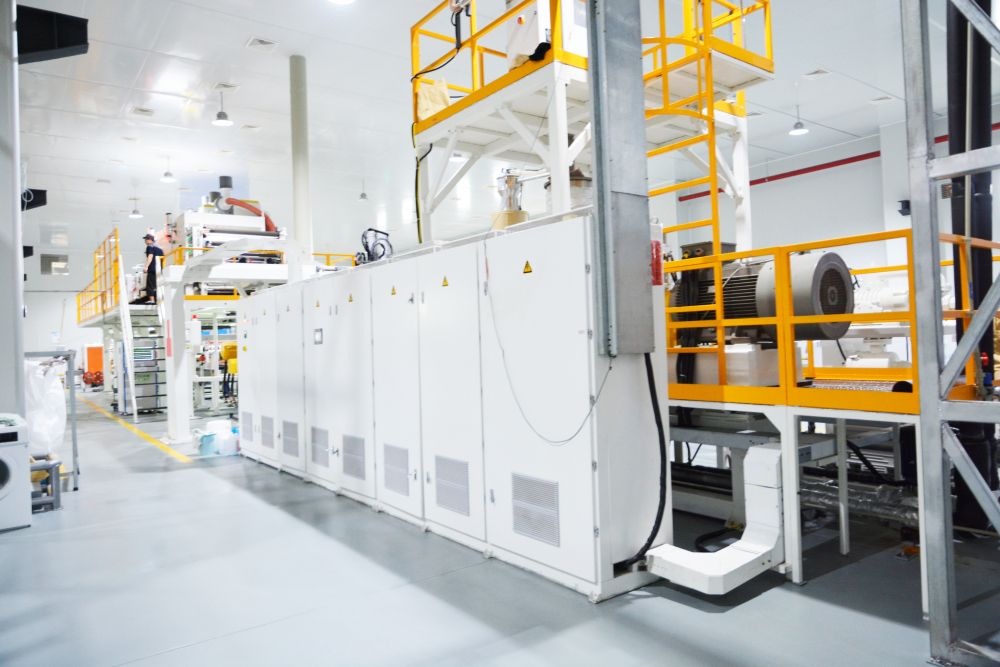
Co-extrusion capacity determines which sheet structures a supplier can hold stable across batches rather than only on a sample. Image: PULIXIN manufacturing base.
| Product line | Material | Published thickness and width | Structure and forming process |
|---|---|---|---|
| PET Thermoforming Plastic Sheet Roll | PET / APET / rPET | Thickness 0.18–1.7 mm customized; width 250–1400 mm customized; roll size 50–800 kg per roll customized | Mono-layer or multi-layer; vacuum forming or pressure forming |
| PP Thermoforming Sheet Roll | Polypropylene (PP) | Thickness 0.3–2 mm customized; width 300–900 mm customized | Mono-layer or multi-layer; vacuum forming or pressure forming |
| HIPS Thermoforming Sheet Roll | Polystyrene (PS) / high impact polystyrene (HIPS) | Thickness 0.24–2 mm customized; width 300–900 mm customized | Mono-layer or multi-layer; glossy or matte surface; vacuum forming or pressure forming |
Customization is published across thickness, width, color matching, surface finish options, multilayer co-extrusion structures, food-grade material solutions and OEM production. Taken together, these are the elements a buyer can use as the starting point for a documented specification, while the controlled-environment condition itself should be confirmed in scope and monitoring terms for the specific order.
Where This Evidence Matters Most: Application Fit
The same evidence package is read differently depending on the finished part. In medical and pharmaceutical packaging, thermoformed sheet is used for medical device trays, pharmaceutical blister packaging, disposable medical product trays and protective packaging inserts. These parts position, separate and protect products and must maintain packaging integrity during handling, storage and transportation, which is why consistent thickness, stable thermoforming performance, clean surface, dimensional stability and suitable transparency are commonly specified together.
In retail-oriented applications the emphasis shifts. Blister packs, clamshell packaging, cosmetic trays, hardware and stationery packaging depend on forming definition, suitable transparency or color, and printability where required. Toy blisters and transparent display packs add impact resistance and consistent appearance. Transparent folding boxes depend on high transparency, a smooth surface, printability, dimensional stability and folding performance, and are converted through printing, die cutting, creasing and folding rather than through thermoforming alone.
For buyers, the practical implication is that a controlled-environment claim should be validated against the application group rather than against a general hygiene statement. A retail blister program may need environmental control and surface protection, while a pharmaceutical tray program usually needs those plus application-specific documentation.
Market Context: Why Documentation Requests Keep Increasing
The demand for verifiable supplier evidence is growing with the category itself. Grand View Research values the global thermoformed plastic market at $14.79 billion in 2023 and projects a compound annual growth rate of 4.9% over 2024–2030. Recycled content adds a second layer of documentation pressure: the rPET market has been projected to grow to $24.6 billion by 2034, according to Dataintelo.
Comparable market figures should be read with care. Published estimates differ depending on whether researchers measure thermoformed materials such as raw sheet or finished thermoformed products; one commercial estimate places the 2024 figure at $15.98 billion while another values 2023 at $14.79 billion. This definitional gap is a useful reminder that category-level numbers describe a market, not a supplier's capability, and cannot substitute for supplier-level evidence.
Regulatory and classification frameworks reinforce the same direction. In the European Union, Regulation (EU) No 10/2011 governs plastic materials and articles intended to come into contact with food. Internationally, thermoforming plastic materials are classified under HS Code headings 3920 for non-cellular and 3921 for cellular products, which matters for customs and trade documentation. Publicly available supplier-level certification and capacity matrices remain limited, which is precisely why per-supplier evidence requests have become a normal part of procurement in this category.
Comparing Supply Routes: Documented Control versus General-Purpose Supply
Most buyers are choosing between two routes rather than between two brands: a documented supply route in which specification, environment and inspection are defined and traceable, and a general-purpose route in which the sheet is purchased largely on material name, nominal thickness and price.
| Decision dimension | Documented supply route | General-purpose supply route |
|---|---|---|
| Specification basis | Written sheet structure, thickness and tolerance, width, roll configuration, color or transparency and application requirements | Material name and nominal thickness, frequently without tolerance or roll definition |
| Environment | Clean and dry indoor processing with controlled temperature and humidity, scope and monitoring confirmed per order | Not defined; environmental conditions are assumed rather than stated |
| Batch control | Thickness tolerance, width accuracy, transparency, mechanical properties and thermoforming performance controlled per batch | Limited or undocumented in-process verification |
| Outgoing acceptance | Specification, thickness and width, appearance and finished-product inspection before shipment; third-party inspection available on request | Visual check at dispatch |
| Commercial profile | Higher documentation and control effort, reflected in the specification discussion rather than in a headline price | Lower administrative effort and often a lower quoted unit price at the point of purchase |
The honest limitation is that the documented route is not automatically the correct choice for every project. Environmental control, tighter thickness tolerance and extended inspection add cost, and they only pay back where the finished package actually requires them. A shallow, non-critical retail insert with a forgiving forming window may not justify the same evidence package as a pharmaceutical tray. Equally, the documented route only covers what is documented: it does not certify a cleanroom class, does not replace food-contact or medical compliance verification, and does not remove the need for a production trial on the buyer's own mold and machine.
Building Verification into a Long-Term Supply Relationship
Supplier evidence checks matter most at the moment a buyer changes source. Comparing suppliers by material name, nominal thickness and price alone is the most common reason a switch disrupts production: two sheets both described as 0.5 mm PET can still behave differently on the same thermoforming line.
A workable sequence starts from the currently proven sheet specification as the comparison baseline. Confirm equivalent specifications and required documentation first, then run a controlled production trial before moving to regular-volume orders. Avoid changing material structure, thickness and process settings at the same time, because that makes the source of any forming difference impossible to identify. For new projects, work backward from the finished part: application, part dimensions, forming depth, rigidity, transparency or color, operating temperature, mold layout and equipment limits.
Roll configuration belongs in the same conversation. Roll width is normally determined by mold layout, product arrangement and trim allowance, while roll diameter, roll weight and core size must remain compatible with the unwinding system. When these are confirmed against the equipment limits before production, environmental and thickness control translate into stable line performance rather than into a specification that only looks correct on paper.
Outlook
Two forces are pushing clean-environment and consistency claims toward harder evidence. The first is application mix: growth in thermoformed packaging continues to include medical, pharmaceutical and high-visibility retail segments where surface condition and dimensional stability are functional requirements rather than appearance preferences. The second is documentation expectation: buyers increasingly compare suppliers using batch-level inspection records, controlled-trial results and clearly scoped environmental statements instead of brochure language.
The likely result is a gradual standardization of how controlled-environment claims are written in this category, with clearer separation between processing conditions, material compliance and validated application performance. Buyers who adopt a decomposable evidence framework now will find that transition easier to absorb, because they are already asking for the parts rather than the label.
FAQ
What does clean room capability usually mean when a thermoforming sheet supplier uses the term?
In thermoforming sheet supply, the term is most often used to describe a clean and dry indoor processing environment with controlled temperature and humidity, rather than a certified cleanroom classification. Because the phrase is not standardized in sheet manufacturing, buyers should ask the supplier to define what is controlled, where it applies in terms of lines or areas, and how it is monitored. Where a specific cleanroom class is required, that class must be stated and evidenced separately for the specific product and order.
What evidence should a buyer request when a supplier claims a controlled processing environment?
Request the scope of the claim, meaning which production areas or lines are covered, how temperature and humidity are controlled and recorded, and how the environment is maintained during handling and packing. The claim becomes considerably more useful when it is linked to batch quality control covering thickness tolerance, width accuracy, transparency, mechanical properties and thermoforming performance, and to pre-shipment inspection covering specification verification, thickness and width inspection, appearance inspection and finished-product quality inspection. Third-party inspection may be arranged where the buyer's own process requires independent confirmation.
Does a controlled processing environment replace food-contact or medical packaging compliance?
No. Environmental control addresses contamination risk during production and does not establish material compliance. Food-contact and medical packaging requirements address different applications and should not be treated as interchangeable, and a general-purpose sheet should not be described as medical grade without supporting documentation. In the European Union, Regulation (EU) No 10/2011 governs plastic materials and articles intended to come into contact with food, and buyers should confirm compliance for the specific material, application and destination market rather than assuming it from a processing claim.
Why does thickness consistency matter as much as environmental control?
Thickness variation changes how the sheet absorbs heat and how material distributes during forming, which affects part weight, wall thickness, cycle stability and reject rate. In deep-draw parts, the decisive question is how material moves from the flange and sidewalls toward the deepest area of the cavity, where initial thickness, draw ratio, mold geometry, corner radius and heating uniformity interact. A controlled environment can reduce surface contamination, but it does not compensate for thickness variation, so thickness and tolerance should be specified, measured and inspected within the same evidence package.
How should clean-surface requirements be protected after the sheet leaves the manufacturer?
The sheet surface remains exposed through unwinding, transport, storage and feeding. Storage temperature, humidity, direct sunlight, packaging condition and storage time can all influence sheet condition before processing, and curl or uneven feeding can originate from winding stress, material structure, temperature change, transport or storage rather than from the material alone. Buyers should therefore agree packaging and handling requirements, follow the supplier's storage recommendations, and determine whether an issue originates in the sheet, storage or the feeding equipment before changing material or process settings.
When does long-term supply evidence matter more than a lower initial sheet price?
When a specification has been qualified on a specific thermoforming line, changing it carries re-trial cost, reject risk and downstream disruption. Finished-package cost depends on material density, required thickness, forming yield, scrap utilization, cycle stability and reject rate rather than on price per kilogram alone, so a lower quoted unit price does not automatically produce a lower packaging cost. Buyers replacing a supplier should use the proven specification as the baseline, confirm equivalent specifications and documentation, and complete a controlled production trial before committing to regular-volume orders.
Reference material: PULIXIN product catalogue (PDF). Company information: pulixin.com.