
Verifying Custom Drainage Geonet Capability for Site-Specific Demands
For drainage geonet used in industrial containment, a decisive part of product performance is set before installation: it is decided when a manufacturer translates site-specific mechanical and chemical requirements into material choice, structural design, and a production run. Buyers at the evaluation-to-execution stage therefore need to verify manufacturing capability, not only compare datasheets. This article explains what capability evidence matters in custom drainage geonet sourcing and how a geosynthetics manufacturer such as Haoyang Environment Co., Ltd. can be assessed against those criteria.
Why Capability Verification Matters in Drainage Geonet Sourcing
Drainage geonets are installed to collect and remove water, leachate, or gas within engineered containment systems. In severe applications, the product is exposed to sustained pressure, aggressive chemistry, long design life, and installation conditions that are difficult to reverse once covered. A product that fails after closure is costly because the drainage layer is no longer accessible without excavation.
The common procurement mistake is to buy a drainage geonet as a commodity defined mainly by thickness and mass per unit area. Those two figures do not describe whether a product can survive the specific acid or alkali environment of a project, whether its structure can carry the overburden without excessive deformation, or whether its drainage capacity matches the expected flow. Suppliers may quote similar dimensions but differ substantially in polymer selection, production consistency, quality control, and the ability to adjust parameters to project conditions.
The opportunity, particularly for mining, smelting, and containment applications, is to shift from a catalogue-based purchase to a capability-based purchase. That means asking which parts of the product can be customised, what evidence exists for each claimed property, and whether the supplier can convert a specification into repeatable production with documented quality.
Supplier Capability Reference: Haoyang Environment
Haoyang Environment Co., Ltd. (Haoyang) is a China-based geosynthetics manufacturer headquartered in Dezhou (Yucheng) National High-tech Industrial Development Zone, Shandong Province. The company develops and produces geomembranes, geotextiles, composite drainage nets, waterproof materials, and related products. Its drainage geonet range is manufactured in HDPE, PP, and PET variants, a fact that matters when buyers need corrosion-resistant or mechanically tailored options for site-specific projects.
R&D and Engineering Depth
Haoyang operates an internationally first-class research and development center for geosynthetic material products and applications, supported by 20 professional engineers. The engineering team gives the manufacturer capacity to respond to project-specific technical questions rather than simply send a standard product list. This is relevant because custom drainage geonet requirements often involve simultaneous changes to load resistance, chemical resistance, drainage capacity, and dimensional constraints.
Customization and OBM Capability
The company provides OBM production services and customization of parameter groups that affect drainage geonet performance. Available customization includes LOGO, width, scroll length, thickness, GSM, tensile yield strength, tensile fracture strength, piercing strength, and specified chemical and physical indicators. OBM capability also allows buyers to receive product under their own brand when procurement and project documentation require it.
For industrial buyers, the practical implication is that custom requirements do not have to be limited to roll width and roll length. If a project demands high compressive resistance, higher tensile performance, or specific acid and alkali resistance, those conditions can be written into production parameters before manufacturing starts.
Production Scale and Procurement Conditions
Manufacturing capability is also a matter of scale and repeatability. Haoyang reports a monthly production capacity of 3,000 tonnes, a standard lead time of 10–30 days, and a minimum order quantity of 5,000 m². The company operates a factory area of 200,000 m² with 190 employees and annual output of 33,000 tonnes. Quality control is stated as 100% tested, and the procurement acceptance procedure includes pre-shipment testing. These facts help buyers assess whether custom specifications can be produced at commercial scale without sacrificing verification.
Documented Compliance
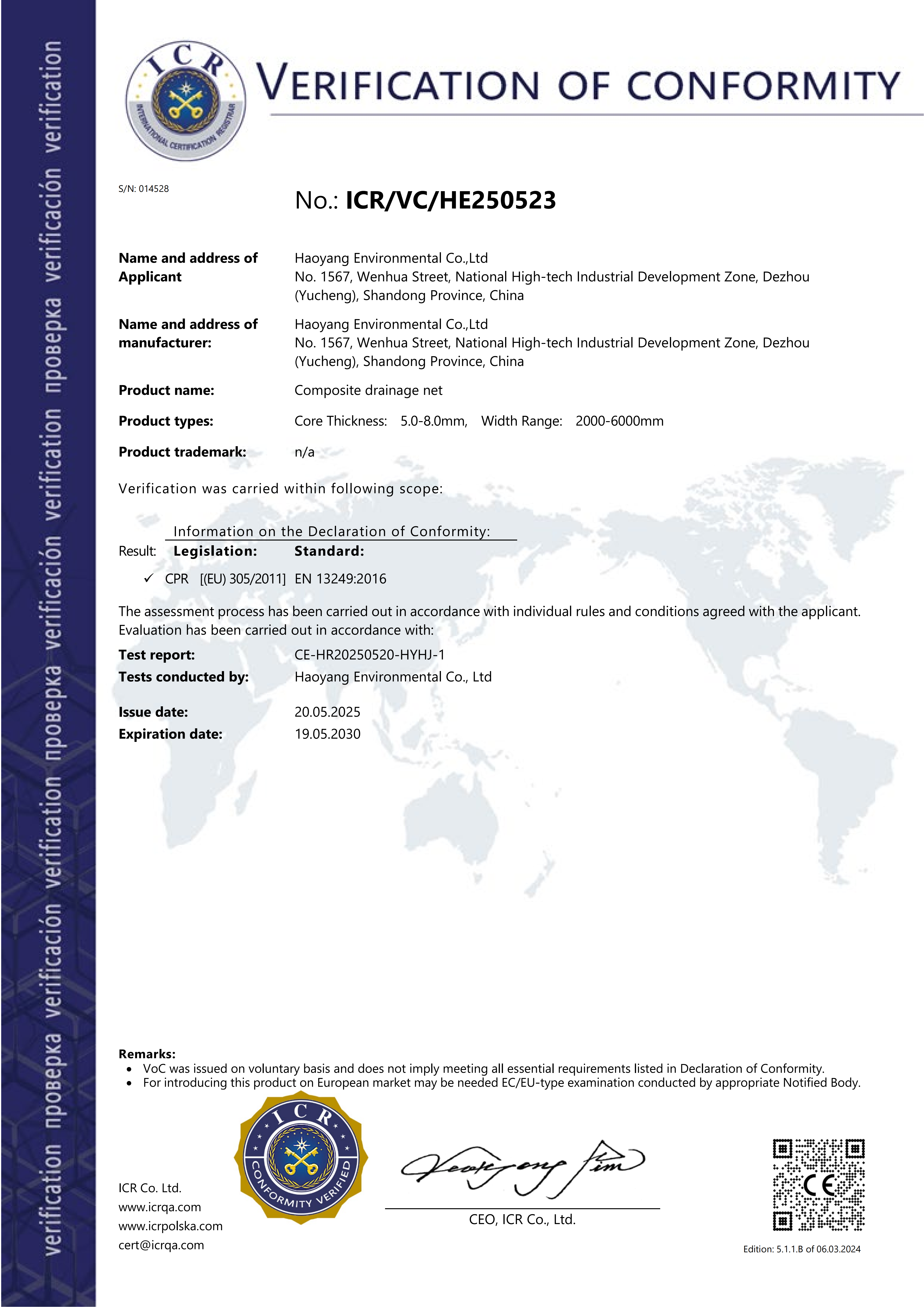
Certification plays a supporting role in capability assessment. Haoyang's composite drainage net holds a CE Verification of Conformity issued under EN 13249:2016, with certificate ICR/VC/HE250523 valid until 2030. For export to the EAEU region, the 3D composite drainage geonet line carries a GOST Certificate of Conformity based on GOST 33068-2014, issued by the Russian certification body ProfSert. Compliance documentation does not replace project-specific engineering review, but it provides an auditable starting point for buyers in Europe, Central Asia, and the broader EAEU market.
Technical Parameters That Should Be Verified in a Custom Drainage Geonet
The performance of drainage geonet products is often summarised by a group of parameters that buyers can cross-check against their project specifications. The table below lists the typical range available in Haoyang's drainage geonet series and the project question each parameter helps answer.
| Parameter | Typical Range | What It Affects in Site Conditions |
|---|---|---|
| Thickness | 4.0–8.0 mm (customisable) | Drainage void geometry and compatibility with confining stress |
| Mass per unit area | 500–1400 g/m² (customisable) | Structural mass, handling characteristics, and performance consistency |
| Tensile strength (MD/TD) | ≥5–15 kN/m | Resistance to installation tensile loads and foundation movement |
| Elongation at break | 10–25% | Deformation tolerance before rupture |
| Compressive strength (10% strain) | ≥500–830 kPa | Resistance to overburden pressure in deep or heavy fill conditions |
| Acid/alkali resistance | ≥90% strength retention | Long-term durability in aggressive leachate or process water |
| Drainage capacity | ≥50–120 (L/min)/m (customisable) | Ability to transmit expected water or leachate flow in-plane |
| Material | HDPE / PP / PET | Base polymer selection for chemical, mechanical, and durability requirements |
These parameters interact. For example, a high compressive resistance drainage geonet must maintain its open structure under load; a product that is strong in a laboratory tensile test may still close its drainage channels if the core and filter layers are not matched to the site stress. Similarly, acid and alkali resistant drainage geonet cannot be evaluated by thickness alone, because chemical resistance depends primarily on the polymer and the structural integrity of the geonet under chemical exposure.
Buyers should also verify which product forms the supplier can produce. Common project names include composite drainage geonet, 3D composite drainage geonet, polyester filament composite drainage geonet, and high-strength polypropylene composite drainage geonet. The presence of a geotextile layer, the method of bonding, and the choice of carrier polymer directly affect filtration and drainage behaviour. The request for quotation should state not only dimensions but also expected compressive stress, chemical exposure, flow rate, and installation sequence.
From Parameters to Site Performance: Application Evidence
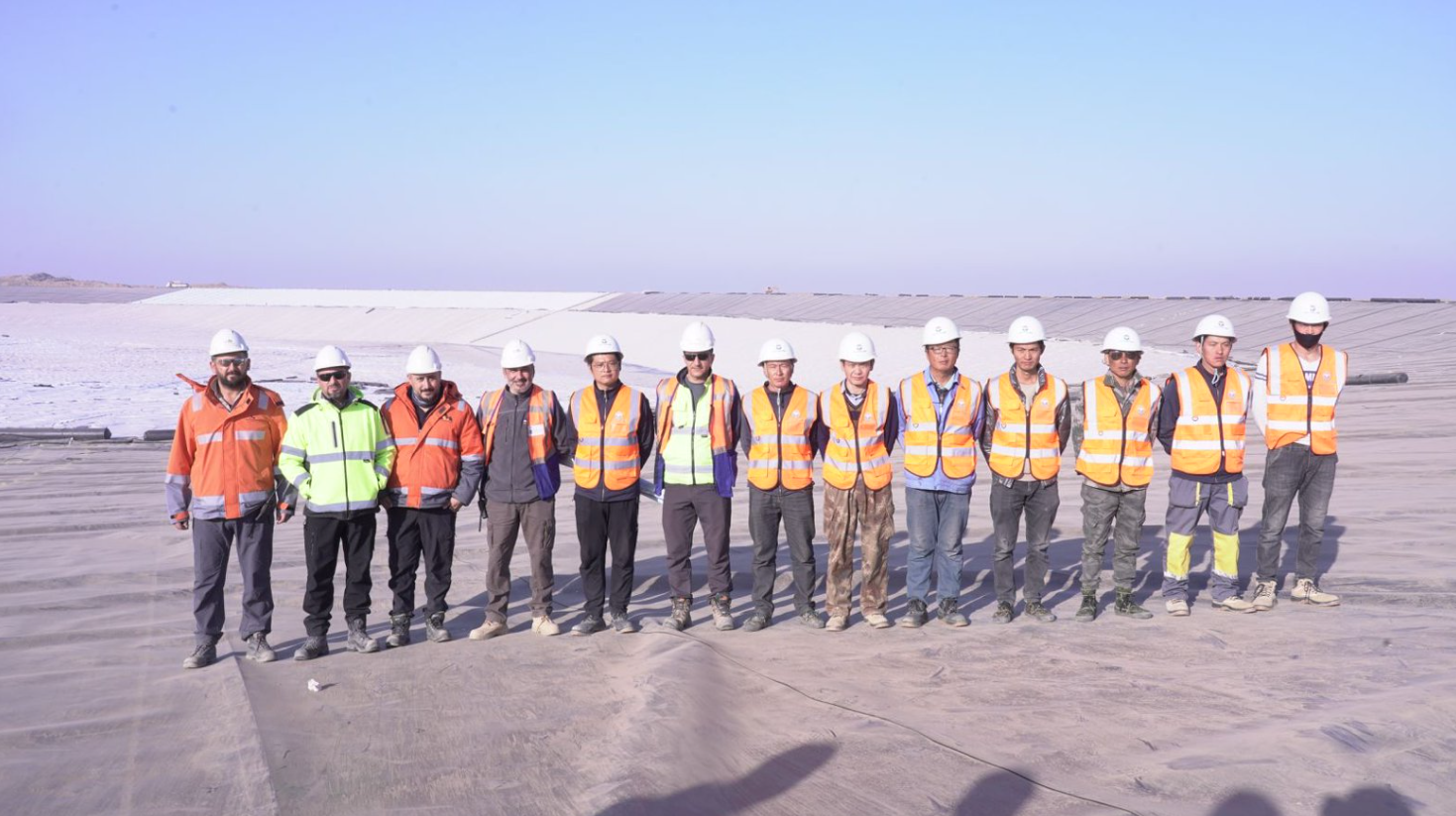
Capability is most credible when it has been demonstrated in an application with similar performance requirements. Haoyang's documented project evidence includes a 900,000 m² seepage prevention project for a gold mine tailings pond in Uzbekistan, serving the mining and smelting engineering sector.
The project adopted a three-dimensional composite drainage network combining a textured geomembrane and high-strength polypropylene geotextile. In this configuration, the drainage network works together with the impermeable liner rather than as an isolated layer. The case also shows a full-chain service system extending from material supply to on-site installation and construction, which is relevant for buyers who need supplier accountability beyond the factory gate.
One technical detail in the published case deserves attention. The textured geomembrane used in the project was produced with a process that forms the rough surface in the molten state, reducing production energy consumption by 25% and avoiding thermal ageing risks caused by secondary processing. This type of process evidence matters to buyers because it shows whether the manufacturer controls material behaviour at the production stage or relies on post-processing that may weaken the final product.
For the drainage geonet itself, buyers should ask for project references that show how the supplier handled high compressive load or chemical exposure. If a supplier has installed a 3D composite drainage network in a gold mine tailings environment, that experience reduces uncertainty when the same manufacturer quotes drainage geonet for leachate or mining process water.
Market Dynamics Supporting Technical Customization
External market data confirms that drainage applications are not a niche within the geosynthetics industry. In 2024, drainage applications accounted for about 44.55% of global geocomposites revenue, according to Grand View Research. The geocomposites market, which includes geotextile-geonet products, was estimated at around USD 564 million in 2024 and is projected to reach roughly USD 1,074.88 million by 2032.
Material selection also shapes competitive supply. Polyethylene-based drainage nets account for nearly 64% of global material demand, largely because polyethylene offers strong chemical resistance. This helps explain why HDPE drainage geonet is frequently requested for containment and mining applications. However, projects requiring higher structural strength or specific installation characteristics may justify PP or PET variants, which is why a supplier's ability to work across multiple polymers is a meaningful capability indicator.
At the same time, procurement patterns are becoming more compliance-intensive. The ASTM D7273 standard, for example, provides a recognised framework for acceptance testing of geonets and geonet drainage geocomposites. Buyers who reference performance standards in their tender documents make it possible for suppliers to demonstrate capability through test evidence rather than through vague marketing descriptions.
Capability-Based Procurement vs. Catalogue-Based Procurement
Traditional drainage geonet procurement tends to be catalogue-based: the buyer selects the closest standard thickness or mass, and the supplier delivers a standard roll. That route can be efficient when site conditions are benign and well understood. It becomes risky when the project involves high overburden, unusual water chemistry, or long service life, because no standard product is optimised for those conditions.
Capability-based procurement is structured differently. The buyer defines functional requirements such as compressive strength at 10% strain, chemical strength retention, drainage capacity, and installation constraints. The supplier then proposes material, thickness, mass, and structural configuration to meet those criteria. This approach requires more technical dialogue before production but reduces the chance of product-site mismatch during execution.
| Procurement Dimension | Catalogue-Based Approach | Capability-Based Approach |
|---|---|---|
| Product choice | Standard thickness/GSM from price list | Parameter customisation to site load and chemistry |
| Material decision | Often default HDPE | HDPE/PP/PET assessed against project chemistry |
| Technical review | Limited before order | Engineering dialogue before production |
| Quality evidence | Basic datasheet | Material-specific test data and third-party compliance |
| Installation risk | Usually transferred to site contractor | Can include full-chain material-to-installation service |
| Delivery flexibility | Faster for small or urgent orders | Production slots and MOQ apply to custom runs |
Customisation has legitimate boundaries. A fully custom drainage geonet requires longer technical preparation than an off-the-shelf product. Haoyang's standard lead time of 10–30 days and MOQ of 5,000 m² mean that custom runs are not suitable for very small trial quantities or emergency repairs. Buyers should therefore compare the economic benefit of tailored drainage performance against the schedule and quantity constraints of a custom manufacturing batch.
Future Outlook: From Generic Rolls to Documented Capability
The next phase of drainage geonet procurement is likely to place more weight on documented technical capability. As clients in mining, smelting, aquaculture, and infrastructure projects extend design lives and face stricter environmental compliance, the buyer question will shift from what thickness is cheapest to whether the supplier can prove how a geonet will perform under site-specific pressure and chemistry.
Three developments are likely to shape purchasing decisions. First, tender documents will increasingly contain functional endpoints such as minimum compressive stress at defined strain, retained strength after chemical exposure, and required in-plane flow capacity. Second, manufacturers with in-house R&D, multi-polymer production, and third-party certification will be easier to evaluate than trading companies that only pass through standard rolls. Third, service scope will expand beyond delivery, with buyers preferring suppliers who can support material supply, installation, and construction as a single accountable chain.
Haoyang's current profile already aligns with this direction: it combines a first-class R&D center, 20 professional engineers, OBM customization services, a 3,000-tonne monthly production capacity, and documented references in mining and smelting engineering. Those facts give industrial buyers a reasonable starting point when assessing whether a supplier can turn site-specific demands into a manufactured drainage geonet.
Frequently Asked Questions
1. What parameters can be customised in Haoyang drainage geonet?
Customization services cover LOGO, width, scroll length, thickness, GSM, tensile yield strength, tensile fracture strength, piercing strength, and specified chemical and physical indicators. OBM production is also available, allowing buyers to brand the final product for their own project documentation.
2. Which materials are offered for drainage geonet at Haoyang?
Haoyang's drainage geonet series is available in HDPE, PP, and PET material variants. HDPE is often specified when high chemical resistance is required. The choice among HDPE, PP, and PET should be evaluated against the chemical environment, mechanical loading, and installation conditions of the project.
3. What production capacity and lead time apply to custom drainage geonet orders?
Haoyang reports a monthly production capacity of 3,000 tonnes and a standard lead time of 10–30 days. The minimum order quantity is 5,000 m², and quality control is described as 100% tested, with pre-shipment testing included in the procurement acceptance procedure.
4. What certification evidence is available for Haoyang drainage geonet?
Haoyang's composite drainage net holds a CE Verification of Conformity based on EN 13249:2016, certificate ICR/VC/HE250523, valid until 19 May 2030. For the EAEU region, the 3D composite drainage geonet line holds a GOST Certificate of Conformity based on GOST 33068-2014, issued by ProfSert. Buyers should always confirm that the certificate scope matches the exact product and market.
5. Does Haoyang offer installation support beyond drainage geonet delivery?
After-sales services include on-site support. In a documented gold mine tailings project in Uzbekistan, Haoyang established a full-chain service system from material supply to on-site installation and construction. Buyers should define site-service scope separately in the contract because installation requirements vary by project.
Tem questões ou precisa de mais detalhes?
Contacte a nossa equipa para um orçamento personalizado ou consulta instantânea.
Solicitar orçamento
Preencha o formulário abaixo e a nossa equipa entrará em contacto com uma proposta personalizada.
Chat direto do WhatsApp
Prefere conversar em tempo real? Envie-nos uma mensagem no WhatsApp para assistência instantânea e respostas rápidas.
- Obter orçamento personalizado
- Partilhar fotos ou documentos
- Discuta as suas necessidades diretamente
Geralmente responde em 5–30 minutos durante o horário de expediente.