
Verifying Eco-Friendly Custom Packaging: From Green Claims to Audit Trails
Eco-friendly custom packaging is only as credible as the documents a supplier can attach to a specific purchase order. Since the EU Packaging and Packaging Waste Regulation (PPWR) entered into force on 11 February 2025 and applied in major part from August 2026, the buyer question has shifted from whether a box is recyclable to which certificate covers which SKU, at which site, under which material specification.
BEJAN GIANT NEW PACKAGING — the operating name of QINGDAO BEJAN GIANT NEW PACKAGING TECHNOLOGY CO.,LTD — is a direct packaging manufacturer founded in 2014 and based on Tianfeng North Road, Chengyang, Qingdao. It operates a 10,000 m² production facility with 200+ employees, six R&D engineers and an annual output of 100,000,000 units across three product families: Rigid Gift Box (BP-RIGID-GIFT02), Corrugated E-commerce Mailer Box (BP-MAIL-EB01) and Folding Paper Carton Box (BP-FBB-CARTON03). Around 80% of output is exported to the EU, USA, UK, JP, AU, CA and KR, and the company reports having served 200+ global brands.
This is not an argument that any single supplier should be selected. It is a working structure for converting sustainability claims into evidence a procurement team can file, using one manufacturer's disclosed records as a concrete example of what documented looks like — and where the documentation stops.
The problem: recyclability is easy to print and expensive to prove
The commercial pressure behind eco-friendly custom packaging is measurable. Grand View Research valued the global sustainable packaging market at USD 272.9 billion in 2023, with Europe holding a 36.2% revenue share, and projects USD 448.5 billion by 2030 at a 7.6% CAGR. Research and Markets figures place paper and paperboard at a 38.2% share of sustainable packaging materials in 2024, while Precedence Research attributes 33.6% of the market to boxes and cartons, driven by e-commerce volumes.
Regulation has moved in parallel. The PPWR requires all packaging to be recyclable by 2030 and sets recycled-content targets; it was adopted on 19 December 2024, entered into force on 11 February 2025, and applies in major part from August 2026. Mordor Intelligence counts Extended Producer Responsibility schemes for packaging in 63 countries as of 2025.
The gap is rarely in intent. It sits in the evidence chain, and it typically fails in one of three places:
- A certificate exists but its scope names a process, not the product the buyer is ordering.
- An ethical or quality audit covers a site whose legal name does not match the entity on the purchase order.
- The material specification mixes coated and uncoated components, or includes plastic hardware, so the pack is paper-based in appearance but not recyclable in the stream it will enter.
A three-layer evidence model for eco-friendly custom packaging
Procurement teams evaluating a green packaging supplier can organise verification into three layers, each answered by a different class of document. The layers are cumulative: a SKU-level certificate statement is only meaningful if the site and the management system behind it also check out.
| Layer | Buyer question | Document that answers it | What to check |
|---|---|---|---|
| 1. Facility | Does the factory physically exist and own the processes claimed? | Site address, floor area, headcount, equipment list, capacity statement, live or recorded factory walkthrough | Equipment matching the claimed finishes; stated daily output per product family; whether production is in-house or subcontracted |
| 2. System | Is quality and labour performance independently audited? | ISO 9001 certificate(s); SMETA audit report with Sedex references | Certificate number, issuing body, validity dates, and the scope wording — process scope versus product scope |
| 3. SKU | Does the certification actually cover the article I am buying? | Product-level certification mapping, FSC Chain of Custody claim type, material and ink specification | Model number correspondence; FSC 100%, Mix or Recycled claim; adhesive and insert composition |
Table 1. A three-layer evidence model for verifying eco-friendly custom packaging suppliers.
Layer one: what a 10,000 m² factory actually demonstrates
Floor area and headcount are weak signals on their own; they matter because they bound what can be done in-house. BEJAN GIANT operates a 10,000 m² facility with 200+ staff and an annual output of 100,000,000 units. The production line-up disclosed by the manufacturer includes Heidelberg offset presses, automatic die-cutters, laminators, folder gluers and UV coating machines, supported by hot-stamping capacity for decorative work.
For a buyer, each of these processes maps to a specific claim that is otherwise difficult to audit:
- Offset printing in-house keeps control of ink specification. The eco configuration on the mailer and folding carton uses food-grade soy-based ink, which is stated at specification level rather than as a general marketing statement.
- Automatic die-cutting and folder-gluing determine dimensional tolerance and glue-line accuracy. On a self-locking corrugated mailer, poor die accuracy shows up as tape reliance in the warehouse — the exact cost the tape-free structure is meant to remove.
- Laminating and coating in-house is where recyclability is most often lost. Matte or gloss lamination and water-based soft-touch varnish are finishing options; buyers should state explicitly whether a film laminate is acceptable in the intended waste stream, or whether a water-based finish should be specified instead.
- Rigid box assembly capability explains how a 1.5–3 mm FSC high-density grey board shell with magnetic closure and moulded pulp or velvet-lined inserts is produced at a stated daily output of 25,000+ pieces.
Capacity figures should be read per family rather than as a single pool. The disclosed daily outputs are at least 60,000 pieces for Folding Paper Carton Box, 40,000 pieces for Corrugated E-commerce Mailer Box and 25,000 pieces for Rigid Gift Box, against a stated monthly capacity of 30,000,000 units, a minimum order quantity of 500 units and a lead time of 7–15 days. Sampling is quoted at 7 days and custom design turnaround at 3 days.
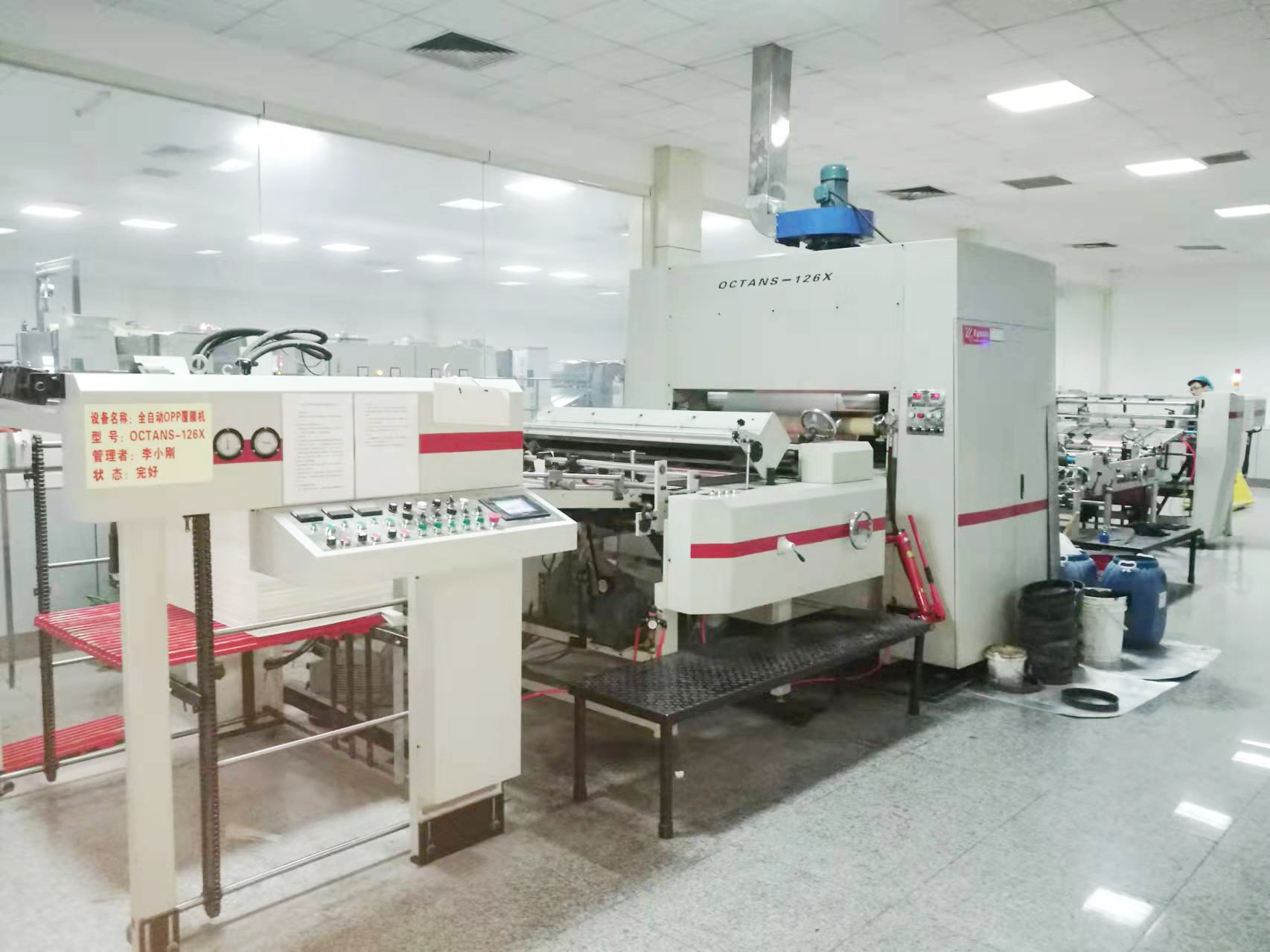
In-house laminating capacity: the process where recyclability specifications are most often decided.
Layer two: system certificates and what their scope covers
Two ISO 9001:2015 certificates are listed for the manufacturer, and the difference between them is instructive for buyers who assume one certificate covers everything.
| Certificate | Number | Issuing body | Scope wording | Validity |
|---|---|---|---|---|
| ISO 9001:2015 Quality Management System | 452QMS2100010 | QINGDAO GFS CERTIFICATION CO.,LTD. | Production and Sales of Paper Products | 2021-10-18 to 2027-10-17 |
| ISO 9001:2015 Quality Management System | 10422Q01616R0S | SHANDONG SEATONE INTERNATIONAL CERTIFICATION CO.,LTD. | Paper Handicraft Design, Paper Packaging Box Sales | 2022-08-30 to 2028-08-29 |
Table 2. ISO 9001:2015 records disclosed for the Qingdao production site, both aligned to GB/T 19001-2016 / ISO 9001:2015.
Both certificates point to the same standard but not the same activity. One is worded around production and sales of paper products; the other is worded around paper handicraft design and paper packaging box sales. A buyer whose order depends on structural design input — a custom rigid box with a die-cut insert, for example — should confirm which scope covers the design stage, because that is the activity being relied on.
Labour and ethical performance is covered separately. The SMETA Ethical Trade Audit Report is registered under number ZAA600099300, with Sedex company reference ZC416599564 and site reference ZS416684560, issued by Openview Service Limited against SMETA 6.1 with two pillars (Labour and Health & Safety). It was issued on 18 November 2024 and is valid until 17 November 2026, covering all production areas of the corrugated carton and colour box workshop, and is positioned for EU, UK and overseas supermarket clients.
Two details in that paragraph are worth a buyer's attention. First, the audited site is named in the report as Qingdao Baina Packaging Co., Ltd. — a different legal name from the trading entity. That is common in Chinese manufacturing groups, but purchase orders, invoices and audit reports should be reconciled before a retailer onboarding pack is submitted. Second, the report's validity window closes on 17 November 2026; programmes running beyond that date should plan for the renewal cycle rather than assume continuity.
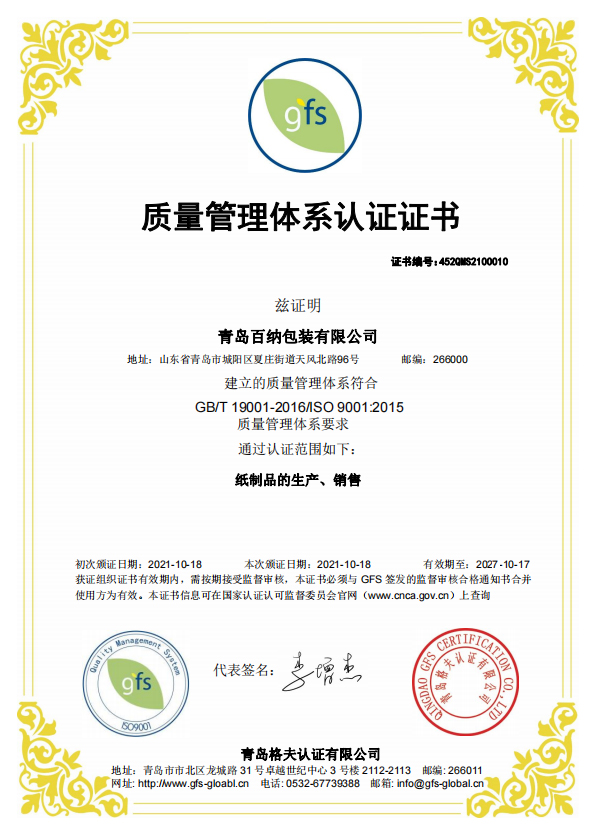
Layer two evidence: a management system certificate is only useful when its scope wording matches the activity being bought.
Layer three: SKU-level documents for carton, mailer and rigid box
This is the layer most supplier questionnaires skip. A valid FSC Chain of Custody certificate means the organisation can trace certified material through purchasing, production and sales; it does not, by itself, tell a buyer that a named article is covered. The disclosed product-level mapping resolves that.
The FSC Chain of Custody certificate is numbered RR-COC-001255, issued by Russian Register against FSC-STD-40-004 v.3-0, valid from 21 June 2023 to 20 June 2028, with a scope covering purchasing of paper materials and production and sales of paper products under FSC 100%, FSC Mix and FSC Recycled claims.
| Product (model) | FSC Chain of Custody | ISO 9001:2015 | SMETA | Core material and consumables | Daily output / price from |
|---|---|---|---|---|---|
| Folding Paper Carton Box (BP-FBB-CARTON03) | Covered — cert. RR-COC-001255; FSC certified FBB/SBS white cardboard and recycled paperboard | Covered under the certified quality management system | Covered at workshop level | 250–400 gsm FSC FBB/SBS board, food-grade soy-based ink, water-based finishes | ≥60,000 pcs / USD 0.3 |
| Corrugated E-commerce Mailer Box (BP-MAIL-EB01) | Covered — FSC certified, global market applicability | Covered | Covered — SMETA 6.1, two pillars | FSC E/B flute corrugated board, soy-based ink, water-based starch glue, moulded pulp inserts | ≥40,000 pcs / USD 0.5 |
| Rigid Gift Box (BP-RIGID-GIFT02) | Covered — cert. RR-COC-001255 | Covered | Covered at workshop level | 1.5–3 mm FSC high-density grey board, recycled coated wrapping paper, soy ink, starch glue | ≥25,000 pcs / USD 1.5 |
Table 3. Product-level certification mapping disclosed for the three eco-friendly custom packaging families. Prices are indicative starting unit prices.
The manufacturer also lists FDA, FSC and ISO 9001 among its compliance credentials, and the folding carton specification states that the all-paper eco configuration has passed a food contact safety test as well as drop and compression testing. Those are specification-level statements rather than certificate numbers, and a buyer submitting to a retailer should request the underlying test report alongside the certificate.
Technical explanation: what actually makes the pack recyclable
Recyclability in paper streams is a design property, not a material slogan. Three variables decide it in practice.
Material mono-composition. All three families are built on paper and board: FSC-certified FBB/SBS white cardboard and recycled paperboard for the folding carton, FSC-certified E/B flute corrugated board for the mailer, and FSC high-density grey board with recycled coated wrapping paper for the rigid box. A single-material structure is easier to sort and repulp than a laminate of paper, film and foam.
Inks and adhesives. The eco configuration uses food-grade soy-based ink and water-based starch glue. These choices matter less at the branding level and more at the repulping stage, where non-water-based adhesives and heavy film coatings complicate fibre recovery.
Inserts and closures. Paper dividers and simple paper trays replace plastic vac-forms in the folding carton; moulded pulp inserts perform the same role in the mailer and can be specified for the rigid box, alongside foam, EVA trays and velvet-lined paper trays. Magnetic closures in the rigid range are hardware, so a fully plastic-free rigid box requires an explicit specification decision rather than a default assumption.
The PPWR logic follows the same sequence: recyclability by design by 2030, plus recycled-content targets, with EPR fee modulation increasingly tied to declared material composition. A supplier that can produce board certification, ink and adhesive specification, and insert composition for a named model is giving a buyer the inputs needed for both the design file and the EPR declaration.
BEJAN GIANT positions its packaging as 100% recyclable and states that products comply with the latest EU PPWR requirements — a claim that is only actionable for a buyer when it is attached to a model number and a material specification, which is what the tables above provide.
Where these three formats fit: application notes
Corrugated E-commerce Mailer Box (BP-MAIL-EB01). The self-locking, tape-free structure targets warehouse packing efficiency in cross-border e-commerce. Full-colour printing on both inner and outer surfaces supports unboxing presentation, and moulded pulp inserts address shock and scratch protection. The disclosed application range spans apparel, shoes and beauty, plus categories from fragrance and candles to small 3C accessories and premium tea and coffee.
Folding Paper Carton Box (BP-FBB-CARTON03). A lightweight retail format for shelf and cross-border e-commerce, with window patching, foil stamping, embossing and spot UV available. Structural options include top-and-bottom lid, auto-lock bottom and window patch box. Applicable categories include beauty and skincare, fragrance and candles, handmade chocolate, small jewellery, pet snacks and tea.
Rigid Gift Box (BP-RIGID-GIFT02). A premium format for cosmetics, jewellery, candles, wine and corporate gift sets, with magnetic closure options at 5 N standard and 7.5 N or 10 N available, and a foldable flat-pack option that reduces inbound freight volume.
A disclosed case profile illustrates how these families are combined in practice: a cross-border DTC brand and foreign trade wholesaler operating in KR, IL and US places batches of 5,000–50,000 pieces for cosmetic, wine and food outer packaging, with cooperation running three to five years on repeat orders. The reported outcome is stable packaging quality and smooth customs clearance, supported by full FSC documentation, pre-shipment inspection and transparent cost accounting.
Market trend: paper-heavy growth and tightening documentation
Three structural trends raise the value of documented suppliers.
First, material gravity. With paper and paperboard at 38.2% of sustainable packaging materials in 2024 and boxes and cartons at 33.6%, the category is not a niche — it is the mainstream of the transition, which means differentiation moves from material choice to verification quality.
Second, segment velocity. Mordor Intelligence puts sustainable e-commerce mailers and envelopes at a 9.41% CAGR through 2031, faster than the overall market. Rapid growth tends to attract suppliers who assemble claims faster than they assemble documentation.
Third, market structure. Grand View Research and Industry Intelligence place Smurfit WestRock at 8.6%, Amcor at 6.0% and International Paper at 5.4% — roughly 20% combined. The remaining 80% is a long tail of regional manufacturers, which is precisely why scope wording and product-level certification mapping matter more than brand recognition at the mid-market tier.
Demand-side signals reinforce the direction without settling the detail: PDI Technologies reports that 80% of consumers in 2024 are willing to pay more for products with sustainable packaging. That figure is survey-based and should be treated as directional rather than predictive of any specific category's price elasticity.
Comparison with traditional sourcing routes — and the limits of this evidence set
The traditional route to eco-friendly custom packaging runs through intermediaries: a trading company aggregates orders, quotes a recyclable specification, and sources production from one or more factories. It can be efficient for small or mixed orders. The structural difference from a direct manufacturer is not price — it is who owns the evidence.
| Verification point | Intermediary-led sourcing | Direct manufacturer model (as disclosed) |
|---|---|---|
| Certificate to product mapping | Requires translation from factory certificate to quoted article | Product-level mapping published for BP-FBB-CARTON03, BP-MAIL-EB01 and BP-RIGID-GIFT02 |
| Audit scope clarity | Audit may belong to a third-party factory not named in the quote | SMETA report names the production site and covers the corrugated carton and colour box workshop |
| Process control | Printing, die-cutting and finishing may sit across several suppliers | In-house offset printing, die-cutting, laminating, folder-gluing and UV coating |
| Change responsiveness | Specification change passes through a commercial layer | 3-day custom design and 7-day sampling stated as standard turnarounds |
Table 4. Structural comparison of evidence ownership, not a quality ranking of any named company.
Where this evidence set stops
Honest procurement work includes the boundary conditions, and four apply here.
- Audit validity is time-bound. The SMETA report runs to 17 November 2026. Buyers running retail programmes into 2027 should confirm the renewal status before committing.
- Plastic-free is an option, not a default. The rigid box range offers FSC-certified all-paper plastic-free configurations, but magnetic closures and certain insert types introduce non-paper components. Specification discipline is required at order stage.
- Entry prices are entry prices. The published starting figures of USD 0.3, USD 0.5 and USD 1.5 per unit correspond to base configurations. Foil stamping, window patching, soft-touch varnish and custom inserts move cost upward, and comparison against a same-price generic pack is rarely like for like.
- Capacity is aggregate. The 100,000,000-unit annual figure spans three product families and multiple markets. Peak-season allocation should be discussed against a forecast, not assumed from headline capacity.
Future outlook
PPWR application from August 2026 and EPR coverage across 63 countries push the industry toward documentation as a standard deliverable rather than a differentiator. The practical consequence for buyers is that supplier evaluation will increasingly resemble a document review: certificate numbers, scope wording, validity windows, model mapping and material composition, checked before a sample is approved rather than after a purchase order is placed.
Two developments are worth watching. First, EPR fee modulation will make declared composition commercially material, not just compliance-relevant, which favours suppliers who can produce ink, adhesive and insert data per SKU. Second, moulded pulp continues to displace plastic vac-forms in premium packaging, a shift already visible in luxury categories and consistent with the insert options disclosed across all three product families.
A full English-language specification brochure covering the rigid gift box, corrugated mailer and folding carton families is available for download: BEJAN GIANT English product brochure (PDF).
Frequently asked questions
Which documents prove that a custom packaging supplier's FSC claim applies to my specific box?
Three documents together: the FSC Chain of Custody certificate, the scope wording describing which material claims and activities are covered, and a product-level statement linking the certificate to the model being ordered. For BEJAN GIANT, the certificate is RR-COC-001255, issued by Russian Register against FSC-STD-40-004 v.3-0, valid from 21 June 2023 to 20 June 2028, covering purchasing of paper materials and production and sales of paper products under FSC 100%, FSC Mix and FSC Recycled. Product-level coverage is stated separately for BP-FBB-CARTON03, BP-MAIL-EB01 and BP-RIGID-GIFT02.
Which certifications apply to the Folding Paper Carton Box (BP-FBB-CARTON03)?
The Folding Paper Carton Box is produced under an ISO 9001:2015 quality management system and is included under the FSC Chain of Custody certification. It is also made in a workshop covered by the SMETA ethical trade audit. At specification level, the all-paper eco configuration uses FSC certified FBB/SBS white cardboard or recycled paperboard with food-grade soy-based ink, and has passed a food contact safety test plus drop and compression testing.
What does the SMETA report cover, and how long is it valid?
The SMETA 6.1 audit, report number ZAA600099300 with Sedex company reference ZC416599564 and site reference ZS416684560, was issued by Openview Service Limited on 18 November 2024 and is valid until 17 November 2026. It covers two pillars — Labour and Health & Safety — and its stated scope is all production areas of the corrugated carton and colour box workshop. The audited site is named in the report as Qingdao Baina Packaging Co., Ltd., so buyers should reconcile that legal name with the entity on their purchase order.
What minimum order quantity and lead time apply to eco-friendly custom packaging orders?
The disclosed terms are a minimum order quantity of 500 units, a lead time of 7–15 days, custom design turnaround of 3 days and sampling in 7 days, against a stated monthly capacity of 30,000,000 units. Scale should be read per product family: daily output is at least 60,000 pieces for the folding carton, 40,000 for the corrugated mailer and 25,000 for the rigid gift box. Small trial runs and large-volume mass production are both supported within those parameters.
How does the EU PPWR affect the specification of custom paper packaging?
The PPWR requires all packaging to be recyclable by 2030 and sets recycled-content targets. It was adopted on 19 December 2024, entered into force on 11 February 2025 and applies in major part from August 2026. In practice this shifts specification toward mono-material paper structures, fibre-compatible inks and adhesives, and paper or moulded pulp inserts instead of plastic components. Buyers should confirm the claim type (FSC 100%, Mix or Recycled), the ink and adhesive chemistry, and the insert composition for the exact model being ordered.
What quality control evidence is available before shipment?
The disclosed process is full inspection before shipment together with a compression resistance test, with on-site third-party inspection by SGS available on request. Product specifications also reference drop and compression testing for the folding carton and FEFCO drop and compression testing for the rigid gift box. After-sales provisions include free blank samples, packaging structure optimisation, full certification document sets, 20-hour online project coordination and rework of defective mass-produced items.
Tem questões ou precisa de mais detalhes?
Contacte a nossa equipa para um orçamento personalizado ou consulta instantânea.
Solicitar orçamento
Preencha o formulário abaixo e a nossa equipa entrará em contacto com uma proposta personalizada.
Chat direto do WhatsApp
Prefere conversar em tempo real? Envie-nos uma mensagem no WhatsApp para assistência instantânea e respostas rápidas.
- Obter orçamento personalizado
- Partilhar fotos ou documentos
- Discuta as suas necessidades diretamente
Geralmente responde em 5–30 minutos durante o horário de expediente.