
Verifying Power Transformer Supplier Capability: Evidence, Models, References
Verifying Power Transformer Supplier Capability: Factory Evidence, Models and References
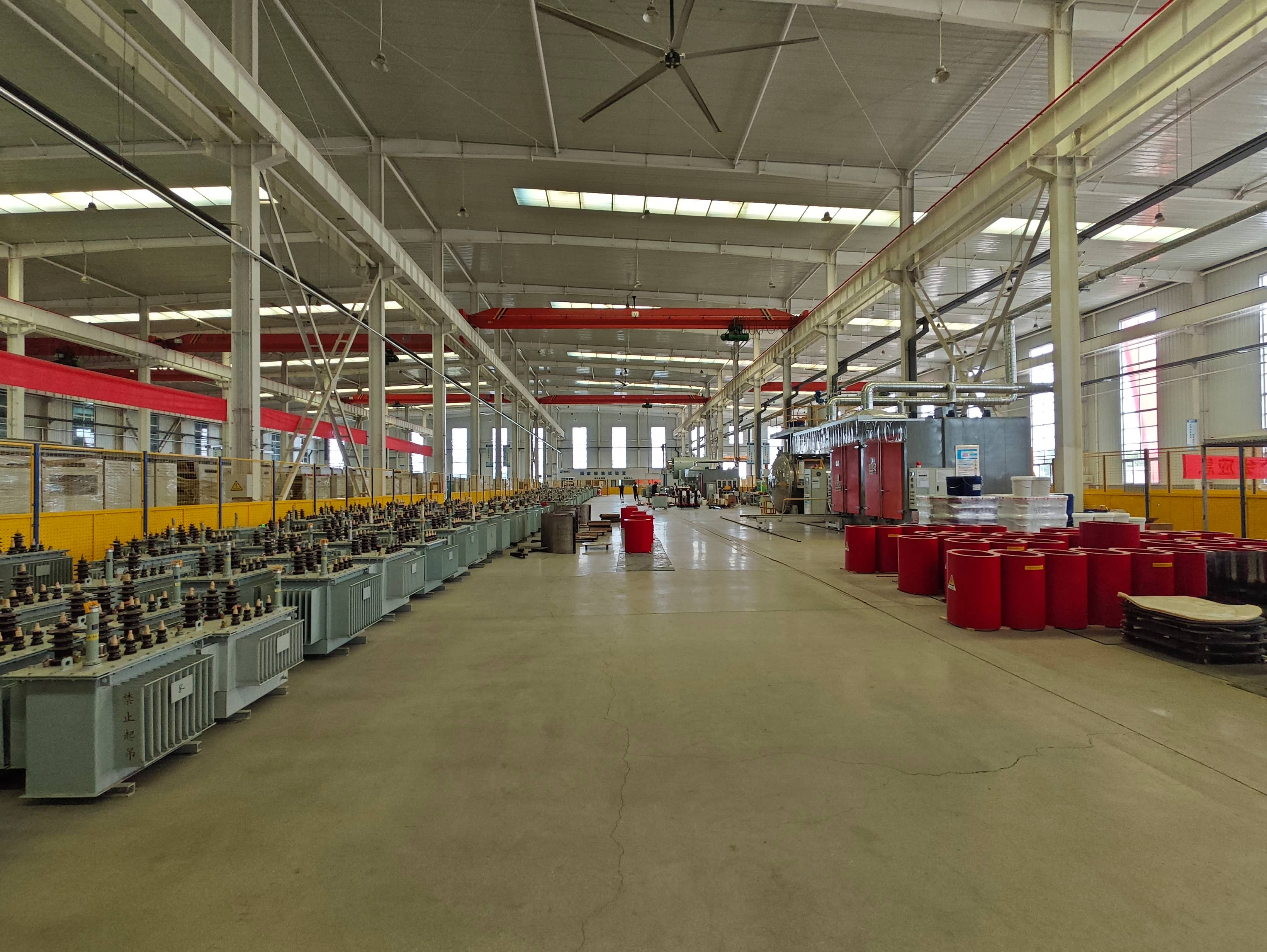
Cover: Milestone Electrical transformer manufacturing workshop. Image source: Milestone Electrical content unit.
Power transformer procurement is a document-heavy decision, but documents matter only when they are tied to the exact unit being bought. A supplier can show a factory, a product catalogue and a certificate and still leave the buyer unable to answer a simpler question: which evidence proves that this model, this design and this unit meet the project duty?
Milestone Electrical is a transformer and electrical equipment brand of Milestone (Xiongan) Electrical Technology Co., Ltd. Its supplied product material covers oil-immersed power and distribution transformers, dry-type transformers, compact substations and related electrical equipment, with OEM/ODM production and export markets including South America, North America, the Middle East, Southeast Asia and Europe.
At the evaluation stage, supplier capability should be verified at three levels: factory evidence, model and document traceability, and application references. This article sets out a practical evidence checklist for that task. The focus is on what can be inspected, matched and traced, not on adjectives.
The Evaluation Problem: Capability Claims Need a Verification Layer
Capability statements are not useless. They set expectations. Milestone Electrical states monthly capacity of 1500 units, lead time of 30-50 days, MOQ of 1 unit, OEM/ODM production and 100% test. Those statements become procurement evidence only when the buyer knows what is included, which unit is covered and how the claim will be demonstrated before shipment.
A factory visit or a video of a production line demonstrates that a manufacturing environment exists. It does not prove that a specific transformer has passed the contracted tests. A certificate is not a substitute for a unit-specific routine test report. A reference list is not proof of comparable duty unless the buyer can map the reference to the load, environment and operating history of the project.
| Evidence layer | What it can support | What it cannot prove by itself |
|---|---|---|
| Unit-specific routine test report or FAT record | The identified unit was tested against recorded values and acceptance criteria. | Whole-system suitability or performance under every future operating condition. |
| Approved datasheet and GA drawing | The intended configuration, ratings and interfaces were defined before manufacture. | That the as-built unit matches the drawing without document review. |
| CE certificate and scope | Listed model families and standards have been assessed within the stated EU scope. | Project-specific approval, every configuration, or all accessories and tap ranges. |
| Factory tour or process images | Manufacturing functions such as winding, insulation, tanking and testing exist. | That a particular order has been manufactured or tested correctly. |
| Application reference | Prior supply and operating history in a stated application and duration. | Identical performance under a different duty, environment or load profile. |
A real limitation should be stated plainly: a complete documentary package cannot compensate for missing type-test evidence, an unapproved design deviation or a factory acceptance arrangement that does not match the project risk. Verification reduces uncertainty; it does not remove engineering responsibility.
Factory Acceptance and Inspection: Select by Consequence, Not Habit
For a critical or customized transformer order, the recommended order is: first, all required tests plus an approved customer or third-party witness and a document-review plan; second, manufacturer testing with comprehensive remote review where accepted. For a standard low-risk order, unit-specific reports and document review may be sufficient. The arrangement should be selected using project consequences, design novelty, contract requirements, supplier evidence, cost and schedule.
Milestone Electrical's testing center is described as being used for factory inspection and electrical testing of dry-type and oil-immersed transformers. Test procedures cover winding resistance, voltage ratio, insulation characteristics and transformer losses as applicable. The facility is also used for routine testing and factory acceptance testing before product delivery. The existence of a testing center does not define the test list for a given order; the contract, applicable standards and approved datasheet do.
| Acceptance arrangement | Suitable context | Boundary to record |
|---|---|---|
| Required tests with customer or third-party witness | Critical projects, new suppliers, significant customization, utility or owner approval conditions. | Adds cost, travel and schedule; a third-party inspection does not automatically certify the entire design. |
| Required tests with approved remote witness and document review | Where the procedure allows adequate equipment identification, observation and record review. | Remote review must be defined, not assumed; evidence quality depends on camera, records and hold points. |
| Manufacturer reports with document review | Accepted standard orders where the contract does not require witnessing. | A similar unit's report cannot replace all required reports for the manufactured unit. |
Factory acceptance testing is an acceptance arrangement, not one universal test list. The buyer should specify the required tests, hold points, instrument calibration evidence, unit identification, acceptance criteria and document set before ordering. This is especially important when the transformer includes an on-load tap changer, non-standard impedance, special cooling or project-specific site protection.
Model Designations as Traceability Anchors
Model designations are not marketing labels. They are the join key between quotation, datasheet, drawings, nameplate, test reports, packing documents and, where applicable, certificate scope. The buyer should require the exact designation to appear consistently across documents. The following models appear in the supplied Milestone Electrical material.
- SFZ-35000/110KV-35KV is a high-voltage power transformer designation in the supplied product record. Verify the exact string on the quotation, approved datasheet, general arrangement drawing, nameplate drawing and routine test report. A test report for a similar unit should not be accepted as the report for this unit.
- YB-1500/35-0.4 is a compact substation designation. The evidence package should cover the integrated assembly, not only the transformer. The solar power plant reference describes a compact substation that brings the transformer, medium-voltage switching and protection, and project-defined low-voltage interfaces into a coordinated prefabricated assembly.
- SCB13-1500/35-0.4 is a dry-type transformer designation. The data center reference notes that design review addresses ventilation, heat dissipation, noise, load profile and maintenance access for an oil-free indoor installation. Those are relevant checks, but dry-type construction does not remove the need for unit test records and site-condition review.
- S13-1500/35-0.38 is a distribution transformer designation. The CE certificate scope lists S13 among oil-immersed transformer models. The buyer should still verify the exact unit, serial number and test report; certificate scope is not a substitute for unit-specific acceptance.
Certificate Scope: Useful, But Not Unlimited
Milestone Electrical's supplied CE certificate is number 3N261027.METCQ45, issued by ECM (Ente Certificazione Macchine Srl) for the EU market. It covers oil-immersed transformer models S9, S11, S13, S20, S22, SF11 and SFS11 under standards EN 60076-1:2011, EN 60076-2:2011, EN 60076-14:2013, EN IEC 61558-1:2019, EN IEC 60076-3:2021 and EN IEC 61000-6-1:2019. The issue date is 27 October 2026 and the expiry date is 26 October 2031.
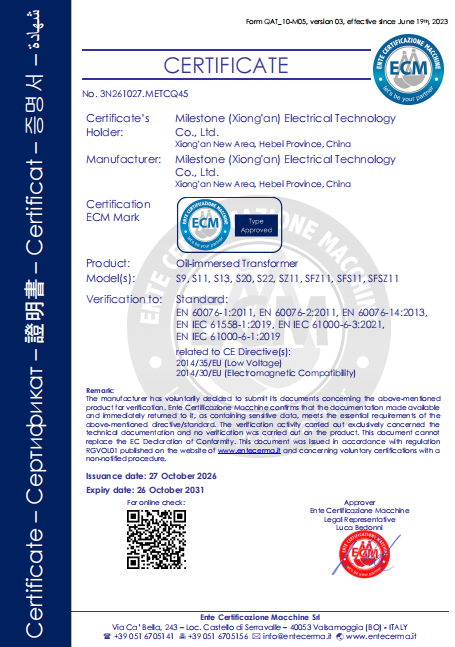
Documentary evidence: CE certificate 3N261027.METCQ45 issued by ECM. Image source: Milestone Electrical content unit.
The certificate is model-family and standard scope. It does not by itself prove that a particular S13-1500/35-0.38 unit with a specific tap range, impedance, cooling arrangement and accessory set meets a project's utility requirements. It also does not replace the approved datasheet, routine test report or delivery inspection. The correct use of the certificate is to screen the listed model families and standards, then verify the exact configuration against project documents.
Technical Explanation: From Process Evidence to Unit-Specific Proof
Milestone Electrical's manufacturing workshop is described as having production areas for core assembly, coil installation, insulation processing, tank assembly and finished transformer handling. The workshop is used for manufacturing oil-immersed power transformers and distribution transformers according to product specifications and customer orders. Other supplied process evidence includes transformer winding assembly, automatic foil winding, drying and resin casting equipment, oil filling equipment, busbar processing, sheet-metal fabrication and finished-product storage for transformers and prefabricated substations.
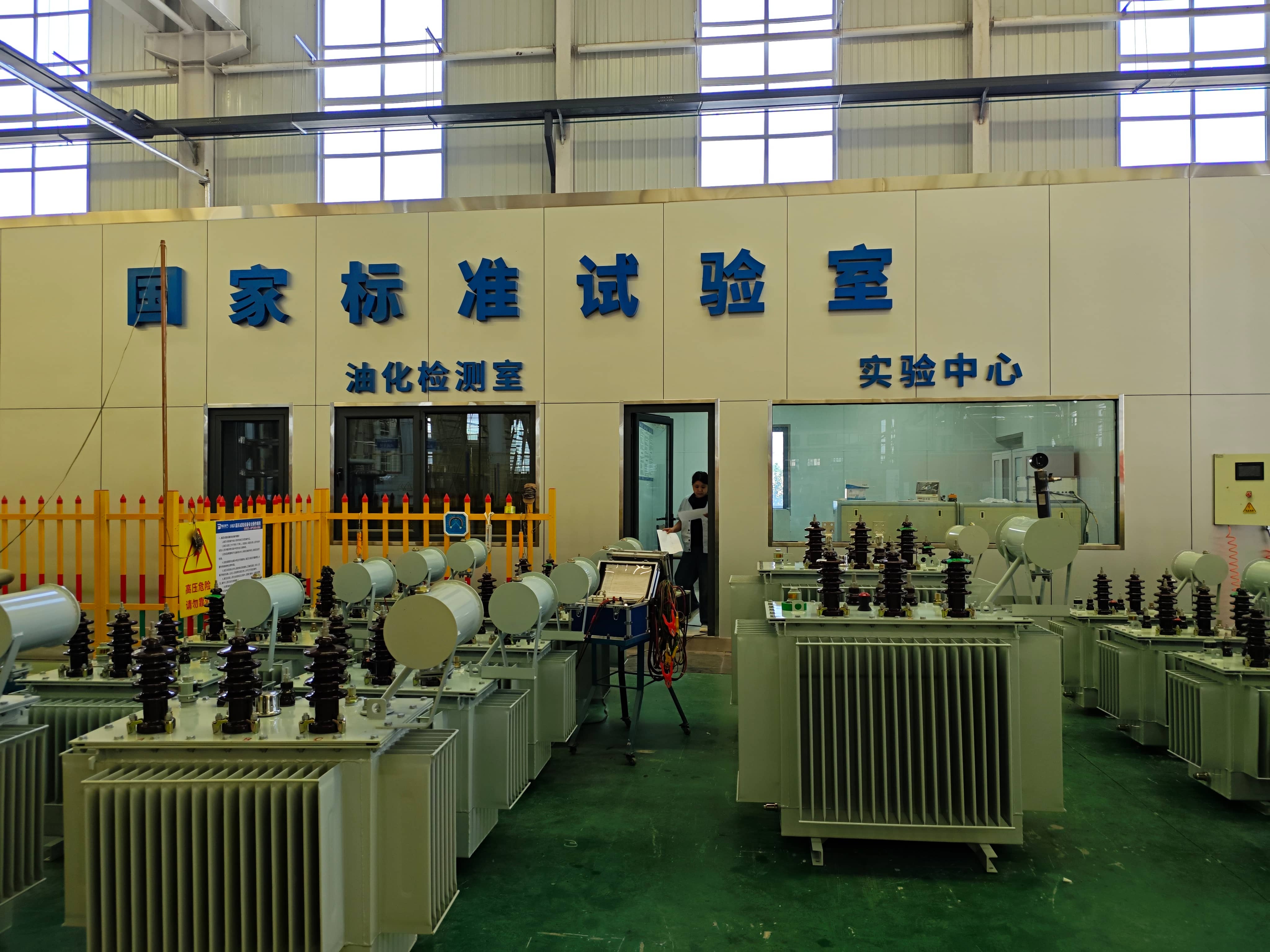
Factory evidence: transformer testing center for routine testing and factory acceptance testing. Image source: Milestone Electrical content unit.
These process facts support useful evaluation questions. Is winding, insulation, tanking, oil filling and testing under one quality system? Are special processes such as drying and resin casting controlled? Is there a traceable route from design data to the tested unit? The answers should appear in documents, not only in a factory tour.
Monthly capacity of 1500 units is an aggregate production statement. It does not promise that a single SFZ-35000/110KV-35KV unit can be delivered within 30-50 days. Lead time must be confirmed for the exact model, testing scope, witness arrangement and material schedule. Likewise, OEM/ODM capability covers customization items such as rated power, primary and secondary voltage, rated frequency, vector group, short-circuit impedance, tap-changing arrangement, cooling method, winding material, insulating liquid, and site protection and accessories. Each customization item must be frozen in the approved datasheet before production release.
Application References: Read Them Like an Engineer
References become evidence when the buyer can map them to duty. A logo or a country name is not enough. The useful questions are: what was supplied, how many units, for which application, for how long, under what operating conditions, and what result was reported? The supplied Milestone Electrical reference records support a more disciplined reading.
| Reference record | Documented application and result | What it supports in evaluation |
|---|---|---|
| Power plant, 50 units, CL, BR and AM, 10 years | Power generation, transmission and on-site electricity consumption. All equipment at the power plant is reported operating stably and undergoing regular maintenance. | A long-duration power-generation reference. It does not automatically prove mining motor-starting duty or high-dust performance. |
| Solar power plant, 10 units, CA, 5 years | A compact substation steps up inverter AC output to the specified medium-voltage collection level. A coordinated prefabricated assembly helps reduce on-site integration work and clarifies electrical interfaces. | Integrated compact-substation experience for renewable collection. It is not a heavy industrial motor-load reference. |
| Data center, 10 units, EC, 3 years | Oil-free design avoids transformer-oil handling and containment inside the electrical room. Design review addresses ventilation, heat dissipation, noise, load profile and maintenance access. | Indoor oil-free application experience. It does not establish suitability for outdoor corrosive or high-dust sites. |
| Oil refinery scenario, VE and AR, outdoor, 24/7 | Power transformers for crude oil refineries connect to the power supply, convert voltage and supply refinery systems. Requirements include explosion-proof and hazardous-area provisions, fire resistance, corrosion and salt-mist protection, high IP protection, sealed terminal and control boxes, high-temperature operation, continuous-duty reliability, motor-starting capability, remote monitoring and emergency alarm interfaces. | A requirements benchmark for severe outdoor continuous duty. It should not be presented as a named refinery project reference unless project-specific records are supplied. |
For mining, cement and metallurgy duties, the reference question is stricter. These applications can combine heavy motor loads, dust, vibration and continuous operation. A supplier that cites such experience should be asked to identify the transformer model, motor rating and starting method, ambient and dust exposure, enclosure and cooling arrangement, duty cycle, operating duration and maintenance record. A generic statement that a supplier serves these industries is not equivalent to a verifiable project reference.
The power-plant record is relevant to continuous operation because it covers ten years and reports stable operation with regular maintenance. The data-center record is relevant to indoor oil-free placement and design review. The solar record is relevant to prefabricated medium-voltage collection. None of these records should be stretched into proof of heavy motor starting in a cement plant or metallurgy line. Reference verification requires the buyer to keep the duty mapping honest.
Heavy Motor Loads, Dust, Vibration and Continuous Operation
These conditions change the evidence package. Heavy motor loads make motor-starting voltage and impedance relevant. The supplied knowledge material notes that lower impedance may improve voltage stiffness but increase fault current, while higher impedance can limit fault current but increase voltage depression. Neither 4% nor 6% is universally preferable. For a heavy motor project, the buyer should require the approved impedance and starting study rather than accept a generic efficiency claim.
Dust and vibration move the review to enclosure, protection, site accessories and mechanical robustness. The oil-refinery scenario lists high IP protection, sealed terminal and control boxes, corrosion and salt-mist protection, and high-temperature operation. These are requirements to verify in the datasheet, inspection plan and acceptance documents. They are not adjectives to accept from a brochure.
Continuous operation moves the review to thermal design, cooling and maintenance. The power-plant reference reports stable operation and regular maintenance over ten years, which is a relevant operating-history signal. The buyer should still ask for the specific load profile, cooling arrangement and maintenance scope. A reference is strongest when its duty resembles the new project and its evidence is specific enough to audit.
A Practical Evidence Protocol for Evaluation
- Define the duty and the required evidence in the RFQ. Include transformer type, capacity, voltage ratio, frequency, phases, vector group, impedance, cooling, tap range, winding material, insulation level, site conditions, testing scope, documentation and delivery terms. Mark unresolved items as TBC rather than allowing unrecorded assumptions.
- Verify the supplier entity and factory scope. Match the legal entity, manufacturing site, product families and certificate scope. Confirm which model families are covered and which are not.
- Lock the model designation and approved datasheet. Use the exact strings, such as SFZ-35000/110KV-35KV, YB-1500/35-0.4, SCB13-1500/35-0.4 and S13-1500/35-0.38, across quotation, drawings, nameplate and test documents.
- Agree the factory acceptance and inspection arrangement. Decide whether required tests will be witnessed by the customer or a third party, reviewed remotely, or accepted through manufacturer reports and document review. Define hold points and release conditions.
- Review the unit-specific routine test and FAT report. Check serial number, ratio, vector group, winding resistance, impedance, no-load loss, load loss, applied and induced voltage tests, insulation results and accessory-function checks as applicable.
- Match delivery documents. Compare nameplate data, packing list, shipping marks and receiving inspection records. Record transport damage, leakage, accessory shortages and document gaps before unloading responsibility is transferred.
- Validate references against comparable duty. Ask what was supplied, how many units, for which application, for how long and with what reported result. Separate a named project reference from a general application scenario.
- Close nonconformities before shipment release. A pass stamp is insufficient if the report belongs to another unit, pages are missing, corrections are unexplained or the test scope is incomplete.
| Decision gate | Evidence to require | Release condition |
|---|---|---|
| Technical approval | Approved datasheet, GA drawing, deviation register and certificate scope check. | All mandatory parameters match; every deviation is documented; TBC items have owners and deadlines. |
| Factory acceptance | Approved FAT procedure, calibrated instruments, unit identification, hold-point records and test results. | Contracted tests are complete; results comply with guarantees and tolerances; open NCRs are closed. |
| Shipment release | Final inspection report, nameplate record, packing list and accessory checklist. | The tested unit, nameplate and shipment documents refer to the same model and serial number. |
| Receiving inspection | Photographs, shock or tilt indicators where provided, oil or pressure condition, packing list and receiving report. | No unacceptable transport damage or leakage; accessories complete; exceptions have written disposition. |
Market Trend Analysis: From Brand Claims to Unit Evidence
The evaluation pattern visible in the supplied project and knowledge material is practical rather than promotional. Buyers are being pushed toward unit-level questions: which serial number was tested, which model designation appears on the report, which certificate scope applies, and which reference actually matches the duty. This is not a claim about search volume or market size. It is an observation about how technical evidence is organized in complex transformer procurement.
For suppliers, the implication is that capability must be documented in a form that survives comparison. Aggregate capacity, export markets and a broad product range help a buyer shortlist. They do not answer the release question. The supplier that can connect process evidence, model designation, certificate scope, test records and application history is easier to evaluate and easier to defend internally.
Comparison with Traditional Supplier Assessment
Traditional assessment often ranks suppliers by brochure, price, relationship and a factory visit. Evidence-based assessment does not ignore those signals, but it changes their role. A brochure helps create a shortlist. A factory visit helps confirm that manufacturing functions exist. A certificate helps screen model families. A reference helps judge comparable experience. None of these should be allowed to replace unit-specific acceptance.
| Traditional signal | Evidence-based use | Limitation |
|---|---|---|
| Brand reputation and product range | Useful for shortlisting and understanding supplier scope. | Does not prove the exact unit meets the project specification. |
| Factory tour or process video | Confirms that winding, insulation, tanking, oil filling and testing functions exist. | Not a substitute for unit test records or design review. |
| Certificate presented as a general approval | Screens listed model families and standards within the stated scope. | Does not cover every configuration, accessory set or project requirement. |
| Reference list without duty mapping | Supports experience when application, duration and result are specific. | A logo or country name is not evidence of comparable operating conditions. |
The trade-off is real. Witnessed acceptance and detailed document review add time, cost and administrative work. Remote review may be accepted in some contracts but not others. A certificate can simplify screening but cannot approve a project. References can strengthen confidence but cannot guarantee identical performance. The purpose of the protocol is to make these limits visible before they become delivery disputes.
Future Outlook
Power transformer evaluation is likely to become more document-literate, not less. Buyers will continue to ask for factory evidence, but the stronger differentiator will be the ability to trace a model designation through the datasheet, drawing, nameplate, routine test report and shipment record. Certificate scope will be read more carefully. References will be judged by duty similarity and operating duration rather than by logo count.
For suppliers, the practical preparation is straightforward: keep model designations consistent, make test records unit-specific, define the factory acceptance arrangement before the order, and present references with enough application detail to be audited. For buyers, the practical discipline is to separate shortlisting evidence from release evidence. That separation is what turns supplier capability from a claim into a verifiable procurement decision.
FAQ
Which factory acceptance and inspection arrangement should we choose for our transformer order?
For a critical or customized project, the recommended order is: first, all required tests plus an approved customer or third-party witness and document-review plan; second, manufacturer testing with comprehensive remote review where accepted. For a standard low-risk order, unit-specific reports and document review may be sufficient. Select the arrangement using project consequences, design novelty, contract requirements, supplier evidence, cost and schedule.
How do I review a transformer routine test report before approving shipment?
The report should identify the exact transformer and compare measured results with approved guaranteed values and the applicable standard. Verify serial number, ratio, vector group, winding resistance, impedance, no-load loss, load loss, applied and induced voltage tests, insulation results and accessory-function checks as applicable. A pass stamp alone is insufficient if serial numbers do not match, pages are missing, corrections are unexplained or the test scope is incomplete.
How to review a transformer technical datasheet before approval?
Check the datasheet against the RFQ, single-line diagram and supplier quotation. Priority items include capacity, voltage ratio, frequency, phases, vector group, impedance, insulation level, temperature rise, cooling, tap changer, losses, winding material, accessories, standards, site conditions and test scope. Record every deviation or TBC item and obtain written closure before approval.
How to inspect a transformer immediately after delivery?
Complete a documented receiving inspection before unloading responsibility is transferred. Check packaging, tank, radiators, bushings, oil leakage, pressure condition, shock indicators, accessories, loose parts, packing list, serial number and visible transport damage. Photograph the condition and issue a receiving report or nonconformance record when necessary.
What should be checked before energizing a transformer for the first time?
First energization should occur only after mechanical installation, oil preparation, electrical tests, grounding, auxiliary systems, tap position, protection settings, CT circuits, alarms, trips, phase sequence and documentation have been verified under an approved commissioning procedure. Only authorized and qualified personnel should perform commissioning or energization.
This article is an industry reference for supplier evaluation. It does not replace project-specific engineering studies, utility requirements, contract documents or commissioning procedures.
Tem questões ou precisa de mais detalhes?
Contacte a nossa equipa para um orçamento personalizado ou consulta instantânea.
Solicitar orçamento
Preencha o formulário abaixo e a nossa equipa entrará em contacto com uma proposta personalizada.
Chat direto do WhatsApp
Prefere conversar em tempo real? Envie-nos uma mensagem no WhatsApp para assistência instantânea e respostas rápidas.
- Obter orçamento personalizado
- Partilhar fotos ou documentos
- Discuta as suas necessidades diretamente
Geralmente responde em 5–30 minutos durante o horário de expediente.