
Verifying QOCI's Production Scale: 9M Units and 35,373 m²
Global demand for porcelain insulators is scaling with grid investment rather than with any single utility's buying cycle. The global porcelain insulator market was valued at approximately USD 8.27 billion in 2023 and is projected to reach USD 15.04 billion by 2033, according to Spherical Insights, and Mordor Intelligence estimates that overhead transmission lines account for approximately 62.1% of global porcelain insulator revenue. At that volume, a supplier's production footprint stops being background information and becomes a decision variable: buyers need to know not only what a factory can make, but how much of it, in which product mix, and with what evidence behind the number.
Jiangxi QOCI Electric Co., Ltd. is a Chinese manufacturer of porcelain and glass insulators, established in December 2002 and located in Luxi Industrial Park, Pingxiang City, Jiangxi Province. The company reports an annual output of 9,000,000 units from a 35,373 m² factory, supported by more than 150 staff members and a dedicated R&D team of 38 engineers. This article examines those claims the way a utility procurement team or a distribution EPC contractor would — figure by figure — including where the numbers line up, where definitions still need to be clarified, and what the capacity claim does and does not imply for a project programme.
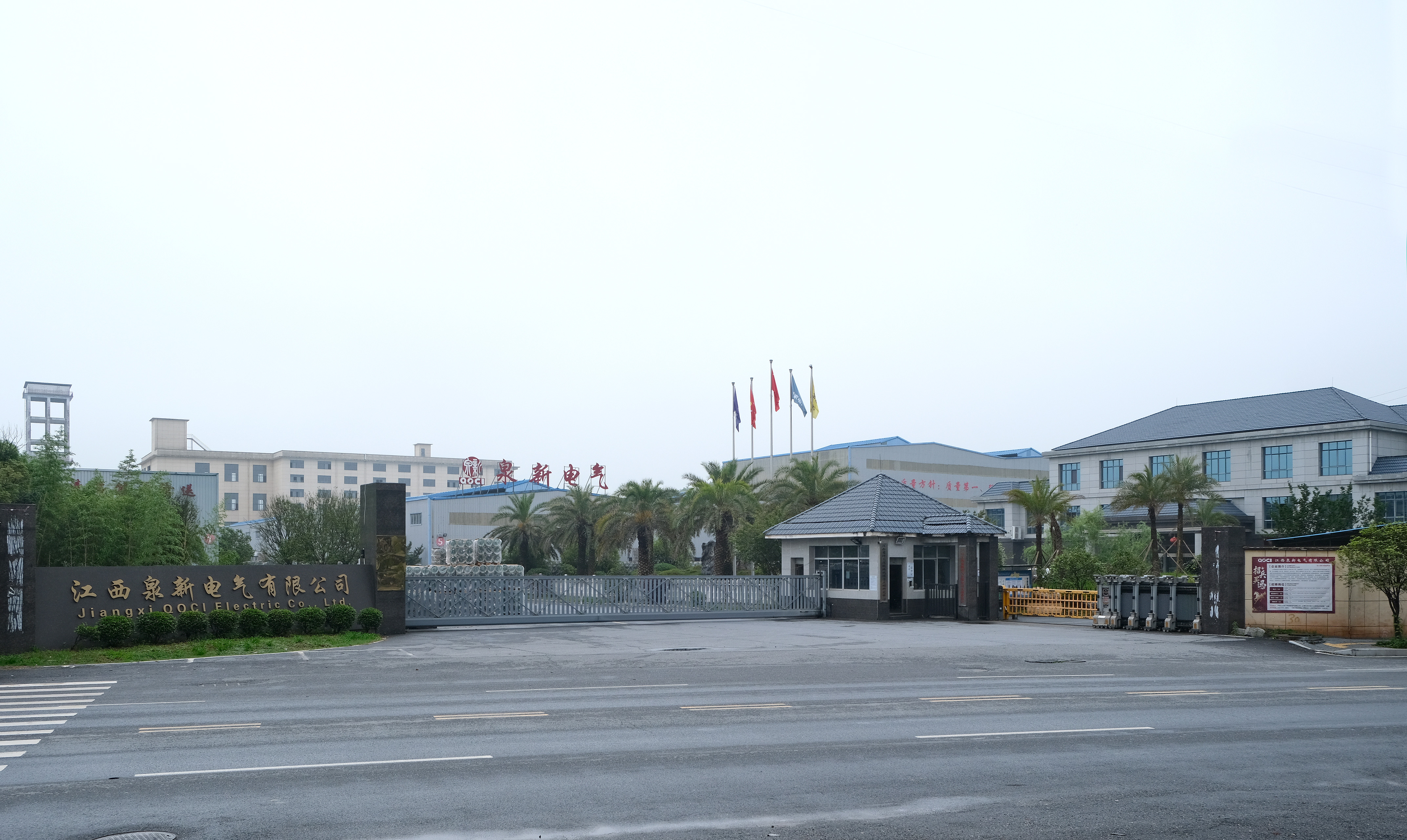
Why production-scale claims became a procurement question
A decade ago, a buyer evaluating a porcelain insulator supplier could reasonably focus on certification, test reports and unit price. Multi-year framework agreements and rolling distribution programmes have changed that. When a utility commits to a five-year distribution reinforcement plan, the constraint is rarely the ability to mould one good insulator; it is the ability to deliver a consistent stream of insulators, in the right voltage classes, without allocation disputes during peak firing season.
China's position in that supply chain makes verification a practical skill rather than an academic one. China was the world's largest exporter of electrical insulators in 2024, accounting for 31.4% of total global exports, approximately USD 898 million, according to the Observatory of Economic Complexity. Porcelain electrical insulators carry HS code 8546.20 under the World Customs Organization nomenclature. A large share of global procurement therefore routes through Chinese factories, and the quality of a buyer's verification process directly affects programme risk.
The problem: capacity numbers are rarely defined
Three ambiguities appear in most supplier capacity claims. First, "units" is undefined: a low-voltage spool insulator and a 210 kN cap-and-pin disc insulator are both one unit, but they differ substantially in ceramic mass, cycle time and kiln load density. Second, area figures are undefined: site area, built-up construction area and production floor area can differ by a factor of two or more, and only the last one constrains output. Third, headcount is undefined: total staff, production staff and engineering staff describe three different capabilities.
None of this means the numbers are wrong. It means a buyer should be able to reconcile them. The useful test is internal consistency: if a supplier states an annual output, a monthly capacity, a facility area, a headcount and a lead time, do those five figures describe the same factory?
What QOCI documents
Jiangxi QOCI Electric is a national high-tech enterprise and a participating unit of the Insulator Standard Committee, according to the company profile. Its reported operating data include the following figures.
| Recorded item | Reported figure |
|---|---|
| Established | December 2002 |
| Location | Luxi Industrial Park, Pingxiang City, Jiangxi Province, China |
| Factory size | 35,373 m² |
| Registered site area | over 120 mu (approximately 8 hectares) |
| Construction area | exceeding 70,000 m² |
| Annual output | 9,000,000 units |
| Monthly capacity | 750,000 units |
| Staff | more than 150 staff members; more than 50 engineering and technical professionals |
| R&D team | 38 engineers |
| Export ratio | 20% |
| Main markets | USA, Asia, EU, Africa, South America |
| Production mode | OEM and ODM |
| Customization | voltage, logo |
| Minimum order quantity | 50 units |
| Lead time | 15–35 days |
| Quality control | 100% pre-shipment test; third-party inspection (SGS) |
Read as a set, these figures describe a mid-sized specialist insulator plant rather than a diversified electrical group. The company states that its products are used in power grid construction projects of State Grid Corporation of China and China Southern Power Grid, as well as in grids in over 40 countries and regions including Europe and the Middle East.
Cross-checking 9,000,000 units against 750,000 units per month
The two headline capacity figures are internally consistent: 750,000 units per month multiplied by twelve months equals 9,000,000 units per year. That is a simple check, but it is one that fails surprisingly often in supplier documentation, and passing it means the annual figure is not a marketing extrapolation bolted onto a different baseline.
Consistency, however, is not the same as applicability. The 9,000,000-unit figure aggregates every insulator family produced at the site — low-voltage shackle and spool insulators, 11 kV pin insulators, disc-shaped suspension units and line post types. QOCI's published range includes, for example, the ED-2B low-voltage shackle insulator with a total height of 76 mm and a maximum diameter of 90 mm, the P-11-Y pin insulator rated at 11 kV with a 240 mm creepage distance and a 10 kN rated mechanical load, and the PS210V / 212V suspension insulator with a 210 kN mechanical failing load and a 280 mm nominal disc diameter.
Those three products occupy very different positions in a production calendar. A 76 mm distribution insulator and a 280 mm transmission disc are not interchangeable units of capacity. Buyers awarding a transmission string package should therefore ask for the capacity split by product family and voltage class for the contract period, not the site total. A useful follow-up question is how much of the monthly capacity the supplier will commit to a single product family during peak firing season.
One further context point matters for export buyers. The company reports an export ratio of 20%, which means the majority of production serves the domestic Chinese market. For a buyer planning an annual programme, the commercial question becomes how export allocation is scheduled against domestic framework demand — a conversation that is easier to hold before a tender is awarded than after.
35,373 m²: which area does the number describe?
QOCI reports three area-related figures: a factory size of 35,373 m², a site area of over 120 mu (approximately 8 hectares), and a construction area exceeding 70,000 m². These are not competing claims; they describe different scopes, and each answers a different buyer question. Site area indicates land available for expansion. Construction area aggregates all buildings on the site, including warehousing, offices and auxiliary structures. The factory figure is the production-related footprint.
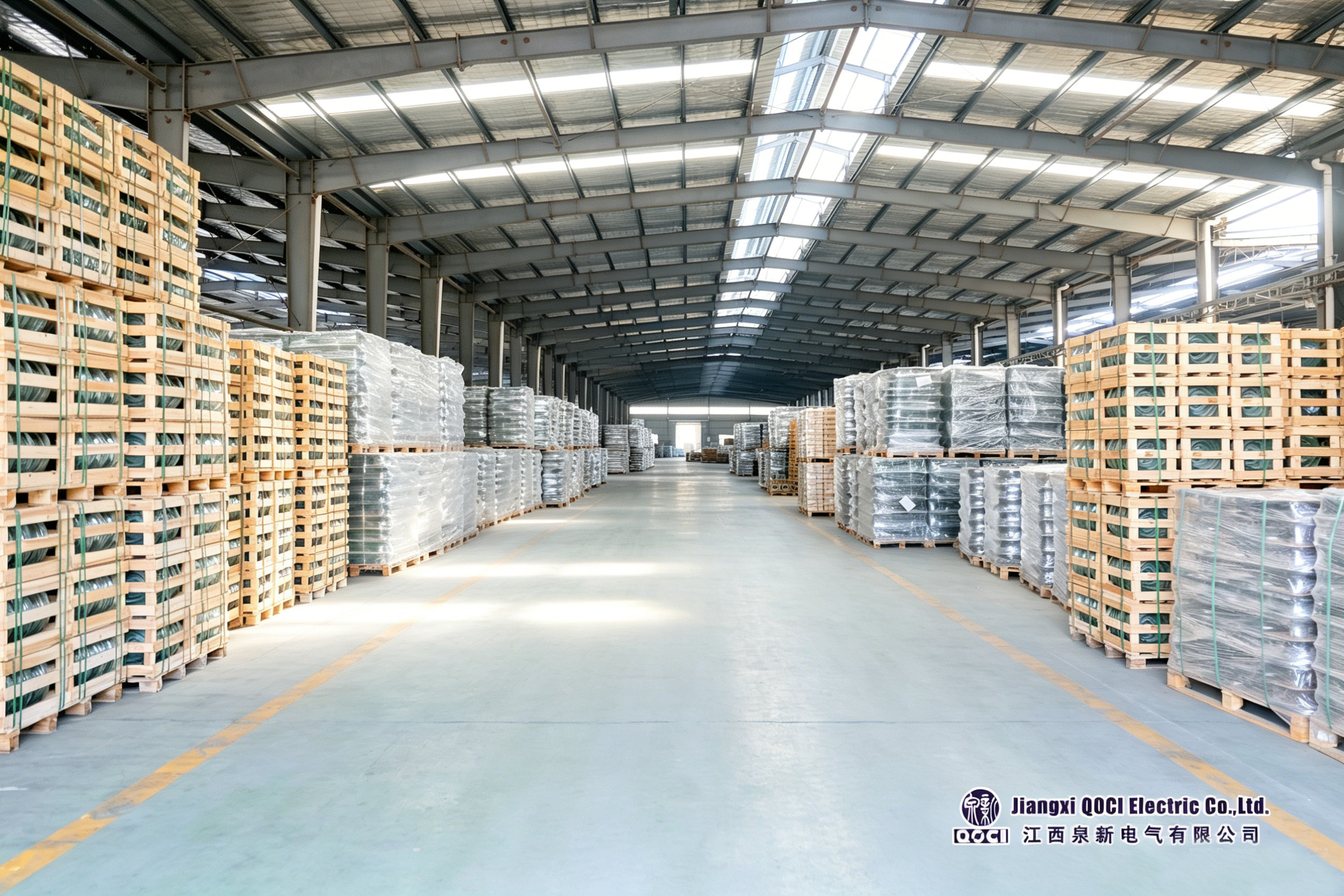
For a ceramic insulator plant, the area that actually governs throughput is the combination of forming, drying, glazing and firing space, because firing capacity is the rate-limiting step. Warehousing and loading areas govern how quickly finished goods can be staged and shipped. QOCI's own facility documentation records the forming area, the thermal shock line, the laboratory, the sample room, the loading area and the warehouse as distinct zones — the level of detail a buyer should use when mapping a stated area to a real process. During evaluation, requesting a site layout plan and walking the forming-to-firing flow is more informative than comparing headline square metres between suppliers.
Engineering depth: 38 engineers inside a 150-person organization
Headcount figures should be read alongside design capability, not instead of it. QOCI reports more than 150 staff members, of whom more than 50 are engineering and technical professionals, with a dedicated R&D team of 38 engineers. Structured company records for the same organization list 138 employees — a reminder that headcount depends on definition, since permanent staff, contracted production workers and seasonal labour are often counted differently. Buyers should ask for production headcount by shift and engineering headcount by function rather than a single total.
The engineering ratio is the more decision-relevant number for anyone buying non-standard insulators. With OEM and ODM production and customization available on voltage and logo, the technical workload includes body and shed profile design, creepage distance matched to site pollution class, fitting and cement joint specification, and test programme definition. A dedicated R&D team of 38 engineers is consistent with that scope. When benchmarking OEM capability, buyers should ask how many engineers work on ceramic body design rather than fittings sourcing, and what share of engineering time is committed to existing series versus customer-specific development.
How the production system reaches that volume
Porcelain insulator manufacturing is a high-temperature ceramics process. Vitrified porcelain is produced from kaolin, quartz and feldspar, fired at approximately 1200–1300 °C, which yields a bulk resistivity above 10^12 Ω·cm and dielectric strength of 15–25 kV/mm. The fired body is dimensionally stable, inorganic and unaffected by ultraviolet exposure. The glazed surface is smooth and reduces contamination adhesion, while the umbrella shed profile extends the surface leakage path — the creepage distance — in line with the pollution severity class defined in IEC 60815.
QOCI states that its porcelain and glass insulators are produced through automated and intelligent production processes. The company's quality control regime is documented as a 100% pre-shipment test combined with third-party inspection (SGS). Its facility documentation shows a dedicated thermal shock line and an on-site laboratory, both consistent with the testing burden that ceramic production requires.
For high-voltage string units, buyers typically extend the requirement beyond pre-shipment electrical testing to unit-by-unit crack detection. Industry screening criteria for insulator procurement include 100% dye penetration testing, porosity testing, thermal cycling, and power frequency and impulse voltage withstand tests, with IEC 60383-1:2023 as the current international standard for ceramic or glass insulator units for AC overhead lines above 1000 V, and ANSI C29.1 covering test methods for the North American market. Whether crack detection is performed on every unit or on a sampled batch is a decisive question in supplier evaluation, and it should be confirmed in writing rather than inferred from a general quality statement.
Where this capacity is used: application fit
QOCI's insulator production is directed at power transmission and distribution, substation construction, railway electrification and industrial power grids. Typical project types include transmission line construction, substation upgrades, and grid modernization and expansion programmes. The application scenario is common in countries including China, Sri Lanka, Egypt, Indonesia and Germany.
Operating conditions are outdoor exposed, with high humidity, industrial pollution and a wide temperature range from -40 °C to +50 °C, under IEC 60305 compliance. In service, the insulator provides electrical insulation between the live conductor and the grounded support, carries mechanical load in suspension and tension positions, and suppresses corona. It operates as a passive component, continuously energized, with no active parts and zero power consumption, and requires no intervention between scheduled inspections.
Deployment also depends on associated hardware. These applications require supporting equipment such as metal fittings, corona rings, suspension and tension clamps, arcing horns, grounding hardware and vibration dampers. A supplier's ability to coordinate insulator units with fittings and string assembly is part of the production capability, not separate from it.
| Product | Type and key ratings | Typical application fit |
|---|---|---|
| ED-2B | Shackle / butterfly low-voltage distribution insulator; 13.5 kN mechanical tensile strength, 90 mm max diameter, 76 mm total height, 13 kV wet and 25 kV dry power frequency withstand | Low-voltage overhead distribution lines, rural electrification, line anchoring, strain and angle positions |
| P-11-Y | Pin type distribution insulator; 11 kV rated voltage, 10 kN rated mechanical load, 240 mm creepage distance, 50 kV wet power frequency withstand, 90 kV lightning impulse withstand | 10 kV overhead distribution lines, rural electrification, urban distribution projects |
| PS210V / 212V | Disc-type cap-and-pin suspension unit; 210 kN mechanical failing load, 280 mm nominal disc diameter, 400 mm creepage distance, 110 kV dry lightning impulse withstand, 130 kV puncture voltage | High-voltage and extra-heavy-load transmission strings and critical grid infrastructure |
Field evidence from tropical and monsoon projects
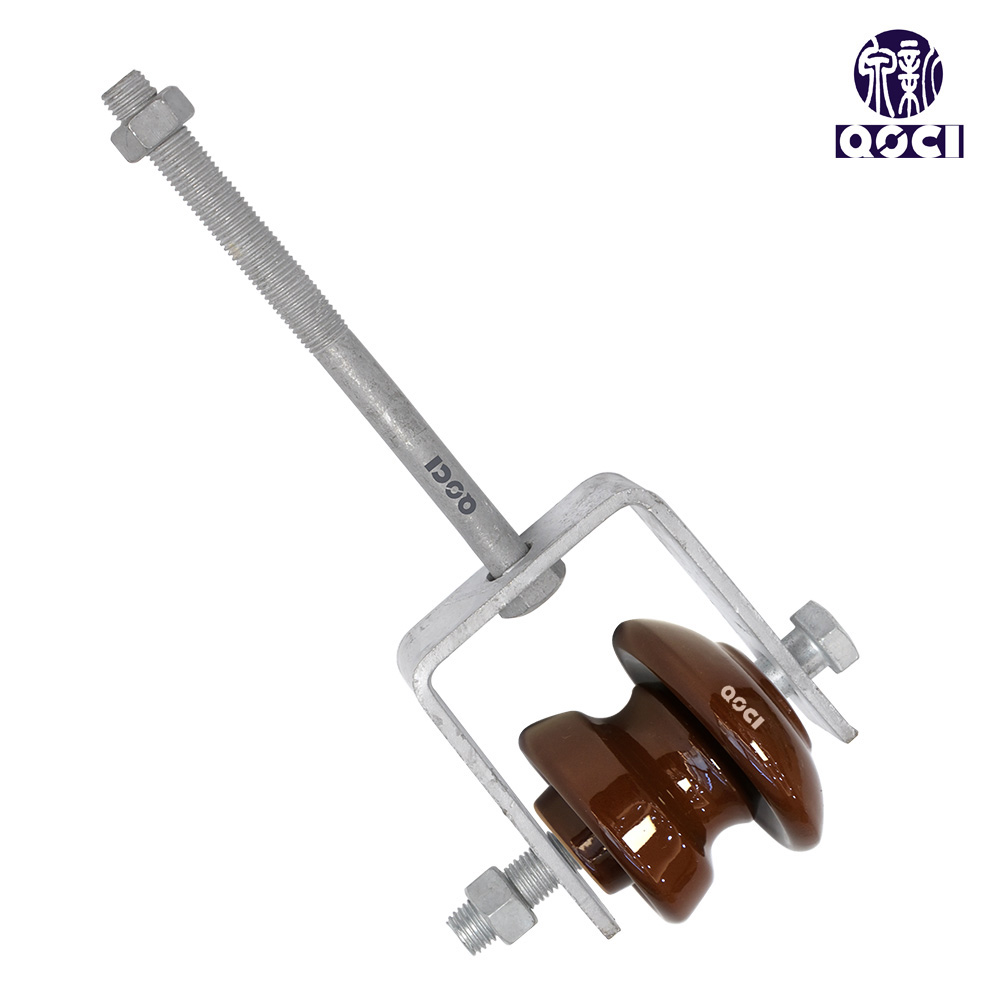
Capacity only matters if it converts into field performance. QOCI documents a distribution insulation programme covering Sri Lanka, Egypt and Ukraine, with a total of 60,000 pieces — 10,000 in Sri Lanka, 40,000 in Egypt and 10,000 in Ukraine — supplied to national power utilities and distribution EPC contractors over three years to 2026. The application scope covered coastal and inland tropical distribution line insulation and monsoon region grid reinforcement.
The reported outcomes over that three-year period were a 60% reduction in salt fog flashover incidents compared with the previous composite batch, zero UV degradation, a 50% reduction in maintenance cost, and a replacement rate under 2%. For buyers assessing comparable coastal or monsoon environments, the relevant point is the failure mode rather than the headline improvement: salt fog flashover and UV-driven material degradation are the two mechanisms that most often shorten insulator service life in tropical service, and both are addressed by the inorganic nature of fired ceramic.
Market signals behind the capacity question
Several verifiable market trends explain why production-scale verification has moved earlier in the buying process. Asia-Pacific dominated the porcelain insulator market with a revenue share of 49.4% in 2025, according to Mordor Intelligence, which places the largest concentration of manufacturing capacity in the same region as the largest consumption base. Within the category, the substation porcelain insulator segment is projected to grow at a CAGR of 7.2% through 2031, driven by gas-insulated switchgear upgrades — a segment that demands tighter dimensional tolerances than line insulators.
Regulatory routing also affects where capacity is sourced. India's DPIIT procurement policy requires 50% local content for porcelain insulators to qualify as Class I for government contracts, which changes the role a Chinese manufacturer plays in an Indian project from direct supply to component or technology supply. Capacity verification and trade-route planning are best treated as one exercise.
Market sizing itself should be triangulated. Published 2025 estimates for the porcelain insulator market vary widely — Mordor Intelligence at USD 9.87 billion, Metastat Insight at USD 9.6 billion and Dataintelo at USD 4.0 billion — most likely because sources differ on whether composite and glass products are included and which voltage ranges are counted. The same discipline applies to supplier capacity claims: ask what is being counted.
Comparison and limits
Porcelain and composite insulators solve the same electrical problem with different trade-offs, and a production-scale assessment should state both sides.
On the porcelain side, fired ceramic is inorganic and does not suffer UV or hydrophobicity degradation in service; industry comparison material cites zero UV aging degradation, compressive strength in the range of 800 MPa, and a service record measured in decades. Composite silicone rubber units are significantly lighter and easier to handle, which matters on weight-constrained towers and in manual installation, but they are reported to degrade by roughly 5–8% per year under tropical UV exposure and require periodic hydrophobicity monitoring. Porcelain's disadvantages run in the opposite direction: higher unit weight increases freight cost and tower loading, the ceramic body is brittle and demands disciplined packing and handling, and a damaged unit cannot be repaired in place. Porcelain insulators can also develop zero-value degradation — internal electrical breakdown with no visible external change — which is why periodic live-line testing every three to five years, using voltage gradient or spark gap methods, is part of the operating model rather than an optional extra.
The capacity claim has limits of its own. A 9,000,000-unit annual figure is a site total and says nothing about the throughput of any single product family. A 35,373 m² factory figure should be read as a production footprint, not as a comparison against the largest global manufacturers: NGK Insulators and Lapp Insulators are recognized as global market leaders in high-performance ceramic insulators, and their scale sits in a different bracket. The 20% export ratio means export allocation is a minority of output and must be confirmed against a specific contract period. And the 15–35 day lead time applies to standard configurations; OEM and ODM runs with custom voltage ratings or branding sit at the longer end of that range and should be scheduled into the project plan accordingly.
What buyers should put in writing
The verification items suggested by QOCI's own documentation form a reasonable checklist for any porcelain insulator supplier:
- Capacity by product family and voltage class for the contract period, supported by monthly output history.
- Definition and breakdown of facility area: production floor, drying and firing zones, warehouse and loading area.
- Production headcount by shift and engineering headcount by function, separated from total staff.
- Crack detection coverage: 100% dye penetration testing versus batch sampling.
- Third-party inspection arrangements and the scope of pre-shipment testing.
- Export allocation for the contract period, given that domestic demand represents the majority of output.
- Lead-time allocation for custom voltage or branding runs.
Future outlook
Grid modernization, railway electrification and gas-insulated switchgear upgrades all point to continued demand for ceramic insulators, with the substation segment growing fastest through 2031. Two shifts are likely to shape how capacity claims are evaluated. The first is traceability: as utilities standardize supplier audits, unit-level test coverage and third-party inspection records will move from differentiators to baseline requirements. The second is anti-pollution design: as pollution severity classifications tighten in fast-industrializing regions, the ability to design and fire shed profiles with extended creepage distance becomes a kiln-time question as much as a design question.
For a manufacturer operating a 35,373 m² plant with 9,000,000 units of annual output, the strategic decision is not whether to grow the topline number but how much verifiable detail to attach to it. Suppliers that publish capacity by family, testing coverage by unit and area by function will find procurement conversations shorter.
FAQ
What does an annual output of 9,000,000 units actually measure?
It measures the site total across all porcelain and glass insulator families produced at the Luxi Industrial Park facility, and it is consistent with the separately reported monthly capacity of 750,000 units. It is not a commitment for a single product family or voltage class. Buyers should request the capacity split by product family for the contract period.
How can a buyer verify a factory area claim such as 35,373 m²?
The figure should first be mapped to a definition — land area, construction area or production floor. QOCI separately reports a site area of over 120 mu, a construction area exceeding 70,000 m² and a 35,373 m² factory, which describe different scopes. Verification normally combines a site layout plan, a walk-through of the forming-to-firing flow, and confirmation of each zone's function.
Which project types do QOCI's porcelain insulators fit?
Transmission line construction, substation upgrades, grid modernization and expansion, railway electrification and industrial power grids. Operating conditions are outdoor exposed, with high humidity, industrial pollution and temperatures from -40 °C to +50 °C, under IEC 60305 compliance.
How does engineering headcount affect an OEM insulator order?
Customization covers voltage rating and logo under OEM and ODM production, which requires engineering work on shed profile, creepage distance, fittings and test programmes. QOCI reports more than 50 engineering and technical professionals and a dedicated R&D team of 38 engineers. Buyers should confirm how much engineering capacity is reserved for customer-specific development rather than series production.
What minimum order quantity and lead time apply?
The reported minimum order quantity is 50 units, with a lead time of 15–35 days. Standard configurations sit at the shorter end of that window; custom voltage or branding runs sit at the longer end.
What are the practical limits of porcelain insulators in weight- or time-sensitive projects?
Porcelain units are heavier and more brittle than composite equivalents, which raises freight cost, tower loading and handling requirements. They also cannot be repaired in place, and zero-value degradation is not visible externally, so periodic live-line testing every three to five years is part of normal operation rather than an optional measure.
How is quality control documented before shipment?
QOCI's stated quality control is a 100% pre-shipment test combined with third-party inspection by SGS. For high-voltage string units, buyers commonly add unit-level dye penetration testing, porosity testing, thermal cycling and impulse withstand tests, with IEC 60383-1:2023 as the current international standard for ceramic and glass insulator units for AC overhead lines above 1000 V.
Public reference document: QOCI glass insulator catalogue (PDF) — https://cdn.socialarks.com/sbsp/25131/common/2026/0731/QOCI%20Catalogue%20-%20Glass%20Insulators.pdf