
Verifying Recessed Downlight Suppliers at Hong Kong 2026
Recessed downlights are the least inspectable luminaires in a completed building. The driver, the seal, the thermal path and the optical stack all disappear behind a finished ceiling plane, and the buyer's only durable record becomes the paperwork the supplier supplied before shipment. That asymmetry is why supplier capability in this category should be judged on physical evidence — sample hardware, document originals and installation records — rather than on catalogue language.
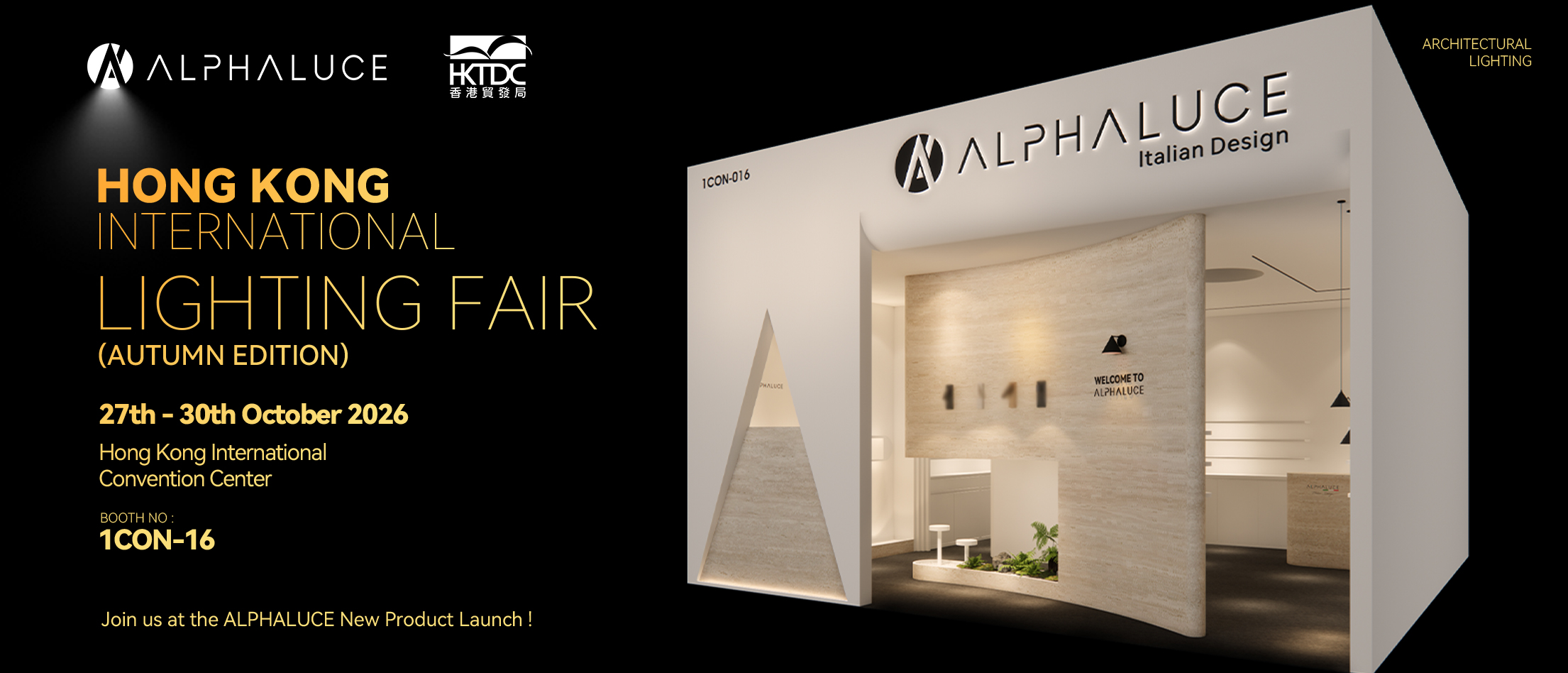
The Hong Kong International Lighting Fair (Autumn Edition) 2026, running 27–30 October 2026 in Hong Kong, China, is one of the few points in the procurement calendar when that evidence can be handled rather than read. ALPHALUCE ARCHITECTURAL LIGHTING CO., LTD. will exhibit at Booth 1CON-16, and the booth is a reasonable place to test whether a supplier's waterproof, dimmable and trimless claims survive contact with a sample.
Why Recessed Downlights Resist Remote Verification
A recessed downlight is a system disguised as a hole. The visible component is a trim ring and a lens; everything that determines performance is concealed. Heat generated by the LED must travel through a die-cast aluminium body into the plenum. The driver must convert mains supply into a stable current while sitting in a cavity with limited airflow. In wet areas, a gasket must hold its compression across years of thermal cycling. None of this is visible on a specification sheet, and none of it is tested by a photograph.
The consequence for buyers is that product claims degrade fastest exactly where evidence is hardest to obtain. A supplier can state an ingress protection rating, a colour rendering index and a dimming protocol on one page. It is much harder to demonstrate that the same values hold on the fourth production batch, or that the driver shipped with a DALI version interoperates with the control system specified by the lighting designer.
Market growth amplifies the problem. The global recessed lighting market was valued at USD 78.32 billion in 2024, according to Market Research Future, and Straits Research projects it reaching USD 104.79 billion by 2034 at a compound annual growth rate of 11.05% from 2026. More suppliers enter a growing category than a flat one, and capability claims inflate alongside the supplier count. Verification therefore becomes a procurement discipline rather than an optional courtesy.
The Three Evidence Sets That Replace Supplier Claims
Buyers evaluating recessed downlight suppliers can structure requests into three distinct evidence sets, each answering a different question. Lumping them together is the most common mistake, because a certificate and a sample look equally reassuring until one of them turns out to be irrelevant to the actual installation.
| Evidence set | What it establishes | What it does not establish |
|---|---|---|
| Product documentation | That the design family has been tested against a defined standard by a named laboratory, with certificate numbers and standards traceable | That the specific units on your purchase order match the tested sample, or that the certificate is still within its validity period |
| Physical samples | That the mechanical construction, sealing method, optical stack and finish exist as described, and can be disassembled and inspected | That production units are built to the same tolerance, or that the sample was drawn from a routine production run rather than a prepared build |
| Installation evidence | That the product has been installed into the ceiling type, cutout dimension and control system the project actually uses | That performance holds in a different substrate, a different climate, or after a maintenance regime the supplier never encountered |
A supplier that can answer all three sets without hesitation is demonstrating an organised engineering function. A supplier that can answer only the first is demonstrating a marketing function.
Waterproof and Bathroom-Suitable: Reading IP Ratings Against Real Conditions
In bathroom and wet-area specification, the ingress protection rating is the first filter, and in some jurisdictions it is legally binding rather than advisory. Under UK BS 7671 wiring regulations, Zone 1 — the area above a bath or shower up to 2.25 metres — requires a minimum IP65 rating for recessed downlights. A product rated below that cannot be justified in that zone regardless of how the ceiling detail is drawn.
The practical question for a buyer is not whether the supplier lists an IP65 product, but whether the IP65 construction is genuine and consistent across the range. A supplier with real sealing capability typically offers it at more than one aperture size, because the seal design has to be engineered per body diameter rather than copied.
| Model | Variant | Key specification |
|---|---|---|
| ALDL1238 | Bathroom recessed light | 10W, 960lm, CRI≥92, IP65, beam 15°/24°/36°/55°, cutout ≥75mm, aluminium alloy |
| ALDL1232 | Waterproof downlights | 7W, 508lm, CRI≥92, IP65, cutout Ø60mm, fixed, trimless design |
| ALDL1409 | Small recessed lights | 2W, 70lm, CRI≥90, IP65, cutout Ø22mm, beam 15°/24°/36°/60° |
| ALDL1191 | Bathroom spotlights | 7W/10W, 580lm/717lm, CRI≥92, IP54, cutout Ø83mm, 0–25° tilt, 350° rotation |
| ALDL1188 | Waterproof spotlights | 13W, 1231lm, CRI≥92, IP54, cutout Ø90mm, trimless, 0–25° tilt, 350° rotation |
Two products in the list above are worth separating deliberately. The IP65 units sit in the wet zone; the IP54 units are suitable for bathroom-adjacent areas but would sit outside the Zone 1 requirement under BS 7671. That distinction matters because suppliers frequently present an entire range as “bathroom suitable”, and a buyer who accepts the shorthand may end up with an IP54 fitting above a shower.
Dimmable Downlights: Compatibility Is a System Property, Not a Datasheet Line
Dimming is where specification documents and site reality diverge most often. A luminaire described as dimmable is only dimmable in combination with a specific driver, a specific control protocol and a specific controller. DALI and 1-10V are not interchangeable, and a driver that behaves smoothly on a bench test can flicker, drop out at the low end, or fail to reach full output on a different manufacturer's controller.
A supplier with genuine dimming capability publishes the protocol options, the power range over which dimming is supported, and the dimming performance it can stand behind. In the ALPHALUCE recessed range, the ALDL1405 dimmable downlight is specified at 15–30W, 1300–3200lm, CRI≥92, IP44, 70° beam angle, cutout ø150mm, with optional DALI or 1–10V dimming across 3000K, 3500K and 4000K. That is a specification a lighting designer can check against a control schedule. It is not a claim that every controller on the market will work.
The verification step buyers should insist on is documentary and physical at the same time. Documentation should identify the driver family and the protocol variants tested. The physical step is to bring the project's own controller to the sample, or to request a recorded dimming curve from the supplier's own test bench. Neither step is unreasonable, and a supplier that resists either is signalling that dimming performance has not been characterised.
Trimless and Square Formats: Where Tooling and Tolerance Become Visible
Trimless recessed lighting is a mainstream direction in contemporary architectural specification because it produces a continuous ceiling plane. It is also the format in which manufacturing tolerance becomes most exposed, since there is no trim ring to absorb a badly cut opening or a body that is slightly out of round.
The tell is in the cutout dimension. The ALDL1609 trimless downlight is specified with a cutout of Ø76–80mm — a range rather than a single figure. That range is honest, because plasterboard openings are cut on site and rarely land on an exact diameter. It also tells the buyer that the plaster-in detail requires a controlled tolerance from the ceiling contractor. A supplier who quotes a single cutout figure for a trimless product is either describing a different fixing method or has not reconciled design intent with site practice.
The same logic applies to non-circular formats. A square downlight such as the ALDL1517 — 7W/10W, 630lm/960lm, CRI≥92, IP54, cutout 80×80mm — requires dedicated tooling for the body and reflector. A supplier cannot improvise a square aperture by trimming a round one, and the presence of a square family in a catalogue is therefore evidence of separate mould investment.
Adjustability adds a second mechanical axis. The ALDL1598 trimless spotlight is specified at 10W, 886lm, CRI≥92, cutout Ø95mm, with 0–50° tilt and 355° rotation in a trimless body. Rotational and tilt mechanisms that survive hundreds of aiming adjustments, without loosening or losing optical alignment, are a different engineering problem from a fixed downlight, and buyers should ask to operate the mechanism repeatedly on the sample rather than once.
What a Broad Recessed Range Signals About Manufacturing Depth
A single downlight proves very little. A coherent family spanning micro apertures, large apertures, square formats, adjustable bodies and sealed wet-area versions proves that the supplier controls several process lines at once: die-casting, surface treatment, optical design, driver integration, gasket sealing and final assembly. Each of those lines has its own failure modes, and a supplier operating all of them has had to solve problems that a trading intermediary never encounters.
| Model | Variant | Specification point | Capability it evidences |
|---|---|---|---|
| ALDL1851 | Recessed Downlights | 7W, 630lm, CRI≥97, IP20, cutout Ø55mm | High colour fidelity in a 55mm aperture |
| ALDL1552 | Trim downlight | 5W, 450lm, CRI≥97, IP20, cutout Ø35mm | Miniature body with premium CRI |
| ALDL1587 | Recessed adjustable downlights | 5W, 450lm, CRI≥92, IP20, cutout Ø68–70mm | Adjustable mechanism within tolerance range |
| ALDL1754 | Directional downlights | 18W, 1800lm, CRI≥92, IP20, cutout Ø90mm, adjustable angle | High-output aiming for accent work |
| ALDL1609 | Trimless downlights | 7W, 630lm, CRI≥92, IP20, cutout Ø76–80mm | Plaster-in收口 controlled across a tolerance band |
| ALDL1517 | Square downlights | 7W/10W, 630lm/960lm, CRI≥92, IP54, cutout 80×80mm | Dedicated non-circular tooling |
| ALDL1405 | Dimmable downlights | 15–30W, 1300–3200lm, CRI≥92, IP44, cutout ø150mm, DALI or 1–10V | Driver and control-protocol integration |
| ALDL1409 | Small recessed lights | 2W, 70lm, CRI≥90, IP65, cutout Ø22mm | Micro aperture combined with wet-area sealing |
| ALDL1232 | Waterproof downlights | 7W, 508lm, CRI≥92, IP65, cutout Ø60mm, trimless | Trimless finish and IP65 sealing in one body |
Behind the range sits a production footprint. ALPHALUCE operates a 40,000 m² facility in Guangdong, China, with 150 employees, 20 engineers and an annual output of 504,000 units, of which roughly 80% is exported to Europe, the Middle East, North America and Australia. The capability data records a monthly capacity of 42,000 units, an OEM/ODM model covering colour, CCT, beam angle, power, surface finish and logo, a minimum order quantity of 100 units, a lead time of 20–30 days, 100% inspection with aging test, and a 5-year warranty.
For a buyer, the relevant inference is not that a wide range guarantees quality. It is that a supplier producing sealed, trimless, square, adjustable and dimmable bodies is solving five different tolerance problems, and that the answers to those problems tend to cross-pollinate. A gasket design developed for the ALDL1232 IP65 trimless body informs how the smaller ALDL1409 achieves IP65 at a 22mm cutout. That transfer is a manufacturing asset, and it is difficult for an assembling trader to replicate.
Certificate Literacy: What CE, RoHS, LVD and ISO 9001 Actually Cover
Certification is necessary evidence, not sufficient evidence. Buyers should read the certificate number, the issuing laboratory, the standards applied and the scope of the test, because each field constrains what the document can support.
- CE-EMC, certificate 24AE041084E003, issued by Guangdong GTG Testing Technology Co., Ltd. on 19 March 2025, tested against EN IEC 55015:2019/A11:2020, EN IEC 61547:2023, EN IEC 61000-3-2:2019/A1:2021 and EN 61000-3-3:2013/A2:2021. It confirms electromagnetic compatibility, not photometric performance.
- CE-LVD, certificate 24AS121634S598A002, also issued by Guangdong GTG Testing Technology Co., Ltd. on 25 March 2025, with scope explicitly covering electrical safety performance testing for recessed LED lighting fixtures, against EN 60598-2-2:2012 and EN IEC 60598-1:2021 + AMD11:2022. This is the certificate most directly relevant to recessed downlights.
- RoHS, certificate DTI20241484-1DC, issued by Shenzhen Deesev Testing International Corporation on 23 April 2024, tested against the IEC 62321 series covering hazardous substance limits for LED lighting products.
- ISO 9001:2015, certificate 04623Q13200R0M, issued by Beijing Head International Certification Co., Ltd. on 14 January 2025, with scope covering production of LED lights under GB/T 19001-2016 / ISO 9001:2015. The recorded validity period ends on 30 July 2026, so a buyer reviewing documents in late 2026 should request the renewal certificate before relying on it.
That last point is the discipline in practice. A certificate expiring mid-year is not a scandal, but a supplier that presents it as current in October is either disorganised or hoping the buyer will not read the date. Requesting the renewal is a small test of document hygiene that reveals a great deal about how other documents are managed.
Two standards outside the supplier's own file also belong in the review. For North America, recessed luminaires must comply with UL 1598 and CSA C22.2 No. 250.0, and units designed for contact with foam insulation require an IC marking under UL 1598 Edition 5. A CE-marked European range does not automatically satisfy these requirements, and buyers sourcing for North American projects should request the specific UL or ETL listing rather than assume equivalence.
A Practical Verification Walkthrough for Booth 1CON-16
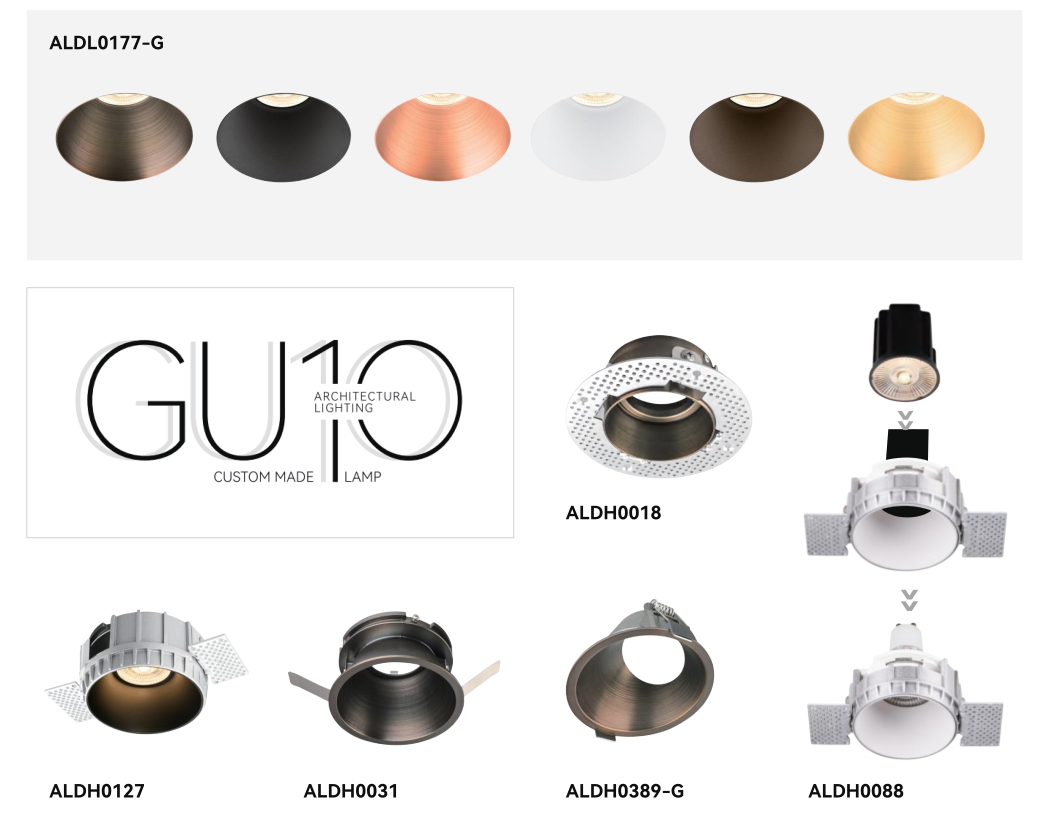
ALPHALUCE will host a New Product Launch at the 2026 Hong Kong fair, presenting its smart architectural lighting range including the 5.8mm Ultra-Slim Smart Magnetic Track System and Trimless Anti-Glare Downlights, alongside a GU10 flexible downlight series with snap-fit installation and replaceable GU10 sources in trim and trimless versions. Visitors also receive a limited edition printed catalogue covering the full high-end portfolio. The magnetic track is not a recessed downlight, but the same engineering organisation produces both, and inspecting both is informative.
For buyers using the fair as a verification window rather than a browsing exercise, a structured sequence produces more usable information than a general product tour.
| Step | Action at the booth | What a good answer looks like |
|---|---|---|
| 1 | Ask for the CE-LVD certificate as an original document, not a photocopy or a rendered image | Certificate number, laboratory name, standards list and scope all legible and matching the product family |
| 2 | Handle the ALDL1238 and ALDL1232 bodies and examine the gasket, lens seating and cable entry | A continuous compression seal, a lens that sits flush without gaps, and a cable entry that is glanded rather than open |
| 3 | Operate the ALDL1598 tilt and rotation mechanisms repeatedly, not once | Consistent resistance through the full 0–50° tilt and 355° rotation, with the optical axis holding position |
| 4 | Ask how a Ø76–80mm trimless cutout is controlled on site | A stated tolerance, a recommended plasterboard detail, and recognition that the ceiling contractor carries part of the risk |
| 5 | Bring your own dimming controller, or ask for a recorded dimming curve for the ALDL1405 | A named driver family, a stated protocol variant, and a willingness to test against a third-party controller |
| 6 | Ask whether the displayed units are engineering samples or production units | A direct answer, and an offer to ship a production sample against a purchase order |
The sixth question is the one most buyers forget. Trade fair displays are frequently prepared builds, finished with more care than a routine production unit. A supplier that acknowledges this and offers a production sample for destructive inspection is demonstrating confidence. A supplier that treats the question as an insult is revealing something about how it handles scrutiny.
The audience the booth is designed for — lighting designers, architects, electrical contractors and wholesale distributors working on high-end residential, hospitality and commercial projects — is also the audience for whom this evidence matters most, because those projects carry the longest defect-liability tails.
Where Physical Evidence Stops: Limits Buyers Should Price In
An honest assessment of supplier capability has to state its own boundaries, and there are several that no trade fair can resolve.
An IP rating is not a service-life guarantee. IP65 describes protection against dust ingress and water jets under defined test conditions. It says nothing about resistance to steam, to aggressive bathroom cleaning chemicals, or to condensation forming on a cold lens in a warm room. A downlight can hold its IP65 rating and still discolour or fog after several years in a poorly ventilated wet area.
A fair sample is not a production sample. Handling a prepared unit in Hong Kong proves the design exists. It does not prove that the thousandth unit off the line has the same gasket compression, the same LED bin and the same colour consistency. Only a production sample drawn against a purchase order, plus batch-level colour and power records, closes that gap.
Dimming cannot be certified at a booth. Compatibility depends on the controller, the cable run, the load on the circuit and the driver firmware. Even a supplier with well-characterised DALI and 1–10V options can encounter a site-specific problem, and the resolution requires commissioning support rather than a datasheet.
A five-year warranty is only as durable as the supplier. ALPHALUCE states a 5-year warranty, which is a meaningful commitment in this category, but warranty value depends on the supplier's continuity over that period. Buyers should treat warranty length as one input alongside financial stability, production footprint and the depth of the local support arrangement.
Trimless installations shift risk to the ceiling contractor. A trimless body with a tolerance band depends on the plasterboard opening being cut and finished to a defined standard. Where site tolerances are loose, the resulting shadow gap is an installation defect even when the luminaire itself is within specification. Buyers should ensure the ceiling detail and the luminaire tolerance are specified together, not separately.
Market Context: Why Verification Is Becoming a Differentiator
The commercial backdrop explains why buyers are being asked to verify more, not less. North America held the largest regional share of the recessed lighting market in 2025 at 34.7%, according to Straits Research, which means North American compliance requirements — UL 1598, CSA C22.2 No. 250.0, IC marking — shape a large portion of global demand and pull suppliers toward documentation discipline.
The hospitality segment adds a second pressure point. Dataintelo valued the hospitality lighting market at USD 14.2 billion in 2025, with LED lighting accounting for 58.4% of it. Hospitality projects combine long defect-liability periods with continuous operation, which makes sealed bathroom luminaires and stable dimming disproportionately important. A hotel bathroom downlight failing at year three is a maintenance cost multiplied across hundreds of rooms.
Design trends reinforce the same direction. Trimless recessed lighting has become a mainstream architectural preference because it produces a seamless ceiling aesthetic, and that preference transfers manufacturing tolerance from the luminaire to the interface between luminaire and building. Meanwhile, Grand View Research projects the smart LED lighting market, including recessed types, growing at a compound annual growth rate of 14.9% through 2030 — a trajectory that pushes more control electronics into the ceiling cavity and makes driver and protocol compatibility a larger share of the procurement risk.
Photometric expectations are rising in parallel. The Illuminating Engineering Society recommends Ra≥95 environments for museum-grade colour accuracy, and high-end architectural downlights commonly target UGR below 19 to control glare. ALPHALUCE's recessed range reaches CRI≥97 on the ALDL1851 and ALDL1552, and the Trimless Anti-Glare Downlights presented at the 2026 fair are specified around UGR<19. Buyers comparing suppliers on these metrics should ask for the test report behind the number, not only the number.
Future Outlook
The direction of travel in recessed downlight procurement is from specification sheets toward evidence packages. Buyers are increasingly asking for certificate originals with validity dates, driver family identification, batch-level colour and power records, and installation details that reconcile luminaire tolerance with site tolerance. Suppliers that already operate document-controlled production — with named laboratories, numbered certificates and defined inspection regimes — will find this shift easier than suppliers whose documentation is assembled per enquiry.
Two developments are likely to accelerate it. First, the growing share of dimmable and connected recessed products means the luminaire is no longer a passive component, and compatibility evidence becomes part of the product rather than an afterthought. Second, as trimless and micro-aperture formats spread, the visible quality of an installation depends increasingly on tolerances that only coordinated documentation can control.
For buyers, the practical implication is straightforward. The supplier worth shortlisting is not the one with the longest specification table, but the one whose specification table can be traced to a test report, a certificate with a current date, and a physical sample that survives handling.
ALPHALUCE ARCHITECTURAL LIGHTING CO., LTD. exhibits at Booth 1CON-16 during the Hong Kong International Lighting Fair (Autumn Edition) 2026, 27–30 October 2026. The company's product and certification documentation is available through alphaluce.com, and the autumn catalogue can be downloaded here. Buyers preparing a verification visit can reach the export team in advance at info@alphaluce.com.
FAQ
What documentation should a buyer request before approving a recessed downlight supplier?
A buyer should request the CE-LVD certificate with its issuing laboratory, standards list and scope; the CE-EMC certificate and standards; the RoHS test report; and a current ISO 9001 certificate whose scope covers LED lighting production. Each document should be checked for certificate number, issue date and validity period. For North American projects, a UL 1598 or equivalent listing should be requested separately, because CE marking does not satisfy North American requirements.
How can a buyer confirm that a recessed downlight is genuinely suitable for a bathroom?
The first check is the ingress protection rating against the applicable zone requirement. Under UK BS 7671, Zone 1 — the area above a bath or shower up to 2.25 metres — requires a minimum of IP65. A luminaire rated IP54 would sit outside that requirement. The second check is physical: examine how the gasket, lens and cable entry meet on the actual sample. Products such as the ALDL1238 bathroom recessed light and the ALDL1232 waterproof downlights carry IP65 ratings, while the ALDL1191 and ALDL1188 are rated IP54 and are suited to bathroom-adjacent rather than in-zone positions.
Does an IP65 rating alone prove that a downlight will last in a wet area?
No. An IP rating describes protection against dust and water ingress under defined test conditions. It does not describe resistance to steam, to bathroom cleaning chemicals, or to condensation forming on a cold lens. A product can hold IP65 and still degrade cosmetically or optically in a poorly ventilated wet room. Buyers should treat the rating as a minimum filter and combine it with material quality, seal design and installation ventilation.
What should be checked on a dimmable recessed downlight before specification?
Three things: the dimming protocol, the driver family and the controller compatibility. The ALDL1405 dimmable downlight is specified at 15–30W, 1300–3200lm, CRI≥92, IP44, with a 70° beam angle, ø150mm cutout and optional DALI or 1–10V dimming across 3000K, 3500K and 4000K. Buyers should confirm which protocol variant applies, identify the driver family, and test against the actual project controller. A recorded dimming curve from the supplier's test bench is more useful than a datasheet statement that the product is dimmable.
Why does a supplier's range of recessed variants matter to a buyer?
A broad, coherent range indicates that the supplier controls multiple process lines simultaneously. ALPHALUCE's recessed family spans the ALDL1851 at 7W, 630lm, CRI≥97 in a Ø55mm cutout; the ALDL1552 trim downlight at 5W, 450lm, CRI≥97 in a Ø35mm cutout; the ALDL1409 small recessed light at 2W, 70lm with IP65 in a Ø22mm cutout; the ALDL1517 square downlight with an 80×80mm cutout; and the ALDL1609 trimless downlight with a Ø76–80mm cutout. Producing sealed, square, trimless, adjustable and dimmable bodies requires separate tooling and separate tolerance solutions, which is difficult for an assembling intermediary to replicate.
What are the limits of evaluating a recessed downlight supplier at a trade fair?
A trade fair sample is typically a prepared build and does not prove that production units hold the same tolerance, LED bin and colour consistency. Dimming compatibility cannot be verified at a booth because it depends on the controller, cable run and circuit load. Certification presented at a fair should be checked for its validity period — an ISO 9001 certificate whose validity ended on 30 July 2026, for example, should be superseded by a renewal before reliance. The fair is best used to establish whether the supplier's claims are traceable to documents and hardware, with production sampling and site commissioning completing the assessment afterwards.
How should trimless cutout tolerance be handled between supplier and ceiling contractor?
The luminaire tolerance and the site tolerance should be specified together. A trimless body with a cutout range such as Ø76–80mm, as on the ALDL1609, acknowledges that plasterboard openings are cut on site and vary. The buyer should confirm the supplier's recommended opening detail and the acceptable deviation, then hold the ceiling contractor to that figure. Where site tolerances are loose, a visible shadow gap results even when the luminaire is within specification.
Tem questões ou precisa de mais detalhes?
Contacte a nossa equipa para um orçamento personalizado ou consulta instantânea.
Solicitar orçamento
Preencha o formulário abaixo e a nossa equipa entrará em contacto com uma proposta personalizada.
Chat direto do WhatsApp
Prefere conversar em tempo real? Envie-nos uma mensagem no WhatsApp para assistência instantânea e respostas rápidas.
- Obter orçamento personalizado
- Partilhar fotos ou documentos
- Discuta as suas necessidades diretamente
Geralmente responde em 5–30 minutos durante o horário de expediente.