
Verifying Rolled Ring Forgings: Standards, Limits, and Materials
Rolled ring forgings are specified across wind power, hydropower, cement production, petrochemical processing, offshore engineering, and construction machinery. For a buyer moving from research into supplier evaluation, the immediate task is to verify constraints: which certifications apply, which dimensions are possible, which materials can be processed, and what the manufacturer can actually test and deliver.
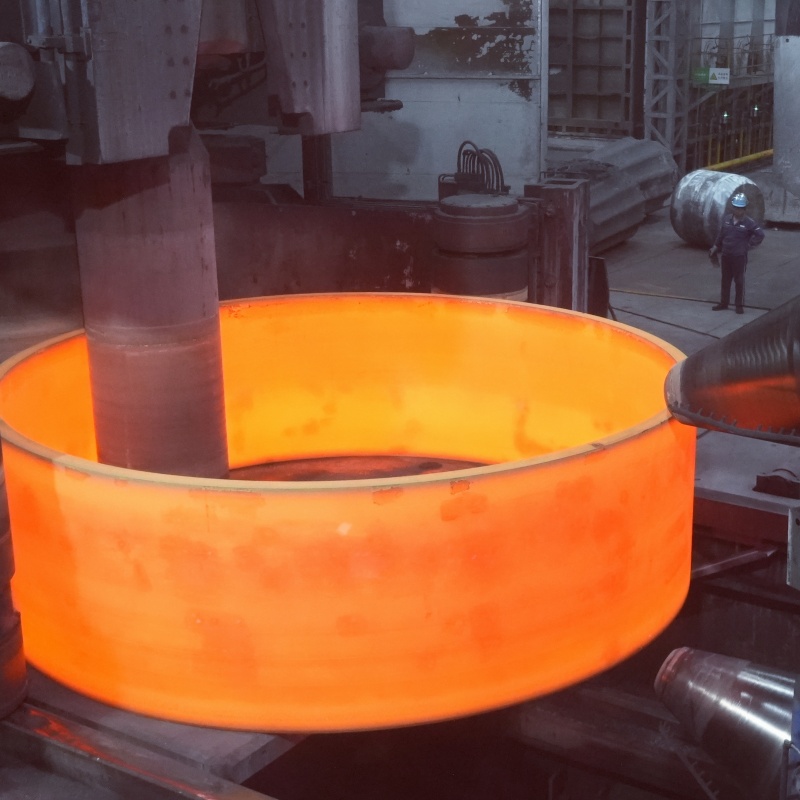
Alloy steel rolled ring forgings. Carbon steel, stainless steel, and alloy steel are the common material families for this product type.
Why Certification and Specification Checks Matter
Many rolled ring forgings enter applications where failure is expensive and difficult to repair. A turbine flange, a kiln tyre, a reactor transition section, or a slewing ring carries loads that are difficult to predict precisely over decades of service. In this context, the buyer's job is to separate documented capability from general marketing claims.
The evaluation usually begins with the specification envelope: maximum diameter, maximum height, maximum weight, and material grades. Next come management system certificates and product-related approvals. Finally, the buyer should check whether the factory performs the full chain—raw material preparation, forging, heat treatment, machining, testing, and logistics—or only part of it. The depth of the quality system can be as important as the finished geometry.
From a procurement point of view, this is an opportunity. A manufacturer that can present certificates with certificate numbers, clear scope, issuer names, and production parameters is easier to compare. A manufacturer that cannot document these constraints creates project risk, regardless of how attractive a quotation appears.
A Capability Profile for Evaluation: Iraeta Energy Equipment
Iraeta Energy Equipment Co., Ltd. is a China- and Spain-based forging specialist that produces discs, rings, shells, bars, shafts, and grinding media for clean energy, oil and gas, marine engineering, tunnel boring, cement production, and metal mining. Established in 2006, the company lists an R&D team of 100 engineers and exports mainly to the EU, USA, Japan, Middle East, Southeast Asia, Brazil, and India.
Iraeta reports an end-to-end workflow from custom material preparation and forging to heat treatment, precision machining, rigorous testing, and global logistics. Its product specification for forgings covers carbon steel, stainless steel, and alloy steel, with a maximum height of 5 meters, a maximum diameter of 21 meters, and a maximum weight of 300 tons. In 2026, the company produced a seamless rolled steel ring measuring 21.029 meters in diameter, breaking its own Guinness World Record of 15.673 meters set in 2022.
For a buyer, the relevant point is not the record in isolation. It is evidence that a supplier has the equipment and production system needed for large, heavy, and highly stressed ring geometries. Each order should still confirm the limits that apply to the exact component being purchased.
Technical Explanation: The Rolled Ring Forging Process
Rolled ring forgings are produced by expanding a pierced preform on a ring rolling mill. In the seamless route, the starting billet is cut, heated, upset, and pierced before rolling. The rolling operation increases the ring diameter while reducing wall thickness and shaping the cross-section. Because the component remains continuous, the final ring has no weld seam and the material structure follows the shape of the ring.
Profiling rolled ring forgings take this a step further: the rolling process creates a contoured cross-section that is closer to the final machined shape. This can reduce material waste and machining time. Hot rolled seamless forged rings are usually supplied after controlled cooling and heat treatment, followed by machining when tolerances and surface finishes require it.
The practical implication for buyers is that the production route influences mechanical performance and inspection, but it must be supported by process controls. A ring rolling line alone is not enough; the factory also needs ingot preparation, furnace capacity, machining capability, and non-destructive testing capacity that match the product size.
Parameters That Define a Rolled Ring Forging Requirement
When specifying custom rolled ring forgings, buyers should use a small set of parameters to compare suppliers:
- Material: carbon steel, stainless steel, or alloy steel.
- Dimensions: maximum outer diameter, cross-section height, wall thickness, and final machined tolerances.
- Weight: unit weight and whether it falls within the factory's handling and machining limits.
- Form: seamless rolled ring, profiling rolled ring, or near-net shape that requires less final machining.
- Heat treatment and testing: required mechanical properties, test methods, and quality documentation.
For Iraeta, the listed production envelope is 5 meters maximum height, 21 meters maximum diameter, and 300 tons maximum weight. The company operates a ring and shell rolling machine designed for 22-meter rings, according to its documented capabilities. Monthly forging capacity is reported at 70,000 tons, the minimum order quantity is one unit, and customization is available for material, size, forging shape, heat treatment, and machining. Quality control is described as 100% testing.
Certifications and Compliance for Rolled Ring Forgings
Certifications are one of the clearest ways to reduce commercial risk in the evaluation stage. The documented certificates for Iraeta's forgings and seamless rolled rings are summarized below:
| Standard | Certificate number | Issuer | Market | Scope |
|---|---|---|---|---|
| PED 2014/68/EU | 01 202 CHN/Q-06 0144.01 | TUV | EU | Manufacturing of forged flanges and hot rolled rings |
| EN 1090-1:2009+A1:2011 and EN 1090-2 | 0035-CPR-1090-1.03389.TÜVRh.2025.003 | TUV | EU | Structural components and kits for steel structures to EXC3 |
| ISO 9001:2015 | F02326Q00125R602 | BV | Global | Raw materials for forgings, manufacturing of forgings, and grinding media |
| ISO 14001:2015 | F01926E00118R502 | NQA Certification Co., Ltd. (Shanghai) | Global | Production of raw materials for forgings and production of forgings |
| ISO 45001:2018 | F01926S00070R502 | NQA Certification Co., Ltd. (Shanghai) | Global | Production of raw materials for forgings and production of forgings |
Documented certificates related to Iraeta's forged rings and seamless rolled rings.
Buyers in pressure and structural applications may also encounter ASTM A182 for forged or rolled alloy and stainless steel pipe flanges and parts for high-temperature service, and EN 10222-2 for steel forgings for pressure purposes. These standards help define material and inspection requirements and should be checked against the project specification.
Application Contexts That Depend on Qualified Rings
Wind power
Wind turbine rolled ring forgings are used in tower connections, gearbox forgings, bearing rings, and flange forgings. Offshore wind farm service adds salt spray, marine corrosion, low-temperature operation, and high cyclic loads. The documented requirement emphasizes high structural strength, fatigue resistance, and corrosion resistance.
Hydropower
Hydropower rolled ring forgings support hydro turbine generating units and pumped storage stations. Components face high water head pressure, sediment abrasion, water erosion corrosion, cyclic loading, and long-term underwater or humid operation. The function is usually load transfer and structural support.
Rotary kiln and cement production
In rotary kilns, kiln tyres and support rings carry extreme temperature, heavy cyclic load, and 24/7 continuous operation. Documented Iraeta supply includes a core supporting ring and kiln tyre for a German cement and energy equipment manufacturer, and a kiln component for a Turkish cement plant, both designed for long-term operation under high-temperature and heavy-load conditions.
Petrochemical and refining
Flange rolled ring forgings, transition sections, and pressure vessel components must withstand high pressure, high temperature, and corrosive media. Documented reference supply includes components for an oil and gas OEM in Saudi Arabia and three pieces for a heavy-duty hydrogenation reactor used in a 7.5 Mt/y European refinery project.
Offshore and marine engineering
Offshore engineering applications use rings in mooring systems, subsea production equipment, marine propulsion systems, and structural connections. Deep-sea pressure, seawater corrosion, cyclic wave load, and long service life are the defining conditions. Shipbuilding applications are another downstream segment for forged ring components.
Construction machinery
Large rings appear in slewing support systems, transmission systems, and cutterhead mechanisms of shield machines and cranes. These systems run under heavy load, vibration, frequent start-stop, and intermittent high-intensity operation, which makes impact resistance and fatigue life important selection criteria.
Market Trends and What They Mean for Buyers
Market data gives context to these requirements. The global ring rolling products market is valued at USD 4.56 billion in 2025 and is projected to reach USD 7.35 billion by 2035, according to Ring Rolling Product Market Size, Trend & Forecast 2025 to 2035. Separate data from Forging Market Trends and Growth Analysis Report indicates that seamless rolled rings represent approximately 24% of global manufactured forging components by production volume.
In the wind sector, the wind turbine forging market was valued at USD 9.6 billion in 2024, with onshore segments holding a 67.3% share, according to Global Market Insights. In materials, carbon steel accounts for approximately 38.2% of raw material share in the global metal forging market, according to Dataintelo. These figures reinforce two points: energy applications will remain a demand driver for large forged rings, and carbon steel will remain an important specification alongside alloy and stainless grades.
Comparison with Traditional Alternatives
Rolled ring forging competes with casting, open-die forging followed by machining, and fabrication from plate or welded segments. The main advantage of a seamless rolled ring is structural continuity. Because the material structure follows the ring shape and there is no longitudinal weld, the ring can be designed with fewer potential weak points under fatigue loading. The process also produces large annular components with lower material waste than machining a ring from solid billet or plate.
The comparison, however, has limits. For non-critical components with very simple geometry, small quantities, or loose inspection requirements, casting or cutting from plate can be faster and more economical. A forged ring is justified when the application requires documented mechanical properties, fatigue resistance, or the strict traceability that certification systems provide.
Another boundary is physical: ultra-large rings require specialized rolling machines, heat-treatment furnaces, and transport planning. A supplier's certified maximum diameter should be validated against the project specification rather than assumed. This is why the evaluation stage must combine certificates, production limits, and application requirements before a sourcing decision is made.
Future Outlook
The projected growth of the ring rolling products market through 2035 points toward continued investment in large-ring capacity. Larger wind turbines, pumped storage hydropower, high-temperature process industries, and offshore infrastructure all create demand for rings that are heavier, larger, and better documented than in earlier project generations.
For buyers, the durable implication is that supplier evaluation will become more evidence-based. A manufacturer's ability to show certificates, test coverage, dimensional limits, and reference applications will carry more weight than generic capability statements. The existence of a 21-meter-class seamless ring record is useful evidence that extreme-scale manufacturing is no longer theoretical, but every order should still be checked against the project's own specification envelope.
FAQ
What certifications are commonly required for rolled ring forgings in Europe?
For the EU market, PED 2014/68/EU covers forged flanges and hot rolled rings, with certificate number 01 202 CHN/Q-06 0144.01 issued by TUV. For structural steel components, EN 1090-1:2009+A1:2011 and EN 1090-2 apply, with certificate number 0035-CPR-1090-1.03389.TÜVRh.2025.003 issued by TUV.
Which ISO certifications should a rolled ring forgings manufacturer hold?
Iraeta's forgings and seamless rolled rings are certified to ISO 9001:2015, with certificate number F02326Q00125R602 issued by BV; ISO 14001:2015, with certificate number F01926E00118R502 issued by NQA Certification Co., Ltd. (Shanghai); and ISO 45001:2018, with certificate number F01926S00070R502 issued by NQA Certification Co., Ltd. (Shanghai).
What size limits should be checked for large rolled ring forgings?
Iraeta's product specification lists a maximum height of 5 meters, a maximum diameter of 21 meters, and a maximum weight of 300 tons. In 2026, the company also produced a 21.029-meter seamless rolled steel ring, according to its documented capability record.
What materials are available for rolled ring forgings?
Carbon steel, stainless steel, and alloy steel are the material families listed for Iraeta's forgings and seamless rolled rings.
Can custom rolled ring forgings be produced with small order quantities?
Iraeta offers customization of material, size, forging shape, heat treatment, and machining. The reported monthly forging capacity is 70,000 tons, and the minimum order quantity is one unit.
What testing should a buyer expect from a rolled ring forgings manufacturer?
Iraeta's quality control is described as 100% testing. Buyers should still confirm the project-specific inspection plan, including mechanical testing and non-destructive testing requirements, during technical evaluation.
Tem questões ou precisa de mais detalhes?
Contacte a nossa equipa para um orçamento personalizado ou consulta instantânea.
Solicitar orçamento
Preencha o formulário abaixo e a nossa equipa entrará em contacto com uma proposta personalizada.
Chat direto do WhatsApp
Prefere conversar em tempo real? Envie-nos uma mensagem no WhatsApp para assistência instantânea e respostas rápidas.
- Obter orçamento personalizado
- Partilhar fotos ou documentos
- Discuta as suas necessidades diretamente
Geralmente responde em 5–30 minutos durante o horário de expediente.