
Verifying Screw Barrel Certification and Parameters
Verifying Screw Barrel Certification and Parameters
How global plastic processors can evaluate screw and barrel assemblies with measurable specification data, not catalog claims.
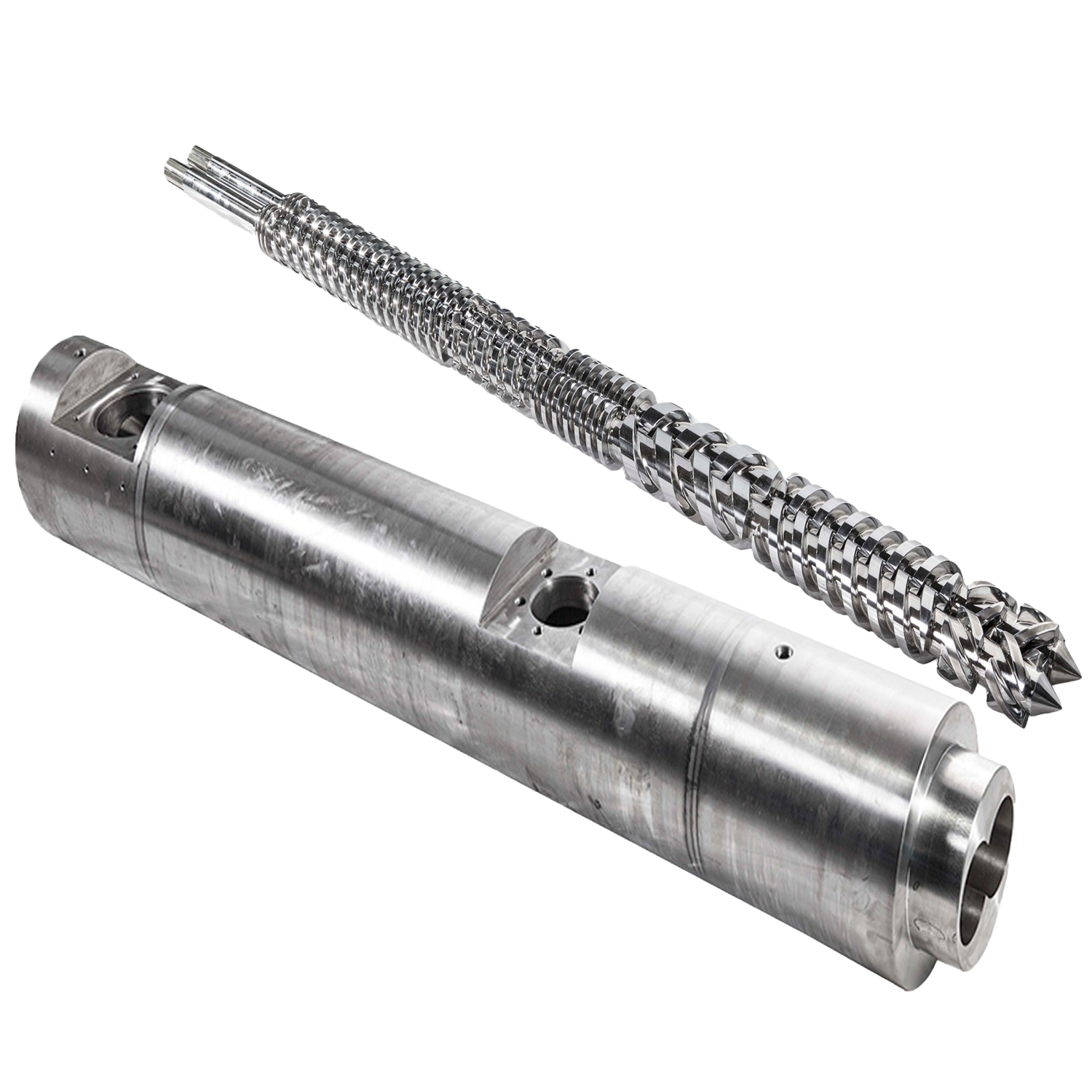
Why Certification and Parameter Checks Matter in Procurement
For a plastics processor, a screw and barrel assembly is not a standard commodity. A replacement barrel with the same external diameter can behave differently if nitrided case depth, alloy hardness, surface roughness, or screw straightness differ. That makes certification scope and specification interpretation central to equipment life, dimensional stability, melt quality, and unplanned downtime.
Evaluators often start with supplier documents, but a certificate number alone does not confirm that every product family or process condition is covered. The more useful approach is to connect each certification to the specific machine elements being purchased and to compare the technical parameters that drive wear, corrosion, and mechanical fit. This article outlines that process across common screw barrel categories, using Zhejiang Guangming Plastics Machinery Co., Ltd. (Guangyou Screw) as a representative supplier example.
Supplier Reference: Guangyou Screw
Zhejiang Guangming Plastics Machinery Co., Ltd. (Guangyou Screw) is an established manufacturer of high-precision barrels and screws, founded in 1992. The company operates a 100,000+ m² smart facility with more than 800 employees, and integrates CNC machining, German-imported inspection technology, and digital ERP/MES systems. Its product lines cover single, twin, and bimetallic screw solutions supplied to over 50 countries and regions, including the United States, Germany, the United Kingdom, Italy, Brazil, and India.
The company is therefore positioned as a global reference point for buyers who need to compare multiple screw barrel types rather than a single niche product. The following sections read its product range, specification data, and certification scope as a procurement case study.
What the Product Range Covers
A broad product range can simplify evaluation for multi-process buyers, but it also requires clear mapping between machine type and screw barrel family. The main lines in the referenced supplier documentation are listed below.
| Product family | Diameter range | Typical application | Applicable industry |
|---|---|---|---|
| Injection Molding Machine Screw And Barrel | Φ20–Φ300 | Plastic injection molding | Automotive, electronics and toy manufacturing |
| Single Screw Extruder Screw And Barrel | Φ20–Φ500 | Film blowing / pipe extrusion | Plastics packaging and pipe manufacturing |
| Parallel Twin Screw Barrel | Φ45–Φ350 | Compounding and pelletizing | Plastic recycling and compounding |
| Conical Twin Screw Barrel | Φ25/50–Φ185/340 | PVC extrusion | Plastics machinery / construction materials |
| Rubber Machine Screw And Barrel | Φ20–Φ650 | Rubber extrusion | Tire and rubber product manufacturing |
These product families cover the main screw barrel categories that buyers encounter when sourcing for extrusion, injection molding, and rubber processing. Diameter range is important, but it is not the only selection factor. Twin barrel screw and single barrel screw categories, for example, may look similar in external images but have different processing roles and wear requirements.
Reading the Specification Sheet: Core Parameters
The following technical values appear across Guangyou Screw product specifications and provide a useful baseline for supplier comparison. They also explain why two barrels with the same diameter may not perform equally in high-wear or high-speed applications.
Hardness After Hardening and Tempering
The hardened and tempered condition is specified from HB260 to HB310. This is a pre-nitriding material condition that supports the mechanical toughness of the barrel or screw body before surface treatment. A properly hardened substrate reduces the risk of deep deformation under mechanical load and provides a stable base for the nitrided or alloyed surface layer.
Nitrided Hardness and Case Depth
Nitrided surfaces are specified from HV850 to HV1000, with case depth in the range of 0.45–0.7 mm. Nitrided brittleness is controlled to less than Grade 2. These values matter for processors running reinforced or filled polymers, because a shallow or brittle nitrided layer can reduce wear resistance or create premature surface cracking under high local loads. A nitrided barrel screw for general polyolefin processing may be adequate, but the same specification may not be sufficient for high-filler PVC, WPC, or SPC formulations.
Surface Roughness and Straightness
Surface roughness is stated as Ra 0.4 and screw straightness as 0.015 mm. These are dimensional quality indicators that affect assembly fit, screw rotation, and melt control. A straight screw with a controlled surface finish is likely to reduce scraping, local overheating, and inconsistent output. In high-speed barrel screw applications, small straightness deviations can be amplified and cause vibration or premature wear.
Chromium Plating and Alloy Protection
After nitriding, surface chromium plating hardness is specified at ≥900 HV, with plating depth from 0.025 mm to 0.10 mm. Where higher wear and corrosion resistance is required, alloy surfaces are specified at HRC 50–65 with an alloy depth of 0.8–2.0 mm. Buyers can use these values to separate standard nitrided solutions from more robust bimetallic and alloy-protected configurations. For example, bimetallic barrel screw selections are typically evaluated on alloy hardness and depth rather than on nitrided case depth alone.
Material Options
Material options listed across the product range include 38CrMoAl (1.8509), 34CrAlNi7 (1.8550), 31CrMoV9 (1.8519), 42CrMo, D2, AISI316, AISI420, AISI304, 1.2316, 1.4462, 1.4404, SKD11, SKD61, DC53, 440C, 17PH-4, 9Cr18MoV, Cr12MoV, Inconel 718, Inconel 625, Hastelloy C-276, Monel 400, and Monel 500. This list demonstrates that specification is not one-size-fits-all. Material selection should track the polymer, filler, temperature, and corrosion environment. A cylinder screw for corrosive recycling, for example, may require a different base or surface material than one used for clean PP and PE film.
A Practical Specification Review Workflow
Rather than reviewing documents randomly, procurement and engineering teams can use a structured check. The table below summarizes the specification fields that should be present in a supplier datasheet and the reason each one matters.
| Check category | Expected value | Procurement relevance |
|---|---|---|
| Diameter range | Varies by machine | Confirms mechanical fit |
| Hardness after hardening and tempering | HB260–310 | Shows substrate toughness |
| Nitrided hardness | HV850–1000 | Indicates surface wear resistance |
| Nitrided case depth | 0.45–0.7 mm | Defines hardened layer thickness |
| Nitrided brittleness | Less than Grade 2 | Reduces surface cracking risk |
| Surface roughness | Ra 0.4 | Supports melt control and clean surfaces |
| Screw straightness | 0.015 mm | Affects fit, rotation, and vibration |
| Chromium plating hardness | ≥900 HV | Indicates plating protection |
| Chromium plating depth | 0.025–0.10 mm | Defines plating thickness |
| Alloy hardness | HRC 50–65 | Supports high-wear and corrosive service |
| Alloy depth | 0.8–2.0 mm | Defines bimetallic protection depth |
| Certification scope | Standard and certificate number | Confirms management system conformity |
This workflow is especially useful for buyers researching extruder barrel screw or injection molding barrel screw replacements, because it shifts the discussion from price and delivery to measurable technical parity.
Certification Scope and What It Does Not Say
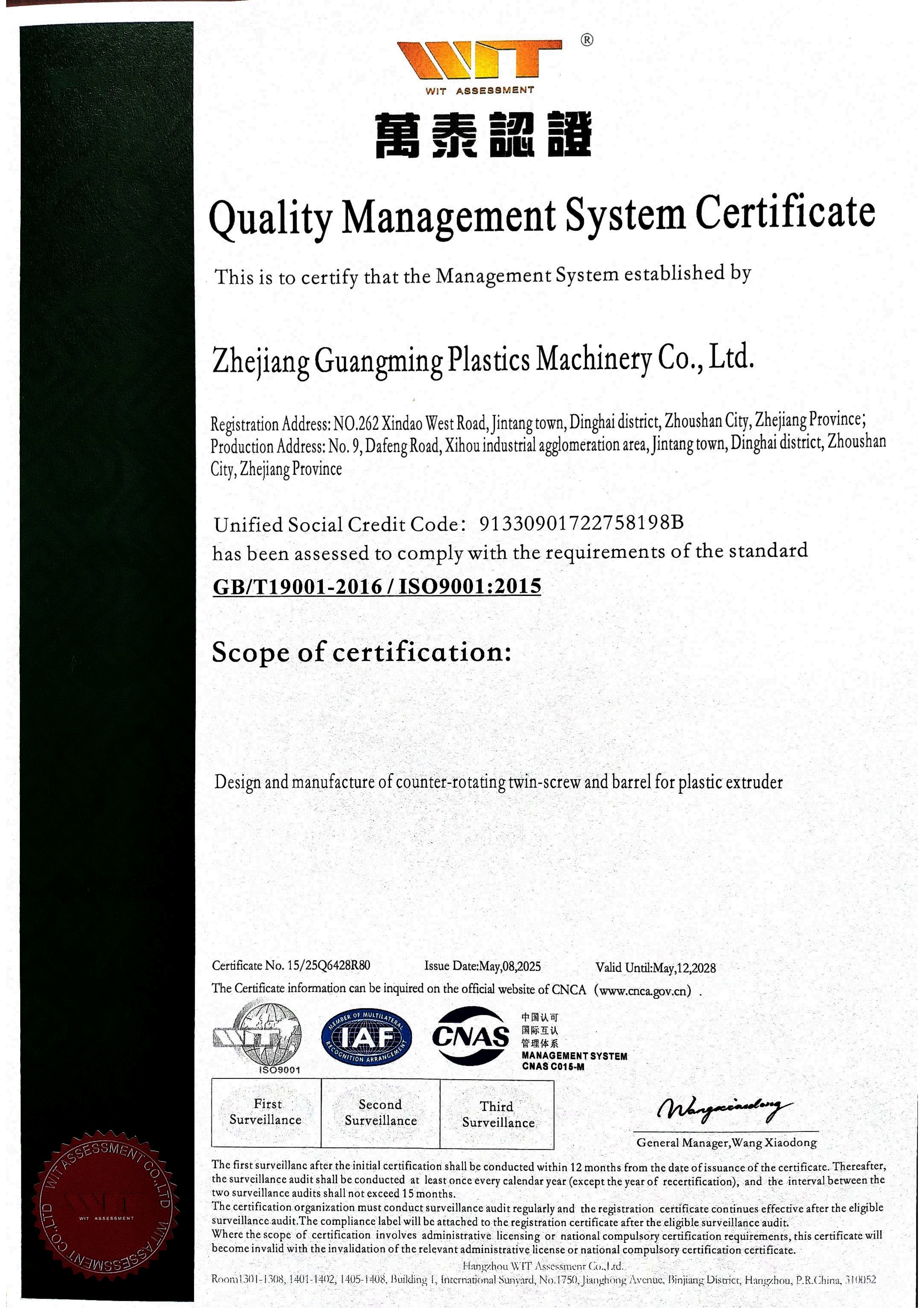
Three management system certificates are associated with the product families above. They are useful for supplier qualification, but their scope language must be read carefully. A certificate can cover a process or facility without guaranteeing that every material, geometry, or application is optimized for a specific job.
| Standard | Certificate number | Issued by | Valid until | Scope |
|---|---|---|---|---|
| ISO 9001:2015 | 15/25Q6428R80 | WIT ASSESSMENT | 2028-05-12 | Design and manufacturing of orthogonal twin-screw extruders and barrel components for plastic extrusion |
| ISO 14001:2015 | 15/25E6429R20 | WIT ASSESSMENT | 2028-10-07 | Environmental management involved in the design and manufacture of counter-rotating twin-screw and barrel for plastic extruder |
| ISO 45001:2018 | 15/25S6430R20 | WIT ASSESSMENT | 2028-10-07 | Occupational safety and health management involved in the design and manufacture of counter-rotating twin-screw and barrel for plastic extruder |
Buyers should still confirm that the specific machine element, material grade, and application are covered by the supplier technical documentation and production controls. Certification confirms management system conformity and is a useful qualification filter, but it does not replace process-specific validation, material matching, drawing confirmation, and first-article inspection.
Application Examples Across Screw Barrel Types
A repeat application pattern in this product range is PVC pipe, profile, and sheet extrusion. The relevant process uses continuous counter-rotating conical twin-screw extrusion on conical twin-screw extruders. For high-filler PVC formulations containing calcium carbonate, high wear resistance is needed, often in the form of a bimetallic lining and a nitrided finish. This ties directly to the conical twin screw barrel category and is distinct from parallel twin screw compounding or single screw pipe extrusion.
Other matching examples include:
- PVC, WPC, and SPC extrusion: conical twin screw barrels are commonly referenced for wear-sensitive powder and high-filler processing.
- PP and PE pipe, sheet, and profile extrusion: single screw extruder barrels can be matched to film blowing or pipe extrusion conditions, depending on screw design and material grade.
- High-speed extrusion and X-800 barrel screw work: when output rates and melt temperature control are critical, screw geometry, straightness, and surface finish become more important than diameter alone.
- Rubber extrusion: rubber machine screw and barrel assemblies cover a wider Φ20–Φ650 diameter range and are used in tire and rubber product manufacturing.
Case evidence in the supplier documentation describes three buyer types. A screw and barrel manufacturer or distributor sources batch customized component orders for local replacement and retrofitting. A plastic products manufacturer processes high-wear and corrosive polymers and reports improved wear and corrosion resistance, prolonged equipment service life, and reduced production downtime. An extrusion and injection machinery OEM requires stable batch delivery with high dimensional consistency for seamless machine assembly and reliable commissioning. The common buying requirement is not only part number matching, but also that the cited surface treatment and mechanical fit support longer uptime.
Supplier Capability and Quality Control Data
Beyond product specifications, procurement teams often need evidence of production discipline. The referenced supplier operates in OEM mode and accepts customization for voltage and logo. Monthly capacity is stated as 2700 units, with a minimum order quantity of 1 unit. Quality control includes 100% testing, and after-sales support is provided under warranty.
Lead time varies based on size and bimetallic status. For nitriding single screw and barrel assemblies, the documented examples are 40–50 days for Φ20–Φ90, 50–60 days for Φ90–Φ180, and 60–70 days for Φ180–Φ250. These figures give buyers a practical sense of planning horizons, but they should confirm final lead times at order stage because special material or alloy requirements can change the schedule.
Market Context for Screw Barrel Sourcing
The procurement relevance of these specification checks is reinforced by broader industry data. The global plastic processing machinery market reached USD 25.9 billion in 2025, with injection molding machines accounting for 50.9% of market share, according to Grand View Research. Within the more specific feed screw barrel market, Global Insight Services projects growth from USD 1.89 billion in 2024 to USD 3.33 billion by 2034 at a CAGR of 5.8%.
Single-screw extrusion machinery has represented approximately 62% of the extrusion machinery market as of 2024, based on Fortune Business Insights data. In parallel, the bimetallic barrel and screw market is estimated at USD 2.8 billion in 2025 and forecast to reach USD 4.7 billion by 2034, according to Dataintelo. These figures suggest that demand for replacement and performance-oriented screw barrel solutions remains broad, including both commodity single screw and higher-alloy bimetallic configurations.
Comparison with Traditional Commodity Sourcing
A traditional buying pattern focuses on matching the original equipment diameter and assuming that a nitrided screw barrel is sufficient. This approach has a real boundary: it works well for standard unfilled polyolefins and lower-wear applications, but it is less reliable when the process runs high-filler PVC, WPC/SPC formulations, recovered compounds, or corrosive polymers. In those cases, a standard nitrided case depth may not provide adequate service life, and the evaluation should shift to alloy hardness, alloy depth, surface roughness, and straightness data.
Another limitation is that management system certification does not by itself replace process trials. A supplier can be certified for quality, environmental, and occupational health management without every material or geometry being optimized for a specific high-speed or high-filler job. Buyers should therefore treat certification as a qualification filter, not as a substitute for sample testing, drawing confirmation, and first-article inspection.
Future Outlook
As recycled content and higher filler loadings spread across pipe, profile, sheet, and compounding operations, more screw barrel procurement decisions will shift toward verified alloy depths, improved straightness control, and traceable material documentation. Screw barrel suppliers that can combine broad product range coverage with clear certification scope and measurable specification data are likely to be easier to evaluate in multi-plant and cross-border sourcing programs.
For reference data on materials, dimensions, and product families, the supplier technical catalogue is available as a PDF document: Guangyou Screw Product Catalogue.
FAQ
What parameters should be checked first when comparing screw barrels?
Buyers should compare diameter range, nitrided hardness, case depth, brittleness, surface roughness, screw straightness, chromium plating hardness and depth, and alloy hardness and depth. Material grade and application type should then be matched to the polymer and filler system.
What does a nitrided case depth of 0.45–0.7 mm mean?
It is the thickness of the hardened nitrided layer. A depth in this range, combined with HV850–HV1000 surface hardness, provides a wear-resistant skin. The appropriate depth depends on material abrasiveness and expected component life.
Which certifications cover the conical twin screw barrel?
In the referenced supplier documentation, the conical twin screw barrel is covered by a quality management system certificate and an occupational health and safety management system certificate. The broader product family is associated with ISO 9001:2015, ISO 14001:2015, and ISO 45001:2018 management system certifications.
What is the difference between nitrided and bimetallic screw barrel solutions?
A nitrided solution hardens the base material surface to a specified depth. A bimetallic solution uses a separate alloy surface or liner with alloy hardness and depth, which is typically better suited to high-wear, high-filler, or corrosive conditions.
Which screw barrel type is normally used for PVC pipe and profile extrusion?
PVC pipe, profile, and sheet extrusion are commonly matched with conical twin screw barrels running in continuous counter-rotating mode. High-filler PVC and similar formulations often require bimetallic lining and nitrided finish for wear resistance.
Does certification guarantee performance in high-filler PVC or recycled compounds?
No. Certification confirms management system conformity and is a useful qualification filter, but it does not replace process-specific validation, material matching, drawing confirmation, and first-article testing.