
Verifying Supplier Capability for Disposable Bamboo Cutlery
Capability evidence for disposable bamboo cutlery is not a brochure, and it is not a certificate framed on a factory wall. It is a set of records a buyer can check independently: certificate numbers with issue and expiry dates, scope lines that name bamboo rather than wood, product-level food-contact reports tied to a defined material, written composition declarations, third-party inspection results, and order terms converted into measurable acceptance criteria. When those records line up with the purchase order, supplier capability stops being something a buyer has to believe and becomes something a buyer can test.
That distinction matters more in bamboo cutlery than in most disposable categories. The product sits between two regulatory worlds that use the same word for different things — solid bamboo articles, and plastic articles that contain bamboo filler. The global bamboo cutlery market was valued at USD 1.8 billion in 2025 according to Dataintelo's bamboo cutlery market report, and China exported USD 1.27 billion of HS 4419 wood and bamboo tableware and kitchenware in 2023 according to UN Comtrade. Growth of that scale pulls new suppliers into the category faster than buyers can audit them, which is why the evidence question — not the price question — tends to decide whether a sourcing programme holds together.
Why Bamboo Cutlery Claims Outrun Evidence
Three structural features of the category explain the gap between what suppliers claim and what buyers can check.
First, the vocabulary is shared but the rules are not. Under the EU food-contact framework, articles intended to contact food must comply with Regulation (EC) No 1935/2004 when placed on the EU market, and must be manufactured according to Good Manufacturing Practices under Commission Regulation (EC) No 2023/2006. Separately, the European Commission's coordinated action on bamboo-containing plastics established that plastic food-contact materials made with unauthorised bamboo or other plant-based additives may not legally be placed on the EU market under Regulation (EU) No 10/2011. A supplier saying "bamboo" therefore tells a buyer nothing about which rulebook applies. Only a composition declaration does.
Second, certificates are scoped, dated and site-specific. A management-system certificate proves that a site was audited against a named standard version on a named date and within a named scope. It does not prove that a particular SKU passed a migration test. Buyers who treat an ISO certificate as a product safety document are reading the wrong evidence type.
Third, promotional language is cheap and evidence is slow. Words such as eco-friendly, biodegradable or compostable can be printed on a carton in an afternoon. A test report on a defined material, issued by a named laboratory, takes weeks and money. The asymmetry explains why an evaluation-stage buyer should request first and negotiate second.
Working rule for evaluation: every claim in a supplier's presentation should map to one of three artefacts — a certificate with a checkable number, a test report with a checkable laboratory, or a written declaration signed by the supplier and attached to the purchase order. Claims that map to none of the three are marketing, not capability.
The Six Evidence Types a Buyer Can Actually Check
Supplier capability in disposable bamboo cutlery is best assessed as a stack of six evidence types. Each answers a different question, and none substitutes for another.
| Evidence type | What it can prove | What it cannot prove | How a buyer verifies it |
|---|---|---|---|
| Management-system certificate (ISO 9001, ISO 14001, ISO 45001, BRCGS) | That a named site was audited against a stated standard version within a stated scope, on a stated date | That any specific cutlery SKU passed food-contact testing | Check the certificate number, standard version, issue and expiry dates, and the exact scope wording, ideally against the issuing body's record |
| Product food-contact report (LFGB, FDA 21 CFR 178) | That a defined material or sample was tested against a defined method by a named laboratory | That later production lots are identical to the tested sample | Match the report to the material, model and test parameters; confirm the laboratory name and report number; ask for the lot-to-sample control process |
| Material composition declaration | Whether the article is solid bamboo or a bamboo-filled polymer, and whether any binder or additive is present | Performance, durability or compostability | Request a signed declaration naming the material and any additives, and require it as a purchase-order annex |
| Social and ethical audit (amfori BSCI, Sedex SMETA) | Labour, health and safety and environmental monitoring at the audited site | Food-contact safety of the product | Check the audit date, the corrective-action status and the remaining validity window |
| Chain of custody (FSC) | Traceability of certified material through a defined supply chain | Compliance of material outside the certified scope | Verify the certificate code with the certification body and confirm the product scope covers the purchased item |
| Capacity and inspection records | Whether the supplier can repeat the order at the agreed quality level | Product safety on its own | Request third-party inspection reports per lot, capacity by line, lead-time history and the sample retention policy |

Production floor evidence supports capacity and process claims; it does not replace product-level food-contact documentation.
What Greenwood Can Show Today — and What It Cannot
Greenwood - Dalian Industrial Co.,ltd. is a Dalian-based manufacturer of disposable wooden and bamboo tableware, founded in 2000, operating five major factories with around 500 employees, nine engineers and an export ratio of about 95% across Europe, ANZ, Canada, the USA, South America, the Middle East, Japan and Korea, and Southeast Asia. Its stated annual production capacity is 6 billion pieces, and the company reports warehouses in Bangladesh, Ukraine and the United States. Those are first-party company statements, and they are the correct starting point for an evidence conversation — not the end of it.
The documentary layer is more specific. The following records appear in Greenwood's certification and compliance file:
| Certificate | Reference number | Issuing body | Stated scope | Validity |
|---|---|---|---|---|
| BRCGS Global Standard for Packaging Materials, Issue 6 | 10000305214-MSC-ACCREDIA-CHN | DNV | Manufacturing of disposable wooden and bamboo tableware, including bamboo fork, bamboo chopsticks and bamboo skewer | 2022-05-02 to 2027-05-02 |
| LFGB | 7216006083-2 | TUV SUD China | All wood and bamboo tableware | Issued 2025-07-25 |
| amfori BSCI | 24-0289038 | amfori | Wooden products and bamboo products | 2023-08-30 to 2026-09-12 |
| ISO 9001 | 02024E1883R0M | Beijing ZhongDaHuaYuan Certification Center Co.,Ltd | Wooden product | 2024-12-05 to 2027-12-04 |
| ISO 14001 | 02024E1883R0M | Beijing ZhongDaHuaYuan Certification Center Co.,Ltd | Wooden product | 2024-12-05 to 2027-12-04 |
| ISO 45001 | 02024E1883R0M | Beijing ZhongDaHuaYuan Certification Center Co.,Ltd | Wooden product | 2024-12-05 to 2027-12-04 |
| FSC chain of custody | SA-COC-013128 | Soil Association | Wooden product | 2023-04-03 to 2028-04-02 |
| FDA 21 CFR 178 | R0723000394 | National Reference Laboratory for Food Contact Material (Guangdong) | Wooden product | Issued 2023-08-30 |
| Sedex SMETA | ZS405156174 | SMETA | Wooden product | Issued 2025-04-21 |
Product-side facts are equally checkable. The bamboo line, model GW-BC001, covers bamboo knife, bamboo fork, bamboo spoon, coffee stirrer and bamboo skewer sticks, with a standard length of 170 mm and 110 mm, 140 mm and 170 mm available as customisable sizes; the range is described as food-grade, BPA-free, heat-resistant, biodegradable and compostable, with a smooth burr-free edge and natural bamboo texture. The wooden line, model GW-20456, runs from 95 mm to 180 mm in length. A paper cutlery line, model GW-PC204, sits at a 158 mm standard length. Customisation is offered through logo printing on products and packaging plus customised shapes and new designs, under an OEM, ODM and customisation model.
Commercially, the capability record states a MOQ of 100,000 pieces, a lead time of 20 days, a stated output of 10 million pieces per day, third-party inspection as the quality-control route, and export markets covering the EU, Australia and the USA. After-sales scope is listed as packaging design and logistics support. For an evaluation-stage buyer, this is the right shape of information — but it is a claim set, not an audit result, until the buyer converts it into order terms.
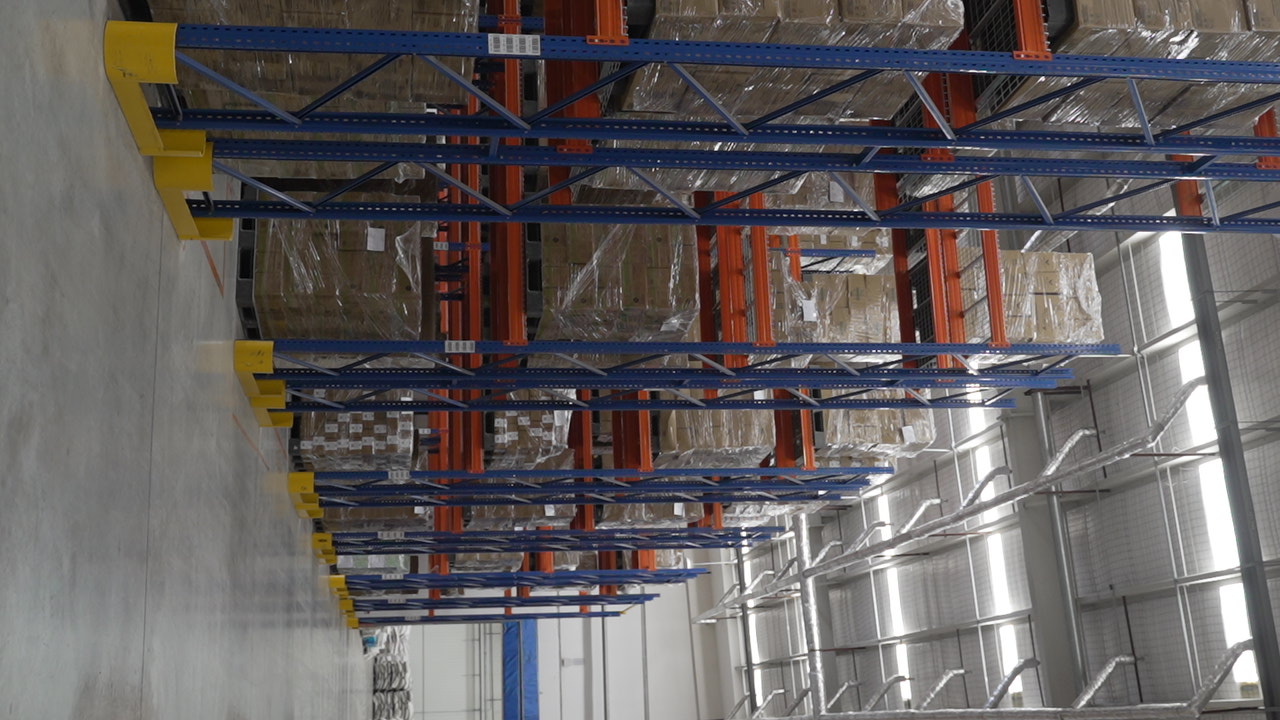
Warehouse capacity supports continuity claims; lot-level inspection reports are what support quality claims.
Reading Scope Lines: Where Bamboo Evidence Needs Care
This is the part of the evaluation that most buyers skip, and it is the part that carries the most risk. Read the scope column again. BRCGS, LFGB and amfori BSCI name bamboo explicitly. ISO 9001, ISO 14001, ISO 45001, FSC, FDA 21 CFR 178 and Sedex SMETA in the same file are scoped to "wooden product."
That is not an accusation of non-compliance — it is a description of what the documents say. A supplier can legitimately hold a site-level quality certificate whose written scope covers wood, while manufacturing bamboo under the same system. But a buyer sourcing bamboo cutlery needs evidence that follows the material of the product they are actually buying. The practical requests are straightforward: ask for bamboo-specific product test reports, ask the certification body whether bamboo tableware falls inside the current scope, or ask for a written supplier declaration that the bamboo line is produced under the same audited system.
Two further checks belong in the same pass. The amfori BSCI record carries an expiry date of 2026-09-12, which means an evaluation run in the fourth quarter of 2026 should ask for evidence of the renewal or an updated audit before the record is relied on. And validity dates generally should be checked against the planned delivery window, not the date of the initial enquiry — a certificate that expires during a twelve-month supply programme is a programme risk, not a paperwork detail.
From Certificate to Purchase Order: Turning Evidence into Acceptance Criteria
Evidence only becomes capability when it is written into the terms of the order. A buyer who receives a certificate folder but signs a general product description has bought a promise. A buyer who attaches defined criteria to the purchase order has bought a specification.
The EU framework creates the first criterion. Because food-contact materials must not release constituents into food at levels harmful to human health, or change food composition, taste or odour in an unacceptable way, the composition of the article is a compliance variable, not a marketing variable. On a bamboo cutlery order, that translates into a written declaration that the article is solid bamboo rather than a bamboo-filled polymer — a distinction the European Commission's work on bamboo-containing plastics makes material to EU market access.
The second criterion is dimensional. If the agreed item is a 170 mm bamboo fork, the acceptance criterion should state 170 mm and the permitted tolerance, because the same supplier also offers 110 mm and 140 mm. Bamboo is a natural material, so lot-to-lot variation in colour and surface texture should be acknowledged in the specification rather than treated as a defect after arrival.
The third criterion is the customisation detail. When the order includes a custom logo, the specification should name the marking method (hot stamping is the method listed for the bamboo line), the placement, and the artwork approval route. Unspecified customisation is the most common source of post-shipment dispute, because neither party has written down what "correct" looks like.
The fourth criterion is inspection. Where third-party inspection is the stated quality-control route, the order should name the inspection stage, the sampling approach and who holds the retained samples. Without those three items, an inspection report proves that someone looked, not that the product met a standard.
Evidence by Channel: Airline, Takeaway, Retail and Skewer Programmes
Different end channels demand different evidence, because they expose the product to different failure modes.
Airline catering is a repetition problem. Individually wrapped bamboo cutlery is counted, sealed and handled on a fixed cycle, so the evidence that matters is piece-count consistency, seal integrity of the individual wrap and dimensional uniformity across lots. Certificate scope matters less here than the inspection record and the packaging specification.
Takeaway and foodservice is a heat and handling problem. Heat resistance and burr-free edges are the claims that need a criterion, and the practical specification is a written surface check with a defined acceptable sample. The bamboo cutlery set — knife, fork, spoon and stirrer — should be specified as a set with a stated composition per pack, not as individual items.
Retail packaged programmes add labelling and carton configuration to the evidence list. A documented supermarket and chain-store relationship in Greenwood's case records covers three years at USD 5 million per year across the DE and US markets, spanning both B2B and B2C application. The relevant lesson for a new buyer is not the revenue figure — it is that a retail programme runs on packaging design, artwork control and repeatable carton specification, all of which sit inside the after-sales scope of packaging design and logistics support.
Skewer and food-stick programmes — bamboo skewers and bamboo food sticks for catering — are governed by a different specification from cutlery. Length and thickness consistency, straightness and packing density drive the acceptance criteria, and a cutlery test report does not automatically cover a skewer. Ask for evidence per product family.
Market Context: Growth, Price Band and a Data Gap
The commercial backdrop explains why buyers are being asked to evaluate more suppliers, faster. The global bamboo cutlery market reached USD 1.8 billion in 2025 (Dataintelo), and Research and Markets' 2026 update on biodegradable disposable tableware indicates continued category expansion. On the cost side, average B2B wholesale pricing for standard 160 mm bamboo and wood utensils in bulk cartons is projected at USD 15.50 to USD 17.10 per 1,000 units in 2026 — a narrow band that leaves little room for unplanned quality costs.
There is an important data gap here, and buyers should know it exists. The available UN Comtrade and UNdata records are classified at broad HS levels — HS 4419 for wood and bamboo tableware, and HS 14 for vegetable plaiting materials — and do not isolate finished disposable bamboo cutlery or bamboo skewers. That means import statistics in this category cannot be used to benchmark a single supplier's scale, and any sourcing-country comparison should be validated against national customs data or transaction-level records before it is treated as fact.
Bamboo, Wood and Paper: Comparing the Evidence Burden
Bamboo cutlery does not compete with wood and paper on price alone; it competes on documentation effort, and buyers should price that effort in.
Wooden cutlery has the most mature evidence trail in most supplier files — FSC chain of custody, long-standing food-contact reports and quality-system scopes are commonly written around wood. That maturity is an advantage for buyers who want pre-existing paperwork. It also creates a subtle trap: a bamboo buyer may inherit a folder of wood-scoped documents and assume they transfer.
Paper cutlery shifts the evidence burden toward water and oil resistance, heat tolerance and food-contact declarations for a formed fibre material. Its dimensional stability story differs from bamboo, and its testing regime is different again.
Bamboo cutlery carries a burden that is genuinely heavier in one respect: the material-composition question. Because bamboo-filled plastic products use the same vocabulary as solid bamboo and fall under a different EU regulatory treatment, a bamboo supplier must be able to evidence composition in writing, not just in a product description. That is an extra document, and it is non-negotiable for EU-bound programmes.
The honest limitation cutlery buyers should accept is this: documentation quality varies by site and by product family, even within one supplier. A single certificate folder does not describe a whole catalogue, and a supplier that is strong on bamboo cutlery may be less documented on skewers or paper lines. Evaluation should be run product family by product family.
An Evidence-Weighted Shortlist Method
When several suppliers quote within the same price band — as the projected 2026 range suggests is likely — the shortlist should be ranked on evidence, not on presentation. A workable scoring model assigns weight to criteria that can be checked.
| Criterion | What to request | Suggested weight |
|---|---|---|
| Bamboo-specific certificate scope | Certificates naming bamboo tableware, with reference numbers and validity dates | High |
| Product-level food-contact report | Report matched to the material and model, with laboratory name and report number | High |
| Written composition declaration | Signed statement that the article is solid bamboo, with additives named | High |
| Inspection and lot control | Third-party inspection reports, sampling approach, retained samples | Medium |
| Capacity and lead-time reliability | Capacity by line, stated lead time, order history | Medium |
| Customisation control | Logo method, placement, artwork approval route, packaging specification | Medium |
| Social and ethical audit currency | Current audit with corrective-action status | Low to medium |
Suppliers that cannot answer the three high-weight items in writing should not be eliminated on suspicion, but they should be moved to a sample-validation track before any volume commitment. The order of operations is what protects the buyer: composition declaration, then product report, then inspection record, then price.
Future Outlook
Two forces are likely to make evidence the deciding factor in this category rather than a supporting document.
The first is regulatory attention on material composition. The European Commission's coordinated action on bamboo-containing food-contact plastics has already established that the word bamboo does not settle the legal question. As that understanding spreads through retail compliance teams, requests for composition declarations are likely to move from optional to standard, and suppliers who can produce them quickly will face shorter qualification cycles.
The second is the normalisation of audit trails in low-value disposables. As the bamboo cutlery market continues to expand from its 2025 base of USD 1.8 billion, procurement teams are applying documentation discipline once reserved for higher-value categories. The practical consequence for a buyer is favourable: the evidence conversation is becoming easier to have, because more suppliers expect it. The consequence for a supplier is less favourable: a folder of certificates with mismatched scope lines is becoming harder to pass off as capability.
For evaluation-stage buyers, the sensible posture is neither trust nor suspicion but sequence — request, verify, write into the order, then inspect against it.
FAQ
What documents should a buyer request when evaluating a disposable bamboo cutlery supplier?
A buyer should request four document groups: management-system and social audit certificates with reference numbers, issue dates and expiry dates; product-level food-contact reports matched to the specific material and model; a signed material composition declaration confirming solid bamboo rather than a bamboo-filled polymer; and third-party inspection records covering sampling approach and retained samples. Each group answers a different question, and none substitutes for another.
How can a buyer tell solid bamboo cutlery from bamboo-filled plastic?
The distinction is established by a written composition declaration naming the material and any additives or binders, not by appearance. The reason it matters is regulatory: under Regulation (EU) No 10/2011, plastic food-contact materials made with unauthorised bamboo or other plant-based additives may not legally be placed on the EU market, while solid bamboo articles fall under the general food-contact framework of Regulation (EC) No 1935/2004 and the GMP requirements of Commission Regulation (EC) No 2023/2006.
Is an LFGB certificate enough to cover FDA requirements for bamboo cutlery?
No. LFGB and FDA 21 CFR 178 are separate schemes issued under separate jurisdictions and separate test standards, and one does not substitute for the other. In Greenwood's compliance file, the LFGB record is issued by TUV SUD China with reference 7216006083-2 and covers all wood and bamboo tableware, while the FDA 21 CFR 178 record is issued under reference R0723000394 by the National Reference Laboratory for Food Contact Material (Guangdong) and is scoped to wooden product. Buyers shipping to the United States should confirm which document applies to the specific SKU.
What commercial terms should be written into a bamboo cutlery purchase order?
The order should convert capability claims into measurable criteria: the exact length and tolerance, since standard bamboo cutlery is 170 mm with 110 mm and 140 mm available as customisable sizes; the marking method and placement where a custom logo applies; the inspection stage and sampling approach where third-party inspection is the stated quality-control route; and the packaging specification for individually wrapped sets. Greenwood's capability record states a MOQ of 100,000 pieces and a lead time of 20 days, both of which should be confirmed against the specific order configuration rather than assumed.
Why do certificate scope lines matter more than the certificate itself?
Because the scope line determines whether the certificate covers the product being purchased. In Greenwood's file, BRCGS, LFGB and amfori BSCI name bamboo explicitly, while ISO 9001, ISO 14001, ISO 45001, FSC, FDA 21 CFR 178 and Sedex SMETA are recorded as scoped to wooden product. That does not indicate non-compliance, but it does mean a bamboo buyer should request bamboo-specific reports or written confirmation that the bamboo line is produced under the same audited system, and should check validity dates — such as the amfori BSCI record dated 2023-08-30 to 2026-09-12 — against the planned delivery window.
Greenwood publishes a company and product brochure covering its wooden, bamboo and paper tableware lines, available for download here: Greenwood company and product brochure (PDF).
Tem questões ou precisa de mais detalhes?
Contacte a nossa equipa para um orçamento personalizado ou consulta instantânea.
Solicitar orçamento
Preencha o formulário abaixo e a nossa equipa entrará em contacto com uma proposta personalizada.
Chat direto do WhatsApp
Prefere conversar em tempo real? Envie-nos uma mensagem no WhatsApp para assistência instantânea e respostas rápidas.
- Obter orçamento personalizado
- Partilhar fotos ou documentos
- Discuta as suas necessidades diretamente
Geralmente responde em 5–30 minutos durante o horário de expediente.