
Verifying Supplier Capability: Drainage Geonet GOST Certificates and EAEU Market Entry
Verifying Supplier Capability: Drainage Geonet GOST Certificates and EAEU Market Entry
When a drainage geonet is specified for a Russian or EAEU project, the supplier's conformity documentation is examined before its price is. That is not a local formality; it is how the market filters foreign suppliers. A certificate number that cannot be resolved to the issuing body's own record carries no procurement value, whatever the datasheet says.
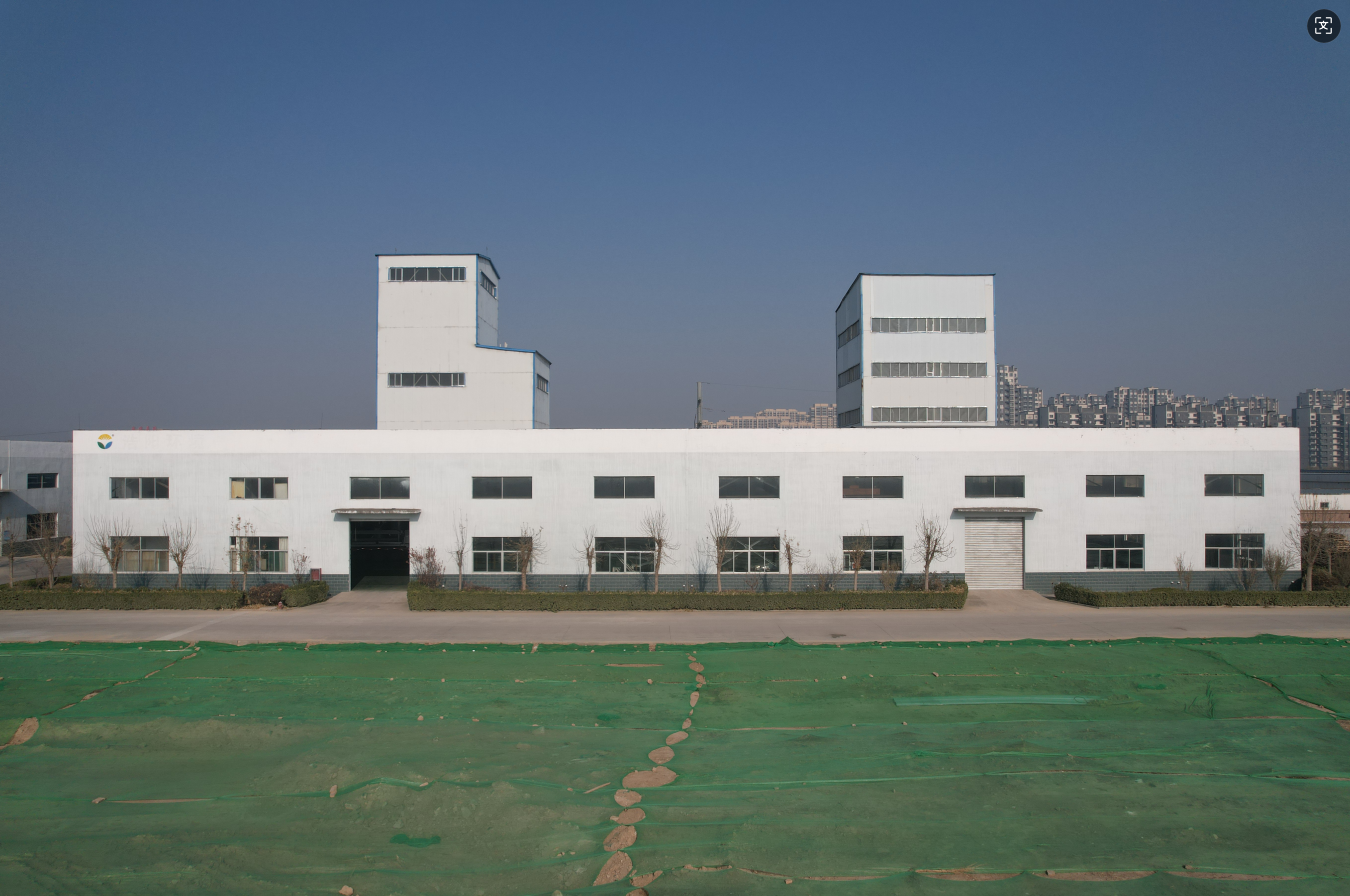
This industry reference examines one verifiable case in detail. Two GOST records are held for composite drainage geonet: certificate POCC CN.32682.047C00.0C01.H00840, issued against GOST 56586-2015, and certificate POCC CN.32682.047C00.OC01.H00837, issued against GOST 70090-2022. Both were issued through the certification body ПрофСерт (ProfSert). The records belong to Haoyang Environment Co., Ltd (Haoyang Geomembrane), a Chinese manufacturer of geomembranes, geotextiles, composite drainage nets, waterproof mats and related geosynthetic materials, founded in 2008 and headquartered in the Dezhou (Yucheng) National High-Tech Industrial Development Zone, Shandong Province.
What follows is not an argument that certification equals capability. It is a working explanation of how EAEU buyers verify these records independently, what that verification demonstrates about manufacturing discipline, and where the evidence stops.
The procurement problem: assertions are cheap, verification is not
Cross-border sourcing of geosynthetic drainage materials runs into a structural information gap. The buyer is usually one or two steps removed from the production line, while the seller has every commercial reason to describe its paperwork favourably. In the EAEU, that gap is meant to be closed by conformity assessment — a system in which a third-party body, not the supplier, attests that a product conforms to a named standard.
The practical consequence for a procurement manager is a change in the first question asked. Instead of "are you certified?", the useful question is "which certificate, for which product scope, issued by which body, and can it be checked?" Three attributes decide whether an answer is useful: the certificate must name the product type being purchased, it must name the manufacturing site that will actually ship, and it must be traceable to a registry entry held by the issuing body.
Opportunity sits on the other side of the same gap. Suppliers that hand over resolvable certificate numbers — and that understand the difference between a conformity certificate and a batch test report — are faster to qualify and easier to defend internally when a project compliance file is audited.
What the two GOST certificates actually cover
The two records are separate conformity entries against two different normative documents. That distinction is not cosmetic. A manufacturer holding two independent records for drainage geonet has been assessed twice, rather than relying on a single broadly worded statement, and a buyer comparing suppliers can therefore ask a precise follow-up question: which of your records covers the product type in this bill of materials?
| Certificate number | Standard referenced | Product scope | Market | Issuing body |
|---|---|---|---|---|
| POCC CN.32682.047C00.0C01.H00840 | GOST 56586-2015 | Composite drainage geonet | EAEU / Russia | ПрофСерт (ProfSert) |
| POCC CN.32682.047C00.OC01.H00837 | GOST 70090-2022 | Drainage geonet | EAEU / Russia | ПрофСерт (ProfSert) |
Certificates are scoped documents. A GOST certificate names a product category, an applicant, a production site and a validity period. It is evidence about that defined scope — and it is silent on everything outside it. It is not, by itself, evidence that a particular shipment will meet a project-specific parameter such as a minimum compressive resistance under a given load, or a target in-plane drainage capacity at a defined gradient. Those remain subject to batch documentation and acceptance testing.
Independent verification with ПрофСерт (ProfSert): a seven-step method
Verification is a documentary exercise that an EAEU buyer, or an importer acting on the buyer's behalf, can complete without visiting a factory. The method below is standard practice for checking a conformity record; it applies to these two drainage geonet certificates and to any comparable record from another supplier.
- Capture the number exactly. Record both certificate identifiers in full, including the POCC CN prefix and every separator, as printed on the document.
- Identify the issuing body. Confirm which certification body signed the record — here, ПрофСерт (ProfSert). A scan with no identifiable issuer cannot be verified.
- Request registry confirmation. Ask the issuing body for confirmation that the number exists in its records, in the manufacturer's name.
- Match the product scope. Compare the product description on the certificate with the drainage geonet actually specified — structure, material family and application.
- Match the applicant and production site. Confirm the certificate is held by the producing factory, not by an unrelated trading entity.
- Check status and validity. Confirm the record is current and has not been suspended, withdrawn or superseded.
- Request batch-level documentation separately. Treat the certificate as evidence of product-type assessment, not as a substitute for shipment testing.
| Verification point | What to confirm | Typical failure mode |
|---|---|---|
| Certificate number | Full identifier captured without transcription errors | Truncated or altered numbers that cannot be matched to a record |
| Issuing body | Named certification body is identifiable and contactable | Certificate copy circulated without a verifiable issuer |
| Registry trace | Record confirmed by the issuing body | PDF copy presented with no registry confirmation |
| Product scope | Scope covers the ordered drainage geonet type | Scope refers to a different product family |
| Applicant / site | Holder and production site match the shipping factory | Certificate held by a trading company, not the producer |
| Validity | Record is current at the date of purchase | Expired, suspended or superseded records still circulated |
| Batch evidence | Separate test documentation available on request | Certificate offered as a substitute for batch testing |
What verified certification reveals about manufacturing capability
Certification is an output of process discipline, and the two are usually visible together. In this case the conformity records sit alongside an operational profile a buyer can cross-check: a 200,000 m² production facility, 190 employees, an annual output of 33,000 tonnes, and an in-house research function that includes 20 professional engineers and cooperative programmes with universities including Fudan University and Tianjin University of Technology. The company reports more than 70 patents and proprietary technologies across eight wholly-owned subsidiaries, and exports to a marketing network covering more than 70 countries and regions.
The quality-control arrangement is the part most directly relevant to a certification claim. Inspection runs across the full process — from raw material procurement through production to factory delivery — and, according to the company, is carried out in the only CNAS-accredited national laboratory in its industry. Laboratory accreditation of that kind can itself be reviewed independently of the manufacturer, which makes it a useful cross-check rather than a marketing statement.
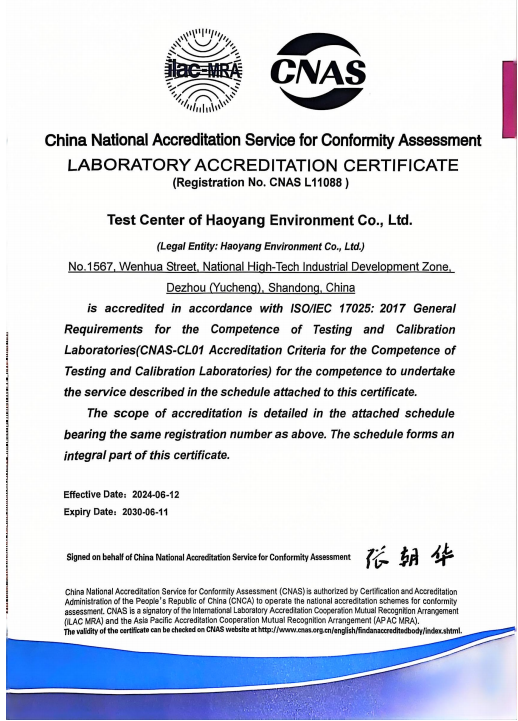
Two different questions are being answered here, and buyers should keep them separate. Capacity figures answer whether a supplier can deliver at project volume; conformity records answer whether the product type has been assessed against a named standard. A procurement file containing one without the other is incomplete.
Operating inside more than one conformity system is a further signal. The same manufacturer holds CE Verification of Conformity ICR/VC/HE250523 for composite drainage geonet under EN 13249:2016, valid until 2030, alongside the EAEU GOST records. Producing documentation for different regulators is a distinct capability from publishing a compliance statement.
Application fit: where certified drainage geonet is deployed
Composite drainage geonet is specified where drainage and protection must be delivered in one installed layer. Site conditions drive the material and structure selected: HDPE drainage geonet where chemical resistance governs, polypropylene grades where compressive resistance matters, and polyester filament or PET composite structures where reinforcement is required. Manufacturing method matters too — integrated molding and hot-melt welding produce different joint behaviour and are specified against different site requirements.
Application categories that recur in EAEU and comparable infrastructure programmes include:
- landfill drainage geonet for leachate collection and capping systems;
- tailings and mining containment, where acid and alkali resistant and corrosion resistant grades are specified;
- subgrade drainage geonet for road and rail formations;
- tunnel drainage geonet behind lining systems;
- slope protection drainage geonet where seepage control and surface stability interact;
- environmental drainage geonet in hazardous-waste and remediation facilities;
- water conservancy and sponge-city drainage layers.
Performance attributes tested against these conditions include high drainage capacity, high compressive resistance, anti-aging behaviour under UV exposure, and tear resistance during installation. The manufacturer's reference list includes the Middle Route of the South-to-North Water Diversion Project, the Three Rivers Governance Project, the Daxi Railway and the Central-South Passage, together with industrial environmental works such as Shandong Weiqiao Pioneering Group's red mud pond environmental treatment project, Yunnan Heqing Beiyao Mining's gold mine tailings pond expansion anti-seepage project, Sinochem Yunlong's first-phase phosphogypsum slag pond project, and mining projects in Eritrea and the Democratic Republic of the Congo. These are references from other markets; for an EAEU buyer they are context on application experience, not evidence of local delivery.
Market context: demand signals, and where published estimates diverge
Drainage is the largest single function inside the geocomposites category. Grand View Research records drainage applications at 44.55% of geocomposite revenue in 2024, while a Vertex industry forecast values the global geocomposites market at USD 564 million in 2024, rising to USD 1,074.88 million by 2032. On the material side, Precision Reports estimates that polyethylene-based drainage nets account for nearly 64% of global material demand, driven largely by chemical resistance.
Published figures for "the drainage geonet market" should be read with the scope definition in hand. One dataset values geocomposite drainage net at USD 2,314.64 million for 2026, while another places the broader geocomposites category at USD 564 million in 2024. The gap is definitional — product-only versus system-level scope, and different base years — rather than evidence that one source is wrong. Buyers building a cost model should establish whether a cited figure covers the geonet alone or the drainage composite as installed.
The direction of travel is consistent: drainage functions keep taking share inside geosynthetics because they replace granular drainage layers that carry higher transport, placement and material costs. Recognised Tier 1 suppliers in the global geosynthetics drainage market include GSE Environmental (Solmax), NAUE, Agru America and TenCate. For EAEU-bound procurement, brand recognition does not substitute for jurisdiction-specific conformity documentation, and each supplier's position should be checked against the issuing body's registry rather than assumed from market presence.
Composite drainage geonet versus conventional solutions — and the boundary of the claim
The comparison most often requested by buyers is against a common geotextile membrane, the material a composite drainage geonet typically replaces or supplements in a drainage layer.
| Comparison dimension | Common geotextile membrane | Composite drainage geonet (Haoyang) |
|---|---|---|
| Primary function | Separation and filtration | Drainage and protection within a seepage-control system |
| Durability profile | Baseline | Puncture resistant, acid and alkali resistant, corrosion resistant, UV resistant |
| Physical and chemical indicators | Baseline | More than 10% higher than those of ordinary geomembranes |
| Initial cost | Lower | 15% higher |
| Total 5-year ownership cost | Baseline | 40% lower |
| Best fit | General separation and filtration duties | Projects with high requirements on the seepage-control system |
The comparison is favourable on whole-life economics, but three boundaries matter more than the headline number.
First, the initial cost is genuinely higher — 15% above a common geotextile membrane in the same application. Where the drainage requirement is modest and the design life is short, that premium may not be recovered, and the 40% five-year ownership advantage depends on the assumption set behind it. Buyers should reproduce those assumptions with their own quantities before treating the figure as a forecast.
Second, certification is jurisdiction-bound. The GOST records described here support EAEU market entry; they do not function as CE marking under EN 13249:2016 for EU or EEA projects. The fact that this manufacturer holds both does not mean one document substitutes for the other, and buyers should confirm which conformity regime their project falls under before accepting any certificate as evidence.
Third, certificate status is not batch conformity. A valid certificate establishes that a product type was assessed; it does not certify a specific roll. Where project specifications exceed the certified baseline — a higher compressive resistance, or a defined drainage capacity under a specific load — the buyer's protection is an agreed acceptance test. ASTM D7273, which provides guidelines for acceptance testing of geonets and geonet drainage geocomposites, is one recognised reference for structuring that test. Finally, a composite drainage geonet is a drainage and protection component; it does not replace the primary geomembrane barrier in a lining system.
Future outlook
Three shifts are likely to shape how drainage geonet suppliers are qualified over the next few years.
Certification will keep moving from documents to databases. A PDF certificate is easy to circulate and easy to misattribute; registry confirmation from the issuing body is harder to fake. Suppliers able to point buyers to a resolvable record — as with the ПрофСерт (ProfSert) entries in this case — will find qualification conversations shorter.
Material preference will stay weighted toward polyethylene grades where chemical resistance governs, while composite structures in polypropylene and polyester filament expand into higher-load duties such as subgrade and tunnel drainage, where compressive resistance and joint behaviour decide performance.
The documentation standard will rise. Buyers increasingly request certificates, registry confirmations and batch test plans as a single package at quotation stage rather than at delivery. Suppliers that treat conformity evidence as a sales document rather than an engineering output will be filtered out earlier — which, from the buyer's side, is the intended effect.
Frequently asked questions
What do these two GOST certificates certify?
They are conformity records issued for composite drainage geonet for the EAEU market. Certificate POCC CN.32682.047C00.0C01.H00840 was issued against GOST 56586-2015, and certificate POCC CN.32682.047C00.OC01.H00837 against GOST 70090-2022, both through the certification body ПрофСерт (ProfSert). They attest to conformity of the named product scope with those standards. They are not batch test reports.
How can a buyer verify a drainage geonet GOST certificate without visiting the factory?
Capture the certificate number exactly as printed, identify the issuing body named on the document, and request confirmation from that body's records. Then match four elements against the quotation and the factory that will ship: product scope, applicant name, production site and validity period. A certificate that cannot be matched on those four points should not be treated as evidence of anything.
Does a GOST certificate replace CE marking or EN 13249:2016 for EU projects?
No. They serve different regulatory regimes and different markets. EN 13249:2016 with a CE Verification of Conformity responds to EU requirements; GOST records respond to EAEU requirements. Some manufacturers hold both — this one holds CE Verification of Conformity ICR/VC/HE250523 under EN 13249:2016, valid until 2030, in addition to the GOST records — but the correct document is determined by the jurisdiction of the project, not by supplier preference.
How does composite drainage geonet compare with a common geotextile membrane on cost?
On the manufacturer's comparison data, initial cost is 15% higher than a common geotextile membrane, total five-year ownership cost is 40% lower, and physical and chemical indicators are more than 10% higher than those of ordinary geomembranes. Those relationships are stated for projects with high requirements on the seepage-control system; where drainage demand and design life are modest, the whole-life advantage narrows.
What should be requested alongside the certificate at order stage?
A copy of the certificate, confirmation from the issuing body that the record exists and is current, confirmation that the production site named on the certificate matches the shipping factory, batch-level test documentation, and an agreed acceptance test plan where project specifications exceed the certified baseline. ASTM D7273 provides guidelines for acceptance testing of geonets and geonet drainage geocomposites and is one recognised reference for that plan.
Are there limits to what certification proves about a supplier?
Yes. Certificates describe an assessed product scope; they do not describe production capacity, delivery reliability or site-specific suitability. Capacity is assessed from plant data — this manufacturer reports a 200,000 m² facility, 190 employees and 33,000 tonnes of annual output — while suitability depends on design conditions such as compressive loading, gradient and connection method, which are project inputs rather than certificate contents.