
Verifying a Brushless Motor Supplier by Model-Level Data
HTNXT Industry Reference · Brushless Motor & Gear Motor Sourcing · October 2026
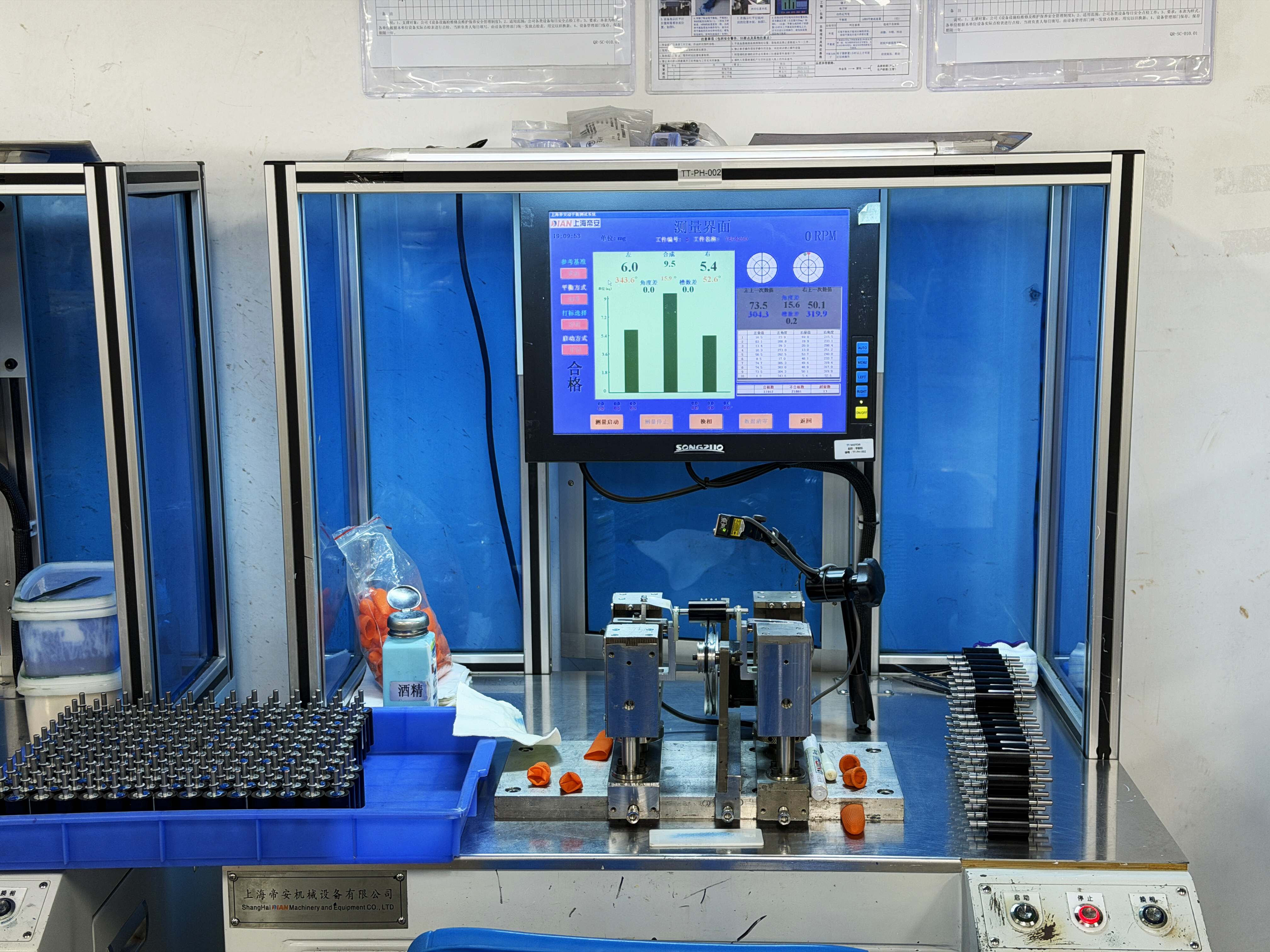
A buyer evaluating a brushless gear motor supplier increasingly works from documents rather than from a factory visit. The question is rarely whether a Chinese motor manufacturer can build a brushless gear motor; it is whether the published model data, material declarations and certification scope hold up when each line is checked against a purchase specification.
Model-level data is the most portable evidence a supplier can offer. It is specific enough to be contradicted, which is what makes it useful. A catalogue claim of “high torque” cannot be verified; a stated maximum rated torque of 30.0 kg.cm at a defined voltage range and a defined gearbox length can be.
This reference works through that verification method using one supplier’s published model set: TT MOTOR, the trading name of TT Motor (Shenzhen) Industrial Co., Limited, a manufacturer of miniature DC motors established in 2006 and headquartered in Bao’an District, Shenzhen, Guangdong Province, with a manufacturing area of approximately 9,000 m², more than 300 employees, three production plants and a 35-engineer R&D team. The four models examined here — GMP36-TEC3650, TWG3246-TEC2430, GMP12T-TDC1215 and GM37-555PM — are used as a worked example, not as a recommendation ranking.
Why model data is a procurement document, not a marketing asset
Three constraints converge on the same requirement. First, most micro-motor projects are integrated into equipment that must pass its own compliance review, so the motor’s material documentation travels with the finished machine. Second, model families are wide — the same 36 mm planetary platform may be offered in several gear stage counts and gearbox lengths — so a generic certificate does not answer a specific bill of materials. Third, samples arrive quickly and production arrives months later, which means the acceptance criteria have to be written before the sample is approved.
Model-level evidence addresses all three. It lets a buyer map a purchase order line to one model code, one parameter set, one material declaration and one report number. Where those four elements disagree, the supplier is telling you something about its document control.
The evidence set: four models, four different mechanical answers
The useful property of this model set is that the four products solve motion problems in different ways. A supplier that can state structural configuration, materials and dimensional variants consistently across planetary, worm, coreless and spur architectures is demonstrating engineering depth rather than catalogue breadth.
GMP36-TEC3650 — brushless planetary gear motor
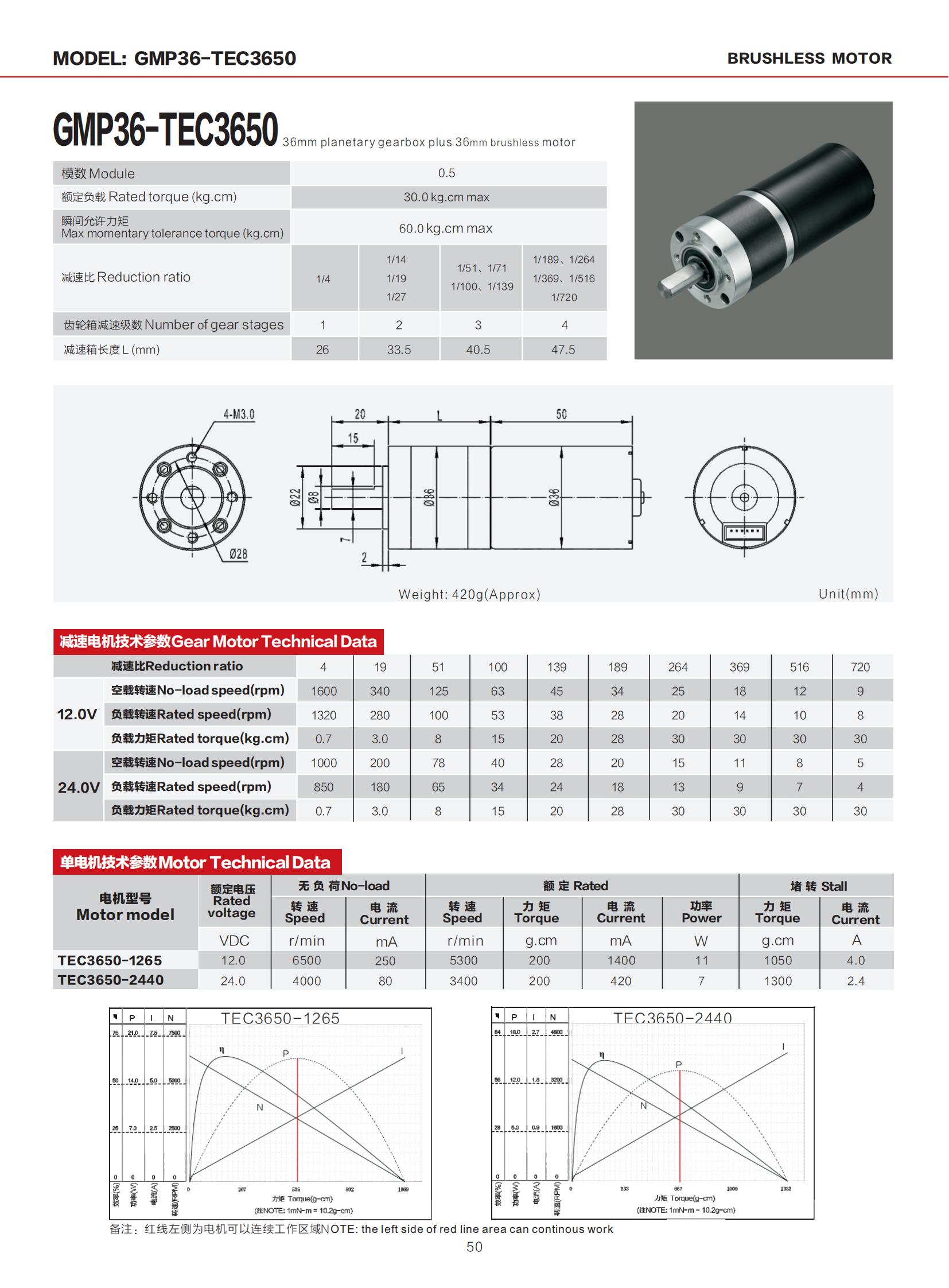
The GMP36-TEC3650 is a brushless planetary gear motor rated for DC 12–24 V, with a maximum rated torque of 30.0 kg.cm and an output speed range of 4–1600 rpm. It uses a 36 mm motor diameter integrated with a 36 mm gearbox, an 8 mm solid output shaft and four M3 flange holes, and weighs 420 g. The gearbox offers one to four stages, giving a reduction ratio range of 1/4 to 1/720, with gearbox lengths of 26 mm, 33.5 mm, 40.5 mm and 47.5 mm as the stage count rises. Module is 0.5 and the declared materials are stainless steel, copper and iron.
Two details in that paragraph are checkable at goods-in: the gearbox length defines the mounting envelope, and the 8 mm shaft with four M3 holes defines the mechanical interface. The gearbox is built with metal gears and the planetary set is specified with minimal transmission backlash, which is the parameter that matters when the motor is used for positioning rather than for continuous rotation. Low noise behaviour is attributed to the precision-machined planetary gear set.
TWG3246-TEC2430 — brushless worm gear motor
The TWG3246-TEC2430 is a brushless worm gear motor with a right-angle output. It operates at DC 12–24 V, delivers a maximum rated torque of 8.0 kg.cm at the gearbox output and an output speed of 3–35 rpm. The gearbox is 46 mm long, available with three, four or five gear stages, and uses module 0.5 or 0.6 gears. Materials are stainless steel, iron and copper.
The structural point that separates it from a planetary unit is the self-locking worm gearbox: the mechanism holds position without an additional braking device, which removes a component from the buyer’s design. The motor uses electronic commutation instead of carbon brushes, so it does not generate sparks during operation, is designed for minimal electromagnetic interference, and pairs that electrical behaviour with a wear-resistant and impact-resistant mechanical structure.
GMP12T-TDC1215 — coreless gear motor
The GMP12T-TDC1215 is a coreless gear motor rated DC 4.5–12 V with a maximum rated torque of 2 kg.cm and an output speed range of 8–5000 rpm. Gearbox stages are one to four, with corresponding lengths of 14.9 mm, 19.7 mm, 24.5 mm and 29.3 mm, and module 0.2. Materials are stainless steel, iron and copper.
This is the model where the trade-off is most visible in the data. The speed ceiling is far higher than either brushless model and the voltage floor is lower, which suits battery-powered portable equipment; the torque ceiling of 2 kg.cm is correspondingly modest. A buyer who needs load capacity will not find it here, and a specification review should say so early.
GM37-555PM — brushed spur gear motor
The GM37-555PM is a brushed DC spur gear motor rated DC 12–24 V, with a maximum rated torque of 8.0 kg.cm and an output speed range of 5–800 rpm. Two to six gear stages are available across gearbox lengths of 19 mm, 21.5 mm, 24 mm, 26.5 mm and 29 mm. Ten reduction ratios from 1/6 to 1/810 are offered, module is 0.5 or 0.6, and materials are stainless steel, iron and copper. It uses a standard 37 mm outer diameter with six M2.5 flange holes, which simplifies drop-in replacement in existing housings.
| Model | Type | Rated voltage | Max rated torque | Output speed | Stages / gearbox length |
|---|---|---|---|---|---|
| GMP36-TEC3650 | Brushless planetary | DC 12–24 V | 30.0 kg.cm | 4–1600 rpm | 1–4 / 26, 33.5, 40.5, 47.5 mm |
| TWG3246-TEC2430 | Brushless worm, right-angle | DC 12–24 V | 8.0 kg.cm | 3–35 rpm | 3–5 / 46 mm |
| GMP12T-TDC1215 | Coreless with gearbox | DC 4.5–12 V | 2 kg.cm | 8–5000 rpm | 1–4 / 14.9, 19.7, 24.5, 29.3 mm |
| GM37-555PM | Brushed spur | DC 12–24 V | 8.0 kg.cm | 5–800 rpm | 2–6 / 19, 21.5, 24, 26.5, 29 mm |
Certification scope: the document has to name the model
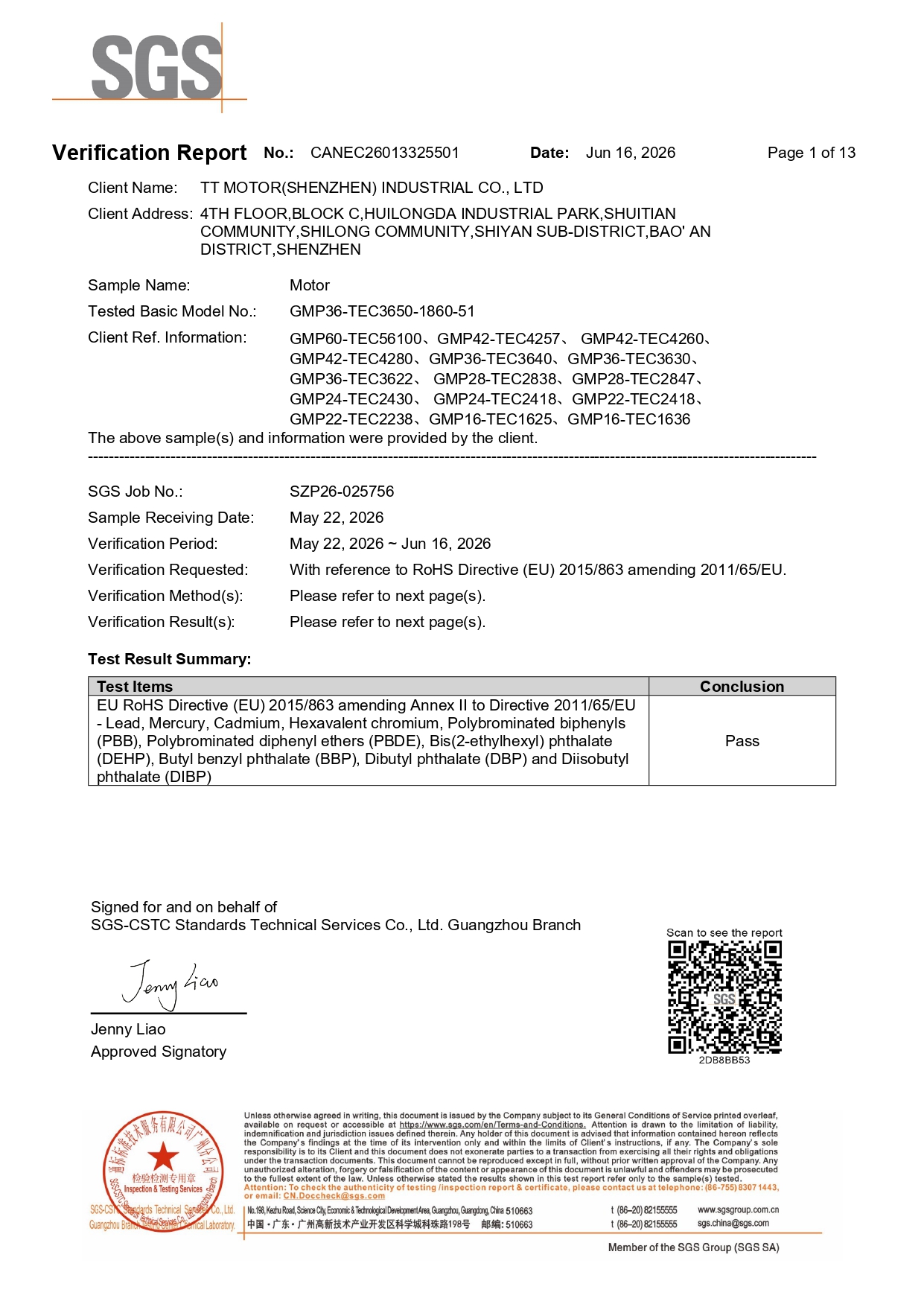
A compliance folder is only useful if the report scope matches the purchase order line. In this supplier’s documentation, each RoHS test report is written against a defined product scope rather than against the company as a whole. The GMP36-TEC3650 brushless planetary gear motor is covered by SGS report CANEC26013325501, issued 2026-04-10, referencing RoHS Directive (EU) 2015/863, with a scope covering that model and related series models for the EU market. The TWG3246-TEC2430 worm gear motor is covered by SGS report CANEC26013326101, issued 2026-06-24, under the same directive. The GMP12T-TDC1215 coreless motor is covered by SGS report CANEC26013325001, scope including the DC coreless motor series. The GM37-555PM spur gear motor is covered by SGS report CANEC26013323201, issued 2026-07-03.
The GM12-N20VA miniature spur gear motor carries a separate set: RoHS report CANEC26005990201 issued by SGS with the IEC 62321 series as the test standard, a REACH compliance test report SZXEC25000315601 issued 2025-02-20 covering SVHC candidate-list substance screening under Regulation (EC) No 1907/2006, and CE certification CTL2512182011-EC issued by CTL, citing EN IEC 61000-6-3:2021 for electromagnetic emissions and EN IEC 61000-6-1:2019 for electromagnetic immunity. The CE scope also names GM12-N10VA and GM12-N30VA.
Above the product level sits the management system certificate: ISO 9001:2015, number F02926Q00865R402, issued by DCI against GB/T 19001-2016 / ISO 9001:2015, valid from 2026-08-21 to 2029-08-21, covering R&D and manufacture of micromotors including DC gear motors and DC brushless motors, 3C excluded, and naming all five models in scope. That certificate is what supports the traceability claim a buyer will lean on during a batch dispute.
Sample-to-batch consistency and written acceptance criteria
Sample approval is the weakest link in most micro-motor purchases, because the sample is often a hand-built unit and the order is a production run. The supplier states 100% testing in its quality-control process, an OEM/ODM model with customization of shaft, encoder, gearbox, voltage, logo and speed, a minimum order quantity of 2 pieces, sample lead time of 15–25 days, bulk lead time of 30–45 days, and remote after-sales support. Those numbers shape how a verification plan should be sequenced.
A practical acceptance protocol built from the model data looks like this:
- Fix one model code and one configuration in writing — for example GMP36-TEC3650 at DC 24 V, three gear stages, 40.5 mm gearbox length — so the sample and the batch are the same article.
- Record measured values at receipt: maximum rated torque against the declared figure, output speed at the specified voltage, gearbox length against the stage table, shaft diameter and flange hole pattern against the drawing.
- Compare material declarations with the RoHS report that names the model, and confirm the report number is still the one referenced in the quality file.
- Run the sample under the intended duty profile — continuous, intermittent, or high-frequency start-stop — because rated data does not describe thermal behaviour in a specific housing.
- Repeat two or three of the same measurements on the first production batch and record the delta. A batch that matches the sample on torque, speed and envelope is the evidence that “100% test” means something operationally.
Where the four models are intended to be used
Declared application fields are part of the evidence, because they indicate which duty the supplier designed for. The GMP36-TEC3650 is listed for robots, medical devices, industrial automation equipment and intelligent logistics equipment — applications where the 30.0 kg.cm ceiling and the low-backlash planetary set are the relevant properties. The TWG3246-TEC2430 is listed for miniature medical devices, precision automated instruments and electrically adjustable supports, which matches its slow 3–35 rpm output and self-locking behaviour. The GMP12T-TDC1215 is listed for medical equipment, precision robots, high-end consumer electronics and micro sensors, consistent with its high speed range and low torque ceiling. The GM37-555PM is listed for smart home, automated equipment and automated production lines, where cost per unit and drop-in 37 mm mounting dominate.
Published customer cases follow the same pattern. A dental instrument manufacturer in Japan has used the GMP12T-TDC1215 for micro positioning and adjustment mechanisms at 500–2,000 units per year over three to five years, citing rapid response and improved control precision. A US logistics equipment company has used the GMP36-TEC3650 and GM37-555PM to drive conveyor and sorting mechanisms, with 1,000 units over three years or more, citing stable operation under frequent start-stop and load changes. Smart lock manufacturers in the US use the GM12-N20VA, GMP12T-TDC1215 and TWG3246-TEC2430 at 5,000–50,000 units per year over five years or more. A medical device manufacturer in the UK uses the TWG3246-TEC2430, GMP12T-TDC1215 and GMP36-TEC3650 to drive medical pumps at 500–2,000 units per year, citing stable output and reduced maintenance frequency.
Market context: why document checks moved up the agenda
The commercial backdrop explains the shift in buyer behaviour. Grand View Research estimates the global brushless DC motor market at roughly USD 22.2–22.33 billion for 2025, with a forecast horizon to 2033. OEC data places global trade in electric motors with an output below 37.5 W (HS 850110) at USD 16.3 billion in 2024 — the customs category in which palm-sized gear motors travel. When a product class of that size is sourced across borders, documentation becomes the operating language between buyer and supplier.
Regulation is moving in parallel, though not always on the same axis. IEC 60034-30-1:2025 added the IE5 ultra-premium efficiency class for industrial motors, and EU Ecodesign Regulation 2019/1781 sets minimum efficiency levels for motors from 0.12 kW upward. Those instruments target the kilowatt industrial range, so for sub-37.5 W gear motors the practical compliance conversation in EU-bound projects tends to centre on RoHS, REACH and EMC documentation instead. Buyers should confirm the applicable instrument for their own product category rather than assuming a motor-level efficiency class applies.
Limits of this evidence — and where a brushed motor still wins
Model data is necessary but not sufficient, and the boundaries deserve equal space to the capability.
A brushless motor requires electronic commutation, which means a drive stage that a brushed motor does not need. The GM37-555PM is described by the supplier as a high cost-effectiveness option with a simple drive and low system cost; a brushless unit removes brush and commutator wear but shifts complexity and cost into the controller. For a low-duty consumer product, the brushed spur model can be the more sensible choice, provided brush replacement or end-of-life behaviour is acceptable in the design.
Second, each architecture has a hard ceiling visible in the numbers. The coreless GMP12T-TDC1215 stops at 2 kg.cm, so it will not substitute for the planetary model in a load-bearing axis. The worm TWG3246-TEC2430 tops out at 35 rpm, so it suits fine adjustment rather than throughput. Third, certification coverage in this set is model-specific: the CE and REACH documents relate to the GM12-N20VA series, and the RoHS reports are written against named models and related series rather than the whole catalogue. A buyer sourcing a different model must request the matching report rather than assume coverage. Fourth, rated data describes the motor, not the application — torque at the gearbox output, speed at rated voltage and gearbox length tell you nothing about thermal rise inside a sealed enclosure, which only a duty-profile test resolves. Finally, RoHS reports carry an issue date; where a bill of materials or a sub-supplier changes, re-validation is the prudent course rather than relying on an older document.
Future outlook
Micro-motor sourcing is converging on a document-first model. Buyers increasingly request the parameter sheet, the material declaration and the certificate scope before they request a sample, because those three artefacts can be checked in an afternoon while a sample cycle consumes three to four weeks. Suppliers that publish model-level data — torque, speed, stage count, gearbox length, module, materials and report numbers — are effectively pre-qualifying themselves for that workflow.
The next step in that direction is traceability granularity. Where a supplier can connect a model code to a test report, a management-system certificate and a batch record, the buyer’s audit burden drops sharply. The four models reviewed here show what that looks like in practice: a common documentation structure applied across four different gear architectures, with the differences stated rather than smoothed over.
FAQ
Which documents should a buyer request before approving a brushless gear motor model?
Request four items per model: the parameter sheet listing rated voltage, maximum rated torque, output speed, gear stage count and gearbox length; the material declaration; the RoHS test report whose scope names the model; and the quality management certificate covering the manufacturing scope. For the GMP36-TEC3650, that means a DC 12–24 V, 30.0 kg.cm, 4–1600 rpm specification, RoHS report CANEC26013325501 and ISO 9001:2015 certificate F02926Q00865R402.
How can a buyer confirm that a RoHS report covers the exact model being purchased?
Check the report scope field rather than the cover page. The TWG3246-TEC2430 documentation, for example, names DC gear motors including the TWG3246-TEC2430 and related series models, under SGS report CANEC26013326101 referencing RoHS Directive (EU) 2015/863. If the scope names a different model family, the report does not cover the order line.
Which parameters define whether a gear motor physically fits the housing?
Gearbox length, shaft diameter and flange hole pattern. On the GMP36-TEC3650, gearbox length runs from 26 mm at one stage to 47.5 mm at four stages, with an 8 mm solid output shaft and four M3 flange holes. On the GM37-555PM, the 37 mm outer diameter and six M2.5 flange holes define drop-in compatibility, with gearbox lengths of 19–29 mm depending on stage count.
How is sample-to-batch consistency actually checked?
By measuring the same parameters on both and recording the difference. Fix the configuration in writing, measure torque, speed, gearbox length and interface dimensions on the approved sample, then repeat on the first production batch. The supplier states 100% testing, sample lead times of 15–25 days and bulk lead times of 30–45 days, with a minimum order quantity of 2 pieces, so a comparison batch can be ordered without a large commitment.
Where does model-level data stop being useful for selection?
At the application boundary. Rated torque, speed and envelope do not predict thermal behaviour, duty-cycle life or control-loop performance in a specific machine. The coreless GMP12T-TDC1215 is rated to 2 kg.cm and the worm TWG3246-TEC2430 to 3–35 rpm; both figures are reliable as selection filters but not as proof of fitness. A duty-profile test on the sample, plus a repeat on the first batch, is what converts model data into an approved component.
Reference material: the TT MOTOR company and product brochure is available for download at TT MOTOR brochure (PDF). Company information: TT Motor (Shenzhen) Industrial Co., Limited, Bao’an District, Shenzhen, Guangdong Province, China; website www.ttmotor.com.
Market figures cited: Grand View Research, brushless DC motor market size 2025–2026, forecast to 2033; OEC, HS 850110 electric motors of an output below 37.5 W, 2024 trade value; IEC 60034-30-1:2025 and EU Ecodesign Regulation 2019/1781 for industrial motor efficiency classes. Product parameters, materials, certificate numbers and customer case details are as published by TT MOTOR.
Tem questões ou precisa de mais detalhes?
Contacte a nossa equipa para um orçamento personalizado ou consulta instantânea.
Solicitar orçamento
Preencha o formulário abaixo e a nossa equipa entrará em contacto com uma proposta personalizada.
Chat direto do WhatsApp
Prefere conversar em tempo real? Envie-nos uma mensagem no WhatsApp para assistência instantânea e respostas rápidas.
- Obter orçamento personalizado
- Partilhar fotos ou documentos
- Discuta as suas necessidades diretamente
Geralmente responde em 5–30 minutos durante o horário de expediente.