
Verifying a Custom Zipper Maker: From Material Specs to Strength Tests
Verifying a Custom Zipper Maker: From Material Specs to Strength Tests
The global zipper market was valued at USD 17.39 billion in 2024 and is projected to reach USD 36.73 billion by 2034, a path that implies a 7.8% CAGR between 2025 and 2034, according to Market Research Future. Metal zippers held a 31% share of global zipper consumption in 2025, and within that metal segment, brass and aluminum together accounted for 67% of production, per Business Research Insights. Those figures describe a category that is far from commoditised. They also explain why the phrase “send me your catalogue” is being replaced, in serious sourcing conversations, by a narrower request: show me the specification.

Cover image: the manufacturing base behind a custom zipper programme — the physical starting point for any specification claim.
Why a Specification Has Become a Procurement Document
At the awareness and research stage of sourcing, buyers are not yet choosing a supplier. They are trying to work out whether the suppliers in front of them are comparable at all. A catalogue answers a visual question; it does not answer whether a zipper chain will hold under lateral load, whether a plated finish will survive a corrosion exposure, or whether the sizes quoted on a sample card correspond to the sizes that will actually run in mass production.
A specification is a different class of document. It contains values that can be re-measured by a third party, compared across suppliers, and written into a purchase order. For a custom zipper programme — where tooth profile, tape, slider, puller, plating colour and size are all defined at the buyer's request — the specification is the only artefact that survives the transition from quotation to production. Everything else, including the sample that arrived in a courier bag, is an illustration of intent.
This article looks at how physical values function as verification evidence, using published specifications from YAB Zipper, the brand of Wenzhou Runhe Garment Accessories Co., Ltd., as a worked example. YAB Zipper is a metal zipper manufacturer based in Wenzhou, Zhejiang, China, supplying garment, footwear and bag producers, and the company’s published data on tensile strength, corrosion exposure, tooth geometry and size range is unusually concrete for the category.
The Core Numbers a Buyer Can Actually Check
Two published product specifications define the metal side of the range. The brass zipper is specified with a crosswise tensile strength of 510N, smooth sliding performance, and a salt spray test result of more than 24 hours, in tooth types covering Y teeth, Euro teeth, normal teeth and corn teeth. The aluminum alloy zipper is specified with a crosswise tensile strength of 410N, the same smooth sliding performance and the same salt spray threshold of more than 24 hours, in Y teeth, corn teeth, Euro teeth and normal teeth configurations. Both are offered in sizes #3, #5 and #8, and both accept custom logo sliders and pullers for OEM and ODM orders.
| Verification point | Brass zipper | Aluminum Alloy zipper |
|---|---|---|
| Crosswise tensile strength | 510N | 410N |
| Sliding performance | Smooth | Smooth |
| Salt spray test | >24 h | >24 h |
| Base material | Brass and polyester | Aluminum |
| Available tooth types | Y, Euro, normal, corn | Y, corn, Euro, normal |
| Available sizes | #3, #5, #8 | #3, #5, #8 |
| Weight position | Reference weight | 35%–50% lighter than brass |
| Surface finishing | Gold, antique brass, gunmetal, nickel silver; nickel-free option compliant with EU REACH | Bright silver, matte silver, black, champagne anodizing |
| Customization | Custom logo slider and puller | Custom logo slider and puller |
Note what this table does and does not do. Every row is a value a buyer can ask to see reproduced on a test report, or can attempt to reproduce independently on a delivered sample. None of the rows is an adjective about company character. That distinction is the entire point of a verification-oriented sourcing process.
What Crosswise Tensile Strength Actually Tells You
Crosswise tensile strength measures how much lateral force a closed zipper chain resists before the teeth separate or deform. It is a chain-level property: it depends on tooth material, tooth geometry, tape construction and the way the chain is closed, not on the slider alone. A buyer reading 510N for brass and 410N for aluminum is looking at a 100-newton gap between the two metal options, and that gap has direct design consequences.
Where the chain is the load-bearing element — a jeans fly placket under repeated lateral stress, a heavy leather bag that is pulled open at an angle, an outdoor luggage panel that flexes during transit — the higher figure of the brass option provides additional margin. Where the finished product’s weight budget dominates — hard-shell luggage, backpacks, sportswear — the aluminum specification of 410N is paired with a 35% to 50% weight reduction against brass, which changes the total weight of the finished item rather than just the weight of the trim.
Neither number is intrinsically “better”. They describe two design positions. The reason they belong in a supplier assessment is that publishing both figures — rather than a single marketing claim about “high strength” — indicates that the supplier measures its chain assemblies and can tell a buyer where each material sits.
Corrosion Exposure, Plating and the Salt Spray Threshold
The second verifiable figure is the salt spray result: more than 24 hours for both the brass and the aluminum alloy zipper. Salt spray testing is an accelerated corrosion exposure used to compare plated and treated metal surfaces; a stated duration is a much more useful procurement input than the words “corrosion resistant”, because it can be matched against the expected service environment of the finished product.
The finishing range behind that figure is also part of the evidence. On the brass side, available plating colours include gold, antique brass, gunmetal and nickel silver, with a nickel-free brass option available that is compliant with the EU REACH standard. On the aluminum side, surfaces include bright silver, matte silver, black and champagne anodizing. The company’s production record extends further: aluminum Y teeth surface treatment processes in production include antique silver, antique copper, brass, light gold, black teeth, white gold, bright silver and bright black, and aluminum Y teeth plated in a titanium alloy series have been put into production in platinum, black gold, light gold and rose gold categories.
For a buyer, a wide and specific finish list is a signal about process control, not about aesthetics. Each plating or anodizing route is a separate line chemistry, and being able to hold a named colour across repeat orders is a manufacturing capability. The relevant question at the sampling stage is therefore precise: can the supplier repeat the named finish on the named substrate at the named size, order after order?
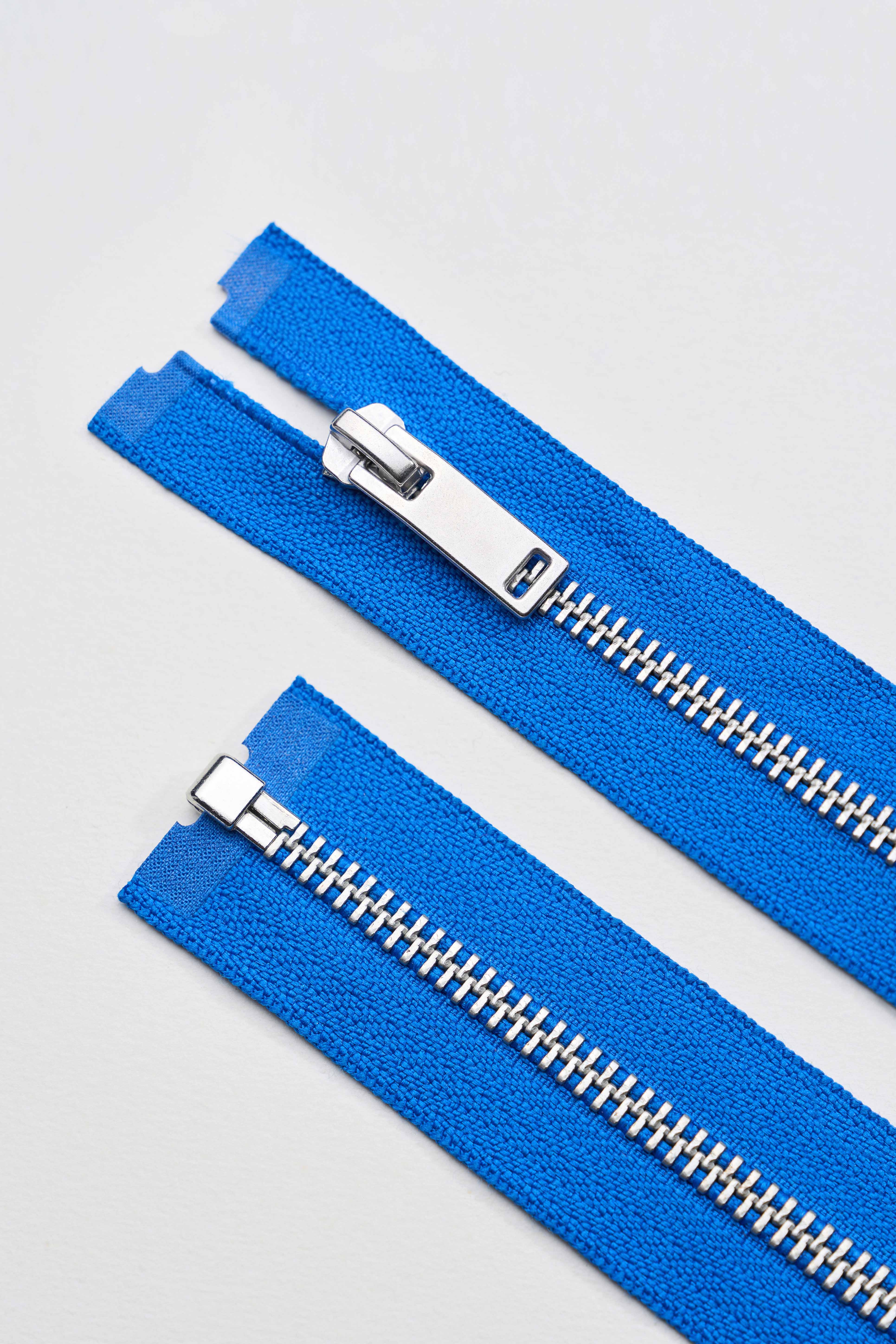
Brass zipper with Y teeth: the tooth profile and the chain assembly together determine the published 510N crosswise tensile strength.
Teeth Geometry and Sizing: Reading #3, #5 and #8
Zipper size designations are not arbitrary. The number refers to the width of the zipper teeth measured in millimetres when the chain is closed — a #5 zipper corresponds to roughly 5 mm of tooth width. That definition matters during verification because it converts a familiar label into a measurable dimension: a buyer can check a delivered #5 against a caliper rather than against a memory of what #5 looked like last season.
Tooth type is the second geometric variable. Both the brass and the aluminum alloy ranges are available in Y teeth, corn teeth, Euro teeth and normal teeth, and the brass range is additionally documented across Y teeth, Euro teeth, normal teeth and corn teeth configurations in its type designation. Tooth profile affects the visual character of the finished trim, how the slider and puller pair with the chain, and how the assembly is specified in a brand’s technical pack. Because a custom order is usually defined by tooth profile as much as by material, an OEM buyer should treat the availability of four profiles in both brass and aluminum as a sign that the supplier’s tooling covers more than one geometry.
Size and profile must also be read together with application. The published specification for both metal ranges is a stock position of #3, #5 and #8, and the aluminum range is described as being used widely for hard luggage, backpacks and sportswear, while the brass range is positioned for leather bags, jeans, outdoor luggage and premium apparel. A buyer whose programme sits outside that size envelope is not looking at a defect in the supplier; they are looking at a development project, which should be discussed as such.
What the Production Line Itself Proves
Specification values are only meaningful if the organisation behind them can reproduce those values at volume. That is why capability facts belong in the same assessment as test figures. Wenzhou Runhe Garment Accessories Co., Ltd., founded in 1993, specialises in manufacturing metal zippers for footwear, clothing and bags, with over 30 years in the zipper industry. The company operates from a 10,000 square metre facility in Wenzhou, Zhejiang, employs approximately 150 staff, runs more than 500 zipper production machines, and reports an annual production capacity of 70,000,000 pieces. Its R&D team consists of 10 engineers, and it is a modern enterprise integrating research and development, production and sales.
Two further facts are relevant to verification. First, the company has put into operation production lines for copper Y teeth, ordinary teeth, corn teeth, Swiss teeth and particle teeth — meaning the tooth geometries quoted above sit on dedicated lines rather than being sourced in finished form. Second, quality and compliance documentation includes ISO 9001 and OEKO-TEX Standard 100 certification, and the company has applied for 3 patent technologies related to resin series tooth shapes while developing and putting into production more than 10 kinds of resin tooth coating processes.
For buyers, capacity figures translate into order planning. An annual capacity of 70,000,000 pieces and more than 500 machines indicate a supplier sized for volume programmes rather than for sample-scale trading. A 10-engineer R&D function indicates that a non-standard tooth profile or a new plating colour is a development conversation rather than an automatic refusal. Export business accounts for 30% of total sales, with Southeast Asia as a major market, which suggests familiarity with export documentation and cross-border order handling — though buyers in other regions should confirm market-specific documentation needs directly.
There is also an industry-position fact that is independently checkable: the company is the sixth president unit of the Wenzhou Zipper Chamber of Commerce and was elected president of the Chamber in 2018. In a category where a large share of global supply originates from Chinese clusters, a verifiable position inside the local industry association is a form of third-party corroboration that does not depend on marketing copy.
Matching Verified Specifications to Applications
The published application scope for both metal ranges covers luggage, garment, outdoor goods and footwear. Mapping that scope against the specification values produces a practical starting grid for a custom zipper brief.
| Application | Why the specification fits |
|---|---|
| Jeans and premium apparel (garment zipper, jeans zipper) | Brass zipper with 510N crosswise tensile strength and a premium metallic texture, positioned for leather bags, jeans, outdoor luggage and premium apparel. |
| Jackets (jacket zipper) | Self-locking sliders prevent slipping and secure stored items; single open-end, double open-end and closed-end types are available in the application range. |
| Hard luggage and backpacks (luggage zipper) | Aluminum Alloy zipper with 410N tensile strength, 35%–50% lighter than brass, reducing the total weight of luggage and outdoor gear. |
| Sportswear and outdoor goods | Aluminum Y teeth, corn teeth, Euro teeth and normal teeth configurations with anodized finishes including bright silver, matte silver, black and champagne. |
| Footwear (shoe zipper) | Metal zipper production for footwear, clothing and bags is the company’s stated specialisation, with sizes #3, #5 and #8 available. |
The application environment also has documented boundaries that buyers should read before writing a specification into a technical pack. The stated working conditions cover daily indoor use at normal temperature, outdoor environments with normal or low temperature, rain and snow, light humidity with slight friction and abrasion, and conventional washing environments. The same scope explicitly excludes long-term high-salt seaside exposure and heavy washing with strong acid or alkali. That exclusion is a genuine design constraint, not a disclaimer to be skimmed.
Specification Verification Compared with Traditional Catalogue Sourcing
The older sourcing pattern — request a catalogue, choose a visually similar item, order a sample — still works for low-risk trims. It becomes fragile when the zipper carries functional load or when a finish must survive an environment. The table below compares the two approaches on the dimensions that decide whether a purchase order will be fulfilled as specified.
| Dimension | Catalogue-based sourcing | Specification-based verification |
|---|---|---|
| Primary evidence | Photographs, sample appearance, verbal capability claims | Named values: 510N brass, 410N aluminum, salt spray >24 h, sizes #3/#5/#8 |
| Comparability across suppliers | Low — “strong” and “smooth” are not measurable | Higher — the same figure can be requested from every candidate |
| Mass-production risk | Discovered late, after tooling and tape are committed | Reduced by agreeing tooth type, size, finish and test threshold before the order |
| Customization handling | Logo slider and puller treated as an add-on | Custom logo slider and puller specified together with material and finish for OEM/ODM |
| Documentation for export | Often assembled after the order | Certification and specification sheets agreed at quotation stage |
One limitation deserves to be stated plainly, because a verification-first approach can create its own false confidence. Published specification values describe the zipper assembly under the stated test conditions; they do not automatically describe the performance of a finished garment, bag or shoe, where the tape is sewn into a host material, the slider may be loaded from an unusual direction, and the finished item may be washed or handled in ways the trim was not tested for. Spec verification narrows the field of candidates. It does not replace buyer-side sampling on the finished product.
Where the Evidence Stops
A supplier assessment is more credible when it states its own boundaries. Four are visible in the published data. First, the aluminum alloy zipper’s 410N crosswise tensile strength is lower than the 510N of the brass zipper, so the two materials are not interchangeable where maximum lateral chain strength is the governing requirement. Second, the salt spray result of more than 24 hours sits alongside an explicit exclusion of long-term high-salt seaside exposure and washing with strong acid or alkali, so coastal and heavy-industrial wash programmes need a different specification discussion. Third, the documented stock size range is #3, #5 and #8; larger or intermediate sizes are not covered by the published position. Fourth, published values are the manufacturer’s production specifications and should be confirmed by the buyer through samples and, where the programme justifies it, independent testing.
None of these points disqualifies a supplier. They define the envelope within which a specification claim can be relied upon. Buyers who write those boundaries into their technical pack tend to have fewer disputes at the inspection stage than buyers who treat a datasheet as universal.
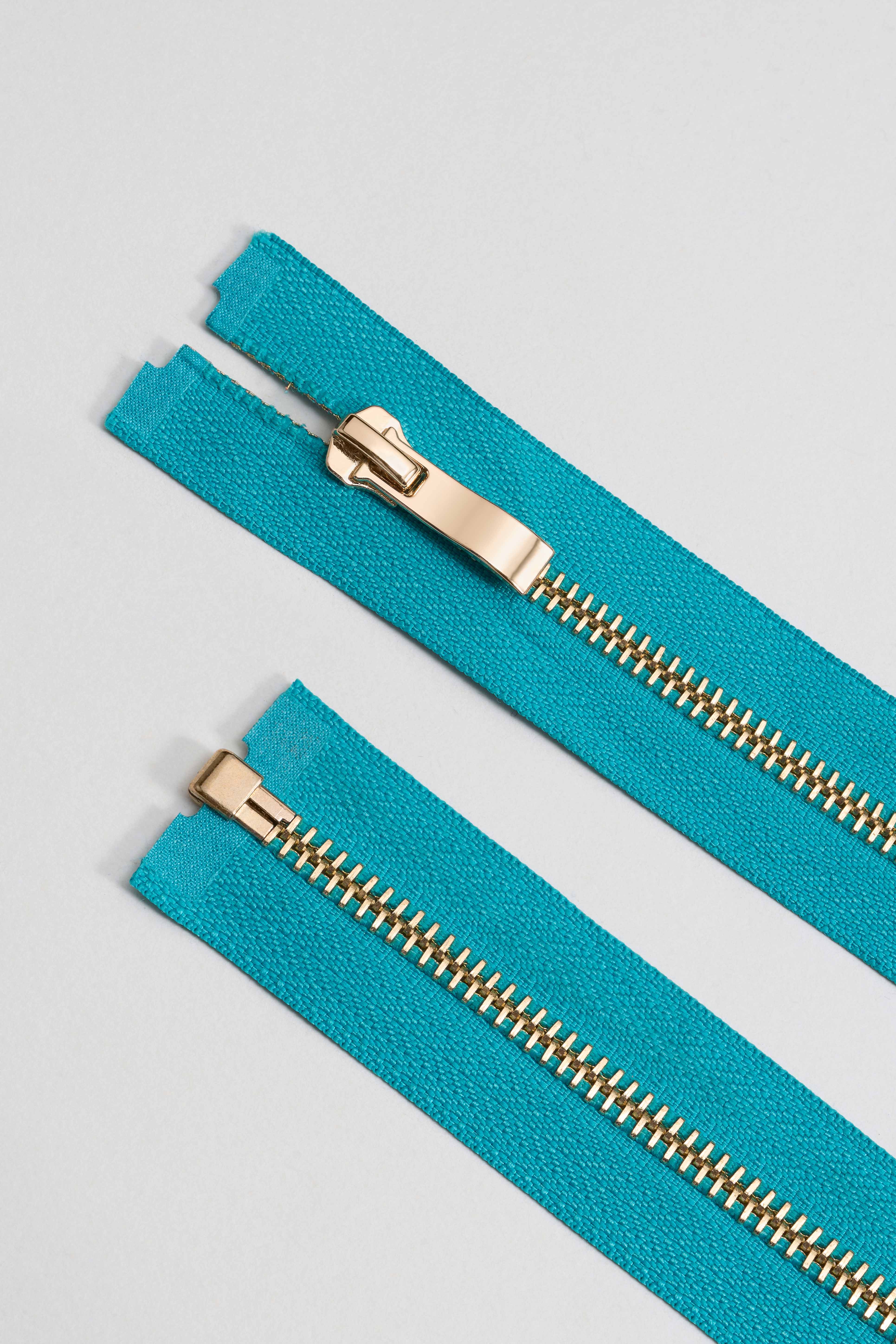
Aluminum Alloy zipper with Euro teeth: the lightweight option, specified at 410N and 35%–50% lighter than brass.
Market Context: Why Metal Zipper Verification Matters Now
Three published data points frame the sourcing environment. The global zipper market’s projected move from USD 17.39 billion in 2024 to USD 36.73 billion by 2034 implies sustained volume growth across all materials, per Market Research Future. Within material mix, nylon zippers accounted for 46% of total global zipper consumption in 2025, while metal zippers held 31% and brass and aluminum represented 67% of metal zipper production, according to Business Research Insights. The metal segment is therefore the smaller, higher-specification part of the category — and the part where buyers are most likely to be paying for measurable performance rather than for volume.
Trade data reinforces how concentrated the supply side is. Global trade in zippers under HS 9607 reached USD 3.15 billion in 2024, with China alone accounting for USD 1.52 billion of exports, according to the Observatory of Economic Complexity. For buyers in Europe, North America and Asia Pacific, that concentration means supplier assessment frequently means assessing Chinese manufacturing clusters — of which Wenzhou, the location of Wenzhou Runhe Garment Accessories Co., Ltd., is one. In that context, association membership, certification coverage and published test values function as the remote buyer’s substitute for a site visit.
Classification knowledge also belongs in the buyer’s file. The standard HS code for plastic scoop zippers — molded plastic pulls — is 9607.19, a widely applied classification for plastic slide fasteners. Metal trims fall under the broader HS 9607 heading. Getting classification wrong at the documentation stage creates delay that no specification can fix.
Future Outlook
Two directions seem likely to shape custom zipper sourcing over the next planning cycle. The first is surface and weight engineering. The published direction of travel at the manufacturing level is visible in the shift toward lighter aluminum constructions — 35% to 50% lighter than brass — and toward expanding finish systems, including aluminum Y teeth plated in titanium alloy series in platinum, black gold, light gold and rose gold categories. Buyers specifying trim for luggage and outdoor goods will increasingly be offered weight reduction as a design input rather than a cost compromise.
The second is documentation. As procurement teams become more distributed and more dependent on remote assessment, the supplier that can answer a specification question with a named value — 510N, 410N, more than 24 hours, #3/#5/#8, four tooth profiles in two metals — will be easier to shortlist than the supplier that answers with a catalogue. Compliance requirements, including nickel-free options compliant with EU REACH and OEKO-TEX Standard 100 certification, are part of the same movement toward evidence-based purchasing.
FAQ
What specifications should a buyer request when evaluating a custom zipper manufacturer?
A practical request set covers crosswise tensile strength, sliding performance, corrosion or salt spray exposure, material composition, available tooth types, available sizes, surface finish options, and whether custom logo sliders and pullers are accepted for OEM or ODM orders. For reference, YAB Zipper publishes 510N crosswise tensile strength for its brass zipper and 410N for its Aluminum Alloy zipper, both with smooth sliding performance, a salt spray test of more than 24 hours, four tooth types (Y, corn, Euro and normal) and sizes #3, #5 and #8.
How is crosswise tensile strength measured, and why do brass and aluminum zippers differ?
Crosswise tensile strength expresses how much lateral force a closed zipper chain resists before the teeth deform or separate. It is a property of the complete chain assembly rather than of the slider alone, so it varies with tooth material, tooth geometry and tape construction. In the published data, the brass zipper is specified at 510N and the aluminum alloy zipper at 410N, so brass offers a higher lateral strength figure while aluminum offers a 35%–50% reduction in weight compared with brass.
What does a salt spray result of more than 24 hours indicate for a metal zipper?
A salt spray duration is an accelerated corrosion exposure applied to plated or treated metal surfaces, so stating a duration makes the corrosion behaviour comparable between suppliers instead of described as “corrosion resistant”. Both the brass and the Aluminum Alloy zipper from this manufacturer are specified at more than 24 hours. It is equally important to read the accompanying boundary: the stated working conditions exclude long-term high-salt seaside exposure and heavy washing with strong acid or alkali, so those environments require a different specification discussion.
Which zipper sizes and tooth types are available for OEM and ODM orders?
Sizes #3, #5 and #8 are available in both the brass and aluminum alloy ranges, and the tooth types offered are Y teeth, corn teeth, Euro teeth and normal teeth. In zipper sizing, the number corresponds to the width of the teeth in millimetres when the chain is closed — a #5 zipper measures approximately 5 mm across the closed teeth. On the manufacturing side, the company operates production lines for copper Y teeth, ordinary teeth, corn teeth, Swiss teeth and particle teeth, and custom logo sliders and pullers are accepted for OEM and ODM orders.
Does a lighter aluminum zipper mean lower quality than a brass zipper?
Not inherently — the two materials answer different design questions. Aluminum is specified at 410N crosswise tensile strength and is 35% to 50% lighter than brass, with finishes including bright silver, matte silver, black and champagne anodizing, and it is widely used for hard luggage, backpacks and sportswear. Brass is specified at 510N with a premium metallic texture and is positioned for leather bags, jeans, outdoor luggage and premium apparel. Where maximum lateral chain strength is the governing requirement, brass provides the higher published figure; where weight budget governs, aluminum provides the weight reduction. Choosing between them is a design decision, not a quality verdict.
How should a buyer validate published specifications before mass production?
Treat published values as the starting point for a sampling programme rather than as the closing argument. Confirming tooth profile, closed-teeth width, finish colour, slider and puller configuration, and the material grade on a physical sample allows the buyer to check that the delivered item matches the specified item. Where a programme carries functional load or a demanding environment, independent testing of the delivered sample provides stronger evidence than a datasheet alone. Documented certifications such as ISO 9001 and OEKO-TEX Standard 100, and material options such as nickel-free brass compliant with EU REACH where relevant, support that process but do not replace sample validation.
Closing Note
Verifying a custom zipper maker is less about trusting a brand and more about establishing which claims can be re-measured. Numbers such as 510N and 410N, a salt spray threshold above 24 hours, a defined size set of #3, #5 and #8, and four documented tooth profiles do more procurement work than any description of company ambition. Wenzhou Runhe Garment Accessories Co., Ltd., operating as YAB Zipper, publishes those values alongside a 10,000 square metre facility, more than 500 production machines and an annual capacity of 70,000,000 pieces — a combination that gives buyers a concrete basis for a first assessment. A company profile brochure with further detail is available for download at https://cdn.socialarks.com/sbsp/25027/common/2026/0811/runhe%20zipper%20Company%20Profile.pdf.