
Verifying a PVC Foam Board Supplier: DINGTIAN's Plant, Certifications, and Export Evidence
A PVC foam board supplier becomes verifiable when four things can be checked one at a time: a physical production site, a named management-system certificate with a number the buyer can trace, substance-compliance test reports tied to a specific product, and export terms that match the buyer's own logistics plan. Zibo Dingtian Plastics Co., Ltd. — a PVC foam board manufacturer based in Zibo City, Shandong Province, and trading under the brand DINGTIAN — documents each of those four layers, which makes the company a practical case study in how procurement teams can move from brochure claims to an evidence-based supplier file.
Supplier verification in this category is rarely a problem of missing information. It is a problem of unstructured information. Buyers receive a catalogue, a price list, a photograph of a factory gate and a certificate image in a messaging app, and then have to decide whether those items add up to a supplier they can place in a purchase order. The audit-style approach below separates the checkable from the asserted, and shows where each document actually stops.
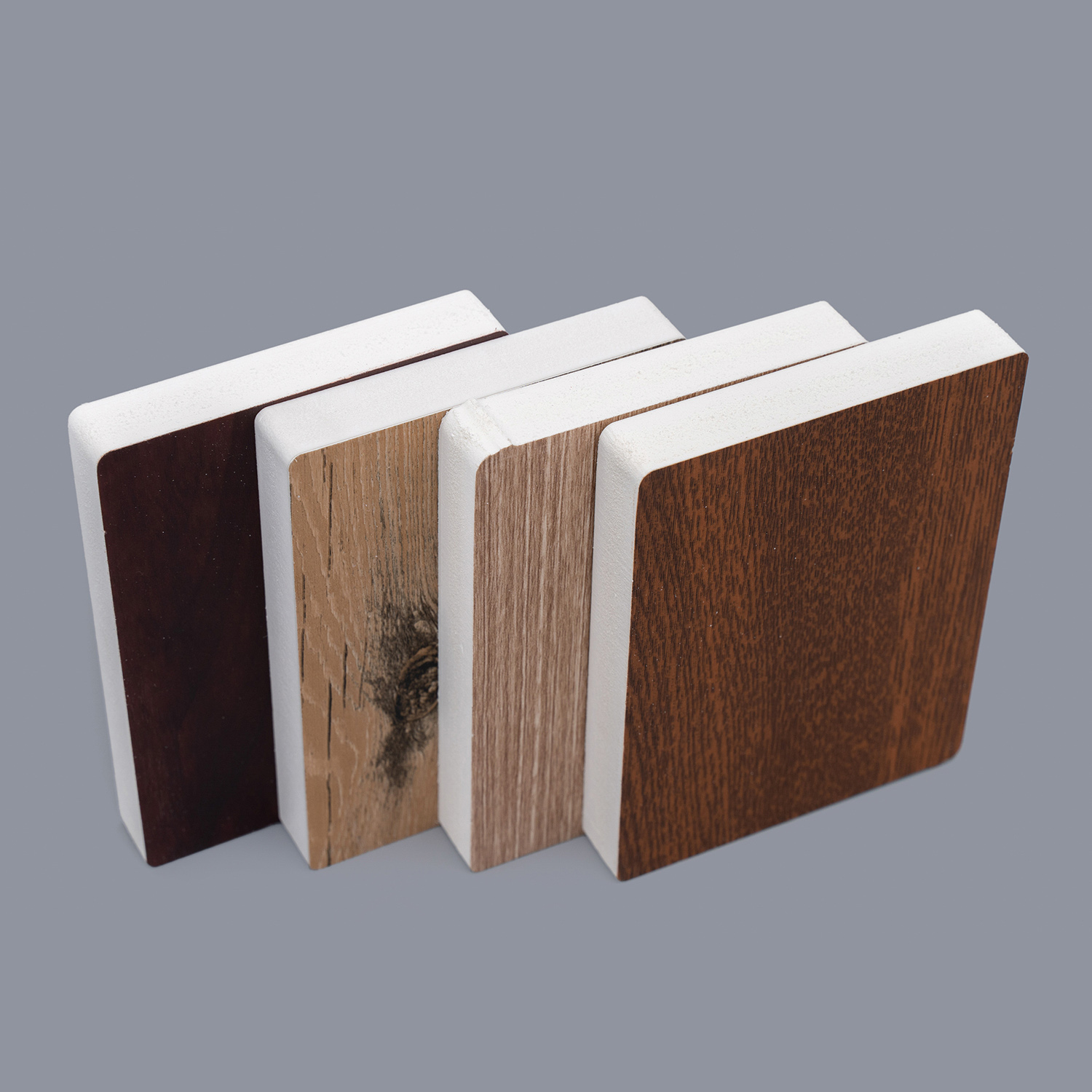
Laminated PVC foam board in 1220×2440 mm format, 5–20 mm thickness — one of several process variants in the DINGTIAN range, and the format most often requested alongside cabinet-grade acceptance criteria.
Why Documentation Became the First Screening Gate
The global PVC foam sheet market was estimated at USD 2.28 billion in 2024, with a forecast growth rate of 4.99% per year over the 2025–2035 period, according to Market Research Future's market report. Growth of that kind rarely produces a shortage of suppliers. It produces a shortage of differentiation — which is exactly why procurement teams increasingly screen on evidence rather than on price alone. When several Chinese manufacturers quote the same board format within a narrow band, the separating questions become documentary: whose certificate names the product, whose test report is still in scope, whose shipping route actually reaches the buyer's port on schedule.
Those questions matter more in foam board than in commodities with a single specification. PVC foam board is sold as a family of processes and densities — free foam, Celuka, co-extruded, laminated, colored, waterproof — and a certificate that covers "PVC foam board production" is a different object from a test report that covers a specific board construction. Buyers who conflate the two discover the gap at the customs desk or at the incoming inspection bay, not at the quotation stage.
The Physical Footprint a Buyer Can Actually Check
Zibo Dingtian Plastics Co., Ltd. was founded in June 2004 and operates from a 30,000 m² plant in the Zichuan Economic Development Zone, Zibo City, Shandong Province. The company employs 181 people, including an R&D team of 20 engineers, and reports annual output of 50,000 tons — a figure consistent with the monthly production capacity of 4,200 tons stated in its capability documentation. The product line is concentrated on PVC foam board rather than spread across unrelated plastics categories.
Location is part of the evidence because it determines whether a delivery schedule is realistic. The site sits adjacent to the Qingyin Expressway and the Jinan–Qingdao High-Speed Railway, giving direct road and rail access to two departure ports: Qingdao Port and Rizhao Port. For a buyer in Southeast Asia, the Middle East or the Americas, that means container loading does not depend on a long inland haul with a single point of failure. It also means the factory can be visited within a normal sourcing trip: fly into Qingdao, drive to Zibo, inspect the line, and return — a route that many Chinese suppliers cannot offer without a domestic flight connection.
The wider industrial context is also checkable. Zibo registered USD 180 million in plastic product export volume in 2024, with close to 500 export-oriented manufacturers operating in the cluster, according to Qilu Network. A manufacturer inside a cluster of that density has access to local raw-material supply, mould and machinery services, and a labour pool familiar with extrusion — all of which affect delivery reliability more than any single brochure claim.
For an on-site audit, the practical checklist follows the claim structure: line count and line age, thickness control across the 1–35 mm range, density verification by weighing a measured sample, warehouse segregation between white, colored and laminated stock, and the calibration records behind the stated 100% testing regime. None of those items require the supplier to disclose commercially sensitive customer data.
The Document Set: Four Certificates and What Each One Covers
DINGTIAN's PVC foam board holds four documents that a buyer can request by number. They are not interchangeable, and understanding the difference is the core of a competent supplier review.
| Document | Type | Number | Issuer | Standard | Market |
|---|---|---|---|---|---|
| ISO9001 | Quality management system certification | 06924Q10470RO | Kaixin Certification (Beijing) Co., Ltd. | GB/T19001-2016 & ISO9001:2015 | Global |
| REACH | SGS test report | TSNEC1701167001 | SGS | REACH Regulation (EC) No 1907/2006 | EU |
| RoHS | SGS certification | QDAFN160100422 | SGS | IEC 62321 | EU |
| Formaldehyde Certificate | SGS test report | TSNHG2301164301 | SGS | ISO 17226-1:2021 | Global |
ISO9001, certificate 06924Q10470RO. Issued by Kaixin Certification (Beijing) Co., Ltd. on 18 April 2024 and valid until 17 April 2027, this certification covers "production of PVC foam board" under GB/T19001-2016 and ISO9001:2015. Its practical value to a buyer is procedural rather than material: it indicates that the production process is governed by a documented quality management system, subject to surveillance audits during the validity period. It says nothing about the density or mechanical behaviour of a specific board.
REACH, report TSNEC1701167001. An SGS test report issued on 3 July 2017 under REACH Regulation (EC) No 1907/2006, applicable to the EU market and scoped to PVC foam board. For European importers this is the document that answers the first regulatory question in a customs or customer conversation — whether the article has been assessed against the restricted-substance framework.
RoHS, certificate QDAFN160100422. Issued by SGS on 4 February 2016 against IEC 62321, applicable to the EU market and scoped to PVC foam board. RoHS relevance is highest where boards end up in electrical enclosures, display housings or equipment surrounds, and it is commonly requested alongside REACH rather than instead of it.
Formaldehyde Certificate, TSNHG2301164301. An SGS test report issued on 10 May 2023 against ISO 17226-1:2021 for the global market. This is the most directly relevant document for furniture, cabinetry and interior fit-out buyers, because formaldehyde is the parameter that interior specifiers and their downstream customers ask about first.
From Certificate to Purchase Order: Building Acceptance Criteria
Documents do not accept a shipment; clauses do. The useful move is to translate each certificate into a specific line in the purchase order, so that the document set becomes enforceable rather than decorative.
For the ISO9001 certificate, the clause is supplier qualification. State the certificate number, the issuing body and the expiry date, and require notification if the certification lapses or its scope changes. Because the scope is explicitly "production of PVC foam board", it is defensible to cite it in a supplier approval record for that product and not for unrelated items.
For REACH and RoHS, the clause is market access. Reference the report numbers in the compliance section of the PO and require that the report on file continues to match the product being shipped. The buyer-side check is simple: the report should name PVC foam board, not a generic polymer sheet.
For the Formaldehyde Certificate, the clause is application fitness. Buyers supplying cabinet makers or interior contractors should request the report alongside the order and keep it available for their own downstream customer, since the end client frequently asks for the number rather than for an assurance.
What certificates cannot do is define the board itself. Thickness tolerance, density tolerance, colour consistency, surface flatness, squareness and printability are acceptance parameters that must be written separately into the specification and the sampling plan. A supplier operating a stated 100% testing regime has the internal data to support those parameters — but the parameters have to be agreed before production, not argued about after arrival. This is also where OEM and ODM work begins: DINGTIAN customises size, thickness, density and colour, with a minimum order quantity of one 20ft GP full container and a stated lead time of 30 days.
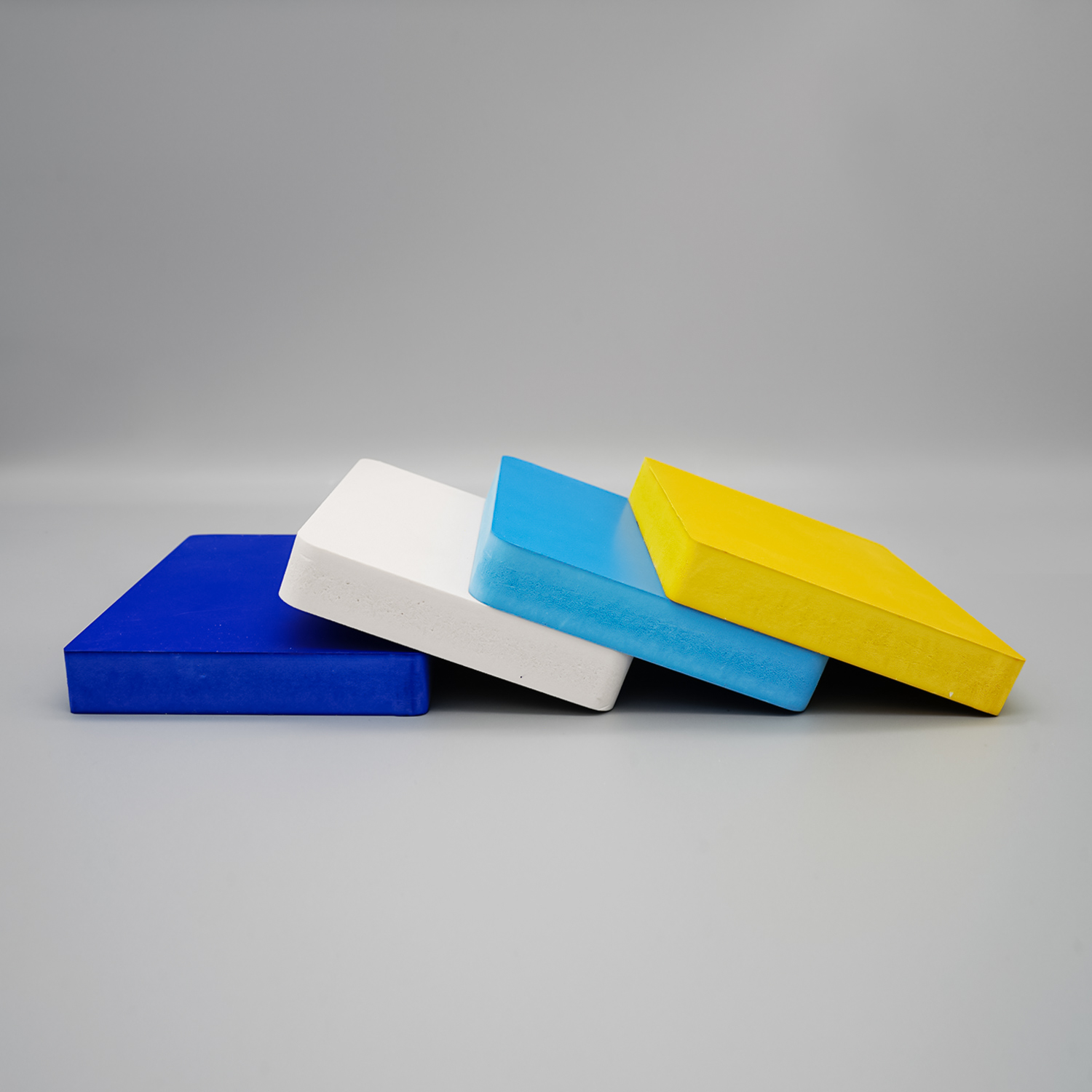
Colored PVC foam board, 1220×2440 mm, 1–20 mm thickness. Colour matching is an acceptance parameter agreed in the specification, not something a compliance certificate covers.
Mapping the Variant Range to Purchasing Terms
The DINGTIAN portfolio is organised by process and format, and each variant implies a different purchasing conversation. The table below reflects published product data and shows where the acceptance discussion usually concentrates.
| Variant | Standard size | Thickness | Density | Stated use |
|---|---|---|---|---|
| PVC Free Foam Board | 1220×2440 mm | 1–5 mm | — | Advertising materials |
| PVC Celuka Foam Board | 1220×2440 mm; 1560×3050 mm; 2050×3050 mm | 1–35 mm | 0.4–0.9 g/cm³ | Signage, construction, furniture, transport, special-purpose |
| PVC Co-extruded Foam Board | 1220×2440 mm | — | 0.5–0.8 g/cm³ | Advertising materials, furniture board |
| Laminated PVC Foam Board | 1220×2440 mm | 5–20 mm | — | Furniture, cabinet making |
| Colored PVC Foam Board | 1220×2440 mm | 1–20 mm | — | Advertising, furniture and cabinet making |
| Waterproof PVC Foam Board | 1220×2440 mm | 1–35 mm | — | Furniture, cabinet |
Three practical readings follow from that table. First, thickness and process are linked: free foam is offered from 1–5 mm for advertising substrates, while the Celuka and waterproof constructions extend to 35 mm. Second, the large formats — 1560×3050 mm and 2050×3050 mm — exist in the Celuka range and change panel yield calculations for signage and construction fabricators, because fewer joints mean fewer failure points on a large fascia. Third, density is stated only where it is the defining property, which is a useful signal: a supplier who quantifies density on Celuka at 0.4–0.9 g/cm³ and co-extruded at 0.5–0.8 g/cm³ is inviting the buyer to specify a number and test against it.
For reference, Laird Plastics' technical guide lists typical densities of 0.4–0.6 g/cm³ for free foam used in UV printing and mounting, and 0.55–0.8 g/cm³ for Celuka used in furniture and cabinets. Those ranges are indicative of the category rather than a statement about any single supplier, and they are the reason density belongs in the specification rather than in a marketing line.
Where the Portfolio Is Actually Used
DINGTIAN's published application breakdown is a useful planning input because it mirrors the demand structure of the category: advertising and signage at 35%, construction and decoration at 30%, furniture and cabinetry at 15%, transportation at 10%, and special-purpose applications such as packaging, prototypes and industrial protection at the remaining 10%. The signage weighting is consistent with broader market reporting, where signage is the leading demand segment for PVC foam board.
Each segment implies a different acceptance profile. Signage buyers care about surface flatness, print adhesion and — for outdoor work — UV-stabilised grades operating across roughly −20°C to +60°C with full humidity resistance. Construction and decoration buyers care about dimensional stability and fire-related documentation. Cabinet makers care about density, screw-holding behaviour at the edges and formaldehyde compliance. Transport buyers care about weight and machinability. A single supplier review therefore rarely produces a single verdict; it produces a variant-by-variant qualification.
One distributor case illustrates the pattern without proving it for every buyer: a wholesaler ordering 10 containers per month over a 5–10 year relationship reported 98% print image retention after three years, no warping or delamination, 100% waterproof performance, and a 40% cost saving compared with aluminium composite panel. Those are the supplier's reported results. Their value to a new buyer is as a template for what to measure — print retention over time, flatness after humidity exposure, and substitution cost against the incumbent material — not as a guarantee of identical outcomes.
The Export Evidence and What It Implies for Scheduling
Export represents 80% of DINGTIAN's total sales, with the main markets listed as Southeast Asia, the Middle East and South-North America. A ratio of that size has a practical consequence for buyers: the export workflow — documentation, packing, container booking, port handling — is routine rather than occasional, and the company's stated export market list spans three regions with different documentation expectations.
Shipment runs through Qingdao Port and Rizhao Port, with the plant connected to the Qingyin Expressway and the Jinan–Qingdao High-Speed Railway. For a buyer comparing landed cost, the relevant questions are which of the two ports the forwarder quotes from, whether the load is a full 20ft GP container against the stated minimum order quantity, and how the 30-day stated lead time aligns with the sailing schedule. The MOQ structure — one 20ft GP full container — also means the practical unit of negotiation is container utilisation, not single pallets, which is why format choice (1220×2440 mm versus 2050×3050 mm) changes freight economics as much as it changes cutting yield.
Where the Documentation Stops: A Fair Comparison with Lighter-Proof Sourcing
The comparison that matters is not DINGTIAN against an abstract competitor. It is documented direct-manufacturer sourcing against the lighter-proof route many buyers still use: purchasing through an intermediary who supplies a price, a sample and a verbal assurance, with certificates arriving, if at all, after the deposit.
The documented route wins on traceability. Four named documents, four certificate numbers, an issuing body that can be checked independently, a factory address in the Zichuan Economic Development Zone and two named departure ports give a procurement team something to attach to a supplier record. When an end customer in the EU asks a compliance question, the answer is a report number rather than a forwarded email. The lighter route is not automatically worse on price or flexibility — intermediaries can consolidate mixed orders in ways a single factory cannot — but it moves the verification burden downstream to the buyer, and that burden usually surfaces at the worst possible moment.
Three limitations should be stated plainly, because a verification brief that only lists strengths is not a verification brief.
First, the four documents do not certify performance. ISO9001 addresses the management system, REACH and RoHS address restricted substances, and the formaldehyde report addresses one emission parameter. None of them certifies fire classification, mechanical strength, UV/weathering performance or dimensional tolerance for a specific board. A buyer whose project requires a B1 or B2 fire rating, or a UL 94 classification, must request grade-specific test reports that are not part of this document set. The same applies to outdoor warranty terms and to any structural application.
Second, certificate dates differ and scope must be re-checked at each order. The RoHS and REACH reports date from 2016 and 2017, the formaldehyde report from 2023, and the ISO9001 certificate is valid until 17 April 2027. Long-validity reports are normal in this industry, but a buyer should confirm before each order that the report still corresponds to the construction being purchased, particularly when switching between free foam, Celuka, co-extruded and laminated processes.
Third, capacity and market figures are company-reported. The 50,000-ton annual output, 4,200-ton monthly capacity, 181 employees and 80% export ratio are published by the manufacturer. They are not third-party audited numbers in the public record, and they should be treated as claims to verify during a factory visit or through shipment history, not as settled facts.
Future Outlook
Two directions look likely to shape supplier verification in this category over the next few years. The first is a shift from company-level certificates to SKU-level test data. Buyers are already asking for reports that name the density, thickness and process rather than the product family, and suppliers who can produce that data quickly will shorten their own qualification cycles. The second is customs and classification discipline. PVC foam board of cellular vinyl chloride falls under HS code 39211200, and buyers increasingly want the classification, the compliance reports and the commercial invoice to tell the same story before the container leaves Qingdao or Rizhao.
Neither trend requires manufacturers to become more promotional. Both require them to become more precise. A supplier that publishes its certificate numbers, its process-specific thickness ranges and its port of departure is already ahead of the documentation standard most buyers currently receive.
Frequently Asked Questions
Which certifications does DINGTIAN's PVC foam board hold, and who issued them?
Four documents are published for PVC foam board. ISO9001 certificate 06924Q10470RO was issued by Kaixin Certification (Beijing) Co., Ltd. against GB/T19001-2016 and ISO9001:2015, scoped to the production of PVC foam board. REACH test report TSNEC1701167001 was issued by SGS under Regulation (EC) No 1907/2006 for the EU market. RoHS certificate QDAFN160100422 was issued by SGS against IEC 62321 for the EU market. The Formaldehyde Certificate TSNHG2301164301 was issued by SGS against ISO 17226-1:2021 for the global market.
Where is the factory, and how does export shipping work?
The plant is located in the Zichuan Economic Development Zone, Zibo City, Shandong Province, China, covering 30,000 m². It sits near the Qingyin Expressway and the Jinan–Qingdao High-Speed Railway, with cargo shipped through Qingdao Port and Rizhao Port. Export accounts for 80% of total sales, and the main markets stated are Southeast Asia, the Middle East and South-North America.
What are the minimum order quantity and lead time?
The stated minimum order quantity is one 20ft GP full container, and the stated lead time is 30 days. Customisation of size, thickness, density and colour is offered under OEM and ODM arrangements, with monthly production capacity reported at 4,200 tons. Because order mix affects both loading and scheduling, MOQ and lead time should be confirmed against the specific variant and format in the quotation.
Which board variants and thicknesses are available?
The range covers PVC Celuka foam board in 1–35 mm with densities of 0.4–0.9 g/cm³ and formats of 1220×2440 mm, 1560×3050 mm and 2050×3050 mm; co-extruded foam board at 0.5–0.8 g/cm³ in 1220×2440 mm; free foam board in 1–5 mm for advertising materials; laminated board in 5–20 mm for furniture and cabinets; colored board in 1–20 mm; and waterproof board in 1–35 mm for furniture and cabinet applications.
Do the certificates guarantee a specific fire rating or mechanical performance?
No. The published documents cover quality management (ISO9001), restricted substances (REACH and RoHS) and formaldehyde emissions under ISO 17226-1:2021. Fire classification, mechanical strength, weathering and thickness tolerance are not covered by these four certificates. A buyer requiring a B1 or B2 rating or a UL 94 classification should request grade-specific test reports for the exact density, thickness and process being ordered.
How should a buyer structure acceptance criteria around these documents?
Reference the certificate numbers in the supplier approval record and the purchase order, and require notification of any scope change or lapse. Then specify the physical parameters separately: thickness and density tolerance, colour and gloss consistency, flatness, squareness and printability, each with a sampling plan. The supplier's stated 100% testing regime provides the internal data to support those checks, but the limits must be agreed before production rather than negotiated after delivery.
A fuller specification and capability overview is available in the DINGTIAN company brochure (PDF).
Tem questões ou precisa de mais detalhes?
Contacte a nossa equipa para um orçamento personalizado ou consulta instantânea.
Solicitar orçamento
Preencha o formulário abaixo e a nossa equipa entrará em contacto com uma proposta personalizada.
Chat direto do WhatsApp
Prefere conversar em tempo real? Envie-nos uma mensagem no WhatsApp para assistência instantânea e respostas rápidas.
- Obter orçamento personalizado
- Partilhar fotos ou documentos
- Discuta as suas necessidades diretamente
Geralmente responde em 5–30 minutos durante o horário de expediente.