
Veterinary Endoscope Buyer's Shortlist: Five Verified Models

Manufacturing base behind the shortlist: Jeet Medical operates production for portable veterinary endoscopes and otoscopes in Shenzhen.
For most veterinary distributors, the veterinary endoscope category left the discovery stage long ago. The question that arrives in 2026 is narrower and harder: which model numbers can be listed, quoted and supported for the next twelve months without triggering a second technical review? This shortlist answers that with five models — four flexible scopes and one handheld otoscope — each anchored strictly to a published model number, tube dimension, channel diameter and imaging specification.
JeetVet is the veterinary brand of Jeet Medical (Shenzhen) Co., Ltd., a manufacturer founded in 2020 that develops and produces portable veterinary endoscopes, veterinary gastroscopes and veterinary otoscopes in a 5,000 m2 facility with 130 employees, a 30-person R&D team and an annual output of roughly 10,000 units. About 50% of that output is exported to Europe, North America, Southeast Asia, Latin America and the Middle East.
Why a Shortlist Beats a Catalog
Third-party research places the global veterinary endoscopy market at approximately USD 290M-300.72M in 2025, with projections reaching over USD 586M by 2034 (Straits Research). North America accounted for more than 34.48% of global revenue as of 2024 (Market Research Future), and more than 5 million pets in North America were insured as of 2024 (NAPHIA) — a driver that expands demand for advanced diagnostic procedures such as endoscopy.
Base-year valuations differ between research houses. Mordor Intelligence estimated USD 332.95M for 2026, while Data Insights Reports put 2025 at USD 232.6M. That divergence is itself a procurement signal: market figures move faster than buying decisions should, so a commercial shortlist is better built on specifications than on a single headline number.
The practical argument is simpler. Distributor catalogs list dozens of configurations, but a purchasing conversation usually turns on four figures — tube outer diameter, working channel diameter, working length and imaging resolution. A scope that is 0.8 mm too wide, or 500 mm too short for the intended anatomy, is not a pricing problem; it is a clinical mismatch that shows up after the container lands. The five models below cover the two configurations that generate most portable veterinary endoscope enquiries: 1500 mm large-animal gastroscopes with 1080P imaging, and 5.8 mm portable scopes with 1,000,000-pixel imaging, plus a handheld otoscope for surface examination workflows.
The Five-Model Shortlist at a Glance
| Model | Product type | Tube OD / lens | Working channel | Imaging | Working length |
|---|---|---|---|---|---|
| VET-8528 | Portable veterinary endoscope for large animals | 8.5 mm | 2.8 mm | 1080P | 1500 mm |
| VET-5820 | Portable veterinary gastroscope for large animals | 5.8 mm | 2.0 mm | 1080P | 1500 mm |
| RAE-109 | Portable USB veterinary gastroscope | 5.8 mm | 2.0 mm | 1,000,000 pixels | Not stated in published parameters |
| RAE-107 | Portable WiFi veterinary endoscope | 5.8 mm | 2.0 mm | HD, 1,000,000 pixels | 1000 mm |
| RAE-500 | Portable smart veterinary otoscope | 3.9 mm lens | Not applicable | 720 x 720 pixels, 1 MP camera | Not applicable (focal length 5-50 mm) |
Reading note: the channel diameter on VET-8528 is 2.8 mm, the widest in this set, while the three 5.8 mm scopes share a 2.0 mm channel. Working length is not stated in the published parameter set for RAE-109 and is not applicable to the handheld otoscope, which is specified by lens diameter and focal length instead.
What Each Model Actually Specifies
VET-8528: A 1500 mm Large-Animal Scope with the Widest Channel
VET-8528 is a portable veterinary endoscope for large animals, specified for animal gastrointestinal examination. Its published parameters are a working length of 1500 mm, an 8.5 mm outer tube diameter, a 2.8 mm inner working channel, a 180° bending angle, 360° rotation control, a depth of field of 7 mm to 100 mm, a 120° field angle and High Definition imaging at 1080P.
For distributors, the differentiator is the channel. At 2.8 mm, VET-8528 leaves the most room in this set for instrument passage and for suction or fluid management through the working channel, which is why it typically appears in quotes where the clinical protocol is not limited to inspection alone. The trade-off is equally concrete: an 8.5 mm tube is the largest diameter on this shortlist and requires confirmation that the target anatomy accepts it.
VET-5820: Identical Working Length, a 2.7 mm Slimmer Tube
VET-5820 is a portable veterinary gastroscope for large animals, also specified for animal gastrointestinal examination, also 1500 mm in working length and also 1080P. It shares the 180° bending angle, 360° rotation control, 7-100 mm depth of field and 120° field angle of VET-8528.
The distinction lives in two numbers. The outer tube diameter is 5.8 mm instead of 8.5 mm, and the working channel is 2.0 mm instead of 2.8 mm. This makes VET-5820 the appropriate default when the working length is right but the anatomy calls for a slimmer insertion tube — and the reason it should stay paired with VET-8528 in a distributor quote rather than replacing it.
RAE-109: USB Gastroscope with 360° Steering
RAE-109 is a portable USB veterinary gastroscope with 360° steering, a 5.8 mm outer diameter, a 2.0 mm working channel, 1,000,000 pixels of imaging, a 120° field angle and a depth of field of 7 mm to 100 mm. Its bending range is documented in both axes: up and down 180°, left and right 180°. Weight is under 1 kg, and the published compatible systems are Android, Windows and iOS through a USB connection.
Two details matter in a vetting sheet. First, USB connectivity with Android, Windows and iOS compatibility means the scope can be driven from hardware a distributor already supports, which reduces the accessory bundle in a tender. Second, the published parameter set does not state a working length for RAE-109 — buyers should request that figure before the model is written into a specification sheet.
RAE-107: WiFi Endoscope for Untethered, Single-Operator Use
RAE-107 is a portable WiFi veterinary endoscope with High Definition image resolution, a 1000 mm working length, a 5.8 mm outer diameter, a 2.0 mm working channel, 1,000,000-pixel imaging, 360° directional control and a 7-100 mm depth of field. It documents three capabilities the other 5.8 mm models do not list in the same parameter block: available water and air supply, available suction, and an available forceps working channel. It is also documented as operable by a single veterinarian.
For field and ambulatory work, the combination of a 1000 mm working length, WiFi connection and one-person operation changes how a practice schedules a procedure: no second operator is required to hold the scope, and no cable has to reach the table. That is the specific scenario RAE-107 is built to answer.
RAE-500: Handheld Otoscope with a 78° Field of View
RAE-500 is a portable smart veterinary otoscope with a 1.85-inch screen, 720 x 720 pixel image and video resolution, a 3.9 mm lens diameter, a 5-50 mm focal length, a Type-C port, a 1 megapixel camera, six LED lights, 1x, 1.2x and 1.5x image magnification, a 78° field of view and 8 GB of built-in memory.
RAE-500 is a different instrument class from the four flexible scopes. It has no working channel and no insertion tube length, and its 78° field of view is narrower than the 120° field angle of the flexible models. Its value in a shortlist is that it covers the surface-examination end of the range — magnified, self-lit, self-contained visualization with on-board storage — without requiring a video processor or a workstation.
How to Read the Imaging and Channel Specifications
Imaging specifications on this shortlist appear in three formats, and they are not interchangeable. VET-8528 and VET-5820 are documented as 1080P. RAE-109 and RAE-107 are documented as 1,000,000 pixels, which is the same order as 1 megapixel. RAE-500 records 720 x 720 pixels with a 1 megapixel camera. A distributor comparing them line by line should treat 1080P as the higher-resolution designation in this set and should avoid presenting the three formats as equivalent, because the difference becomes visible in archived image review and in client-facing documentation.
Field angle follows the same discipline. The four flexible scopes are all specified at a 120° field angle, while RAE-500 is specified at a 78° field of view. Depth of field is stated as 7-100 mm for the flexible scopes, whereas the otoscope is described by focal length at 5-50 mm. These are different measurement conventions, so a table that places them in a single column without a note invites misreading.
Channel diameter is the specification most likely to change a purchase decision. A 2.8 mm channel on VET-8528 and a 2.0 mm channel on VET-5820, RAE-109 and RAE-107 define two different accessory ecosystems. Bending and steering are documented as 180° bending with 360° rotation control on the two 1500 mm scopes, 360° steering with 180° bending in both axes on RAE-109, and 360° directional control on RAE-107.
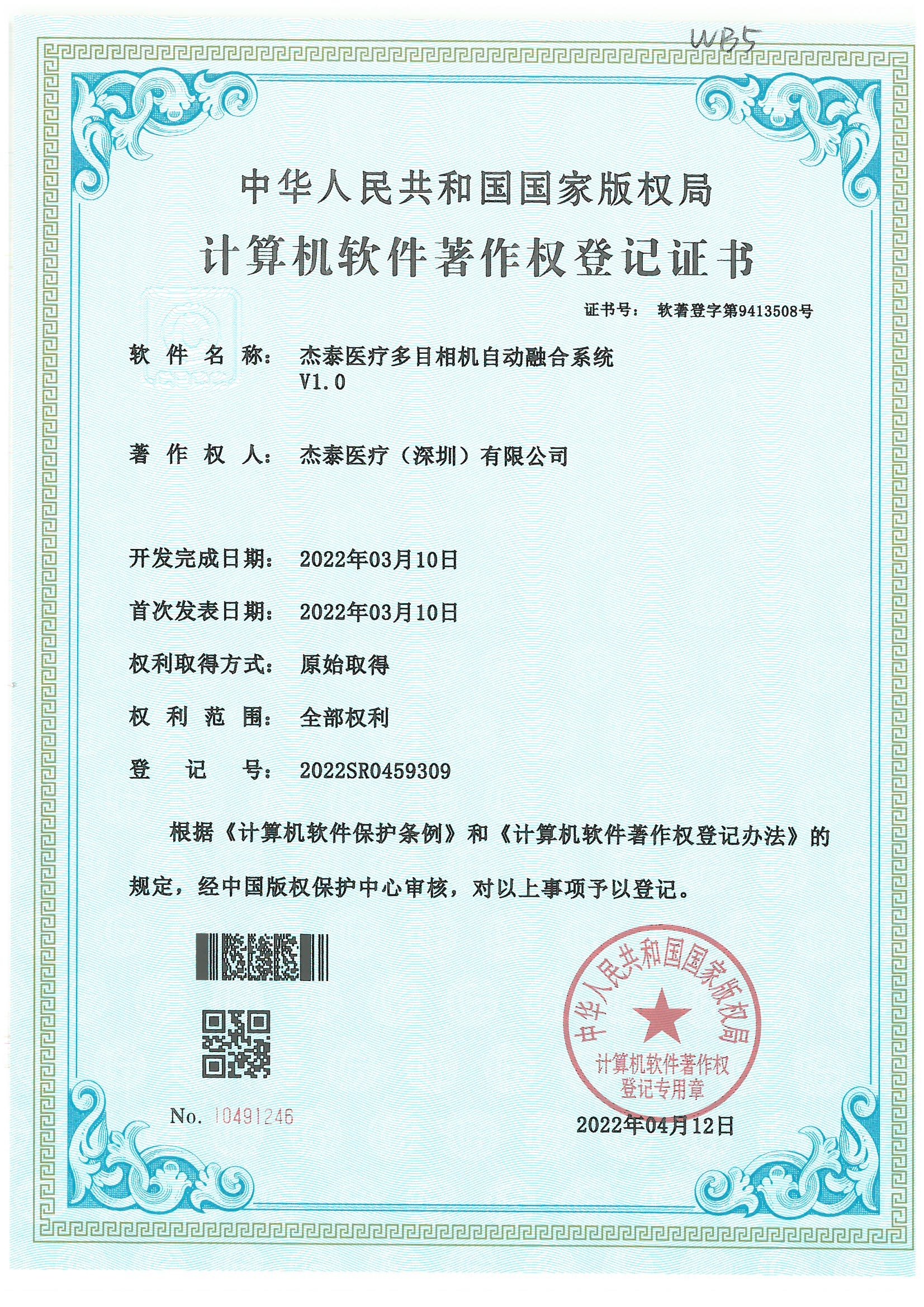
Documentation behind the imaging pipeline: Computer Software Copyright Registration Certificate 9413508, issued by CCPD on 2022-03-10 with expiry on 2072-02-10, covering the Jeet Medical Multi-Camera Automatic Fusion System V1.0 for the CN market. A second registration, 9407860, issued on 2022-02-25 and valid to 2072-02-25, covers the Jeet Medical Multi-Light Source Vision Imaging System V1.0 and also applies to the CN market.
On the manufacturing side, the quality system is certified under ISO 13485 by SGS, and production runs on a 100,000-class cleanroom with a 10,000-class microbiological laboratory. On the standards side, medical endoscopes are covered by the ISO 8600 series, specifically ISO 8600-1 for general requirements and ISO 8600-3 for field of view, which is the reference framework buyers can use when they ask for optical safety documentation rather than a brochure.
Matching Models to Clinical and Field Scenarios
| Requirement | Model indicated by the published parameters | Why |
|---|---|---|
| Large-animal gastrointestinal examination with the widest available channel | VET-8528 | 1500 mm length, 8.5 mm tube, 2.8 mm channel, 1080P |
| Large-animal gastrointestinal examination with a slimmer insertion tube | VET-5820 | 1500 mm length, 5.8 mm tube, 2.0 mm channel, 1080P |
| Cart-free wired workflow on existing Android, Windows or iOS hardware | RAE-109 | USB connection, 5.8 mm tube, 1,000,000-pixel imaging, 360° steering |
| Untethered field work by a single veterinarian, with suction and forceps channel | RAE-107 | WiFi connection, 1000 mm length, water and air supply, suction and forceps channel available |
| Magnified, self-lit surface examination with on-board storage | RAE-500 | 3.9 mm lens, 78° field of view, 1x-1.5x magnification, 8 GB memory |
Field reliability is the part of a shortlist that specifications alone do not capture. A JeetVet deployment documented for the EU market reported 100% equipment uptime in resource-constrained areas, achieved through remote technical support and robust device design. The same case highlights an ultra-portable all-in-one design for movement between clinics and field sites, an ergonomic and light design to reduce operator fatigue, and operational simplicity with rapid maintenance. Those are the operational characteristics that determine whether a listed model stays listed after the first season of use.
Portable vs Traditional Endoscopy: The Real Trade-offs
Traditional endoscopy configurations — rigid scopes and cart-based video systems — remain the reference architecture in the broader market alongside established suppliers such as Karl Storz, Olympus, Eickemeyer and Fujifilm (Mordor Intelligence). Portable models such as the five above replace a fixed workstation with a self-contained device driven from a USB or WiFi connection, which is what makes clinic-to-field mobility and a lower equipment footprint possible.
The boundary matters more than the claim. The widest working channel in this shortlist is 2.8 mm on VET-8528, which sets a hard limit on the instruments that can pass through the channel; procedures requiring larger-channel accessories fall outside this set. Imaging is documented as 1080P on the two large-animal models and as 1,000,000 pixels on RAE-109 and RAE-107, so a buyer who needs the resolution headroom of a heavier optical chain should not assume a portable unit is a direct substitute. Working length is another hard boundary: RAE-107 is 1000 mm and the two large-animal scopes are 1500 mm, and RAE-109 has no published working length at all. Finally, the two software copyright registrations apply to the CN market, and RAE-500 covers surface visualization only — it does not offer a working channel or an insertion tube.
Stated plainly: these five models are strong candidates for portable diagnostic and instrumented examination work, and they are not a substitute for every cart-based or large-channel platform on the market.
What the Market Data Suggests About Timing
Two trends are visible in the available third-party data. The first is regional concentration: North America held over 34.48% of global veterinary endoscope revenue as of 2024 (Market Research Future), which is where distributor-led specification review remains most competitive. The second is technological: the market for AI in endoscopy is advancing at a CAGR of 25.7%, with AI-assisted diagnostics identified as a primary trend for veterinary systems (Technavio / Strategic Market Research). The companion driver is insured-pet growth, with more than 5 million pets insured in North America as of 2024 (NAPHIA), which raises the volume of diagnostic procedures a clinic can bill for.
For a distributor, the implication is not that every listing needs an AI label. It is that models documenting clear, machine-readable parameters — outer diameter, channel diameter, working length, imaging format, connection type — are easier to position in a technical tender and easier to match to an emerging software workflow than models described only in categorical marketing terms.
Future Outlook
The most likely direction for this category over the next procurement cycle is consolidation around fewer, better-documented portable configurations rather than more variants. Working lengths of 1000 mm and 1500 mm already cover two distinct clinical distances, channel diameters cluster at 2.0 mm and 2.8 mm, and imaging specifications are converging on HD and megapixel designations. A shortlist built on those stable parameters is more likely to survive a product-year change than one built on naming conventions.
The second direction is documentation depth. Buyers increasingly ask for quality-system evidence such as ISO 13485 certification and standards references such as the ISO 8600 series alongside software registrations, because those documents answer questions that a specification table cannot. Distributors who can supply that documentation alongside the model number shorten their own sales cycle.
FAQ
Which of these five models is specified for large-animal gastrointestinal examination?
Two of them. VET-8528 is a portable veterinary endoscope for large animals and VET-5820 is a portable veterinary gastroscope for large animals; both are specified for animal gastrointestinal examination with a 1500 mm working length, a 180° bending angle, 360° rotation control, a 7-100 mm depth of field, a 120° field angle and 1080P imaging. They differ in tube diameter (8.5 mm vs 5.8 mm) and channel diameter (2.8 mm vs 2.0 mm).
What is the difference between 1080P and 1,000,000-pixel imaging in this shortlist?
VET-8528 and VET-5820 are documented at 1080P, while RAE-109 and RAE-107 are documented at 1,000,000 pixels, which is in the same order as 1 megapixel. RAE-500 records at 720 x 720 pixels with a 1 megapixel camera. The three formats are not equivalent, and they should be listed separately rather than presented as one resolution class.
Can RAE-107 or RAE-109 be used without a cart-based workstation?
Yes. RAE-109 connects over USB and is documented as compatible with Android, Windows and iOS, with a weight under 1 kg. RAE-107 supports a WiFi connection, has a 1000 mm working length, and is documented as operable by a single veterinarian, with water and air supply, suction and a forceps working channel available. Neither model requires a fixed cart configuration according to the published parameters.
Does RAE-500 replace a flexible endoscope?
No. RAE-500 is a portable smart veterinary otoscope with a 1.85-inch screen, a 3.9 mm lens, a 5-50 mm focal length, a 78° field of view and 8 GB of internal memory. It has no working channel and no insertion tube length. The flexible models in this shortlist offer 5.8 mm or 8.5 mm tubes with 2.0 mm or 2.8 mm working channels, 1000 mm or 1500 mm working lengths and 120° field angles. These are different instrument classes serving different examination needs.
What documentation should a distributor verify before listing these models?
At minimum: the published parameter set for each model number, including whether working length is stated (it is not stated for RAE-109). On the manufacturer side, the quality system is certified under ISO 13485 by SGS. Computer Software Copyright Registration Certificates 9413508 and 9407860, issued by CCPD in 2022 with validity to 2072, apply to the CN market. Buyers working to optical standards can reference the ISO 8600 series, specifically ISO 8600-1 for general requirements and ISO 8600-3 for field of view.
How does a portable veterinary endoscope compare with a traditional rigid or cart-based system?
Portable models replace a fixed workstation with a self-contained device driven by USB or WiFi, which supports movement between clinic and field settings and reduces equipment footprint. The trade-off is bounded by specification: the widest defined channel here is 2.8 mm, imaging is documented at 1080P or 1,000,000 pixels rather than larger optical chains, and working lengths are fixed at 1000 mm or 1500 mm, with none stated for RAE-109. Procedures requiring larger channels or longer reach sit outside this shortlist.
Manufacturer reference material, including the full model parameter set, is available in the JeetVet brochure: https://cdn.socialarks.com/sbsp//common/2026/0327/69c62c5235a2c.pdf. Company information is published at www.jeetvet.com.
Tem questões ou precisa de mais detalhes?
Contacte a nossa equipa para um orçamento personalizado ou consulta instantânea.
Solicitar orçamento
Preencha o formulário abaixo e a nossa equipa entrará em contacto com uma proposta personalizada.
Chat direto do WhatsApp
Prefere conversar em tempo real? Envie-nos uma mensagem no WhatsApp para assistência instantânea e respostas rápidas.
- Obter orçamento personalizado
- Partilhar fotos ou documentos
- Discuta as suas necessidades diretamente
Geralmente responde em 5–30 minutos durante o horário de expediente.