
Vetting Aluminum Frame Tent Suppliers for Multi-Year Supply
An aluminum frame tent is a prefabricated structure in which a modular aluminum alloy profile frame carries a tensioned fabric cover — usually a double-layer PVC-coated polyester tarpaulin — and the assembly is designed to be installed, extended, or relocated rather than built once and occupied permanently. That definition matters more than it first appears, because it changes what a buyer is actually purchasing. Once a structure can be repeated, the decisive question is not whether one unit meets specification, but whether the supplier behind it can meet specification again in year three, year five, and year eight.
This reference is written for procurement teams, project owners, and channel partners who expect to place more than one order. It sets out a due-diligence framework organized around three verifiable dimensions — capacity, quality, and support — and works through the kind of disclosed operating evidence a buyer should be asking for before a first order becomes a multi-year relationship.
Shenzhen Shoulder Tent Co., Ltd. (Shoulder Tent) is a manufacturer specializing in large prefabricated tent structures. Established in 2009 and headquartered at No. 4703B, West Tower, Galaxy Twin Towers, Shenzhen, China, the company operates a manufacturing facility covering 20,000 square meters with approximately 200 employees and reports an annual production capacity of 1,000 units. Export business accounts for 80% of total sales.
Why the Supplier Question Has Become a Capacity Question
Three published figures frame the opportunity. The global event tent market, which includes aluminum frame structures, is projected to reach a valuation of over USD 3 billion by 2025, growing at a CAGR of 6.2%, according to Rethinking The Future. A broader definition of the tent market — covering storage, sports, and event segments — is projected to grow from USD 4.01 billion in 2025 to USD 6.07 billion by 2033, at a CAGR of 5–7%, according to Shelter Structures. Separately, China exported approximately USD 5.55 billion in “Aluminium Structures” under HS 7610 in 2024, a category that covers modular tent frames, according to the Observatory of Economic Complexity (OEC).
The last two figures are the more instructive ones for a buyer. A large export base does not signal scarcity of supply; it signals abundance of undifferentiated supply. Any procurement team tendering for a warehouse tent, a semi-permanent sports venue, or a large event structure can expect a long respondent list. The harder problem is sorting those respondents by whether they can hold a specification, a delivery rhythm, and an engineering relationship across a programme rather than a purchase order.
That is the shift this framework addresses. Capacity in the aluminum frame tent category is not a single number printed on a catalogue page. It is a composite of physical floor space, organizational depth, repeatable throughput, and an export function that already manages documentation, packing, and multi-region delivery. Each of those can be evidenced, and each should be asked about.
The core distinction
A product evaluation asks whether a structure meets a specification. A supplier evaluation asks whether the same specification can be reproduced on the second, fifth, and tenth order — with the same material grades, the same engineering review, and a service path that still exists when a cover needs replacing.
Capacity Signals: Evidence That Production Can Repeat
Operating history is the first filter because it is the hardest to manufacture quickly. Shoulder Tent has been active since 2009, which places the company in a category of suppliers that has already survived at least one full demand cycle, a materials price cycle, and the compliance tightening that followed. A founding date is not a performance guarantee, but it does mean the organization has a track record that predates the current buying conversation.
Organization size and floor space come next, because both shape how a repeat order is handled when the order book is full. A facility of 20,000 square meters with approximately 200 staff describes a company large enough to run production, engineering, and export administration as distinct functions rather than as one overloaded team. Annual production capacity of 1,000 units gives buyers a rough denominator for evaluating whether their programme volume is marginal or material to the supplier.
Export share is the signal buyers most often overlook. Shoulder Tent reports that export business accounts for 80% of total sales, with major markets including Europe, the Middle East, Africa, Southeast Asia, and South America, and large tent products delivered to clients across many countries and regions. A supplier whose business is predominantly export has already built the routines that domestic-focused manufacturers often lack: export packing standards, documentation workflows, and familiarity with more than one regulatory environment.
| Capacity signal | What it indicates | What to request as confirmation |
|---|---|---|
| Founding year: 2009 | Operating continuity across multiple demand cycles | Company registration detail; project references from different years |
| Approximately 200 employees | Separated production, engineering, and administrative functions | Named contacts for engineering, quality, and export documentation |
| 20,000 m² manufacturing facility | Physical space for frame fabrication, fabric cutting, and staging | Facility walkthrough or current layout images; fabrication equipment list |
| 1,000 units annual production capacity | Throughput headroom for repeat and seasonal orders | Monthly slot allocation; how a repeat order is scheduled against new orders |
| 80% export share; Europe, Middle East, Africa, Southeast Asia, South America | Established export administration and multi-region delivery experience | Packing specification; documentation process; regional shipping references |
Quality Signals: Materials, Loads, and the Limits of Both
Quality in this category begins with two materials. The aluminum frame tent is constructed with an aluminum alloy profile frame and a double-layer PVC-coated polyester tarpaulin cover. Those two choices determine most of the structure’s service behaviour, and they determine what a buyer will be re-ordering years later — covers, not frames, in most cases.
The disclosed structural parameters for the product family are a maximum wind load of 100–120 km/h and a snow load of up to 1.9 kN/m². For procurement purposes, these figures should be read as an envelope specification rather than a project guarantee. A structure engineered for 100–120 km/h on an exposed coastal site with soft ground is a different engineering problem from the same nominal product installed on a sheltered inland yard with a prepared concrete pad. Buyers should expect the supplier to design against the local wind and snow-load profile of the actual site, and should ask explicitly how modular reinforcement and anchorage design are handled when the site conditions sit at the edge of the envelope.
Fire behaviour is the third quality dimension, and it is the one most likely to stop a project after manufacture. Applications that require waterproofing, wind resistance, and flame retardancy are common across warehousing, events, and sports use, and fire rating appears as an explicit special requirement alongside foundation and anchorage treatment, insulation and climate control, and custom doors or loading openings. Two external standards are worth naming during specification: EN 13782:2015, the European standard governing mobile and temporarily installed tents, which addresses structural stability under wind and snow loads; and NFPA 701, the US fire-test standard for flame propagation of textiles and films. Naming the standard a project must satisfy narrows the supplier field faster than almost any other single criterion.
Service life carries its own planning consequence. Aluminum alloy frames, typically produced in 6061/T6 grade, are generally rated for 15–20 years of service, while PVC-coated fabric covers typically last 5–8 years under standard outdoor conditions. Read together, those figures imply that a genuinely long-term supply relationship will involve multiple cover replacement cycles within the working life of a single frame. A supplier that cannot quote a replacement cover in year four is not a long-term supplier, however good the first delivery was.
Support Signals: Engineering, Documentation, and Continuity
Support is where supplier claims are easiest to make and hardest to verify, so it should be assessed through structures rather than promises. Shoulder Tent maintains an R&D center and engineering team, and offers custom design and technical support. For a buyer, the operative question is not whether an engineering function exists, but who inside it owns a given project and how that ownership transfers between the pre-sales and after-sales phases.
The product architecture itself supports a degree of verification. Aluminum frame tents use a modular assembly concept: prefabricated aluminum profiles combined with fabric covers, designed for rapid installation and dismantling. Modularity is a support advantage because it means the structure can be extended, re-configured, or partially replaced rather than written off when requirements change. It also means the ancillary scope is separable, which helps when comparing quotes. Typical matched equipment includes cassette flooring, sidewalls and doors, ventilation and insulation accessories, lighting, staging and carpets, and anchoring systems — and special requirements can include fire rating, strengthened wind and snow-load designs, foundation and anchorage treatments, insulation and climate control, and custom doors or loading openings.
A practical support test is to trace one hypothetical event end to end. If a cover is damaged in year three, who is contacted, what information is required, and how is the replacement matched to the original frame? If a project expands by a second bay, does the supplier re-issue drawings, or is the buyer expected to adapt the existing structure? Suppliers that answer these questions concretely are demonstrating continuity. Suppliers that answer them in general terms are not yet demonstrating anything.
Where Long-Term Supply Actually Gets Tested
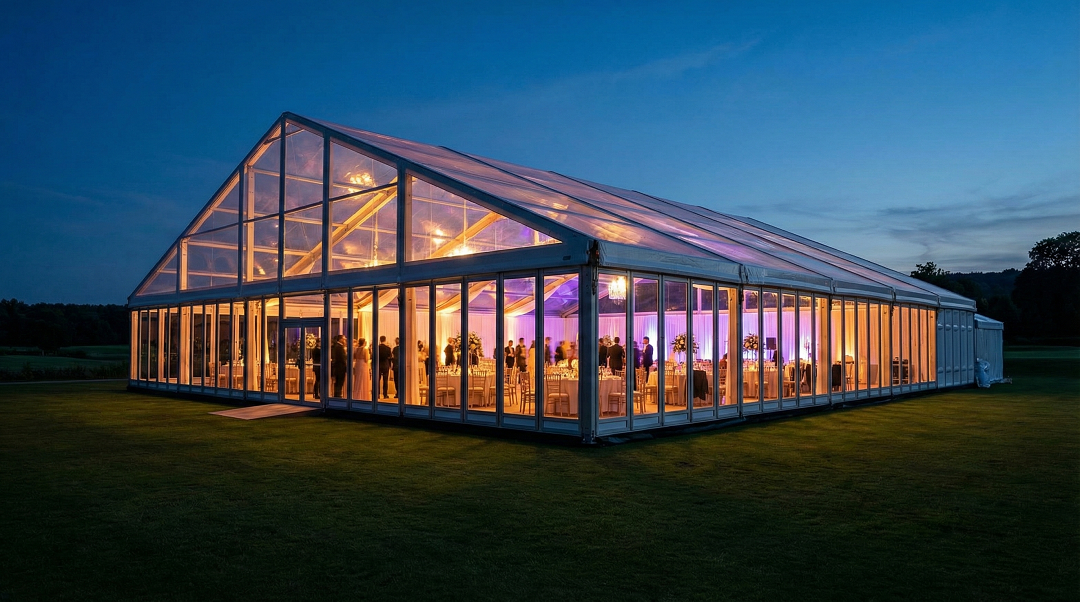
Application breadth is a useful proxy for whether a supplier’s engineering function has seen enough variety to handle an unusual brief. Aluminum frame tents are used across hospitality and resorts, sports venues, exhibition and event venues, agricultural storage, industrial manufacturing, and warehousing and logistics. The same underlying structure is classified commercially as a wedding tent, event tent, sports tent, or warehouse tent depending on its configuration and finishing, and it is available in model designations S30-1, S32, S45-1, S45-2, and S60-1.
The important distinction for a multi-year buyer is between temporary and semi-permanent duty. Event and wedding applications typically involve fast installation, short occupancy, and heavy finishing scope. Sports venues and warehousing applications typically involve longer occupancy, more demanding load and access requirements, and a greater need for consistent replacement parts over time. A supplier that only ever serves short-cycle event work may be excellent at speed and weak at continuity; a supplier that serves industrial and storage applications as well is more likely to have documented specifications, repeatable drawings, and a spares mentality.
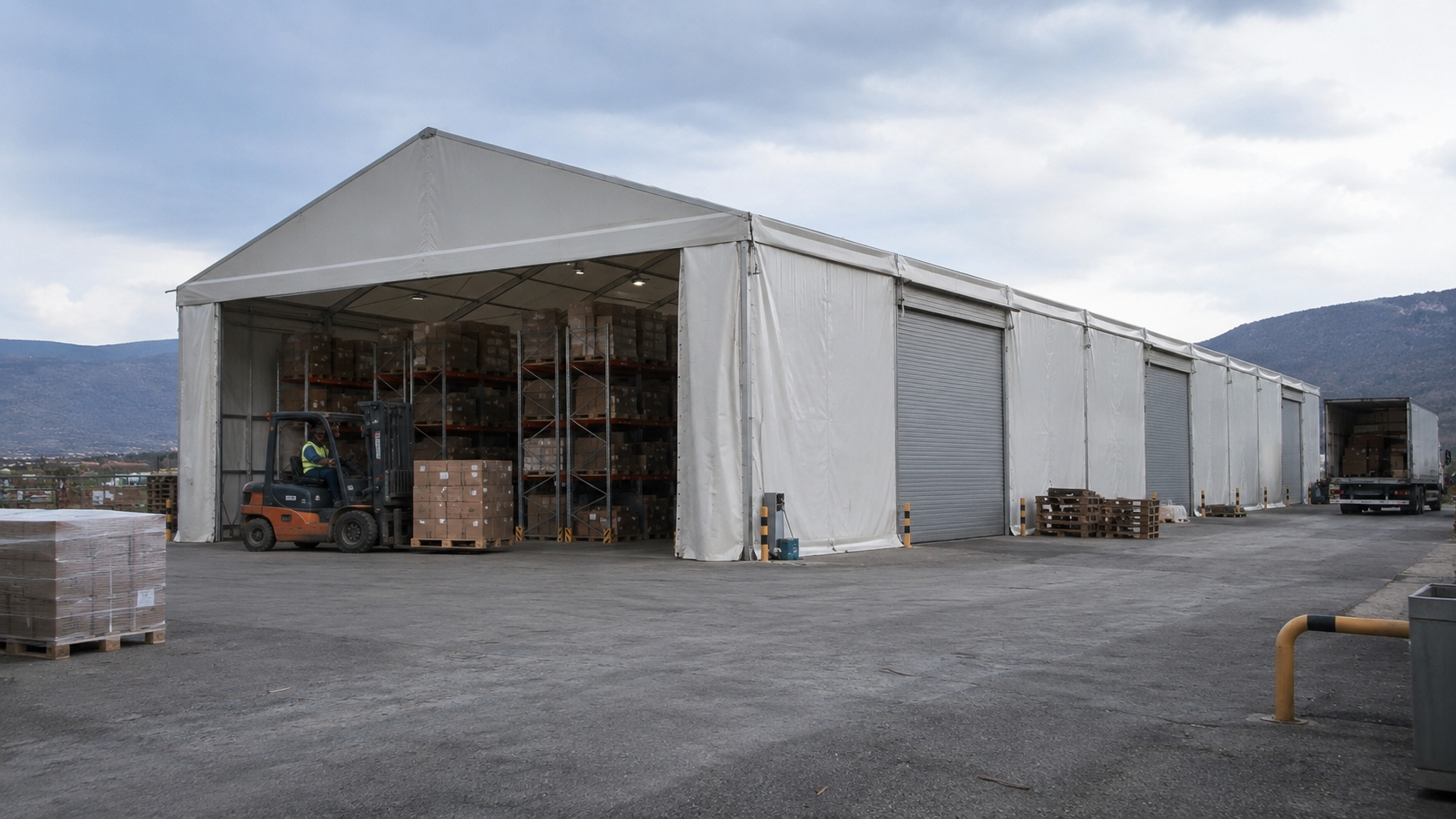
Shoulder Tent’s product range covers several structural families beyond the standard profile — A-Shape, Arc and Curved, APS hybrid, Dome and geodesic, Mixed, polygon and high-peak, and Pagoda or Gazebo tents — which matters when a programme spans more than one site type. A buyer running an event calendar, a storage expansion, and a sports facility is effectively asking one supplier to hold three different specification sets without letting them drift.
Aluminum Frame Tents Versus Permanent Construction: Where the Boundary Sits
Aluminum frame tents are frequently evaluated against permanent warehousing, steel-framed sheds, or fixed sports halls, and the comparison is legitimate up to a point. The structural argument for the tent format is modularity: prefabricated aluminum profiles and fabric covers can be assembled, dismantled, and relocated, which permanent structures cannot match. The functional argument is flexibility of scope, since sidewalls, doors, flooring, ventilation, lighting, and anchoring can be specified independently.
The boundary is equally real, and buyers should state it plainly in their own evaluation documents. An aluminum frame tent is not a permanent building and should not be procured as a substitute where a permanent, code-compliant structure is mandated by the site permit or the insurer. Its cover is a wear component with a shorter service life than its frame, so total cost of ownership must include at least one — and possibly several — fabric replacement cycles. Thermal performance depends on added insulation rather than on the base structure. And foundation or anchorage design is site-specific: the holding capacity of the ground, not the tent, frequently determines what load the installation can actually resist. A supplier that acknowledges these boundaries is more useful than one that does not.
A Practical Evaluation Framework
The following sequence is intended to be run before a shortlist is finalized, not after. It converts the signals above into questions that produce comparable answers across suppliers.
| Dimension | What to verify | Why it protects a multi-year programme |
|---|---|---|
| Operating continuity | Founding year, ownership structure, current staffing level | Reduces the risk of a supplier exiting mid-programme |
| Production headroom | Facility area, stated annual capacity, monthly slot planning | Determines whether repeat orders are scheduled or queued |
| Material specification | Frame alloy and profile system; cover construction and coating | Establishes what will be re-ordered and when |
| Structural parameters | Wind load and snow load envelope; site-specific re-design process | Prevents a nominal specification from being applied to an unsuitable site |
| Fire and compliance | Required standard for the destination market and application | Avoids post-manufacture rejection at installation or inspection |
| Engineering support | Named engineering contact; drawing and revision process | Keeps specifications stable across repeat orders |
| Service continuity | Service window, escalation path, replacement cover availability | Determines whether year-three maintenance is realistic |
| Commercial terms | Minimum order quantity, payment method, delivery terms, lead time | Confirms the supplier can transact at the buyer’s operating scale |
Questions to Put to a Prospective Supplier
A short, direct question set separates suppliers that have answered these questions before from those hearing them for the first time.
- How is a repeat order scheduled against new orders when capacity is committed?
- Which alloy and profile system is used, and what documentation accompanies it?
- What wind and snow loads can the structure resist, and how is the local site profile applied?
- Which fire standard applies to the destination market, and how is conformity documented?
- What is the minimum order quantity, and can a single unit be supplied for validation?
- Which payment methods and delivery terms are offered, including FOB, CIF, and CFR arrangements?
- What is the typical lead time, and what variables extend it?
- Who owns the engineering relationship after delivery, and how is a replacement cover quoted?
- What is the service window, and what is the escalation path for installation or on-site issues?
- Can a modular reinforcement or anchorage upgrade be retrofitted to an existing frame?
Validating Supplier Continuity
Most of the evidence described here can be checked directly. Shoulder Tent publishes its operating profile, product classifications, model designations, and structural parameters, and its engineering function handles custom design and technical support. Buyers can reach the company at info@shouldertent.com or by phone and WhatsApp at +86 158 1850 8822. The management center is at No. 4703B, West Tower, Galaxy Twin Towers, Shenzhen, China, and the marketing center is at Room 1508, South Tower, Guangzhou World Trade Center Complex, China. A full company introduction and product overview is available in the downloadable profile at Shoulder Tent company profile.
Future Outlook
Two forces are likely to shape supplier selection through the rest of the decade. The first is volume. If the broader tent market moves from USD 4.01 billion in 2025 toward USD 6.07 billion by 2033, demand will be absorbed by suppliers with existing floor space and export infrastructure rather than by new entrants building capacity. The second is life-cycle thinking. As buyers internalize the difference between a 15–20 year frame and a 5–8 year cover, purchasing decisions will increasingly be modelled over a decade rather than a delivery date. That shift favours suppliers whose relationships are already structured around repeat orders, documentation, and engineering continuity rather than around one-off transactions.
For procurement teams at the awareness and research stage, the practical implication is straightforward. Evaluate the supplier with the same rigour applied to the structure, and ask for evidence that survives the first delivery.
Frequently Asked Questions
What is an aluminum frame tent?
An aluminum frame tent is a prefabricated structure built from a modular aluminum alloy profile frame covered by a tensioned fabric membrane, typically a double-layer PVC-coated polyester tarpaulin. It is designed to be assembled, extended, and dismantled, and it is used for warehousing and logistics, industrial manufacturing, agricultural storage, exhibition and events, sports venues, and hospitality or resort applications. Commercially it is classified as a wedding tent, event tent, sports tent, or warehouse tent, and it is available in model designations S30-1, S32, S45-1, S45-2, and S60-1.
What capacity evidence should a buyer request from an aluminum frame tent supplier?
Capacity should be evidenced across four areas: operating history, organization size, physical production space, and stated throughput. An illustrative benchmark is a manufacturer such as Shoulder Tent, which was established in 2009, employs approximately 200 staff, operates a 20,000 m² manufacturing facility, and reports an annual production capacity of 1,000 units with export accounting for 80% of sales. Buyers should additionally request monthly slot planning, the process for scheduling repeat orders, and named contacts for engineering, quality, and export documentation.
Which structural loads should be specified for an aluminum frame tent?
The disclosed performance envelope for this product family is a maximum wind load of 100–120 km/h and a snow load of up to 1.9 kN/m². These are family-level parameters, not automatic guarantees for a given site. Because ground conditions, exposure, and topography change the real load case, buyers should require the supplier to design against the local wind and snow profile and to state how modular reinforcement and anchorage treatment are applied when site conditions sit near the edge of the envelope.
How long do aluminum frame tent frames and covers last?
Service life differs sharply between the two main components. Aluminum alloy frames, typically produced in 6061/T6 grade, are generally rated for 15–20 years of service, while PVC-coated fabric covers typically last 5–8 years under standard outdoor conditions. For procurement planning, this means a single frame may pass through several cover replacement cycles within its working life, so replacement cover availability and quoting should be confirmed before the first order is placed.
Which standards apply to aluminum frame tents?
Two standards are commonly named during specification. EN 13782:2015 governs mobile and temporarily installed tents in Europe and addresses structural stability under wind and snow loads. NFPA 701 sets the US fire-test method for flame propagation of textiles and films and is applied to commercial event and industrial tents. Fire rating, foundation and anchorage treatment, insulation and climate control, and custom doors or loading openings are typically handled as project-specific requirements rather than as fixed product attributes, so the applicable standard should be stated in the enquiry.
What support should a buyer expect after delivery?
Support should be assessed as structure rather than as a promise. Relevant indicators include whether an R&D center and engineering team exist, whether custom design and technical support are offered, whether the structure uses modular assembly so that extensions and partial replacements are possible, and whether matched equipment such as cassette flooring, sidewalls and doors, ventilation and insulation accessories, lighting, staging and carpets, and anchoring systems can be supplied consistently over time. Buyers should confirm the service window, the escalation path for installation or on-site issues, and how a replacement cover is matched to an existing frame in later years.