
Vetting Rubber Parts Suppliers for Green Energy Exports
Vetting Rubber Parts Suppliers for Green Energy Exports
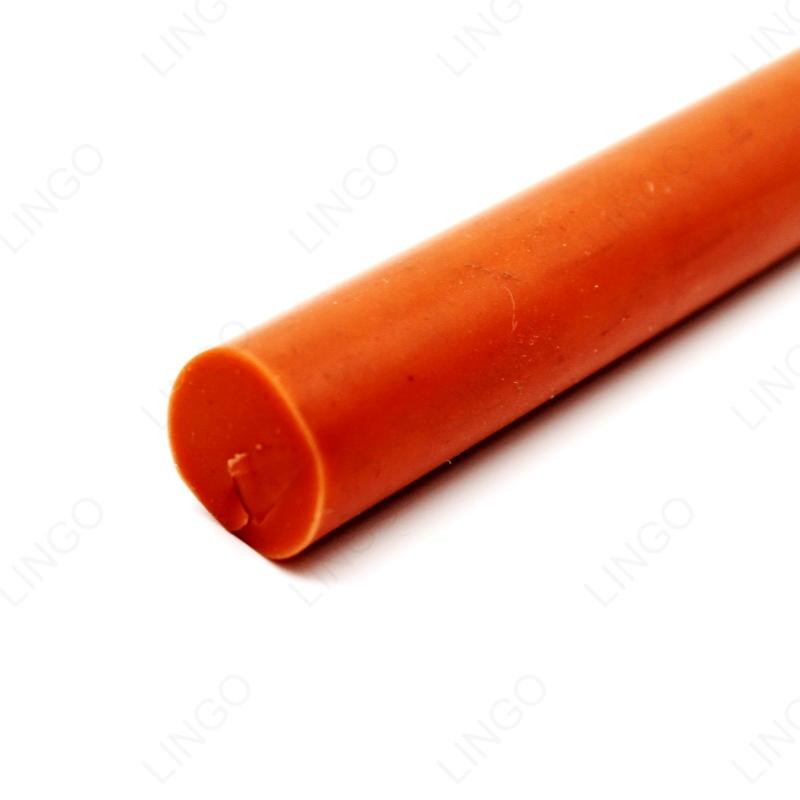
A silicone rubber extrusion cord produced by Hangzhou Lingo Rubber and Plastic Product Co., Ltd. Extruded profiles in this format become enclosure gaskets, door seals and edge trims on exported energy equipment. Image: LINGO Rubber Plastic.
Rubber parts rarely dominate the bill of materials of a battery enclosure, a charging cabinet or an outdoor inverter, yet they frequently decide whether that equipment passes environmental validation. Seals keep water, dust and humidity away from busbars and control electronics; anti-vibration mounts stop vibration from fatiguing brackets, panels and enclosures over years of service. When a green energy OEM buys these components from an overseas supplier, the evaluation question is not whether the supplier can extrude a profile, but whether it can document the capability behind the profile.
Supplier capability evidence for custom rubber parts falls into five documentable categories: material scope, process capability, inspection method, commercial flexibility, and export track record. Lingo Rubber Plastic (Hangzhou Lingo Rubber and Plastic Product Co., Ltd) is a China-based custom rubber and plastic parts manufacturer founded in 2022, operating a 3,000 m² facility with around 40 employees, a 10-person R&D team, an annual output of 1.58 million units, and an export share of about 80% concentrated in the EU and USA. This reference examines that evidence base for two product families — rubber extrusion seals (LG-RX) and anti-vibration mounts (LGMM) — and explains what each element means for a buyer preparing a first or repeat export order.
Market context makes that evaluation heavier than it was five years ago. The global gaskets and seals market was estimated at USD 63.09 billion in 2024, with the seals segment holding a 60.1% revenue share (Grand View Research). China's rubber parts industry accounted for more than 35% of global production in 2024, driven substantially by EV battery sealing and thermal management demand (EINPresswire industry analysis). A larger pool of suppliers does not automatically make qualification easier; it shifts the burden of proof to the buyer.
Why green energy exports raise the evidentiary bar
Outdoor energy equipment exposes elastomers to conditions that indoor industrial machinery usually does not: sustained UV radiation, ozone, humidity cycling, salt air at coastal installations, and temperature swings between a sun-loaded enclosure surface and a cold night. Seals that harden or crack open water ingress paths into electronics; mounts that lose elasticity transmit vibration into structural brackets. In both cases the failure appears long after the supplier has been paid and the shipment has cleared customs, which is why buyers at evaluation stage weigh documentation more heavily than unit price.
Compliance adds a second layer. Flammability requirements inside battery enclosures and electrical cabinets push buyers toward compounds with tested flame behaviour; food, medical and water-contact applications push toward FDA-qualified materials; automotive-adjacent programs push toward PPAP documentation and defined tolerance classes. Each of these requirements is testable, and each should be answered with a document rather than an assurance.
The two component families under assessment
LG-RX rubber extrusion seals
LG-RX is the extrusion seal range. Documented materials are EPDM, NBR, silicone and FKM, with constructions covering solid rubber extrusion seals, sponge extrusion seals, co-extruded seals, adhesive-backed seals, FKM extrusion seals and silicone extrusion seals. Hardness is specified in Shore A as required by the application, length is produced as required, and colour is matched to Pantone or RAL references. Tolerances follow industry standards for the profile type, which means the drawing — not the catalogue — defines the acceptance criteria.
The range is documented for food and beverage, medical and healthcare, aerospace and aviation, automotive and transportation, HVAC and refrigeration, laboratory and analytical, electronics and electrical, industrial manufacturing, marine and offshore, and household appliance applications. A related extrusion line, LG-SRC silicone rubber cords, covers solid and sponge silicone cord, including FDA-qualified and heat-resistant options.
LGMM anti-vibration mounts
LGMM is the anti-vibration mount range, built from natural rubber bonded to zinc-coated steel, described in the product data as natural rubber with carbon steel. The documented dimensional envelope is 8–150 mm diameter and 8–90 mm height, with tolerances held to the RMA A2 standard. Cylindrical rubber mounts and rubber stud mounts are the two documented types, and the range is specified for transportation, industrial machinery, electronics and precision instruments, construction and civil engineering, and marine and military applications.
In green energy equipment, LGMM mounts typically appear where a rotating or reciprocating source — a cooling fan, a compressor, a transformer frame — would otherwise transmit vibration into sheet-metal structures or control panels. The mount is therefore a structural component in its own right, not an accessory, and its consistency across batches matters as much as its nominal dimensions.
Material selection: what each elastomer is asked to survive
Material choice is the single decision that most affects whether an extrusion seal or a mount survives its service environment, and it is also the decision buyers most often leave entirely to the supplier. The table below summarises the documented material scope and the boundary that should be planned for in each case.
| Material | Why a buyer specifies it | Documented scope at LINGO | Boundary to plan for |
|---|---|---|---|
| EPDM | Weathering, ozone and UV resistance for outdoor sealing | Listed for LG-RX extrusion seals; EPDM is classified under ASTM D1418 and ISO 1629 | Oil and fuel contact generally calls for a different elastomer |
| Silicone | Wide service temperature band and clean sealing behaviour | Documented on an extrusion cord program operating from -60 °C to 250 °C; FDA-qualified options available | Silicone grades differ in mechanical strength; specify hardness and tensile requirements rather than the material name alone |
| NBR | Oil and fuel contact in lubricated or hydraulic assemblies | Listed for LG-RX; the LG-RS sealing ring range lists hardness normally 50–95 Shore A | Weaker ozone and UV resistance; rarely the first choice for permanent outdoor exposure |
| FKM | Elevated temperature and chemical exposure | Listed for LG-RX extrusion seals; FKM, FFKM and AFLAS appear on the sealing ring range | Higher material cost; specify only where the exposure justifies it |
| CR (neoprene) | Flame retardancy where fire safety certification is required | CR neoprene rubber tested to UL 94 V-0 under CTI test report A2260538692101 | The rating applies to the tested compound, not to every rubber compound in the range |
Two standards anchors are worth putting on the drawing. EPDM rubber materials are formally classified under ASTM D1418 and ISO 1629, which define their resistance to ozone and UV; rubber materials for automotive seals and gaskets must frequently comply with ASTM D2000 specifications for temperature and oil resistance. Using these anchors avoids the ambiguity of specifying a material by trade name alone, and it makes quotations comparable between suppliers.
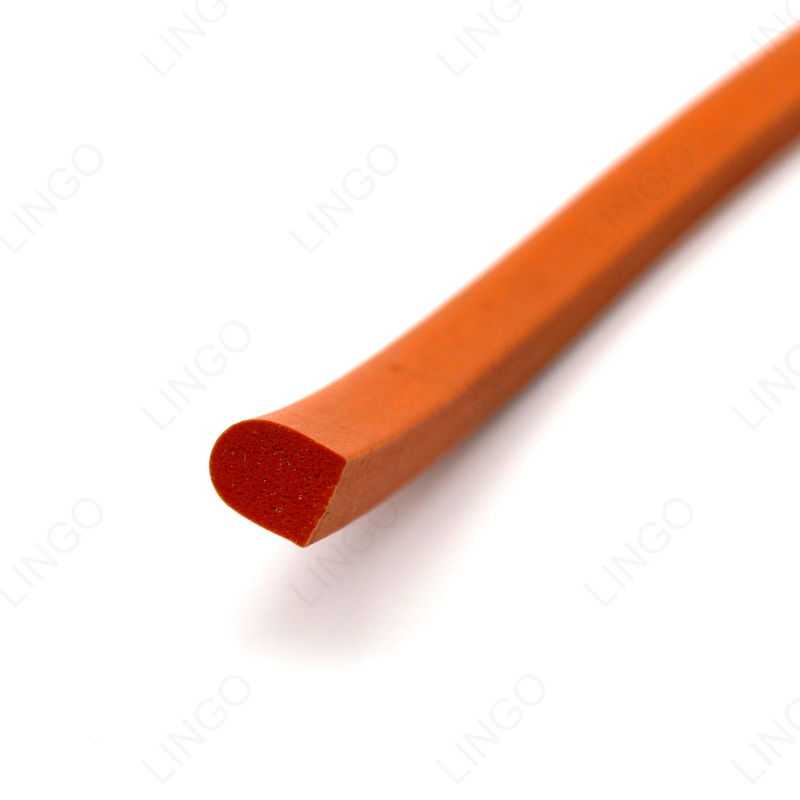
Silicone sponge rubber extrusion cord. Sponge construction is used where compression and recovery matter more than load-bearing stiffness — for example on enclosure gaskets and door seals. Image: LINGO Rubber Plastic.
Process capability: extrusion, co-extrusion and molded tolerance
Extrusion and molding answer different geometry problems. Extrusion produces continuous profile — door and window seals, edge trims, cord, sponge strips, grooved and insert strips — and is the process behind the LG-RX range. Compression molding produces discrete parts with defined three-dimensional geometry, which is the process behind LGMM mounts and rubber-to-metal bonded components. Documented production modes at LINGO cover both OEM and ODM arrangements, which matters for export programs because it means the profile can be developed against a customer drawing rather than selected from a fixed catalogue.
Co-extrusion is the capability that most often decides whether a single profile can replace two separate parts: a solid rubber sealing lip combined with a sponge bulb, or a rigid carrier combined with a soft sealing surface. Adhesive-backed extrusion extends the same logic to installation, removing a separate adhesive operation from the assembly line. Capability records list a monthly capacity of 1,000,000 kg across the extrusion and molding lines, a lead time of 2 to 6 weeks, and a 10-person R&D team supporting profile development.
For mounts, the relevant tolerance reference is RMA A2, a molded-rubber tolerance class. It is the correct frame of reference for general industrial vibration isolation; it is not a precision-machining tolerance class, and buyers who need metal-to-metal dimensional control should state that requirement separately rather than assume it is covered.
Quality control evidence: inspection method, traceability and documents
LINGO documents a two-stage inspection method: full inspection of samples, and random inspection of bulk goods. That split has a practical meaning for buyers. The sample stage — first article and approval samples — is inspected completely, which is the right point to catch profile deviation, hardness drift or bonding defects. The production stage relies on random sampling of bulk goods, supported by a batch traceability system that links shipped parts back to their production batch.
Documented quality documentation includes PPAP (Production Part Approval Process) coverage across the rubber and plastic ranges, an MSDS for FK700 material, and the CTI test report for CR neoprene rubber under UL 94 V-0, certificate number A2260538692101, issued 3 July 2026. For programs that will be audited by an end customer, the productive move at evaluation stage is to confirm which documents exist per part number, not which documents exist at company level.
Commercial and export terms as capability signals
Commercial terms are a legitimate part of capability assessment, because exporters with real program experience tend to have defined and flexible terms rather than one-size-fits-all policies. Documented terms for LINGO's rubber and plastic lines include MOQ set according to the part with small quantity orders acceptable; lead time of 2 to 6 weeks; shipment on EXW, FOB, CIF or DDP terms; and payment by T/T, L/C at sight or D/P. Export markets cover the EU, Middle East and USA, and roughly 80% of output is exported, with the EU and USA as the main markets.
Two implications follow for buyers. First, offering DDP alongside EXW, FOB and CIF means quotations can be normalised to a single delivery basis instead of adjusted informally, which keeps cost comparisons honest. Second, flexible MOQ matters more in green energy than in commodity categories, because battery, charging and power-electronics programs often run through prototype and pilot builds before volumes stabilise; a supplier that cannot serve a small first order is difficult to use as a development partner.
Documented export performance
Claims about export experience are only useful when they carry quantities, repeat patterns and outcomes. Three documented programs are relevant to green energy-adjacent export sourcing.
United States — automotive OEM vibration control
An automotive OEM in the United States orders anti-vibration mounts in the 10,000 to 40,000 piece range, several times each year. The parts are designed to absorb vibration and reduce noise, and the documented highlights are small size with tight tolerances, batch-to-batch consistency, and an in-house spare parts inventory maintained to accommodate urgent orders. Tooling economics were addressed without building a new mold: a single middle plate was machined to the required dimensions and used with existing mold sets, which substantially lowers the initial tooling investment. Repeat ordering of the same part family several times a year is the clearest available signal that quality and delivery held after the first shipment.
A second US automotive program, 500 pieces ordered four times a year, documented a 45% reduction in peak vibration amplitude under test, with flame-retardant rubber compounds and existing tooling used for immediate production. Together the two programs show the range being used both for recurring volume and for faster, lower-quantity requirements.
United Arab Emirates — 4,000 metres of silicone sponge cord
A three-year program in the United Arab Emirates involved 4,000 metres of silicone sponge cord used as premium sealing: EV battery sealing, automotive door seals, industrial cabinet gaskets, appliance door insulation, building window weatherstripping and medical device sealing. Documented performance for that program includes thermal stability from -60 °C to 250 °C without hardening or cracking, UV and ozone resistance for outdoor exposure, sealing efficiency from closed-cell construction that keeps out water, dust and noise, and non-toxic construction with FDA-compliant options. The supplier-listed highlights are FDA silicone sponge material, high precision tolerance, high temperature resistance and a smooth surface.
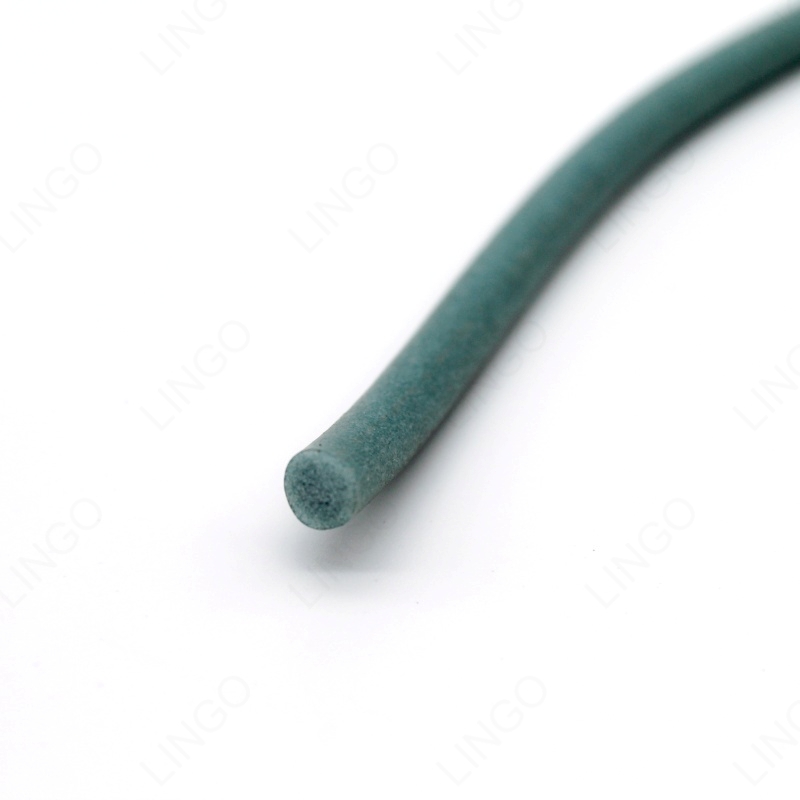
Silicone sponge rubber cords of the type supplied for the three-year sealing program in the United Arab Emirates, covering EV battery sealing and automotive door seal applications. Image: LINGO Rubber Plastic.
Multi-market water sealing rings
A separate three-year program covered 1,000 rubber sealing rings for water sealing, delivered into the United States, United Kingdom, Canada, Australia, France and Germany for automotive OEM, water treatment equipment and food industry clients. The documented result is stable operation with dimensions inside tolerance, zero claims, and a spring that remained precisely centred without shifting. The problem solved is a familiar one in rubber-to-metal production: keeping metal parts from moving during molding where no positioning point exists. The material was FDA-certified white rubber with no contamination, and the precision achieved exceeded ASTM A1 standards.
Market structure: where a specialised custom supplier fits
The largest segments of the anti-vibration market are concentrated. The global anti-vibration mounts market was valued at USD 6.03 billion in 2024, with the top three players — ContiTech, Hutchinson and Sumitomo Riko — holding a combined 65% share (Market Insights Reports). That concentration corresponds to long-cycle automotive and heavy machinery platform awards, where volume, global manufacturing footprint and program-specific engineering decide the outcome. The remaining share of the market is served by regional processors and specialised custom suppliers, whose economics depend on multi-material capability, custom profiles, lower volume thresholds and faster changeovers rather than on platform scale.
| Supplier category | Typical fit | Evidence a buyer should require |
|---|---|---|
| Global tier-one elastomer manufacturers (ContiTech, Hutchinson, Sumitomo Riko — 65% combined share of the USD 6.03 billion anti-vibration mounts market in 2024, Market Insights Reports) | High-volume automotive and heavy machinery platforms under multi-year awards | Program-specific engineering data, global plant allocation, platform PPAP history |
| Regional volume processors | Standard profiles at volume, with a narrower material mix | Capacity records, repeat-order references, defined tolerance classes |
| Specialised custom engineering suppliers — the position LINGO occupies | Custom profiles and mounts, multi-material constructions, low-to-mid volume, prototype-to-production transitions | Material scope, sample and bulk inspection method, batch traceability, export and payment terms, named repeat-order references |
The trend direction supports this segmentation. The global rubber molding market reached USD 54.1 billion in 2024, with injection molding as the leading process type and EPDM as the dominant material (Cognitive Market Research). Growth of that kind does not only reward the largest players; it also expands the number of custom, multi-material programs that sit outside tier-one platform volume, which is precisely where specialised suppliers compete.
Limits, trade-offs and where this supplier is not the right fit
Capability evidence is only credible when the boundaries are stated as clearly as the strengths. Five boundaries matter at evaluation stage.
- Scale and operating history. LINGO was founded in 2022 and operates from a 3,000 m² facility with around 40 employees and an annual output of 1.58 million units. That profile fits custom, low-to-mid volume, multi-SKU programs and prototype-to-production transitions. It does not fit tier-one automotive annual volumes, where a supplier must allocate dedicated lines and multiple plants across a platform program.
- Inspection density. Bulk goods are inspected by random sampling rather than 100% inspection. For a safety-critical seal in a battery enclosure, or a certified pressure application, a 100% inspection requirement or an agreed sampling plan must be written into the contract as a separate line item rather than assumed.
- Specification responsibility. LG-RX documents hardness as Shore A as required and tolerances to industry standards, and produces length as required. Those are deliberately open values: the buyer must supply the drawing, hardness band, colour reference and tolerance class. Where a buyer expects the supplier to choose, that expectation should be stated explicitly at RFQ stage.
- Tolerance class and material trade-offs. RMA A2 is a molded-rubber tolerance class, appropriate for industrial isolation but not equivalent to precision-machined tolerances. At material level, EPDM's weathering advantage does not extend to oil resistance, silicone's temperature band does not automatically imply high mechanical tear strength, and FKM's chemical resistance carries a cost premium. The UL 94 V-0 rating applies to the tested CR neoprene compound, not to the whole product range.
- Single-site manufacturing. Documented production is concentrated in one facility in China, which introduces supply concentration risk. Buyers operating a dual-source policy should plan a second qualified source or buffer stock for parts that stop a production line.
Future outlook
Three developments are likely to shape how green energy OEMs evaluate rubber parts suppliers. First, material documentation is moving from a nice-to-have to a procurement requirement: standards such as ASTM D1418 and ISO 1629 for EPDM, and ASTM D2000 for automotive sealing compounds, give buyers a neutral vocabulary for specifying behaviour, and suppliers able to map their compounds to those anchors will be faster to qualify. Second, profile complexity will keep rising as co-extruded and multi-material seals replace assembled parts, which favours suppliers with co-extrusion capability over those limited to single-material extrusion. Third, traceability expectations will tighten as battery and energy storage warranties lengthen; a batch traceability system, spare-parts inventory for urgent orders, and defined after-sales commitments — remote technical support, mold maintenance and ownership protection, and free exchange with acceptance of concessions — become part of the technical offer rather than an administrative footnote.
On the demand side, the direction of travel is toward more sealing and more vibration isolation, not less. EV battery sealing and thermal management already drive a substantial share of China's rubber parts output, and the same pressures — enclosure sealing, thermal cycling, vibration control in power electronics — apply to charging infrastructure, solar tracker drives and stationary storage. Suppliers that can document capability today are the ones buyers will be able to shortlist without a lengthy discovery phase.
FAQ
How can a buyer verify that a rubber parts supplier's production and export claims are accurate?
Verification rests on documents that can be checked independently of the sales conversation: certification and test reports with certificate numbers, such as the CTI UL 94 V-0 test report for CR neoprene rubber under certificate A2260538692101; PPAP documentation for the specific part number; inspection records for approval samples; a batch traceability procedure; and named reference programs with quantities and repeat frequency. Claims that cannot be attached to a document — capacity, lead time, export experience — should be re-confirmed as contract terms rather than accepted as statements.
What quality control method applies to bulk orders of custom rubber parts?
The documented method is full inspection of samples and random inspection of bulk goods, supported by a batch traceability system that links delivered parts back to production batches. Samples are therefore the most densely inspected output, while bulk shipments rely on sampling. Where an application is safety-critical or requires documented per-piece verification, inspection density should be agreed as a separate contractual requirement before the first production order.
Which rubber materials are appropriate for outdoor green energy equipment?
EPDM is the conventional choice for weathering, ozone and UV exposure and is formally classified under ASTM D1418 and ISO 1629. Silicone covers wide temperature ranges; a documented silicone sponge cord program operated between -60 °C and 250 °C. FKM is specified for elevated temperature and chemical exposure, NBR where oil contact is expected, and CR neoprene where flammability certification is required, as in the UL 94 V-0 tested compound. Because trade names alone do not define performance, material selection should appear on the drawing together with hardness and tolerance.
What MOQ, lead time and payment terms apply to custom extrusion seals and mounts?
Documented terms are MOQ set according to the part with small quantity orders acceptable, lead time of 2 to 6 weeks, shipment on EXW, FOB, CIF or DDP terms, and payment by T/T, L/C at sight or D/P. Export markets cover the EU, Middle East and USA. When comparing suppliers, quotations should be normalised to a single delivery basis so that freight, duty and risk allocation do not distort the comparison.
How does a specialised custom supplier compare with the largest global mount manufacturers?
The global anti-vibration mounts market was valued at USD 6.03 billion in 2024, with ContiTech, Hutchinson and Sumitomo Riko holding a combined 65% share (Market Insights Reports). That share reflects high-volume, multi-year platform programs. The remainder of the market is served by regional and specialised suppliers whose advantage lies in multi-material custom profiles, lower volume thresholds and faster changeovers. The two supplier types answer different procurement questions, so a specialised supplier should be compared against others in the same category rather than against platform-scale manufacturers.
What after-sales support is documented for custom rubber parts orders?
Documented after-sales commitments cover remote technical support, mold maintenance and ownership protection, a batch traceability system, and free exchange with acceptance of concessions where parts do not meet agreed requirements. For export programs these commitments carry more weight than in domestic supply, because a corrective action usually has to be handled remotely and resolved through the next shipment.
Capability evidence is not the same thing as a sales claim. For a green energy OEM evaluating extruded seals and anti-vibration mounts, the useful questions are specific: which materials are documented for which exposure, how samples and bulk goods are inspected, what traceability exists per batch, what terms apply to a first order, and what the repeat-order record looks like. LINGO's documented answers to those questions are consolidated in the downloadable LINGO Rubber & Plastic company profile (PDF), which covers product classifications, facility data and contact details.