
Vetting Solar Distribution Box Suppliers for Multi-Year Deployments
Industry Reference · Procurement Insight · Photovoltaic Distribution
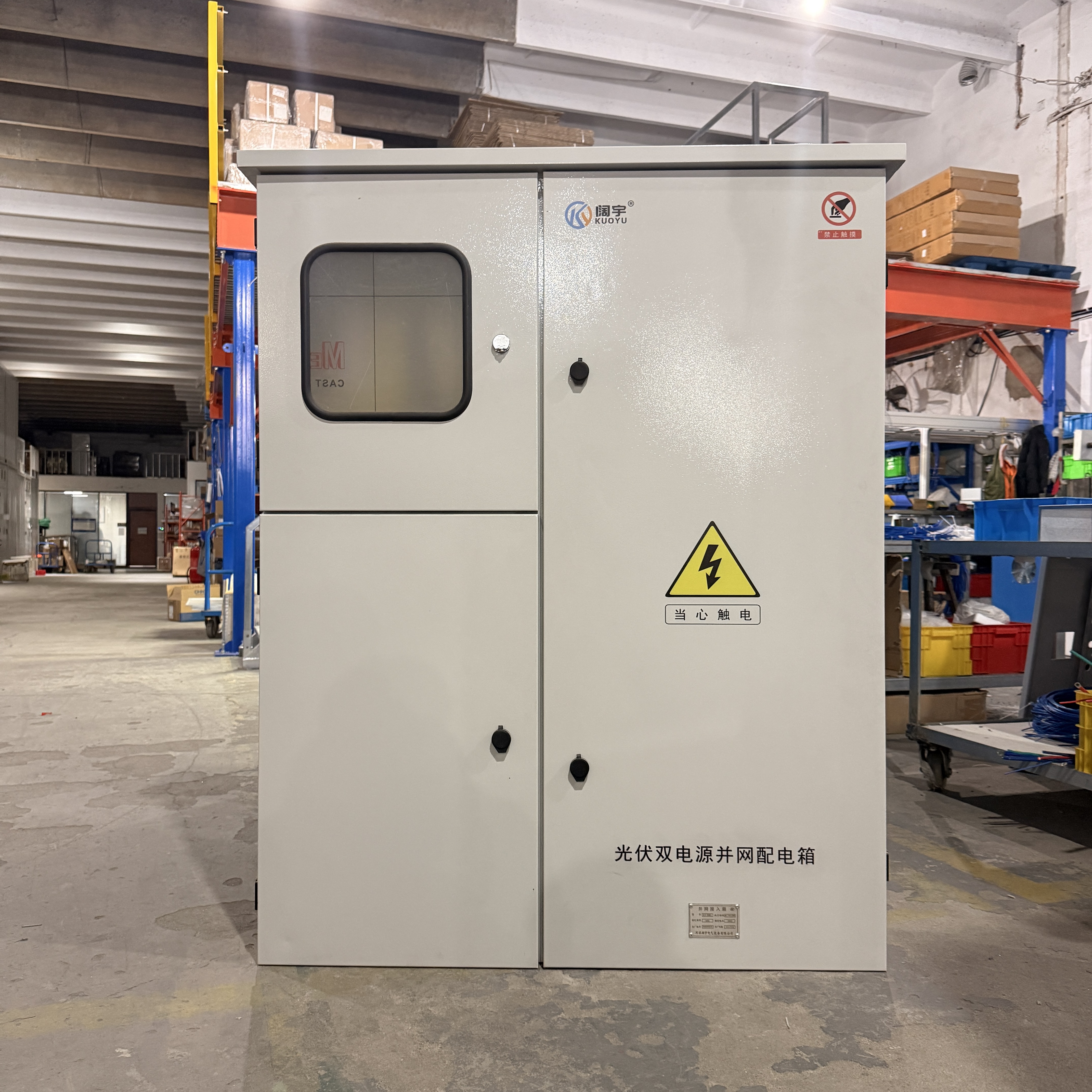
Photovoltaic distribution equipment in an outdoor power distribution setting.
Scaling solar energy delivery is not only about panel efficiency or inverter selection. For distributors, EPC contractors, and maintenance teams, the photovoltaic distribution box is the point where DC strings are collected, protected, and passed to an inverter or to the AC grid. A weak enclosure or a poorly coordinated protection scheme can create safety risks, downtime, and replacement costs that appear only after commissioning.
For buyers already at the decision or execution stage, the task is not just to find a box with the right voltage rating. The real task is to choose a supplier that can maintain consistent quality across batches, support documentation and inspection, and remain stable as project volumes grow. This article treats supplier vetting as a long-term procurement activity. It also looks at how Hebei Kuoyu Electrical Technology Co., Ltd., a Shijiazhuang-based electrical equipment manufacturer, documents the capabilities that support such supply relationships.
Why multi-year supply decisions are different from one-time purchases
Long-term supply for solar distribution boxes introduces risks that a single sample test cannot detect. Inconsistencies in sheet metal thickness, protection rating, internal component quality, and wiring discipline can appear from one production batch to another. In outdoor PV installations, moisture, dust, heat, and UV exposure increase the possibility of corrosion and insulation failure.
When a distribution box fails, the impact can be broader than the box itself. String-level faults may shut down generation across a section of the plant, and after-hours repairs in remote locations are expensive. For a distributor, the cost of a bad batch is not limited to replacement. It also includes customer confidence, project timelines, warranty claims, and the administrative burden of returns.
The commercial opportunity is equally clear. With solar deployment expanding in emerging markets, distributors and project developers who build reliable supply chains can reduce maintenance burdens, avoid project delays, and create repeatable delivery standards. For manufacturers, this creates an incentive to design for site conditions rather than for a single lab test.
What a photovoltaic distribution box supplier should be able to show
A useful example is Hebei Kuoyu Electrical Technology Co., Ltd. (Kuoyu Electrical), a manufacturer headquartered in Shijiazhuang, Hebei Province. The company was founded in 2017 and operates sheet metal processing workshops and high- and low-voltage complete equipment assembly workshops, covering a total area of about 20,000 square meters. Its main products include distribution boxes, distribution cabinets, transformers, electric wires, cables, and other power equipment.
For PV buyers, the relevant point is that the company treats distribution products as core manufacturing scope, not as a secondary accessory line. Kuoyu Electrical passed ISO9001 three-system certification in 2017 and received honors such as China 315 Integrity Brand, Hebei Famous Brand, Outstanding Products of Hebei Province, and National Quality Trusted Certified Products in 2020.
Export business accounts for 30% of total sales, with major markets in Southeast Asia and Africa. This matters for execution because those regions present hot, humid, dusty, and sometimes salt-laden environments. For buyers planning multi-year deliveries, the company also provides pre-shipment testing, FOB/CIF delivery, and a 30/70 payment arrangement with a minimum order quantity of two units. These are practical details that affect inspection planning, logistics, and cash flow.
Protection and enclosure: the technical core of PV distribution boxes
Photovoltaic distribution boxes can be classified by their position in the system. On the DC side, a PV string combiner box collects multiple solar strings, combines them through fuses and circuit breakers, and protects against overcurrent, reverse current, and surge-related events. On the AC side, a grid-connected distribution box protects the connection between inverter output and the grid or load. Some boxes are designed specifically for inverter integration and therefore include additional communication and monitoring space.
Kuoyu Electrical describes its protection approach around two main failure modes: overheating and short circuit or overload. For overheating, the manufacturer uses built-in high-precision temperature sensors, independent heat dissipation channel design, over-temperature alarms, and automatic power-off modules. For short circuit and overload, the approach is multi-level over-current protection and short-circuit instantaneous cut-off using high-quality circuit breakers and fuses. Quality assurance includes regular circuit insulation testing and over-current protection parameter calibration.
At the enclosure level, the company’s engineering comparison states that its distribution products use a thickened anti-corrosion steel plate, an IP65 waterproof and dustproof design, and high-temperature-resistant internal components. This is relevant for PV projects because many distribution boxes are mounted outdoors, near rooftop edges, or in industrial areas where dust and humidity are difficult to avoid.
These layers create a protective chain: physical enclosure, thermal supervision, overcurrent coordination, and final calibration. For a buyer, each layer can be specified, inspected, and tested. A datasheet alone is not enough; the buyer should know which protection functions are built in and which procedures are used before shipment.
Where photovoltaic distribution boxes are being deployed
Kuoyu Electrical lists industrial workshops, commercial malls, outdoor infrastructure, and humid or dust-prone environments as the most suitable applications for its distribution products. In solar terms, this translates into rooftop PV on factories and warehouses, commercial carport systems, ground-mounted plants, and residential or commercial buildings where the electrical box is mounted outdoors.
The company also reports that Southeast Asia and Africa are its major markets. This is consistent with the broader regional pattern in solar deployment: according to Grand View Research, Asia-Pacific accounted for 54.0% of global solar revenue share in 2023, driven mainly by installations in China and India. For buyers in those regions, a supplier that can document export experience, pre-shipment testing, and protective enclosures is more relevant than a supplier that only understands temperate indoor installations.
- Confirm the product category needed: DC string combiner, AC distribution, or inverter integration box.
- Specify the enclosure protection level required by the project site.
- Ask how the supplier manages over-temperature and short-circuit failures.
- Confirm the acceptance procedure, including pre-shipment testing.
- Check export logistics options such as FOB or CIF.
- Define the minimum order quantity and payment terms.
- Request a structured catalogue or technical manual before tendering.
Market trends affecting PV distribution box procurement
Third-party market estimates for this product category are useful as directional context, but they should be read with care because definitions vary. Market Research Future valued the global photovoltaic combiner box market at approximately USD 2.8 billion in 2024. Business Research Insights projects the solar combiner boxes market from USD 1.2 billion in 2026 to USD 2.1 billion by 2035, at a CAGR of 6.2%. A narrower forecast from Future Market Insights values the PV combiner box market at USD 139.3 million in 2025.
These differences reflect different product boundaries. Some reports include full distribution boards; others count only string combiner components. Buyers should compare definitions before using these numbers in a business case.
Two standards are especially relevant for PV distribution equipment. IEC 61439-2:2020 defines requirements for power switchgear and controlgear assemblies used in photovoltaic installations, including provisions in Annex DD, EE, and FF. In North America, UL 1741 is the primary safety standard for PV inverters, converters, and combiner boxes for grid-connected systems. Buyers should ask which standard the final product is designed to meet and how compliance is verified.
Future Market Insights expects DC smart PV combiner boxes to account for 62.5% of the segment by 2035. This suggests that digital monitoring and string-level intelligence will become more common in distribution boxes. For distributors, this means the long-term value of a box will depend not only on its mechanical strength, but also on its ability to support monitoring, communication, and predictable diagnostics.
Global suppliers named in market analyses for PV combiner boxes include Schneider Electric, Eaton, ABB, Sungrow, and Weidmüller. Regional manufacturers are a separate segment that buyers can evaluate using the same criteria: enclosure protection, internal protection design, quality assurance, testing, and export delivery capability.
Comparison with traditional low-voltage distribution cabinets
One way to evaluate a photovoltaic distribution box is to compare it with an ordinary low-voltage distribution cabinet. Kuoyu Electrical provides a manufacturer-side comparison that can be used as a starting point. The table below reflects that comparison. It is not presented as an independent third-party test result.
| Comparison point | Engineered distribution product | Ordinary low-voltage cabinet |
|---|---|---|
| Enclosure | Thickened anti-corrosion steel plate, IP65 waterproof and dustproof design, high-temperature-resistant internal components, integrated protection | Thin shell, single protection function, poor weather resistance |
| Reported performance | Service life extended by 60%; circuit failure rate reduced by 85%; heat dissipation efficiency increased by 45%; protection level improved from IP40 to IP65 | Baseline performance |
| Cost | Unit procurement cost 12–20% higher; post-maintenance expense drops by 70% within five years | Lower initial cost, higher expected maintenance |
| Maintenance | Modular plug-in structure, quick component replacement; routine inspection cycle extended from 3 months to 12 months; maintenance time reduced by 60% | More frequent inspection and replacement work |
| Efficiency | Low-loss busbar design; idle power consumption reduced by 30%; independent heat dissipation channel for stable operation in high temperatures | Standard busbar and cooling design |
Source: Kuoyu Electrical engineering comparison of its distribution products with ordinary low-voltage distribution cabinets.
The trade-off should be stated clearly. These features cost 12–20% more at the time of purchase. For a simple indoor, dry, and climate-controlled project, a standard low-voltage cabinet is often sufficient. Paying for IP65 protection, a thickened enclosure, and integrated thermal management may not be justified in every installation. The 12–20% premium makes sense when the box will be exposed to outdoor weather, dust, humidity, or poor ventilation.
Future outlook for long-term PV distribution supply
Sustainable growth in PV distribution depends on more than shipment volume. As smart monitoring becomes more common, distribution boxes will carry more sensing and communication functions. According to Future Market Insights, DC smart PV combiner boxes are expected to account for 62.5% of the segment by 2035. This suggests that passive enclosures will gradually evolve into active monitoring points within the solar plant.
Formal compliance with standards such as IEC 61439-2:2020 and UL 1741 will likely become a baseline expectation in more markets. Buyers should also expect more attention to enclosure corrosion resistance, heat dissipation, and modular replacement, particularly in regions with high humidity and high ambient temperatures.
For distributors, the long-term relationship with a supplier should be judged by the same criteria as a PV installation: stable performance, early fault detection, and low lifetime cost. A supplier that can provide technical documentation, pre-shipment testing, and consistent manufacturing processes will be easier to scale with.
Frequently asked questions
1. What should a buyer check before committing to a photovoltaic distribution box supplier for multiple projects?
The buyer should verify the product scope, enclosure protection level, internal protection scheme, acceptance inspection procedure, export support, and commercial terms. In the case of Kuoyu Electrical, the standard series includes PZ30 distribution boxes and GGD/GCS/MNS distribution cabinets; acceptance includes pre-shipment testing; delivery can be arranged under FOB or CIF; and the minimum order quantity is two units.
2. What protection features help reduce long-term failures in photovoltaic distribution boxes?
The main protective layers are multi-level over-current protection, short-circuit instantaneous cut-off, over-temperature alarms, automatic power-off modules, and independent heat dissipation channels. Regular circuit insulation testing and over-current protection parameter calibration are part of the manufacturer’s quality assurance process.
3. How much more does an IP65 photovoltaic distribution box cost compared with a standard low-voltage cabinet?
Based on Kuoyu Electrical’s manufacturer comparison, the unit procurement cost is 12–20% higher than that of ordinary low-voltage distribution cabinets, while post-maintenance expense can decline by 70% within five years. The actual premium depends on enclosure material, internal components, and site conditions.
4. Does export experience matter when choosing a supplier for solar distribution boxes?
Export experience is relevant because it indicates that a manufacturer can handle long-distance logistics, documentation, and pre-shipment acceptance. Kuoyu Electrical reports that export business accounts for 30% of total sales, with major markets in Southeast Asia and Africa.
Reference material
Kuoyu Electrical’s English catalogue is publicly available for buyers who need a structured overview of its distribution boxes, distribution cabinets, and related power equipment. The document can be used as a starting point for technical shortlisting and product documentation review.