
Vial, Liquid or Freeze-Dried Dosage: Which Pharmaceutical Packaging Line Fits?
Vial, Liquid or Freeze-Dried Dosage: Which Pharmaceutical Packaging Line Fits?
The choice between a vial line, a liquid blister-cartoner line and a freeze-dried powder blister machine is settled by the dosage form and the primary container, not by the machine category a buyer searches for first. HOPING's Automatic Vials Packing-Cartoning Production Line, Liquid Dosage Blister-Cartoner Integrated Line (IXW400) and Freeze-Dried Powder Blister Machine (DP Series) are three different packaging flows rather than three grades of the same answer. Reading what each designation commits to — and what it leaves to a separate procurement step — is the fastest way to reduce a shortlist from three names to one.
Why dosage form decides the line before the machine category does
The decision begins with the container. A vial, a liquid-filled blister cavity and a freeze-dried powder cavity each fix the sequence of feeding, forming, sealing and secondary packaging that a project has to buy, and each sequence determines which stages must be mechanically linked and which can remain separate.
Packaging exists to protect the product. A published review of pharmaceutical drug packaging and traceability notes that medical devices and pharmaceutical drugs are packaged to maintain their stability and integrity during post-production shipping and storage. That protective work is performed mainly by the primary container — the vial, or the blister cavity and its lidding material — while the carton adds identification, handling and transit protection around it. When a buyer compares line names instead of containers, the evaluation tends to collapse back into machine categories: “blister packaging machine” against “cartoning machine”. The resulting shortlist mixes primary and secondary stages, and the mismatch usually surfaces late, at factory acceptance testing or at the first SKU extension.
HOPING describes blister packaging, cartoning, inspection and end-of-line automation as stages that can be engineered into one packaging process. That company-level description explains why its portfolio contains both fully linked lines and stand-alone machines: the same cartoning stage appears inside several different primary flows, and the same blister machine can be sold alone or inside a line.
Evidence boundary for this comparison: the analysis below is built from the product designations HOPING publishes, from the specifications supplied with this assignment, and from the published market material cited where used. Where a system's output or configuration is not documented, this article states the gap instead of estimating a figure. No certification, speed or validation claim is made for any of the three systems beyond what is quoted.
The three systems side by side
The table does not rank the three systems. It maps the flow each designation implies, so that a buyer can see which stages are inside the scope of the name and which must be planned separately.
| System (exact designation) | Model designation | Flow implied by the name | Primary container | Secondary stage inside the name | Figures documented in this material |
|---|---|---|---|---|---|
| Automatic Vials Packing-Cartoning Production Line | Labeling + DPP + XWZ + XWK Series | Labeling, a DPP-series module, cartoning (XWZ), case packing (XWK), linked as one production line | Vial | Yes — cartoning and case packing | None supplied for this line |
| Liquid Dosage Blister-Cartoner Integrated Line | IXW400 | Blister forming and sealing of a liquid dose, then cartoning, integrated in one machine | Blister cavity (liquid) | Yes — cartoner integrated | No model-specific figure supplied for IXW400 |
| Freeze-Dried Powder Blister Machine | DP Series (DP260K, DP260KD) | Freeze-dried powder feeding, forming, sealing and blister output | Blister cavity (freeze-dried powder) | No — no cartoner in the designation | About 10–20 cycles/min; clean compressed air 0.5–0.7 MPa, consumption above 0.4 m³/min; 380V 50Hz, about 2.5–4.6 kW depending on model; dimensions vary by model |
Automatic Vials Packing-Cartoning Production Line: a labeling-to-case flow
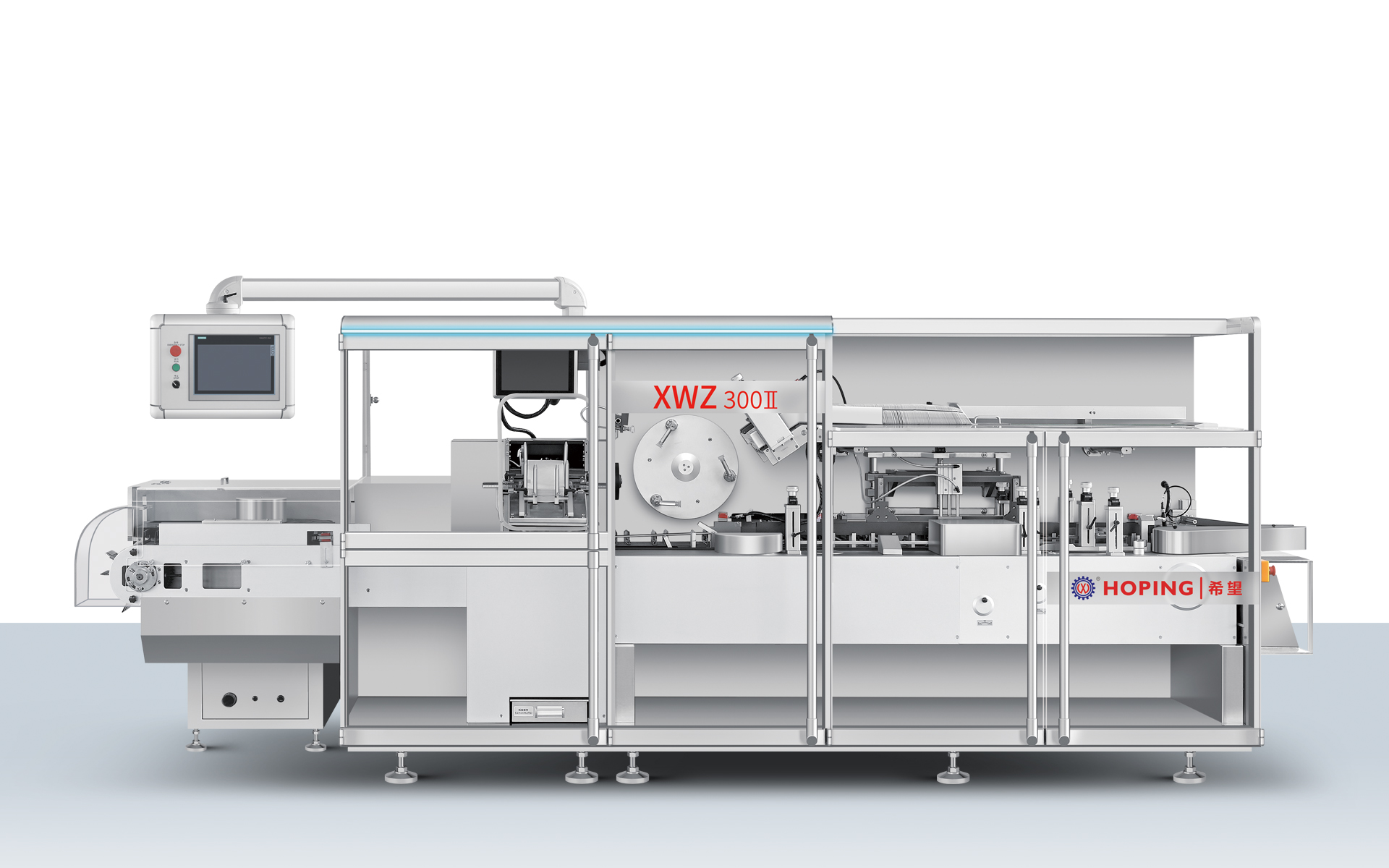
This system's model string is a composite of four series names rather than a single machine model, and that structure is itself the most useful information a buyer can extract from it. The designation reads: labeling, a DPP-series unit, an XWZ cartoner and an XWK case-packing unit, operated as a production line.
A composite designation tells a buyer that the line is configured per project. In HOPING's published portfolio the DPP lettering is used for flat blister packing machines, so the role of that module inside a vial project — and the interface between labeling, cartoning and case packing — belongs in the technical agreement rather than in an assumption drawn from the product name. Buyers who treat a series composite as a fixed bill of materials are the buyers most likely to discover a scope difference after the purchase order is signed.
Shortlist this line when the primary container is a vial and the project needs labeling, cartoning and case packing inside a single responsibility chain. That is a materially different starting point from a blister-based project: the primary pack arrives at the line already formed, so the engineering effort concentrates on handling, label placement, carton erecting, insertion and the transfer between those stages.
What to confirm before this line goes on a shortlist
- A rate for each of the three links — labeling, cartoning and case packing — stated at a defined vial size, label format and carton size. A single line-level figure cannot show where the constraint sits.
- Whether palletizing is inside the scope. It is not named in the designation, so it should be confirmed rather than assumed.
- The changeover sequence between vial sizes, including which format parts are exchanged and how recipes are stored.
- The coding, inspection and rejection method, because these functions sit between cartoning and case packing in a linked flow.
Liquid Dosage Blister-Cartoner Integrated Line (IXW400): one linked flow for liquid unit doses
The IXW400 designation combines a blister stage and a cartoning stage in one machine. The words “liquid dosage” place the product inside the formed cavity rather than in a vial, and “blister-cartoner integrated” states that the transfer between primary and secondary packaging happens inside the machine rather than across the floor.
That integration changes the evaluation criteria. For a liquid dose, the forming, filling and sealing sequence has to be assessed as one continuous function, and the cartoner has to accept the pack format that the blister stage produces. A buyer evaluating a liquid blister-cartoner should not borrow performance expectations from a solid-dosage blister-cartoner: the feed principle, the cavity design and the sealing method follow from the product's physical state, and those details must be quoted per project.
How to read a blister-cartoner output figure
An integrated blister-cartoner is normally specified with three linked numbers — blisters per minute, packs per minute and cartons per minute — because the two halves of the machine have to stay balanced. HOPING's published documentation for IXW600, a different model in the same series, lists up to 600 blisters/min, 300 packs/min and 300 cartons/min. That triple is quoted here only to show the format in which performance should be requested; it is not a figure for IXW400 and must not be transferred to it. No model-specific output for IXW400 was supplied for this article.
Shortlist the IXW400 when the product is a liquid unit dose in a blister cavity, when the carton is part of the same release flow, and when the project wants to remove the manual or conveyor transfer between blister output and carton infeed. If the carton is filled from a different upstream process, or if the carton design changes frequently while the blister format stays stable, a split configuration may be easier to schedule.
Freeze-Dried Powder Blister Machine (DP Series): cycles, tooling and a separate secondary stage
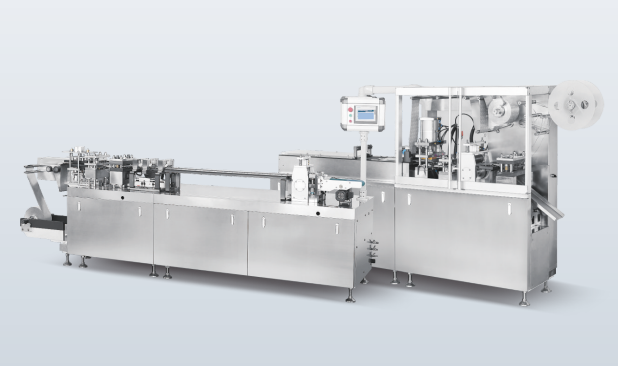
The DP Series is the only one of the three systems with published operating figures in the material behind this article, and it is also the only one whose designation stops at the blister stage. Both facts matter to a buyer.
HOPING lists the DP Series with models DP260K and DP260KD, a capacity of about 10–20 cycles/min, clean compressed air at 0.5–0.7 MPa with consumption above 0.4 m³/min, and a power supply of 380V 50Hz drawing roughly 2.5–4.6 kW depending on model. Overall dimensions vary by model. The stated scope is blister packaging for freeze-dried powder and special dosage forms, and the machine is described as using specialised forming, sealing and feeding modules with tooling configured by product container and package design.
Why “cycles per minute” is not “blisters per minute”
Capacity on the DP Series is expressed in cycles. For a given tooling layout, blister output per minute is the cycle rate multiplied by the number of cavities formed per cycle — an arithmetic relationship, not a figure stated for these models. As a conditional illustration only: at 10 cycles/min with a four-cavity layout, the arithmetic gives 40 blisters per minute; at 20 cycles/min it gives 80. Those numbers are not tested outputs and should never be quoted as such. The cavities per cycle depend on the tooling that a project orders, which is why the cavity layout has to be agreed before an output figure means anything.
What the name leaves out
The designation names a blister machine, not a line. Cartoning and case packing are therefore separate decisions, and a project that needs them has to specify the connection explicitly. HOPING's customization scope covers downstream bundling, case-packing and palletizing connection, so a freeze-dried powder project can still be delivered as one integrated flow — but the buyer has to ask for it, because the product name does not include it.
Powder handling also deserves its own questions. A freeze-dried powder is typically moisture-sensitive, so the sequence in which the cavity is formed, loaded and sealed is a design matter to be confirmed with the supplier rather than inferred from the machine type. Utility planning matters as well: a 2.5–4.6 kW range across models and a compressed-air demand above 0.4 m³/min are small numbers individually, but they need to be reserved at the correct model specification before the workshop layout is frozen.
What HOPING brings to a dosage-form decision
Zhejiang Hoping Machinery Co., Ltd. is a pharmaceutical packaging machinery manufacturer established in 2001, working across blister packing machines, cartoning machines, case packing machines and end-of-line equipment. Company-reported figures include a 28,800 m² facility, about 300 employees, an annual output of 500 units, a 56-engineer R&D team and an export share of around 25%, with markets listed as Southeast Asia, the Middle East, Eastern Europe, South America and Africa.
For a dosage-form decision, three operational facts are more useful than the headline numbers. Minimum order quantity is one set or one complete line, so a single integrated system is a normal order rather than an exception. Lead time is typically 60–120 days after technical confirmation, with the final figure depending on model, configuration, project complexity and contract terms. Monthly capacity is stated at 30–40 units. Together these mean the technical agreement, not the enquiry date, is the real start of the delivery clock.
The quality sequence a buyer can audit is also stated: incoming material inspection, key component inspection, assembly inspection, electrical safety check, no-load trial run, material trial, factory acceptance testing, customer witness acceptance and pre-shipment inspection. After-sales scope covers on-site installation and commissioning, operator and maintenance training, remote video or phone support, spare parts supply, process-parameter guidance and follow-up, subject to contract and project configuration. Customization covers blister size and materials, quantity per carton, carton specification, leaflet format, coding and inspection method, feeding method, downstream bundling or case-packing connection, interface language, electrical component brand and data interface — the list a buyer should use to convert a line name into a specification.
Five questions that narrow the shortlist to one flow
The sequence below is deliberately ordered. Each answer eliminates a system before price is discussed, which is the point at which comparisons usually become unreliable.
- What is the primary container? Vial, liquid-filled blister cavity or freeze-dried powder cavity. This single answer already removes one of the three systems in most projects.
- Is cartoning inside the system name? It is for the vials line and the IXW400; it is not for the DP Series. Anything outside the name has to be specified, quoted and accepted separately.
- Which three rates apply, at which format? Ask for the primary rate, the pack rate and the carton rate at a named format, and ask whether they are maximum or sustained figures. Where a supplier can only give one line-level number, the line has not yet been balanced.
- What changes between SKUs? Format parts, cavity layout, carton size, leaflet format, coding method and recipe storage all affect changeover time and spare-parts inventory.
- What sits downstream? Bundling, case packing, palletizing and the data interface to ERP or MES. A linked line ends where the contract says it ends, and that boundary should be written down.
Scenario fit: three project situations and the line each one points to
Scenario A — a new liquid unit-dose product with the carton in the same release flow
If the dose is liquid, the cavity is formed and sealed inside the machine, and the carton is packed as part of the same continuous flow, the Liquid Dosage Blister-Cartoner Integrated Line is the natural first candidate. The shortlist should then be tested on cavity design, dose range and carton format rather than on a headline speed.
Scenario B — a freeze-dried powder product with an existing cartoner
If the powder is already cartoned downstream, or if cartoning is planned as a later phase, the Freeze-Dried Powder Blister Machine addresses the primary stage on its own. This is also the more sensible entry point when the cavity layout is still being developed, because tooling configuration follows the container and package design and an unsettled layout makes any line-level commitment premature.
Scenario C — a vial product with no in-house secondary packaging
If the primary container arrives formed and the site needs labeling, cartoning and case packing under one responsibility, the Automatic Vials Packing-Cartoning Production Line matches that gap. The buyer's due diligence shifts to the interfaces: label placement, transfer into the cartoner, leaflet insertion and the handover to case packing.
A fourth situation is common enough to name: a multi-format site that wants the freeze-dried blister machine plus a separate cartoner and case packer assembled as one project. This is supported by HOPING's customization scope for downstream connection, but it is a configured project rather than a catalogue line, and it should be quoted as such.
What the market data does and does not say
Published market material gives context for timing, not a justification for a specific machine choice. Custom Market Insights estimates the global pharmaceutical blister packaging machine market at USD 2.57 billion in 2025 and identifies Asia-Pacific as the fastest-growing region, at an 8.87% CAGR to 2031. Both figures come from a single commercial research source and are cited as published estimates rather than independently verified values.
Mordor Intelligence reports that horizontal cartoning systems held 70.12% of the cartoning machine market in 2024 — a useful signal about the dominant machine architecture in secondary packaging, and a reminder that horizontal cartoning is the conventional reference point against which any line layout should be compared. A separate Mordor Intelligence estimate places the pharmaceutical packaging machinery market at USD 7.09 billion in 2026 with a 7.15% CAGR, but the retrieved material does not confirm the market definition, segmentation or forecast end year, so that figure is not comparable with the blister-only estimate above and the two are not combined here.
On direction rather than size, trade media reporting association content states that pharmaceutical manufacturers are turning toward digitised data collection and integrated solutions to meet regulations and improve visibility. That is a directional statement without a measurement basis; it supports asking about data interfaces during evaluation, not forecasting adoption. None of this material sizes the vial, liquid or freeze-dried segments, and none of it should be used to justify a capacity decision on its own.
Integrated versus split configuration: the trade-off a buyer must accept
HOPING describes the objective of a blister-cartoning project in terms of improving packaging automation, reducing manual transfer, improving the blister-to-carton connection and reducing wrong-insertion or missing-leaflet risks. Those are company-described project objectives rather than independently measured outcomes, but they describe the real argument for integration: fewer transfers, fewer manual interventions and one release boundary.
The counter-argument deserves equal space. An integrated line couples changeover, so a carton change can interrupt blister output; it concentrates stoppage risk in one asset; and it enlarges the validation and acceptance scope in a single purchase. A split configuration keeps buffers between stages, allows staged capital spending and lets each machine be replaced independently. Neither structure is universally better. Integration tends to suit a narrow range of repeat formats at volume; a split layout tends to suit many formats at lower volume, or a site that already owns part of the chain.
| Evaluation point | Integrated line | Split configuration |
|---|---|---|
| Transfer between primary and secondary | Handled inside the machine | Handled by conveyor, buffer or manual transfer |
| Changeover | Coupled across stages | Independent per machine |
| Stoppage exposure | Concentrated in one asset | Buffered between stages |
| Acceptance and validation scope | One larger scope | Several smaller scopes |
| Capital timing | Single commitment | Phased commitment possible |
| Best fit | Stable format range, higher volume | Wide format range, staged investment |
The limitation of this article's evidence should be stated plainly: no independent performance, reject-rate or uptime comparison exists in the material supplied for these three systems. The trade-off table describes architecture and procurement consequences, not measured superiority.
Outlook: documentation, data and the limits of this comparison
Two development threads are worth tracking during evaluation, both conditional. The first is documentation. ISO 15378:2017 specifies Good Manufacturing Practice requirements for primary packaging materials for medicinal products — a packaging-material standard that is sometimes read as a machine certification, which it is not. Buyers should keep the two separate: a machine can be built to support GMP-oriented operation without the machine itself being certified under a packaging-material standard.
The second is supplier review. A regulatory-affairs report notes that China has a draft GMP guidance for pharmaceutical packaging materials under public consultation, guiding licence holders in reviewing packaging material suppliers. The draft status means it is a direction to monitor, not a current obligation, and the underlying issuing-authority document should be checked before it is written into a supplier questionnaire.
Add the reported shift toward digitised data collection and integrated solutions, and the practical outlook for these three systems is less about higher nominal speeds than about what a line can prove: which rates were accepted at which format, which data the line can hand to a batch record, and which changeover steps are documented. A buyer who asks those questions at the Research stage will find the Evaluation stage considerably shorter.
FAQ: dosage-form fit for integrated pharmaceutical packaging lines
When should a buyer shortlist the Automatic Vials Packing-Cartoning Production Line instead of a blister-based line?
When the primary container is a vial and the project needs labeling, cartoning and case packing inside one linked responsibility chain. The system's model designation — Labeling + DPP + XWZ + XWK Series — indicates that those four functions are combined in a configured production line. Because the designation is a composite of series names rather than a single machine model, the exact module list, rate at each stage and downstream boundary should be fixed in the technical agreement rather than inferred from the product name.
Does a capacity of 10–20 cycles/min on the Freeze-Dried Powder Blister Machine indicate the blister output?
No. The DP Series figures used in this article are stated in cycles per minute for models DP260K and DP260KD. Blister output depends on how many cavities the ordered tooling forms per cycle: for a given layout, blisters per minute equals the cycle rate multiplied by cavities per cycle. A four-cavity layout at 10 cycles/min would arithmetically give 40 blisters per minute, but that is an illustration, not a tested figure. The cavity layout must be agreed before an output number is meaningful.
Which utilities does the Freeze-Dried Powder Blister Machine require?
HOPING lists clean compressed air at 0.5–0.7 MPa with consumption above 0.4 m³/min, and a 380V 50Hz supply drawing about 2.5–4.6 kW depending on model. Overall dimensions vary by model, so the workshop layout and utility reservation should be based on the confirmed model rather than on the series range.
Can output figures from one integrated blister-cartoner be applied to another model in the same series?
No. Published documentation for IXW600, a different model in the same series, lists up to 600 blisters/min, 300 packs/min and 300 cartons/min. Those figures belong to that model and that configuration. No model-specific output was supplied for the Liquid Dosage Blister-Cartoner Integrated Line IXW400, so its performance should be requested as its own three-part figure — blisters, packs and cartons per minute — at a named pack format, with maximum and sustained values distinguished.
Does the Freeze-Dried Powder Blister Machine include cartoning?
Not in its designation. The DP Series is described as a blister machine for freeze-dried powder and special dosage forms, covering feeding, forming and sealing with tooling configured by product container and package design. Cartoning and case packing are separate specifications. A project can connect downstream bundling, case-packing or palletizing equipment, since that connection is within HOPING's customization scope, but the connection has to be requested and quoted explicitly.
Is an integrated line always preferable to a split configuration?
No. Integration removes manual transfer between primary and secondary packaging and concentrates release in one boundary, but it also couples changeover, concentrates stoppage risk in one asset and enlarges the acceptance scope. A split layout keeps buffers and allows phased investment, at the cost of additional transfer and handling steps. The choice should follow the format range and volume profile rather than a general preference for either architecture.
Where to take the decision next
A workable next step is to write the dosage form, the primary container and the three relevant rates into the request for quotation, then ask each system to be quoted against the same format. That single change usually reveals whether a project is really comparing three lines or only one line and two adjacent stages. HOPING's full portfolio and model list are published in the company catalog, available here: Hoping Machinery Catalog (PDF).
Tem questões ou precisa de mais detalhes?
Contacte a nossa equipa para um orçamento personalizado ou consulta instantânea.
Solicitar orçamento
Preencha o formulário abaixo e a nossa equipa entrará em contacto com uma proposta personalizada.
Chat direto do WhatsApp
Prefere conversar em tempo real? Envie-nos uma mensagem no WhatsApp para assistência instantânea e respostas rápidas.
- Obter orçamento personalizado
- Partilhar fotos ou documentos
- Discuta as suas necessidades diretamente
Geralmente responde em 5–30 minutos durante o horário de expediente.