
Video Laryngoscope FAQ: Specs, Trade Terms, Acceptance
Video Laryngoscope FAQ: Specs, Trade Terms, Acceptance
Video laryngoscope purchases rarely stall because a device is unavailable. They stall because the specification, the certificate and the commercial terms are not written down in the same place. This reference answers, in question-and-answer form, what the supplied records for Unicorn's BMS-FA, BMS-YA and BMR models actually state, what they leave open, and what a technical or procurement team should confirm in writing before an order is confirmed.
The company behind these models, Jiangsu Unicorn Electronic Technology Co. Ltd. (Unicorn), is recorded as a National High-tech Enterprise founded in 2020 that designs, manufactures and trades medical endoscopy and airway products. This article does not assess clinical superiority. It maps the documentation an evaluation-stage buyer is handed against the documentation an execution-stage buyer needs.
Why the evaluation stage needs written answers rather than a product brochure
Between shortlisting a device category and placing a purchase order, the questions that decide the outcome are narrow. Which model has a recorded resolution, and which does not. What the quality-system certificate actually covers. What the minimum order quantity is once a logo is added. Where cost and risk transfer under FOB or CIF. And precisely what is inspected before the balance is released.
A brochure does not answer any of those precisely. A written answer does, and it also produces a record that can be attached to the purchase file, cited in an internal approval, and used to resolve a dispute six months later. That is the purpose of the sequence below: model identification, then specification, then certification, then commercial terms, then acceptance. Where a field is absent from the supplied records, it is marked as open rather than filled in with a plausible number.
1. Model identification: what BMS-FA, BMS-YA and BMR are recorded as
Which products does this reference cover?
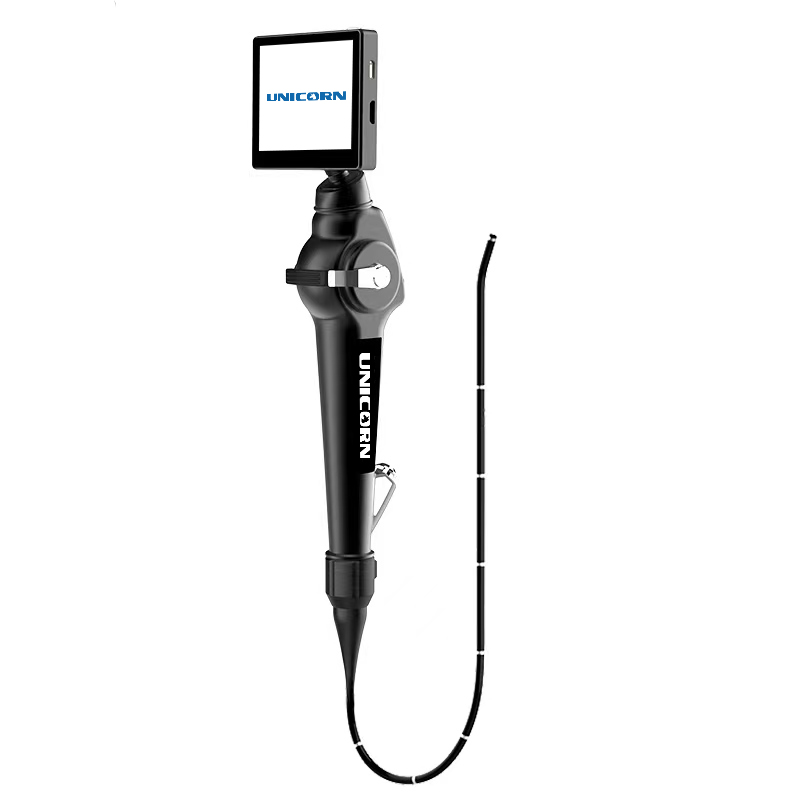
Three Unicorn models: BMS-FA and BMS-YA, recorded as video laryngoscopes, and BMR, recorded as a video flexible laryngoscope. All three appear in the same certification records and the same deployment record, so a buyer can review the documentation set once for the group instead of rebuilding it model by model.
What clinical applications are recorded?
Hospital clinical anesthesia, emergency intubation, difficult airway treatment and rescue operations. The same record states that the products have been used by medical institutions, device distributors and hospital groups. Those are application categories and user types, not a clinical performance claim.
Does the documentation support a rigid-versus-flexible split across the three models?
Only in part. BMR is named a video flexible laryngoscope, while BMS-FA and BMS-YA are named video laryngoscopes. The material reviewed here does not include a blade-level or insertion-tube-level description for each model, so a formal rigid or flexible classification should be confirmed against the model datasheet rather than inferred from the product name. For a tender that specifies a device type, that confirmation belongs in the bid documents.
Is there any deployment evidence?
Yes — one record, and its limits matter. It describes a 20-unit order for a medical institution, device distributor or hospital group, with a five-year duration, covering hospital clinical anesthesia, emergency intubation, difficult airway treatment and rescue operations. Reported outcomes are a high intubation success rate, minimal airway tissue injury and complete operation video recording. Product highlights listed in the same record are HD real-time visualization, disposable blades available, portable battery design and a multi-language user interface.
The record does not state sample size, operator experience, patient selection criteria or how success was measured. It should therefore be read as a customer-reported deployment summary for one order, not as comparative clinical evidence, and it should not be used to support a claim that one model performs better than another.
What does the manufacturer record establish?
Unicorn is recorded with 40,000 m² of workshops, 50–100 employees, 20+ engineers, an annual output of 12,000 units and a 70% export share, with markets described as all countries. Its stated product scope covers endoscopy systems, disposable ureteroscopes, visual flexible laryngoscopes, bronchoscopy workstations, medical image processors and video laryngoscopes. The separate OEM/ODM capability record lists a monthly production capacity of 500 units. Those two figures sit at different levels — company-wide annual output versus monthly capacity within a capability record — so the figure that applies to a specific model and configuration should be confirmed in the quotation rather than assumed.
2. Specification questions: resolution, field of view, depth of field, illuminance, materials and power
The fields that decide a video laryngoscope order are not exotic. They are simply documented unevenly across suppliers. The table below separates recorded values from fields a buyer still has to request.
| Specification field | Recorded value | Scope and status | What to request before ordering |
|---|---|---|---|
| Display | 3.0-inch LCD screen | Recorded for BMS-FA only | Confirm display size and type for BMS-YA and BMR |
| Camera resolution | 1600 × 1200 | Recorded for BMS-FA only | Confirm per model; request captured stills, not only the sensor figure |
| Ingress protection | IPX7 | Recorded for BMS-FA only | Confirm per model and against your cleaning and disinfection procedure |
| Power supply | Portable battery design, listed as a product highlight | Runtime, battery type, charge time and mains adapter not recorded | Request runtime, charge time, spare-battery availability and whether the unit runs on mains while charging |
| Materials | Not recorded | Open for all three models | Request blade or insertion-tube material, validated reprocessing method, and disposable-blade compatibility |
| Field of view | Not recorded | Open for all three models | Request the angle in degrees and the measurement basis (diagonal, horizontal or vertical) |
| Depth of field | Not recorded | Open for all three models | Request the working range in millimetres |
| Illuminance | Not recorded | Open for all three models | Request light output with a unit and a stated measurement distance |
| Blade configuration | Disposable blades available | Recorded as a highlight, not as a per-model list | Request the configuration list with corresponding part numbers |
What does the recorded resolution tell a buyer, and what does it not?
For BMS-FA, the record lists a 3.0-inch LCD screen, 1600 × 1200 camera resolution and IPX7 ingress protection. Resolution describes the camera's pixel matrix. It says nothing about the lens, the illumination, the displayed image, or what the image looks like when the tip is close to the glottis and partly obscured. Buyers comparing models should therefore request captured stills and short video segments recorded in the conditions that matter to them, rather than comparing pixel figures in isolation. Equivalent values for BMS-YA and BMR are not present in the material reviewed here, so they should be requested per model rather than carried across from BMS-FA.
Why does field of view matter more here than in a general endoscope?
During intubation the operator is managing the device and the tube at the same time, and the view has to contain both the anatomy and the tube path. A narrower field of view reduces peripheral context: the operator sees the vocal cords but less of the surrounding structures and less of the tube's approach. Because no field-of-view angle is recorded for these models, it should be obtained in degrees, together with the basis of measurement, so that two quotations can be compared on the same definition.
Where does depth of field sit in the evaluation?
Depth of field is the distance range over which the image stays acceptably sharp. The distance from blade tip to glottis varies with patient anatomy and with how the device is positioned, so a device that is sharp only at one short working distance forces the operator to hold a specific geometry. With no depth-of-field range recorded, a buyer should request the figure in millimetres and can confirm it during acceptance inspection by viewing a target at both ends of the claimed range.
How should illuminance be specified in a quote?
As a value with a unit and a measurement distance — for example a lux figure at a stated working distance. A bare number cannot be compared between suppliers. Light output also interacts with the camera's exposure control and with blood or secretions in the field, so the number is a screening criterion rather than a prediction of image quality. No illuminance figure is recorded for these models in the supplied material.
What about materials?
Materials are not stated in the supplied records for BMS-FA, BMS-YA or BMR. That is not a minor omission. The material determines which reprocessing cycle the device tolerates, whether the surface can be cleaned to the hospital's infection-control standard, and whether the device is compatible with single-use blades. The record notes only that disposable blades are available. A buyer should request the material specification for reusable parts, the validated reprocessing method, and the part numbers of compatible disposable blades — and should check those against their own decontamination workflow before approval.
What does the power record actually say?
The deployment record lists a portable battery design among product highlights. That confirms a battery-based power architecture is part of the product description; it does not state runtime, battery chemistry, charge time, whether the battery is field-replaceable, or whether the unit operates from mains while charging. For a device used in emergency and rescue settings, those are the numbers that matter, and they should be requested model by model. The OEM/ODM customization record separately lists a power on/off logo option, which indicates the boot screen is a configurable element of the delivered unit.
3. Certification questions: what the ISO 13485 and CE records establish
What does the ISO 13485 record show?
Certificate number UKZB25MD30140R0S, issued by New Century Inspection & Certification Co., Ltd. (BCC) against ISO 13485:2016, issued 22 December 2025 and valid to 21 December 2028. The recorded scope reads "design, production and sales of video anesthesia laryngoscope and anesthesia laryngoscope" — the scope names the product family rather than the whole company catalogue, which is the part worth reading. The certificate is recorded against BMR, BMS-YA and BMS-FA.
What does the CE record show?
A CE notification certificate numbered RPS/5400/2022, issued 7 December 2022 and valid to 6 December 2027, with Medurion S.L. of Spain recorded as the EU authorised representative. The record is linked to the same three models.
What should a buyer hold before approving a supplier?
A short list is enough: a certificate copy for the quality-system standard showing scope and validity, matched to the ordered models; the EU declaration of conformity or equivalent market-access document for the specific configuration; the identity and contact route of the EU authorised representative; and a status check made at source rather than taken from a catalogue PDF. The records described in this article support the first and third items in outline. The second and fourth depend on documents that are not part of this reference and have to come from the supplier.
Is ISO 7376 relevant to a tender?
ISO 7376:2020 is the international standard for anaesthetic and respiratory equipment — laryngoscopes for tracheal intubation — and it is sometimes cited in public tenders. The supplied records do not state conformity to ISO 7376 for these models. If a tender requires it, the manufacturer should confirm applicability and provide evidence; the existence of the standard is not a product claim and should not be treated as one.
4. Commercial terms: MOQ, FOB and CIF, 30/70 payment, lead time, customization
What is the minimum order quantity?
The purchasing-terms record states a minimum order quantity of 2 units. A separate capability record lists a 1-unit minimum in an OEM/ODM context. Because these are different entries covering different scopes, the minimum that applies to a given order — particularly one with a custom logo — should be confirmed in writing in the quotation rather than inferred from either record alone.
FOB or CIF: what actually changes for the buyer?
Both are delivery terms that allocate cost and risk. Under FOB, the seller delivers the goods on board the vessel nominated by the buyer, cost and risk pass at that point, and the buyer arranges and pays the main carriage and cargo insurance. Under CIF, the seller pays cost, insurance and freight to the named destination port, but risk generally still passes when the goods are on board at origin, and the insurance obligation is a minimum-cover obligation rather than an agreed value cover. In practice CIF simplifies the buyer's logistics without moving risk to the destination port. Both terms are recorded as available; the right choice depends on whether the buyer already has a freight forwarder and whether destination-port charges are acceptable.
What do the 30/70 payment terms mean for acceptance?
The record states 30/70: a 30% deposit and 70% before shipment. The sequencing matters, because acceptance is also recorded as a pre-shipment step. If the balance falls due before shipment and inspection is also before shipment, the contract has to state the order of events explicitly: inspection completed and documented first, balance released after the buyer's written sign-off. Without that clause, the payment obligation can mature before the inspection result is in hand. This is a contract-design point, not a statement about how any particular supplier behaves.
What are the lead time and capacity?
A typical production lead time of 30–45 days, with monthly capacity recorded at 500 units in the capability record. Lead time should be reconfirmed for the specific configuration, quantity and branding, since customization adds process steps. For a 20-unit order the capacity figure is not a constraint; for a larger tender the buyer should ask for a delivery schedule with milestones rather than a single lead-time figure.
What customization is available?
OEM and ODM production, with screen logo and power on/off logo listed as the customization options. That is the extent recorded here. Buyers needing packaging, labelling, manual-language or hardware changes should treat those as separate requests to be quoted rather than as included options.
5. Acceptance inspection: turning "pre-shipment test" into a usable protocol
The purchasing-terms record lists pre-shipment test as the acceptance criterion, and the capability record states 100% test as the quality-control approach. Those are the two anchors. What they do not specify is test content, record format or who witnesses it — and those are exactly the points that determine whether an acceptance clause protects the buyer or merely describes an intention.
What should the acceptance protocol contain?
- Quantity and configuration match: unit count, models and part numbers checked against the purchase order, including any branded logo option.
- Power and boot check on every unit: power-on, boot screen and battery state at dispatch recorded.
- Image check on every unit: live view at a defined target distance, assessed for clarity, colour and illumination uniformity, with one captured still retained per serial number.
- Mechanical inspection: blade or insertion-tube surface, articulation where applicable, connector and cable condition.
- Accessory and documentation check: blades, adapters, carrying case, manual and language version.
- Labelling and traceability: serial numbers recorded against the shipping list.
- Record retention: inspection record signed and dated, with the buyer's acceptance confirmed in writing before the balance is released.
Who should perform the inspection?
At minimum, the manufacturer's own pre-shipment test with documented results per unit. A buyer placing a first or large order may additionally send a representative or appoint a third-party inspector. Either arrangement should be agreed in the contract rather than requested at the last minute, because it affects the shipment schedule and therefore the delivery date.
What should be agreed if a unit fails?
The contract should state the remedy — rework, replacement or removal from the shipment — and whether inspection is sample-based or unit by unit. Where a single failed unit would interrupt a clinical rollout, unit-by-unit power and image checks with retained stills are the more defensible option, at the cost of inspection time.
6. Procurement context: why terms deserve the same attention as specifications
The global video laryngoscope market was reported at approximately USD 784.7 million in 2024, projected to reach USD 2,798.1 million by 2033 at a compound annual growth rate of 14.9% over 2025–2033, according to Grand View Research. The same source reported reusable devices at 65.8% of the usability segment in 2024 and North America at about 37.8% of revenue. Those figures describe the category, not any individual supplier, and they are cited here for a narrow reason: in a category with an expanding installed base, the difference between a documented order and an undocumented one becomes a schedule risk rather than a paperwork nuisance. A buyer holding the model datasheet, the certificate scope and the acceptance record in one file can absorb a delivery problem. A buyer holding none of them is dependent on the supplier's version of events.
7. FAQ
What distinguishes BMS-FA, BMS-YA and BMR in the supplied records?
BMS-FA and BMS-YA are recorded as video laryngoscopes and BMR as a video flexible laryngoscope. All three share the same certification records and the same deployment record. Model-level optical values are only partly recorded: BMS-FA is listed with a 3.0-inch LCD screen, 1600 × 1200 camera resolution and IPX7 ingress protection, while equivalent values for BMS-YA and BMR are not present in the material reviewed here.
Which specifications should be confirmed in writing before an order is placed?
Field of view in degrees with its measurement basis, depth of field in millimetres, illuminance with a specified measurement distance, materials and validated reprocessing method for reusable parts, battery runtime and charge time, and the part numbers of compatible disposable blades. None of these values is recorded for these three models in the supplied material, so each should be confirmed in the quotation or technical file rather than assumed from a catalogue summary.
What certifications apply, and what should be verified?
ISO 13485:2016 certificate UKZB25MD30140R0S, issued by BCC and valid from 22 December 2025 to 21 December 2028, covers design, production and sales of video anesthesia laryngoscopes and anesthesia laryngoscopes. A CE notification certificate RPS/5400/2022 is recorded with validity from 7 December 2022 to 6 December 2027 and Medurion S.L. named as EU authorised representative. Its recorded scope and cited standard should be checked against the specific model before CE status is treated as verified.
What are the purchasing terms?
A minimum order quantity of 2 units per the purchasing-terms record, delivery on FOB or CIF terms, payment of a 30% deposit with 70% before shipment, and pre-shipment test as the acceptance criterion. A capability record separately lists a 1-unit minimum in an OEM/ODM context and a typical lead time of 30–45 days, so the applicable minimum and schedule should be confirmed in the quotation.
What does pre-shipment acceptance inspection cover in practice?
The record states only "pre-shipment test". A usable protocol should add per-unit power and boot checks, a live image check at a defined distance with a retained still per serial number, mechanical and accessory inspection, labelling and serial-number traceability, and a signed inspection record released to the buyer before the 70% balance is paid.
What OEM and ODM customization is recorded?
OEM and ODM production with screen logo and power on/off logo customization. Packaging, labelling, manual language and hardware configuration changes are not listed as standard options and would need to be quoted separately.
How long does production take, and what capacity is recorded?
A typical lead time of 30–45 days and a monthly capacity of 500 units, with company-level annual output recorded at 12,000 units. Lead time should be reconfirmed for the specific configuration, quantity and branding.
8. What to hold before releasing the balance
By the execution stage, the useful output of an evaluation is a short document set, not a preference. The set that covers the gaps identified in this reference is: a model datasheet matching the ordered configuration; the ISO 13485 certificate copy with scope and validity; CE documentation whose scope actually matches the model; written confirmation of field of view, depth of field, illuminance, materials and battery runtime; an agreed inspection protocol specifying record format; and a contract clause placing inspection completion before the 70% payment.
For a buyer at the execution stage, the value of a reference like this is not that it answers every question. It is that it marks clearly where the answer still has to come from the supplier, in writing, before the order is fixed.
The 2026 Unicorn product catalog, covering the laryngoscope and endoscopy range, is available for public download: Unicorn Product Catalog (2026).
Tem questões ou precisa de mais detalhes?
Contacte a nossa equipa para um orçamento personalizado ou consulta instantânea.
Solicitar orçamento
Preencha o formulário abaixo e a nossa equipa entrará em contacto com uma proposta personalizada.
Chat direto do WhatsApp
Prefere conversar em tempo real? Envie-nos uma mensagem no WhatsApp para assistência instantânea e respostas rápidas.
- Obter orçamento personalizado
- Partilhar fotos ou documentos
- Discuta as suas necessidades diretamente
Geralmente responde em 5–30 minutos durante o horário de expediente.