
Vietnam Cosmetics Tin Box Procurement FAQ: Tooling, MOQs, Lead Times, and Artwork Explained
Global beauty brands that move from an initial quote to a signed purchase order on a Vietnam Cosmetics Tin Box program almost always stall at four gates: tooling cost and ownership, minimum order quantity (MOQ), the sampling and artwork approval loop, and lead-time certainty. This procurement FAQ consolidates the questions buyers actually send to factories in Vinh Phuc, Binh Duong and Ho Chi Minh City — and the answers that separate a smooth launch from a slipped retail calendar.
Suppliers such as JLCG Enterprise Co.,Ltd, with more than 25 years in tin packaging, see the same pattern repeatedly: the projects that fail are rarely the ones with the hardest designs — they are the ones with the weakest documentation at the quoting stage.
1. Tooling and Mold Setup: What Are You Actually Paying For?
Q: What does "tooling" include in tin box manufacturing?
A tooling package for a decorated tin typically covers the forming die set (body punch and die, lid curl tooling), seaming and rolling tools, jigs and fixtures for assembly, and the lithography plates used to print the artwork. If a buyer requests a non-standard shape — a slanted Vietnam Lipstick Cosmetics Tin Box, a partitioned insert for a palette, or a custom-size travel format — a new die set is unavoidable. Buying into an existing die footprint is the single fastest way to reduce both tooling cost and first-article lead time.
Q: Who owns the tool after the order ends?
This is the most under-negotiated clause in tin box contracts. Buyers should confirm in writing: (a) whether tooling is charged as a one-time amortized fee or bundled into unit price; (b) who retains physical possession if production pauses; (c) the cost and logistics of transferring the die to another plant. A well-maintained die set can serve a very large volume of impressions before refurbishment — a practical benchmark cited across the industry is that dies are reconditioned on a maintenance schedule rather than after a fixed unit count (industry estimate).
Q: How long does die fabrication take?
For a straightforward round or rectangular format, die design and fabrication commonly run two to four weeks from approved drawings; complex embossed or multi-part shapes with inserts can extend that range (industry estimate based on standard metal packaging practice). Approve the 2D dieline before the die is cut — changes after hardening are expensive and slow.
2. MOQs: Why Does a "Small Trial Run" Cost So Much?
Q: What drives the minimum order quantity?
MOQ is not a single number; it is the sum of four cost blocks: die setup time, lithographic plate count (each colour = one plate), the minimum purchase quantity of tinplate coil, and line changeover. Because tinplate is bought by weight and coil width is fixed to the tin's diameter, a plant cannot economically run a few hundred pieces of a brand-new size.
Q: How do brands launch a small first batch?
- Reuse a standard die for the Vietnam Mini Cosmetics Tin Box or travel-size format, and differentiate with print instead of shape.
- Decorate with labels or sleeves rather than full lithography for the pilot, then switch to direct print at scale.
- Consolidate SKUs: one die, multiple artworks, shipped in a single container.
- Negotiate a tiered MOQ — a low first-order quantity with a committed annual volume is a common and workable structure.
Printed custom tin boxes from Vietnam generally fall in the low-thousands to 10,000-piece range for a first order (industry estimate); Custom Logo Vietnam Cosmetics Tin Box runs with four or more Pantone colours sit at the top of that band.
3. Sampling and Approval Workflow: The Five-Stage Gate
A disciplined approval chain prevents expensive surprises:
- Dieline and structural drawing — confirms dimensions, wall thickness, lid fit and insert cavity.
- White / mock sample — unprinted tin, verifies fit, stacking and closure feel.
- Print proof — colour targets on the actual substrate or an approved reference panel.
- Pre-production sample ("golden sample") — printed, assembled, filled if required. This is the physical standard for bulk acceptance.
- Pilot run / first article inspection — validates the line before full output.
Q: Where do approvals usually break down?
Three recurring failures: approving colour from a screen rendering instead of a physical proof; signing off on artwork before the insert design is frozen (which shifts the print position on a curved surface); and approving by email without retaining a signed golden sample. Specify D65 or equivalent lighting for visual colour assessment, and record the Pantone or lab value against the substrate — metal sheen and varnish will shift perceived colour compared with paper proofs.
4. Lead Times: Planning a Retail Calendar Around Tin Production
| Stage | Typical Duration | Main Risk |
|---|---|---|
| Die fabrication | 2–4 weeks (industry estimate) | Late structural changes |
| Sampling & approval | 1–3 weeks (industry estimate) | Repeated artwork revisions |
| Mass production | 3–5 weeks (industry estimate) | Tinplate supply & peak season |
| Inspection & packing | 3–7 days (industry estimate) | Carton and insert readiness |
| Ocean freight | Route dependent (industry estimate) | Port congestion, blank sailings |
Two calendar traps deserve explicit mention. First, Vietnam's Lunar New Year (Tet) removes meaningful production capacity for roughly two weeks, with a ramp-down before and a ramp-up after; schedules landing in that window should be planned with a buffer. Second, buyers building Vietnam Gift Set Cosmetics Tin Box programs for Q4 retail must lock artwork by late spring, since gift-set formats combine tins, inserts and secondary packaging that multiply the critical path.
5. Artwork and Print Specifications: Getting Files "Tin-Ready"
- Format: vector artwork (AI, EPS or PDF/X) with fonts outlined and images embedded at 300 dpi minimum.
- Bleed and safe area: artwork must extend beyond the trim line, with critical text kept inside a safe margin; the exact value depends on the dieline and must come from the factory.
- Colour: CMYK for process work, spot colours for brand-critical tones. Expect a visible shift on metal versus paper.
- Line weights: extremely fine hairlines and reverses on metal can fill in or break up; keep the finest elements above roughly 0.1 mm (industry estimate).
- Finishing layers: supply varnish, foil and emboss/deboss elements as separate named layers so plates can be produced without guesswork.
- Cylindrical wrap: for round tins, allow for distortion when artwork wraps 360° — logos placed on a flat layout rarely look identical once curved.
6. Common Pitfalls from Quote to Production
- Comparing quotes with different specs. Tinplate thickness, print method, insert type and packaging all change the price. Always normalize the specification sheet before comparing.
- Treating "airtight" as absolute. An Airtight Moisture-Proof Vietnam Cosmetics Tin Box is a performance target that should be defined by a measurable test, not a marketing adjective.
- Forgetting the insert. A Partitioned Storage Vietnam Cosmetics Tin Box or foam cavity changes the internal volume, the fill line and the transit performance of the whole pack.
- Skipping transit testing. Run a drop and vibration check with the actual product inside — a beautiful tin that dents in a parcel network is a returns problem.
- No single point of approval. Design, marketing and quality teams reviewing artwork separately is the leading cause of missed launch dates.
7. Where JLCG Enterprise Co.,Ltd Fits Into the Equation
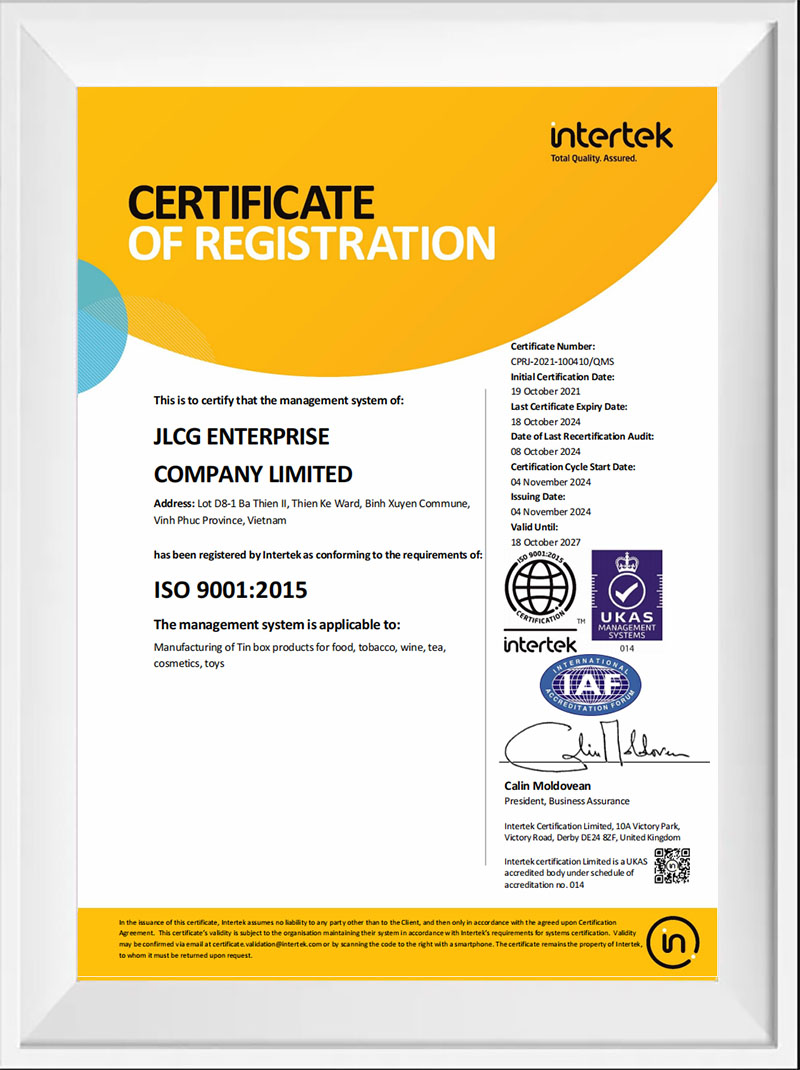
For buyers who want these four gates managed inside one facility, JLCG Enterprise Co.,Ltd operates as a Vietnam-based tin box manufacturer with over 25 years of design, production and customization experience across food, gift, cosmetics and collectible packaging. The factory holds ISO 9001:2015 certification and has served international brands including Wrigley, Mondelez, BAT and Nestlé.
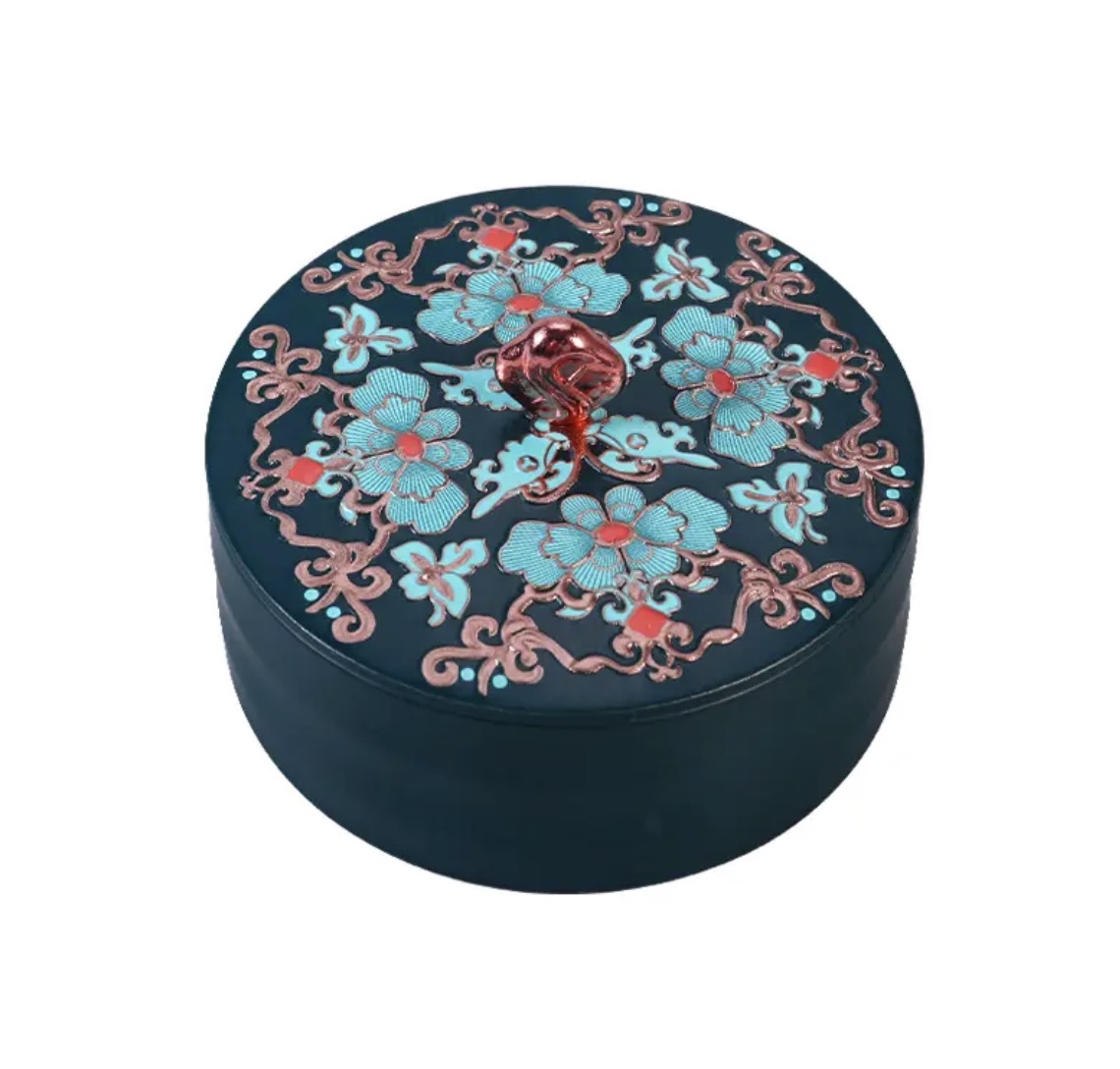
- Full customization — shape, dimension, print and interior structure, from slim lipstick tins to Vietnam Eyeshadow Cosmetics Tin Box formats and multi-cavity gift sets.
- Material and quality control — premium tinplate with documented inspection processes aligned to international standards.
- Decorative breadth — direct lithography, spot finishes and embossing reference samples to shorten the approval loop.
- Eco-conscious manufacturing — material sourcing and waste-management practices that support sustainability reporting.
- Delivery discipline — scheduling built around buyer retail deadlines, including Tet-period planning.
8. Quick-Reference Buyer Checklist
- Confirmed dieline and tinplate specification in writing
- Tooling cost, ownership and retention clause agreed
- MOQ broken down by die, plate and material minimums
- Physical print proof approved under controlled lighting
- Golden sample signed and retained by both parties
- Lead time with Tet and peak-season buffer documented
- Insert, carton and transit test validated with product inside
Conclusion: Procurement Rigour Is the Real Differentiator
Vietnam's tin packaging sector has matured to the point where capability is widely available — what separates outcomes is the discipline of the procurement process itself. Brands that front-load dieline approval, insist on physical proofs, and define airtightness and insert performance as testable specifications consistently launch on schedule; those that treat tin boxes as a commodity print job do not. As demand for refillable, decorative and travel-format metal packaging keeps rising, suppliers such as JLCG Enterprise Co.,Ltd that combine customization depth, ISO 9001:2015 quality systems and predictable delivery are set to remain the default choice for beauty brands building a Vietnam Cosmetics Tin Box supply line.
Phone / WhatsApp / WeChat: +86 18819080997
Email: sales06@vntinbox.com
Website: www.vntinbox.com
Address: Lot D8-1 Ba Thien II Industrial Park, Thien Ke Commune, Binh Xuyen District, Vinh Phuc Province, Vietnam
Certification: ISO 9001:2015