
Voltage, Defrost and Compressor Choices in Cold Room Procurement
Voltage, Defrost and Compressor Choices in Cold Room Procurement
A cold room project is rarely decided by a single product number. It is decided by how completely the specification is written down. The refrigeration system, the air cooler, the condensing unit, the controls and the on-site electrical supply have to agree with one another before the equipment leaves the factory, because correcting a voltage mismatch, an unclear defrost method or an unconfirmed refrigerant after delivery costs far more than confirming it in a quotation. This procurement FAQ addresses the questions that buyers in the evaluation and execution stages most often raise — voltage and frequency, cold room air cooler fan quantity and fan diameter, defrost methods, compressor options, refrigerant selection, customization scope, and the purchasing terms and acceptance criteria that should be fixed in writing.
Company facts referenced throughout come from Clevier Refrigeration (Jiangsu) Co., Ltd., a manufacturer based in Wujin District, Changzhou City, Jiangsu Province, China, producing evaporators, condensing units, compressors, cold rooms and polyurethane insulated panels. The purpose is not to promote a particular configuration but to set out which fields a buyer should require the supplier to state explicitly, and why each one matters to the project.

A project-based cold room system is configured against a fixed specification, not selected from a catalogue number.
Why project cold room procurement differs from buying standalone equipment
A cold room refrigeration system is a matched assembly rather than an isolated appliance. The cold room air cooler (also described as an evaporator or unit cooler) inside the room and the refrigeration condensing unit outside it are selected together against room volume, product load, target room temperature, ambient conditions and refrigerant. If either half is chosen independently, the result is a system that may run but will not be verifiable against the design intent.
This is why the practical risk for a buyer is not usually an obvious equipment failure. It is the specification gap: a quotation that lists a capacity and a price but leaves voltage, fan configuration, defrost method and refrigerant as assumptions. Each of these becomes a change order, a delay or a disputed acceptance item later. The sections below treat each one as a field to be confirmed, with the reasoning behind it.
Voltage and frequency: the first field to fix
Voltage and frequency should be stated by the buyer's electrical engineer before the supplier quotes a refrigeration condensing unit or air cooler, because the supply condition determines motor selection, control circuit design and protection devices. Two systems that look identical on a capacity table can be built for different electrical environments.
What the buyer should state
- Voltage and phase: whether the site supplies 220V single-phase, 380V three-phase, or another site-specific arrangement.
- Frequency: 50Hz or 60Hz. Frequency affects motor speed and therefore fan and compressor performance; a 50Hz unit installed on a 60Hz supply, or the reverse, is a design change, not a plug-in substitution.
- Control voltage and protection: the low-voltage control circuit, starter type and any site requirement for isolation or protection devices.
- Who supplies what: whether the control panel, cabling and site wiring are inside or outside the equipment scope.
| Field | What to confirm in writing | Why it matters |
|---|---|---|
| Voltage / phase | 220V single-phase, 380V three-phase, or site-specific | Determines motor, starter and protection selection |
| Frequency | 50Hz or 60Hz | Affects fan speed, compressor operation and rating basis |
| Control circuit | Control voltage and panel scope | Defines interface with the site electrical installation |
| Scope boundary | Cable, isolator and wiring responsibility | Prevents installation gaps at handover |
Clevier's stated customization scope includes voltage, alongside size, capacity, material, structure, control system and installation solution. That scope statement is a starting point for a specification conversation; the buyer's own site condition still has to be written into the order.
Cold room air cooler selection: fan quantity, fan diameter, material and outlet direction
The cold room air cooler is the component most often described loosely in a quotation, and it is where several small specification decisions accumulate. Fan quantity and fan diameter are not cosmetic details; they influence airflow distribution, throw, noise and the physical fit of the unit inside the room.
Fan quantity and fan diameter
Commercial cold room air coolers are commonly specified by the number of fans per unit and the diameter of those fans. Supplier ranges typically span configurations from one to four fans, with fan diameters across the range of roughly 300 mm to 600 mm. These are specification fields rather than defaults: a buyer should require the quotation to state the exact fan count and diameter for the model offered, and should confirm the supplier's actual available range rather than assuming any combination is available in every series.
- Fan quantity affects total airflow and how evenly air is distributed along the room length; long, narrow rooms and wide, shallow rooms rarely suit the same arrangement.
- Fan diameter affects throw and the unit's physical depth, which in turn affects ceiling clearance, door swing and stacking height.
- Airflow versus room height should be checked so that air reaches the product rather than short-circuiting near the ceiling.
Material and outlet direction
Coil material, casing finish and the direction of the air outlet are project-level decisions. Outlet direction determines how the unit is positioned relative to doors, aisles and loading areas, and it is difficult to change after the room layout is fixed. Material selection should be tied to the actual environment — washdown practice, humidity and product type — rather than to a generic preference. Both fields belong in the written specification, not in a verbal understanding.
Defrost methods: air, electric, water and hot gas
Defrost is a design decision, and the wrong method creates either unnecessary energy use or repeated operational problems. Four methods appear in commercial cold room practice, and each fits a different operating condition.
| Defrost method | Typical fit | Practical consideration for the buyer |
|---|---|---|
| Air (off-cycle / natural) | Higher-temperature chilled rooms with short running cycles | Depends on room temperature and humidity; limited where frost load is heavy |
| Electric | Low-temperature rooms and freezers | Reliable and simple to control, but adds heat and electrical load to the room |
| Water | Conditions where water supply and drainage are available and managed | Requires water availability and drainage design; not suitable where water handling is impractical |
| Hot gas | Larger low-temperature systems where compressor discharge gas is used | More efficient in principle, but requires a system designed for it and correct control logic |
The buyer's specification should state the defrost method, the termination condition and the expected defrost frequency basis, because these determine control settings and operating cost. A supplier cannot choose the method reliably from a room temperature alone; product type, door traffic, humidity and the defrost water removal arrangement all matter.
Compressor options: Copeland and Bitzer
Compressor selection is where procurement teams most often revert to brand shorthand. It is reasonable for a buyer to ask for a named compressor platform, but the brand name alone is not a specification. Copeland and Bitzer are two compressor families that appear in commercial refrigeration condensing unit offers; which one fits a given project depends on the required capacity, the evaporating and condensing conditions, the refrigerant and the service arrangements in the destination market.
Copeland's own product documentation describes indoor condensing units as self-contained systems housing the compressor, condenser coil and fan assembly, and lists low-temperature applications including cold rooms, freezers, industrial chillers and pharmaceutical storage. This is useful context for buyers configuring a complete condensing unit, because it clarifies what is and is not inside the unit boundary. It does not, by itself, establish which compressor model suits a specific room, and buyers should not read a platform description as a performance guarantee.
Refrigerant selection: R404A, R507A and R22
Refrigerant choice affects the compressor, the expansion device, the air cooler circuit design and the buyer's long-term service position. Three refrigerants still appear in project specifications and requests: R404A and R507A — both HFC blends used in commercial refrigeration — and R22, an HCFC that is subject to phase-down controls in many markets.
| Refrigerant | Status in project specifications | What the buyer should verify |
|---|---|---|
| R404A | HFC blend used in existing and new commercial systems | Local import, use and service availability of the refrigerant |
| R507A | HFC blend with overlapping application range | Availability in the destination market and service network |
| R22 | HCFC subject to phase-down; legacy systems and some markets | Whether local rules permit use and whether supply is sustainable over the asset's life |
The supplier should be asked to state the refrigerant the unit is configured for and whether the same hardware can be re-configured for an alternative. A refrigerant change is not a label change: lubricant, sealing materials, pressure settings and control parameters may all be affected. Buyers in regions with refrigerant restrictions should also confirm that the quoted gas can be supplied and serviced for the life of the installation, and should obtain written confirmation of the applicable local requirements rather than relying on the equipment supplier's interpretation.
Matching the air cooler to the condensing unit
System matching is the point at which individual component choices either align or conflict. The cold room evaporator and the refrigeration condensing unit must be selected against the same design point: room temperature, evaporating temperature, ambient condition and refrigerant. A unit cooler rated at one condition and a condensing unit rated at another produce a system whose real capacity is unknown.
Several practical checks reduce that risk:
- Common design point: confirm both components are quoted at the same evaporating temperature, ambient condition and refrigerant.
- Defrost compatibility: verify that the air cooler's defrost method and the condensing unit's control logic are designed for each other.
- Control integration: confirm which controller manages defrost termination, fan delay and alarm handling, and whether the panel is included.
- Physical integration: check pipe runs, oil return and access for service before the room layout is frozen.
For buyers assembling a complete room, working with one supplier for both the air cooler and the condensing unit removes a common source of misalignment. Clevier's product scope covers cold room air coolers, condensing units, air cooled condensers, polyurethane insulated panels and related equipment, which allows a single matched system to be quoted rather than a set of separately sourced parts.
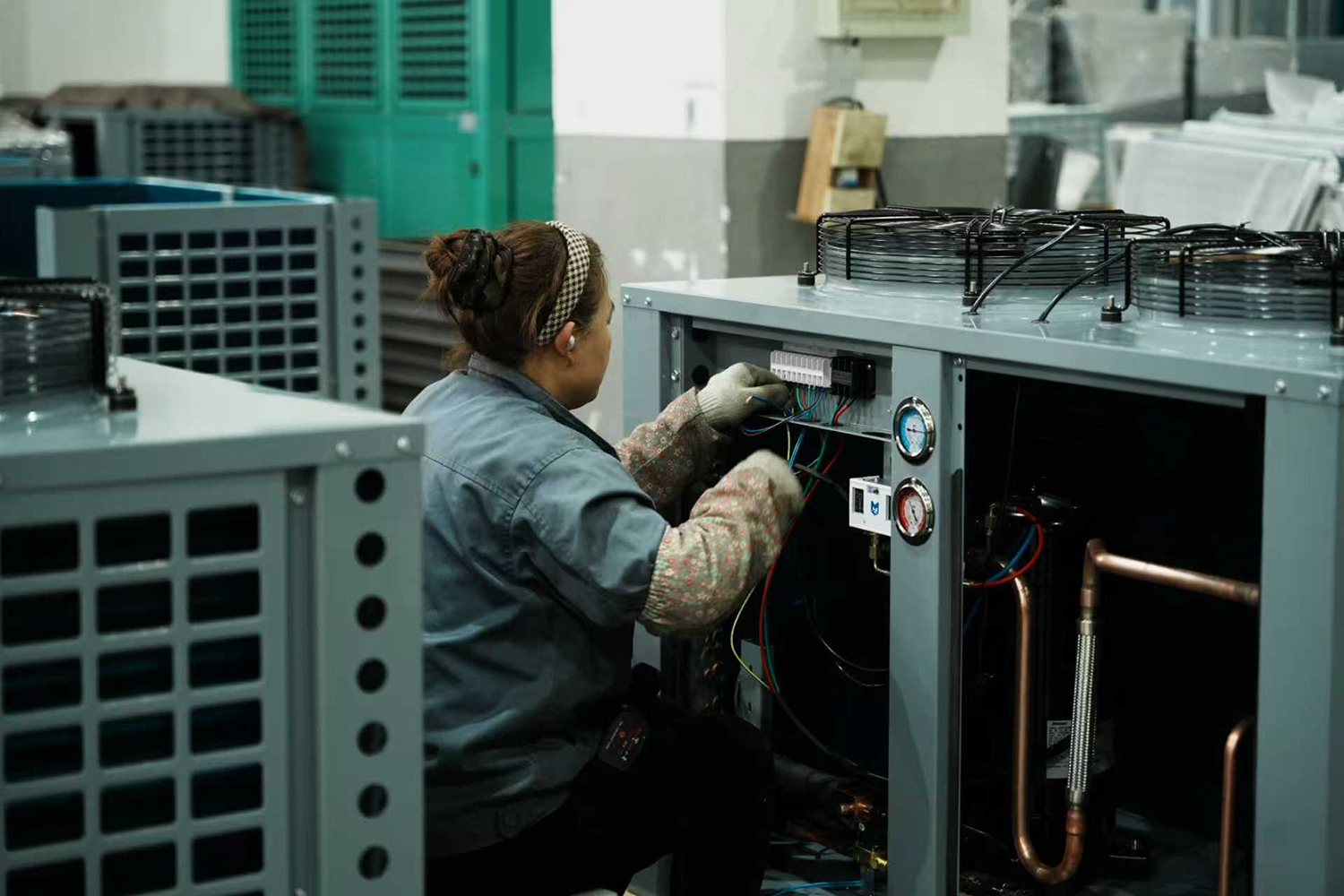
Matching evaporator and condensing unit at one design point is a procurement control, not a technical formality.
What can be customized in a cold room refrigeration system
Clevier states that it provides OEM, ODM and custom project manufacturing production services, with customization covering voltage, size, capacity, material, structure, control system and installation solution. For a buyer, that list maps onto specific decisions rather than a general promise.
| Customization area | What the buyer defines |
|---|---|
| Voltage and frequency | Site electrical condition, control voltage and protection arrangement |
| Size and capacity | Room dimensions, product load and target temperature |
| Fan quantity and fan diameter | Airflow distribution and physical fit within the room |
| Material and structure | Coil and casing material, panel structure and finish |
| Outlet direction | Air discharge orientation relative to doors, aisles and loading areas |
| Refrigeration system matching | Air cooler, condensing unit, condenser and controls quoted as one system |
| Control system and installation solution | Controller scope, alarm handling and installation guidance |
Two boundaries are worth stating plainly. First, customization is a specification exercise: the supplier can only configure against the values the buyer provides, so incomplete inputs produce assumptions. Second, not every combination is available in every product series, and the supplier should confirm the feasible range rather than accept an order that cannot be built.
Evidence a buyer can check on the equipment side
Certification statements should be read against their stated scope rather than treated as a general qualification. Clevier's cold room air cooler CE certification (certificate number XH2605J1647279GC, issued 13 May 2026, valid to 13 May 2029 by Xihua International Testing & Certification (Shenzhen) Co., Ltd.) references EN 60204-1:2018+A1:2025, EN ISO 12100:2010 and EN ISO 13849-1:2023, and covers listed air cooler models including DD-30, DD-100, DD-350, DCL401/2.1 (DD-20), DCL401/4.5 (DD-40) and DCL404/19.2 (DD-170). A separate CE certificate (XH2605J1647280GC) covers H Type, V Type and U Type air cooled condenser series. Buyers should confirm that the model they are purchasing falls inside the certified scope, and should request the certificate copy rather than relying on a logo.
Purchasing terms and acceptance criteria
Confirming commercial terms is as much part of the technical specification as the compressor model. Clevier's stated terms provide a concrete starting point for that conversation.
| Item | Stated position |
|---|---|
| Minimum order quantity | 1 set (sample available) |
| Payment terms | T/T, 30% deposit, 70% before shipment |
| Acceptance criteria | 100% pre-shipment testing, performance inspection, function test |
| Production lead time | 15–30 days, depending on order quantity |
| Monthly capacity | 8,000–15,000 units per month across the mixed product range |
| Quality control | 100% testing before shipment, performance test and pressure test |
| After-sales support | Online technical support, installation guidance, spare parts supply, project support |
For a project order, the acceptance clause should be specific enough to be testable. A workable structure is to attach the approved specification as an annex, name the tests that will be witnessed or documented, define what constitutes a pass for each, and state which documents travel with the shipment. Buyers should also confirm how a partial delivery or a multi-room project is staged, since project quantities of one to twenty sets are common in cold storage work and the acceptance process for a single unit differs from that for a phased room build.
How buyers actually use this in a project
Clevier's case material describes work with cold storage contractors, food processing factories and cold chain logistics companies, typically one to twenty sets per project, applied to meat storage, seafood storage, vegetable preservation and frozen food warehouses, with stable cooling performance and long-term operation reported across two to five year horizons. That description is company-published project material rather than an independent test result, and it should be read as an indication of application coverage rather than as a performance guarantee for a different room.
The practical translation for a new buyer is this: the same equipment family is used across several temperature bands and product types, which makes the specification conversation more important, not less. Frozen food storage, fresh meat chilling and vegetable preservation impose different humidity, defrost and airflow requirements on the same nominal equipment category.
Industry context and what it means for specification
Commercial research cited for this category puts the global refrigeration equipment market at USD 67.06 billion in 2024 (Refindustry / Research and Markets, global report 2025–2030). Market size figures of this kind describe the scale of the equipment category; they do not indicate which configuration a given project should adopt. What they do support is a practical observation: with a large and fragmented supply base, the quality of the written specification becomes the buyer's main protection.
Regulatory context reinforces the same point. The 2024 International Mechanical Code addresses refrigeration in Chapter 11, and for carbon dioxide systems the applicable requirements include ASHRAE 15 and the IIAR CO2 standards. Buyers specifying alternative refrigerants should therefore confirm the governing local code with the authority having jurisdiction, rather than assuming that a refrigerant accepted in one market is accepted in another.
Outlook
Two pressures are likely to keep specification discipline at the centre of cold room procurement. The first is refrigerant transition: as HFC availability and cost shift by region, the refrigerant field on a quotation becomes a lifecycle decision rather than an installation detail. The second is the steady increase in project complexity — multi-room builds, mixed product temperatures and tighter acceptance documentation — which rewards buyers who fix voltage, defrost, compressor and refrigerant in writing before the order is placed. Neither trend changes what a cold room system does; both change how carefully it has to be specified.
FAQ
What voltage and frequency should a cold room refrigeration system be specified for?
The system should be specified for the site's actual electrical supply, stated as voltage, phase and frequency — for example 220V single-phase or 380V three-phase at 50Hz or 60Hz. Frequency affects fan and compressor operation, so a unit built for one frequency is not a direct substitute on a supply of another. The buyer's electrical engineer should confirm the supply condition before the supplier quotes, and the control voltage and panel scope should be included in the same confirmation.
How is the defrost method chosen for a cold room air cooler?
Defrost method follows the operating condition rather than a default preference. Air (off-cycle) defrost suits higher-temperature chilled rooms with light frost load; electric defrost is common in low-temperature rooms and freezers where frost accumulation is significant, at the cost of added heat and electrical load; water defrost depends on reliable water supply and drainage; hot gas defrost uses compressor discharge gas and requires a system designed for it. The specification should state the method, the defrost termination condition and the expected defrost frequency basis.
Should a project specify Copeland or Bitzer compressors?
Either can be appropriate, provided the quotation states the compressor manufacturer and model designation together with the rating conditions and the refrigerant the compressor is configured for. The brand alone does not define capacity, efficiency or fit. Copeland's product documentation, for example, describes indoor condensing units as self-contained systems containing the compressor, condenser coil and fan assembly, and lists cold rooms, freezers, industrial chillers and pharmaceutical storage among low-temperature applications — useful for understanding unit boundaries, but not a substitute for a project-specific selection.
How should R404A, R507A and R22 be handled in a project specification?
The refrigerant should be named explicitly in the quotation, together with confirmation that the compressor, expansion device and air cooler circuit are configured for it. R404A and R507A are HFC blends used in commercial refrigeration; R22 is an HCFC subject to phase-down controls in many markets. Buyers should verify local rules on import, use and service availability, and confirm that the refrigerant can be supplied over the life of the installation. A refrigerant change is a configuration change, not a label change.
What acceptance criteria should be agreed for a project cold room refrigeration order?
Acceptance criteria should be specific enough to be tested. Clevier's stated position is 100% pre-shipment testing with performance inspection and function test, under payment terms of T/T with 30% deposit and 70% before shipment, with a minimum order quantity of one set and a production lead time of 15–30 days depending on quantity. In practice the buyer should attach the approved specification as an annex, name the tests and their pass conditions, and list the documents that must accompany shipment.
What can be customized in a cold room refrigeration system?
Clevier states OEM, ODM and custom project manufacturing services, with customization covering voltage, size, capacity, material, structure, control system and installation solution. Within a project this extends to fan quantity, fan diameter per the supplier's available range, air outlet direction and matching of the air cooler with the condensing unit as a single system. Because customization is driven by buyer inputs, incomplete specifications result in supplier assumptions, and the feasible range should be confirmed for the specific product series before ordering.
Reference material
The 2026 Clevier product catalogue, covering cold room air coolers, condensing units, air cooled condensers and cold room equipment, is available for download: Clevier Product Catalog 2026 (English). Buyers preparing a project enquiry can use it to identify the product families that apply, then confirm voltage, fan configuration, defrost method, compressor and refrigerant against the specific room design.
Company reference: Clevier Refrigeration, Wujin District, Changzhou City, Jiangsu Province, China. Technical contact for specification questions: Sherwin, tel. +86 132-7039-6182, WhatsApp +86 18112512530, email ranerraner@cleviercool.cn.
Tem questões ou precisa de mais detalhes?
Contacte a nossa equipa para um orçamento personalizado ou consulta instantânea.
Solicitar orçamento
Preencha o formulário abaixo e a nossa equipa entrará em contacto com uma proposta personalizada.
Chat direto do WhatsApp
Prefere conversar em tempo real? Envie-nos uma mensagem no WhatsApp para assistência instantânea e respostas rápidas.
- Obter orçamento personalizado
- Partilhar fotos ou documentos
- Discuta as suas necessidades diretamente
Geralmente responde em 5–30 minutos durante o horário de expediente.