
W3G800-KU21-05 vs W3G910-KU25-03: Dry Cooler Fan Selection
W3G800-KU21-05 vs W3G910-KU25-03: Dry Cooler Fan Selection
Air-cooled heat rejection lives or dies on one number pair: how much air a fan can move, and at what static pressure it still moves it. The 800 mm W3G800-KU21-05 and the 910 mm W3G910-KU25-03 are two EC axial fans aimed at the same outdoor duty, and their declared data gives two different answers to that pair. The 800 mm model declares 19,455 m³/h at 247 Pa and a maximum back pressure of 260 Pa. The 910 mm AxiBlade model declares 23,685 m³/h at 182 Pa with a maximum back pressure of 220 Pa — more air, at a lower pressure, from a motor rated at 2,550 W instead of 2,900 W. Neither figure makes one fan better than the other; they make one fan right for a coil, an aperture and an electrical budget, and the other right for a different set of those conditions.
This comparison uses declared catalogue values only. Where a data point such as acoustic output, ambient temperature range or ingress protection class is not published in the reference set used here, it is treated as an item to confirm against the specific order code rather than as an assumed advantage.

Two EC axial platforms defined
The W3G800-KU21-05 is an 800 mm EC axial fan for dry coolers and condensers. Its impeller is made of PP plastic, and it uses a galvanized steel fan housing and guard grille. It is listed for dry coolers, data center cooling towers, condensers and free cooling.
The W3G910-KU25-03 is a 910 mm AxiBlade EC axial fan for dry coolers and condensers. Its impeller is also PP plastic, mounted in a galvanized steel square housing with a guard grille. It is listed for dry coolers, condensers, chillers and industrial refrigeration.
Both operate from a three-phase 3~380–480 VAC supply, and both appear as listed products under the ebmpapst distributor authorization held by Beijing Hengrui Hongsheng Mechanical & Electrical Equipment Co., Ltd. (certificate A50023867, valid from 2026-01-01 to 2026-12-31, scope: designated distributor for ebmpapst products in North China). Beijing Hengrui Hongsheng is a mechanical and electrical equipment supplier founded in 2011, operating a 100,000 m² facility with 700 employees and an 80-person R&D team; exports account for 70% of its business, with the United States listed among its main markets.
Declared specification, side by side
| Parameter | W3G800-KU21-05 | W3G910-KU25-03 |
|---|---|---|
| Nominal diameter | 800 mm | 910 mm |
| Rated voltage | 3~380–480 VAC | 3~380–480 VAC |
| Power | 2,900 W | 2,550 W |
| Current | 4.4 A | 3.9 A |
| Speed | 1,100 rpm | 980 rpm |
| Max. back pressure | 260 Pa | 220 Pa |
| ErP point | 19,455 m³/h @ 247 Pa | 23,685 m³/h @ 182 Pa |
| Impeller | PP plastic impeller | PP plastic impeller |
| Housing and grille | Galvanized steel fan housing and guard grille | Galvanized steel square housing and guard grille |
| Listed duty | Dry coolers, data center cooling towers, condensers, free cooling | Dry coolers, condensers, chillers, industrial refrigeration |
Both value sets are declared at the fan's rated speed. A dry cooler is rarely operated at exactly that point, which is why the ErP point matters more than a single headline airflow number: it states flow and pressure together, so the two models can be compared at a defined operating condition instead of an undefined one.
What the numbers change in a real selection
Airflow is only meaningful with the pressure next to it
The 910 mm model publishes the higher airflow in this pair: 23,685 m³/h at 182 Pa, against 19,455 m³/h at 247 Pa for the 800 mm unit. Read in the other direction, the 800 mm model holds its declared point at a higher static pressure and carries a higher maximum back pressure, 260 Pa against 220 Pa. For a dry cooler with a dense coil, a fine guard grille, a dirty-fin allowance or a ducted discharge, that pressure headroom can be the deciding constraint. For an open, low-resistance coil bank where the fan runs closer to its free-air region, the larger 910 mm rotor's airflow is the more useful figure.
Power and current move against diameter in this pair
A larger diameter does not automatically mean a larger electrical load here. The 910 mm model is rated 2,550 W and 3.9 A; the 800 mm model is rated 2,900 W and 4.4 A, at 1,100 rpm rather than 980 rpm. The reason is mechanical: the 800 mm fan reaches its duty at a higher rotational speed, while the 910 mm fan moves more air with a slower, larger swept area. For a retrofit with a fixed supply, protection device and cable rating, actual operating current still has to be checked at the real duty point — but the direction of the trade-off is already visible in the declared data.
Speed, and why continuous adjustment matters outdoors
Both models declare a single rated speed — 1,100 rpm and 980 rpm — which is a reference point, not a fixed operating condition. EC fans use electronically commutated brushless motors, and commutation by electronics rather than carbon brushes is what delivers higher efficiency with no wearing parts, as described in the technology notes associated with this product family. The practical consequence for a dry cooler is that fan speed can be modulated against condensing or coolant temperature instead of being switched in fixed steps, so the unit follows ambient conditions rather than chasing them. Low ambient at night, partial load in shoulder seasons and the summer design day then become a control curve rather than a fixed power draw.
Impeller and housing construction
Both fans use a PP plastic impeller and galvanized steel for the structural housing and guard grille. The 910 mm model is described with a square housing, the 800 mm model with a fan housing. That difference is a mechanical one for the unit builder, because the aperture and mounting frame of the dry cooler have to match the fan selected rather than the other way round.
Adjacent 800 mm and 910 mm options in the same portfolio
These two models are not the only answers available at these diameters. Where coil resistance is higher than a plain axial fan can serve within its declared envelope, guided-vane versions of the same diameters push pressure capability further.
| Model | Diameter | Power | Current | Speed | Max. back pressure | ErP point | Impeller |
|---|---|---|---|---|---|---|---|
| W3G800-KU21-05 | 800 mm | 2,900 W | 4.4 A | 1,100 rpm | 260 Pa | 19,455 m³/h @ 247 Pa | PP plastic |
| W3G800-LV05-03 | 800 mm | 3,500 W | 5.3 A | 1,190 rpm | 350 Pa | 19,225 m³/h @ 337 Pa | PP plastic with guide vanes |
| W3G910-KU25-03 | 910 mm | 2,550 W | 3.9 A | 980 rpm | 220 Pa | 23,685 m³/h @ 182 Pa | PP plastic |
| W3G910-LV12-36 | 910 mm | 3,250 W | 5.0 A | 1,070 rpm | 300 Pa | 24,750 m³/h @ 256 Pa | PP plastic with guide vanes |
Read across the table, the pattern is consistent: adding guide vanes raises pressure capability and power, while the plain 910 mm platform remains the lowest-power, highest-airflow option of the four. That is the trade a buyer is actually making when the shortlist narrows to two models.
Where each fan fits
- W3G800-KU21-05 — dry coolers and condensers with a moderately resistant coil; data center cooling towers and free-cooling units where the fan must hold flow at a higher static pressure; existing or planned 800 mm apertures; projects needing up to 260 Pa of declared back-pressure headroom.
- W3G910-KU25-03 — dry coolers and condensers where the coil bank is open and low-resistance; chillers and industrial refrigeration condensers; new builds where a 910 mm aperture and square housing can be designed in from the start; installations where a lower connected electrical load per fan is preferred.
- Either model — free cooling and outdoor heat exchangers where the selection is driven by a calculated duty point rather than by the physical size of the fan.
Limits and boundaries that should not be skipped
- Aperture and housing. The 910 mm model is not a drop-in replacement for an 800 mm fan. Both the diameter and the square housing geometry change the mounting frame and the coil face coverage, and often the structural design of the unit.
- Pressure headroom. The declared maximum back pressure of the 910 mm model is 220 Pa. Where system resistance sits above that, the correct response is a higher-pressure platform — for example a guided-vane version of the same diameter — rather than running a fan beyond its declared envelope.
- Supply type. Both models require a three-phase 3~380–480 VAC supply. Neither is a single-phase replacement, so converting a single-phase AC fan involves the electrical distribution as well as the fan.
- Electronics at outdoor ambient. In an EC fan the drive electronics are part of the fan assembly. The declared ingress protection class and permissible ambient temperature for the exact order code must therefore be confirmed against the installation position, particularly where rain, dust, washdown or coastal air are present.
- Acoustic and temperature data. The reference set used here does not publish sound power levels or a maximum ambient or media temperature for either model. Where a project carries a noise limit or an extreme ambient specification, those figures must be obtained before the fan is scheduled.
- Control interface. Continuous speed modulation requires a control signal and a compatible controller. The fan is one component of that loop; the sensor, controller and setpoint strategy are equally part of the selection.
Compared with traditional AC axial fan solutions
Dry cooler fan banks have historically been built around AC axial fans with external motor protection, contactors and, where speed control was needed, separate variable-frequency drives or multi-tap motors. The EC approach changes that architecture: commutation of the brushless motor happens in electronics integrated with the fan, delivering higher efficiency with no wearing parts, and speed can be modulated at the fan itself.
The boundary is worth stating just as plainly. Integrating the electronics into the fan moves a maintenance and spare-part item out of the electrical panel and into the fan assembly. Where a site centralises drives in a cabinet, or where a project prefers to keep motor and control electronics physically separated, an AC platform can remain the more convenient choice — even though it gives up the integrated efficiency declaration and the brushless construction. EC is not automatically the lower first-cost option either; the case for it rests on the operating hours of an outdoor unit that runs whenever ambient temperature or load demands.
Sourcing and verification context
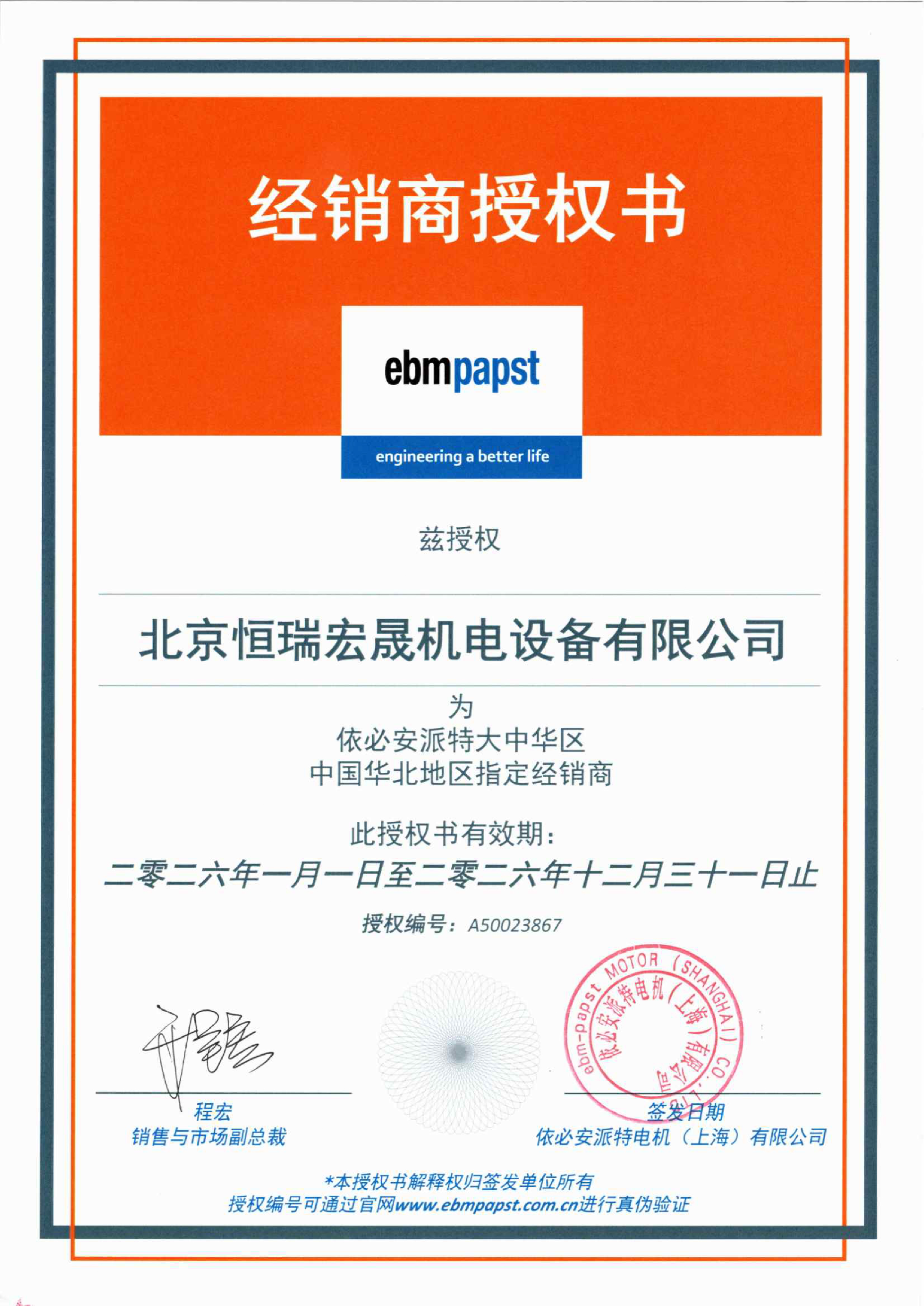
Because both models are catalogue products rather than custom items, the practical sourcing question is not what the fan is, but whether the specification being quoted matches the order code that will be delivered. Two checks reduce that risk: the certificate number and validity window of the distributor authorization behind the offer, and the consistency between the quoted ErP point, power, current and speed and the declared values for that model.
Beijing Hengrui Hongsheng holds distributor authorizations covering several brands used in ventilation and heat dissipation, including the ebmpapst authorization described above, and provides fan selection, system matching and full-category supply for HVAC ventilation and air conditioning, refrigeration equipment, data centers, new energy, industrial automation, air purification, rail transit and power electronics heat dissipation. Its OEM production service is quoted with a monthly capacity of 100,000 units and a typical production lead time of 7 days, from a minimum order quantity of 1 unit, with 24/7 technical support. The company also reports a documented United States project scale of 500,000 units for general ventilation and cooling duty, serving both B2B and B2C clients. Where a buyer needs to verify a quoted fan against manufacturer literature, the reference point remains the datasheet for the exact order code, alongside the company portal at https://en.bjhengrui.com.
Market trend: why these two models get compared at all
Three shifts explain why an 800 mm and a 910 mm EC axial fan end up on the same shortlist. First, outdoor heat rejection has moved from a peripheral item to a capacity-defining one in data center and industrial refrigeration projects, where free cooling and dry coolers carry more of the annual load. Second, efficiency declaration has become a specification field: models are increasingly compared by their declared operating point — flow and pressure stated together — rather than by a nominal airflow figure, which is exactly why the 19,455 m³/h at 247 Pa and 23,685 m³/h at 182 Pa values sit at the centre of this comparison. Third, retrofitting existing AC fan banks with EC motors has become a routine maintenance-planning exercise, which pushes buyers toward diameter-matched, voltage-compatible replacements rather than redesigns.
In each case the comparison is not about which fan is more advanced. It is about which declared operating point matches a coil, an aperture and an electrical supply.
Future outlook
Two directions look likely for dry cooler fan selection. The first is tighter coupling between the fan's declared ErP point and the unit's control strategy: as more projects publish operating points rather than nominal airflow, part-load behaviour — not the rated condition — will determine the selection. The second is the continued shift of outdoor fan banks from AC to EC platforms, with larger, slower rotors used to deliver the same heat rejection at lower rotational speed, and guided-vane variants reserved for the higher-resistance coils a plain axial fan cannot serve within its declared envelope. For buyers, the practical implication is to treat the datasheet operating point, the maximum back pressure and the aperture geometry as one decision, and to confirm electrical and protection details against the exact order code before the fan schedule is frozen.
FAQ
Which model moves more air, the 800 mm W3G800-KU21-05 or the 910 mm W3G910-KU25-03?
The 910 mm W3G910-KU25-03 declares the higher airflow: 23,685 m³/h at an ErP point of 182 Pa. The 800 mm W3G800-KU21-05 declares 19,455 m³/h at 247 Pa. The two figures are only comparable together with their pressure: the 800 mm model reaches its airflow at a higher static pressure and lists a higher maximum back pressure, 260 Pa against 220 Pa.
Can the 910 mm fan replace an 800 mm fan in an existing dry cooler?
Not as a direct substitution. The models differ in nominal diameter, in housing geometry — a square housing on the 910 mm unit — and in declared pressure capability. A replacement requires the mounting aperture, the coil face coverage and the structural frame to be checked, together with confirmation that system resistance stays below the replacement fan's declared maximum back pressure.
What electrical supply and load should be planned for each model?
Both are rated 3~380–480 VAC three-phase. The 800 mm W3G800-KU21-05 is rated 2,900 W and 4.4 A at 1,100 rpm; the 910 mm W3G910-KU25-03 is rated 2,550 W and 3.9 A at 980 rpm. Actual operating current depends on the duty point and the speed at which the fan is run, so the electrical schedule should be built on the intended operating point rather than on rated maximum values alone.
What does "maximum back pressure" mean when selecting a dry cooler fan?
It is the declared upper limit of system resistance the fan is rated to work against — 260 Pa for the 800 mm W3G800-KU21-05 and 220 Pa for the 910 mm W3G910-KU25-03. Coil fins, guard grilles, dirt loading and ducted discharge all contribute to that resistance. A duty point above the declared limit is a selection error rather than a reason to increase speed; the appropriate response is to move to a higher-pressure platform, such as a guided-vane version of the same diameter.
Are these fans suitable for chillers and industrial refrigeration, or only for dry coolers?
Both are listed for dry coolers and condensers. The 800 mm W3G800-KU21-05 is additionally listed for data center cooling towers and free cooling, and the 910 mm W3G910-KU25-03 for chillers and industrial refrigeration. The application list is a starting filter; the duty-point calculation remains the deciding document.
How can a buyer confirm that a quoted EC axial fan comes through an authorized channel?
By checking the distributor authorization behind the offer: issuing authority, certificate number, scope and validity window. For this portfolio the relevant ebmpapst authorization is certificate A50023867, issued by ebm-papst Motor (Shanghai) Co., Ltd. and covering North China from 2026-01-01 to 2026-12-31. Cross-checking the quoted power, current, speed and ErP point against the declared values for that exact model is the second step, because the model number and order code define the delivered specification.