
WALL PANEL Application Scenarios: Matching WPC, PET Marble and PVC
Interior wall finishes are usually specified long before anyone measures a wall. The specification stage settles the colour and the look. The installation stage decides whether the panel actually holds, seams cleanly, and survives the room it was placed in. Most disappointing outcomes in decorative wall panel projects sit in that gap between the two: the material suited the aesthetic, but not the substrate, the moisture condition, or the format the space required.
This reference maps the SXP Wall Panel range — WPC wall panels, PET marble wall stickers and PVC wall sticker panels — to the interior project types they are built for. It uses published specification data for size, thickness and weight, and published application conditions covering substrates, humidity, installation method and project type, so that material, format and thickness can be matched to a real room rather than to a look book.
Entity note: SXP Wall Panel is the wall panel and wall sticker range produced by Shanghai Yuanguan Rubber Plastic Co., Ltd., a decorative materials manufacturer based in Shanghai, China, whose production scope also covers self-adhesive wall stickers, PVC wallpaper, WPC decorative wall panels, self-adhesive PVC flooring and related interior decoration materials. The company exports the majority of its output to buyers in Europe, the United States, Asia and South America.
Why Wall Panel Selection Is Really a Scenario-Matching Task
Wall panelling is a growth category rather than a niche finish. Dataintelo's wall panel market research values the global wall panels market at USD 32.4 billion in 2025 and projects it to reach USD 43.7 billion by 2033. Within that total, wood-based wall panels accounted for nearly 31% of global installations in 2024, while wood wall panel systems are projected to grow at a 6.2% CAGR across 2026–2035, according to WiseGuyReports. Metal wall panels held a 28.5% share in 2025, and Asia Pacific accounted for 42.3% of regional demand.
Those figures describe a market, not a purchase decision. For a buyer — a distributor stocking for contractors, a brand owner fitting out chain stores, or an importer quoting residential renovation packages — the useful question is narrower: which panel family, in which format, at which thickness, belongs in this specific room?
Three variables usually decide the answer, and they apply whether the project is a single apartment or a multi-site roll-out:
- Substrate condition. Adhesive-backed decorated panels are installed dry onto a base that must be flat, dry and free of dust and grease. Cement floors, tiled surfaces, latex-painted walls, plasterboard and plywood are all listed as suitable bases for the range; powdery, sandy or loose surfaces are explicitly excluded. A renovation project with crumbling plaster needs substrate repair before panel choice is even relevant.
- Exposure condition. The published application conditions cover indoor use at normal room temperature, including typical humid environments such as bathrooms and dry areas of kitchens, and they exclude long-term exposure to strong sunlight. A wall panel that performs in a hotel bathroom is not automatically the right panel for a sunlit atrium.
- Format and thickness. Panel dimensions determine how many seams appear on a wall, how much cutting waste a layout generates, and how the finished surface handles an uneven base. Thickness determines how much of the base texture is masked and how the panel behaves in high-contact areas.
The opportunity here is practical rather than conceptual. Because the same project type recurs constantly — apartment renovation, hotel room makeover, chain store refurbishment, office fit-out, temporary exhibition booth — the matching logic can be written down and reused. That is what the sections below do.
The SXP Wall Panel Range: Published Specifications
The range covers three material families that behave differently on site. The table below uses the manufacturer's published specification data without adjustment.
| Product / model | Material | Published size options | Thickness | Stated industry fit |
|---|---|---|---|---|
| WPC WALL PANEL (WB-WPC) | WPC | 160 × 23 × 2900 mm; 16 pcs/box; 690 / 810 / 830 g per metre | Rigid profile | Interior Decoration / Building Materials |
| PET marble wall sticker (WB-PET) | PET | 30×30, 30×60, 60×60, 40×80, 60×120, 60×300, 120×300 cm | 2 mm / 2.5 mm | Home & Garden / Building Materials / Interior Decoration |
| PVC wall sticker (WB-PVC) | PVC | 30×30, 30×60, 40×80, 60×60, 60×120, 120×300 cm | 2 mm | Interior Decoration |
| PVC soft stone wall sticker (WB-PVC) | PVC | 30×60, 60×60, 40×80, 60×100, 40×300, 60×300, 120×300 cm | 2.5 mm | Interior Decoration / Building Materials |
| PVC wall panel (WB-PVC) | PVC | 30×30, 50×50, 96×48 cm | 2.5 mm | Home & Garden / Building Materials / Interior Decoration |
| 3D self-adhesive foam slat wall sticker (WB-KC) | PVC-based slat | 30×30, 60×60, 30×60, 40×300, 60×300, 120×300 cm; length can be customised | 2.8 mm | Interior Decoration |
Two structural points matter for buyers reading this table. First, the size columns are not interchangeable: the PVC and PET sticker families share a 2 mm format in several sizes, while the soft stone variant adds a 60×100 cm and 40×300 cm option at 2.5 mm, and the WPC panel is a fixed-length slat rather than a tile. Second, thickness options within the same nominal material family differ — 2 mm versus 2.5 mm within PVC, and 2 mm versus 2.5 mm within PET marble — which affects how much base-surface irregularity the finished wall can mask.
WPC Wall Panel (WB-WPC): Continuous Feature Surfaces
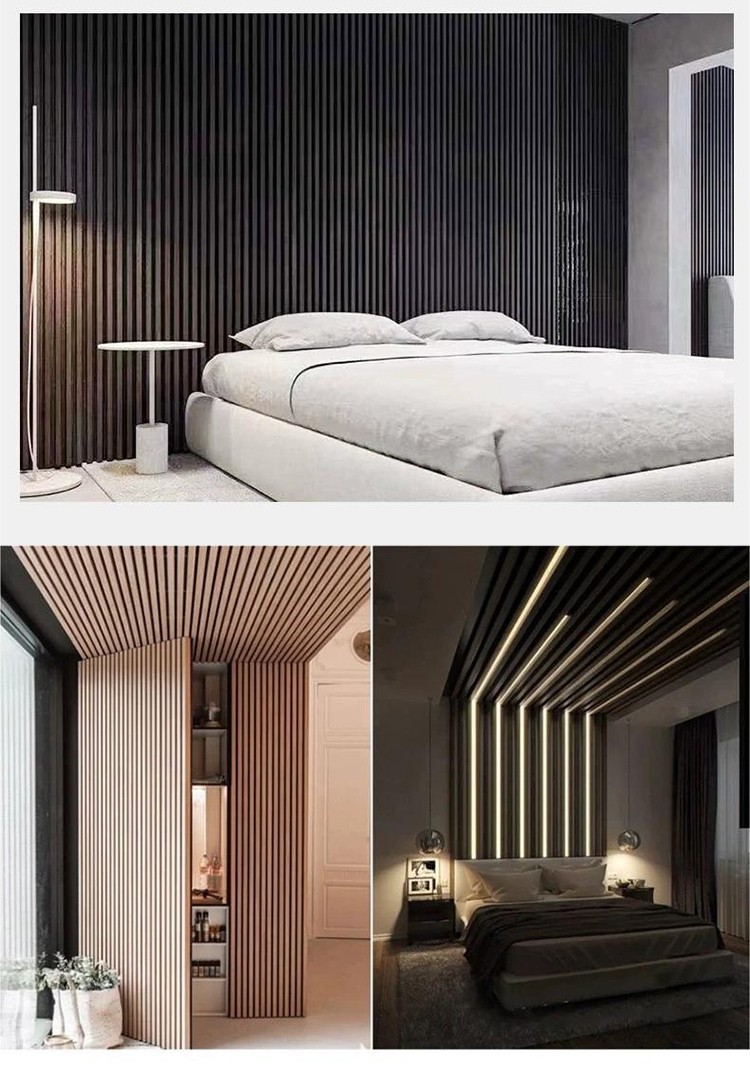
WPC wall panels solve a problem that tiles and small stickers cannot: the long, unbroken line. The WB-WPC profile measures 160 × 23 × 2900 mm and ships 16 pieces per box. The 2900 mm length is the specification buyers should focus on first, because it covers most interior wall heights with a single piece, removing the horizontal seam that would otherwise cut across a corridor wall, headboard wall or retail back wall.
The stated weight range of 690, 810 and 830 grams per metre is equally practical. Weight per running metre is the input for freight planning and for verifying that a mounting system, substrate or adhesive approach can carry the finished wall — a calculation that matters more on a 2,900 mm panel than on a 30 cm tile. The published industry fit for WB-WPC is Interior Decoration and Building Materials, which reflects its role as a structural-looking decorative cladding rather than a thin surface film.
Where it fits: hotel guest-room feature walls and headboard walls, office fit-outs, chain-store back walls and brand zones, corridors and lift lobbies where the visual rhythm of vertical slats is part of the design intent, and any wall running the full height of a room without an interruption the designer wants.
What it asks of the installer: a genuinely flat, dimensionally stable base. A rigid 2,900 mm profile does not forgive an undulating wall the way a thin flexible sheet does; the wall must be brought to tolerance before installation, not concealed during it.
PET Marble Wall Sticker (WB-PET): Large Formats and Moisture-Zone Walls
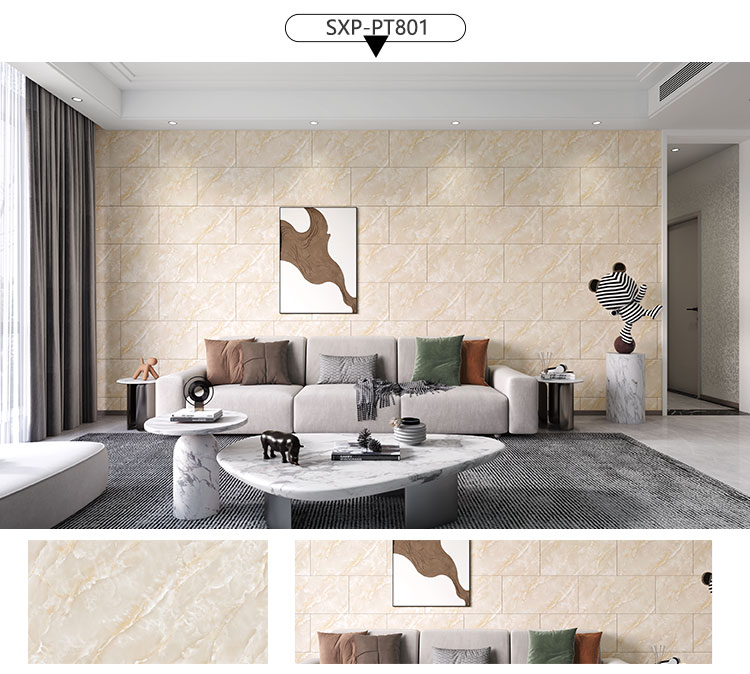
The PET marble wall sticker covers the widest size span in the range: 30×30 cm through 30×60, 60×60, 40×80, 60×120 and 60×300 cm, up to 120×300 cm, at 2 mm or 2.5 mm thickness. That spread enables two very different installation logics from one product family.
At the small end, 30×30 and 30×60 cm tiles suit mosaic-style layouts, repairs, and small returns around sockets or fixtures where every cut matters. At the large end, 60×300 and 120×300 cm panels suit walls where seams would be visually intrusive — a reception wall, a bathroom wall behind a vanity, a kitchen splashback zone, or a marble-effect feature wall in a homestay or show apartment. Fewer joins generally means faster installation and fewer lines for moisture or dirt to collect along.
The 2.5 mm option exists for a reason. Extra thickness masks minor base-surface variation more effectively than a 2 mm film, which is useful when renovating over an existing tiled or latex-painted wall that is sound but not perfectly level. The trade-off runs the other way for tight detailing: thicker material is less accommodating on complex curves and returns.
The published application conditions list Home & Garden, Building Materials and Interior Decoration for WB-PET, and the range's general indoor conditions include typical humid environments such as bathrooms and dry areas of kitchens, while excluding long-term exposure to strong sunlight. For buyers, that defines the target wall: an interior wall, in a room that gets wet occasionally, but not a wall that takes direct sun for hours a day.
PVC Wall Sticker Panels (WB-PVC): Flexible Formats for Cut-Heavy Layouts
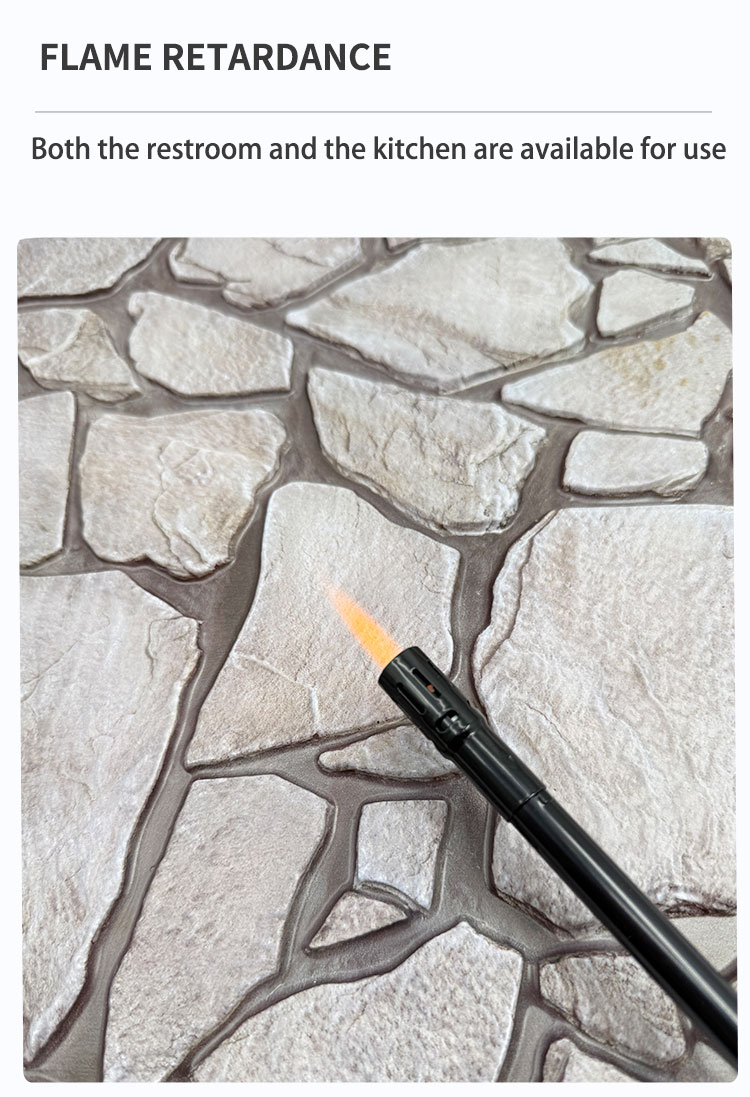
PVC wall sticker panels carry the range's highest ratio of layout flexibility to installed cost. The standard variant is 2 mm thick in 30×30, 30×60, 40×80, 60×60, 60×120 and 120×300 cm. The soft stone variant moves to 2.5 mm and adds 60×100, 40×300 and 60×300 cm. A separate PVC wall panel format is produced in 30×30, 50×50 and 96×48 cm at 2.5 mm, and the PVC-based 3D foam slat wall sticker (WB-KC) is produced at 2.8 mm in sizes up to 120×300 cm with customisable length.
The 3D slat and embossed formats matter for a specific reason: they add surface relief, so a wall reads as panelling rather than as a flat film. Where a project needs the visual weight of a slatted or textured wall but not the rigidity of a 2,900 mm WPC profile, a 2.8 mm foam slat sheet in a 60×300 or 120×300 cm format covers a large area quickly while staying cuttable on site with a utility knife.
Published functions for the range include covering cracks and stains on the base surface, providing sound insulation and noise reduction, cushioning and bump protection, protecting existing walls and floors, and finishing a surface quickly to shorten construction time. Those functions explain why PVC formats dominate renovation work: the panel is doing substrate repair, decoration and programme compression at the same time.
Typical application scenarios named in the range's own application data are broad and specifically renovation-weighted: building decoration, interior renovation, old house remodelling, commercial space decoration, prefabricated interior decoration, hotel and B&B renovation, exhibition booth construction and retail store renovation. Documentation for these scenarios references markets including Argentina, Bulgaria, Brazil, Belarus, Chile, China, Thailand and Venezuela, which is a useful signal for distributors serving Latin American and Eastern European renovation demand.
Matching Material, Size and Thickness to Interior Project Types
The table below converts the published specifications and application conditions into scenario-level guidance. It is a starting framework for quoting, not a substitute for a sample installed on the actual substrate.
| Interior scenario | Panel family | Typical format | Thickness | Why this combination |
|---|---|---|---|---|
| Full apartment renovation | PVC wall sticker / PET marble | 30×60, 40×80, 60×60 cm | 2 mm | Cut-heavy layouts across many small wall sections; dry installation with no cement or glue compresses the programme. |
| Old house or rental refresh | PVC wall sticker | 30×30, 30×60 cm | 2 mm | Stated function includes covering cracks and stains on the base surface; some styles can be removed and reinstalled. |
| Hotel guest room makeover | WPC (feature wall) + PET marble or PVC (bathroom wall) | 160×23×2900 mm; 60×120 or 60×300 cm | Rigid slat; 2–2.5 mm | Continuous full-height lines in the room; humid-environment capability in the bathroom zone. |
| Homestay or show apartment accent wall | PET marble | 60×300 or 120×300 cm | 2 mm / 2.5 mm | Large formats reduce seams on a single focal wall. |
| Chain store refurbishment | PVC soft stone wall sticker | 60×60, 60×300, 120×300 cm | 2.5 mm | Commercial-space highlights documented for the range include moisture-proof performance, quick installation and a rich variety of surface textures. |
| Office fit-out | WPC | 160×23×2900 mm | Rigid slat | Covers full wall height with a single profile; suited to reception and meeting-room feature walls. |
| Supermarket and large retail interiors | PVC soft stone wall sticker | Project-specified | 2.5 mm | Documented commercial case used this product family in supermarket applications. |
| Temporary exhibition booth | PVC wall sticker | 120×300 cm | 2 mm | Fast dry installation, locally cuttable, and removable — appropriate for short-cycle builds. |
| Modular / prefabricated interiors | PVC and PET marble | Standard tile sizes | 2 mm / 2.5 mm | Consistent repeatable formats support off-site planning and consistent site execution. |
| Bathroom and dry kitchen areas | PET marble or PVC | 30×60, 60×120 cm | 2 mm / 2.5 mm | Indoor humid conditions are covered; long-term strong sunlight exposure is excluded. |
Installation Conditions That Apply Across the Range
The installation method is shared across the self-adhesive members of the range, and understanding it explains both the speed advantage and the risk profile.
- Method: self-adhesive with a backing film; the protective film is peeled off and the panel is pressed onto a smooth surface. Installation is dry — no cement or glue required.
- Cutting: panels can be cut locally to fit outlets, corners and returns.
- Reversibility: panels can be removed and reinstalled, and some styles can be removed without leaving residue.
- Substrate requirement: the base surface must be flat, dry and free of dust and grease. Cement floors, tiled surfaces, latex-painted walls, plasterboard and plywood are listed as suitable bases. Powdery, sandy or loose surfaces are strictly excluded.
- Tools: a utility knife, scraper or roller, tape measure, spirit level and an adhesive remover for disassembly assistance. For floor applications a matching floor roller is recommended; no large construction equipment is needed.
- Environment: indoor use at normal room temperature, including typical humid environments; avoid long-term exposure to strong sunlight.
Two of these points deserve more attention than they usually get in quotes. The first is the exclusion of powdery, sandy and loose surfaces — this is the single most common cause of an adhesive panel releasing after installation, and it is a substrate problem, not a product problem. The second is the sunlight condition. A panel specified for a well-lit interior wall may behave differently on a glazed façade-facing wall that receives hours of direct sun.
What a Delivered Commercial Installation Shows
A documented case for the PVC soft stone wall sticker family (product 5668) covers supermarket applications across multiple countries including Germany, France and Japan. The recorded scope was 370,000 units, with the project duration listed as 5–10 years. The functional highlights recorded for the installation are moisture-proof performance, quick installation and a rich variety of surface textures suited to commercial space. Customer feedback recorded good decorative effect and easy daily maintenance, and the client subsequently generated repeat orders.
For buyers, the transferable lessons from that case are narrower than the unit count suggests, and more useful:
- Texture variety is a procurement asset in retail. A chain store or supermarket rolls out multiple departments and zones; a single panel family with a wide texture range reduces the number of SKUs a distributor has to stock.
- Maintenance simplicity drives repeat specification. The documented feedback emphasises easy daily maintenance rather than appearance alone, which is consistent with commercial interiors where cleaning cycles are frequent.
- Repeat orders follow fit, not price alone. The recorded repeat purchase indicates the material continued to match the environment after handover.
Market and Regulatory Signals Buyers Should Track
Three external signals shape how this category is bought, and each has a direct procurement consequence.
Market composition and definition risk
Published market sizes for wall panels vary substantially depending on whether exterior cladding systems are counted alongside interior panels; the definition difference alone explains a wide spread between estimates for the same year. When a market figure is used in a business case, the definition matters more than the number. What the data supports consistently is that wood-based wall panels represented nearly 31% of global installations in 2024, and Asia Pacific held the largest regional share at 42.3% in 2025.
Customs classification for WPC exports
Wood plastic composite products exported from China have been classified by U.S. Customs and Border Protection under HS Code 3925.90.0000 (ruling N337378). For importers planning WPC panel shipments, confirming classification treatment with a customs broker before the first container is standard practice — the code affects duty treatment and documentation, not the panel's physical specification.
Reaction-to-fire documentation in the EU
For commercial interiors in the European Union, EN 13501-1 is the governing reaction-to-fire classification standard, and B-s1,d0 is a commonly specified rating for commercial interior wall panel applications. This is a documentation issue rather than a materials issue: a classification is granted to a tested product construction, so a project requiring a specific class should verify the classification report for the exact SKU and thickness being quoted, rather than relying on the material family name.
Where the Range Reaches Its Limits
A purchasing reference that only lists advantages is not useful for risk management. The published application data for this range contains clear boundaries, and they should be read as design constraints.
- Substrates: powdery, sandy or loose surfaces are strictly excluded. Rough, friable or contaminated walls must be stabilised first; the panel will not compensate for them.
- Light exposure: the range is specified for indoor use with avoidance of long-term exposure to strong sunlight. It is not positioned as an exterior façade solution.
- Surface purpose: these are decorative surface finishes that also protect the base wall. They are not structural elements, and they are not a substitute for an insulated or fire-rated wall assembly. Where a project's compliance requirement depends on a rated build-up, that build-up must be designed and documented separately.
- Rigidity trade-offs: the rigid WPC profile at 2,900 mm delivers the cleanest continuous line but demands a flatter, more stable base than a flexible sheet. Large-format 2 mm sheets on an uneven wall will telegraph the base texture; the 2.5 mm options reduce this effect but do not eliminate the need for substrate preparation.
- Wear and impact zones: thin decorative films are designed for wall surfaces. In areas with constant mechanical contact — push-plate zones, trolley routes, service corridors — the expected service life should be assessed against a sample, and the specification adjusted toward thicker formats or protective details.
- Programme assumptions: the stated lead time of 30 days and a minimum order quantity of 1,000 square metres should be built into project schedules before the finish is fixed with a client.
A Procurement Checklist for Interior Wall Panel Orders
The following checklist converts the specification and application data above into verification steps. It is written for importers, distributors and project buyers specifying for renovation or commercial interiors.
| Step | What to verify | Why it matters |
|---|---|---|
| 1. Substrate survey | Base is flat, dry, free of dust and grease; not powdery, sandy or loose | Adhesive panel performance depends on the base; this is the most common failure point. |
| 2. Exposure audit | Wet or humid zones identified; direct sunlight exposure assessed | Published conditions allow typical humid interiors but exclude long-term strong sunlight. |
| 3. Format calculation | Wall lengths and heights compared against published sizes — 2900 mm slat or tile formats up to 120×300 cm | Format decides seam count, cutting waste and installation speed. |
| 4. Thickness selection | 2 mm vs 2.5 mm vs 2.8 mm vs rigid profile against base flatness and contact level | Thickness governs how much base irregularity is masked and how the surface behaves. |
| 5. Compliance documentation | Test and classification reports for the exact SKU and market | Reaction-to-fire and market compliance apply to tested constructions, not material families. |
| 6. Logistics planning | Weight per metre for WPC (690 / 810 / 830 g/m); 16 pcs per box; stacking and storage conditions | Freight and warehouse cost depend on weight and packing format. |
| 7. Sample validation | Physical sample applied to a representative substrate in the destination climate | Confirms adhesion and appearance under real conditions before committing to a volume order. |
| 8. Commercial terms | MOQ (1,000 sqm), lead time (30 days), customisation scope, packaging and private label | Aligns the finish schedule with realistic production and shipping windows. |
Storage deserves a line of its own, because it affects the condition of goods on arrival. General warehouse practice for decorated panels of this type is a cool, ventilated space, goods on pallets rather than directly on the floor, limited stacking height, and separation from heat sources and water; foam-based and textured formats are the most sensitive to heat, pressure and dust, and soft or impact-sensitive decorative faces should not have heavy rigid panels stacked on top of them. First-in, first-out rotation prevents long-term stockpiling.
Future Outlook
Three directions are visible from the specification and market data, and each has consequences for how buyers should plan inventory.
Formats are getting larger where seams are expensive. The range already spans 30×30 cm tiles through 120×300 cm panels. As commercial interiors prioritise programme speed, demand concentrates on formats that cut installation time per square metre — provided the substrate has been brought up to tolerance.
Renovation demand, not new-build demand, drives adhesive formats. The documented application scenarios for this range are dominated by renovation: old house remodelling, rental apartment upgrades, hotel room makeovers, chain store refurbishments and exhibition builds. Distributors serving those segments need fast-moving, cuttable formats in a small number of dependable textures rather than long, exotic ranges.
Documentation is becoming part of the product. With EN 13501-1 governing EU reaction-to-fire classification and customs classification actively applied to WPC products, the supplier's ability to supply the correct report for the exact SKU is becoming as important as the panel itself. Buyers who build documentation checks into their sourcing process reduce the risk of a completed installation failing a compliance review after handover.
FAQ
Which wall panel family should be used for bathrooms and dry kitchen areas?
The published application conditions for the range cover indoor use at normal room temperature, including typical humid environments such as bathrooms and dry areas of kitchens, while excluding long-term exposure to strong sunlight. Within that envelope, the PET marble wall sticker (WB-PET, 2 mm or 2.5 mm) and the PVC wall sticker panels (WB-PVC, 2 mm or 2.5 mm) are the formats most often used in wet-adjacent zones, with 60×120 cm, 60×300 cm and 120×300 cm panels reducing the number of seams. Any panel specified for these rooms must still be installed on a flat, dry, dust-free and grease-free base.
How do I choose between a WPC wall panel and a self-adhesive PVC or PET panel?
The choice is driven by the visual requirement and the substrate, not by preference. The WPC wall panel (WB-WPC) is a rigid 160 × 23 × 2900 mm profile packed 16 pieces per box, and its length allows most interior walls to be covered with a single piece, producing an uninterrupted vertical line. Self-adhesive PVC and PET panels are thinner films (2 mm, 2.5 mm or 2.8 mm depending on the variant) that install dry without cement or glue, can be cut locally, and can be removed and reinstalled, with some styles removable without leaving residue. Rigid profiles demand a flatter, more stable base; flexible sheets tolerate more complex cutting and are easier to handle in multi-room renovation layouts.
What size panels make sense for a full apartment renovation versus a single feature wall?
For a full apartment renovation, smaller formats in the 30×30 cm to 60×60 cm range generate less waste across many small wall sections, corners and returns, and they are easier to cut around sockets and fixtures on site. For a single feature wall, large formats such as 60×300 cm and 120×300 cm reduce the number of seams that interrupt the visual surface, which is typically the point of a feature wall. Both approaches use the same dry, self-adhesive installation method and the same substrate requirement.
Does a thicker panel matter if the wall is already covered with tiles or painted plaster?
Thickness affects how much minor base-surface variation the finished wall masks. The range offers 2 mm and 2.5 mm within the PET marble and PVC families, and 2.8 mm in the 3D foam slat format. Tiled surfaces, latex-painted walls, plasterboard and plywood are listed as suitable bases for the range, provided they are flat, dry and free of dust and grease. A thicker sheet helps with slight irregularity, but it does not replace substrate preparation: powdery, sandy or loose surfaces are excluded regardless of panel thickness.
What are the conditions where these panels should not be specified?
Three exclusions come directly from the published application conditions. The range is not for powdery, sandy or loose surfaces. It is not for long-term exposure to strong sunlight, which places it in interior rather than exterior applications. And it is a decorative surface finish that protects the existing wall or floor — it is not a structural element and does not replace an insulated or fire-rated wall assembly. Where a project depends on a specific reaction-to-fire class under EN 13501-1, the classification report must be verified for the exact product being supplied.
What should a buyer confirm before placing a volume order?
At minimum: the base-surface condition on site; the exposure condition of each wall; the required format and thickness from the published size list; the compliance documentation applicable to the destination market; weight and packing data for freight planning, such as the 690 / 810 / 830 g per metre range and 16 pieces per box for WB-WPC; and the commercial parameters, which for this manufacturer are stated as a 1,000 square metre minimum order quantity, a 30-day lead time, and customisation across size, colour, pattern, embossing texture, material structure, thickness, packaging, logo and private label. A physical sample tested on the actual substrate in the destination climate remains the most reliable final check.
Matching wall panels to interior projects is ultimately a discipline of reading the room before reading the catalogue: substrate, exposure, format, thickness, and the documentation that the destination market requires. The SXP Wall Panel range gives buyers published specifications for each of those variables, which makes the matching decision traceable rather than intuitive.