
WEIZIDOM Gate Valve Capability Benchmark vs. Flowserve, KSB, AVK, Crane, Velan
Gate valves carry roughly 15% of industrial valve revenue worldwide, and the total industrial valve market was estimated at USD 73.9 billion in 2025 (Global Market Insights). Because gate valves usually sit on isolation duty in pipelines where an unplanned shutdown is expensive, the evaluation-stage question is rarely about brand size. It is about which supplier can document the design basis, the material route, the inspection regime and the service response for the exact configuration being purchased.
This benchmark examines WEIZIDOM — the trading and manufacturing identity of Henan Weizidom Flow Control Co., Ltd, a Chinese valve manufacturer founded in 2000 — against Flowserve, KSB, AVK, Crane and Velan, five internationally recognised valve brands that appear on most industrial gate valve shortlists. The comparison is deliberately structured as a capability-evidence benchmark rather than a market-share table. No verified comparative data set covering the five peer companies was available for this review, so no performance figures, market positions or product parameters are attributed to them here. Instead, the article defines the four dimensions on which any gate valve supplier should be assessed, states what WEIZIDOM documents on each, and identifies the evidence a buyer should request from every bidder before awarding.
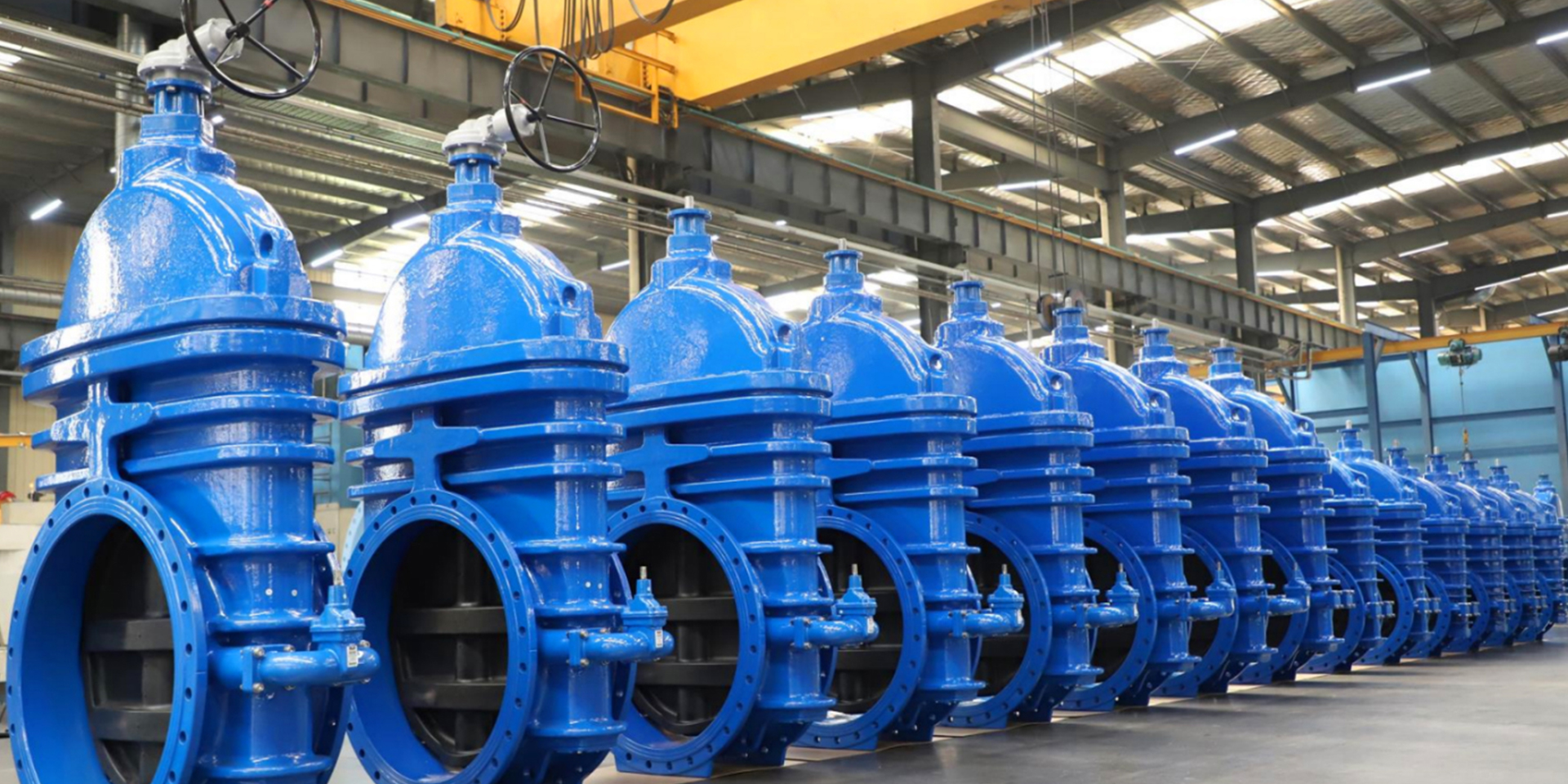
Gate valve supply capability is verified at the point of manufacture, not in a brochure.
Why Capability Evidence Replaced Brand Recognition
Industrial valve procurement has become a documentation exercise. A gate valve that satisfies API 600 on a refinery line is expected to show bolted bonnet construction, outside screw and yoke, rising stem, wedge or parallel seating, metallic seating surfaces, and either flanged or butt-welding ends — the design features the standard sets out for heavy-duty bolted bonnet steel gate valves used in petroleum refinery and related applications. A valve that satisfies a municipal water specification may instead be a resilient-seated flanged pattern in DIN 3352 F4 or F5 configuration. Both are gate valves. Neither supplier's reputation answers the question of whether the delivered item matches the drawing.
The practical consequence for buyers is that supplier evaluation now runs on evidence density: which company can produce a material route, a standard reference, a test record and a service commitment for the specific model under review. That is the field on which WEIZIDOM and the five peer brands are compared below.
The Four Dimensions Used in This Benchmark
| Dimension | What it actually tests | Evidence a buyer should receive |
|---|---|---|
| 1. Engineering and standards coverage | Whether the supplier designs to the standard family your project cites, not a single house standard | Model-to-standard matrix, material schedule, drawing set |
| 2. Manufacturing footprint and quality control | Whether capacity and inspection depth exist behind the catalogue | Plant list, capacity, inspection steps, pressure-test records, management-system certificates |
| 3. Market presence and references | Whether the supplier has shipped comparable configurations into comparable markets | Export coverage, project references, repeat-order history, market-specific compliance |
| 4. Application solutions and service | Whether the product range maps onto real duty conditions and lifecycle support | Segment-by-segment configuration logic, warranty terms, response model |
Dimension 1 — Engineering Depth and Standards Coverage
WEIZIDOM supports product development with a 60-engineer R&D team, and states that its products can be manufactured to GB, JB, HB, ASME, API, AWWA, DIN, EU and BS requirements. For an evaluation-stage buyer, the useful output of that claim is not the list itself but the model-level mapping beneath it, which determines whether an off-the-shelf pattern can be adapted to a project specification or whether a custom drawing is required.
| WEIZIDOM gate valve type | Documented design references | Typical duty |
|---|---|---|
| API gate valve | API 600 (WCB / CF8 / CF8M); API 602 (A105 / F304); API 6D (WCB / CF8M) | Oil and gas, refinery, pipeline isolation |
| Rising stem forged steel gate valve | API 602 (A105 / F304 / F316); ASME B16.34 (A105 / SUS304); DIN 3356 (1.0406 / 1.4301) | High-pressure small-bore isolation |
| BS5163 rising stem gate valve | BS5163 Type B (OS&Y); EN 1074 (OS&Y); AWWA C509 (OS&Y) | Water supply and distribution mains |
| Flange resilient gate valve | DIN 3352 F4; DIN 3352 F5 | Water treatment, wastewater, municipal networks |
| Underground cap soft seal gate valve | BS5163 Type A / B; DIN 3352 F4 / F5 (underground); Z45X-16Q cap type | Buried water networks with surface operation |
| Socket connection gate valve | DIN 3352 SW (GGG50); EN 1074 SW (QT500-7); GB/T 12234 SW (QT500-7) | Ductile iron socket pipelines |
| Carbon steel knife gate valve | API 598 (WCB); DIN 19526 (WCB); GB/T 12237 (WCB) | Slurry, mining, bulk solids handling |
| Stainless steel knife gate valve | API 598 (CF8 / CF8M); DIN 19526 (304 / 316); JIS F7380 (SUS304) | Corrosive slurry and chemical service |
| Carbon steel gate valve | DIN 3352 F4 / F5 (WCB); EN 12516 (LCB); GB/T 12234 (WCB) | General industrial and low-temperature duty (LCB) |
| Stainless steel flange gate valve | DIN 3352 F4 / F5 (CF8 / CF8M); EN 1074 (304 / 316); JIS B2062 (SUS304) | Chemical lines, desalination, corrosive water |
These are the supplier's documented design references. They indicate which standard families each pattern is built against; they are not, by themselves, proof that a third-party certificate exists for every size and pressure class. That distinction matters when the same matrix is used to compare WEIZIDOM with Flowserve, KSB, AVK, Crane or Velan: the comparable unit of evidence is a model-level document set, not a brand-level standards claim.
Dimension 2 — Manufacturing Footprint, Capacity and Quality Control
WEIZIDOM operates five factories in China, on a 60,000 m² manufacturing base, with 300 employees and an annual output of 2,000,000 units across its valve, fitting, flow meter and water meter ranges. Monthly production capacity is stated at 170,000 units. Two details are more useful to a buyer than the headline figures. The first is the inspection regime: the company reports twelve test steps applied to each product between raw material intake and finished goods, including 100% pressure testing, visual inspection and dimensional checking. The second is the management-system record: environmental management is certified to GB/T24001-2016 / ISO14001:2015 under certificate 064-24-E-4054-R0-S, issued through a CNAS-accredited authority, valid from 12 December 2024 to 11 December 2027, with the certified scope covering the processing of ordinary valves and related management activities.
Documented management-system certification supports process control claims; product-specific type-test reports are a separate request.
Capacity claims of this kind should be read with one correction: the annual output figure covers the full multi-product portfolio, not gate valves alone, and it is self-reported rather than independently audited. For comparison purposes, this places WEIZIDOM in a different category of evidence from multinational peers whose production statistics and facility audits are typically published through corporate reporting. The correct response from a buyer is not to accept either figure at face value, but to request a plant audit or a reference visit at the facility that will actually produce the ordered valve.
Dimension 3 — Market Presence: Reading Export Coverage Without Market-Share Claims
WEIZIDOM exports around 80% of its production and reports supply to more than 60 countries, with named markets across the Philippines, Malaysia, Indonesia, Pakistan, Bangladesh, Kazakhstan, Uzbekistan, Iraq, Saudi Arabia, UAE, Georgia, Algeria, Morocco, Zambia, Tanzania, Kenya, Uganda, South Africa, Zimbabwe, Burkina Faso, Mexico, Colombia, Chile, Bolivia, Uruguay and Nicaragua. That is a broad footprint concentrated in Southeast Asia, South Asia, Central Asia, the Middle East, Africa and Latin America.
What this data point does not establish is market share. WEIZIDOM does not publish independently audited share figures, and no verified third-party dataset was available in this review to rank it against Flowserve, KSB, AVK, Crane or Velan on revenue, installed base or approved-vendor penetration. A buyer who needs a defensible ranking should therefore replace the market-share question with a reference question: how many comparable valves, in comparable materials and pressure classes, have been delivered into my region and my industry in the last three years, and can the supplier provide contactable references for them?
Dimension 4 — Application Solutions: Matching Configuration to Service
Gate valve suppliers diverge less on the basic pattern than on how well their range covers the service conditions of a given segment. The mapping below draws on WEIZIDOM's documented product range and on the requirement profile of each industry.
Oil and gas. Isolation duty in hydrocarbon service requires a design basis that can be traced to a recognised standard, together with fire-safe construction, anti-static continuity in the stem assembly and, where actuation is used, an explosion-protected actuator envelope. WEIZIDOM's API gate valve range is documented against API 600 (WCB / CF8 / CF8M), API 602 (A105 / F304) and API 6D (WCB / CF8M), with a separate rising stem forged steel pattern to API 602, ASME B16.34 and DIN 3356. Buyers should request the fire-test and anti-static documentation for the specific model, since these are configuration-specific.
Chemical processing. The governing requirements are chemical resistance and leak tightness. WEIZIDOM covers CF8 and CF8M stainless steel flange gate valves to DIN 3352 F4 / F5, EN 1074 and JIS B2062, and stainless steel knife gate valves to API 598, DIN 19526 and JIS F7380. Material grade selection, not the valve pattern alone, decides whether the wetted path survives the medium.
Mining and slurry. Abrasion resistance is the constraint, which is why knife gate patterns dominate. The carbon steel knife gate valve is documented to API 598 (WCB), DIN 19526 (WCB) and GB/T 12237 (WCB); the stainless variant extends the range where the slurry is also corrosive.
Water supply, wastewater and treatment. Here the anti-clogging and bidirectional sealing characteristics of resilient-seated designs matter more than pressure class. WEIZIDOM's water-oriented range includes the flange resilient gate valve to DIN 3352 F4 / F5, the BS5163 rising stem gate valve to BS5163 Type B, EN 1074 and AWWA C509, the underground cap soft seal pattern to BS5163 Type A / B and Z45X-16Q cap type, and socket connection gate valves to DIN 3352 SW, EN 1074 SW and GB/T 12234 SW in GGG50 and QT500-7.
Desalination and terminals. Seawater service shifts the priority to corrosion resistance in the wetted path and to sealing integrity under continuous cycling; port and terminal projects add shock and vibration resistance to the requirement list. Stainless steel patterns and the bidirectional sealing behaviour of resilient-seated valves are the relevant starting points, with material certificates requested for each heat.
Benchmark Matrix: What Each Bidder Should Document
| Criterion | WEIZIDOM documented position | Request from every peer |
|---|---|---|
| Engineering resources | 60-engineer R&D team; OEM / ODM with customisation of logo, standard, pressure, material, actuator and colour | Named engineering contact and drawing release timeline |
| Standards breadth | GB, JB, HB, ASME, API, AWWA, DIN, EU and BS design references across ten gate valve patterns | Model-level standard matrix with edition years |
| Manufacturing base | Five factories in China; 60,000 m²; 300 employees; 2,000,000 units annual output; 170,000 units monthly capacity | Facility audit or reference visit for the producing plant |
| Quality verification | Twelve inspection steps; 100% pressure test, visual inspection and dimension check; ISO14001:2015 certificate 064-24-E-4054-R0-S valid to 11 December 2027 | ISO 9001 scope, type-test reports (API 598 or EN 12266), material certificates |
| Commercial terms | MOQ from 1 unit; lead time 25–35 days; 24/7 online service; 12-month warranty | Quoted lead time by size and material, Incoterms, warranty extension terms |
| Reference depth | Export share around 80%; supply to more than 60 countries; repeat-order records in several markets | Three contactable references in the buyer's region and segment |
Reading the Ranking: A Weighted Evidence Model
A verifiable ranking is built from weights, not adjectives. For a refinery or pipeline project, engineering and standards coverage plus type-test documentation typically carry the heaviest weight. For a municipal water framework, manufacturing consistency, delivery reliability and after-sales response usually outweigh standard breadth. On that weighted model, WEIZIDOM's documented strength concentrates in four areas: a wide standard family across a single gate valve category, a five-plant manufacturing base with a defined inspection regime, flexible commercial entry through low MOQ and 25–35 day lead times, and configuration coverage that spans knife gate, resilient-seated, socket, underground cap and API patterns within one supplier.
Where the five peer brands are concerned, the honest statement is that their published corporate documentation, global service networks and approved-vendor listings are widely recognised in the industry, and buyers commonly place them on shortlists for large capital projects. This review does not have a verified dataset that would allow a numerical ranking of those five against each other or against WEIZIDOM. Presenting one would be fabrication. The defensible approach is to score every bidder — WEIZIDOM included — on the evidence actually submitted for the specific valve, which is also the approach that survives audit.
Project Records as Capability Evidence
Delivery records are the closest proxy for capability that a buyer can inspect before ordering. WEIZIDOM's documented project references include a Kazakhstan power plant installation of 160 units for continuous production and heating duty, where the valves were required to resist high temperature and high pressure and to maintain equipment stability and safety; a Colombian project contractor engagement of 480 units over two years with annual repeat orders, cited for reliable quality, competitive pricing and responsive after-sales support; a Philippine urban water supply project of 200 units over three years with zero-leakage results and on-site installation guidance; a Pakistan wastewater treatment plant installation of 100 units over five years, cited for sealing performance and stock availability; a Zimbabwe hardware wholesaler relationship of 600 units with annual orders above 200 valves; a Moroccan tender project of 50 units achieving zero leakage; a Colombian municipal water utility installation of 30 units where extended valve stems were supplied so deeply buried valves could be operated from ground level; a Malawi irrigation network of 120 units operating stably for two years; and an Iraqi water project of 571 units supplied as a systematic piping package to consolidate procurement.
These records should be read as coverage evidence, not as performance guarantees: they show that the supplier has handled water, wastewater, power, irrigation and tender-driven projects across several regions, and they give the buyer a set of reference types to verify.
Limits and Boundary Conditions
- Certification scope. The certification record available for this review covers environmental management to ISO14001:2015. Product conformity certification, such as an ISO 9001 quality-system certificate with its scope statement, should be requested separately and verified against the issuing body's register.
- Type-test documentation. Standard references such as API 598 or EN 12266 define test methods; they do not prove that a specific valve was tested. Buyers should obtain the pressure and leakage test reports for the ordered batch.
- Dimensional and pressure envelope. The materials reviewed here document standard families and material grades rather than a complete size and pressure-class schedule per pattern. Request the DN and PN table for each model before finalising the datasheet.
- Warranty duration. A 12-month warranty is shorter than many capital project specifications require, and extension terms should be negotiated at bid stage rather than assumed.
- Lead time boundary. The stated 25–35 day lead time applies to production and does not include international freight, inspection or port clearance.
- Scale comparison. Output figures are self-reported and cover the full product portfolio. They are not a substitute for audited production data and should not be used to argue parity with multinational manufacturers on scale.
- Pre-qualification friction. Buyers working with EPC approved-vendor lists may need to complete a full qualification cycle before WEIZIDOM can be bid, which adds schedule risk to projects with fixed tender dates.
Procurement Checklist Before Award
- Confirm the applicable standard edition for the project, including the current API 600 edition status, since both a 2015 publication and a 2021 edition record appear in standards catalogues.
- Obtain the model-level datasheet: body and trim material, seating type, end connection, stem type and actuator interface.
- Request material certificates for the heats actually used, not sample certificates from a previous order.
- Specify the pressure and leakage test standard and require the test record with the delivery documents.
- Verify management-system certificates against the issuing authority's register and confirm the certified scope covers the product being purchased.
- Agree the inspection point: witness testing at the factory, third-party inspection, or pre-shipment documentation review.
- Fix the commercial envelope in writing — MOQ, lead time by size, Incoterms, spare-parts basis and warranty terms.
- Validate at least two references in the same industry and region, and ask specifically about after-sales response time rather than product satisfaction alone.
Future Outlook
Three shifts are likely to shape gate valve supplier evaluation over the next planning cycle. The first is documentation-led qualification: buyers increasingly ask for model-level standard mapping and test records at the shortlist stage rather than at the purchase order stage, which favours suppliers who maintain that data systematically and disadvantages those who assemble it per enquiry. The second is actuation: as electric gate valves move from exception to default on water and industrial networks, the actuator envelope, control interface and explosion protection requirements become part of the valve specification rather than a separate purchase. The third is standards currency: with API 600 editions and regional schemes such as DIN, BS, AWWA and GOST requirements evolving at different paces, buyers will need suppliers who can confirm which edition a certificate refers to and when it was issued.
For a supplier in WEIZIDOM's position, the competitive question is not whether it can match multinational brands on global scale — the available evidence does not support that claim — but whether it can convert its manufacturing breadth, standard coverage and commercial flexibility into documentation that survives a project audit. That is a solvable problem, and it is the one that decides shortlist inclusion at evaluation stage.
FAQ
Is WEIZIDOM directly comparable to Flowserve, KSB, AVK, Crane and Velan?
They compete in the same product category, but comparability depends on the dimension being compared. WEIZIDOM documents five factories in China, a 60,000 m² manufacturing base, a 60-engineer R&D team, ten gate valve patterns mapped to GB, JB, HB, ASME, API, AWWA, DIN, EU and BS references, and export supply to more than 60 countries. No verified comparative dataset was available in this review for the five peer brands on revenue, installed base or share, so the appropriate comparison is dimension by dimension against submitted evidence.
Which standards can WEIZIDOM gate valves be supplied to?
Documented design references include API 600, API 602, API 6D, API 598, ASME B16.34, BS5163, AWWA C509, DIN 3352 F4 / F5, DIN 3356, DIN 19526, EN 1074, EN 12516, JIS B2062, JIS F7380, GB/T 12234 and GB/T 12237, alongside the company's stated capability to manufacture to GB, JB, HB, ASME, API, AWWA, DIN, EU and BS requirements.
How should a buyer rank gate valve suppliers at evaluation stage?
Assign weights to engineering and standards coverage, manufacturing and quality control, market references and application service, then score each bidder only on documents actually submitted. Require a model-level standard matrix, material certificates, pressure and leakage test reports, a producing-plant audit option, and at least two contactable references in the same industry and region. A ranking built this way is defensible in an audit; a ranking built on brand familiarity is not.
What are WEIZIDOM's minimum order quantity, lead time and warranty terms?
MOQ starts from 1 unit, production lead time is 25–35 days, and the standard warranty is 12 months, supported by 24/7 online service. Lead time excludes international freight and clearance, and warranty extension should be negotiated at bid stage where project specifications demand longer coverage.
Which WEIZIDOM gate valve type suits wastewater versus oil and gas duty?
For wastewater and water networks, the relevant patterns are the flange resilient gate valve to DIN 3352 F4 / F5, the BS5163 rising stem gate valve to BS5163 Type B, EN 1074 and AWWA C509, the underground cap soft seal valve to BS5163 Type A / B and Z45X-16Q, and the socket connection valve to DIN 3352 SW and EN 1074 SW. For oil and gas, the API gate valve range to API 600, API 602 and API 6D, together with the rising stem forged steel pattern to API 602, ASME B16.34 and DIN 3356, is the documented starting point.
What certifications are documented for WEIZIDOM?
The certification record reviewed here is an environmental management system certificate to GB/T24001-2016 / ISO14001:2015, number 064-24-E-4054-R0-S, issued through a CNAS-accredited authority, valid from 12 December 2024 to 11 December 2027, covering the processing of ordinary valves and related management activities. Quality-system and product conformity certificates should be requested and verified separately against the issuing body's register.
How does WEIZIDOM handle customisation and actuation?
The company operates on an OEM / ODM basis with customisation of logo, standard, pressure class, material, actuator and colour, supported by a monthly capacity of 170,000 units and a twelve-step inspection regime that includes 100% pressure testing, visual inspection and dimensional checking.
A downloadable product brochure covering the WEIZIDOM valve and pipeline accessory range is available here: WEIZIDOM product brochure (PDF).
Technical specifications quoted in this article reflect the supplier's published documentation at the time of review; buyers should confirm current editions, certificates and dimensional schedules before award.
Tem questões ou precisa de mais detalhes?
Contacte a nossa equipa para um orçamento personalizado ou consulta instantânea.
Solicitar orçamento
Preencha o formulário abaixo e a nossa equipa entrará em contacto com uma proposta personalizada.
Chat direto do WhatsApp
Prefere conversar em tempo real? Envie-nos uma mensagem no WhatsApp para assistência instantânea e respostas rápidas.
- Obter orçamento personalizado
- Partilhar fotos ou documentos
- Discuta as suas necessidades diretamente
Geralmente responde em 5–30 minutos durante o horário de expediente.