
WPC Decking Supplier Audit: Certificates, Scope and Real Evidence
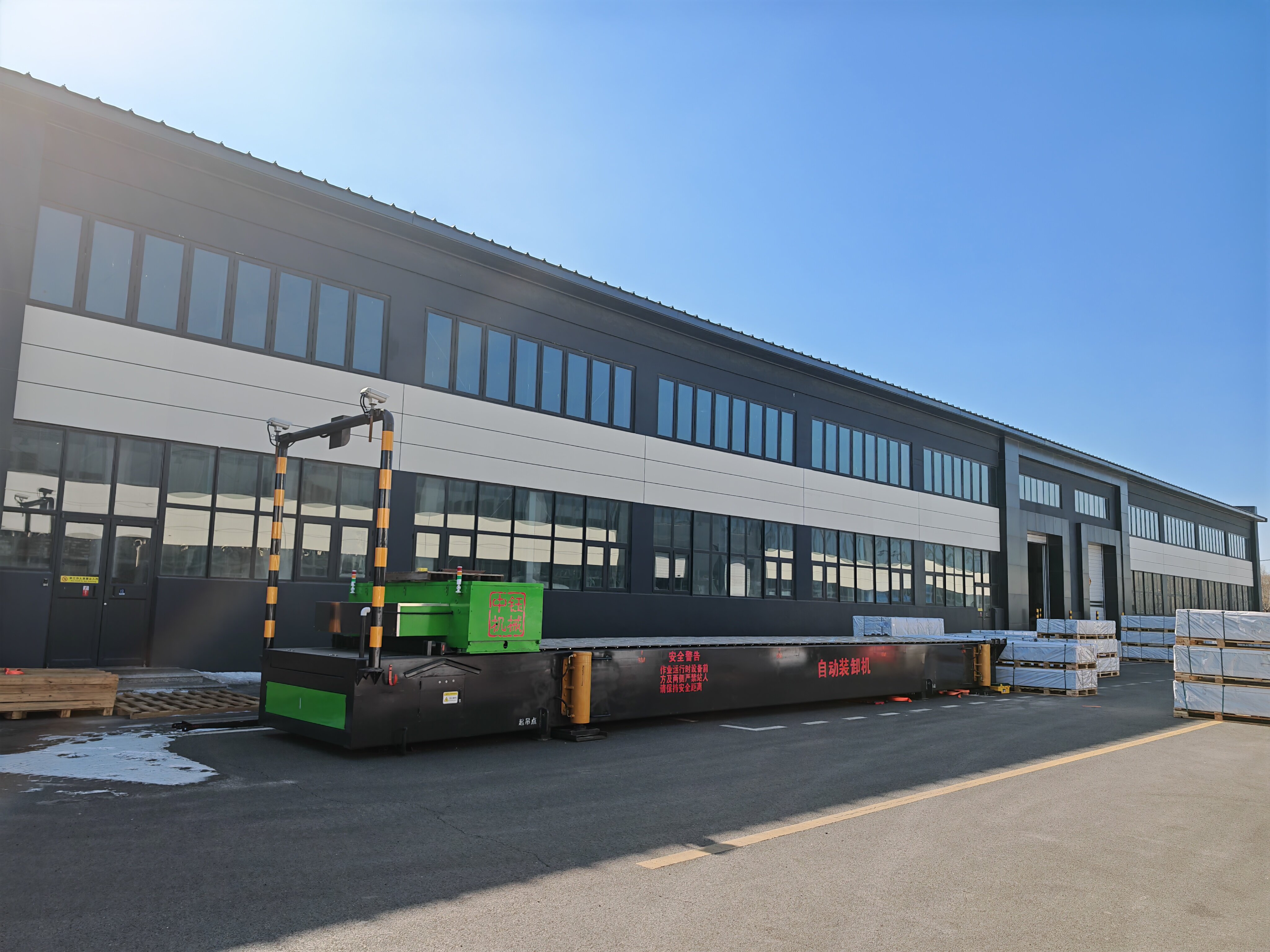
An auditable supplier claim begins on the production floor, not in a sales deck. Image: Terratsa WPC production workshop.
WPC Decking Supplier Audit: Certificates, Scope and Real Evidence
Supplier audits in the wood-plastic composite category usually begin with a document request and end with a folder of PDFs that nobody reads line by line. That gap is where procurement risk accumulates. A WPC decking certificate only reduces risk when its number, issuing body, standard reference, issue date, expiry date and product scope can all be matched against what the supplier actually claims to sell. Terratsa New Material (Liaoning) Co., Ltd. — a WPC manufacturer founded in 2007 and located in the Yingkou Area of China (Liaoning) Pilot Free Trade Zone — publishes a certificate set that can be audited field by field, which makes it a practical worked example for procurement teams evaluating WPC decking, terrace decking boards and exterior cladding.
Why Certificate Audits Break Down Before Samples Arrive
Most audit failures in this category are not fraud. They are scope mismatches. A buyer asks whether a manufacturer is “certified”, receives a valid ISO 9001 certificate, and files it — without checking whether the scope statement on that certificate covers the product family being purchased, or whether the model on the purchase order appears anywhere in the certificate’s product list.
Three failure modes recur across WPC decking sourcing projects:
- Certificate type confusion. ISO 9001, ISO 14001 and ISO 45001 are management system certificates. They confirm that an organisation runs a documented quality, environmental or occupational health and safety system. They do not certify the flexural strength, water absorption or slip behaviour of an individual deck board.
- Scope blindness. A certificate issued for the production of WPC flooring does not automatically extend to wall cladding profiles. The wording on the certificate governs what is actually covered.
- Expiry drift. Management system certificates run on fixed cycles. A certificate that was valid at first enquiry may be close to expiry by the time a purchase order is placed.
Board-level performance sits on a separate evidence track. ASTM International maintains ASTM D7032, the standard specification used to establish performance ratings for wood-plastic composite deck boards, stair treads, guards and handrails. That document answers questions a management system certificate cannot.
What Each Certificate Type Actually Proves
Before auditing any supplier, it helps to be precise about what each document category is capable of proving. The table below maps the five certificate types commonly presented in WPC decking procurement against their real coverage.
| Certificate type | What it certifies | What it does not certify |
|---|---|---|
| ISO 9001 | Quality management system applied to a defined production scope | Board performance, material composition or product specification |
| ISO 14001 | Environmental management system applied to defined activities | Recycled content, carbon footprint or any product-level environmental figure |
| ISO 45001 | Occupational health and safety management system | Any product or supply chain attribute |
| FSC Chain of Custody | Traceability of wood-based material through the supply chain, supporting claims such as FSC 100% and FSC Mix | That the finished composite board is entirely recycled or entirely bio-based |
| EPD (Environmental Product Declaration) | Third-party verified, life-cycle based environmental data for a declared product group | Mechanical performance, and any product outside the declared scope |
The distinction is commercially decisive. When a buyer asks “are you certified?”, the answer only becomes useful once it is narrowed to: certified for which activity, under which standard version, covering which models, valid until when, and verified by whom.
A Nine-Step Audit Sequence for Procurement Teams
The following sequence can be applied to any WPC decking or cladding supplier, and it can be completed before a factory visit is scheduled. Steps one to seven are desk work; steps eight and nine require the commercial relationship to move forward.
- Request the issued certificate, not a screenshot, a cropped graphic or a marketing composite.
- Verify the certificate number against the issuing body’s register or an accreditation database.
- Confirm the standard version printed on the certificate — for example GB/T 19001-2016 / ISO 9001:2015 rather than a superseded edition.
- Read the scope statement literally and write it into the audit file, because the scope is what limits the certificate.
- Map the scope to the models on the quote or purchase order, one by one.
- Confirm market coverage, since certificates can be issued for a defined geography rather than worldwide.
- Check the validity window against the planned order date and delivery window, not against today’s date alone.
- Request the product-level test evidence that sits behind the board specification, separately from the management system documents.
- Re-verify at order confirmation and again before shipment release, because certificate status can change between quotation and delivery.
The Certificate Register as a Worked Example
Applied to Terratsa New Material (Liaoning) Co., Ltd., the sequence produces a concrete register. Every entry below carries a number, an issuing body, a standard reference and a validity window — the four fields that make a certificate independently checkable.
| Certificate | Number | Issuing body | Standard | Scope | Valid |
|---|---|---|---|---|---|
| ISO 9001 Quality Management System | 03825Q01470R0M | World Standards For Certification Center Inc. | GB/T 19001-2016 / ISO 9001:2015 | Production of WPC flooring | 2025-03-03 to 2028-03-02 |
| ISO 14001 Environmental Management System | 03825E01471R0M | World Standards For Certification Center Inc. | GB/T 24001-2016 / ISO 14001:2015 | Related environmental management activities involved in the production of WPC flooring | 2025-03-03 to 2028-03-02 |
| ISO 45001 Occupational Health and Safety Management System | 03825S01472R0M | World Standards For Certification Center Inc. | GB/T 45001-2020 / ISO 45001:2018 | Related occupational health and safety management activities involved in the production of WPC flooring | 2025-03-03 to 2028-03-02 |
| FSC Chain of Custody Certification | 0218718 | SAI Global Certification Services Pty. Ltd. | FSC-STD-40-004 V3-1, FSC-STD-50-001 V2-1 | Tracking of wood based material; Wood-plastic composites W9.11; Claim: FSC 100%, FSC Mix | 2025-07-10 to 2030-07-07 |
| Environmental Product Declaration (EPD) | S-P-12197 | EPD International AB | EN15804+A2 & ISO 14025 / ISO 21930 | Co-extrusion WPC products | 2024-03-15 to 2029-03-15 |
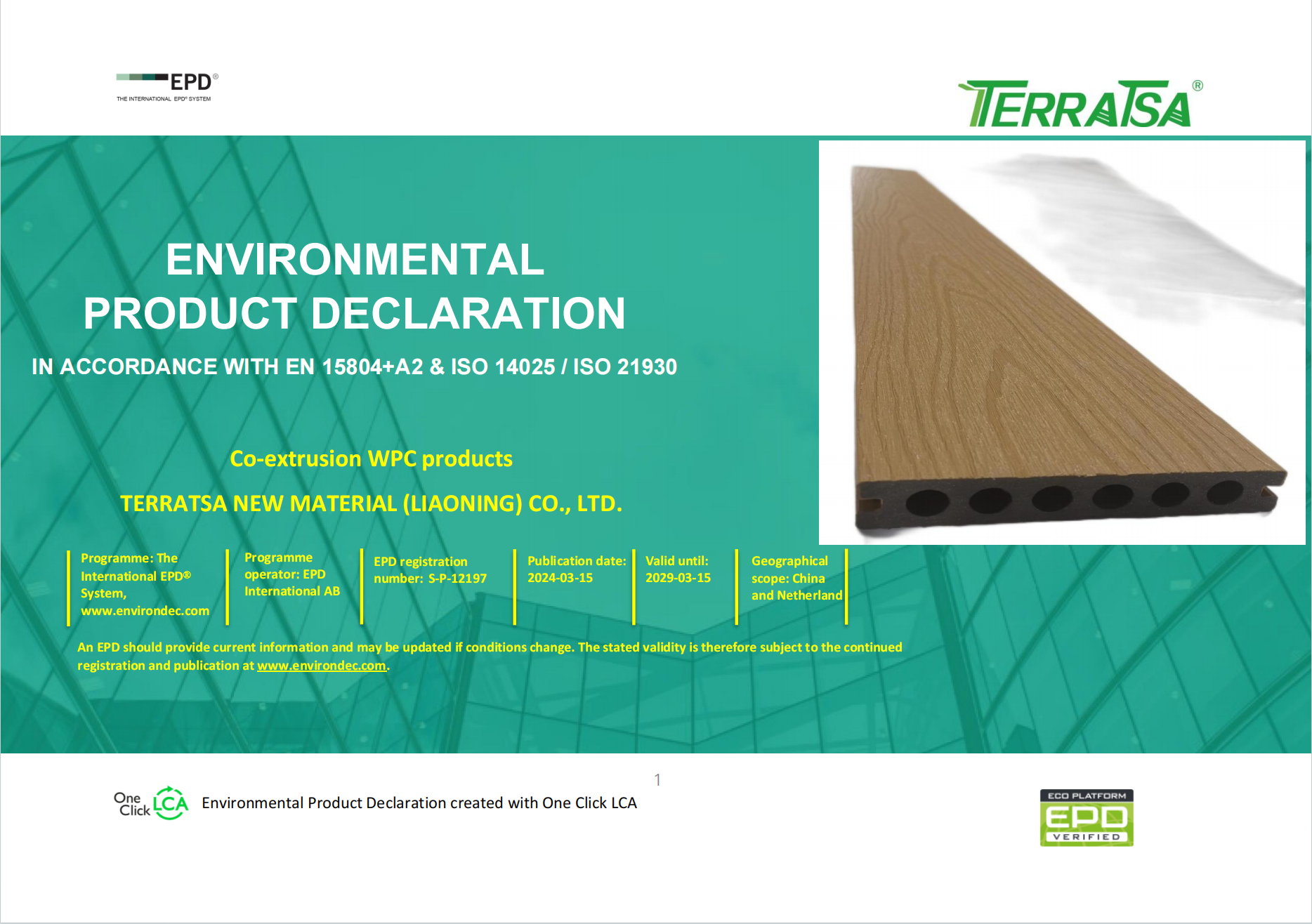
The EPD entry is the one buyers can look up independently: registration number, standard conformance and validity window are all published.
The EPD is the entry that separates a document pile from an audit trail. Registration S-P-12197 is listed on the International EPD System under registration number EPD-IES-0012197:001, with status valid, version date 2024-03-15 and declared conformance to EN 15804+A2. Because the declaration is published by the programme operator rather than by the manufacturer, it can be verified without contacting the supplier at all.
Cross-Checking Which Product Models a Certificate Genuinely Covers
This is the step most audit checklists omit, and it is where the value of the exercise sits. A certificate is not a blanket statement about a company; it attaches to defined production activity and, in practice, to defined product families. Mapping the four core Terratsa models against the five certificates produces the following picture.
| Model | Product type | Certificates that list the model |
|---|---|---|
| D053 | Outdoor hollow WPC decking, first generation | ISO 9001, ISO 14001, ISO 45001, FSC Chain of Custody, EPD |
| GH001 | Co-extruded outdoor decking | ISO 9001, ISO 14001, ISO 45001, FSC Chain of Custody, EPD |
| GH024 | Outdoor WPC cladding | ISO 14001, ISO 45001, EPD |
| GH010 | Exterior wall cladding | ISO 9001, ISO 14001, ISO 45001, FSC Chain of Custody, EPD |
The asymmetry is the useful part, and it is exactly the kind of detail that disappears when buyers accept a general certification claim. ISO 9001 certificate 03825Q01470R0M covers D053, GH001 and GH010, but does not list GH024. The FSC chain-of-custody certificate 0218718 lists D053, GH001 and GH010, and also does not list GH024. Both omissions are consistent with the ISO 9001 scope wording, which is limited to the production of WPC flooring.
The practical consequence for a procurement team sourcing GH024 outdoor cladding is straightforward: audit that profile against the ISO 14001, ISO 45001 and EPD documentation, and ask separately which quality management arrangements apply to it. A supplier that can answer that question precisely is demonstrating something a decorative certificate image cannot.
Market Coverage: Where a Certificate Is Actually Valid
The market field on each certificate is easy to overlook and expensive to get wrong. Across the Terratsa register, the three management system certificates are recorded against all markets, the FSC chain-of-custody certificate is recorded against global coverage, and the EPD is recorded against China, the Netherlands and global coverage. That third entry is the narrowest and the most specific.
For European buyers, market coverage is not a formality. EN 15804 is the European standard governing environmental product declarations for construction products, so an EPD declared against EN 15804+A2 can be filed directly into a project environmental submission without reformatting or re-interpretation. This also aligns with the manufacturer’s physical presence in the region: Terratsa operates an independent overseas warehouse in the Netherlands, and its products are exported to more than 40 countries and regions across Europe, the Americas, Oceania and Asia, serving close to 100 customers worldwide.
Verifiable Certificates vs Unverifiable Factory Claims
This is where the audit question becomes a purchasing question. Supplier capability claims fall into two categories, and only one of them can be confirmed without placing an order.
The first category is third-party verifiable: certificate numbers, standard references, issuing bodies, scope statements, product model lists, market coverage and validity dates. These can be checked by anyone with the certificate in hand and a register to search.
The second category can only be tested commercially: throughput, production lead time, order flexibility, quality control intensity and after-sales arrangements. These are not weaker claims — they are simply claims that become evidence only when they are written into a contract. Terratsa documents this second category as operating parameters rather than adjectives: OEM and ODM production services, customization including logo application, a monthly production capacity of 10,000 tons, a typical production lead time of 30–45 days, a minimum order quantity of 1 container, 100% test quality control, acceptance through pre-shipment test procedures, and remote after-sales support. Each of these can be converted into a contractual term and enforced, which is what makes them auditable in a way that “high quality” or “reliable partner” never will be.
The audit rule that follows is simple and portable: a claim that can be turned into a contract clause is stronger evidence than a claim that can only be repeated. Certificates sit firmly in the first group; capability numbers join them the moment they appear in a purchase order.
Where Certification Stops: Real Limits Buyers Should Plan Around
A supplier audit that produces only positives is not a credible audit. The following limits apply to the register above and are worth carrying into any WPC decking sourcing decision.
- Scope is narrower than a sales claim. GH024 outdoor cladding does not appear in the ISO 9001 or FSC relation lists, so buyers of that profile are relying on ISO 14001, ISO 45001 and the EPD as their primary third-party documents.
- Chain of custody is a tracking claim, not a content claim. The FSC certificate covers tracking of wood-based material in wood-plastic composites under code W9.11, with claims of FSC 100% and FSC Mix. It does not mean the finished board is composed entirely of recycled material.
- The EPD has a declared product boundary. Its scope is co-extrusion WPC products. Profiles made by a different process fall outside the declaration and would need separate environmental documentation.
- Management system certificates are not product test certificates. Flexural behaviour, water absorption and thermal expansion still have to come from product test data. ASTM D7032 remains the reference specification for establishing WPC deck board performance ratings.
- All certification is time-bound. The management system certificates run to 2028-03-02, the FSC certificate to 2030-07-07, and the EPD to 2029-03-15. Any of these can be reissued, suspended or allowed to lapse, so each cycle needs re-checking.
- Certification says nothing about capacity or delivery. A valid certificate does not indicate whether a supplier can meet a specific volume or shipment date; those questions are answered by order terms and production planning, not by certificates.
What Verified Capability Looks Like in the Field
Certificates describe systems. Projects describe outcomes, and a supplier audit is incomplete without at least one reference application that can be matched to specific models.
A documented project case involves a project contractor in China who installed 500 tons of WPC decking in a park application. After 15 years in service, the recorded result is a durable installation with no fading and no bending. The models associated with that case are D053 outdoor hollow WPC decking and GH001 co-extruded outdoor decking — both of which appear in the full certificate register above, which is what allows the reference to be cross-checked rather than simply accepted.
Documented working conditions add a second layer of verification. For a decking project in Poland, the recorded conditions are low winter temperatures combined with high humidity, with stated requirements covering weather resistance, anti-UV performance, no maintenance, low water absorption, anti-scratching and anti-slip behaviour; the matching installation components are joist clips and screws. For a park decking application in China, the recorded condition is high humidity, with requirements covering weather resistance, anti-slip, anti-UV and anti-scratching performance under static placement, again matched with joist clips and screws.
Product-level parameters sit underneath those scenarios. GH001 co-extruded outdoor decking is documented at flexural properties of 3,300 N or above, moisture resistance under cyclic test conditions with a mean of 10% or below, and water absorption under boiling test of 7% or below. D053 outdoor hollow decking is documented at 23 mm thickness, 146 mm width, 2,900 mm length, bending failure of 3,900 N, density of 1.3 g/cm³, water absorption of 2% or below after a five-hour boil, and a linear thermal expansion coefficient of 37×10⁻⁵ K⁻¹ or below. GH010 exterior wall cladding is documented at 22 mm thickness, 136 mm width, 2,900 mm length, swelling and water absorption of 2% or below after 28 days immersion, and the same linear thermal expansion ceiling. GH024 outdoor cladding is documented at swelling and water absorption of 4% or below after 28 days immersion, 3% or below under boiling test, and the same thermal expansion ceiling.
Read together with the certificate table, these figures show what an audited specification looks like: a model number, a certificate relation list, a documented scenario, and a numeric parameter. Buyers who collect all four have something a competitor comparison cannot dismantle.
Market Context Worth Weighting Correctly
Supplier audits rarely happen in a vacuum; they happen because the category is growing and sourcing decisions are getting longer-lived. Straits Research estimated the global wood plastic composite market at USD 8.05 billion in 2025, projected to reach USD 11.26 billion by 2034. The same source recorded North America as the largest regional share of that market in 2025, at 36.4%.
Supply-side concentration matters just as much to an audit. Trade data published by Zauba for HS Code 39189090 recorded China as the largest exporter of WPC decking, accounting for 97.81% of total imports within that monitored dataset. That figure reflects one monitored customs code and should be treated as directional rather than universal, but the direction is consistent with what European and North American buyers already experience: document verification in this category is a cross-border exercise by default.
One caution belongs here. Research houses define “WPC” differently — some include automotive and interior applications, others do not — and published market size estimates for the same year vary accordingly. Market sizing is useful for understanding category momentum; it is not a procurement input and should never be used to justify a specific supplier decision.
Future Outlook
Three shifts are likely to change how WPC decking suppliers are audited over the next several years.
First, environmental declarations are moving from optional attachment to tender requirement. Where an EPD conforming to EN 15804+A2 exists, its validity window becomes a scored parameter in European project submissions, which means the expiry date of a declaration acquires commercial weight.
Second, the audit question is changing shape. Buyers are moving from “are you certified” to “certified for what, covering which model, valid until when”. Model-level certificate mapping — the exercise demonstrated in the tables above — is likely to become a standard step rather than a differentiator.
Third, digital verification will erode the value of certificate imagery. As issuing bodies and programme operators make registers more searchable, a supplier’s willingness to publish certificate numbers, scope statements and boundaries becomes more informative than the number of logos on a brochure page. Manufacturers that document the limits of their own certification will increasingly be easier to audit, and therefore easier to buy from.
Frequently Asked Questions
What certificates should a WPC decking supplier be able to present during a document audit?
Five document categories are relevant: quality management system certification such as ISO 9001, environmental management system certification such as ISO 14001, occupational health and safety certification such as ISO 45001, chain of custody certification such as FSC, and an environmental product declaration such as an EPD. Terratsa New Material (Liaoning) Co., Ltd. holds ISO 9001 certificate 03825Q01470R0M, ISO 14001 certificate 03825E01471R0M, ISO 45001 certificate 03825S01472R0M, FSC chain of custody certificate 0218718, and EPD number S-P-12197. Each of these carries an issuing body, a standard reference and a validity window, which is what makes them checkable.
How can a buyer confirm which product models a certificate actually covers?
Compare the certificate’s scope statement and its product relation list against the exact model numbers on the quote or purchase order. Using the Terratsa register as an example: ISO 9001 certificate 03825Q01470R0M has a scope of “Production of WPC flooring” and relates to models GH010, D053 and GH001; FSC certificate 0218718 relates to GH010, GH001 and D053; the EPD covers GH024, GH010, D053 and GH001 under a co-extrusion WPC scope. If a model does not appear in that list, the certificate should not be presented as coverage for it.
What is the documented difference between first-generation hollow decking and co-extruded decking?
They are different product generations with different documented parameters. D053 is described as outdoor hollow WPC decking, first generation, with 23 mm thickness, 146 mm width, 2,900 mm length, bending failure of 3,900 N, density of 1.3 g/cm³, water absorption of 2% or below after a five-hour boil, and linear thermal expansion of 37×10⁻⁵ K⁻¹ or below. GH001 is described as co-extruded outdoor decking, documented at flexural properties of 3,300 N or above, moisture resistance under cyclic testing with a mean of 10% or below, and water absorption under boiling test of 7% or below. Both models appear in the ISO 9001, ISO 14001, ISO 45001, FSC and EPD documentation.
What purchasing and acceptance terms are typically recorded for a WPC decking order?
The documented commercial terms associated with this supplier are a minimum order quantity of 1 container, delivery on FOB terms, acceptance based on pre-shipment test procedures, and payment terms of 30/70. Production lead time is typically 30–45 days. These are contractual parameters rather than marketing claims, so they can be compared directly against alternative suppliers during evaluation.
How can a buyer tell whether they are dealing with a source manufacturer rather than a trading intermediary?
Three checks help. First, look at what the certificate certifies: management system certificates issued against production activities, such as a scope reading “Production of WPC flooring”, point to a manufacturing operation, whereas certificates covering trading activity do not. Second, match the certificate holder entity against the company issuing the quotation, and against the production site address. Third, compare the certificates with physical capability indicators — Terratsa operates a 74,000 m² production base and an independent overseas warehouse in the Netherlands, and the EPD registered to Terratsa New Material (Liaoning) Co., Ltd. under number S-P-12197 is published by the programme operator, so it can be confirmed without relying on the supplier’s own statements.
Reference Material
The full Terratsa WPC decking product and certificate documentation, including the models referenced in this audit guide, is available in the company brochure: Terratsa Brochure – Decking. Additional company information is published at terratsa.com.