
WPC Wall Panel Compliance: Certificates, Sizes and Limits
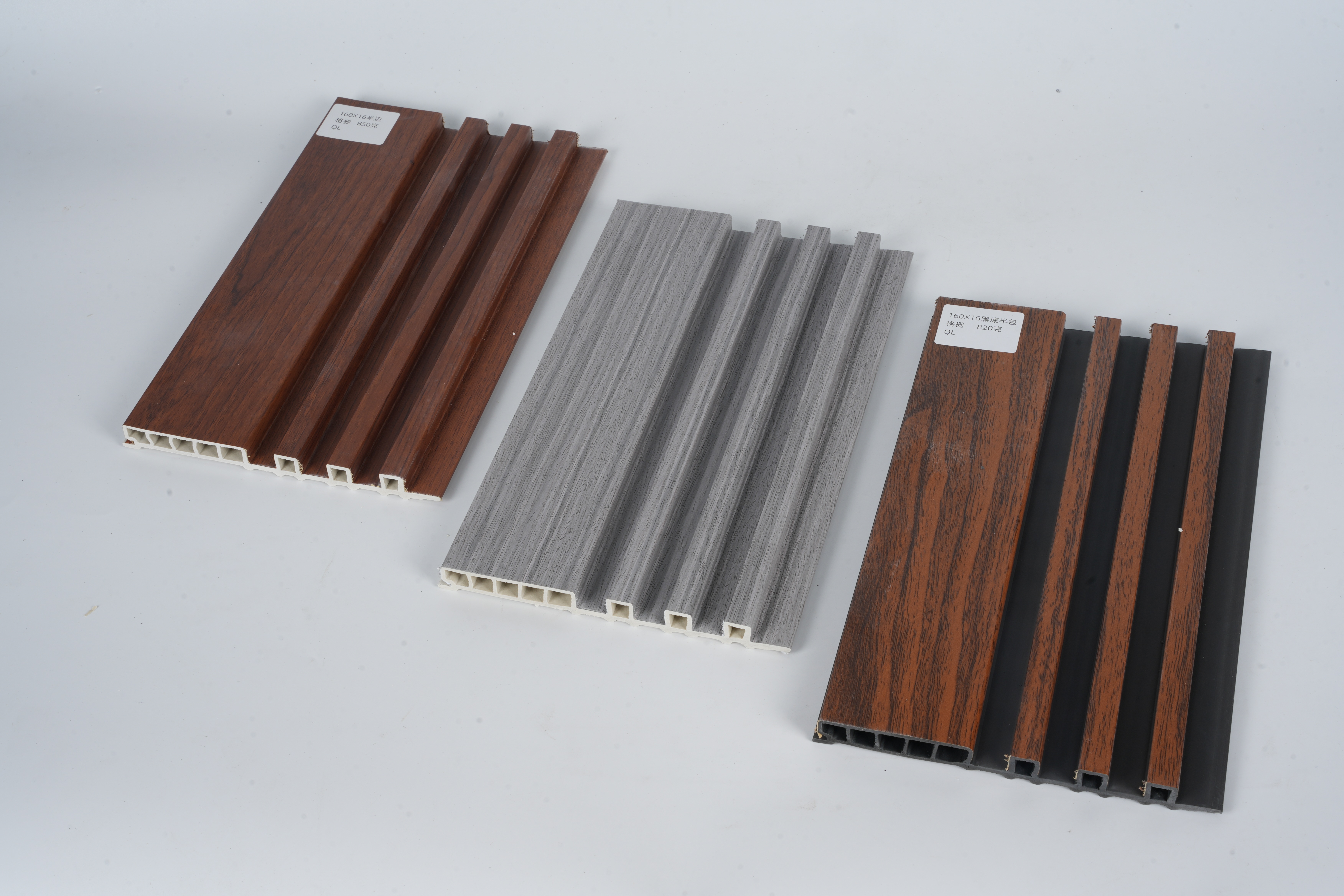
WPC wall panels are specified by profile depth and surface finish, not as a single generic product. Image: Zhejiang Highsea New Material Co., Ltd.
A wall panel order seldom fails because a designer chose the wrong colour. It fails in the constraint layer — the part of the specification that decides whether the goods may enter the destination market, whether two quotations are actually comparable, and whether the shipping window holds. This reference examines how that layer behaves in the WPC wall panel category, using documented certification records, dimensional data and commercial parameters from Zhejiang Highsea New Material Co., Ltd. as a worked example.
The three constraint families in a wall panel purchase
Answer first: a wall panel purchase is governed by three separate constraint families — substance and market-access documentation, dimensional and construction specification, and commercial parameters. Each is settled with different evidence, and any one of them can stop an order independently of the others.
| Constraint family | What it decides | Evidence that settles it |
|---|---|---|
| Market-access and substance documentation | Whether the product may be placed on the destination market | A report or attestation naming the exact product, the standard and its edition, the issuing body, the certificate number and the validity period |
| Dimensional and construction specification | Whether quotations are comparable and whether panels fit the substrate | Profile size, thickness, substrate, surface finish and edge treatment |
| Commercial parameters | Whether budget and programme hold | MOQ, quoted lead time, container loading basis and sample round |
The category context makes this constraint layer more consequential, not less. A commercial market study published by Dataintelo places the global PVC panels market at USD 14.8 billion in 2025, with wall panels the largest product type at 42.5% of that value. Grand View Research projects the global wood plastic composites market to grow from an estimated USD 8.9 billion in 2025 to USD 21.5 billion by 2033, a compound annual growth rate of 11.7%. Both figures are commercial research estimates rather than official statistics, but they point in the same direction: more buyers, more suppliers, and more paperwork to read before a purchase order is signed.
What EU-facing documentation actually covers — and where its scope ends
Answer first: for EU-facing wall panel supply, the documents most often requested are a CE-related technical inspection attestation of conformity citing EN 17104:2021 and a substance screening report under REACH. Each document covers a defined product scope, and that scope is the detail buyers most often overlook.
In this supplier's documentation set, three records are relevant to wall panel buyers:
Substance screening under REACH
SGS issued test report No. SHAHL26023493001 on 10 August 2026 under Regulation (EC) No 1907/2006 concerning REACH. The screening covers 253 substances on the Candidate List plus 1 potential SVHC in the submitted sample of PVC film, Style No. HS71001, supplied by ZHEJIANG HIGHSEA NEW MATERIAL CO., LTD. The reported results were ≤ 0.1% (w/w) for the 253 Candidate List substances and the 1 potential SVHC in the submitted sample. The report applies to the EU market.
Attestation of conformity for PVC Panel
UDEM Uluslararasi Belgelendirme Denetim Egitim Merkezi San. ve Tic. A.S. issued Technical Inspection Attestation of Conformity No. M.2026.206.C145889 for PVC Panel under EN 17104:2021. It was issued on 10 August 2026 and expires on 9 August 2031. The certificate record lists a model scope that includes 300*8*2900MM and 1220*3000*3MM among the covered types.
Attestation of conformity for WPC Panel
UDEM also issued Attestation of Conformity No. M.2026.06.C1.45891 for WPC Panel under EN 17104:2021, valid from 7 August 2026 to 9 August 2031. The covered model scope includes 160*24MM, 160*22MM, 160*20MM, 150*10MM, 150*15MM, 140*18MM, 140*13MM, 150*13MM, 194*10MM, 180*20MM, 200*11MM, 200*20MM, 50*50MM, 50*10MM, 50*150MM, 50*90MM, 1220*3000*5MM, 1220*3000*3MM and 1220*3000*2.8MM.
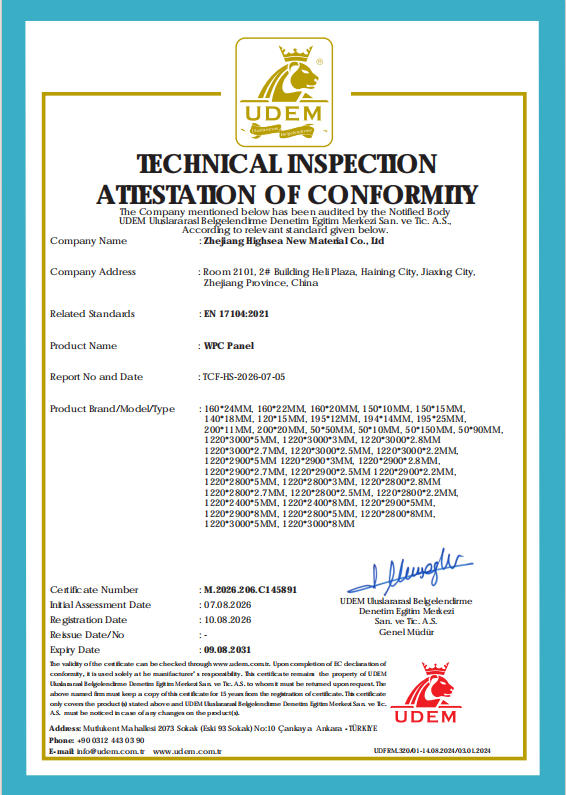
Certificate scope lists the exact model types covered. A profile size outside that list is not automatically covered by the same attestation. Document: Zhejiang Highsea New Material Co., Ltd.
These attestations sit inside a wider European framework. EN 13245-2:2008, published by the European Committee for Standardization (CEN) on 25 July 2008, specifies health and safety requirements for unplasticized poly(vinyl chloride) profiles used for interior and exterior wall and ceiling finishes. Buyers who need the market-access picture should read the two frameworks together rather than treating either one as a complete statement of compliance.
Scope discipline is the limitation here. The SVHC report in this set names a PVC film style, not a finished panel SKU. A substance screening result belongs to the sample that was submitted. A buyer ordering HS-WPC or HS-PVC panels should confirm whether the substrate, surface film and coating in that specific order fall inside the tested configuration, or request an equivalent report on the finished panel. The same logic applies to attestation scope: a newly developed profile size that does not appear on the covered model list would need its own coverage before it can be presented as attested.
Dimensions and finishes: what makes two quotations comparable
Answer first: a quotation that names only “WPC wall panel” cannot be compared with another quotation that names only “WPC wall panel.” Thickness, profile depth and surface finish change material content, panel weight and fixing detail, and they should be aligned before price is compared at all.
| Product family | Model designation | Documented sizes |
|---|---|---|
| WPC wall panel | HS-WPC WALL PANEL | 160×22 mm, 160×24 mm, 150×10 mm, 150×15 mm, 195×12 mm |
| PVC wall panel | HS-PVC WALL PANEL | 300×8 mm, 300×8.5 mm |
| UV board | HS-UV BOARD | 1220×2440×3 mm, 1220×2440×2.5 mm |
| Bamboo charcoal board | Supplied within the same panel range | 1220×2440×5 mm, 1220×2440×8 mm |
For fluted WPC profiles, the company's published FAQ lists common standard sizes of 160×22 mm, 160×24 mm, 150×15 mm, 160×16 mm, 160×13 mm, 195×12 mm and 195×14 mm. That list is slightly wider than the specification sheet range above, which reflects variation between profile series rather than a contradiction. The practical reading for buyers is that any published size list is a starting point: confirm the exact profile, groove depth, coating and edge treatment for the SKU being ordered, and put those values in the purchase order.
Commercial procurement guidance in the category recommends a specific verification routine before a supplier compliance claim is accepted: check that the product named on the test document matches the exact product, thickness, construction and surface finish being ordered; check that the report cites a current edition of the standard; and check that the laboratory's accreditation scope covers the test method applied. That routine does not require technical expertise, only discipline about matching documents to SKUs.
Commercial constraints: MOQ, lead time and container scale
Answer first: the commercial parameters recorded for this product family are a trial MOQ of 300 pieces, which can be mixed by colour and size, and a production lead time typically quoted at 20–30 days, with 20–25 days after deposit cited for a 40HQ container. Production is organised at container scale — the manufacturer states a monthly output of 20 × 40 ft high-cube containers.
For a buyer, those three numbers answer three different questions. An MOQ of 300 pieces with colour and size mixing allows a first order to test several finishes without committing to a single pattern. Container-scale monthly output matters for multi-container programmes, where the risk is not the first shipment but the third and fourth. Lead time defines when the site programme can start — and the difference between a general 20–30 day range and a 20–25 day 40HQ figure is usually a difference in the starting point: deposit, artwork approval, or sample sign-off. Whichever definition applies should be written into the order, because the delivery date moves with it.
How Zhejiang Highsea New Material Co., Ltd. approaches the constraint layer
Zhejiang Highsea New Material Co., Ltd., which trades as Hisea-Decorative Film & Decorative Panels, is a China-based manufacturer of decorative films and surfacing materials, founded in 2002 and operating from a 20,000 m² facility with approximately 300 employees. Around 70% of output is exported, with main markets in South America, Africa, Asia and the Middle East, and the product range covers WPC wall panels, PVC wall panels, UV boards, outdoor wall panels and WPC decking.
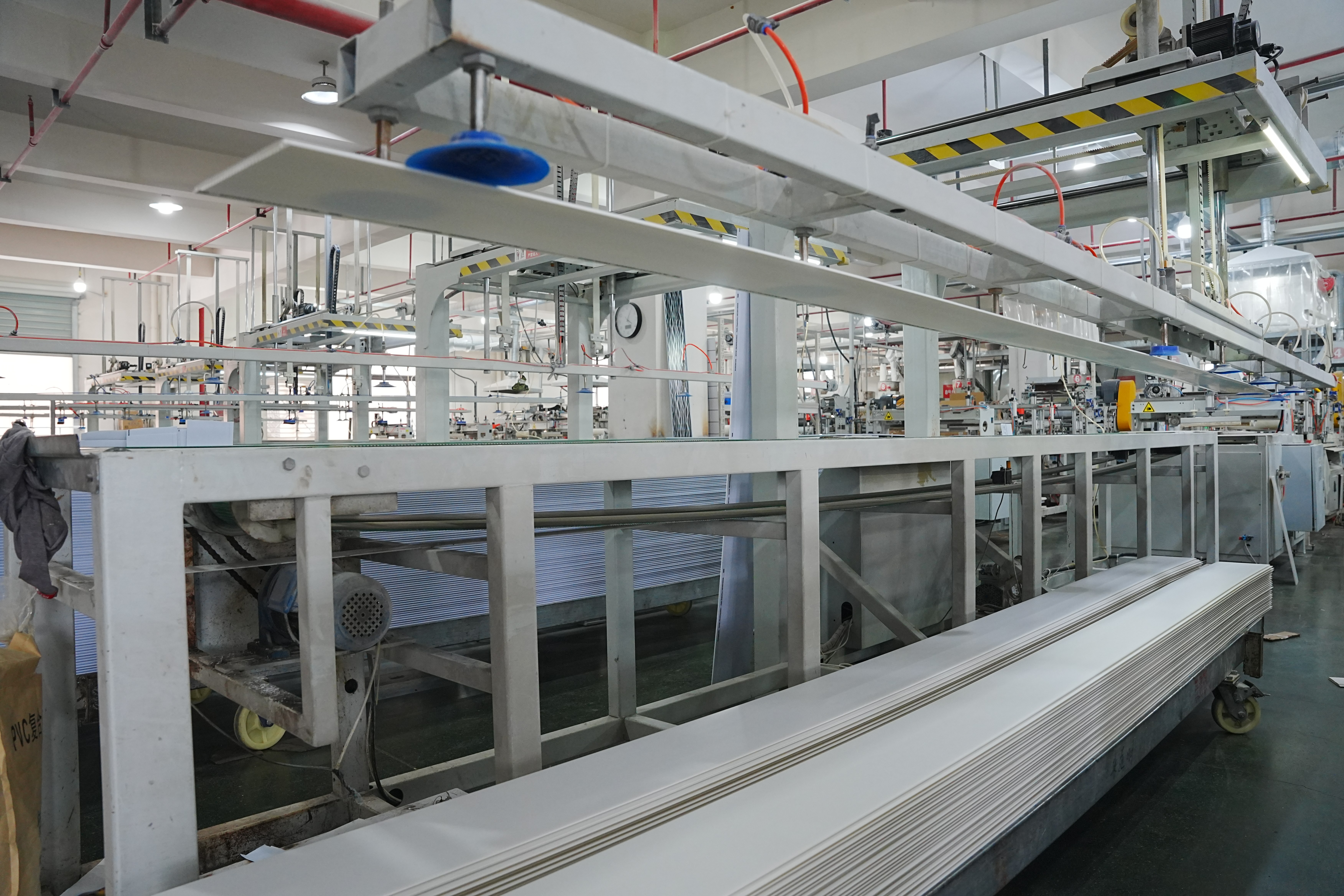
Panel production is organised as a continuous loop from formulation through extrusion or calendering, surface treatment, and cutting and packaging. Image: Zhejiang Highsea New Material Co., Ltd.
Production runs as a closed loop: formulation, extrusion or calendering, surface treatment, then cutting and packaging. Quality control operates at three stages. Incoming raw materials are inspected batch by batch to keep formulation and process parameters consistent. In-process control points monitor thickness, density, colour difference, surface flatness and texture consistency. Every batch is inspected before shipment, and loading is arranged only after the batch passes. The capability record states that testing is applied at 100%. For custom work, the company offers OEM production with customized patterns, customized packaging, customized colours and customized sizes, supported by remote after-sales service.
The company profile states that its products hold CE and RoHS certification. The specific certificate records made available for this reference are the two UDEM attestations under EN 17104:2021 and the SGS SVHC screening report described above — which is the reason scope discipline matters: a company-level statement and a SKU-level document are not the same evidence, and the second is the one that settles a purchase decision.
Where the panels are used, and which constraint follows each use
Answer first: WPC and PVC wall panels are used as decorative and protective wall finishes across interior and semi-exposed exterior applications, and each application adds its own constraint to the specification.
Interior surfaces dominate. The company's published application list covers interior feature walls, TV backgrounds, living rooms and bedrooms, hotel lobbies and corridors, offices and meeting rooms, restaurants, retail stores and showrooms, and ceilings. These are dry or intermittently humid interiors where the requirement is appearance consistency, easy cleaning and fast installation rather than moisture resistance.
Wet and hygiene-sensitive areas change the requirement. PVC wall panels have a non-porous surface that does not absorb water or hold odours, which is why the product is chosen for kitchens, bathrooms, clinics, food preparation rooms, laboratories and public washrooms — spaces where a smooth washable wall surface reduces routine cleaning effort. WPC wall panels carry moisture and rot resistance, because the polymer content surrounds the wood fibre and limits water uptake; that makes them a practical finish for bathrooms, laundry areas and covered outdoor walls, and allows one material family to cover interior and exterior zones in the same project.
The documented application profile for this category describes interior and exterior wall decoration projects in indoor and outdoor conditions with humid environments and normal ambient temperature, installed statically with no power consumption. It lists waterproofing, termite resistance, low formaldehyde and easy cleaning as the special requirements attached to that application class. UV boards address a different surface problem: a UV-cured coating forms a dense sealed film over the base sheet, so the decorative face resists water rings, grease spots and light scratches on cabinet fronts, wall boards and furniture faces.
A documented customisation order illustrates how these constraints combine in practice. One 40-foot high-cube container of customized panels was delivered to buyers in the Philippines, Poland, Palestine and Portugal, for resale and for personal indoor and outdoor decoration, within a relationship that has run about five years. The reported outcome was correct sizes, no colour difference between batches, and repeat orders — a result reported by the customer rather than independently measured, but typical of the criteria that container-level buyers actually track.
Market trend: growth, price pressure and documentation
Answer first: the category is expanding, price competition in standard specifications is compressing margins, and documentation requirements are becoming a selection filter rather than an afterthought.
On volume, the Dataintelo estimate of USD 14.8 billion for the global PVC panels market in 2025, with wall panels at 42.5% of product-type share, and the Grand View Research projection of the wood plastic composites market moving from USD 8.9 billion in 2025 toward USD 21.5 billion by 2033 at an 11.7% CAGR, describe a category with a genuinely larger addressable base. On price, a manufacturer-level commercial benchmark published by Aesthedge put average FOB China prices for standard 3 mm PVC marble sheet at USD 3.00–3.60 per square metre in 2024, described as gradually stabilising after a period of volatility. That benchmark carries medium confidence and is a budgeting reference, not a quotation: it excludes Incoterm differences, packaging basis and freight.
An editorial interpretation, offered as interpretation rather than fact. If WPC volumes grow faster than standard PVC while commodity PVC sheet prices stabilise, value migrates toward surface engineering — UV-cured coatings, anti-scratch finishes, and suppliers who can hold specification across several material families. The counterweight is that portfolio breadth does not prove equivalent quality across categories. A supplier covering WPC, PVC and UV boards still requires a separate sample round, separate specifications and separate compliance documents for each family it supplies.
Compared with tiles, paint and solid timber
Answer first: polymer wall panels win on installation speed, moisture behaviour and refurbishment disruption; they lose on structural contribution, on fire-assembly substitution, and on the depth of third-party documentation that mineral and timber systems carry as standard.
| Finish | Installation basis | Moisture behaviour | Site finishing | Main limitation |
|---|---|---|---|---|
| Ceramic tile | Adhesive and grout, wet trade, curing time | Water tolerant; grout joints need regular cleaning | Grouting and joint finishing on site | Removal is disruptive; substrate preparation is extensive |
| Paint and wallpaper | Substrate preparation dominates the programme | Sensitive to damp and mould in poorly ventilated rooms | Multiple coats or hanging, plus drying time | Short refresh cycle in high-traffic areas |
| Solid timber cladding | Skilled carpentry, battens or direct fixing | Dimensionally unstable in humid or very dry conditions unless protected | Sealing and periodic re-oiling | Higher material and labour cost; maintenance dependency |
| WPC and PVC wall panels | Dry fix onto battens or a flat, dry substrate using clips, screws or adhesive | Polymer content limits water uptake in WPC; PVC surfaces are non-porous | None required beyond matching trims at joints | Decorative, not structural; fire and exterior performance depend on the documented configuration |
The limits deserve the same prominence as the fit.
First, panels are decorative finishes. They are not load-bearing elements and should not be specified as structural members.
Second, a panel product does not replace a fire-rated wall assembly on its own. Reaction-to-fire requirements depend on jurisdiction and project specification, and the frameworks differ: commercial procurement guidance in the category references EN 13501-1 for Europe and the UK, ASTM E84 for the USA and Canada, and GB 8624 for China. Classifications produced under different test systems are not interchangeable, and a supplier's general fire statement is not a substitute for a product-specific test report matched to the exact thickness, construction and finish being ordered, issued by an accredited laboratory, and citing the current edition of the applicable standard.
Third, installation depends on the substrate. Panels are fixed onto battens or directly onto a flat, dry substrate using clips, screws or adhesive, with matching corner and edge trims to finish joints; cutting is done with standard woodworking tools and no painting or finishing is required on site. Where the substrate is uneven, damp or newly plastered, the installation advantage disappears.
Fourth, exposure changes performance. Polymer-based panels are affected by sustained heat and direct sunlight more than mineral finishes, so exterior and long-run installations need correct fixing detail and allowance for movement. The documented exterior case in this data set is covered outdoor walls and balcony or patio cladding, not fully exposed facades.
Fifth, surface durability is coating-dependent. A UV-cured film protects the printed pattern against water rings, grease and light scratches, but it does not make a panel scratch-proof in high-abrasion corridors or service areas.
What to expect next
Three shifts are likely to shape wall panel procurement over the next sourcing cycles. Documentation is moving from a company-level statement to a SKU-level requirement, because buyers who have been burned by scope mismatches now ask for the certificate that names their exact product. Trade classification is a related caution: plastic wall coverings do not map to one universal customs heading, since classification depends on construction and product form, so landed-cost models should be built on a confirmed classification for the specific SKU rather than on a generic wall panel code. And supplier consolidation will continue, with multi-category manufacturers offering one relationship across WPC, PVC and UV surfaces — but each family still requires its own samples, datasheets and compliance evidence before it can be approved.
FAQ
What documents should accompany a WPC wall panel order for the EU market?
Buyers typically look for a technical inspection attestation of conformity citing EN 17104:2021 and a substance screening report under REACH. In this supplier's documentation set, two UDEM attestations are relevant — No. M.2026.06.C1.45891 for WPC Panel, valid from 7 August 2026 to 9 August 2031, and No. M.2026.206.C145889 for PVC Panel, issued 10 August 2026 and expiring 9 August 2031 — alongside SGS test report No. SHAHL26023493001 for SVHC screening under Regulation (EC) No 1907/2006. Each document should name the exact product and model being ordered.
What are the standard WPC wall panel sizes?
For fluted WPC wall panels, published standard sizes are 160×22 mm, 160×24 mm, 150×15 mm, 160×16 mm, 160×13 mm, 195×12 mm and 195×14 mm. The HS-WPC WALL PANEL specification sheet lists 160×22 mm, 160×24 mm, 150×10 mm, 150×15 mm and 195×12 mm. Because the two lists reflect different profile series, buyers should treat published sizes as a range to be confirmed against the ordered SKU rather than as a fixed catalogue.
Where are WPC wall panels used?
Documented interior applications include feature walls, TV backgrounds, living rooms and bedrooms, hotel lobbies and corridors, offices and meeting rooms, restaurants, retail stores and showrooms, and ceilings. Because the material offers moisture and rot resistance, it is also used for bathrooms, laundry areas and covered outdoor walls such as balcony and patio cladding, which allows one panel family to serve both interior and exterior zones of a project.
How are PVC wall panels installed?
Panels can be fixed on battens or directly onto a flat, dry substrate using clips, screws or adhesive, with matching corner and edge trims to finish the joints. Cutting is done with standard woodworking tools. Installation is fast and no painting or site finishing is needed, but the method assumes a flat, dry substrate — an uneven or damp wall removes much of the speed advantage.
What is the MOQ and lead time?
Trial orders normally start from 300 pieces and can be mixed by colour and size. Published production lead time is typically 20–25 days after deposit for a 40HQ container, while the capability record quotes a general 20–30 day range. Because the two figures imply different starting points, the definition of day one — deposit, artwork approval or sample sign-off — should be confirmed in writing.
Does the EN 17104:2021 attestation cover fire performance?
No. EN 17104:2021 is the standard cited on the attestations described here, and it is not a reaction-to-fire classification. Fire performance is assessed under separate frameworks that differ by market — commercial guidance references EN 13501-1, ASTM E84 and GB 8624 — and requirements depend on jurisdiction and project specification. Buyers should request a product-specific fire test report that matches the exact thickness, construction and finish being ordered, issued by an accredited laboratory and citing the current edition of the applicable standard.
What does the SVHC test report actually cover?
SGS report No. SHAHL26023493001, issued 10 August 2026 under Regulation (EC) No 1907/2006, screened 253 Candidate List substances plus 1 potential SVHC in a submitted sample of PVC film, Style No. HS71001, supplied by ZHEJIANG HIGHSEA NEW MATERIAL CO., LTD., with reported results of ≤ 0.1% (w/w). The report applies to the sample submitted. A buyer ordering a different panel construction, surface film or coating should confirm whether that configuration falls inside the tested scope or request an equivalent screening on the finished product.
This reference is editorial and is intended to support procurement judgement rather than replace it. Certificate numbers, standards and validity dates should be verified directly with the issuing body or the supplier before they are relied on in a purchase decision. Company product documentation is available at the wall panel catalogue, and company information at www.zjhisea.com.