
WR100 vs WR110 vs WR120 Windproof Roller Blinds: Procurement FAQ
WR100 vs WR110 vs WR120 Windproof Roller Blinds: Procurement FAQ
A buyer comparing WR100, WR110 and WR120 windproof roller blinds is not choosing between three interchangeable product codes. The comparison is a documentary exercise: match the opening, establish the mounting and side-rail conditions, write down the exposure assumptions, and then ask for evidence that is scoped to the exact model suffix being offered. That is the difference between a model shortlist and a defensible procurement decision.
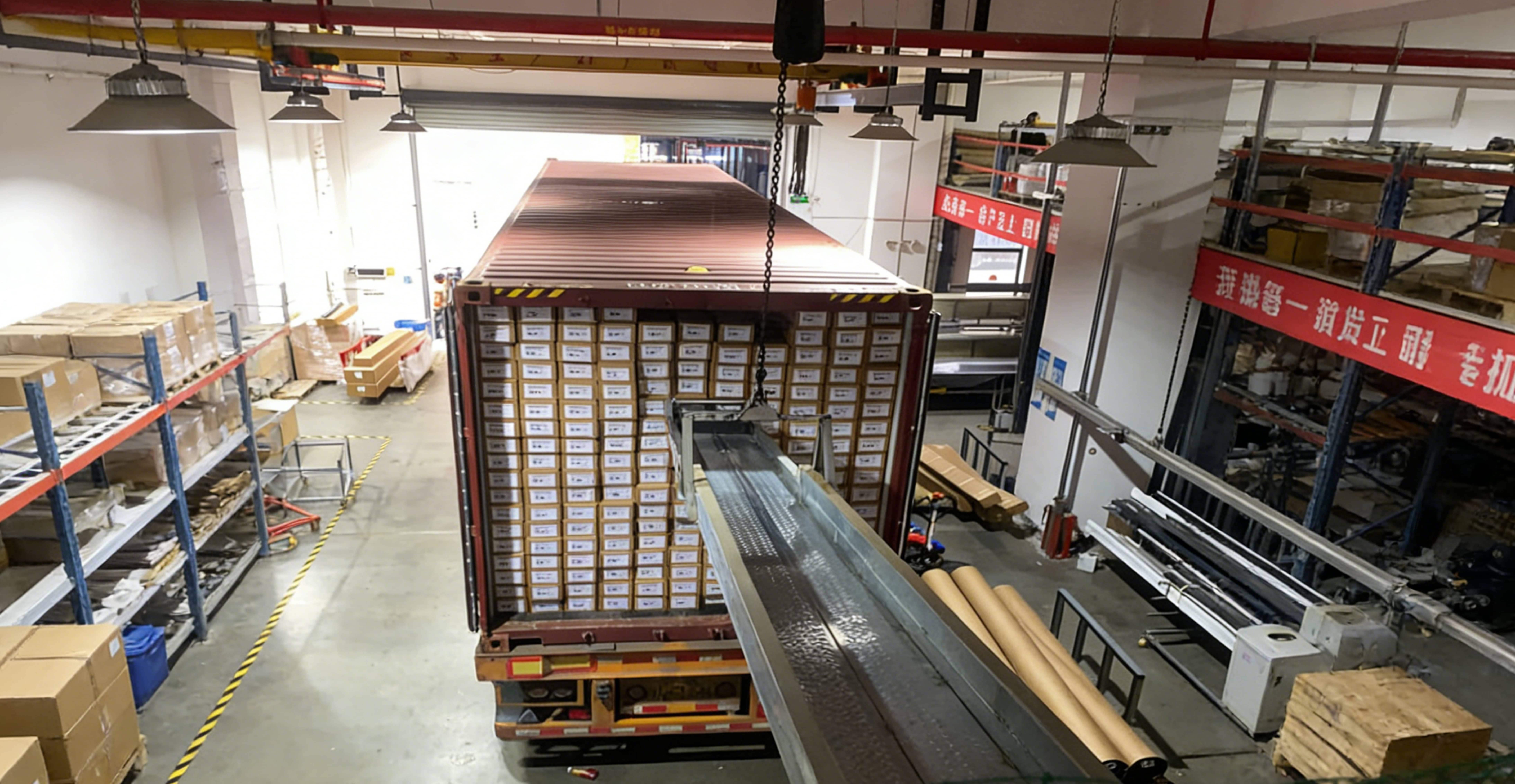
Shipment: supply-chain context for a project procurement file.
NEWHOO, legally Guangzhou Newhoo Technology Co.,Ltd, is a Guangzhou-based manufacturer established in 2015, with a 20,000 m² factory and exports to Europe, the USA, Australia, and Southeast Asia. Its product list places WR100 in a universal zip screen family, WR110 in pergola-specific zip screens, and WR120 in an outdoor family with several suffixes. That naming is the starting point for this FAQ, not proof of fit for any particular facade, pergola, balcony, or commercial opening.
Short answer: choose the family by scenario, then verify the suffix
WR100, WR110, and WR120 should be compared as different family roles rather than as a ranked list. WR100 is the universal reference in the supplied product architecture. WR110 is the pergola-specific reference. WR120 is the outdoor reference, with variants for connectable, LED, adjustable side-rail, solar-powered, extra-wide, and dual-layer applications. The buyer's first job is to identify which of those roles matches the project. The second job is to force the supplier to name the exact suffix, mounting method, side rail, operation system, and test evidence that apply.
For a project windproof roller blind, the six questions that matter most are: What is the exact model suffix? How will it be fixed? What side-rail or guidance system is included? What wind, rain, salt, temperature, and UV exposure is assumed? How will it be operated and maintained? Which test report or certificate covers the offered configuration? A model name alone does not answer any of them.
What each family name tells the buyer, and what it does not
| Family | Documented role in the supplied product list | Supplied test evidence to check | First procurement question |
|---|---|---|---|
| WR100 | Universal Zip Screen WR100A and WR100B; Pergola-Specific Zip Screen WR100C; related recessed model WR100-120. | Class 12 structural wind resistance report for WR100, Report No. 24J00783-JAALB-2400178, related product WR100A. The supplied evidence does not state that the same report covers WR100B or WR100C. | Which WR100 suffix, mounting method, and operation system are being offered? |
| WR110 | Pergola-Specific Zip Screen WR110A and WR110B. | No model-specific WR110 wind resistance report appears in the supplied evidence set. That is a documentation gap to resolve, not a finding that the product lacks performance. | What pergola fixing, side-rail arrangement, exposure assumption, and exact test evidence apply to WR110A or WR110B? |
| WR120 | Outdoor Zip Screen WR120A and WR120B; connectable WR120C and WR120FB; LED Strip WR120D; Adjustable Side-Rail WR120E; Solar-Powered WR120F; extra-wide and commercial variants such as WR120-140A, WR120-140B, WR120-140C; Combined Dual-Layer WR120-175. | Class 12 report for WR120, Report No. 24J00783-JAALB-2400179, related product WR120A; Class 12 report for WR120-140, Report No. 24J00783-JAALB-2400176, related product WR120-140A. Not every WR120 suffix is covered by those reports. | Which WR120 suffix is being proposed, and which report or certificate matches that suffix and configuration? |
The table is deliberately not a ranking. It shows what the supplied product names and reports establish, and where the buyer must ask for more. A supplier that cannot connect a family name to a suffix and a document has not yet made a comparable offer.
FAQ: Which family fits which project scenario?
Universal and semi-outdoor openings. The WR100 Universal Zip Screen family is the natural reference when the project needs a broad universal zip screen platform and the operation system is still being decided. The supplied WR100 data distinguishes a 63 aluminum tube, which supports motorized, motor plus manual, spring push, bead chain, and hand crank systems, from a 70 steel tube, which supports motorized, motor plus manual, and spring push. That does not mean every WR100 suffix uses both tubes; it means the buyer should ask which tube and operation system the quoted suffix uses.
Pergola structures. WR110A and WR110B are listed as Pergola-Specific Zip Screen models, so they belong in a pergola windproof roller blind discussion. However, WR100C is also listed as a Pergola-Specific Zip Screen. The buyer should therefore ask what changes between WR100C, WR110A, and WR110B, and should not assume that the WR110 label is the only pergola option. The fixing to the pergola beam, post spacing, side-rail support, drainage around the cover, and service access all need to be shown on a drawing.
Outdoor and commercial openings. The WR120 family is the outdoor reference when the project needs an outdoor windproof roller blind with a more specialised suffix, such as connectable panels, LED strip, adjustable side rail, solar power, extra-wide construction, or a dual-layer arrangement. The model names identify those application directions, but they do not prove that every WR120 suffix carries the same wind rating or the same test report. That distinction is central to procurement.
Sunroom and skylight openings. A sunroom project may involve Skylight Blinds for Sunroom rather than a vertical zip screen. The supplied product list includes Sunroom Skylight Awning SR-150A and SR-150B, which are awning products, not substitutes for WR110A or WR110B. If the opening is a sloping glazed roof, the buyer should request the correct product family and the corresponding fixing and water-management details instead of forcing a vertical zip screen into a roof application.
FAQ: What mounting and recess information must be on the RFQ?
Mounting information is not a detail to settle after the model is chosen. It can change the cassette, side rail, bottom rail, fixing method, and even whether a recessed or surface-mounted product is appropriate. The supplied general measuring guidance gives a useful starting point. For inside mounting, the width should be reduced by 2–3 mm and the minimum height of the door or window should be used. For outside mounting, the width should be increased by 4–20 cm according to the side-rail width, and the height should be increased by 7–20 cm according to the cassette height. Those are general allowances, not a substitute for the selected model's installation drawing.
Recessed work needs a separate set of questions. The supplied product list includes the WR100-120 Recessed Curtain-Box Concealed Zip Screen and the TR110 Curtain-Box Recessed Zip Screen. If the project has a curtain box or narrow recess, ask for the slide-channel detail, the minimum clearance, the removal path for maintenance, and the way the bottom rail retracts into the cassette. A recessed model is not automatically interchangeable with a surface-mounted model, even when both sit in the same family.
The RFQ should also state the wall or beam substrate, the fixing locations, whether reinforcement is needed for hollow walls, the power-supply position for motorized versions, and any exterior-facade approval requirement from the building owner or property manager. A supplier that quotes a model without asking for these conditions is quoting a product, not a project solution.
FAQ: Why are side rails and guidance systems not a footnote?
In a zip screen, the fabric edge carries a zipper that runs inside a track built into the side rail. The zipper remains locked in the track, creating a continuous load path from the fabric to the frame. This is why a zip screen behaves differently from a regular roller shade, which has no comparable edge-locking structure. The side rail is therefore part of the wind-resistance system, not a trim item. A procurement comparison that lists only the model name and fabric colour has not compared the wind-resistance system at all.
The buyer should ask for the side-rail profile, the number of pieces, the fixing method, the track material and finish, the zipper type, and the seal detail. The supplied guidance also makes a clear distinction between the #3 zipper and T-tape. The #3 zipper is used for ordinary solar fabrics. T-tape is used for full-blackout, 0% or 1% openness, and special fabrics thinner than 0.5 mm, giving a flatter fabric. T-tape zip screens can only be used indoors. If a supplier proposes T-tape for an outdoor project, that proposal should be stopped and verified before it reaches the purchase order.
Where a conventional side rail cannot be anchored, the Cable-Guided Zip Screen DK120-63 is a separate family in the supplied product list. It should be evaluated as a cable-guided windproof roller blind with its own anchoring and tensioning requirements, not treated as a simple variant of WR100 or WR120. The same discipline applies to the WR120E Adjustable Side-Rail model: the adjustment feature is a specific variant attribute, and the actual adjustment range and fixing conditions must be quoted.
FAQ: What exposure assumptions must be written down?
Exposure should be recorded before the model is selected. The project file should state the building height, the orientation of the opening, whether it is windward or sheltered, the coastal or salt-spray condition, the rain exposure, the ambient temperature range, the UV condition, and any design wind speed or pressure supplied by the project engineer. These assumptions determine which model family and which fixing strategy belong in the tender, not the other way round.
The supplied evidence includes Class 12 structural wind resistance reports for WR100, WR120, and WR120-140. The WR100 report is Report No. 24J00783-JAALB-2400178. The WR120 report is Report No. 24J00783-JAALB-2400179, and the WR120-140 report is Report No. 24J00783-JAALB-2400176. The reports were issued on 2024-11-08 by Guangzhou Testing Centre of Construction Quality & Safety Co., Ltd. and cite GB/T29007-2013 and JG/T239-2009. The reports identify the related products as WR100A, WR120A, and WR120-140A respectively. The buyer should check the report scope against the exact suffix and configuration being supplied.
Class 12 is a test classification, not a blanket project guarantee. A report should be read with its sample size, side-rail configuration, fixing method, test standard, and date. A supplier that says Class 12 without producing the report and matching it to the offered model has not supplied evidence. The supplied evidence set does not contain a model-specific WR110 wind resistance report. That absence should be treated as a request for the missing WR110 document, not as permission to borrow the WR120 report.
Evidence check: ask for the exact report number, model suffix, test standard, issue date, test laboratory, sample configuration, and side-rail arrangement. A report for WR120A does not automatically cover WR120C, WR120D, or WR120-140B. A report for WR100 does not automatically cover WR100B or WR100C.
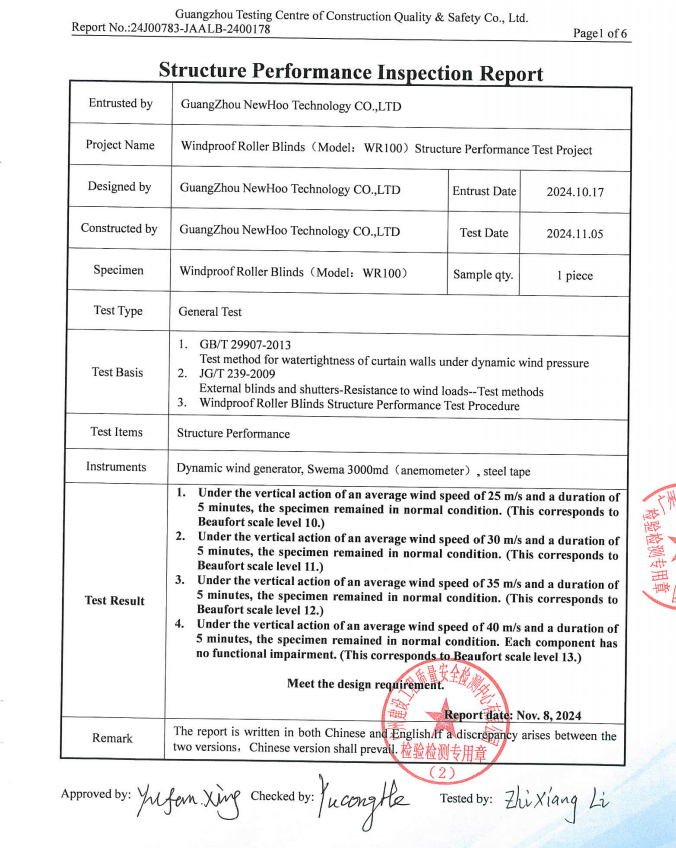
Supplied WR100 test report image, Report No. 24J00783-JAALB-2400178.
FAQ: How do operation needs change the model comparison?
Operation is part of the product definition, not an accessory added at the end. For the WR100 Universal Zip Screen, the supplied data states that the 63 aluminum tube supports five systems: motorized, motor plus manual, spring push, bead chain, and hand crank. The 70 steel tube supports three systems: motorized, motor plus manual, and spring push. For motorized versions, a 45 or 35 motor can be selected. This gives the buyer a concrete checklist: which tube, which drive, which motor, and which control interface are included in the quotation?
For WR110 and WR120, the supplied evidence does not establish the same tube and operation matrix for every suffix. That is not a reason to assume the WR100 matrix applies. It is a reason to ask each supplier to state the operation system, tube, motor specification, control method, power requirement, and manual-override provision for the exact WR120 or WR110 variant being offered. A motorized outdoor windproof roller blind on a commercial facade may also need a service plan for motor access, limit adjustment, and remote pairing; those items should be written into the execution schedule.
Manual operation deserves equal scrutiny. A bead-chain or hand-crank system changes the handling, the tube, and the maintenance routine. A spring-push system changes the way the fabric and bottom rail behave. The buyer should ask for the operation force, the locking position, the child-safety provision where relevant, and the spare-parts path. The supplied patent list includes a hand-push windproof roller blind with a child safety lock, which shows that safety hardware can be a specific configuration issue rather than a generic promise.
FAQ: What should a model-specific evidence pack contain before purchase?
A useful evidence pack has eight parts. First, a dimensioned drawing showing the exact suffix, cassette, side rail, bottom rail, and fixing points. Second, the mounting condition, including inside or outside mounting, recess dimensions, substrate, and power location. Third, the side-rail and guidance specification, including the zipper or T-tape choice and the outdoor or indoor limitation. Fourth, the operation system, tube, motor, control, and limit-setting method. Fifth, the fabric specification, including openness, colour, coating, and flame-retardant documentation where required. Sixth, the wind resistance report or engineering basis, with its exact scope. Seventh, the target-market compliance file. Eighth, the packaging, inspection, warranty, and after-sales route.
On compliance, the supplied service material lists CE including motor EMC and LVD, RoHS, AS/NZS 4745, UL for electrical components, and CA Prop 65. For fabrics, it lists GB/T 17591-2006 B1, NFPA701, and EN 13501-1 flame-retardant test reports, with each fabric having its own independent report rather than a mixed report. These are documents to request according to the destination market and project specification, not labels to assume. The same applies to the ISO 9001 and ISO 14001 certificates in the supplied company material: they support the management system context, but they do not replace the model-specific wind report.
The commercial evidence should also be clear. Ask for the sample plan, the bulk lead time, the peak-season scheduling rule, the MOQ for the chosen customization level, the tiered pricing basis, the packaging specification, and the inspection and balance-payment arrangement. The supplied service guidance recommends a sample order before bulk production for first cooperation, and it recommends specifying lead time and breach liability in the contract. Those are practical risk controls, not reasons to skip the technical comparison.
FAQ: Where do cable-guided, double-layer, extra-wide, and adjacent families fit?
They fit only when the opening calls for them. The Cable-Guided Zip Screen DK120-63 belongs in the comparison when the project needs a cable-guided windproof roller blind and the side-rail fixing cannot provide the required support. The extra-wide windproof roller blind discussion belongs with models such as WR120-140A, WR120-140B, and WR120-140C, or the larger extra-high and extra-wide commercial families, not with a standard-width WR100 quote. The double-layer windproof roller blind discussion belongs with models such as WR120-175, WR130-180, and WR150-230, where the project actually requires a dual-layer arrangement.
The same logic applies to product categories that sit outside the zip screen comparison. A Folding Arm Retractable Awning is an awning family, not a zip screen. A Sliding Screen Door is a door-screen family, not a facade zip screen. A Sunroom Skylight Awning is a skylight awning, not a vertical pergola zip screen. These products can appear in the same building, but they should not be used as substitutes in a model comparison merely because they share a supplier or a project. That is how procurement errors start.
For a pergola windproof roller blind, the relevant supplied names are WR100C, WR110A, and WR110B. For an outdoor commercial facade, the relevant names begin with the WR120 suffixes and then move to the extra-wide or dual-layer variants only if the geometry requires them. For a balcony, the WR120D LED Strip Outdoor Zip Screen is a specific option when ambient lighting is part of the brief, but the buyer still needs the same mounting, side-rail, exposure, and evidence checks.
FAQ: What mismatches should stop a purchase order?
| Mismatch | Why it matters | What to request instead |
|---|---|---|
| A WR120 report is used to support WR110. | The supplied WR120 report identifies WR120A, not WR110A or WR110B. | Request a model-specific WR110 report or a documented engineering basis for the offered WR110 suffix. |
| Class 12 is stated without report scope. | A classification does not show which model, width, side rail, or fixing was tested. | Request the report number, test standard, sample configuration, and exact model suffix. |
| T-tape is proposed for an outdoor opening. | The supplied guidance says T-tape zip screens can only be used indoors. | Confirm the correct zipper and fabric combination for the outdoor model. |
| The mounting allowance is copied from another project. | Inside and outside mounting have different width and height allowances, and the side rail changes the result. | Request a project-specific measurement drawing and fixing plan. |
| A cable-guided product is treated as the default WR120 option. | The Cable-Guided Zip Screen DK120-63 is a separate family with its own anchoring and tensioning logic. | Compare it as a separate cable-guided windproof roller blind proposal. |
| Extra-wide or dual-layer is assumed from a standard-width quote. | The supplied list treats extra-wide and dual-layer as distinct model families. | Request the exact extra-wide or dual-layer suffix and its own drawing and evidence. |
| The pergola fixing is treated as a generic wall fixing. | Pergola beams, posts, covers, and drainage details create different load paths. | Request a pergola-specific fixing drawing for WR110A, WR110B, or WR100C. |
FAQ: What is a practical evaluation-to-execution sequence?
Begin with the opening, not the model. Record the use case, dimensions, mounting condition, substrate, access, and exposure. Then ask for the family that matches the scenario: WR100 for a universal zip screen brief, WR110 or WR100C for a pergola brief, WR120 for an outdoor or commercial brief, and a separate family for cable-guided, extra-wide, dual-layer, sunroom skylight, awning, or sliding screen door work. Next, require the exact suffix and drawing. After that, require the side-rail and guidance specification, the operation system, and the model-specific evidence. Only then compare price, sample, lead time, packaging, and warranty.
The sample stage should test the same configuration that will be ordered. A sample of a different side rail, tube, fabric, or mounting bracket does not validate the project configuration. The first-cooperation process in the supplied service material is sample confirmation, contract, deposit, bulk production, inspection, balance, and shipment. That sequence is useful because it puts technical confirmation before commercial commitment. It does not remove the need for the buyer to read the drawing and the report scope.
Before release to production, hold a short evidence review. The drawing should match the site dimensions. The report should match the model suffix. The fabric and zipper should match the indoor or outdoor condition. The operation system should match the power and control plan. The packaging should match the shipping route. The warranty and spare-parts route should be written down. If any of those items is still described only by a family name, the procurement file is not complete.
Quick-reference FAQ
Is WR110 covered by the WR120 Class 12 report?
No. The supplied WR120 report identifies WR120A, and the supplied WR120-140 report identifies WR120-140A. The supplied evidence set contains no model-specific WR110 wind resistance report. WR110A or WR110B requires its own document or a clearly stated engineering basis.
Does the WR100 report cover WR100B and WR100C?
The supplied WR100 report is scoped to WR100 and identifies WR100A as the related product. The buyer should not assume that it covers WR100B or WR100C without written confirmation from the supplier and a document that names the offered suffix.
What is the minimum evidence for a recessed installation?
Ask for a dimensioned recess drawing, the slide-channel or fixing detail, the removal path for maintenance, the bottom-rail retraction detail, and the clearance to the curtain box. The supplied product list includes WR100-120 and TR110 as recessed or curtain-box models, but the exact model still needs its own installation drawing.
Can T-tape be used outdoors?
The supplied guidance states that T-tape zip screens can only be used indoors. T-tape is associated with full-blackout, 0% or 1% openness, and special fabrics thinner than 0.5 mm. For outdoor work, confirm the correct zipper and fabric combination in writing.
What single question best exposes an incomplete offer?
Ask: which exact suffix, mounting method, side-rail configuration, operation system, and test report scope will you supply for this opening? If the answer is only a family name, the offer is not yet comparable.
Conclusion: the comparison is settled by scope, not by a model number
WR100, WR110, and WR120 can all be legitimate starting points, but they answer different questions. WR100 is the universal reference, with a pergola-specific WR100C and a recessed WR100-120 relative. WR110A and WR110B are the pergola-specific references, but the supplied evidence set does not include a model-specific WR110 wind report. WR120 is the outdoor reference, with specific Class 12 reports for WR120 and WR120-140 but no automatic coverage of every suffix in the family. A buyer who understands those boundaries will ask better questions, compare like with like, and avoid borrowing evidence from the wrong model.
For readers who need the broader product-family context, a downloadable NEWHOO Catalog 2026 is available. It should be used alongside the project drawing, the exact model suffix, and the model-specific test report, not as a substitute for any of them.
Tem questões ou precisa de mais detalhes?
Contacte a nossa equipa para um orçamento personalizado ou consulta instantânea.
Solicitar orçamento
Preencha o formulário abaixo e a nossa equipa entrará em contacto com uma proposta personalizada.
Chat direto do WhatsApp
Prefere conversar em tempo real? Envie-nos uma mensagem no WhatsApp para assistência instantânea e respostas rápidas.
- Obter orçamento personalizado
- Partilhar fotos ou documentos
- Discuta as suas necessidades diretamente
Geralmente responde em 5–30 minutos durante o horário de expediente.