
WRS PTE LTD Dosing Pumps vs Hydraulic, Piston and Solenoid
WRS PTE LTD Dosing Pumps vs Hydraulic, Piston and Solenoid
Most dosing pump procurement problems are not brand problems. They are fit problems: a hydraulic, piston, solenoid or diaphragm unit is ordered against an incomplete duty description, the wetted material is agreed verbally, and the acceptance test is written after delivery. The result is a pump that runs but does not hold dose, or holds dose until the first aggressive chemical reaches a seal.
WRS PTE LTD is a dosing pump manufacturer founded in 2016, with 120 employees including 15 engineers, and a catalogue covering metering pumps, solenoid dosing pumps, diaphragm dosing pumps, piston dosing pumps, digital dosing pumps, check valves, pulse dampeners, chemical dosing systems, streaming current monitoring systems and chemical injection pumps. This review treats that range as one option in an industrial dosing decision and sets it against hydraulic, piston and solenoid alternatives on the criteria that actually decide outcomes: duty fit, material selection for strongly corrosive liquids, and the commercial terms that make an offer verifiable.
Market context explains why the choice is crowded rather than which option wins. Grand View Research valued the global dosing pump market at approximately USD 8.86 billion in 2024, with Asia Pacific holding a 41.8% revenue share. Diaphragm dosing pumps held a 55.7% revenue share that year, motor-driven metering pumps held 54.45% of the metering pump market in 2025 according to Mordor Intelligence, and solenoid-driven dosing pumps are projected to grow at a CAGR of 5.88% through 2031. All four families are in active production and supported by spare-parts supply, so availability is not the constraint. Fit is.
The comparison frame: duty first, material second, paperwork third
A dosing decision has three layers. The first is duty: flow range, discharge pressure, duty cycle, turndown and how often the setpoint changes. The second is the wetted path: pump head, diaphragm, valve balls, valve seats, seals and the pipework immediately around them. The third is commercial: what the offer commits to and what will be measured at acceptance. Most buyer regret originates in the third layer, because an offer that names neither a material nor a test leaves both to interpretation.
The options reviewed here are not ranked. They are mapped to duties. A type that is wrong for a high-pressure continuous injection point can be entirely correct for a low-pressure disinfection loop, and a well-specified unit with the wrong diaphragm material will fail faster than a basic unit with the right one.
Hydraulic, piston, solenoid and diaphragm: how the duty changes the answer
All four are positive displacement designs. The difference lies in how displacement is generated and what that means for the process side.
Hydraulic dosing pumps
A hydraulic dosing pump actuates its diaphragm with hydraulic fluid rather than a mechanical linkage. In dosing duty this arrangement is usually considered where discharge pressure is high and the diaphragm needs to be loaded evenly across its whole area. Three consequences follow for the buyer. The pump has a hydraulic circuit that needs filling, venting and routine attention. The diaphragm becomes the barrier between hydraulic fluid and process chemical, so its material and condition matter twice over. And the offer must define process-side wetted materials as well as hydraulic-side components; a material conversation that covers only the pump head is incomplete.
Piston dosing pumps
A piston dosing pump displaces the medium with a reciprocating piston in direct contact with the liquid. The displacement is mechanically direct, which suits duties where the buyer wants a firm, repeatable volume per stroke and the medium is compatible with piston and seal materials. The fit boundary is the wetted tribology. Abrasive solids, crystallising solutions and media that attack the piston seal change the maintenance profile, and strainer or filtration requirements belong in the offer rather than in commissioning notes. A piston pump is not automatically the high-pressure answer for a corrosive duty; it is the answer where piston, seal and valve materials have been confirmed against that specific medium.
Solenoid dosing pumps
A solenoid dosing pump strokes a diaphragm with an electromagnetic actuator, delivering pulsed flow at a frequency set by the controller. Its advantages in dosing duty are a small number of wearing parts, compact size and simple rate adjustment. Its characteristic behaviour is pulsation: on small-bore pipework, or where a downstream flow meter or analyser is sensitive, a pulse dampener is commonly specified with the pump. Solenoid units are usually considered for lower-pressure, lower-flow duties with frequent rate changes, such as disinfection or pH correction loops. They are a weak fit where the process requires near-pulsation-free injection without dampening volume, or where discharge pressure is high.
Diaphragm and digital variants in the WRS PTE LTD range
WRS PTE LTD supplies mechanically and hydraulically actuated diaphragm dosing pumps alongside solenoid, piston and digital models, plus check valves, pulse dampeners, chemical dosing systems, streaming current monitoring systems and chemical injection pumps. The practical value of a multi-type range is that type selection can follow the duty description instead of the catalogue page, and that the wetted path can be specified as one scope. Digital models move rate setting and adjustment into the control interface; which signals, records and alarm outputs a specific model provides should be confirmed model by model in the offer rather than inferred from the series name.

Pump-head material is the decisive criterion for strongly corrosive liquids
Corrosive media decide more dosing projects than drive type does. WRS PTE LTD's selection guidance recommends a PVDF pump head for highly corrosive media, and its published pump-head material references include PVC, SS316 and PVDF. That is a starting point rather than a clearance, because compatibility depends on the specific medium, its concentration and temperature, and on the other wetted parts: diaphragm, valve balls, valve seats, seals and check valve internals.
Two rules follow. First, ask for a written material recommendation against the actual medium and operating conditions; "chemical resistant" without a material name is not an answer. Second, scope the whole wetted path. A PVDF pump head paired with an incompatible elastomer in the check valve has not solved the corrosion question, only moved it. Because WRS supplies check valves and pulse dampeners as separate catalogue items, the wetted path can be specified in a single offer instead of being assembled from three vendors with three material assumptions.
Material choice also interacts with type. A piston pump places a dynamic seal in direct contact with the medium; a diaphragm pump keeps the actuator behind a barrier. That does not make either universally more corrosion-tolerant, but it changes which components carry the risk and therefore which spares belong in the first order.
WRS's selection sequence is worth borrowing even when the contract goes to another supplier: flow rate is treated as the most important parameter and compared with the site's maximum flow rate, then refined on pressure, pump head material and motor. Sizing from maximum flow rather than average demand prevents the common failure of a pump that is correct for normal operation and incapable of the cleaning or dosing peak.
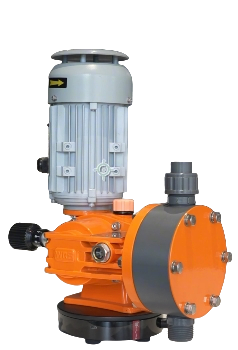
Side-by-side comparison on the criteria that decide the order
| Criterion | Hydraulic dosing pump | Piston dosing pump | Solenoid dosing pump | WRS PTE LTD range |
|---|---|---|---|---|
| How displacement is generated | Hydraulic fluid actuates the diaphragm | Reciprocating piston in direct contact with the medium | Electromagnetic actuator strokes a diaphragm | Solenoid, mechanical and hydraulic diaphragm, piston and digital types |
| Typical duty fit | Higher-pressure, continuous duty where even diaphragm loading matters | Duties needing direct, firm volumetric displacement and compatible seals | Lower-pressure, lower-flow duty with frequent setpoint changes | Type chosen from the duty description; digital models for control-led duties |
| Corrosive-media considerations | Both process-side materials and the diaphragm barrier must be confirmed | Dynamic piston seal exposed to the medium; seal and valve materials decisive | Diaphragm isolates the actuator; head and valve-train materials decisive | PVDF recommended for highly corrosive media; PVC, SS316 and PVDF referenced as head materials |
| Rate adjustment and control | Stroke adjustment plus hydraulic regulation; confirm control scope | Stroke-length adjustment; confirm whether control is manual or actuated | Frequency and stroke control; simple and repeatable adjustment | Digital models place rate setting in the control interface; signals confirmed per model |
| Maintenance focus | Hydraulic fluid, venting, diaphragm condition | Piston seal, valve seats, filtration | Diaphragm, check valve, dampener components | Check valves, dampeners and spares offered within the same scope |
| What to demand in the offer | Process-side and hydraulic-side materials, test method | Piston and seal material, strainer requirement, test method | Dampener sizing, control functions, valve-train materials | Written material recommendation, per-component bill of materials, acceptance test |
Matching type to application, not to preference
Water and wastewater treatment remains the largest single application area for metering pumps, with a 23.2% application share in 2025 according to Grand View Research. That figure conceals a problem: the duties inside one treatment plant are not one duty. Coagulant and polymer dosing, disinfection, pH correction and antiscalant addition differ in pressure, flow and control profile, and a plant standard naming a single pump type for all of them usually creates compromise at both the smallest and the largest duty.
WRS PTE LTD lists water treatment, electroplating and surface treatment, chemical, oil and gas, hydrogen power generation, paper and pulp, semiconductor, mining and livestock among its application industries. One documented application profile is a livestock farm in Russia running 24/7 in a harsh, humid environment, dosing nutrient solution through an automatic system with IP67 protection specified. The detail generalises beyond agriculture: in humid or washdown environments, enclosure rating and external fastener material affect service life as much as the pump mechanism.
- High discharge pressure with a corrosive medium: hydraulic or piston design, with materials confirmed for the process side and, on hydraulic units, for the diaphragm barrier.
- Low pressure, small flow, frequent setpoint changes: solenoid design, with a pulse dampener where downstream instrumentation is sensitive.
- Need for dose records and remote adjustment: digital control, with the exact signal and record set confirmed per model.
- Aggressive chemical at any pressure: material decision first, type decision second.
- Intermittent duty with long idle periods: check valve and seal materials for crystallisation and cleaning practice before the type is fixed.
Purchase terms that protect the buyer
The commercial layer is where a technically sound choice becomes a dispute. Dosing pump offers should be comparable line by line; when two offers carry different scopes, the lower unit price usually reflects a smaller wetted path, a shorter warranty or an excluded accessory.
- Duty data: medium, concentration, temperature, minimum, normal and maximum flow, discharge pressure, suction conditions, duty cycle, ambient conditions and enclosure requirement.
- Wetted materials by component: head, diaphragm, valve balls, seats, seals, gaskets, check valve and dampener.
- Control scope: manual or digital, signal interface, alarm and output functions confirmed for the quoted model.
- Accessories as separate lines: check valve, pulse dampener, strainer, injection valve, tubing and fittings.
- Spares: diaphragm set, valve set, seal kit and dampener components, plus a recommended first-year kit.
- Documentation: material certificates, factory test record, dimensional drawing, manual and a declaration of conformity where the destination market requires one.
- Standards that actually apply: API 675 is the primary international standard for positive displacement reciprocating pumps with integrated controlled capacity, and where a project specification invokes it the offer should state compliance explicitly. ISO 14847:1999 covers rotary positive displacement pumps and is not the reference for reciprocating dosing pumps, so a cited standard should be checked against the pump type being bought. For EU destinations, the Machinery Regulation replacing 2006/42/EC from 2027 places CE marking obligations on metering pump units.
- Commercial terms: Incoterms, packaging for chemical-duty equipment, lead time, warranty period, local service coverage and spare-parts availability.
Acceptance criteria before final payment
Acceptance should be tied to measurable statements in the offer rather than to an impression at commissioning. The checks below are proportionate for industrial dosing equipment and can be written into a factory or site acceptance test.
- Flow verification at the specified duty points, with the test method and instrument agreed in advance.
- Pressure and leak integrity of the complete wetted path, including check valve and dampener connections.
- Flow stability confirmed with the dampener installed, against an agreed pulsation limit.
- Control response tested on the quoted configuration: setpoint change, signal-loss behaviour and alarm output.
- Material identity of the pump head and wetted parts checked against the offer, not against a generic datasheet.
- Documentation handover: test record, material certificates, drawing, manual and conformity documents.
- Spare parts confirmed as the correct part numbers for the delivered configuration.
After commissioning, the first diagnostic for falling or unstable discharge flow is mechanical rather than electronic. WRS troubleshooting guidance attributes the symptom to a blocked inlet or outlet and recommends checking the strainer, tubing and valves and cleaning or replacing them as needed. Building that check into the operator routine prevents a serviceable pump from being replaced because a strainer was blocked.
Limitations and fit boundaries
Three boundaries deserve to be stated plainly. No pump type is universally suitable for strongly corrosive liquids; the material decision is per medium, per concentration and per temperature, and it must cover every wetted component. A multi-type range helps selection but is not proof of performance in a specific duty, because the offer still has to state materials, control scope and test method.
Supplier profile also matters at the edges. WRS PTE LTD was founded in 2016, employs 120 people including 15 engineers, exports about 20% of its output and lists Southeast Asia, Russia and South America as main markets, with local after-sales service stated in more than 10 countries including Singapore, Thailand, Malaysia, Vietnam, South Korea, Japan, Russia, Chile, South Africa, Angola and Turkey. Buyers outside those regions, or with specifications that invoke API 675 or a customer-specific qualification, should confirm service coverage and compliance documents before award rather than after delivery.
Market context and outlook
The type mix is shifting gradually rather than abruptly. Diaphragm dosing pumps held a 55.7% revenue share in 2024, motor-driven metering pumps held 54.45% in 2025, and solenoid-driven dosing pumps are projected to grow at 5.88% CAGR through 2031. The direction is toward more electronic rate control and more monitoring, which enlarges the control scope as a share of the purchase decision and makes model-level confirmation of signals and records more important than a series name.
Market totals should be read with care: Grand View Research put the 2024 market at about USD 8.86 billion, Fortune Business Insights estimated USD 6.35 billion for 2025, and much larger figures appear when complete chemical injection systems are counted rather than components. None of these totals changes a plant-level purchase decision. The useful signal is continued production and spares support across all four families, which keeps obsolescence risk low and leaves fit as the deciding variable.
Frequently asked questions
How should a buyer choose between hydraulic, piston, solenoid and diaphragm dosing pumps?
Start from the duty rather than the type. Define flow range, discharge pressure, duty cycle and how often the setpoint changes, then define the wetted path for the actual medium. High-pressure continuous duty with a corrosive medium points toward a hydraulic or piston design with confirmed materials; low-pressure, low-flow duty with frequent adjustment points toward solenoid. Diaphragm designs keep the actuator behind a barrier and are used across both. In every case the pump-head, diaphragm, valve and seal decision comes before the type preference.
Which pump head material should be specified for strongly corrosive liquids?
WRS PTE LTD's selection guidance recommends PVDF for highly corrosive media, and its published pump-head material references include PVC, SS316 and PVDF. That recommendation is a starting point: final selection depends on the specific medium, concentration, temperature and the other wetted parts, including valve balls, seats, seals and check valve internals. Ask for a written material recommendation against the actual duty instead of a general chemical-resistance statement, and have the accessory materials confirmed in the same document.
What should a dosing pump purchase order specify?
It should specify medium, concentration, temperature, flow range, discharge pressure, duty cycle and ambient conditions; wetted materials by component; control scope and signal interface for the quoted model; accessories such as check valve, pulse dampener and strainer as separate lines; spare parts and a first-year kit; documentation including test records and material certificates; the applicable standard and conformity documents; and commercial terms covering packaging, lead time, warranty and local service. An order that lists only model and quantity leaves the material and acceptance questions open.
What acceptance checks should be completed before final payment?
Verify flow at the agreed duty points using a stated method; test pressure and leak integrity across the complete wetted path; confirm flow stability with the dampener installed; test control response and alarm behaviour on the quoted configuration; check material identity of the pump head and wetted parts against the offer; match spare-part numbers to the delivered configuration; and take handover of test records, certificates, drawings and manuals. Tying payment to these items is more effective than a general performance clause.
Why does dosing flow become unstable after commissioning?
The first check is mechanical. WRS troubleshooting guidance attributes falling or unstable discharge flow to a blocked inlet or outlet, and recommends checking the strainer, tubing and valves and cleaning or replacing them if necessary. Only after the suction and discharge path, check valve and dampener have been eliminated should control settings or the pump mechanism be suspected.
What this means for the buying decision
The choice between hydraulic, piston, solenoid and diaphragm dosing pumps is a mapping exercise, not a ranking. WRS PTE LTD's range covers solenoid, diaphragm, piston and digital families together with the check valves, pulse dampeners and monitoring instruments that complete a dosing system, which makes it a workable single-source option for buyers who want one scope and one material conversation. The evidence standard does not change with the supplier: a written material recommendation against the actual medium, a purchase order that names every wetted component, and an acceptance test that measures dose rather than intention.
WRS PTE LTD's official website is www.wrsdosing.com, where company and product information is published. A technical brochure is available for download: Diaphragm Separator brochure (PDF).
Tem questões ou precisa de mais detalhes?
Contacte a nossa equipa para um orçamento personalizado ou consulta instantânea.
Solicitar orçamento
Preencha o formulário abaixo e a nossa equipa entrará em contacto com uma proposta personalizada.
Chat direto do WhatsApp
Prefere conversar em tempo real? Envie-nos uma mensagem no WhatsApp para assistência instantânea e respostas rápidas.
- Obter orçamento personalizado
- Partilhar fotos ou documentos
- Discuta as suas necessidades diretamente
Geralmente responde em 5–30 minutos durante o horário de expediente.