
Wafer Butterfly Valve Selection: The Constraints That Matter
A wafer butterfly valve is clamped between two adjacent pipe flanges, with the flange bolts compressing the seat and holding the body in place while the disc rotates on its stem. Because the flanges, not the valve, carry the clamping load, the specification of a wafer valve is decided less by the valve alone than by the interface around it. Flange drilling standard, face-to-face length, pressure class, seat material, lining and the certificates the project accepts are what separate a shortlist that survives drawing review from one that is rejected before a price is discussed.
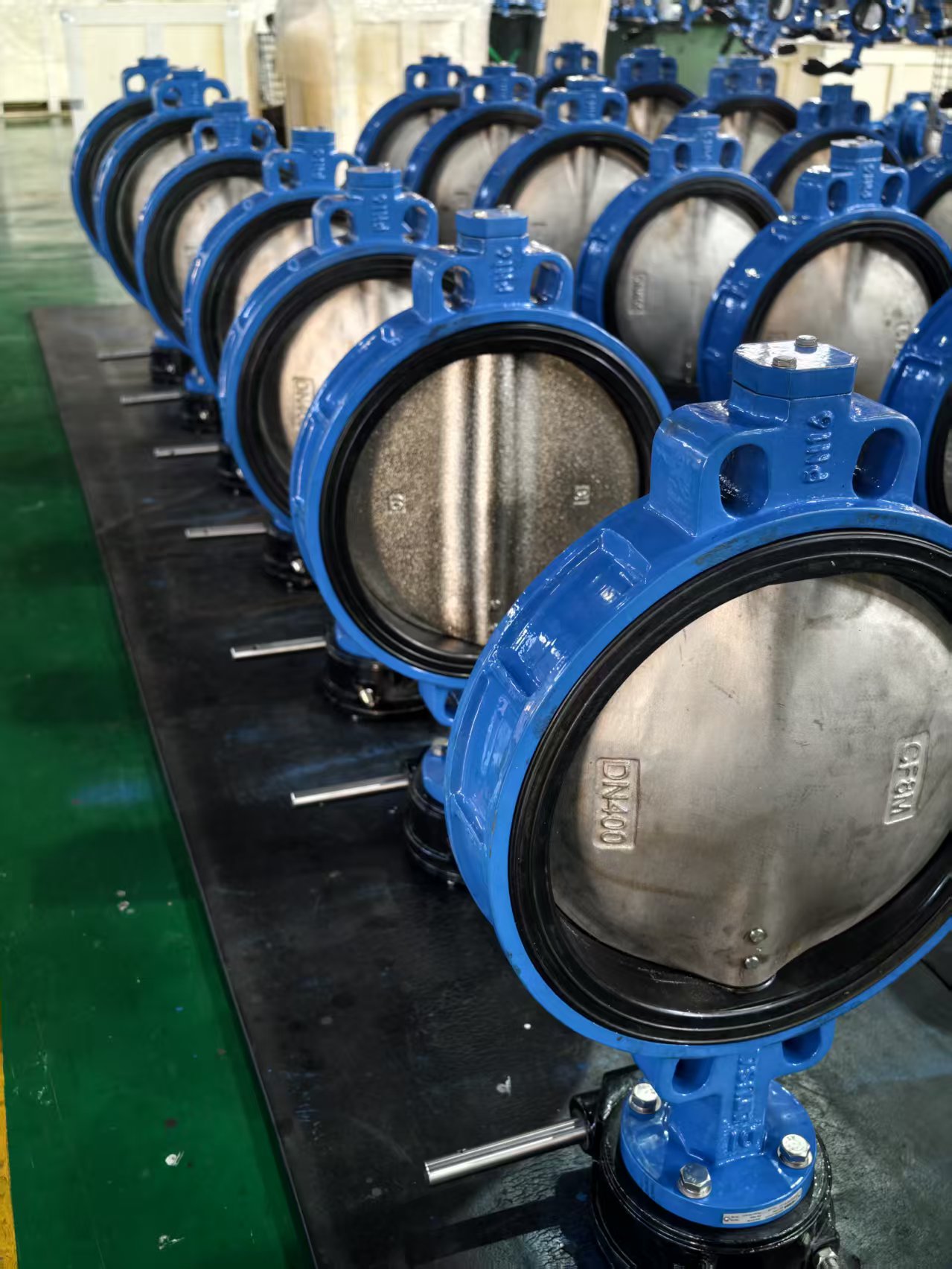
Tianshun Valve production workshop. Wafer butterfly valves are machined, assembled and pressure-tested in-house at the Tianjin facility.
Why the Wafer Interface Is a Procurement Constraint, Not a Detail
Buyers in the research and evaluation stage usually approach a butterfly valve from the catalogue side: body material, disc, actuator, price. In practice, three interface constraints do most of the qualifying work.
The first is flange compatibility. A wafer body has no independent flange of its own; it is sandwiched between the pipe flanges and must match their drilling pattern, bolt circle and pressure rating. A valve built to EN 1092 will not seat correctly against an ANSI 150 flange, and a JIS 10K line will not accept a valve drilled to AS 2129 Table D. Because a single plant frequently runs a mix of standards across imported and domestic pipework, the drilling specification must be confirmed per line, not per project.
The second is face-to-face length. The dimension between the two flange faces determines whether the disc can swing clear of the bore when the valve opens. EN 558-20 and API 609-2-A define this envelope for wafer designs; a valve built to a different face-to-face family will either obstruct the disc rotation or leave an installation gap that no gasket can close.
The third is the seat and lining system, because that is where temperature range and chemical compatibility are actually set — not by the body material. A ductile iron body rated PN16 is not a PN16 valve if the seat facing it can only hold that class at ambient temperature.
Wafer Butterfly Valve BFW: What the Specification Sheet Actually Fixes
Tianshun Valve Co., Ltd. (Tianshun Valve) is a valve manufacturer founded in 1993 and based in the Tanggu Ocean High-tech Zone, Binhai New Area, Tianjin, China. The company operates an 8,000 m² factory with 50 employees and an annual output of 680,000 units, supported by a team of more than 30 industry experts and engineers, and exports approximately 95% of production to markets including the United States, Spain, Italy, Britain, Germany, Turkey, South Korea, Singapore and India.
Within that range, the wafer butterfly valve supplied under model BFW is the reference product for this constraint discussion, because its published parameters define what a buyer can and cannot assume.
| Parameter | Published specification (WAFER BUTTERFLY VALVE, model BFW) |
|---|---|
| Size range | DN40–DN1000 |
| Basic design | EN593, API 609 and ISO 5211 |
| End flange | EN1092 PN6-10-16-25 / ANSI150 / AS2129 Table D-E-F / SABS Table 1000/1600 / JIS 10K-16K |
| Face-to-face | EN558-20, API609-2-A |
| Test and inspection | EN12266-1, API 598 |
| Body coating | Fusion bonded epoxy coated body |
| Body material options | Ductile iron / cast steel / stainless steel / carbon steel / bronze |
| Applicable industries | Industry / construction / marine / irrigation |
Two points in that table carry disproportionate weight during evaluation. The multi-standard end flange list means a single BFW body can be prepared for European, American, Australasian, South African or Japanese pipework, which matters to importers and distributors who resell into several markets from one stock position. The face-to-face reference to EN558-20 and API609-2-A means the valve is dimensioned to a recognised envelope rather than a factory-specific one, so replacement against an existing installed base is a dimensioning exercise rather than a fabrication job.
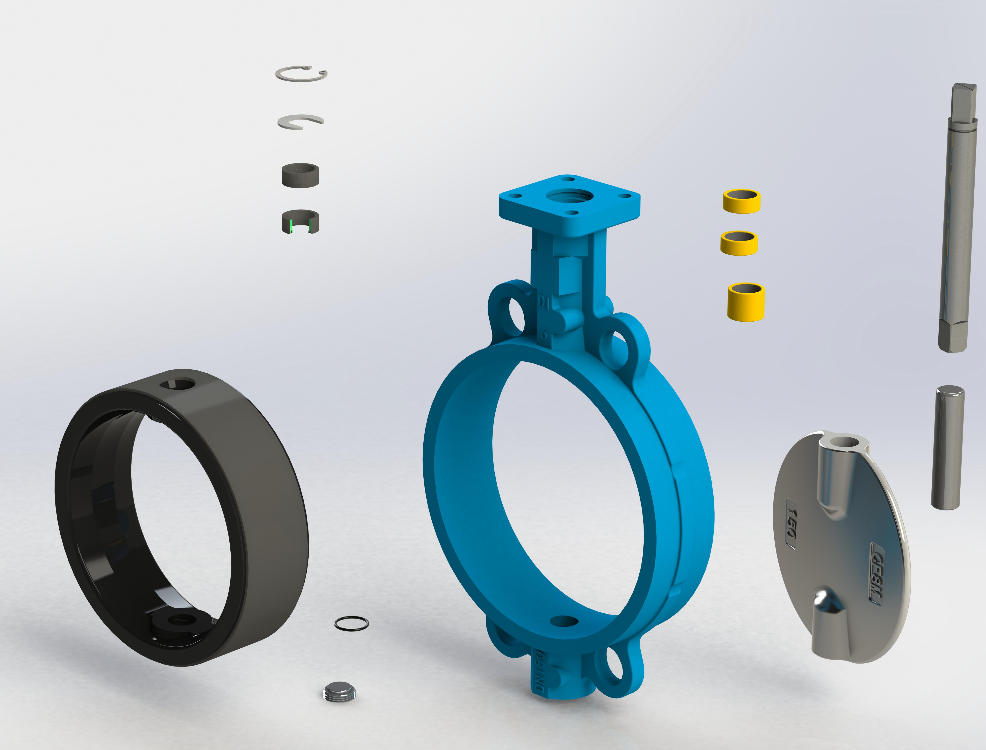
Exploded view of a wafer type butterfly valve: body, resilient seat, disc, stem and bushing. The seat is compressed by the mating flanges, which is why flange and face-to-face standards are qualifying constraints.
Certification Constraints: Which Documents Decide Acceptance
For municipal water, HVAC and process work in regulated markets, the certification file often determines eligibility before the technical datasheet is read. Tianshun Valve's published certificate set addresses three separate questions.
Potable water approval (WRAS)
WRAS Approved Product certificate 2307016 covers WRAS-1716-1310 (wafer type) and 2716-2310 (lug type) butterfly valves, issued on 25 July 2023 and valid until 25 July 2028. The certificate is held by TIANJIN TANGGU TIANSHUN VALVE CO., LTD and confirms the products were examined, tested and certified as meeting the quality and standard requirements of the Water Supply (Water Fittings) Regulations and Scottish Water Byelaws. A separate WRAS certificate, 240602030, issued 20 June 2024 and valid to 20 June 2029, covers TSD2F butterfly valves. For a UK or Republic of Ireland drinking water project, the wafer valve's eligibility to be installed on a potable line rests on that first document.
Pressure equipment quality assurance (TÜV)
Certificate 01 202 CHN/Q-02 0045.00 is a Quality Assurance System approval under Directive 2014/68/EU, Module H, issued by TÜV with an issue date of 8 October 2026 and an expiry of 30 September 2029. Its scope covers the design and manufacturing of butterfly valves, butterfly check valves and gate valves PN10–PN16, DN50–DN1200, against API609, EN593 and EN1171/EN12516-4. The certificate is listed against the double eccentric butterfly valve (BFFF), double flange butterfly valve (BF2F), lug butterfly valve (BFL) and wafer butterfly valve (BFW).
Quality management system (ISO 9001)
ISO 9001 certificate 00524Q1532R7S was issued on 30 December 2024 by CHINA CLASSIFICATION SOCIETY CERTIFICATION CO., LTD., valid until 13 January 2028, covering the manufacture of butterfly valve, butterfly check valve, flanged butterfly valve and gate valve under GB/T19001-2016 / ISO9001:2015.
Pressure and Temperature: Why a Wafer Valve Is Derated in Service
The nameplate class of a wafer butterfly valve is a cold-water reference point, not a working limit. Pressure ratings follow the flange standard: EN 1092-2 covers PN6, PN10, PN16, PN25 and PN40, while ASME B16.5 covers Class 125, 150, 300 and 600. Wafer, lug and grooved-end bodies most commonly appear as PN10, PN16, PN25 or the 150 psi / 300 psi equivalents.
Temperature, however, is set by the seat compound, and the seat is what derates first:
- EPDM — approximately −30 °C to +120 °C; suitable for water, steam condensate and mild chemicals.
- NBR — approximately −20 °C to +90 °C; suitable for oil, fuel and air.
- PTFE — approximately −40 °C to +180 °C; broad chemical resistance with low friction.
- Viton (FKM) — approximately −20 °C to +200 °C; oil, fuel and aggressive chemicals.
- Metal seat — up to +400 °C and above; severe-service and high-cycle applications.
A PN16 valve fitted with a resilient seat may only be good for PN10 at elevated operating temperature, which is why manufacturers publish pressure/temperature curves rather than a single number. The practical design rules that follow from this are straightforward. Apply the weakest-component rule across body, disc, seat, stem, gasket and actuator. Size the rating at 1.3–1.5 times normal operating pressure for general service, rising to 1.5–2.0 for cyclic, pulsating or water-hammer-prone lines. And treat the hydrostatic test pressure — typically 1.5 × PN for the body and 1.1 × PN for the seat — as a factory proof test, never as a continuous operating condition.
Installation and Interface Constraints That Cause Field Failures
Most wafer valve problems that reach a warranty conversation were created before the line was pressurised. The installation sequence matters because the seat is compressed by the flange bolts and the disc must clear the bore.
- Fully close the valve disc before installation.
- Align the pipeline flanges and verify the pipe spacing against the valve's face-to-face dimension.
- Insert gaskets and centre the valve body between the flanges.
- Tighten the flange bolts evenly in a cross sequence.
- Cycle the valve fully open and closed to confirm smooth operation before commissioning.
Two failure modes dominate. The first is using the disc to pull misaligned pipework together, which distorts the seat and produces leakage at the flange face. The second is a disc that contacts the flange inner wall because the flange bore or the face-to-face spacing was outside the valve's envelope. Neither is repairable in place, and both are avoidable at the drawing stage.
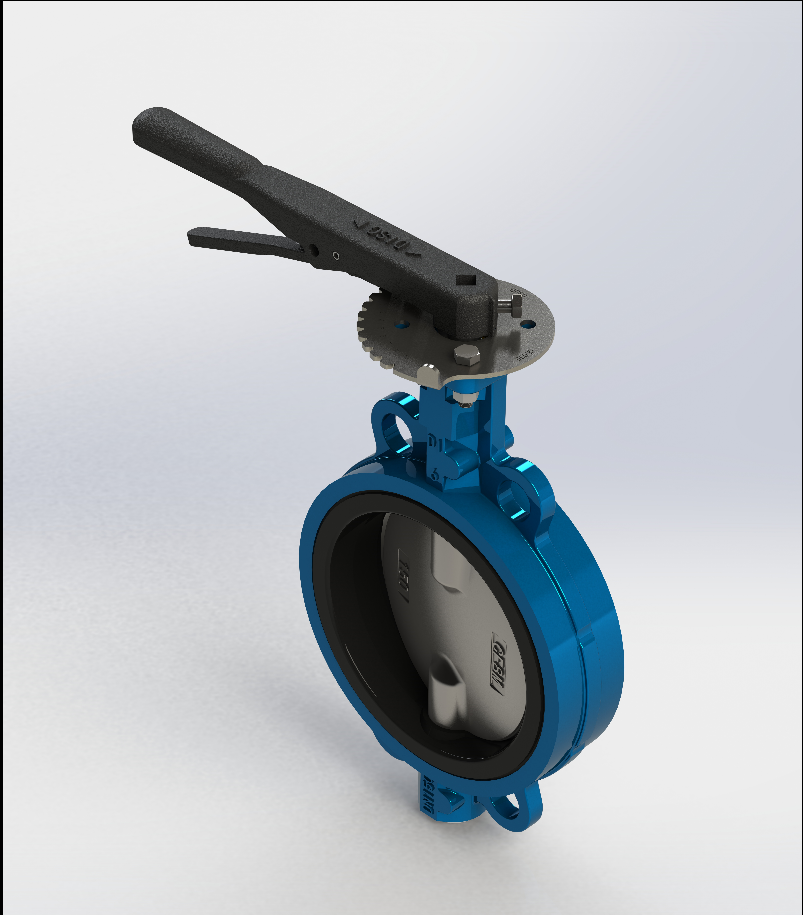
Wafer butterfly valve, model BFW. The body is clamped between two pipe flanges, so the surrounding flange standard and spacing carry as much weight as the valve specification itself.
Where a Wafer Butterfly Valve Fits: Application Evidence
The application record for wafer and lug butterfly valves spans six recurring duty profiles, each with its own constraint priority.
HVAC chilled and hot water systems
Commercial buildings and data centres in markets such as South Korea and Singapore use wafer and lug butterfly valves for flow regulation, isolation and balancing on chilled and hot water loops, matched with chillers, cooling towers, pumps, AHU/FCU units, heat exchangers and CRAC/CRAH units. The governing requirement is bubble-tight shutoff with low leakage, quiet operation and anti-condensation behaviour in tight plant rooms.
Municipal water supply
Potable water distribution networks and booster stations require certified, low-leakage, resilient-seated valves with full epoxy coating, suitable for buried installation. This is the segment where WRAS approval becomes a pass/fail gate rather than a differentiator.
Water and wastewater treatment
Wastewater treatment and desalination pretreatment in markets such as Turkey and India place valves in seawater, corrosive media, high humidity and coastal atmospheres. Anti-corrosion design, epoxy-coated discs and duplex or super duplex body options matter more here than nominal pressure class.
General industrial piping
Chemical, food and pharmaceutical clean pipelines in Germany, Britain, Spain and Italy use grooved and anti-corrosion butterfly valves for media cut-off and flow regulation, with hygienic-grade and leak-proof requirements driving material selection.
Shipbuilding and marine
Ballast, fire and engine-room piping on newbuild vessels requires seawater resistance, vibration tolerance and class-ready materials. Tianshun Valve supplies marine valve batches to Wuhan Shipyard, Wuhu Shipyard and Tianjin Port Shipbuilding, where compact wafer and lug designs suit confined engine-room spaces.
Fire protection and oil & gas
Fire sprinkler and hydrant systems require signal butterfly valves with open/close position indication and lockable devices. Oil and gas gathering and water injection lines require API-compliant, fire-safe, H₂S-resistant and NACE-compliant material selection; Tianshun Valve has supplied industrial butterfly valves under long-term framework cooperation with China National Petroleum Corporation (CNPC).
Market Context: Standards Tightening While Demand Grows
The global butterfly valve market was valued at USD 11.88 billion in 2026 according to Global Market Insights, against USD 11.31 billion in 2025. Within that total, double-offset (double eccentric) designs accounted for a 30% share in 2025 and are projected to reach USD 5.28 billion by 2035 — a shift that reflects tightening leakage and emissions requirements in process industries rather than a change in basic demand.
Published growth estimates for the category vary widely depending on whether smart and instrumented valve segments are included, so buyers comparing forecasts should check what each figure counts rather than comparing headline CAGRs directly. What is not in dispute is the direction of the compliance side: API 609 moving to its 10th edition with a 1 December 2026 programme effective date for monogram licensees, and potable water schemes continuing to require recognised approvals before installation.
For a wafer valve buyer, the practical translation is that documentation review is becoming a gating step in evaluation, not a formality after supplier selection.
Comparison With Adjacent Designs: Where the Wafer Configuration Stops
A wafer valve is not a universal substitute for a lug or double-flange valve, and the boundary is worth stating plainly.
| Configuration | Model in this range | Size range | Practical boundary |
|---|---|---|---|
| Wafer butterfly valve | BFW | DN40–DN1000 | Requires pipe flanges on both sides to clamp and seal the body |
| Half lug butterfly valve | BFHW | DN40–DN300 | Smaller size envelope; suited to compact industrial and marine lines |
| Lug butterfly valve | BFL | DN50–DN1000 | Threaded lugs allow one side of the line to be unbolted independently |
| Double flange butterfly valve | BF2F | DN50–DN1800 | Extended to larger diameters and flanged end connections on both faces |
The genuine limitation of the wafer configuration is that it depends on both mating flanges for mechanical retention and seat compression. It cannot serve as a dead-end or end-of-line isolation point, because with the downstream flange removed there is nothing to hold the body and compress the seat. Where a line must be opened on one side for maintenance without draining or dismantling the whole run, a lug design is the appropriate choice. Where the pipe diameter exceeds the wafer range, or where the specification calls for a flanged face on both ends, a double flange design is required.
A second boundary is less technical but equally real: because the wafer body sits inside the bolt circle, the installer has less tolerance for flange misalignment than with a flanged body. Projects with poor pipe alignment discipline should budget for alignment work rather than assume the valve will compensate.
Future Outlook
Three developments are likely to shape wafer butterfly valve procurement through the rest of the decade. The API 609 10th edition transition, effective for monogram licensees from 1 December 2026, will require suppliers to reissue documentation and may require buyers to restate which edition governs existing framework agreements. Potable water approval schemes will continue to function as market entry gates in the UK and Europe. And the shift toward double-offset designs — projected at USD 5.28 billion by 2035 — will keep pushing buyers to distinguish concentric from high-performance designs at the specification stage rather than at the quotation stage.
For suppliers, the visible pressure is documentation. For buyers, the visible benefit is a specification that can be compared across suppliers on measurable terms.
Frequently Asked Questions
What pressure and temperature ratings should I expect from a wafer butterfly valve, and what safety margin should I apply?
Ratings depend on the design standard, body material, seat material and end connection. Flanged valves under EN 1092-2 are rated PN6, PN10, PN16, PN25 or PN40; under ASME B16.5 they are rated Class 125, 150, 300 or 600. Wafer, lug and grooved-end bodies commonly appear as PN10, PN16 or PN25, or the 150 psi / 300 psi equivalents. Always confirm against the manufacturer's pressure/temperature curve, because the rating falls as temperature rises. Temperature range is set by the seat: EPDM approximately −30 °C to +120 °C, NBR approximately −20 °C to +90 °C, PTFE approximately −40 °C to +180 °C, Viton approximately −20 °C to +200 °C, and metal seats up to +400 °C and above. On safety margin, the system design pressure must not exceed the lowest rating among body, disc, seat, stem, gasket and actuator; specify a rating at least 1.3–1.5 times the normal operating pressure for general service, and 1.5–2.0 times for cyclic, pulsating or water-hammer-prone service. Note that hydrostatic test pressure, normally 1.5 × PN for the body and 1.1 × PN for the seat, is a proof test and not a safe continuous operating pressure.
How should a wafer type butterfly valve be installed between pipeline flanges?
Close the valve disc fully, align the pipeline flanges and check the pipe spacing, insert gaskets and centre the valve body, then tighten the flange bolts evenly in a cross sequence and cycle the valve open and closed to verify smooth operation. Depressurise the pipeline before installation, never use the disc to force pipe alignment, and confirm the disc does not contact the flange inner wall. Improper installation can damage the seat and cause leakage.
How is an electric actuated butterfly valve commissioned?
Commissioning includes verifying that the supply voltage matches the actuator rating, wiring the power and control signal correctly for the switching or regulating type, setting the open and close limit positions and torque protection, testing local and remote open-close commands, and checking the flow regulation response under the control signal. Cut off power before wiring; in explosive environments use actuators with a matching explosion-proof class; and do not touch moving parts during testing.
How should butterfly valves be maintained for a long service life?
Regular maintenance includes cycling the valve fully open and closed at least once per period, inspecting flange connections and the stem for leakage, lubricating stem threads and bearings, checking the seat and disc sealing surface for wear, and replacing seals or seats when leakage occurs. Depressurise and drain the pipeline before disassembly; for corrosive media, wear protective equipment and flush the valve before servicing.
Product specifications and certificate references in this article are drawn from Tianshun Valve Co., Ltd. published documentation. Buyers should confirm current certificate validity and edition status against the manufacturer's document pack before contract award. Manufacturer reference: en.tianshun.com.cn.
Tem questões ou precisa de mais detalhes?
Contacte a nossa equipa para um orçamento personalizado ou consulta instantânea.
Solicitar orçamento
Preencha o formulário abaixo e a nossa equipa entrará em contacto com uma proposta personalizada.
Chat direto do WhatsApp
Prefere conversar em tempo real? Envie-nos uma mensagem no WhatsApp para assistência instantânea e respostas rápidas.
- Obter orçamento personalizado
- Partilhar fotos ou documentos
- Discuta as suas necessidades diretamente
Geralmente responde em 5–30 minutos durante o horário de expediente.