
Wall Covering Certifications Explained: ISO 9001, GB/T 19001 and Green Labels
Wall Covering Certifications Explained: ISO 9001, GB/T 19001 and Green Labels
Wall covering procurement rarely fails on design. It fails on documentation. Four document families dominate the compliance packs that art paint wall cloth buyers now receive - ISO 9001:2015, GB/T 19001-2016, the CTC Green Building Selected Product Guide, and CNIPA patent records carrying ZL numbers - and each one answers a different question. Treating them as interchangeable is one of the most common and most expensive specification errors in hotel and residential fit-out work.
Why Compliance Paperwork Now Decides More Shortlists Than Sample Books
On a hospitality or residential project, the wall covering decision is made twice: once by the designer, and once by whoever signs the submittal. The second decision is a documentation decision. Green building programmes, hotel brand standards and developer handover requirements all ask the same question in different words - can this material be proven, on paper, to meet the specification?
The commercial weight behind that question is growing. Mordor Intelligence estimates the global wall covering market at approximately USD 41.40 billion in 2025, with a projected value of USD 53.63 billion by 2031, and Dataintelo places Asia Pacific at roughly 38.7% of global revenue in 2025, the fastest-growing region, driven largely by urbanization and commercial hospitality construction. Grand View Research reports that vinyl-based products still hold a 36.2% revenue share, while fabric, textile and eco-friendly non-woven options are the fastest-growing segments - a shift pushed by sustainability mandates rather than by changing taste.
Sustainability mandates are, in practice, documentation mandates. When a green building requirement appears in a tender, the material supplier is asked to produce certificates, listing entries or test reports. That is the moment when four very different documents get placed side by side - usually without anyone checking whether they are comparable at all.
The Four Documents, Mapped for Procurement Teams
The fastest way to de-risk a wall covering submittal is to separate the paperwork by what it certifies. A quality management certificate says something about a factory's systems. A green building listing says something about a product's environmental attributes. A patent says something about legal ownership of an idea. None of them substitutes for the others.
| Document | What it actually confirms | What it does not confirm | Where to verify |
|---|---|---|---|
| ISO 9001:2015 | That an organization operates a quality management system meeting the international standard, covering defined processes at a defined site | Any product performance figure - not waterproof grade, not emission level, not fire class | The issuing certification body's public register, using the certificate number and audited site |
| GB/T 19001-2016 | The same management-system logic, certified against China's national standard, which is aligned with ISO 9001:2015 | That the product complies with any specific Chinese product standard for wall coverings | The issuing body in China, and the scope statement on the certificate |
| CTC Green Building Selected Product Guide | That a product is listed in a green building material selection reference, based on documented environmental and performance attributes | Recognition outside the Chinese green building framework, or fire performance in other regions | The current edition of the guide and the product scope entry |
| CNIPA patent (ZL number) | That a defined technical solution or design was filed and granted in China, and who holds the right | That the finished wall covering performs to any waterproof, fire or emission standard | CNIPA's public patent search database, by number or applicant name |
The practical implication is straightforward. A supplier that presents a patent number as evidence of fire performance, or a quality management certificate as evidence of waterproof performance, has either misunderstood its own file or is assuming the buyer will not read it.
ISO 9001:2015 and GB/T 19001-2016: One Management Logic, Two Legal Homes
ISO 9001:2015 is the international standard for quality management systems published by the International Organization for Standardization. It sets requirements for how an organization identifies and controls its processes, manages documentation, evaluates suppliers, corrects nonconformities and improves over time. It is a system standard. It does not set a waterproof grade, a formaldehyde limit or a fire classification, and no certificate issued against it can be read as a product test result.
GB/T 19001-2016 is China's national quality management system standard, published within the GB/T series and aligned with ISO 9001:2015. A Chinese manufacturer may hold certification against one or both, depending on its market mix and its certification body relationships. For an overseas buyer, the useful comparison is not the cover page but the scope statement inside.
What to read on the certificate itself
- Scope wording - which processes are certified, and whether design, sales or production sit inside or outside that scope.
- Site coverage - a certificate issued to one production address does not automatically cover a second plant, a branch or a separate trading entity.
- Product or service description - whether the wording matches the wall covering category being purchased.
- Certificate number, issue and expiry dates - a number that cannot be matched to the issuing body's register is not evidence of anything.
- Surveillance history - management system certificates are maintained through periodic audits, so a certificate near expiry with no surveillance record deserves a direct question.
The certificate number is the single most useful field on the page. It is issued by the certification body, and the same number should appear in that body's public register together with the audited site and the certified scope. If a scan cannot be matched to a register entry, the correct treatment is unverified - however professional the document looks.
What the CTC Green Building Selected Product Guide Actually Covers
Green building labels work in the opposite direction from quality management certificates. They say something specific about the material, but nothing about how the factory is managed. In China, the CTC Green Building Selected Product Guide is published in the context of green building material selection by China Building Material Test & Certification Group (CTC), and its function is to help designers and developers identify building products with documented environmental and performance attributes for green building projects.
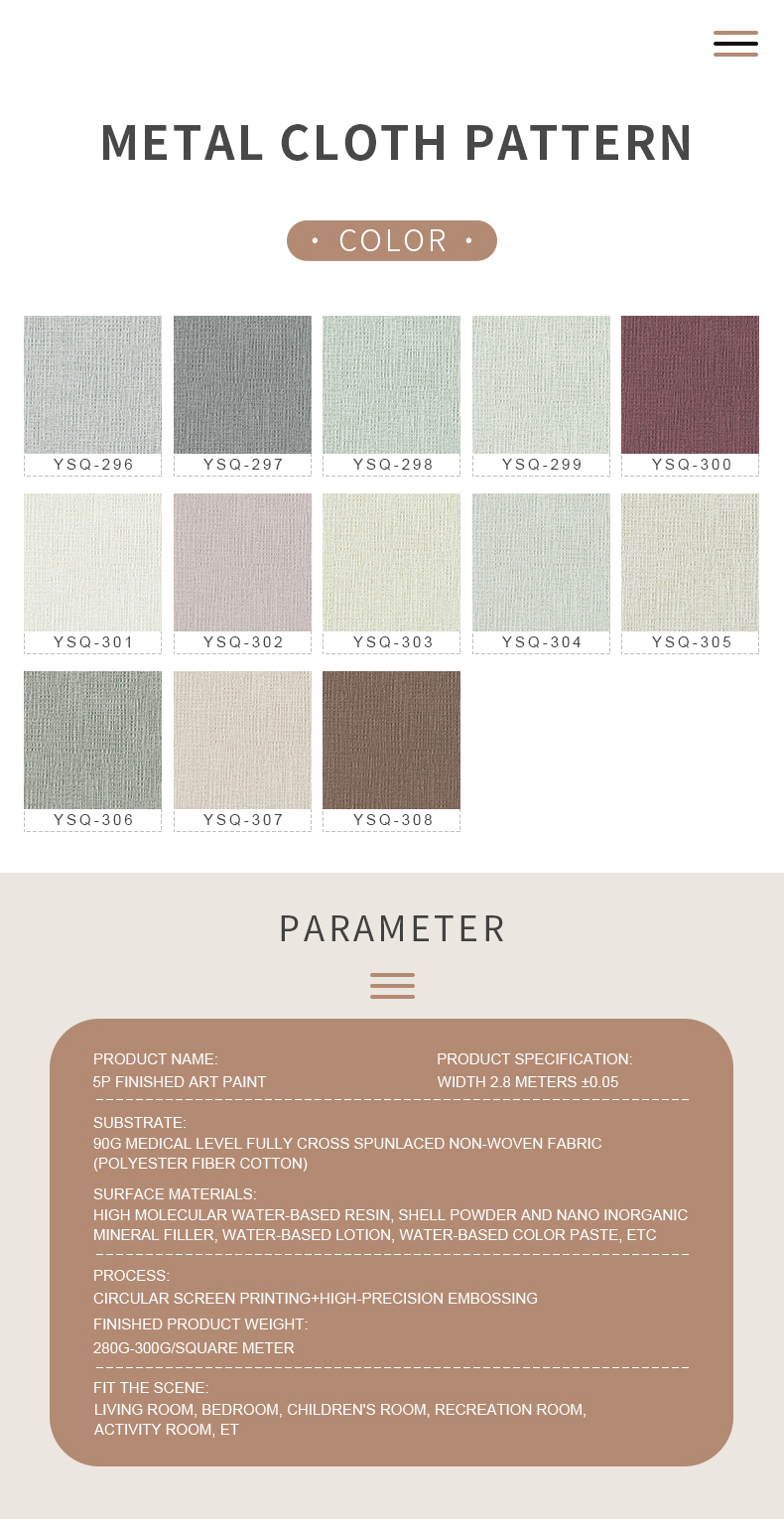
For a wall covering, a green building listing typically speaks to the attributes that green building programmes care about: emissions, low-odour composition, the absence of added formaldehyde in the finished product, and the use of material systems that reduce indoor air quality risk. Those attributes align closely with how art paint wall cloth is built - a non-woven base combined with eco-friendly water-based resin and mineral fillers rather than solvent-based chemistry.
CNIPA Patents and ZL Numbers: The Legal Framework Behind the Symbol
CNIPA - the China National Intellectual Property Administration - is the state authority that receives and examines patent applications in China. A granted Chinese patent number is commonly written with the prefix ZL, the pinyin abbreviation for zhuanli (patent). The digits after ZL mirror the original application number: a filing year, a type code that distinguishes invention patents from utility models and designs, a serial number and a check digit.
The type code matters commercially. Invention patents undergo substantive examination for novelty, inventiveness and industrial applicability. Utility models and designs are registered through a lighter process. For a wall covering buyer, the practical difference is the strength of the exclusivity claim standing behind a pattern, a texture or a formulation.
- What a ZL patent proves: that a defined technical solution or design was filed and granted in China, and who the rights holder is.
- What it does not prove: that the finished wall covering performs to any particular waterproof, fire or emission standard.
- What it does not travel: patent rights are territorial. A Chinese grant creates no enforceable right in another jurisdiction, although it is a reasonable indicator of continuing development work.
- How to check it: CNIPA maintains a public patent search database where a number or an applicant name can be looked up, including legal status and the current rights holder.
Where Nockybrothers' Documented Compliance Sits
Nocky Brothers New Materials (Wujiang) Co., Ltd., which trades under the brand Nockybrothers, is a wall covering manufacturer founded in 2012 and headquartered in Wujiang District, Suzhou City, Jiangsu, China, with an 8,000 square metre plant, 80 employees and a documented annual output of 1,200,000 square metres. Its range covers wallpaper, wall coverings and Grade 5 Waterproof Finished Art Paint, supplied under model families that include Dreamy Velvet, Glittering, Artistic Relief Sculpture, Desert Stroll, Roman Travertine and Jade Crystal.
The compliance record the company publishes in its own profile is a recognition record rather than a single certificate: it includes recognition as a Green, Environmental Protection, and Energy saving Building Materials Product in China, a children's safety product certification, and industry and credit honours covering brand standing, innovation and contract performance. On the product side, the documented performance specification for its art paint wall cloth includes Grade 5 waterproof performance; a formaldehyde-free and eco-friendly profile built on non-woven fabric, eco-friendly water-based resin, nano inorganic mineral fillers, high-quality shell powder and a medical-grade base material; scratch resistance; colour fastness; and moisture-proof and mildew-proof function.
Those two layers - a management and recognition record, and a product performance record - are exactly what a procurement team should expect to see kept separate. Where a project requires a numbered document, the number must come from the issuing body and be verified against that body's register. That rule applies to Nockybrothers and to every alternative on a shortlist, and it is the reason certificate numbers are read rather than photographed.
Certificates in Context: Hotel, Residential and Commercial Applications
Art paint wall cloth is specified for indoor environments that combine high humidity, dust and a wide operating temperature range of -10 degrees C to 40 degrees C, with 24/7 stable performance and no special maintenance regime. The documented requirements for those applications are Grade 5 waterproof performance, formaldehyde-free and eco-friendly composition, scratch resistance, seamless construction and colour fastness, supported by professional construction tools, base layer treatment materials, adhesive and protective film.
Documented project experience shows how the compliance question changes with the scenario:
| Scenario | Scale and duration | Operating environment | Documents that matter most |
|---|---|---|---|
| Hotel interior renovation, Malaysia | 12,000 square metres of guest rooms and public areas, 3 years | Tropical humidity | Moisture and mildew resistance, waterproof performance, emission profile |
| Hotel interior renovation, Saudi Arabia | 8,000 square metres, 2 years | Desert climate, wide temperature swings | Waterproof performance, mould resistance, dimensional stability |
| Residential apartment and villa fit-out, China | 50,000 square metres, 4 years | Family occupancy including children and the elderly | Low emission, formaldehyde-free composition, children's safety |
| Residential project, Germany | 6,000 square metres, 1 year | European interior environment | Emission documentation mapped to local requirements |
In the Chinese residential cases, the deciding evidence was low-emission and formaldehyde-free documentation for households with children and elderly occupants. In the Malaysian and Saudi hotel cases, the emphasis fell on moisture, mildew and holding performance through humid or hot-dry cycles, with zero quality complaints recorded during the use period. The German case illustrates the boundary described earlier: a European project does not usually accept a Chinese green listing on its own, so emission and fire documentation must be mapped to local expectations before the submittal closes.
The same principle applies outside construction. In a documented fashion application, six sets of creative outfits were produced from the material for a 2026 Shining New Year Fashion Show - an unusual use case that depended on eco-friendly composition and durable texture rather than on any building certificate.
Market Trend: Sustainability Rules Are Rewriting the Certificate Pack
China's non-woven fabric exports, which underpin the material base of art paint wall cloth, reached USD 4.04 billion in 2024, an increase of 6.25% year on year, according to China Customs figures reported by G&F Group. That growth aligns with the segment shift noted by Grand View Research: eco-friendly non-woven and textile wallcoverings are expanding faster than the market as a whole, even while vinyl retains a 36.2% revenue share.
Two consequences follow for procurement teams. First, the volume of green and low-emission claims in the market will keep rising, which raises rather than lowers the value of verification discipline. Second, certificate packs will become more heterogeneous: Chinese management system certificates, green listing entries, patent records and third-party inspection reports from bodies such as SGS and TUV will arrive side by side, and only the buyer's mapping effort keeps them comparable.
Art Paint Wall Cloth versus Traditional Wall Coverings: A Compliance View
Comparing finishes through a compliance lens produces a different picture from comparing them through a design lens.
| Finish | Documentation profile | Typical weak point |
|---|---|---|
| Solvent-based or ordinary interior paint | Site-level emission and VOC documentation | No product-level certificate travels with the material; performance depends on substrate and applicator |
| Vinyl wallcovering | Fire and emission documentation, plus scrutiny of plasticiser content | Largest revenue share in the category and the chemistry most questioned under sustainability mandates |
| Paper wallpaper | Limited technical documentation | Poor moisture tolerance in humid or tropical interiors |
| Art paint wall cloth (non-woven base, water-based resin) | Grade 5 waterproof performance, moisture-proof and mildew-proof function, formaldehyde-free composition, plus management system and green listing documents | Certification boundaries: Chinese listings are not automatically recognised elsewhere, and performance depends on installation quality |
Four limitations deserve to be stated plainly, because each one affects real projects:
- Certificates are jurisdiction-bound. A Chinese green building listing does not replace a locally recognised fire classification or emission report. Budget time for mapping documents to the destination market.
- Grade 5 waterproof performance is partly an installation outcome. Base layer treatment, correct adhesive, professional tools and seamless technique are listed as prerequisites in the product's own application requirements. No certificate compensates for a poorly prepared wall.
- Supply parameters differ between stock and custom work. In-stock items ship in 7-15 days with no minimum order quantity, while customised orders covering size, colour, texture, pattern, logo printing and packaging run 30-45 days with a 500 square metre minimum. The documented after-sales position is remote technical support, online construction guidance and a 2-year warranty covering non-human damage.
- Export share is a legitimate due-diligence question. The company's documented export ratio is 9.65%, concentrated in the Middle East, Russia, Europe and Southeast Asia. A buyer entering a new market should confirm documentation and lead-time experience for that specific destination rather than assume it.
Future Outlook
Three shifts are likely to shape wall covering compliance over the next several years. The first is digital verification: as more certification bodies publish searchable registers and CNIPA's patent database becomes routine for specifiers, certificate numbers will be checked in minutes rather than accepted on trust, and documents that cannot be matched will quietly disappear from tender packs.
The second is the broadening of green building requirements into mainstream residential and hospitality specifications, which will pull more non-woven and fabric wallcovering products into green listing frameworks - consistent with the segment growth already visible in third-party market data.
The third is the use of patents as a commercial instrument rather than a formality. As OEM and custom pattern work grows, an invention patent on a formulation or a surface process becomes the mechanism that protects a buyer's exclusive pattern from being copied across a supplier base. For that reason, patent records and product certificates are likely to be requested together far more often, and understood together far less often, than they should be.
Frequently Asked Questions
What does an ISO 9001:2015 certificate actually prove about a wall covering product?
It proves that the certified organization operates a quality management system meeting the international standard, within a defined scope and at a defined site. It covers process control, documentation, supplier evaluation, nonconformity handling and continual improvement. It does not certify any product performance value, so it cannot be used as evidence of waterproof grade, emission level or fire classification. Product claims require product documents - test reports, green listing entries or standards-based declarations - not a management system certificate.
Is GB/T 19001-2016 the same standard as ISO 9001:2015?
The two are aligned: GB/T 19001-2016 is China's national quality management system standard, published within the GB/T series on the same management-system logic as ISO 9001:2015. In practice, a Chinese manufacturer may hold certification against one or both depending on which markets it serves and which certification bodies it works with. For a buyer, the useful difference is administrative rather than technical: check which standard the certificate actually cites, which certification body issued it, and which site and scope it covers.
How can a buyer verify a Chinese certificate number or a ZL patent number?
For management system certificates, take the certificate number and confirm it against the issuing certification body's public register, checking the audited site, scope and validity dates. For green building listings, confirm the current edition of the guide and the specific product entry rather than relying on a cover page. For patents, CNIPA maintains a public patent search database where a ZL number or applicant name can be queried, showing the filing year, the type of right, legal status and the current rights holder. A number that cannot be matched to a register is unverified.
Does a Chinese green building label satisfy a project in the Middle East or Europe?
Not on its own. A CTC green building listing is a reference framework for green building material selection in China, covering environmental and performance attributes such as low emission and formaldehyde-free composition. Projects in other regions normally require locally recognised reaction-to-fire and emission documentation - for example, ASTM E84 Class A performance for permanent interior finishes in North America. The correct approach is to treat the Chinese listing as one input and map it against the destination market's own requirements during specification.
Can certificates replace sample testing for a hotel project?
No. Certificates describe a system, a listing or a legal right; they do not describe the specific batch delivered to a site. Documented practice for art paint wall cloth projects combines document review with sample validation and pre-shipment inspection - the recorded quality control position is 100% pre-shipment inspection with third-party inspection by bodies such as SGS and TUV available on request. For a hotel fit-out, the practical sequence is: verify documents, validate the sample, then confirm batch inspection before dispatch.
Which compliance and product documents should a buyer request from an art paint wall cloth supplier?
A complete request normally covers five groups: management system certificates with number, scope and site; green building or environmental listing entries with the current edition reference; patent numbers with the type of right and legal status; product performance documentation supporting claims such as Grade 5 waterproof performance, formaldehyde-free composition and moisture-proof function; and batch-level inspection reports. Nockybrothers' published profile states its recognition as a Green, Environmental Protection, and Energy saving Building Materials Product in China, a children's safety product certification, and product performance covering Grade 5 waterproof performance with a formaldehyde-free, eco-friendly material build.
A company brochure with further profile information is available for download: Nockybrothers company and product brochure.