
Wall Panel Compliance Playbook: B1 Fire Ratings Decoded
Wall Panel Compliance Playbook: B1 Fire Ratings Decoded
A single line on a wall panel datasheet — "fire rating: B1" — now shapes more supplier shortlists than colour, texture or price. In hotel refurbishments, office interiors, multi-family housing and villa facades, the fire classification of a decorative panel is a document that has to be produced, matched to the specification, and explained in front of a local authority long before the first panel is fixed to the wall.
The commercial stakes behind that line are visible in the category numbers. The global wall panel market was valued at USD 32.4 billion in 2025 and is projected to reach USD 43.7 billion by 2033 (Dataintelo), while the Wood Plastic Composite segment reached USD 8.89 billion in 2025 with a projected CAGR of 11.7% through 2033 (Grand View Research). Asia-Pacific accounts for approximately 42.3% of global wall panel market share (Dataintelo). Growth of that scale pushes more specification pressure onto suppliers — and more compliance questions in front of buyers working through the research and evaluation stages of a project.
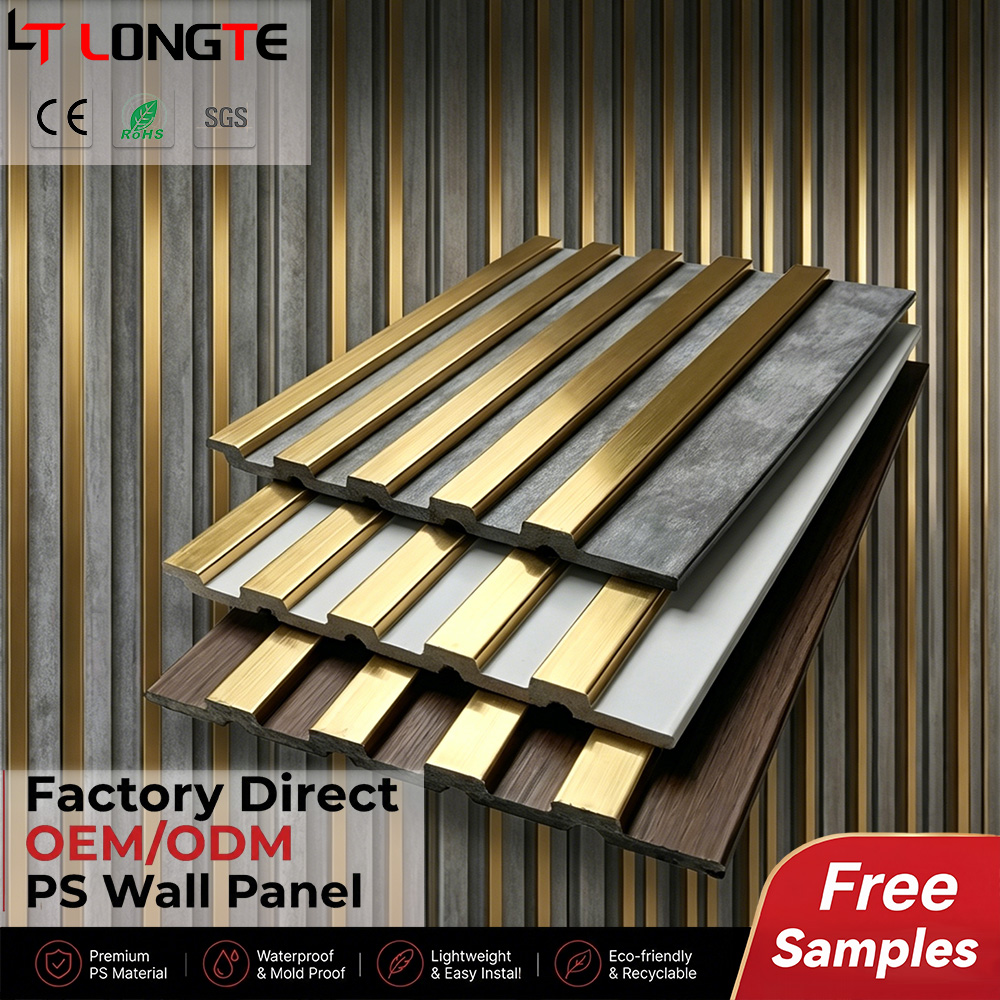
Fluted interior wall panel. Buyers increasingly specify the core and fire class before approving the finish.
What "B1" Actually Records — and What It Cannot Prove
B1 is a flame-retardant classification tier used in building-material fire-performance systems. It describes a material that resists ignition and limits flame spread under a defined test method. It does not describe a non-combustible material. A-class categories, including A2, sit elsewhere in the same hierarchy and are specified where non-combustibility is mandatory rather than preferable.
A B1 entry only becomes a procurement document when three things are attached to it: the test standard applied, the exact specimen tested — product, thickness, density, surface finish and backing — and the test report that names both. A datasheet that states "fire rating: B1" without those anchors answers a product question. Project reviewers, insurance assessors and fire consultants ask the second question: which specimen, tested how, installed where.
Two failure patterns recur in panel procurement. The first is comparing the same decorative look across suppliers without checking the core. An identical marble or wood-grain surface can sit on PVC, SPC, WPC, PS or polyurethane cores, and those cores do not behave identically in a fire test. The second is treating a class as a certificate — assuming a B1 line means a panel has passed "the" fire test, when the same core family can produce different results at different thicknesses and in different mounting assemblies.
Reading B1 Alongside European and Local Fire Classes
B1 does not translate directly into the European framework. Under EN 13501-1, commercial WPC wall panels are required to meet the standard, ideally achieving a B-s1,d0 outcome (European Standard EN 13501-1). In that notation the main letter describes contribution to fire, the s value describes smoke production and the d value describes flaming droplets. B-s1,d0 is therefore a more granular statement than a single B1 tier, and it is the format European consultants typically expect to see in a technical submittal.
The practical consequence for buyers is documentation stacking rather than substitution. A project in the Gulf, South America or Southeast Asia may be reviewed against a national classification system, while a European consultant on the same job asks for EN 13501-1 evidence. Where a specification names both, the panel file needs both. Before an order is placed, the buyer should confirm which classification the local authority will actually accept — because approval is granted at authority level, not at catalogue level.
Why the Core, Not the Surface, Sets the Fire Class
In decorative panel systems the visible layer is thin: a UV-coated film, a printed marble pattern or a laminated foil over a structural core. Combustion behaviour is dominated by that core — its polymer matrix and its mineral loading. The LONGTE product range illustrates how wide the spread can be inside a single supplier's catalogue. Bamboo Charcoal Wood Wall Panel (LT-BC) is built on a bamboo charcoal fiber and PVC composite. WPC Fluted Wall Panel (LT-WG) uses wood powder, PVC and additives. SPC Stone Plastic Composite Wall Panel (LT-SW) is based on limestone powder, PVC and a UV layer. PU Faux Stone Wall Panel (LT-PU) combines polyurethane foam with a surface coating. Flexible Soft Stone Wall Panel (LT-FS) is produced from modified clay and polymer resin — and it is the product in the range listed with an A2 fire classification rather than B1.
The evaluation lesson is straightforward to apply: specify the panel by core and thickness first, then choose the finish. A buyer who selects a finish and afterwards asks which core it can be delivered on is prioritising aesthetics and treating compliance as an afterthought — the reverse of how project approval actually works.
The LONGTE Wall Panel Range: Declared Fire Class, Water Performance and Dimensions
Haining Longtime Industry Co., Ltd. (LONGTE) is a Chinese building-materials manufacturer founded in 2003, based in Haining, Zhejiang Province, producing PVC, WPC, SPC, PU and PS panel and flooring systems. The company reports an 80,000 m² manufacturing base, 220 employees, a 12-engineer R&D team and an 85% export ratio serving 60+ countries.
For buyers building a compliance file, the following values are the declared product-level data points that a submittal normally has to reconcile with a project specification.
| Product (model) | Construction size / thickness | Declared fire class | Water and surface performance | Typical application |
|---|---|---|---|---|
| Bamboo Charcoal Wood Wall Panel (LT-BC) | 600×2900 mm / 9 mm | B1 | Waterproof; formaldehyde-free; 20+ colours | Residential, hotel, office, kids room |
| WPC Fluted Wall Panel (LT-WG) | 159×2900 mm / 12 mm, 8 mm groove depth | B1 | Waterproof; termite-proof | Living room TV background, hotel lobby, office |
| SPC Stone Plastic Composite Wall Panel (LT-SW) | 1220×2800 mm / 4 mm | B1 | 100% waterproof; anti-scratch; wear-resistant | Bathroom, kitchen, hotel, commercial |
| PVC Marble Wall Panel (LT-PM) | 1220×2800 mm / 3–8 mm | B1 | UV-coated marble surface; density 1.4–1.5 g/cm³ | Interior decoration, hotel, villa, commercial space |
| PS Polystyrene Fluted Wall Panel (LT-PS) | 150×2900 mm / 10 mm, 5 flutes | B1 | Waterproof; ultra-lightweight; easy install | TV background, bedroom, hotel, office |
| Acoustic Slat Wood Wall Panel (LT-AC) | 600×2400 mm / 21 mm | B1 | NRC 0.5–0.85; wood veneer with polyester felt backing | Cinema, studio, office, home theatre, restaurant |
| PU Faux Stone Wall Panel (LT-PU) | 600×1200 mm / 20–30 mm, 2–3 kg/m² | B1 | Weather-resistant; impact-resistant | Exterior facade, villa, hotel, restaurant |
| Flexible Soft Stone Wall Panel (LT-FS) | 600×1200 mm / 2–3 mm, 3–5 kg/m² | A2 | Bendable; weather-resistant 20+ years | Curved wall, exterior facade, interior feature wall |
Declared product data for the LONGTE wall panel range. Class values apply to the products as listed; buyers should confirm that the report supplied covers the exact thickness and core being quoted.
Matching Fire-Class Data to Project Scenarios
The value of a fire class is realised only when it is matched to the room, the substrate and the maintenance regime. The scenario mapping below uses the LONGTE product data and the company's documented application records.
Wet rooms and high-traffic interiors
Bathrooms, kitchens and hotel wet areas impose two demands at once: moisture resistance and a declared fire class. LT-SW combines a B1 fire rating with a 100% waterproof, anti-scratch surface on a 4 mm rigid SPC core at 1220×2800 mm, which is why it appears in bathroom, kitchen, hotel and commercial applications. LT-WG and LT-BC are also listed as waterproof while carrying B1, so a wet-adjacent specification does not automatically force a buyer away from a flame-retardant class — but the fixing and sealing system still has to suit the wet area.
Hospitality and commercial feature walls
Hotel lobbies, corridors and office reception walls are typically high-visibility, high-traffic surfaces. LT-WG at 159×2900 mm with a 12 mm thickness and 8 mm groove depth is the range's 3D fluted cladding option for living room TV backgrounds, hotel lobbies and offices. Long-format panels reduce joint count, which matters both visually and practically: fewer joints means fewer places where the surface build-up and the substrate interface have to be resolved on site.
Residential interiors and children's rooms
LT-BC at 600×2900 mm and 9 mm is described in the product data as formaldehyde-free, waterproof and B1, with 20+ colours, for residential, hotel, office and kids room applications. Fire class and emissions are separate properties, and both belong in the submittal. Bamboo charcoal wood veneer panels as a category are increasingly certified to E0 formaldehyde emission standards (≤ 0.07 mg/m³) (AesthedgeWallPanel) — a reference point buyers can use when asking what emission evidence is available, rather than assuming every panel in the category performs the same way.
Exterior facades, heat and curvature
Outdoor cladding adds UV, thermal cycling and fixing weight to the compliance question. LT-PU at 600×1200 mm and 20–30 mm carries a B1 rating with weather resistance and impact resistance at 2–3 kg/m², for exterior facades, villas, hotels and restaurants. Its light weight reflects a wider shift in the facade category: PU stone wall panel sales reached USD 3.7 billion in 2024, driven by a 70–80% weight reduction compared to natural stone (Witop Decor). Where the design includes curved walls, LT-FS provides the A2-rated option at 600×1200 mm, 2–3 mm and 3–5 kg/m², described as bendable with weather resistance of 20+ years.
Acoustic-critical interiors
Cinemas, studios, conference rooms and restaurants need sound absorption and a fire class in the same panel. LT-AC at 600×2400 mm and 21 mm is listed with NRC 0.5–0.85, a wood veneer face with polyester felt backing, and a B1 rating, for cinema, studio, office, home theatre and restaurant use. These rooms are exactly where the class declaration deserves closer reading: acoustic felt and veneer are combustible components, and the applicable scenario data for entertainment and media spaces specifies NRC 0.5+, a fireproof B1 requirement and easy on-site cutting as the working conditions.
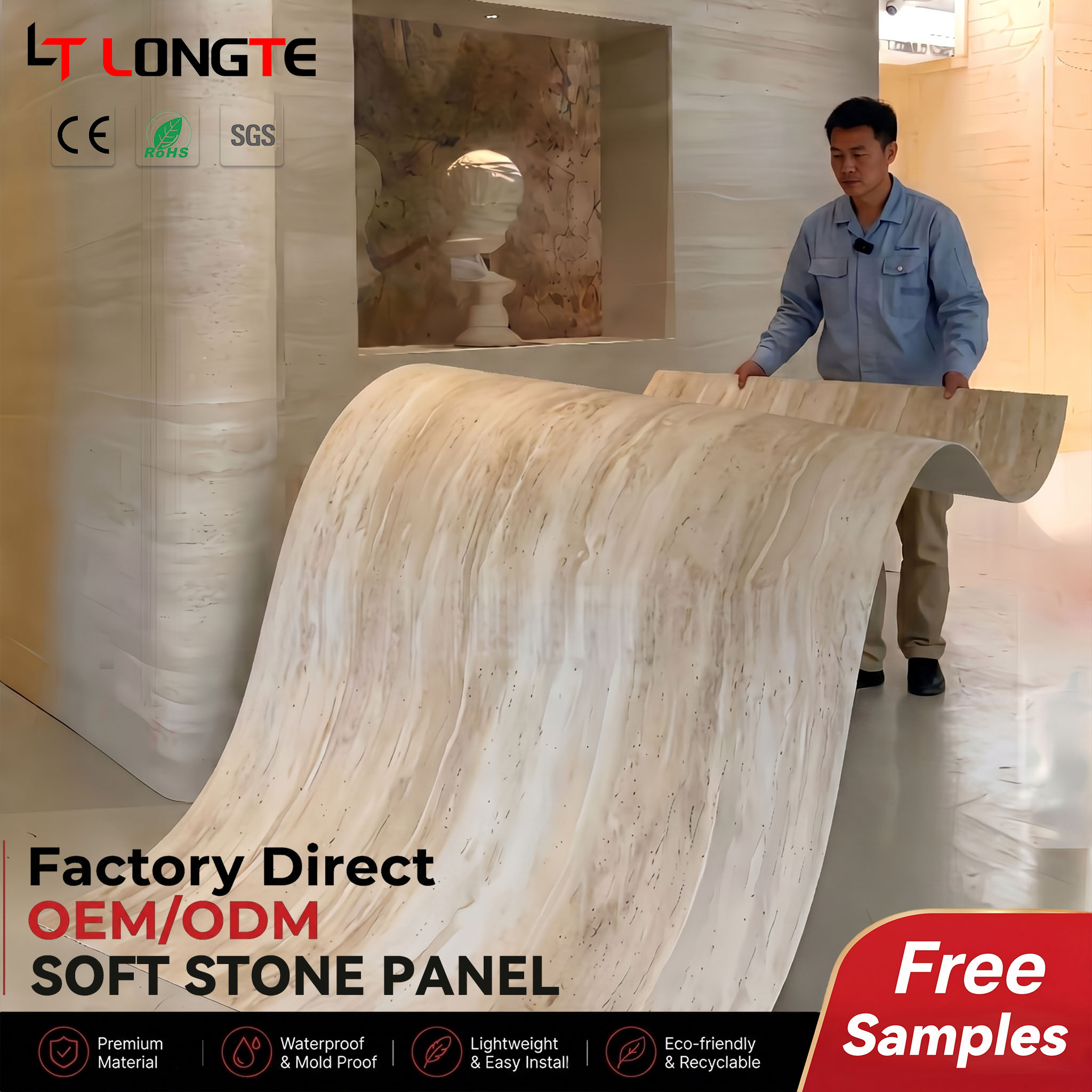
Flexible soft stone is the A2-rated option in the range — the one product class that moves a specifying buyer closer to a non-combustible requirement.
Evidence from installed projects
Project records show how these ratings behave outside the datasheet. A villa developer and luxury interior fit-out company in the UAE used 6,000 m² of PU stone panel and 4,000 m² of acoustic panel across a villa community and a five-star hotel, covering villa exterior feature walls, hotel lobby and executive suite acoustic walls. The project ran 2+ years without complaints, the case record states that the Dubai Civil Defense fire test was passed and that B1 compliance with UAE regulations was documented, and the developer signed a 3-year exclusive frame agreement. That sequence — test approval first, commercial commitment second — is a useful model for buyers writing a compliance gate into their own tender.
In the Philippines, a resort developer and landscape contractor installed 8,000 m² of WPC decking and 3,500 m² of wall panel for a beachfront resort covering pool deck, beach walkway, villa terrace and outdoor dining areas. After three years the record reports zero warping and zero fading despite tropical humidity and salt air, with termite-proof and salt-corrosion-resistant performance and anti-slip R11 grade, and the resort placed a repeat order for phase two. These are weathering results rather than fire results, but they demonstrate the kind of durability evidence that supports a long-life specification in a demanding climate.
Distributor projects add the procurement dimension. An India-based wholesale distributor and project contractor moves 12 × 40HQ containers per year, roughly 50,000 m², supplying small hotels, residential builders and retail interior shops in Mumbai, Delhi and Chennai over 4+ years. A Colombia-based interior finishing retailer chain grew from a single container trial to 3 × 40HQ containers per month (approximately 10,000 m²) with Spanish-language installation guides and DDP service to Cartagena and Buenaventura. A USA building-material distributor has supplied 15 × 40HQ containers per year for 5+ years, expanding from 3 SKUs to 20+ SKUs. Each of these accounts depends on the same underlying requirement: the declared class, the thickness and the core must stay consistent across reorders.
Market Trend: Compliance Documentation Is Becoming a Purchasing Filter
Three data points explain why B1 claims are being audited more closely than they were five years ago. First, category growth has pulled in new suppliers: the WPC segment alone is projected to grow at 11.7% CAGR through 2033 (Grand View Research). Second, decorative materials are consolidating around a small number of product families — UV marble sheets captured 18% of the global decorative materials market in 2024, a 260% increase from 2020 (Witop Decor). Third, supply is concentrated: China is the top exporter of PVC marble sheets, with 1,480 documented export records as of late 2025 (Volza Export Trade Data).
Read together, those figures describe a market where the number of suppliers quoting a fire class has grown faster than the number able to produce the matching report on demand. That gap is what turns compliance into a purchasing filter rather than a formality. It also explains why buyers increasingly bundle fire class with emissions performance — E0 documentation on bamboo charcoal panels, for example — into a single pass/fail gate at the sample stage, instead of reopening the question after the purchase order is issued.
Wall Panels vs Traditional Finishes — and the Limits of a B1 Claim
Panels are not automatically the more compliant choice; they are the more documented one. The comparison below frames the general differences that matter in a specification decision.
| Evaluation point | Decorative wall panel systems (PVC / WPC / SPC / PU / PS) | Traditional finishes (tile, natural stone, gypsum and paint, timber veneer) |
|---|---|---|
| Declared class at product level | Supplied with a declared class — B1 across most of the LONGTE wall range, A2 for LT-FS | Depends on the site-applied assembly and coating, which must be assessed as built |
| Weight and substrate demand | PU faux stone at 2–3 kg/m² and flexible soft stone at 3–5 kg/m² can be fixed to suitable substrates without rebar or mortar | Natural stone is substantially heavier and typically requires additional substrate and mechanical fixing |
| Wet-area behaviour | LT-SW is specified as 100% waterproof and anti-scratch for bathroom and kitchen use | Tiled surfaces are water-resistant, with grout lines and wet trades in the programme |
| Installation sequence | Long-format panels up to 2900 mm reduce joint count and site time | Multi-step processes — setting, curing, drying — extend the programme |
| Retrofit suitability | Can be installed over sound existing surfaces in many renovation cases | Frequently requires demolition or surface build-up before finishing |
General procurement framing. It is not a code assessment — overall performance depends on the complete installed assembly and on local requirements.
Where a B1 claim stops being sufficient deserves equal clarity, because this is the boundary most often discovered late in a project:
1. B1 is flame-retardant, not non-combustible. Where a code requires an A-class or a fully non-combustible assembly — certain high-rise applications, escape routes and fire compartments — a B1 panel does not qualify. Only an A-rated product, such as LT-FS at A2, moves the panel itself closer to that requirement, and even then the complete assembly still has to be assessed.
2. A classification is tied to the tested specimen. Thickness, density, surface and backing all form part of the specimen. In fire testing generally, a result recorded for one configuration does not automatically extend to another configuration of the same appearance, which is why buyers should confirm that the report covers the exact thickness and core being quoted.
3. The installed assembly governs the outcome. Adhesives, battens, cavities, substrates, trims and sealants can change how a wall behaves in a fire. A product classification is not the same thing as a system classification, and a specification that only names the panel leaves a gap that the installer has to resolve on site.
4. Class systems are not interchangeable across markets. A B1 tier and an EN 13501-1 class are different statements, and authorities may require additional project-level evidence. The UAE villa and hotel case is instructive: the relevant approval was described as a Dubai Civil Defense fire test result, that is, an authority approval rather than a catalogue entry.
5. Decorative panels are not structural. They do not replace fire-stopping, and their class should never be read as a substitute for the fire rating of the wall assembly behind them.
What Buyers Should Expect Next
The direction of travel is towards documentation-first procurement. Fire class, emission data and moisture performance are being requested at the sample stage rather than at the contract stage, and third-party verification is migrating from an exception to a routine step — LONGTE's quality-control description already includes 100% incoming raw-material inspection, in-process checks every two hours, finished-goods visual and dimension checks, and third-party pre-shipment inspection by SGS, BV or TUV on request.
A second expectation is closer matching between class and location inside a single project. Rather than one panel type throughout, specifications are increasingly layered: an A2-rated flexible stone on a curved facade, a B1 waterproof SPC panel in wet rooms, a B1 fluted panel in lobbies, and a B1 acoustic panel in media rooms. Manufacturers that produce their own films and foils alongside finished panels, as LONGTE does across its film, panel and flooring operations, are better positioned to hold a declared class stable across reorders than suppliers assembling from external components.
For buyers, the practical conclusion is unglamorous but durable: treat the fire class as part of the product identity, not as a marketing line. Match the class to the room, the core to the thickness, the report to the specification, and the approval to the authority that will issue it.
Reference Materials
The LONGTE product catalogue, including panel formats, finishes and application references, is available for download: LONGTE product catalogue (PDF).
Manufacturer reference: Haining Longtime Industry Co., Ltd., Haining, Zhejiang Province, China — website: www.ltpvcfactory.com.
FAQ
What does a B1 fire rating mean on a wall panel?
B1 is a flame-retardant classification used in building-material fire-performance systems. It indicates that a material resists ignition and limits flame spread under a defined test method, but it is not a non-combustible (A-class) rating. On a datasheet, a B1 entry is meaningful only when it is linked to the test standard applied, the exact specimen tested and the report that documents both. In the LONGTE range, B1 is declared for LT-BC, LT-WG, LT-SW, LT-PM, LT-PS, LT-AC and LT-PU, while LT-FS is declared at A2.
Is B1 the same as the European B-s1, d0 classification?
No. B1 belongs to a classification system built on tiers for combustible materials, while EN 13501-1 describes a class (A to F) together with smoke production (s1–s3) and flaming-droplet (d0–d2) sub-classes. For commercial WPC wall panels, compliance with EN 13501-1 at a B-s1,d0 outcome is the target commonly referenced in European specifications (European Standard EN 13501-1). A B1 datasheet entry does not by itself produce an EN classification, and buyers working across both markets normally keep both documents in the project file.
Which LONGTE wall panels carry a B1 rating, and which are rated A2?
The B1-rated products are Bamboo Charcoal Wood Wall Panel LT-BC (600×2900 mm, 9 mm), WPC Fluted Wall Panel LT-WG (159×2900 mm, 12 mm), SPC Wall Panel LT-SW (1220×2800 mm, 4 mm), PVC Marble Wall Panel LT-PM (1220×2800 mm, 3–8 mm), PS Fluted Wall Panel LT-PS (150×2900 mm, 10 mm), Acoustic Slat Wood Wall Panel LT-AC (600×2400 mm, 21 mm) and PU Faux Stone Wall Panel LT-PU (600×1200 mm, 20–30 mm). Flexible Soft Stone Wall Panel LT-FS (600×1200 mm, 2–3 mm) is the product listed with an A2 fire classification instead of B1.
Does a B1 rating automatically satisfy a commercial project's code requirement?
No. The classification is one input into a larger compliance decision. Local codes set the required class according to building type, height and location; authorities may require the installed assembly to be assessed; and specific areas such as escape routes, shafts and some high-rise applications may require non-combustible materials. A B1 product can be appropriate where the specification calls for a flame-retardant class, and it does not qualify where an A-class non-combustible material is required.
Can a B1-rated panel also be used in bathrooms and other wet areas?
Fire class and water performance are separate properties and should be checked separately. In the LONGTE range, LT-SW pairs a B1 rating with a 100% waterproof and anti-scratch surface on a 4 mm rigid SPC core at 1220×2800 mm, which is why it is listed for bathroom, kitchen, hotel and commercial applications. LT-WG and LT-BC are also described as waterproof while carrying B1. Fire performance itself does not change with moisture, but the fixing and sealing system has to suit the wet area.
How should a buyer verify fire-rating claims before ordering?
A workable sequence is to request the test report and confirm that the standard, specimen, thickness and date match the product being quoted; verify the class for the exact thickness and core rather than the collection as a whole; ask how the panel is intended to be installed, because the assembly affects the outcome; and check that the destination market accepts the classification cited. LONGTE's quality-control description covers 100% incoming raw-material inspection, in-process checks every two hours, finished-goods visual and dimension checks, and third-party pre-shipment inspection by SGS, BV or TUV on request. Sample quantities and order thresholds are documented as one free sample piece, trial orders from a 1×20GP mixed container, and 500 m² for custom design.