
Wall Panel Shortlist for EU Interior Projects: PVC, PET and WPC
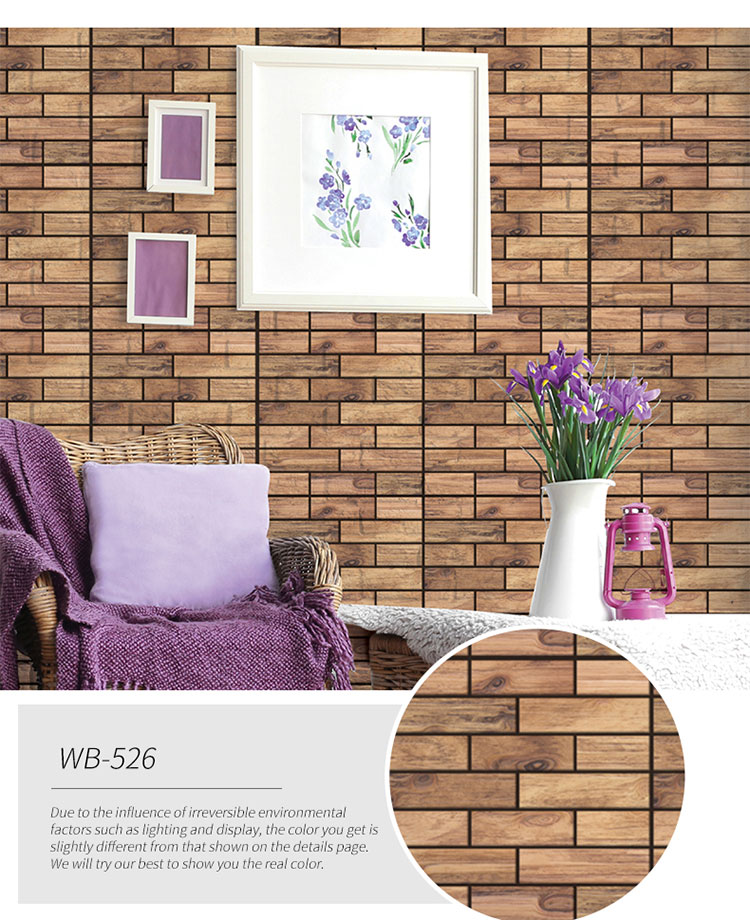
PVC wall panels are one of three material families assessed here for European interior decoration projects.
Three material families cover most European interior wall briefs: PVC, PET marble and WPC. Projects rarely stall because the panel itself was poor; they stall because thickness, substrate, fire classification and customs classification were never fixed in writing before the order was placed.
Why a shortlist works better than a single recommended panel
Interior wall panel work in Europe is rarely one project type. The published application scope for this product family covers renovation of old houses, apartment full renovations, hotel room makeovers, homestay renovations, chain brand store refurbishments, office fit-outs, temporary exhibition booths, simple rental apartment renovations and modular interior projects. Substrate conditions are just as varied: cement floors, tiled surfaces, latex-painted walls, plasterboard, plywood and other smooth, solid bases are listed as suitable, while powdery, sandy or loose surfaces are explicitly excluded.
That spread explains why buyers who ask for “the best wall panel” usually end up re-specifying later. A panel that performs well on a latex-painted feature wall in an apartment may be the wrong choice for a chain store frontage where daily contact and visual consistency matter more, and neither question is answered by the material name alone.
Compliance adds a second layer. Reaction-to-fire performance for construction products in the EU is classified under EN 13501-1, and B-s1,d0 is a commonly specified Euroclass rating for commercial interior wall panel applications. Fire classification therefore belongs in the specification rather than in the marketing description, and it should be confirmed per material and per item rather than assumed across a product range.
The shortlist below draws only on published specifications from SXP Wall Panel, the wall panel line of Shanghai Yuanguan Rubber Plastic Co., Ltd. That manufacturer was established in 2005, operates an 8,000-square-metre manufacturing facility, runs an R&D team of five engineers and reports an annual production capacity of 75,000,000 units across 12 independent decorative material brands. Export accounts for 90% of its sales, reaching more than 80 countries, with major markets including the EU, USA, Asia and South America.
The shortlist at a glance
Three entries cover the majority of EU interior briefs; two adjacent formats are noted for projects that need surface relief or a soft texture.
| Shortlist entry | Model | Material | Thickness | Published sizes | Typical project fit |
|---|---|---|---|---|---|
| PVC wall panel and sticker family | WB-PVC (panel, wall sticker, soft stone, parquet variants) | PVC | 2.5 mm (panel, soft stone); 2 mm (wall sticker); 1.5/2 mm (parquet sticker) | 30×30 cm to 120×300 cm depending on variant | Residential renovation, rental apartments, hotel and homestay rooms, retail interiors |
| PET marble wall sticker | WB-PET | PET | 2 mm / 2.5 mm | 30×30, 30×60, 60×60, 40×80, 60×120, 60×300, 120×300 cm | Feature walls in hotel rooms, homestays, retail and reception areas requiring a marble look |
| WPC wall panel | WB-WPC | WPC (wood plastic composite) | 160×23×2900 mm; 16 pcs per box; 690/810/830 g per metre | 2900 mm fixed length | Interior decoration and building materials applications needing a rigid linear panel |
| Adjacent: 3D self-adhesive foam slat wall sticker | WB-KC | PVC | 2.8 mm | 30×30, 60×60, 30×60, 40×300, 60×300, 120×300 cm, custom lengths | Indoor wall relief and slat effects |
| Adjacent: leather wall sticker | WB-PG | Leather | 6 mm | 60×60, 60×240, 70×70, 70×280, 70×300 cm | Soft-texture interior wall panels |
Option 1 — PVC wall panels and stickers (WB-PVC)
PVC is the widest of the three entries, and the WB-PVC designation covers several formats that are often quoted as one item. They should be separated at line-item level:
- PVC wall panel (WB-PVC): 2.5 mm thick, available in 30×30 cm, 50×50 cm and 96×48 cm sizes.
- PVC wall sticker (WB-PVC): 2 mm thick, available in 30×30 cm, 30×60 cm, 40×80 cm, 60×60 cm, 60×120 cm and 120×300 cm sizes.
- PVC soft-stone wall sticker (WB-PVC): 2.5 mm thick, available in 30×60 cm, 60×60 cm, 40×80 cm, 60×100 cm, 40×300 cm, 60×300 cm and 120×300 cm sizes.
- PVC parquet wall sticker (wb-PVC): self-adhesive, 1.5 or 2 mm thick, available in 30×30 cm, 30×60 cm, 40×80 cm and 60×60 cm, or customized.
The application data for this family describes a dry, self-adhesive installation: the backing film is peeled off and the panel is pressed onto a smooth surface, with no cement or glue required, cutting carried out on site, and some styles removable without leaving residue. The tool list is short — a utility knife, a scraper or roller, a tape measure, a spirit level and, for removal, an adhesive remover. Published functions include covering cracks and stains on the base surface, sound insulation and noise reduction, cushioning and bump protection, protecting the existing wall, and shortening construction time.
For EU projects, the practical value of that combination is speed in renovation settings: rental apartments, apartment refurbishment, hotel and homestay rooms, and retail interiors where the base wall is already sound and the work has to be completed without wet trades.
Option 2 — PET marble wall stickers (WB-PET)
WB-PET is published as a PET marble wall sticker, intended for interior decoration, building materials and home and garden applications. It is offered in 2 mm and 2.5 mm thicknesses and in a size ladder running from 30×30 cm and 30×60 cm through 60×60 cm, 40×80 cm and 60×120 cm up to 60×300 cm and 120×300 cm sheets.
The large-format end of that ladder is the commercially interesting part for EU projects. A 120×300 cm sheet reduces the number of seams on a feature wall compared with a tile-based installation, which matters where the brief calls for a continuous stone look — hotel room walls, homestay interiors, retail fitting and reception areas. Because two thicknesses are published under the same model, the thickness has to be stated on the purchase order; a “WB-PET marble” line item alone is not a complete specification.
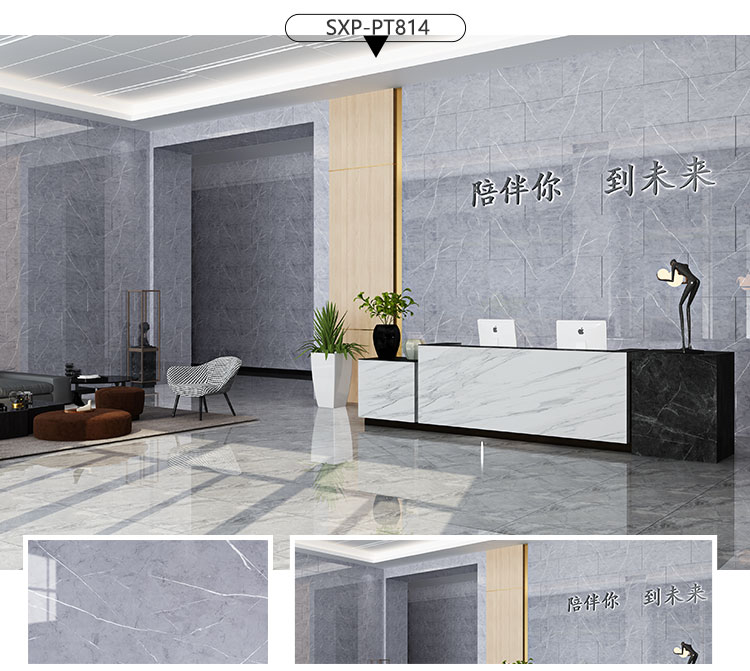
PET marble wall stickers (WB-PET) are published in 2 mm and 2.5 mm thicknesses, with sheet sizes up to 120×300 cm.
Option 3 — WPC wall panels (WB-WPC)
WB-WPC is a wood plastic composite wall panel for interior decoration and building materials applications. Its published specification is compact: 160×23×2900 mm, packed 16 pieces per box, with a weight of 690, 810 or 830 grams per metre.
Those three figures drive most of the planning. The weight range gives buyers a way to calculate freight and handling before the order is placed, but it also means the weight class must be fixed per line item — a quotation that mixes 690 g/m and 830 g/m is not a like-for-like comparison. The fixed 2900 mm length means layout and cutting should be planned against the actual wall run rather than assumed, and the fixing method should be confirmed per project rather than carried over from the self-adhesive formats in the same catalogue.
Customs classification is a separate planning item. The standard HS code for wood plastic composite wall panels exported from China is 3925.90.0000, as set out in U.S. Customs and Border Protection ruling N337378. EU importers should treat that as a reference point for broker confirmation rather than a substitute for it.
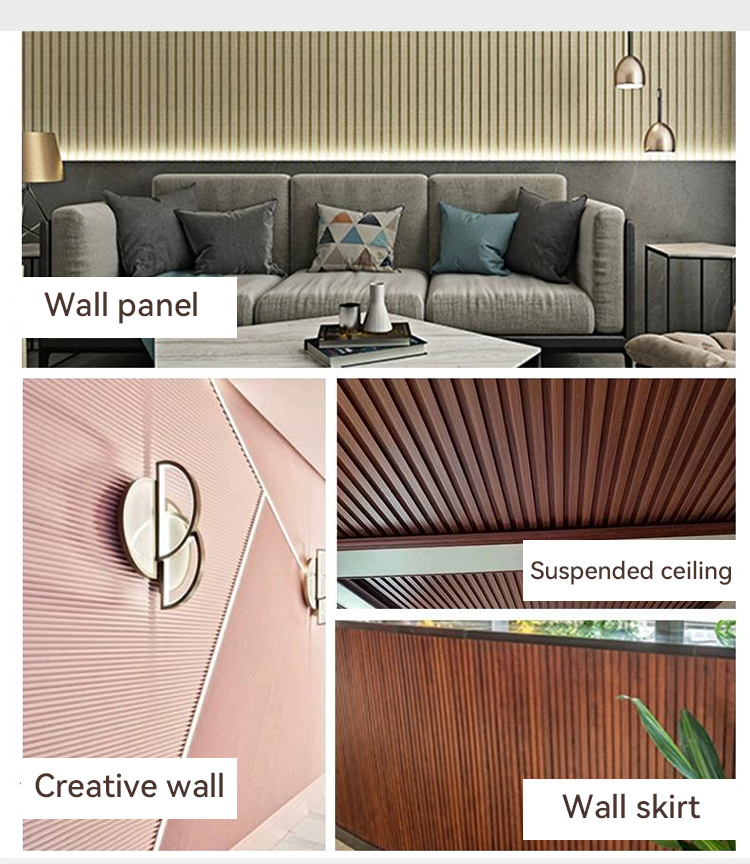
WPC wall panels (WB-WPC) are published at 160×23×2900 mm, 16 pieces per box, at 690, 810 or 830 grams per metre.
Where each option stops working: limits to plan around
None of the three entries is a universal answer, and the boundaries are more useful to a buyer than the feature list.
- Substrate: the self-adhesive formats require a base that is flat, dry and free of dust and grease. Powdery, sandy or loose surfaces are explicitly excluded, which rules out several older plaster and unfinished masonry walls without preparation.
- Environment: use is indoor, at normal room temperature, including typical humid environments such as bathrooms and dry areas of kitchens, but long-term exposure to strong sunlight should be avoided.
- Thickness and size: PVC appears at 1.5 mm, 2 mm and 2.5 mm; PET at 2 mm and 2.5 mm; WPC in a single 2900 mm format with three weight classes. A generic material name will not protect a buyer if the delivered batch differs.
- Fire classification: EN 13501-1 classification must be confirmed per item for commercial interiors; it should not be inferred from the material family alone.
- Documentation coverage: the RoHS evidence on record for this manufacturer — SGS RoHS Test Report SHAEC1709394501, verified by SGS-CSTC under RoHS Directive (EU) 2015/863 — relates to a 3D wall brick in PE material. It should not be presented as covering every PVC, PET or WPC item without separate confirmation.
- Storage: foam-type goods are sensitive to high temperature, heavy pressure and UV light; rigid stone-type panels are vulnerable to moisture and impact; soft-pack goods are vulnerable to dust, damp and mildew. Damage from improper storage is treated as a handling issue rather than an inherent product defect.
Purchase terms and acceptance criteria for EU orders
Acceptance criteria decide whether a container is accepted or disputed, so they should be written before production rather than after arrival.
- Name the material in the proforma invoice for export orders, rather than relying on a model code alone.
- Use a third-party laboratory report as the acceptance criterion. Visual checks and hand-press testing are useful for preliminary screening only and should not be used as the basis for a claim.
- Request physical samples and test adhesion and aging performance before bulk purchasing.
- Verify target-market compliance certificates for the specific item being ordered.
- State thickness, size and, for WPC, the weight class on every line item.
Application fit: which entry for which space
Mapping project type to product is where the shortlist earns its place in a tender package.
- Residential renovation, rental apartments and homestays: the self-adhesive PVC formats, where fast dry installation and clean removal matter more than rigidity. Large 120×300 cm sheets reduce the seam count on long walls.
- Hotel guest rooms and chain-store interiors: the PVC soft-stone format for surfaces that take daily contact, or PET marble where the design language is stone.
- Offices, retail and exhibition booths: PET marble for feature surfaces and WPC where a rigid, linear panel suits a continuous wall run; exhibition booths additionally benefit from dry installation and short renovation cycles.
- Bathrooms and dry kitchen zones: the published humid-environment conditions for this product family apply, provided the substrate is sound and sun exposure is limited.
- Old-house remodeling: the substrate rule dominates. If the existing wall is powdery or loose, the panel is not the first problem to solve.
Market context: what EU buyers are walking into
Wall panel demand is growing, but published market numbers need reading with care. The global wall panels market was valued at USD 32.4 billion in 2025 and is projected to reach USD 43.7 billion by 2033 (Dataintelo). A separate estimate puts the 2025 market at USD 10.2 billion, a gap that points to different definitions of what counts as a wall panel — interior decorative panels versus exterior cladding systems being the likely split. Buyers should treat such figures as directional rather than precise.
Material mix is clearer. Metal wall panels held the largest product share in 2025 at 28.5%, while Asia Pacific held the largest regional share at 42.3% — a reminder that much of the supply base for EU projects sits in the same region. Wood-based wall panels accounted for nearly 31% of global installations in 2024, and wood wall panel systems are projected to grow at a 6.2% CAGR to 2035, which supports the continued specification relevance of composite and wood-look formats such as WPC.
Future outlook
Three shifts are visible in EU interior panel sourcing. First, documentation is becoming part of the product: fire classification under EN 13501-1, RoHS evidence and a correct customs code now sit alongside thickness and finish in the specification. Second, the definitional gap in market reporting is likely to narrow as buyers standardise language, with interior wall panels and cladding specified separately, which will make supplier comparison more honest. Third, the practical advantage in renovation-driven markets will keep moving toward dry, adhesive-based installation, because it removes curing time from the programme.
For the shortlist itself, the balance is unlikely to change quickly: PVC remains the flexible, fastest-to-install family; PET marble holds the stone-look brief; WPC carries the rigid linear panel role. What will change is the volume of evidence a supplier is expected to provide with each of them.
Frequently asked questions
What does this EU wall panel shortlist actually include?
Three material families are shortlisted: PVC (WB-PVC, published at 2.5 mm for the wall panel and soft-stone variants, 2 mm for the wall sticker, and 1.5/2 mm for the parquet sticker), PET marble (WB-PET, 2 mm or 2.5 mm) and WPC (WB-WPC, 160×23×2900 mm, 16 pieces per box, 690/810/830 g per metre). Two adjacent formats are noted for relief or soft-texture briefs: the WB-KC 3D self-adhesive foam slat wall sticker at 2.8 mm and the WB-PG leather wall sticker at 6 mm.
How do PVC, PET marble and WPC differ in thickness and size?
PVC variants are published at 1.5 mm, 2 mm and 2.5 mm, with sizes from 30×30 cm up to 120×300 cm depending on the variant. PET marble stickers are published at 2 mm and 2.5 mm, in sizes from 30×30 cm to 60×300 cm and 120×300 cm. WPC panels are published in a single format of 160×23×2900 mm, packed 16 pieces per box and weighing 690, 810 or 830 grams per metre. Thickness and size therefore have to be stated per line item.
Which option fits a hotel, office or retail interior?
For hotel guest rooms and chain-store interiors, published positioning for this category favours the PVC soft-stone format, citing scratch resistance, premium texture and anti-aging performance. PET marble suits feature walls where a stone look is required, including hotel rooms, homestays, retail and reception areas, and its 120×300 cm sheet size limits seams. WPC is published for interior decoration and building materials applications and suits briefs that need a rigid linear panel. All three assume an indoor environment at normal room temperature with a flat, dry, dust-free substrate.
What should be verified before bulk purchasing for an EU project?
Four items: that the material is named in the proforma invoice rather than implied by a model code; that a third-party laboratory report is agreed as the acceptance criterion, since visual and hand-press inspection is preliminary screening only; that physical samples are tested for adhesion and aging performance; and that target-market compliance certificates are verified for the specific item. Reaction-to-fire classification under EN 13501-1 should be confirmed per item for commercial interiors. The RoHS evidence on record for this manufacturer (SGS RoHS Test Report SHAEC1709394501, verified by SGS-CSTC under RoHS Directive (EU) 2015/863) covers a 3D wall brick in PE material and should not be extended to other items without separate confirmation.
What substrate and storage conditions apply?
Installation requires a flat, dry base free of dust and grease; powdery, sandy or loose surfaces are excluded. Use is indoor at normal room temperature, including typical humid areas such as bathrooms and dry kitchen zones, with long-term exposure to strong sunlight avoided. Storage guidance is a cool, ventilated warehouse at no more than 40°C, goods on pallets rather than directly on the floor, away from sunlight, heat and water sources, with limited stacking height and FIFO rotation. Foam goods are sensitive to high temperature, heavy pressure and UV; rigid stone-type panels are vulnerable to moisture and impact; soft-pack goods to dust, damp and mildew. Damage from improper storage is not classified as an inherent product defect.
What HS code applies to WPC wall panels exported from China?
The standard HS code for wood plastic composite wall panels exported from China is 3925.90.0000, as set out in U.S. Customs and Border Protection ruling N337378. Importers should confirm classification with their own customs broker for the specific shipment, since classification rulings apply to the goods described in the ruling.
Product documentation, including the Shanghai Yuanguan product brochure (PDF), is available for download: Shanghai Yuanguan Product Brochure.
Tem questões ou precisa de mais detalhes?
Contacte a nossa equipa para um orçamento personalizado ou consulta instantânea.
Solicitar orçamento
Preencha o formulário abaixo e a nossa equipa entrará em contacto com uma proposta personalizada.
Chat direto do WhatsApp
Prefere conversar em tempo real? Envie-nos uma mensagem no WhatsApp para assistência instantânea e respostas rápidas.
- Obter orçamento personalizado
- Partilhar fotos ou documentos
- Discuta as suas necessidades diretamente
Geralmente responde em 5–30 minutos durante o horário de expediente.