
Wall Switch Applications by Scenario: Home to Industrial Fit
Scenario decides which wall switch configuration is correct far more reliably than product family does. A bedroom, a villa staircase, a hotel corridor and an office lighting zone can all be served by flush-mounted mechanical wall switches, yet each needs a different contact configuration, a different panel format and, in service areas, a different signalling function.
The configurations examined here come from the product records of Wenzhou Huafeng Electric Co., Ltd. (HYFF), a wall switch and wall socket manufacturer based in Longwan, Wenzhou, Zhejiang, founded in 2011 and exporting 100% of its output to Europe, the Americas, Oceania, Asia and Africa. Ratings, panel dimensions, base materials and certification references quoted below are taken from those product records and the accompanying certificate documents. Where a record is silent, this article says so rather than filling the gap.
Why Scenario Should Be Settled Before Product Family
Switch catalogues are usually organised by mechanism: one-way, two-way, intermediate, bell push. Projects rarely fail because a specifier did not know these categories. They fail on mismatch — a 1 gang 1 way device specified where a second control point was needed, an 81.6×81.6 mm plate dropped into a scheme built around 86×86 mm modules, or a service-call circuit installed without an indicator a guest can actually read from the doorway.
Four questions resolve most of the mapping, and they are worth answering in this order:
- How many control points does the lighting circuit need? One, two, or more than two with a mid-run device.
- What plate format and material does the visible surface require? Compact 65×65 mm, mid-size 81.6×81.6 mm, or the 86×86 mm series, in PC, tempered glass or aluminium.
- Does the room carry a signal function? A bell push with an LED indicator is a different device from a lighting switch, even when the plate looks identical.
- What load and environment must the device tolerate? A 10AX rating, a 16A rating and an IP54 enclosure are answers to different problems.
Answering these four before choosing a model number removes most late-stage substitution on residential, hotel and office fit-outs, and it is the reason scenario-led specification tends to produce fewer change orders than product-led specification.
| Scenario | Dominant need | Configuration that fits | Models in the HYFF record |
|---|---|---|---|
| Residential | Single-point lighting, room-by-room counting | 1 gang 1 way; 2 gang 1 way for split lighting | H111, B111, M111, S111, E121, U121 |
| Apartment / villa | Multi-point control across floors, stairs and corridors | 2 gang 2 way plus intermediate switch | A122, V122N, KM141S |
| Hotel | Guest-facing finish plus service-call indication | LED bell push; 2 gang 2 way for room lighting | HG110NB, HA159, V122N |
| Office | Zoned lighting, corridor switching, auxiliary power | 2 gang 1 way; 2 gang 2 way; intermediate; 10A power point | E121, U121, A122, KM141S, HT213 |
| Industrial / utility | Surface mounting, wash-down areas, load discipline | Surface-mounted switch and socket; 10AX / 16A devices | B111, S111, WP149 IP54, HT213 |
The Reference Range in Brief
The HYFF switch range referenced here is a mechanical, predominantly flush-mounted family. Panels are polycarbonate (flame-retardant PC on most models), bases vary between ABS plastic, PC and high-strength PA depending on the series, and ratings sit at 10A, 10AX or 16A at 220–250V~. Panel sizes in the record include 65×65 mm, 81.6×81.6 mm, 86×86 mm, 86×90 mm, 68×68 mm and 74×83 mm, with a 22×49 mm intermediate switch module and an 80×120 mm power point completing the set.
| Model | Configuration | Panel size | Rating | Mounting | Panel / base | Certification in record |
|---|---|---|---|---|---|---|
| B111 | 1 gang 1 way switch | 65×65 mm | 10AX 250V~ | Surface mounted | PC panel / ABS plastic base | CE |
| H111 | 1 gang 1 way switch | 86×86 mm | 10A 220–250V~ | Flush mounted | Flame-retardant PC / high-strength PA base | CE, TÜV |
| M111 | 1 gang 1 way switch | 74×83 mm | 10AX 250V~ | Flush mounted | Flame-retardant PC / PA66 base | CE / RoHS |
| S111 | 1 gang 1 way switch | 68×68 mm | 10A 220–250V~ | Surface mounted | Flame-retardant PC | CE |
| E121 | 2 gang 1 way switch | 86×86 mm | 10A 220–250V~ | Flush mounted | Flame-retardant PC | — |
| U121 | 2 gang 1 way switch | 86×90 mm | 10AX 250V~ | Flush mounted | Flame-retardant PC / PC base | CE |
| A122 | 2 gang 2 way switch | 81.6×81.6 mm | 10A 250V~ | Flush mounted | Flame-retardant PC / PC base | CE, TÜV |
| V122N | 2 gang 2 way switch with LED indicator | 86×86 mm | 10A 220–250V~ | Flush mounted | Flame-retardant PC / high-strength PA base | CE, TÜV |
| KM141S | Intermediate switch (small size modular) | 22×49 mm | 10A 220–250V | Flush mounted | Flame-retardant PC shell | CE, RoHS |
| HG110NB | 1 gang push bell switch with LED indicator | 86×86 mm | 10A 220–250V~ | Flush mounted | Tempered glass panel / high-strength PA base | CE, TÜV |
| HA159 | 1 gang push switch with bell sign and LED indicator | 86×86 mm | 16A 220–250V~ | Flush mounted | Aluminium panel / high-strength PA base | CE, TÜV |
| HT213 | 10A single power point | 80×120 mm | 10A 250V~ | Flush mounted | Flame-retardant PC panel / PC base | SAA |
| WP149 IP54 | 1 gang Schuko socket | 75×75 mm | 16A 220–250V~ | Surface mounted | Flame-retardant PC, grey | — |
Residential Fit: One-Way Control and Room Counting
In a dwelling, the majority of switch positions are single-point lighting control, and the specification task is arithmetic rather than engineering: count rooms, count lighting groups, decide how many plates sit on each wall. A 1 gang 1 way switch covers a bedroom, a bathroom or a single-lamp store room; a 2 gang 1 way switch covers a living area where ceiling and wall lighting are switched separately from one position.
For that basic layer, H111 (1 gang 1 way, 86×86 mm, 10A 220–250V~, flame-retardant PC panel, high-strength PA base, CE and TÜV) is the straightforward choice, and E121 (2 gang 1 way, 86×86 mm, 10A 220–250V~) extends the same plate format to two-gang positions so the elevation stays visually consistent. Where the design language calls for a compact plate, B111 provides a 65×65 mm 1 gang 1 way switch with a PC panel and ABS plastic base rated 10AX 250V~ — note that the B111 record specifies surface mounting, which makes it a fit for retrofit and surface wiring rather than for a fully recessed new-build wall.
S111 (68×68 mm, 10A 220–250V~, surface mounted, CE) and M111 (74×83 mm, 10AX 250V~, flush mounted, PA66 base, CE/RoHS) serve the same single-point role in different plate dimensions, which is useful when a project is matching an existing plate series or a landlord-standard format rather than starting from a clean sheet.
Apartment and Villa Fit: Multi-Point Control Across Floors and Corridors
Multi-storey dwellings introduce the control problem that single-point devices cannot solve: the same luminaire must be operated from two or more positions — bottom and top of a staircase, both ends of a corridor, opposite doors of a large living space. Two device types carry that requirement in this range.
A122 is the 2 gang 2 way switch at 81.6×81.6 mm, rated 10A 250V~, flush mounted, with a flame-retardant PC panel and PC base, carrying CE and TÜV in its product record. V122N adds an LED indicator to the same 2 gang 2 way function at 86×86 mm, rated 10A 220–250V~, with a high-strength PA base and CE/TÜV. The indicator is a practical detail in villas: it lets a resident find the switch on a dark landing without changing the mechanism.
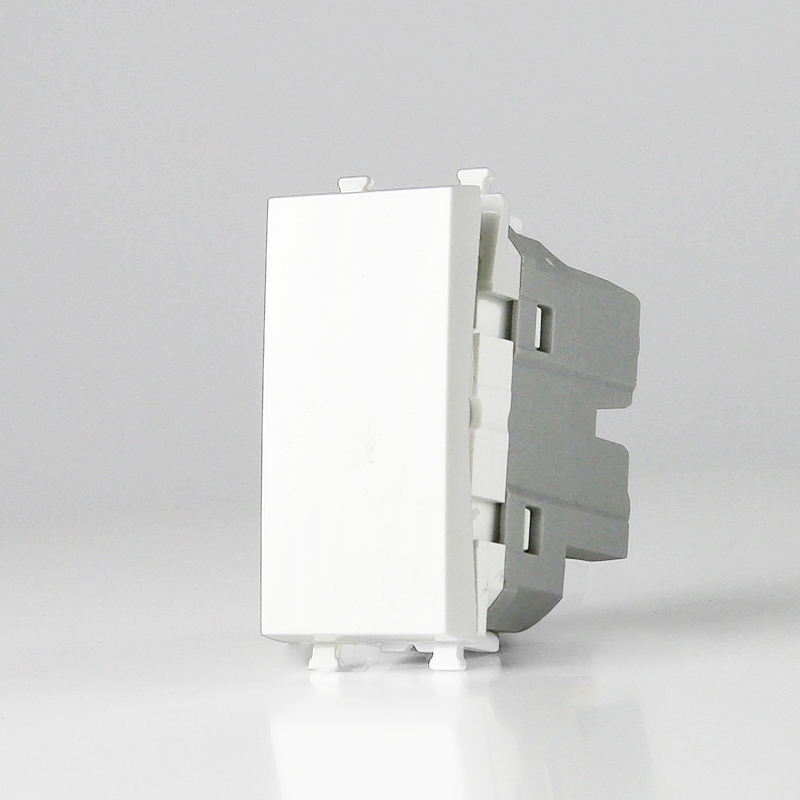
For three or more control points, KM141S is the small modular intermediate switch at 22×49 mm, rated 10A 220–250V, flush mounted, with a flame-retardant PC shell and CE/RoHS. It is a module rather than a complete plate, so it is installed inside a compatible modular plate and support frame together with the two-way devices at each end of the circuit. That distinction matters at procurement stage: an intermediate switch order is a module order, not a plate order.
Hotel Fit: Service-Call Indication and Guest-Facing Finishes
Hotel rooms split the switch brief in two. Guest areas need a finish that survives close visual inspection; service and back-of-house areas need a call function that is unmistakable under pressure. The range addresses the second requirement with two bell-push devices.
HG110NB is a 1 gang push bell switch with LED indicator at 86×86 mm, rated 10A 220–250V~, with a tempered glass panel and high-strength PA base, carrying CE and TÜV. HA159 provides the same push-with-bell-sign function in an aluminium panel at 86×86 mm, with a 16A 220–250V~ rating recorded and CE/TÜV certification. Both carry a bell sign and an LED indicator, which is the combination that makes a corridor or room-entry call point readable rather than guessed at.
For in-room lighting, V122N's 2 gang 2 way function with LED indication at 86×86 mm suits entrance and bedside control pairs within the same plate family, keeping the room's visible hardware consistent. Where a hotel project specifies by finish first, the tempered glass and aluminium panel options are the differentiators in this range; where it specifies by mechanism first, the 2 gang 2 way and bell-push functions are what determine the bill of quantities.
Office Fit: Zoned Lighting, Corridor Switching and Auxiliary Power
Office floors are zoned rather than roomed, and the switching pattern reflects that. A typical floor plate needs two-gang control at zone boundaries (perimeter versus core lighting), two-way control at corridor ends, an intermediate device on long runs, and power points for cleaning, printing or maintenance equipment independent of the desk ring main.
E121 and U121 cover the two-gang zone positions at 86×86 mm and 86×90 mm respectively; A122 covers two-way corridor and stairwell pairs at 81.6×81.6 mm; KM141S extends those runs beyond two control points. HT213, the 10A single power point at 80×120 mm, rated 10A 250V~, flush mounted with a flame-retardant PC panel and PC base, is the auxiliary power element — and it is the one device in this set carrying SAA certification in its record, which makes it relevant to Australian and New Zealand fit-outs where socket control requirements differ from European practice.
Industrial and Utility Fit: Surface Mounting, Ingress and Load Discipline
Industrial and utility areas change the requirement from appearance to robustness. Where cabling runs on the surface, a surface-mounted device avoids unnecessary chasing: S111 (68×68 mm, 10A 220–250V~) and B111 (65×65 mm, 10AX 250V~, ABS base) are the surface-mounted options in this record. WP149 IP54 is a 1 gang Schuko socket at 75×75 mm, 16A 220–250V~, surface mounted in flame-retardant PC with a grey finish.
IP54 is a meaningful but bounded claim. It addresses dust ingress and water splashing, which covers plant rooms, workshops and sheltered service areas. It is not the IP65 level referenced for low-pressure water jets in exposed outdoor and landscape installations, so a fully exposed garden or façade position sits outside this device's stated protection.
What Certification Covers, and Where It Stops
Certification is where scenario claims become auditable. Three documents matter for this range, and they do not all say the same thing.
The TÜV Rheinland certificate R 50714462 0001 covers flush-type fixed switches under EN 60669-1:2018, issued 10 March 2026 and valid to 10 March 2028 for the EU market. Its model list includes H111 and V122N among the V, H, VC and HG series variants. EN 60669-1:2018 is the mandatory safety standard for manual switches in household fixed installations in the EU, so this certificate is the document that anchors the flush-mounted switch family to a recognised standard.
ISO 9001 certificate 0350225Q30335R0S, issued 15 August 2025 and valid to 14 August 2028 by Xingyuan Certification Center Co., Ltd., covers the design, production and export of switches (wall switches, dimmer switches, buzzer switches), sockets and electromagnetic buzzers, plus production and export of plugs and lamp holders. That is a management-system scope, not a product approval, and it should not be presented as proof of a specific model's electrical performance.
CE appears as a certification entry in the individual product records for the switch models listed. Separately, the CE certificate of conformity in the file set — DACE260331002RL under IEC 60884-1:2022 — covers socket models, not switches. That distinction is worth keeping straight during a technical submittal: a socket certificate does not evidence a switch.

Behind the documents sits a quality-control sequence the company describes as running from raw material to finished goods: material incoming inspection, plastic parts inspection, process inspection, glowing filament testing, silver layer thickness inspection, performance life testing, plastic ball pressure testing, switch and socket on-off testing on the assembly line, and doorbell testing. For a buyer, that sequence is the operational counterpart to the certificates — the certificates state the standard, the test sequence states how consistently it is met.
Panel Format, Base Material and Installation Practicalities
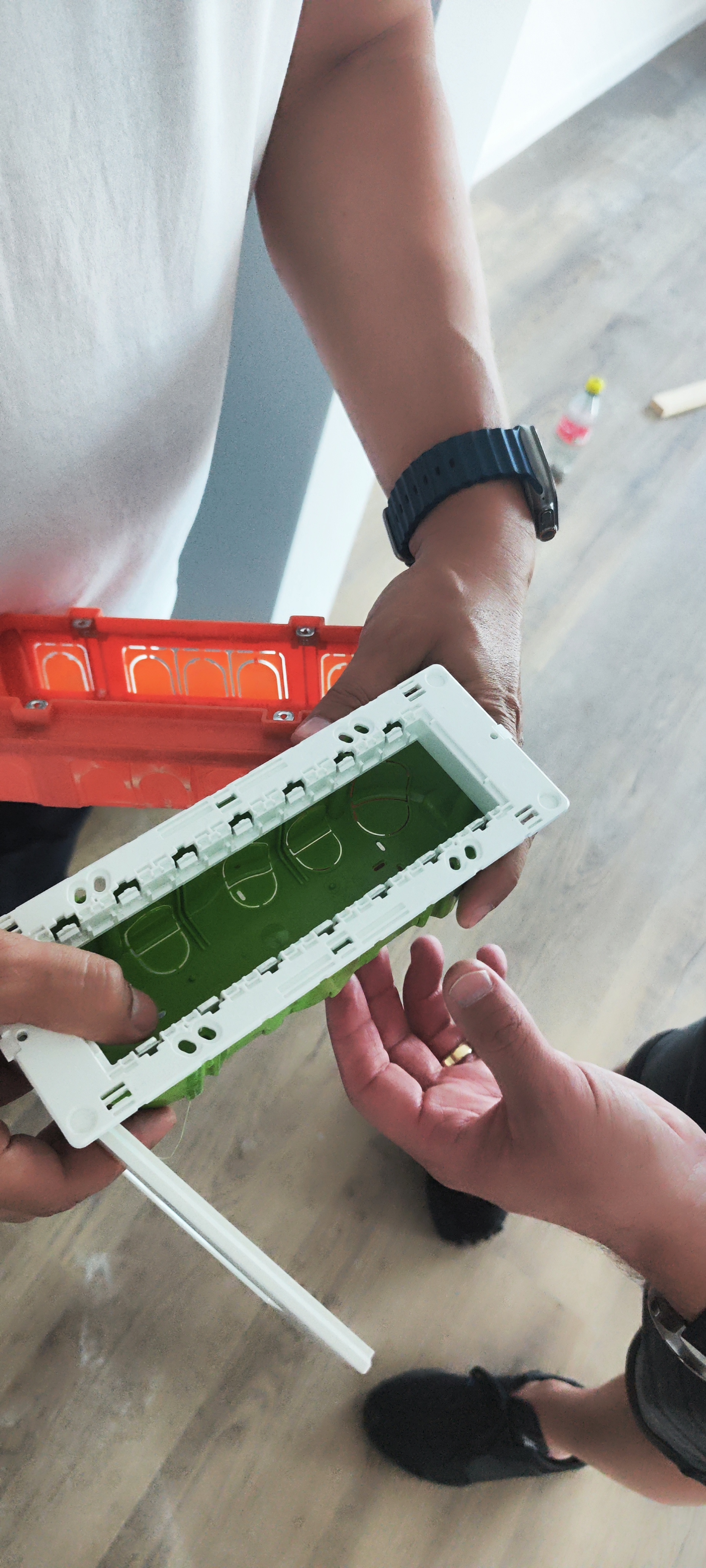
Panel format is the most common source of on-site friction in mixed-scenario projects, because it is decided visually but discovered physically. The range spans 65×65 mm, 81.6×81.6 mm, 86×86 mm, 86×90 mm, 68×68 mm and 74×83 mm plates, plus a 22×49 mm module and an 80×120 mm power point. Those formats are not interchangeable on one elevation; a 65×65 mm plate beside an 86×86 mm plate reads as two different installations, and the smaller the plate, the less room there is for tolerance in the wall box cut-out.
Base material follows the same logic. B111 uses an ABS plastic base with a PC panel in the compact 65×65 mm format. A122 and U121 use PC bases at 81.6×81.6 mm and 86×90 mm. H111, V122N, HG110NB and HA159 use high-strength PA bases in the 86×86 mm series, while M111 uses PA66. For a specifier the practical takeaway is that base material is a per-model attribute, not a range-wide promise — it should be read from the model record rather than assumed from the series.
Wall box compatibility is the second practical check. In the case record for a European brand owner and distributor, switches were supplied in bulk orders above 1,000 units per model after sample installation and functional testing confirmed compatibility with the customer's local wall boxes and mounting system. That sequence — sample, install, verify, then commit volume — is the reliable way to de-risk a plate and frame format that was designed against a different market's box dimensions.
Boundaries and Trade-offs Worth Knowing Before Specification
A scenario map is only useful if it also states what the range does not do.
- It is a mechanical range. No touch, Wi-Fi, voice-control or dimmer switch model is recorded in the supplied product data; dimmer switches appear only inside the ISO 9001 scope wording. Projects specifying app or voice control need a different product line.
- Installation type is per model. B111 and S111 are recorded as surface mounted, KM141S is a 22×49 mm module rather than a complete plate, and the remaining switches are flush mounted. Assuming a uniform mounting type across the range will produce errors in the bill of quantities.
- Ratings are not uniform. The record distinguishes 10AX 250V~ (B111, M111, U121) from 10A 250V~ and 10A 220–250V~ (A122, H111, E121, V122N), and HA159 and WP149 IP54 are recorded at 16A. In EN 60669-1 practice the AX suffix is associated with fluorescent-lamp load capability, so the designations should not be treated as interchangeable without checking the actual load type.
- Order economics are volume-oriented. Minimum order quantity is 1,000 units, lead time 30–45 days, delivery terms EXW/FOB/CIF, and payment terms 100% TT in advance. Small trial batches are not the operating model; sample approval before volume is.
- Ingress protection is specific. WP149 IP54 is suited to sheltered utility areas, not to fully exposed outdoor positions where IP65 is the referenced level.
Market Signals Behind Scenario Demand
Demand for mechanically switched lighting has not disappeared as smart control has grown; the two are moving at different speeds and into different parts of the same buildings. Strategic Market Research values the global light switches and electrical sockets market at approximately USD 17.6 billion in 2024, while Dataintelo places Asia Pacific's share of electrical switch revenue at 42.5% in 2025 — consistent with the region's role as both a manufacturing base and a large-volume fit-out market.
The smart segment is the faster-moving one: Grand View Research reports the global smart switch market at USD 4.8 billion in 2023 with a projected path above USD 14 billion by 2030 at a 17.2% CAGR. Read together, those figures describe a market where smart control is expanding the upper layer of specification while mechanical devices continue to carry the bulk of lighting points in residential, office and hotel fit-outs — which is precisely why scenario mapping remains a procurement discipline rather than a legacy exercise.
Procurement Checklist for Mixed-Scenario Projects
- Lock the control-point schedule first: one-way, two-way and intermediate positions counted per room before any model number is chosen.
- Fix one plate format per elevation. Do not mix 65×65 mm, 81.6×81.6 mm and 86×86 mm plates in the same visible run.
- Read base material per model (ABS, PC or high-strength PA) rather than assuming a series-wide specification.
- Confirm mounting type per model, especially where surface wiring is present.
- Match rating to load: 10AX, 10A or 16A as recorded, with fluorescent loads checked against the AX designation.
- Verify market certification against the destination: EN 60669-1:2018 for the EU, AS/NZS 3133:2020 as the Australian and New Zealand switch standard, SAA for HT213.
- Plan for a 1,000-unit minimum per model and a 30–45 day lead time, and allow for pre-shipment inspection against approved samples and confirmed specifications.
- Order bell-push and indicator devices as a separate line item for hotel and service zones; they are functionally distinct from lighting switches even when plates match.
Future Outlook
Two pressures are likely to shape scenario-based switch specification over the next planning cycles. The first is finish diversification: tempered glass and aluminium panels already appear in this range alongside PC, and mixed-material elevations are increasingly specified within a single project rather than across separate ones. The second is the widening gap between the smart layer and the mechanical base layer, which pushes mechanical devices toward clearer documentation of rating, base material and mounting type — the attributes that decide whether a device installs cleanly and stays installed.
For buyers, the practical consequence is that a scenario map is worth keeping current. The configuration logic changes slowly; the evidence behind it — certificate numbers, validity dates, panel formats, model lists — has to be re-checked against current documents each time a project goes to submittal.
Frequently Asked Questions
Which models in the range are 2 gang 2 way switches, and what are their panel sizes?
Two models are recorded as 2 gang 2 way switches. A122 is an 81.6×81.6 mm flush-mounted 2 gang 2 way switch rated 10A 250V~ with a flame-retardant PC panel and PC base, carrying CE and TÜV in its product record. V122N is an 86×86 mm flush-mounted 2 gang 2 way switch with LED indicator, rated 10A 220–250V~, with a flame-retardant PC panel and high-strength PA base, carrying CE and TÜV, and it appears in the TÜV Rheinland certificate model list for flush-type fixed switches.
What is the KM141S intermediate switch used for, and what format is it?
KM141S is a small modular intermediate switch measuring 22×49 mm, rated 10A 220–250V, flush mounted, with a flame-retardant PC shell and CE/RoHS certification. It is used to add a control point between the two 2-way switches at each end of a lighting circuit, allowing three or more switching positions on the same luminaire. Because it is a module rather than a complete plate, it must be installed in a compatible modular plate and support frame.
Which switch is suitable for a hotel service call or bell indication?
Two devices are recorded as push bell switches with both a bell sign and an LED indicator. HG110NB is an 86×86 mm device rated 10A 220–250V~ with a tempered glass panel and high-strength PA base, carrying CE and TÜV. HA159 is an 86×86 mm device with an aluminium panel and high-strength PA base, recorded at 16A 220–250V~ and certified CE and TÜV. Both are flush mounted and belong to the same 86×86 mm family as the V122N room-lighting switch.
Which certifications and standards apply to the flush-mounted switch range?
TÜV Rheinland certificate R 50714462 0001 covers flush-type fixed switches to EN 60669-1:2018 for the EU market, issued 10 March 2026 and valid to 10 March 2028, with a model list that includes H111 and V122N. ISO 9001 certificate 0350225Q30335R0S, valid 15 August 2025 to 14 August 2028, covers the design, production and export of switches and sockets as a management-system scope. CE is declared in the individual product records for the listed switch models. For sockets, a separate CE certificate of conformity (DACE260331002RL, IEC 60884-1:2022) applies. HT213 additionally carries SAA. EN 60669-1:2018 is the EU safety standard for wall switches, while AS/NZS 3133:2020 is the primary technical standard for switches in Australia and New Zealand.
What are the ordering terms for an OEM wall switch programme?
The recorded terms are a minimum order quantity of 1,000 units, lead time of 30–45 days, delivery terms EXW/FOB/CIF, and payment terms of 100% TT in advance. Acceptance is based on pre-shipment inspection against approved samples and confirmed specifications. Production is described as ODM with logo customisation, monthly capacity is 2,900,000 units, annual output is 35,000,000 units, and the after-sales position in the capability record is an 8-year warranty.
Does the range include touch, Wi-Fi, voice-control or dimmer switches?
No such models are recorded in the supplied product data. The recorded range consists of mechanical flush-mounted and surface-mounted switches, bell-push devices and sockets; dimmer switches appear only within the ISO 9001 scope wording, not as a specific product record. Projects requiring touch, Wi-Fi, voice-control or dimming functions would need to be sourced from a separate product line, and hybrid projects should treat those requirements as a distinct package rather than assuming they are covered by this switch family.
How is quality controlled before shipment?
The stated quality-control sequence runs from raw material to finished goods and covers material incoming inspection, plastic parts inspection, process inspection, glowing filament testing, silver layer thickness inspection, performance life testing, plastic ball pressure testing, switch and socket on-off testing on the assembly line, and doorbell testing, with 100% testing stated for production. This sits alongside ISO 9001 certification valid to 14 August 2028. In the European distributor case record, switches passed sample installation and functional testing, were compatible with the customer's local wall boxes and mounting system, and met requirements for residential lighting control, brand customisation and bulk supply.
For the full product and certification record, the HYFF 2026 catalogue is published as a downloadable PDF reference.
Tem questões ou precisa de mais detalhes?
Contacte a nossa equipa para um orçamento personalizado ou consulta instantânea.
Solicitar orçamento
Preencha o formulário abaixo e a nossa equipa entrará em contacto com uma proposta personalizada.
Chat direto do WhatsApp
Prefere conversar em tempo real? Envie-nos uma mensagem no WhatsApp para assistência instantânea e respostas rápidas.
- Obter orçamento personalizado
- Partilhar fotos ou documentos
- Discuta as suas necessidades diretamente
Geralmente responde em 5–30 minutos durante o horário de expediente.