
Warning Post Supplier Evidence: PU Specs and Rebound Checks
Flexible warning posts are bought by the thousand, anchored permanently and then left to be struck. That is why the evidence behind a warning post matters more than the wording on its datasheet. For buyers in the research and evaluation stages of a road safety procurement, the useful proof set is short and concrete: measured dimensions, a named polymer with stated mechanical properties, a documented rebound routine, a reflective grade and a defined operating temperature range. This reference sets out how that evidence appears on two Mnsd PU warning post models, YD-WP45 and YD-WPS75, and how buyers can convert a supplier datasheet into verification checkpoints.
The category has real scale behind it. The global road marker posts market was valued at USD 3.4 billion in 2024 and is projected to reach USD 5.4 billion by 2032, according to Road Marker Posts Market Size Analysis. Dataintelo projects the wider traffic safety products market to expand at a CAGR of 6.6% from 2026 to 2034, driven by urban population growth and infrastructure investment. Published estimates differ by scope: studies covering adjacent definitions of the same market publish figures around USD 6.4 billion and USD 12.5 billion for 2024. That divergence is itself an argument for buyers to evaluate product-level evidence rather than category headlines.
Mnsd is the brand of Tiantai Yuanda Traffic Device Co., Ltd, a road safety equipment manufacturer based in Tiantai, Zhejiang, China, producing convex mirrors, warning posts, rising bollards, speed humps and traffic lights. The company supplies importers, distributors, contractors and infrastructure project suppliers, offers OEM and ODM customization, and states a warning post capacity of 50,000 pcs per month with a 10-15 day lead time for bulk orders and a 200 pcs minimum order quantity.
The practical question this article answers is narrower than a company profile: when a buyer asks a warning post supplier to prove capability, what belongs on the evidence list, and how should each item be checked?
Why Warning Post Claims Are Hard to Verify
The vocabulary in this product category is remarkably uniform. Suppliers describe flexible safety plastic warning posts as high elasticity, impact resistant, unbreakable, highly visible and UV protected. Those phrases are not testable as written. A traffic road safety warning post that loses elasticity does not fail dramatically; it simply stops rebounding, becomes a semi-rigid obstacle and then cracks at the base after repeated contact.
Field failure modes across flexible delineation products tend to repeat: a permanent bend after a low-speed crush, colour fade that erodes contrast against the carriageway, delamination or abrasion of the reflective sleeve, stress cracking around the base plate, and loosened anchors. Each of these maps back to a parameter that a supplier either publishes or does not. Converting marketing vocabulary into named parameters is therefore the first step of supplier qualification, not a later-stage detail.
For the Mnsd PU warning posts, that conversion produces a defined set of values: tensile strength, elongation at break, hardness, rebound cycle testing, reflective grade and tape width, temperature resistance, and a stated period for anti-oxidant and colourfast performance. Everything that follows is drawn from that published data.
Physical Specifications You Can Measure
Dimension data is the first filter because it removes mismatched models from the discussion before technical questions are asked. The three Mnsd models relevant to a flexible warning post evaluation differ in height, construction and base form.
| Evidence item | YD-WP45 | YD-WPS75 | YD-PE50 |
|---|---|---|---|
| Overall dimensions | 450 x 80 x 200 mm | 750 x 80 x 200 mm | 500 x 260 mm |
| Post height | 450 mm | 750 mm | 500 mm |
| Body material | High-elasticity polyurethane (PU) | High-elasticity polyurethane (PU) | Heavy-duty PE |
| Base | 200 x 80 mm base | 200 x 80 mm base | PE with Φ260 mm rubber base |
| Reflective grade | High-Intensity Prismatic (HIP) / Class 1 | HIP / Class 1 | HIP / Class 1 |
| Reflective tape width | 250 mm, double or triple sleeves | 250 mm, double or triple sleeves | 250 mm, double or triple sleeves |
| Visibility distance | 200+ metres | 200+ metres | 200+ metres |
| Installation | Expansion bolt fixing, 3 or 4 holes | Expansion bolt fixing, 3 or 4 holes | Expansion bolt fixing, 3 or 4 holes |
| Top design | Ring top for chain attachment | Ring top for chain attachment | Ring top for chain attachment |
| Colour options | Traffic orange / yellow / red / black | Traffic orange / yellow / red / black | Traffic orange / yellow / red / black |
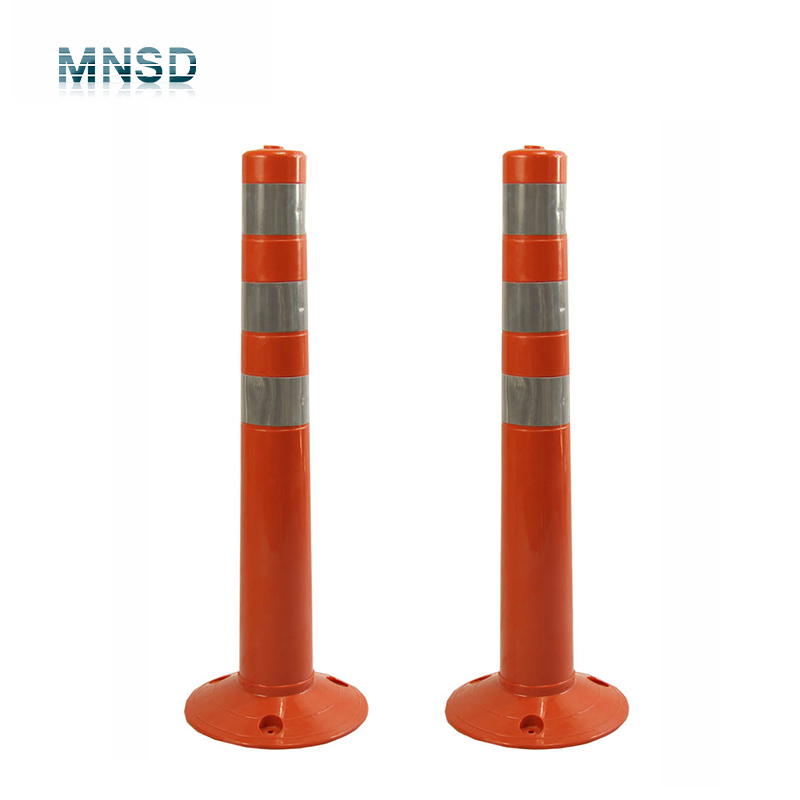
Two details are worth noting for procurement planning. First, YD-WP45 and YD-WPS75 share the same 200 x 80 mm base, so a project can mix 450 mm and 750 mm heights without changing the anchor pattern or keeping two sets of fixing hardware. Second, the YD-PE50 is a different construction: a 500 mm heavy-duty PE post on a Φ260 mm rubber base, which suits positions where a wider perimeter footprint under the post is preferred, or where buyers search specifically for a warning spring post with rubber base or a rubber base traffic delineator post.
Buyers should request a dimensioned drawing that shows base plate hole positions, not only a text list of sizes. The anchor layout is the part of the drawing that site teams actually work from, and it is also the part that is hardest to correct after delivery.
PU Material Evidence: What 15.0 MPa and 400% Elongation Tell You
Both PU models are documented with the same mechanical and environmental profile:
- Tensile strength: 15.0 MPa
- Elongation at break: 400%
- Hardness: 80-85 Shore A
- Temperature resistance: -40°C to +70°C
- UV protection: UV-stabilized coating
- Aging resistance: anti-oxidant and colourfast over 3 years
- Weatherproof: water and oil resistant
Read together, these values describe a specific material behaviour rather than a general claim. Tensile strength indicates how much force the body withstands before it ruptures. Elongation at break describes how far the material stretches before failing; at 400%, the body can be stretched to roughly four times its original length before it breaks, which is the mechanism that allows a high visibility flexible traffic safety PU warning post to fold under a wheel and survive. Hardness in the 80-85 Shore A band describes the surface: soft enough to deflect on contact, firm enough to remain upright in service.
The environmental values matter as much as the mechanical ones. A stated operating range of -40°C to +70°C covers hot Gulf road surfaces and cold-climate winter exposure within one specification. Anti-oxidant and colourfast performance over three years addresses the slow loss of contrast that turns a bright post into a dull one. Water and oil resistance is relevant in service yards, fuel stations, loading docks and logistics centres, where flexible posts frequently sit in the path of vehicle fluids.
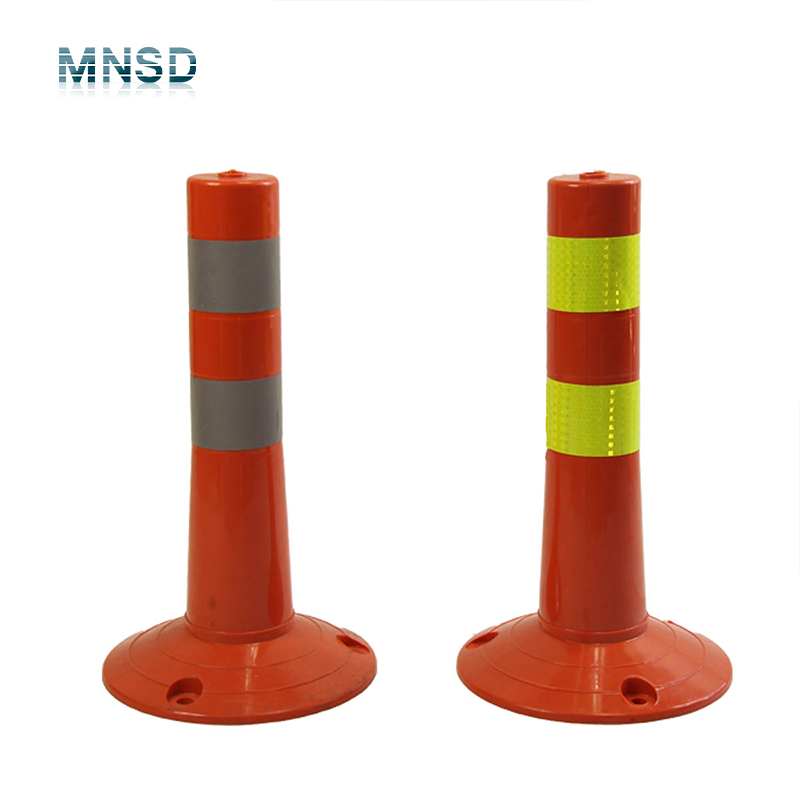
The buyer action here is straightforward: ask for the polymer identification and the basis of the mechanical values, not a generic description of the material. A supplier able to state 15.0 MPa, 400% and 80-85 Shore A is describing a defined grade; a supplier able to state only high-elasticity polyurethane is describing an intention.
Impact Recovery: How Self-Recovery Is Documented
Impact recovery is the performance that separates a flexible post from a plastic obstacle. Both models are listed as 360° flexible and impact resistant, with self-recovery defined as rapid rebound after vehicle crush. Mnsd states a quality control routine of 1,000+ compression and rebound cycles, which is the internal test record behind that claim.
A cycle count alone is not enough to compare suppliers, so buyers should ask for the test conditions alongside the number:
- The deformation applied during each cycle, and the cycle count stated as a pass threshold rather than a maximum.
- The temperature at which the rebound routine is run, since elastomer behaviour changes across the stated -40°C to +70°C range.
- How recovery is measured: return to vertical, time to rebound, or residual deformation after a set number of cycles.
- Whether the test is performed on the post body alone or on the assembled unit with base and sleeve fitted.
- Whether the base plate, anchor points and reflective sleeve are inspected after the routine.
Boundary to note in the RFQ: a self-recovery claim covers the elastomeric body. The reflective sleeve and the anchor set are separate components with separate failure modes, and the 1,000+ cycle routine is a factory quality control process rather than an accredited third-party certification. Projects that require third-party test reports or an independent laboratory statement should specify that requirement explicitly, so that it is priced and scheduled from the start.
Reflective Performance and Visibility Distance
Both PU warning posts carry High-Intensity Prismatic (HIP) / Class 1 reflective material at 250 mm tape width, applied as double or triple sleeves, in silver white or fluorescent yellow, with a stated visibility distance of 200+ metres. Customization data also identifies reflective tape brand as a configurable item, with 3M or Grade A tape listed as options alongside height and colour.
Visibility figures travel badly between markets, because the frameworks behind them differ. The European standard EN 12899-3 specifies requirements for delineator posts and retroreflectors used in traffic circulation areas. In the United States, MUTCD addresses delineator visibility under high-beam illumination, requiring retroreflective delineators to be visible from 1,000 feet when illuminated by high-beam headlights. Those are different measurement conditions applied to different product classes, so a single visibility number should not be treated as a universal equivalence. The practical approach is to map the supplier figure against the standard that governs the specific project, and to record the basis of the figure.
Buyers have three levers they can specify directly: the reflective grade (HIP / Class 1 on these models), the sleeve configuration (250 mm tape applied in double or triple sleeves), and the reflective colour. Sleeve cleanliness and abrasion resistance should be treated as lifecycle items, because a reflective sleeve that is scuffed or soiled stops performing long before the PU body does.
Matching the Post to the Site: UAE Road Projects as a Reference Scenario
The application context determines which height and base form a project should specify. One documented Mnsd scenario covers road safety, traffic management and municipal infrastructure work in the United Arab Emirates, where the posts are used for lane separation on high-speed expressways, highway ramps and T-junctions, for urban sidewalk protection, and at multi-level parking lot entrances. This application scenario is common in the United Arab Emirates, and it is typically applied in the United Arab Emirates across both permanent municipal installations and project-based traffic management.
The scenario definition lists the following requirements:
- Project type: traffic channelization, median delineation and pedestrian-vehicle segregation.
- Function: clear visual guidance, defined lane boundaries, prevention of unauthorised vehicle entry, and mitigation of impact damage during accidental collisions.
- Operation mode: surface-mounted or bolt-down fixed installation for permanent deployment.
- Matched equipment: high-visibility reflective sleeves in a honeycomb pattern, M10/M12 heavy-duty expansion anchors, and optional epoxy adhesive for base reinforcement.
- Special requirement: 360° full-recovery impact resistance with memory springback, UV-stabilized colour fastness across multiple years, high-intensity reflectivity, and an operating temperature range of -40°C to +70°C.
Mapping that requirement set onto the product range is a matter of height and footprint rather than material choice, since both PU models share the same mechanical and optical specification. YD-WPS75, at 750 mm, places the 250 mm reflective sleeve higher in the driver field of view, which is the usual starting point for expressway ramps and median delineation. YD-WP45, at 450 mm, keeps a lower profile for parking structures, sidewalk edges and internal traffic routes. Where the site calls for a wider perimeter footprint under the post, YD-PE50 pairs a 500 mm heavy-duty PE body with a Φ260 mm rubber base.
A separate reference case comes from a contractor deployment in Vietnam, where flexible warning posts were installed to warn vehicles and pedestrians and to mark road edges and dangerous areas. The project was completed and accepted by the local authority, with the installed posts carrying a stated service duration of 5-8 years, on the basis of high visibility, impact resistance, durability and straightforward installation.
Complementary Sight-Line Evidence: The YD-OC80 Convex Mirror
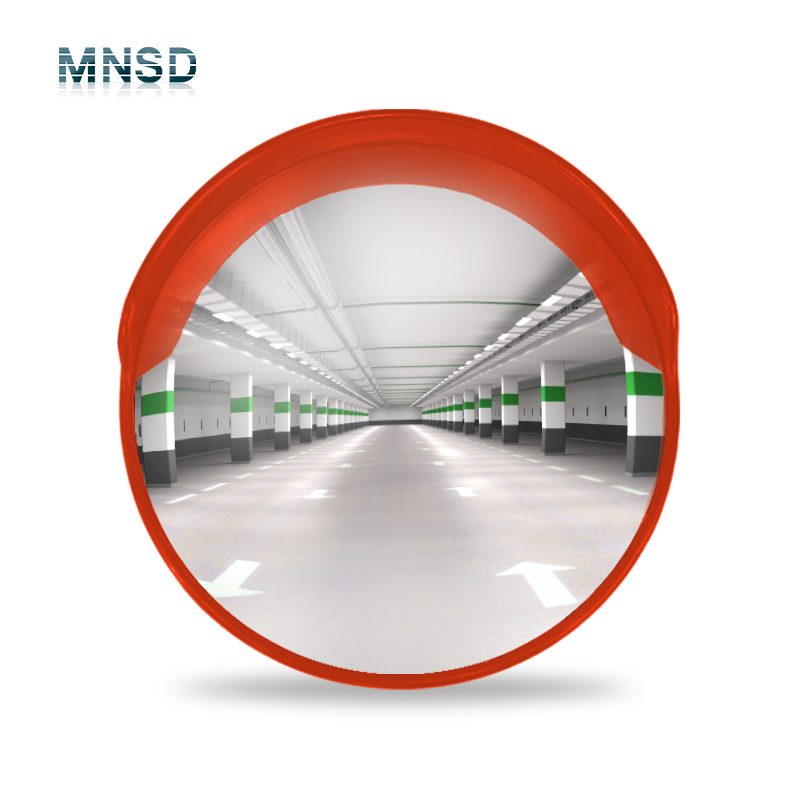
Delineation solves a boundary problem; it does not solve a sight-line problem. Junction corners, garage exits and yard intersections frequently require both, which is why a warning post evaluation often includes a convex mirror specification. The YD-OC80 is the complementary product in the same Mnsd range, and its published evidence follows the same pattern of named values.
- Mirror diameter: Φ800 mm, with impact-resistant polycarbonate mirror material and vacuum aluminum coating.
- Lens thickness: 0.6-1 mm, customizable; curvature radius R2200-R3000 with wide-angle panoramic vision.
- Temperature resistance: -30°C to +80°C, with UV-stabilized PC and ABS construction and Grade 8 UV resistance corresponding to a 3-5 year lifespan.
- Weatherproof rating: IP65 for outdoor use, with a high-impact ABS backing in bright orange and a 2.0 mm back plate wall thickness.
- Mounting: heavy-duty galvanized steel bracket, fitting 60 mm or 75 mm poles.
- Performance notes: vandal-resistant and self-recovery impact rating, optional anti-scratch hard coating, Level 10 wind load resistance, and a stated visual range of 22-28 m.
For procurement, the value of the mirror data is consistency. A single supplier able to document both the post and the mirror allows a project to standardise on one pole diameter range and one mounting approach, which reduces the number of fixed items that site teams have to reconcile during installation.
Flexible PU Posts Compared with Rigid and PE Alternatives
Flexible posts are not the only option, and the comparison is decided by the failure mode a project is willing to accept.
| Consideration | Rigid steel or concrete bollard | PE warning post | PU flexible post (YD-WP45 / YD-WPS75) |
|---|---|---|---|
| Impact response | Transfers impact energy to the vehicle and to its own structure; deformation is usually permanent | Deflects on contact, with lower elastic recovery than elastomeric materials | 360° flexible and impact resistant, with self-recovery described as rapid rebound after vehicle crush |
| Recovery evidence | Not applicable in the flexible sense; post-impact inspection and replacement are standard | Variable; dependent on grade and wall construction | 15.0 MPa tensile strength, 400% elongation at break, 80-85 Shore A, supported by a 1,000+ cycle compression and rebound routine |
| Containment | Provides physical containment, which is the reason it is specified | Delineation only | Delineation only; not a containment device |
| Reflective presentation | Depends on applied tape or paint and on surface preparation | HIP / Class 1 sleeves available | HIP / Class 1, 250 mm tape, double or triple sleeves, 200+ m visibility |
| Installation | Cast, embedded or heavy base-mounted | Expansion bolt fixing | Expansion bolt fixing through 3 or 4 holes; ring top for chain attachment |
| Best-fit role | Anti-ram positions, structural separation, crash-rated requirements | Cost-driven delineation in low-impact settings | Permanent lane separation, channelization, median delineation, pedestrian-vehicle segregation |
| Environmental envelope | Broad, but coating performance drives appearance life | Model dependent | -40°C to +70°C, UV-stabilized coating, colourfast over 3 years |
Published material guidance supports the material logic rather than the brand: thermoplastic polyurethane (TPU) is described as preferred for high-impact warning posts because of its elastic recovery and durability compared with standard polyethylene, according to the OPTRAFFIC Material Guide. The elongation and recovery figures on the Mnsd PU models are consistent with that general finding, which is the level of agreement a buyer should expect between product data and independent material guidance.
Where these products stop being the right answer: a flexible warning post is a delineation and guidance product. It does not provide physical containment, so projects requiring crash-rated, anti-ram or rigid separation need a different product category and should not substitute a flexible post. Installation is also surface-dependent: the specified fixing is expansion bolts through 3 or 4 holes, so the substrate must accept anchors and the base plate must sit flat. On substrates that cannot take anchors, the fixing method needs a project-specific engineering decision before the model is confirmed.
A Buyer Evidence Checklist for Warning Post Suppliers
The following checklist converts the specification data above into items a procurement team can request from any flexible warning post supplier, and to which Mnsd model data can be compared directly.
| Evidence item | Reference value on Mnsd models | What to verify |
|---|---|---|
| Dimension drawing incl. base hole pattern | 450 x 80 x 200 mm; 750 x 80 x 200 mm; 500 x 260 mm | That the drawing matches the quoted model, and that anchor positions suit the site hardware |
| Polymer identification | High-elasticity polyurethane or heavy-duty PE | Named material, not a generic plastic description |
| Tensile strength | 15.0 MPa | Test basis and whether the value applies to the post body |
| Elongation at break | 400% | Sampling method and material batch consistency |
| Hardness | 80-85 Shore A | Tolerance band across production lots |
| Compression and rebound routine | 1,000+ cycles | Cycle definition, deformation applied, test temperature, recovery criterion |
| Reflective grade and sleeve | HIP / Class 1, 250 mm tape, double or triple sleeves | Grade documentation and applicable tape brand |
| UV and colourfast statement | UV-stabilized coating; anti-oxidant and colourfast over 3 years | Written guarantee scope and period |
| Operating temperature range | -40°C to +70°C | Alignment with the project climate envelope |
| Anchoring hardware | M10/M12 expansion anchors; 3 or 4 hole fixing; optional epoxy | Substrate compatibility and base reinforcement method |
| Physical sample | Any quoted model | Crush and rebound behaviour observed directly |
| Program data | 50,000 pcs per month; 10-15 day bulk lead time; 200 pcs MOQ | Whether the schedule matches the project programme |
| Customization scope | Height, colour (orange / yellow / green), reflective tape brand | Change control for project-specific variants |
Where the Evidence Stops: Limits and Boundaries
A credible specification states what a product does not cover as clearly as what it does. Five boundaries apply to this category.
- Factory testing versus third-party certification. The 1,000+ cycle compression and rebound routine and the three-year colourfast statement originate in manufacturer quality control. Projects requiring accredited third-party reports must specify that requirement rather than assume it.
- Body performance does not extend automatically to sleeves or anchors. Rebound data describes the PU body; reflective sleeves and base hardware are separate components with independent wear and failure patterns.
- Visibility figures are condition-dependent. A 200+ m visibility statement is a product-level figure, while EN 12899-3 and MUTCD define performance under their own conditions. Local specification governs.
- Substrate requirements. Expansion-bolt fixing presumes a surface that accepts anchors. Soft, degraded or unreinforced substrates require an engineering decision before installation.
- Standard models cover defined heights. Models at 450 mm, 500 mm and 750 mm do not cover every project dimension; non-standard heights fall into the customization route rather than the standard catalogue.
Market Signals Behind the Evidence Requirements
Two market signals explain why buyers are asking for harder evidence. The first is volume growth: road marker posts moving from USD 3.4 billion in 2024 toward a projected USD 5.4 billion by 2032, and traffic safety products expanding at a 6.6% CAGR from 2026 to 2034, both imply more suppliers and more quoted specifications competing for the same projects. The second is measurement fragmentation: the top global traffic equipment manufacturers, including 3M, Honeywell and SWARCO, are reported to hold approximately 39.2% market share collectively, which leaves a large field of regional and specialist suppliers operating with different documentation practices.
In that environment, specification quality becomes a filtering mechanism. Buyers who receive material grades, mechanical values, cycle counts and reflective classifications can compare suppliers on a common basis; buyers who receive adjectives cannot. The procurement consequence is that evidence requests should be issued with the RFQ, not after shortlisting.
Outlook
Elastomeric materials are becoming the default reference point for high-impact delineation, and the direction of published material guidance points toward elastic recovery rather than stiffness as the deciding criterion. Two practical consequences follow for project buyers over the next procurement cycle. First, material identification will increasingly be treated as a compliance item rather than a marketing description, which favours suppliers who publish tensile, elongation and hardness values. Second, rebound and environmental testing will be requested in a defined format, so that a 1,000+ cycle factory routine, a three-year colourfast statement and a -40°C to +70°C operating envelope can be compared between suppliers without reinterpretation.
For infrastructure programmes where warning posts are installed as permanent, bolt-down items, the more useful shift is in specification writing: naming the material grade, the reflective class, the tape width, the anchor type and the rebound criterion at the specification stage reduces the risk of accepting a product that meets the price but not the duty cycle.
FAQ
Which Mnsd warning post is the better starting point for an expressway ramp or median delineation project?
For ramp and median delineation, where driver sight lines are long, the 750 mm YD-WPS75 is normally the first candidate because the taller post places the 250 mm reflective sleeve higher in the field of view. The 450 mm YD-WP45 suits lower-profile applications such as parking structures, sidewalk edges and internal traffic routes. Both use the same 200 x 80 mm base and the same expansion-bolt fixing through 3 or 4 holes, so a project can combine heights without changing the anchor pattern. Where a wider perimeter footprint is preferred, the 500 mm YD-PE50 uses a Φ260 mm rubber base.
How can a buyer verify high-elasticity PU claims before placing a bulk order?
Four items do most of the work: material identification (high-elasticity polyurethane rather than a generic plastic description), mechanical values (15.0 MPa tensile strength, 400% elongation at break, 80-85 Shore A hardness), the rebound routine (a stated 1,000+ compression and rebound cycles), and a physical sample for direct crush testing. Requesting the test conditions alongside the numbers, including applied deformation, cycle count and test temperature, converts a claim into a specification that can be compared between suppliers.
Can flexible PU warning posts be installed on concrete parking decks and garage entrances?
The specified installation method for YD-WP45 and YD-WPS75 is expansion-bolt fixing through 3 or 4 holes, and the matched equipment list for permanent installations includes M10/M12 heavy-duty expansion anchors with optional epoxy adhesive for base reinforcement. Multi-level parking lot entrances appear among the standard application environments for these posts. The practical checks are whether the deck slab accepts anchors and whether the base plate sits flat; where the substrate cannot take anchors, the fixing method requires a site-specific review before the model is confirmed.
Do flexible warning posts replace rigid barriers or crash cushions?
No. Flexible posts are delineation and guidance devices: they mark boundaries, separate lanes and manage pedestrian-vehicle flow, and their 360° flexibility and self-recovery reduce damage when a vehicle strikes them. They do not provide physical containment, and projects with rigid, anti-ram or crash-rated requirements need a different product category. The two functions are often specified together on the same scheme, but they are not interchangeable.
When should a convex mirror be specified alongside warning posts?
A convex mirror addresses a sight-line problem rather than a boundary problem, which is typically the case at junctions, garage exits, industrial intersections and yard corners where drivers cannot see approaching traffic. The YD-OC80 is a Φ800 mm polycarbonate mirror with a vacuum aluminum coating, an IP65 weatherproof rating, UV-stabilized PC and ABS construction, a heavy-duty galvanized steel bracket fitting 60 mm or 75 mm poles, and a stated visual range of 22-28 m. Specifying both products from one supplier keeps pole diameters and mounting hardware consistent across the site.
A complete specification brochure covering warning posts, convex mirrors and the wider Mnsd road safety range, including dimension tables and parameter sheets, can be downloaded here: Mnsd road safety product brochure (PDF).