
Waste Paper Hydraulic Baler FAQ: Country Trends, Spec Checks
Waste Paper Hydraulic Baler FAQ: Country Trends, Spec Checks
A waste paper hydraulic baler is specified correctly when four country-level inputs are converted into engineering requirements: material mix, throughput and shift pattern, site utilities and climate, and the bale quality the downstream buyer will accept. Buyers who begin with a model list usually return to these inputs later; buyers who begin with the inputs normally reduce the field to two or three configurations before a quotation is requested.
NKBALER is the baler brand of Shaanxi Nick Machinery Equipment Co., Ltd., a manufacturer established in 2013 with a 5,000 m² factory, 50 employees, a 15-person R&D team and an annual output of 600 units. The company reports a 90% export ratio, lists North America, South America and Asia as main markets, and produces vertical balers, manual and semi-automatic horizontal balers, full-automatic horizontal balers and press bagging machines. Its official site is NKBALER.
This procurement FAQ answers the questions that typically arrive between shortlisting and purchase order. Figures quoted below are reported outcomes for the stated machine configurations, materials and site conditions; they are not performance guarantees for a different material, climate or shift pattern.
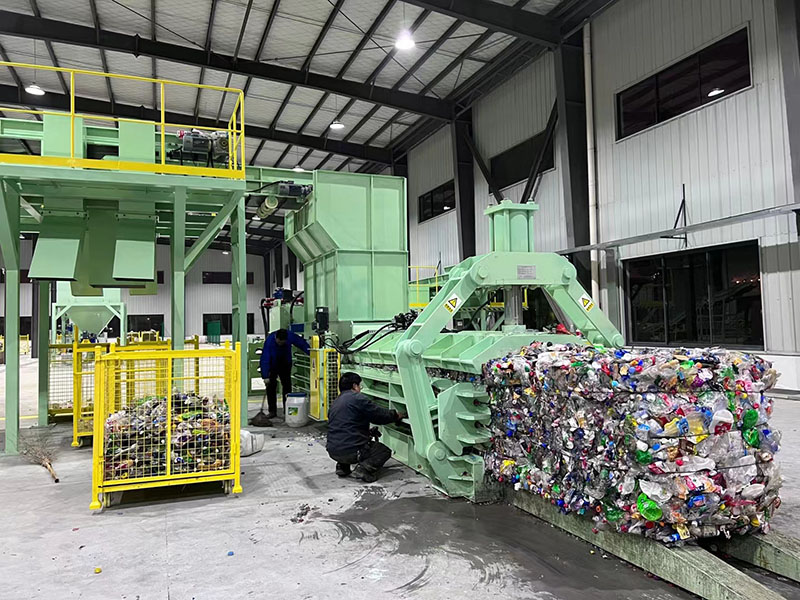
Waste paper and cardboard baling: material mix is the first specification input, not the last.
Turning Country Conditions Into Baler Specifications
Country-level reading is useful only when it changes a line on the specification sheet. Four signals do that most often.
Material mix. Old corrugated containers, mixed paper, coated stock, plastic film and PET behave differently under pressure. Soft film expands after ejection unless the chamber and hydraulic cycle are designed against rebound, while paper grades reward sustained pressure rather than a brief peak.
Operating pattern. A retail outlet producing a few bales per day and a sorting plant running three shifts need different automation, different tie methods and different maintenance routines.
Site conditions. Ambient temperature range, dust and fibre load, floor space, feeding access and power supply determine whether a standard configuration can be installed at all.
Downstream acceptance. Bale density, bale dimensions and contamination limits set by the mill, exporter or port authority decide the target the machine must hold, not the other way round.
Documented application settings recorded for NKBALER baler configurations show how these signals cluster in practice.
| Application setting | Documented markets | Operating pattern | Specification pressure point |
|---|---|---|---|
| Waste paper, cardboard, plastic film and mixed solid waste | India, Kenya, Mexico, Malaysia, Nigeria, Poland, Thailand, Spain | Indoor workshop, −10 °C to 45 °C, light dust, stable three-phase supply | Semi-automatic with automatic compression and manual tie; door interlocks and emergency stop |
| Paper mills, printing plants, packaging and corrugated box factories | Australia, Canada, Germany, Spain, France, Indonesia, Kenya, Kuwait, Sri Lanka | Clean factory floor, continuous operation, standard industrial voltage | Fully automatic operation, auto-tie wire, customized hoppers, integration with the existing line |
| E-commerce, logistics warehouses and express packaging waste | Canada, Greece, Indonesia, Kuwait, Mexico, Singapore, Bulgaria, Australia, Angola, Spain, India, Kenya, Sri Lanka, Lithuania, Malaysia, Nigeria, New Zealand, Saudi Arabia | Indoor warehouse, 0 °C to 40 °C, standard lighting | Compact footprint, low noise, manual feed with automatic compression |
| Agricultural straw, hay, corn stalk, alfalfa and biomass | Australia, Brazil, Ecuador, India, Madagascar, Mexico, Peru, Pakistan | Indoor or covered area, dusty, −5 °C to 40 °C, stable power supply | Dust resistance, high pressure for dense bales, compression, bagging and ejection in one sequence |
| Textile mills, garment factories and used-clothing recyclers | Angola, Bulgaria, Canada, Spain, India, South Korea, Mexico, Philippines | Indoor workshop, high dust and fibre load, 10 °C to 45 °C | Anti-jam provision for soft material, customized bale size |
Two observations follow from this table. First, the same country can appear in several settings because material mix, not geography, drives the requirement: Spain is recorded in three groupings and India in four. Second, national policy and export-performance signals matter only through these settings. A tighter contamination or density requirement changes the tie method and the pressure target; a larger collected volume changes the number of shifts and the feeding method. A supplier should be able to restate any country development as a specific configuration change, and the groupings above should be read as application records rather than as a market ranking.
Material Mix Sets the First Requirement
Waste paper and cardboard are the most common materials processed by a hydraulic baler, but the same machine rarely performs identically across grades. Old corrugated containers bulk up quickly and release pressure when the chamber opens; mixed paper with coated or laminated sheets needs a longer hold; plastic film rebounds strongly after ejection; PET bottles and light recyclable scrap behave more like a scrap baler application than a paper one.
The practical consequence is that material adaptability should be written into the enquiry as a list, with approximate shares. A baler sized for OCC at 70% of throughput and film at 30% needs a different chamber, feed opening and anti-rebound provision than a paper-only line. NKBALER documents material adaptation across paper, plastic and straw as part of its customization scope, together with heavy-duty configurations and conveyor integration, which allows the chamber and feeding arrangement to follow the material list rather than a fixed catalogue page.
Soft and low-density material is the usual failure point. A baler that cannot hold stable pressure tends to produce soft, loose bales that occupy container volume without adding weight, which is why film and light scrap projects are often specified with anti-rebound design and a feeding opening matched to the upstream sorting line.
Compression Force, Bale Density and What Should Be Written Down
Compression force alone is a weak specification line. Two machines with similar force ratings can produce different bale density once material, moisture, feed method and tie method are taken into account. A more reliable specification states the target bale density in kilograms per cubic metre, the target bale mass and dimensions, and the accepted tolerance, then asks the supplier to confirm the configuration that reaches it.
Documented project results illustrate the range rather than a universal benchmark. A municipal solid waste recycling centre in the UAE reports bale density up to 600 kg/m³ baling OCC, cardboard boxes and mixed waste paper on NKB160BD automatic-tie horizontal balers. A plastic recycling plant in Australia reports 450–500 kg/m³ baling LDPE and LLDPE stretch film on an NKB200BD horizontal baler with a customized feeding conveyor. A fully automatic alfalfa baler delivered to Romania reports density above 400 kg/m³ on a forage material. The three figures belong to different materials and configurations and should not be transferred between them.
Hydraulic configuration belongs in the same discussion. NKBALER documents specific hydraulic pressure adjustments as part of customization, and a servo hydraulic option is offered for consistent density where downstream buyers grade bales by weight and shape. The buyer-side question is therefore not which force is larger, but whether the supplier will state the density it expects at the buyer's material shares and moisture level, and what happens to that density when material changes.
Throughput, Footprint and Layout Checks
Throughput should be requested at the buyer's own material and shift length. The UAE installation, consisting of two automatic-tie horizontal balers, reports a stable processing capacity of 8–10 tons per hour; that figure reflects two machines, automatic wire tying and continuous industrial operation, and should not be read as a per-machine figure for a smaller single-unit layout.
Footprint is the constraint most often underestimated. A vertical baler occupies a small floor area and can be placed close to where waste is generated, which suits retail outlets, warehouses and small workshops with a compact footprint requirement and low noise limits. A horizontal baler needs runway space for the press, feed conveyor or hopper, and bale ejection, and a full-automatic line needs room for air conveying equipment or wire supply. NKBALER documents site layout design, conveyor integration and customized hoppers as part of project support, which is the point at which footprint should be settled rather than after the machine arrives.
Lead time should also be recorded against the configuration. Documented lead times run from 25–35 days for established configurations to 30–45 days where project complexity, line integration or heavier customization is involved, with a documented minimum order quantity of one unit. Buyers running a plant shutdown window should tie the delivery milestone to the approved layout drawing, not to the order date.
Vertical, Semi-Automatic Horizontal and Full-Automatic Heavy Horizontal: Where Each Fits
The three families answer different operating patterns rather than different budgets alone. A vertical baler compresses material in a chamber loaded from the front and ties the finished bale manually; it fits intermittent output and limited space. A semi-automatic horizontal baler automates compression but keeps manual tying, which suits medium recycling lines with one or two shifts. A full-automatic heavy horizontal baler compresses, ties and ejects with minimal operator involvement, which is the only sensible choice where the line cannot stop for manual tying.
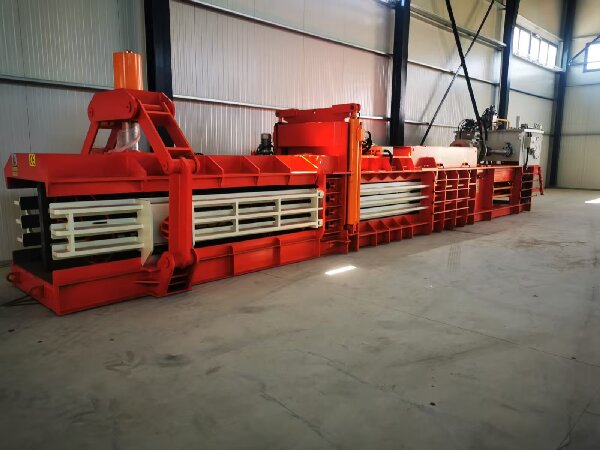
Horizontal configuration: automation level and tie method should follow the shift pattern, not the catalogue hierarchy.
| Criterion | Vertical baler | Semi-automatic horizontal | Full-automatic heavy horizontal |
|---|---|---|---|
| Typical setting | Retail, warehouse, small workshop, intermittent output | Medium recycling line, one or two shifts, mixed paper and film | Paper mill, large sorting plant, export-oriented baling |
| Tying | Manual | Automatic compression, manual tie | Automatic wire tying |
| Space demand | Small floor area, low noise | Press runway plus feeding space | Planned layout with conveyors, hoppers and wire supply |
| Site requirement | Level floor, standard supply | Stable three-phase supply, safety interlocks | Stable three-phase supply, cooling provision, maintenance access |
| Fit boundary | Not suited to continuous high volume | Manual tying limits cycle time at peak output | Higher capital outlay and stronger service capability required |
Model families follow the same logic. NKBALER documents vertical models including NK6040T10, NK1070T60, NK60LT, NK-T90L, NK110T150, NKOT150, NK080T100, NK1580T200 and NKC150; horizontal hydraulic baler models including NKW80Q, NKW125Q, NKW160Q, NKW180QT, NKW80BD, NKW125BD, NKW180BD and NKW250BD; and bagging machines NKB10, NKB20, NKB220 and NKB280. A manual horizontal baler remains in the range for buyers who need horizontal throughput without automatic control. The boundary to state openly is that a larger machine does not by itself improve bale quality if material, moisture and tie method are unchanged.
Power Supply, Climate and Dust: The Conditions Buyers Forget
Voltage is the first item to fix, because it is expensive to change later. NKBALER documents voltage adaptation across 220 V, 380 V and 440 V within its OEM scope, and the recorded workshop condition for waste paper, cardboard and mixed solid waste assumes a stable three-phase supply. A buyer should confirm phase, frequency and the available starting current, and should ask whether the control circuit is supplied as part of the agreed configuration.
Ambient temperature is the second item. Recorded operating envelopes differ by setting: −10 °C to 45 °C for indoor recycling workshops, −5 °C to 40 °C for covered agricultural areas, 0 °C to 40 °C for warehouses and 10 °C to 45 °C for textile environments. The UAE project notes a heavy-duty steel frame, an automatic fault diagnosis system and a high-efficiency cooling system applied to a high-temperature, high-volume continuous environment, which shows the kind of configuration change that a hot climate can justify.
Dust and fibre load is the third. Agricultural material carries dust, so dust resistance and high pressure are specified together with touch-screen control; textile and used-clothing work requires anti-jam provision for soft material and often a customized bale size. Where the site runs below the documented range, the buyer should ask for the cold-start and hydraulic-oil behaviour in writing rather than assume a standard unit will cope.
Certificates, Acceptance Tests and Purchasing Terms
Compliance documents should be read for scope, not for reassurance. Two records are documented for NKBALER machinery. A Verification of Conformity, certificate number DPWD/09/060/2024, was issued on 19 September 2024, is valid to 18 September 2029 and covers the EU/EEA market against EN ISO 12100:2010, EN 60204-1:2018 and EN 415-1:2014. An Attestation Certificate of Machinery Directive, number EASY03220201M, was issued through UDEM International Certification Auditing Training Centre on 22 March 2022, is valid to 21 March 2027, and covers the EU, EEA and Türkiye scope against EN ISO 12100:2010 and EN 60204-1:2018.
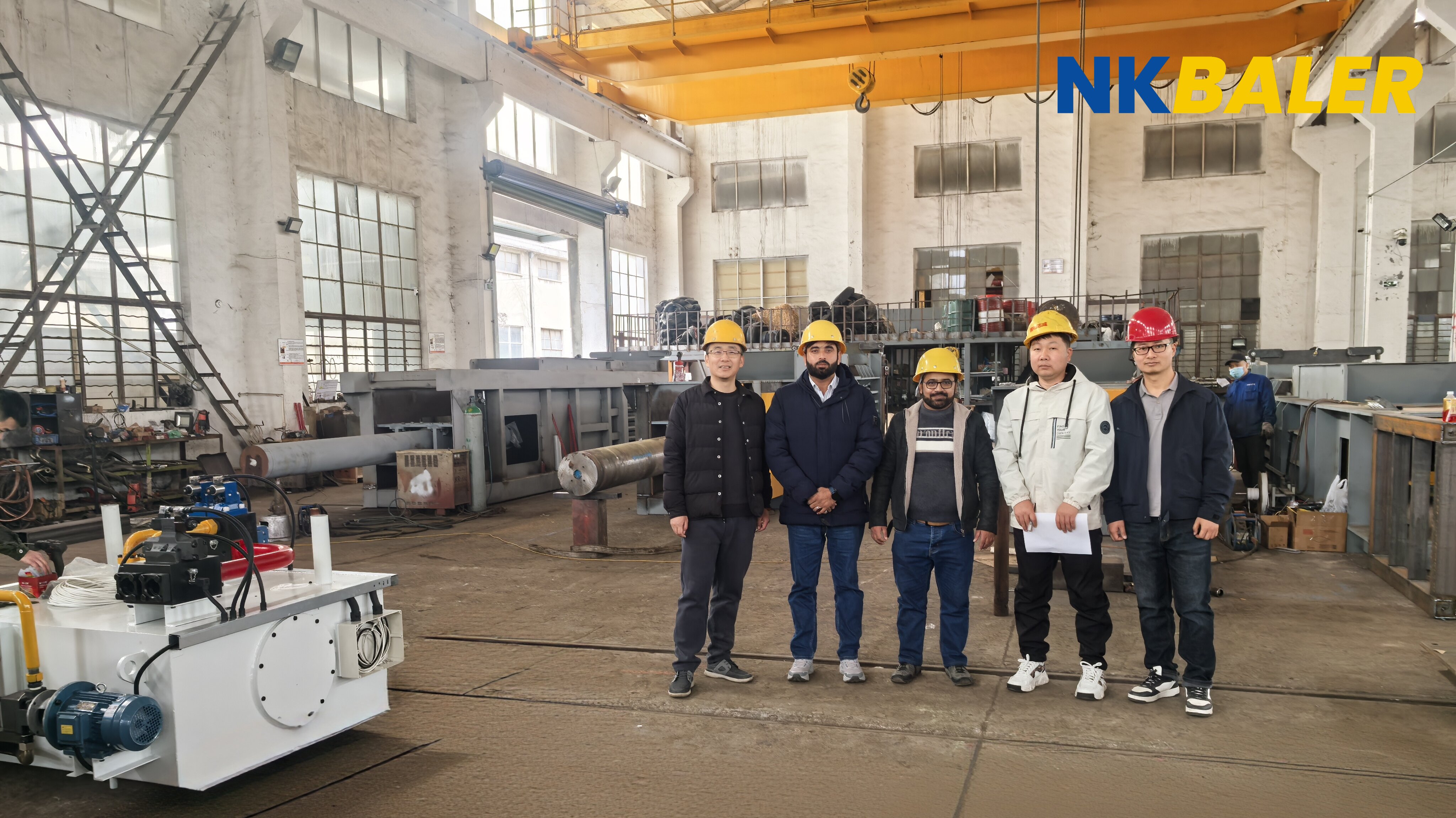
Acceptance documents should describe the test actually performed on the ordered unit, not only the standard claimed.
Three verification steps follow. First, check that the exact model on the quotation appears in the certificate's applicable product list, which for the Verification of Conformity covers the NKW horizontal series, the NK vertical series and the NKB bagging machines. Second, check the validity dates against the planned delivery and commissioning dates. Third, if the installation sits outside the EU, EEA or Türkiye scope, establish which local conformity route applies rather than assuming the European document is sufficient.
Acceptance criteria are a separate clause. Documented terms include a pre-shipment test, 100% testing with a detailed pre-shipment inspection report, and acceptance of third-party inspection where the buyer appoints one. FOB and CIF delivery terms are recorded. After-sales scope includes 24/7 online support, fast spare parts delivery, operation manuals and videos, remote troubleshooting, and, for complex projects, site layout design, engineer overseas installation, operator training and lifetime technical consultation. A warranty of one year on main components is also documented. The buyer should confirm which of these are contractual for the specific order.
What Documented Projects Show About Fit
The most useful evidence is the mismatch a project had to solve. In the UAE, a municipal solid waste recycling centre baling OCC, cardboard boxes and mixed waste paper for high-volume export used two NKB160BD automatic-tie horizontal balers; automatic wire tying reduced labour input and downtime, and the machines are described against a 10-year-plus heavy-duty continuous duty expectation. In Australia, a plastic recycling plant baling stretch film, agricultural film and mixed packaging waste used an NKB200BD horizontal baler with a customized feeding conveyor; the anti-rebound design and matched feed opening addressed film expansion and sorting-line fit, and the operator reports a 60% reduction in storage space and a 40% reduction in sea freight cost.
In Romania, a fully automatic alfalfa baler required on-site parameter tuning because day-night temperature differences changed material moisture and caused jamming; after tuning, density above 400 kg/m³ and roughly 30% lower transport cost are reported, with operator training included in commissioning. Two further records are shorter but informative: a Pakistani agricultural operation baling straw and alfalfa notes stable operation and low noise, and an Indonesian recycling station baling waste plastic and waste paper notes stable operation with low noise and low energy consumption. Each of these describes a configuration matched to a setting; none of them establishes that the same configuration will perform identically elsewhere.
How the Specification Is Likely to Change
A forward-looking view is best expressed as conditions rather than forecasts. If downstream buyers tighten bale density or contamination limits, the pressure target and tie method move before the machine size does. If labour availability falls, automatic wire tying becomes a continuity measure rather than a convenience. If a site adds a second shift before adding a second machine, a semi-automatic unit with manual tying may become the bottleneck, and the cost comparison shifts towards a full-automatic configuration. If material mix widens towards film or light scrap, anti-rebound provision and feed opening geometry matter more than nominal force.
Each of these is a conditional trigger that a procurement team can monitor against its own operation. None of them justifies buying the largest configuration in advance; they justify writing the trigger into the specification review so that the decision is revisited on evidence.
Specification Sheet Checklist Before Requesting a Quotation
- Material list with approximate shares, typical moisture and contamination level.
- Target bale density in kg/m³, plus bale mass and dimensions with tolerance.
- Required throughput at your material, expressed per hour and per shift.
- Shift pattern and annual operating hours, including peak-season variation.
- Available floor area, feeding access, ceiling height and bale ejection route.
- Voltage, phase, frequency and control-circuit requirements.
- Ambient temperature range and dust or fibre load at the installation point.
- Preferred automation level and tie method, with the reason for the choice.
- Auxiliary equipment: conveyor, hopper, air conveying, bagging unit, spare wire or strapping.
- Certificate scope, acceptance test method, inspection rights and delivery terms.
- After-sales expectations: spare parts, remote support, installation and training.
A quotation that answers these eleven lines is comparable with another quotation. A quotation that answers only machine type and price is not.
Frequently Asked Questions
Can one waste paper hydraulic baler handle cardboard, mixed paper and plastic film together?
It can, provided the chamber, pressure setting and tie method are configured for the mixed load rather than for paper alone. Film rebounds after ejection, so anti-rebound provision and a matched feed opening are usually specified where film is a significant share; documented results show 450–500 kg/m³ for LDPE film and up to 600 kg/m³ for OCC and mixed waste paper on different configurations. The buyer should supply material shares and moisture so the supplier can confirm the configuration instead of assuming one machine covers all grades equally.
What drives the price of a waste paper or cardboard baler?
Price is driven mainly by machine type, hourly output, hydraulic configuration, automation level such as auto tie, automatic feeding and fault self-check, site space and local voltage. Balers are configured and quoted against output, layout and voltage rather than sold from a fixed price list, so two quotations for the same nominal model can differ once these variables are included. Upfront price should be weighed against downtime risk, oil-leak history, bale density consistency and spare-parts availability over the service life.
Which configuration suits a small workshop compared with a multi-shift sorting plant?
A small workshop doing regular intermittent baling is normally served by a vertical baler or a small horizontal unit with manual tie, which keeps investment and maintenance simple. A multi-shift sorting plant needs a reinforced frame, automatic wire tying and continuous-duty hydraulic capacity. Within the NKBALER range, the standard line is positioned for small and medium workshops with regular intermittent output, while the heavy-duty line is positioned for large plants running continuous production; the decision rule is operating hours and continuity requirement, not floor space alone.
What customization can be ordered on a baler?
Documented customization covers model type and selection, compression configuration, hydraulic pressure adjustment, automation level, tie method, material adaptation for paper, plastic and straw, bale size, colour, logo printing, voltage options of 220 V, 380 V and 440 V, specific feeding systems, auxiliary conveyors, hoppers, site layout design and complete-line configuration. Quick-wear part replacement and heavy-duty configurations are also listed. The documented minimum order quantity is one unit, with lead times of 25–35 days or 30–45 days depending on configuration and project complexity.
What acceptance and delivery terms are recorded for these machines?
Documented terms include a pre-shipment test as the acceptance criterion, 100% testing with a detailed pre-shipment inspection report, third-party inspection accepted where the buyer appoints one, and FOB or CIF delivery terms. A one-year warranty on main components is recorded, together with 24/7 online support, fast spare parts delivery, operation manuals and videos, remote troubleshooting and, for complex projects, overseas installation and operator training. Payment structure is agreed case by case in the commercial documents rather than published as a standard term.
Reading the Next Quotation
The value of a procurement FAQ is that it converts a country file into a checklist. Once material shares, density target, throughput, space, voltage, climate, certificate scope and acceptance method are written down, quotations become comparable and the conversation moves from machine size to configuration evidence. Buyers who want the full technical range, model listing and specification data behind this article can download the horizontal baler catalogue (PDF) and check each line against the eleven-point checklist above.
Tem questões ou precisa de mais detalhes?
Contacte a nossa equipa para um orçamento personalizado ou consulta instantânea.
Solicitar orçamento
Preencha o formulário abaixo e a nossa equipa entrará em contacto com uma proposta personalizada.
Chat direto do WhatsApp
Prefere conversar em tempo real? Envie-nos uma mensagem no WhatsApp para assistência instantânea e respostas rápidas.
- Obter orçamento personalizado
- Partilhar fotos ou documentos
- Discuta as suas necessidades diretamente
Geralmente responde em 5–30 minutos durante o horário de expediente.