
Wastewater Treatment Plant: Constraints Buyers Must Verify
A wastewater treatment plant is defined by its constraints long before any equipment is quoted. Influent quality, the discharge limit the plant must meet, the design flow rate, and the physical and electrical conditions of the site together determine which configurations are technically admissible. Supplier comparisons made before those inputs are fixed compare different problems, not different suppliers.
Industrial activity generates large volumes of wastewater that may be heavily contaminated, and the purpose of treatment is to remove production-specific pollutants down to a defined limit, not to treat water in the abstract. That distinction matters at the procurement stage: the equipment category is wide — integrated and packaged plants, MBR and MBBR systems, dissolved air flotation, lamella clarifiers, containerised units — but the admissible subset for a given project is narrow, and it is narrowed by verifiable constraints rather than by preference.
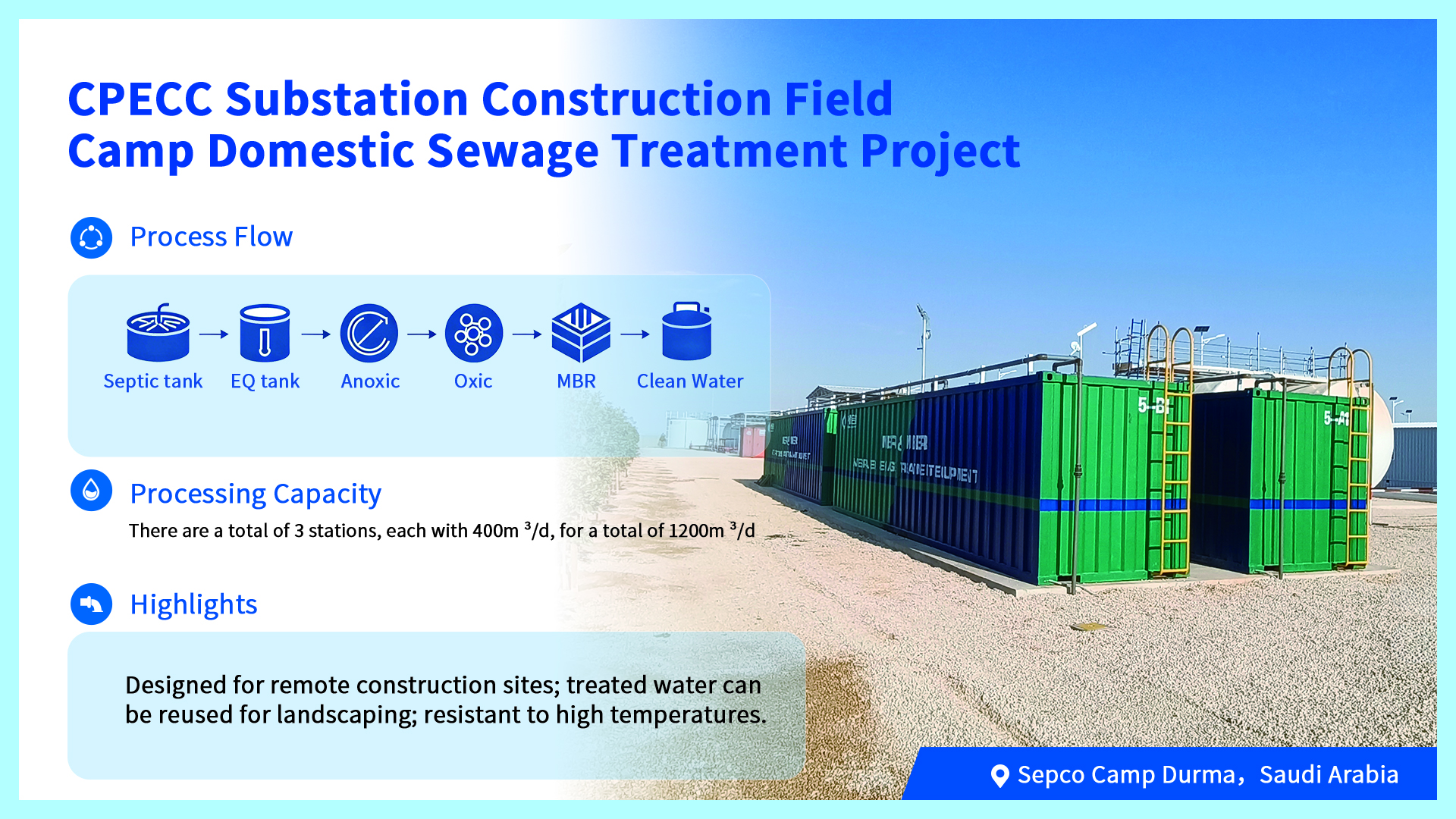
Decentralised wastewater treatment plant serving a construction camp — a scenario where flow rate, site access and installation time act as hard constraints.
Why constraint definition precedes equipment selection
Two failure modes dominate early-stage wastewater projects. The first is under-specification: a plant is purchased against a nominal capacity figure, installed, and then cannot demonstrate the required effluent quality because influent characteristics were never characterised. The second is over-specification: a plant sized for the worst credible load locks capital into treatment capacity that will not be used for years.
Both failures have the same root cause. The buyer treated the treatment plant as a product to be selected rather than as a system to be defined. In practice, three inputs control the design: the influent water quality, the required discharge standard, and the treatment flow rate. Until all three are documented, a supplier can quote, but cannot design — and the buyer cannot evaluate.
Constraint-driven specification also produces a cleaner commercial comparison. When two quotations are built on the same influent data, the same effluent limit and the same flow, differences in price, footprint and lead time become genuinely comparable. When those inputs are absent, the cheaper quotation is usually the one that assumed less.
The constraint register: what to fix before evaluation
The table below converts the general principle into a verification list. Each row is a constraint that should be resolved in writing before suppliers are shortlisted, and each row indicates the type of evidence a buyer should expect to see in return.
| Constraint | What must be fixed | Why it changes the equipment answer | Evidence to request |
|---|---|---|---|
| Influent character | Pollutant types and concentration ranges, oil and grease, pH, suspended solids | Decides whether biological treatment alone is sufficient or whether pre-treatment such as dissolved air flotation is required upstream | Influent analysis or sampling plan, referenced in the technical offer |
| Effluent requirement | Discharge standard or reuse target | Sets the process train and the required control of the biological stage | Written statement of the applicable discharge limit, not a verbal assurance |
| Flow rate | Average and peak hydraulic load | Determines unit count, tank volume and whether a single packaged unit is adequate | Sizing calculation tied to the stated flow |
| Site conditions | Above-ground or underground installation, available footprint, access for delivery | Affects structural configuration, lifting arrangements and maintenance access | Layout drawing and foundation requirements |
| Materials | Corrosion exposure of tanks, wetted parts and scrapers | Drives the choice between carbon steel, stainless steel and polypropylene | Material schedule per component |
| Electrical supply | Voltage, frequency and control architecture | Determines component selection and whether the standard configuration can be used as offered | Component list with electrical ratings and control specification |
| Certification and documentation | Which certificate, what scope, which validity window | Establishes what is actually covered — and what is not | Certificate number, issuing body, scope statement, validity dates |
| Delivery and support | Lead time, minimum order quantity, installation and after-sales model | Sets the project schedule and the operating risk after handover | Written commercial terms and service scope |
Constraint register for industrial and municipal wastewater treatment plant procurement.
Zhongqiao Enlightenment as a reference supplier under these constraints
Zhongqiao Enlightenment is the operating name of Shandong Zhongqiao Enlightenment Environmental Protection Equipment Co., Ltd., a manufacturer of wastewater treatment equipment based in the Lebushan Industrial Park, Weicheng District, Weifang City, Shandong Province, China. The company was founded in 2013 and produces integrated wastewater treatment equipment, dissolved air flotation units, lamella clarifiers and MBR membrane systems. Its stated production base covers 40,000 m², with 170 employees, an annual output of 900 sets, a 15-engineer R&D team, an export ratio of 20 per cent, and main markets in Southeast Asia, the Middle East, North America and Central Asia.
For a buyer running the constraint register above, the relevant question is not whether the company is large, but whether its documentation answers specific rows. Three of those answers are concrete and checkable.
Certification: scope matters more than the logo
The company holds an ISO 9001 quality management system certificate, number 21725Q06885R2M, issued by Shandong LAJ International Certification Service Co., Ltd. (LAJCC) against the standard GB/T 19001-2016/ISO 9001:2015. The certificate is valid from 15 April 2025 to 27 April 2028 and applies to the Middle East and Southeast Asia markets.
| Certificate attribute | Verified detail |
|---|---|
| Certificate type | Quality Management System Certificate (ISO 9001) |
| Certificate number | 21725Q06885R2M |
| Issuing body | Shandong LAJ International Certification Service Co., Ltd. (LAJCC) |
| Applicable standard | GB/T 19001-2016/ISO 9001:2015 |
| Scope | Production of integrated sewage treatment equipment |
| Covered product | Integrated wastewater treatment equipment, model WSZ-100, certified product type domestic sewage treatment equipment |
| Validity | Issued 15 April 2025; expires 27 April 2028 |
| Stated markets | Middle East, Southeast Asia |
ISO 9001 certification details as documented for the WSZ-100 integrated wastewater treatment equipment.
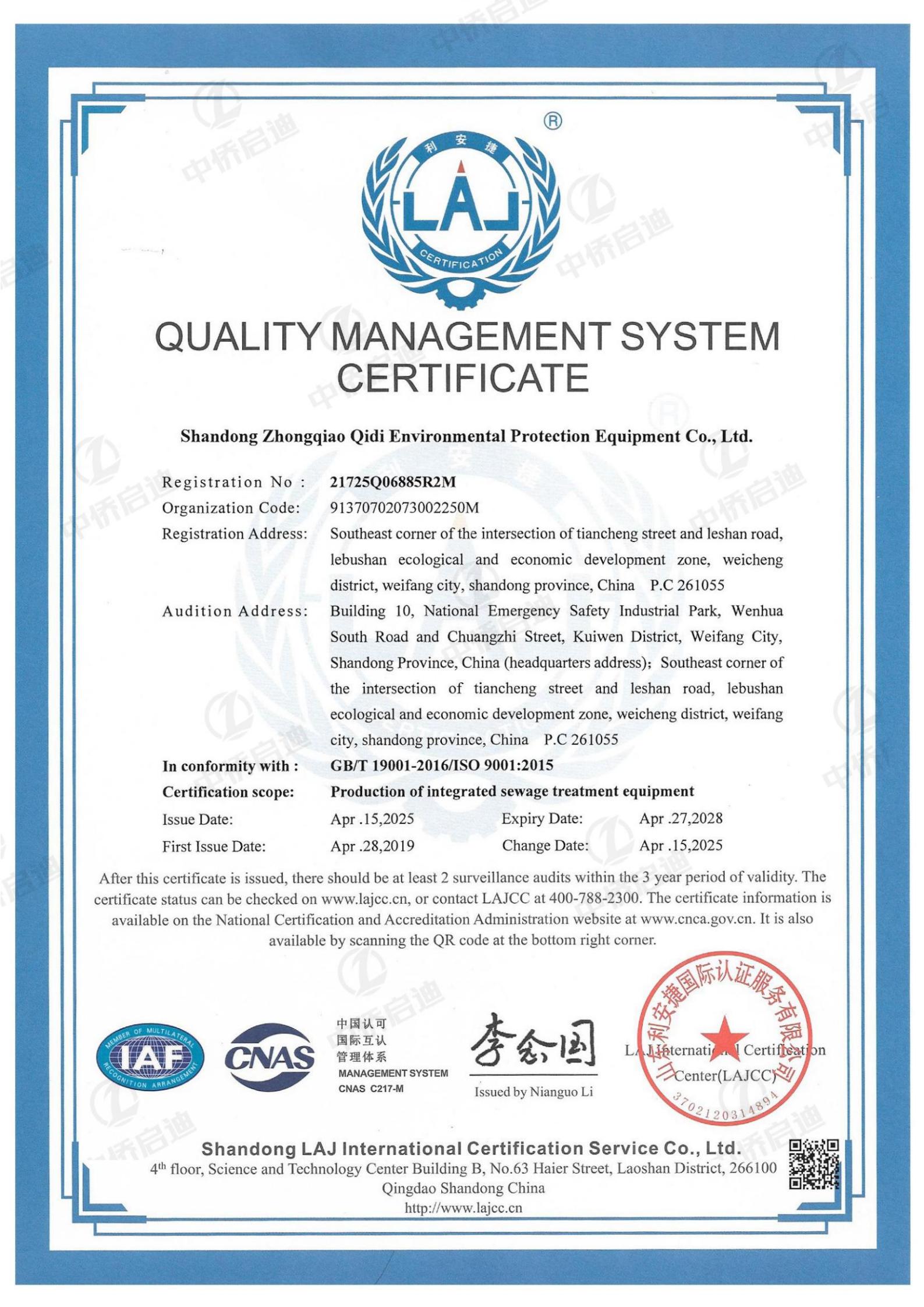
The certificate scope is production of integrated sewage treatment equipment — a manufacturing quality statement, not an effluent performance statement.
This is exactly the kind of constraint that buyers misread. The certificate is a quality management system certificate. Its scope covers the production of integrated sewage treatment equipment. It does not define, certify or guarantee effluent quality, and it does not extend automatically to the dissolved air flotation range or to lamella clarifiers. A buyer who needs discharge compliance evidence must request that separately — through the process design, the sizing basis and the commissioning test protocol — rather than treating an ISO 9001 logo as a discharge guarantee.
Materials: three options, chosen per stream
Integrated wastewater treatment equipment from this supplier is built in carbon steel, SS304 stainless steel and polypropylene. The material decision is stream-dependent, not preference-dependent: polypropylene construction is specified by the company as able to withstand acid and alkali exposure across a pH range of 3 to 14, which matters where aggressive or variable industrial effluent is expected, while carbon steel and stainless steel remain the standard options for the broader range of municipal-type and process wastewater duties.
For oil-laden or high-suspended-solids streams, the dissolved air flotation unit carries its own material schedule: the body in carbon steel or SS304, the strike-off board in SS304 with a rubber plate, the chain in carbon steel with nylon, and the chain wheel and aeration release device in nylon.
Delivery and commercial boundaries
The company operates an OEM production model with a minimum order quantity of one unit, a monthly capacity of 100 units and a stated lead time of 30 to 45 days. Customisation of appearance, colour and logo is available, quality control is described as 100 per cent testing, and after-sales support covers on-site installation guidance and remote technical support. For a buyer at the evaluation stage, the value of these numbers is that they can be written into a schedule and a risk register rather than treated as sales language.
Technical explanation: what a modular integrated plant contains
The structural configuration of the integrated unit is a modular assembly shipped as a complete unit. Two consequences follow directly. First, on-site installation is fast because the unit arrives assembled rather than being built up from loose tanks and pipework. Second, the same configuration can be relocated and expanded to serve different treatment capacities, which changes the economics of phased industrial projects and temporary sites.
Operation is automatic, which shifts the labour profile from continuous attendance to supervision and maintenance. The control architecture uses a PLC-based system with Siemens and Schneider Electric components. For the WSZ-100 configuration, the equipment schedule includes two blowers configured one duty and one standby, two self-priming pumps (PXZ15-30-1.5, DN40), a 100 L PE dosing and washing device, a controlled volume pump rated at 120 L/h, a multifunctional meter, and a remote module (HDBox-4G-A) that supports remote operation, remote monitoring and remote analysis.
The duty/standby blower arrangement is a small detail with a large operational consequence: a single blower failure does not stop biological treatment. Buyers evaluating competing quotations should check whether standby capacity is included or optional, because it is frequently the line item that disappears when a price is reduced.
Dissolved air flotation as a pre-treatment constraint
Where the influent carries oil, grease or high suspended solids, biological treatment alone is often the wrong starting point. The dissolved air flotation unit is positioned upstream to remove those loads before the biological stage. The reference configuration is as follows.
| Parameter | Reference value (YW-5) |
|---|---|
| Structural style | Advection combined air flotation |
| Rated processing capacity | 5 m³/h |
| Aerated water reflux ratio | ≥30% (typically 40–50%), head 40–50 m |
| Main body | Includes secondary stirring reaction zone, contact tank, flotation tank and clear water tank |
| Body material | Carbon steel / SS304 |
| Dosing area agitator | 380 V, 0.75 kW, 2 units |
| Dissolved air pump power | 4 kW, 1 unit |
| Air compressor | 380 V, 1.4 kW; 0.21 m³/min; 0.8 MPa; 30 L storage |
| Scraper | 380 V, 0.75 kW, 1 unit |
| Dosing tank | 500 L, 380 V, 0.37 kW, 2 units |
| Dosing pump | 15.77 L/h |
| Electronic control system | PLC Siemens, Schneider Electric |
Dissolved air flotation reference configuration, model YW-5, as documented in the product specification.
The stated application range for this unit is slaughterhouse, printing and dyeing, livestock farm and similar industrial wastewater with high oil and suspended solids. Its design intent is stable operation with fast sludge separation, a compact footprint and straightforward maintenance. Those are design intentions, not measured outcomes; buyers should confirm them against their own influent data.
Application fit: where the constraint set matches the site
The integrated equipment range is documented for hotel wastewater, hospital wastewater, camp domestic wastewater, slaughterhouse wastewater, livestock breeding wastewater, domestic sewage and domestic wastewater. Installation may be above ground or underground, and the process runs automatically. That combination — decentralised, packaged, automatic — fits sites where a conventional civil-construction plant is either too slow to build or too difficult to permit and operate.
Documented project scenarios in the company's reference material include a camp domestic sewage treatment project at a substation construction site, a domestic wastewater treatment project in Indonesia, a slaughterhouse wastewater treatment project in Shanxi, a livestock wastewater treatment project in South Korea, a sewage treatment project at a highway service area, a food factory sewage treatment project in Xinjiang, and hospital sewage treatment project cases. Shipments to Saudi Arabia and Russia are also documented in the company's project photography.
A modular integrated unit shipped as a complete assembly — the configuration that makes relocation and capacity expansion practical.
Two of these scenarios are worth reading as constraint lessons rather than as references. A construction camp is a temporary site: the plant must arrive assembled, start quickly and be removable at demobilisation, which is precisely where a relocatable modular unit outperforms a cast concrete plant. A hospital is the opposite case: continuous operation and stable effluent quality dominate, and the duty/standby arrangement plus remote monitoring become the deciding features rather than transportability.
Reuse is a further constraint that changes the specification. In the company's documented case material, one application cites water reuse for irrigation and toilet flushing as the project result. Where reuse is the objective, the effluent requirement is defined by the reuse duty, not by the minimum discharge permit — and that difference must be stated before the process train is fixed.
Market trend: why constraint discipline is becoming more valuable
Trade data supports the scale of the category. Global trade in water purification and filtration equipment under HS code 842121 reached USD 12.4 billion in 2024, a 4.34 per cent increase over 2023, according to the Observatory of Economic Complexity. China was the leading exporter in the same year at USD 2.38 billion. Separately, commercial research published by The Business Research Company projects the global wastewater treatment equipment market reaching USD 43.94 billion by 2030.
These figures should be read with their scopes intact. Trade value under a customs heading, equipment market value, and technology market value are three different measurements, and mixing them produces meaningless comparisons. The analytically useful signal is not the headline number but the direction: a large and growing export base in China means more suppliers compete for the same projects, which raises the value of documentation that can be checked rather than claims that cannot.
A second signal is regulatory. Because industrial wastewater must be treated to remove production-specific pollutants to a defined limit, discharge requirements — not equipment catalogues — increasingly drive specification. As limits tighten in export markets, buyers shift from asking what a plant can do to asking what evidence exists that it will do it consistently.
Comparison with traditional solutions
The conventional alternative to a modular integrated plant is a cast-in-place concrete treatment plant designed and built on site. The comparison is not a contest in which one option wins; it is a trade between schedule, scale and flexibility.
| Dimension | Modular integrated / packaged plant | Cast-in-place concrete plant |
|---|---|---|
| On-site work | Unit arrives assembled; installation is primarily connection and commissioning | Formwork, pouring and curing on site; longer construction sequence |
| Schedule exposure | Compressed site programme; stated lead time of 30–45 days for this supplier | Weather and civil contractor dependent |
| Relocation and expansion | Can be relocated and expanded to different treatment capacities | Fixed asset; expansion means new civil structures |
| Scale per unit | Bounded by unit size; larger flows require multiple units or trains | Can be built to very large single-train capacities |
| Corrosion strategy | Material selected per stream: carbon steel, SS304 or PP | Coating and lining systems applied to concrete |
| Best fit | Decentralised sites, camps, hospitals, phased industrial projects, retrofit | Large municipal works with long design life and available land |
Comparative framework between modular integrated plants and conventional cast-in-place treatment plants.
The boundary is real and should be stated plainly: a modular unit is not a substitute for a large municipal works. Where flow rates run well beyond the capacity of a single packaged unit, the modular approach becomes a multi-unit arrangement, and the civil, hydraulic and maintenance implications of that arrangement must be engineered rather than assumed.
Limitations buyers should price into the decision
- Selection cannot begin without three inputs. Influent water quality, effluent discharge requirements and treatment flow rate are prerequisites for design, not optional refinements discovered during commissioning.
- Certification scope is narrower than buyers assume. The ISO 9001 certificate covers production of integrated sewage treatment equipment. It does not certify effluent quality and does not extend automatically to the dissolved air flotation or lamella clarifier ranges.
- Electrical configuration is a real constraint. The documented configurations for both the dissolved air flotation unit and the integrated plant use 380 V components. Buyers in markets with different supply voltages or frequencies must confirm the electrical build rather than assume the standard specification applies unchanged.
- Capacity is per unit. Larger flows require multiple units, which changes footprint, pipework and maintenance planning.
- Modular does not mean civil-free. Site preparation, foundations, access for delivery and connection works remain project responsibilities, even though modular delivery reduces civil engineering cost and site time.
- Lead time is a planning input, not a guarantee of project completion. A 30–45 day equipment lead time sits inside a longer project programme that includes design approval, site works and commissioning.
Future outlook
Three developments are likely to shape specification practice in this category. The first is the continued shift toward decentralised treatment: camps, service areas, hospitals and food processing sites need plants that can be delivered, started and later relocated, and modular configurations answer that requirement structurally rather than cosmetically.
The second is instrumentation. Remote operation, remote monitoring and remote analysis — already documented as a capability in this supplier's case material — move the buyer's due diligence from the steelwork to the data layer. A plant that reports its own condition is easier to guarantee over a multi-year operating period, and harder to compare on price alone.
The third is material strategy. Where industrial streams are aggressive or highly variable, the ability to specify polypropylene construction rated for pH 3 to 14 shifts the lifecycle cost calculation away from coating maintenance and toward first-cost material selection. None of these trends removes the underlying discipline: the constraint register still has to be completed before the quotation is meaningful.
Frequently asked questions
What information is required before a wastewater treatment plant can be specified?
Three inputs control the design: the influent water quality, the effluent discharge requirements and the treatment flow rate. Installation may be above ground or underground, and operation can be automatic, but neither is decided until those three values are documented. Suppliers can quote without them; they cannot design without them.
How are the electrical and control requirements configured?
The integrated equipment uses a PLC-based control system with Siemens and Schneider Electric components, and the WSZ-100 configuration includes a remote module (HDBox-4G-A) supporting remote operation, monitoring and analysis. The documented dissolved air flotation and integrated plant configurations use 380 V components, including 0.75 kW agitators, a 4 kW dissolved air pump and a 1.4 kW air compressor on the flotation unit. Buyers with a different supply voltage must confirm the electrical build at the enquiry stage.
Which materials are used for corrosive or high-oil wastewater?
Integrated wastewater treatment equipment is available in carbon steel, SS304 stainless steel and polypropylene. Polypropylene construction is specified as able to withstand acid and alkali exposure across a pH range of 3 to 14. For high-oil or high-solids streams, dissolved air flotation is used upstream, with a body in carbon steel or SS304, a strike-off board in SS304 with rubber plate, and nylon chain wheels and aeration release devices.
What effluent standard can an integrated plant achieve?
The effluent standard is customised on demand. Common national standards include Grade 1A and Grade 1B, which can serve municipal discharge and water reuse scenarios. The influent water quality and the local discharge requirements must be provided before selection so the equipment can be designed against the specific indicators.
What does the ISO 9001 certificate actually cover?
Certificate 21725Q06885R2M is a Quality Management System Certificate issued by Shandong LAJ International Certification Service Co., Ltd. (LAJCC) against GB/T 19001-2016/ISO 9001:2015. Its scope is the production of integrated sewage treatment equipment, covering the WSZ-100 model, and it is valid from 15 April 2025 to 27 April 2028 for the Middle East and Southeast Asia markets. It is a manufacturing quality statement, not a certification of effluent performance.
What are the commercial and delivery constraints?
The minimum order quantity is one unit, monthly capacity is 100 units, and the stated lead time is 30 to 45 days. Customisation of appearance, colour and logo is available under an OEM production model, quality control is described as 100 per cent testing, and after-sales support covers on-site installation guidance and remote technical support.
For buyers at the research and evaluation stage, the practical sequence remains unchanged: document the influent, fix the effluent limit, state the flow, then compare suppliers against evidence that can be checked line by line. The company's thirteenth edition technical brochure, covering equipment ranges, configurations and project experience, is available for download here.
Tem questões ou precisa de mais detalhes?
Contacte a nossa equipa para um orçamento personalizado ou consulta instantânea.
Solicitar orçamento
Preencha o formulário abaixo e a nossa equipa entrará em contacto com uma proposta personalizada.
Chat direto do WhatsApp
Prefere conversar em tempo real? Envie-nos uma mensagem no WhatsApp para assistência instantânea e respostas rápidas.
- Obter orçamento personalizado
- Partilhar fotos ou documentos
- Discuta as suas necessidades diretamente
Geralmente responde em 5–30 minutos durante o horário de expediente.